Overreacting. Sensitive. Dramatic. I’ve heard all three before—usually from people who’ve never worked a twelve-hour ER shift and still had to show up at a family event with a smile like nothing is wrong. I’m Camille. I’m thirty-two, a registered nurse in Portland, and my boyfriend Grant always claimed he “respected” what I did… as long as it didn’t inconvenience him, as long as it stayed polished enough to match the version of me he likes showing off.
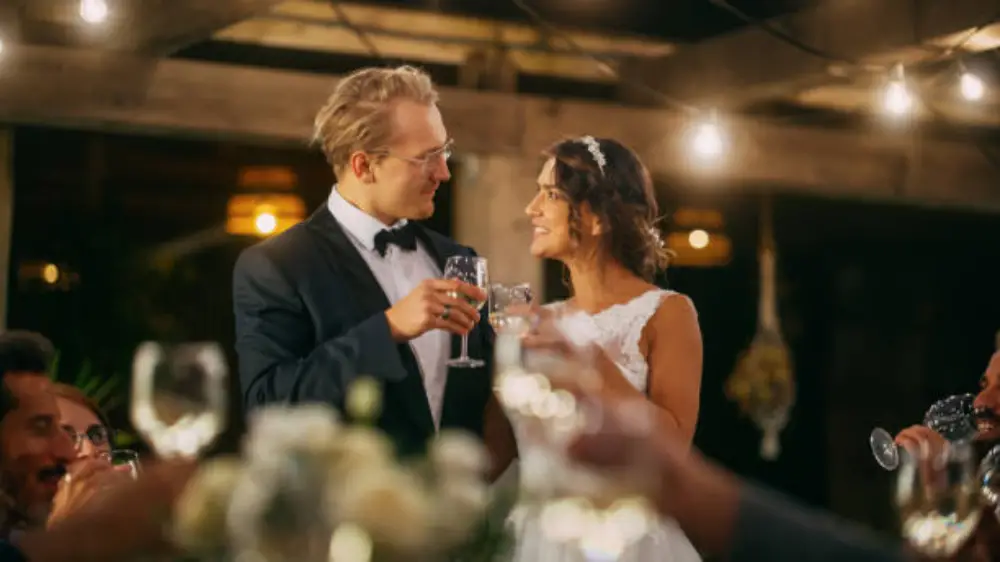
Last weekend was my brother’s wedding at a vineyard in the Willamette Valley—string lights draped between oak trees, long wooden tables set with cream linens, champagne flutes catching the glow of the setting sun, everyone softened by music and that golden late-summer air. It was beautiful in that effortless way expensive things are when someone else has done all the planning.
Grant treated it like an audition. He spent hours getting ready that morning, adjusting his suit in the hotel mirror, checking his watch, practicing that charming laugh he uses when he wants a room to like him. I was exhausted—I’d worked a double shift two days before and barely slept—but I still curled my hair, wore the dress he’d picked out months ago, and put on the smile that said everything was perfect.
Because that’s what Grant needed. Perfect.
We’d been together for three years. Three years of me accommodating his schedule, his career in tech consulting, his need to be seen as successful and enviable. He worked from home most days, complained about Zoom fatigue, talked about his “grind” like it was equivalent to what I saw in the ER—the overdoses, the car accidents, the elderly patients dying alone because their families couldn’t make it in time.
But I loved him. Or I thought I did. Love gets blurry when you’re always too tired to see it clearly.
My best friend Sloan was at the wedding too. Sloan and I met in nursing school ten years ago, and she’s the kind of woman people either want to impress or quietly compete with. Confident without being loud. Calm in a way that makes anxious people feel steadier. She’d recently broken up with her long-term boyfriend and moved to Seattle for a new job at a trauma center. I’d invited her because I wanted her there, because she’d been part of my life longer than Grant had, because she deserved to celebrate something beautiful after a hard year.
From the second Grant spotted her at the ceremony, something shifted. He got louder. Warmer. Too attentive. During cocktail hour, he kept finding reasons to stand near her—offering drinks she didn’t ask for, asking questions that felt less like conversation and more like a performance. What kind of nursing do you do? Do you miss Portland? Have you always been this dedicated to your career?
Sloan kept her posture polite but braced, like she was holding a boundary with her spine. I watched from across the patio, champagne in hand, feeling something cold settle in my chest. I told myself I was being paranoid. I told myself Grant was just being friendly, that I was reading too much into it because I was tired and stressed and worried about my brother’s toast going well.
I told myself a lot of things that afternoon that I knew weren’t true.
Dinner was served family-style—roasted chicken, summer vegetables, bread still warm from the oven. I sat next to Grant at a table with college friends and distant cousins. He barely spoke to me. Every time I tried to engage him in conversation, his eyes would drift across the room to where Sloan was sitting, laughing with my aunt. When I touched his arm, he pulled away slightly, like I was interrupting something.
“Are you okay?” I asked quietly.
“Fine,” he said, already looking past me. “Just enjoying the night.”
The speeches started around nine. My father spoke about my brother with the kind of pride that made my throat tight. My new sister-in-law’s maid of honor told a story that had everyone laughing and crying at the same time. And through it all, Grant kept glancing at Sloan.
Around ten, the dancing started. The DJ played all the classics—songs that make people nostalgic and brave and willing to look silly. I wanted to dance. I wanted to remind myself—and everyone else—that Grant and I were still a couple, that we were happy, that the distance I’d been feeling for months was just stress and exhaustion and not something fundamentally broken.
But when I looked for him, he was gone.
I found them at the outdoor bar, tucked under the fairy lights, close enough that I could hear the ice clink in their glasses. Sloan was leaning against the bar with her arms crossed, her expression carefully neutral. Grant was facing her, gesturing with his drink, smiling that smile he uses when he’s trying to impress someone.
I walked up quietly. Neither of them noticed me at first.
Then Grant said it, clear as a bell: “I wish I’d met someone like you before I met her.”
The words landed in my chest like something heavy and cold. A few people nearby—strangers from the groom’s side—laughed nervously, like they were waiting to see what kind of woman I’d be next. Sloan’s face went still. She looked at me, and I saw something like apology in her eyes, though she’d done nothing wrong.
Grant turned and saw me standing there. His smile didn’t falter. If anything, it widened, like he thought this was funny, like I was supposed to laugh along.
“Relax,” he said, voice light and dismissive. “It’s just a compliment. Don’t be so sensitive.”
My body went quiet in that way it does when something breaks cleanly. Not a loud, messy break—the kind that shatters into a thousand pieces you can never put back together. This was surgical. Precise. Final.
I didn’t yell. I didn’t cry. I didn’t make a scene that would ruin my brother’s wedding. I just looked at Grant—really looked at him—and realized he wasn’t sorry. He was annoyed I’d noticed. Annoyed that I was standing there, interrupting his flirtation, ruining his fun.
So I turned and walked away.
I heard Sloan say something sharp to Grant as I left, but I didn’t stop. I walked through the vineyard, past the dancing guests and the dessert table and the photographer capturing perfect moments. I walked until I reached the edge of the property where the grapevines stretched into darkness and the music faded to a distant hum.
I stood there and breathed. In through my nose, out through my mouth, the way I do when a patient is coding and I need to stay calm. I counted my breaths. I felt the cool night air on my skin. I reminded myself that I was fine, that I’d survived worse, that this was just another hard thing and I knew how to do hard things.
My phone buzzed. A text from Sloan: I’m so sorry. I told him that was completely inappropriate. Do you need me?
I texted back: I’m okay. Thank you for being here.
Another text, this time from Grant: Where did you go? You’re being dramatic again.
I didn’t respond. I stayed at the edge of the vineyard for another twenty minutes, watching the stars, feeling the ground solid beneath my feet. Then I went back to the reception, found my mother, told her I had a headache, and asked if she could give me a ride back to the hotel.
She looked at me with that mother-knowing and squeezed my hand. “Of course, sweetheart.”
I didn’t say goodbye to Grant. I figured he wouldn’t notice.
When I got back to the hotel room—the room we were sharing, the room I’d booked and paid for because Grant was “tight on cash” that month—I changed out of my dress, washed my face, and sat on the edge of the bed in the dark.
I thought about the last three years. I thought about all the times Grant had made me feel like I was too much or not enough. Too serious. Too tired. Too focused on work. Not fun enough. Not spontaneous enough. Not whatever he needed me to be in that particular moment to make him feel good about himself.
I thought about the time I’d worked a double shift and came home to find him annoyed because I’d forgotten to pick up his dry cleaning. I thought about the vacation we’d planned to Mexico that he’d canceled because a “work opportunity” came up, even though I’d already requested the time off and we’d lose the deposit. I thought about every ER shift where I’d dealt with life and death and trauma, then come home to Grant complaining about his internet speed.
I thought about Sloan’s face when he said those words—the way she’d looked at him with something close to disgust.
And I thought about my own face, about how I must have looked standing there, holding my champagne, waiting to see if my boyfriend would apologize or double down.
He’d doubled down. He always doubled down.
Around midnight, I heard the keycard in the door. Grant stumbled in, loosened tie, flushed from dancing and drinking. He closed the door, kicked off his shoes, and looked at me sitting there in the dark.
“What’s wrong now?” he asked, not unkindly, but with the exhaustion of someone who’d been asked this question too many times.
“You told my best friend you wished you’d met her before you met me,” I said calmly. “At my brother’s wedding. In front of other people.”
He sighed, pulled off his tie. “I was joking, Camille. Everyone knew I was joking.”
“I didn’t think it was funny.”
“That’s because you take everything so seriously.” He sat down on the other bed—we’d requested two queens because I worked nights and didn’t want to disturb his sleep. “You’re always looking for something to be upset about.”
I felt that familiar pull, the one that wanted me to apologize, to smooth things over, to be the reasonable one who made everything okay. I’d felt it a thousand times in our relationship. The urge to shrink, to accommodate, to fix.
But I was tired. So tired. And something had shifted in me out there among the grapevines.
“I’m not upset,” I said quietly. “I’m done.”
He looked at me, confusion flickering across his face. “Done with what?”
“With this. With you. With pretending this is working when it hasn’t been working for a long time.”
He laughed—actually laughed. “You’re breaking up with me because of a joke?”
“I’m breaking up with you because you spent my brother’s wedding flirting with my best friend. Because you told her you wished you’d met her instead of me. Because when I told you that hurt me, you called me sensitive. Because this is who you are, Grant, and I don’t want to spend the rest of my life making excuses for you.”
The laughter died. He stood up, pacing now. “You’re being ridiculous. You’re going to regret this. You think you’re going to find someone better than me? Someone who puts up with your crazy schedule and your mood swings and your—”
“I’d rather be alone,” I interrupted, surprised by how much I meant it. “I’d rather be completely alone than spend one more day feeling lonely next to you.”
That stopped him. For the first time in three years, Grant didn’t have a comeback. He just stood there, face flushed, mouth open, looking like someone had pulled the script away mid-performance.
“I’m staying here tonight,” I continued. “Tomorrow I’m driving back to Portland. You can get a ride with whoever you want. When I get home, I’ll pack your things. You can pick them up next week.”
“Camille—”
“I’m done talking about this.” My voice was steady, calm, the voice I use when I’m telling a family their loved one didn’t make it. Gentle but final. “Goodnight, Grant.”
I got into bed, pulled the covers up, and closed my eyes. I didn’t sleep. I heard Grant moving around the room, heard him typing on his phone, probably texting someone about what a bitch I was being. I heard him get into his own bed, heard his breathing even out after an hour.
And I lay there in the dark, feeling something I hadn’t felt in years: light.
The next morning, I left before Grant woke up. I got dressed quietly, grabbed my overnight bag, and walked out of that hotel room without looking back. I texted my mother that I was heading home early, texted Sloan that I’d call her later, and got in my car.
The drive back to Portland was beautiful—morning light on the mountains, the highway mostly empty, some old folk song playing on the radio. I cried a little around Salem, not because I was sad, but because I was relieved. Because I’d finally done something I should have done months ago.
When I got home, I immediately started packing Grant’s things. It didn’t take long—three years together and he’d barely left a mark on my apartment. His clothes, his laptop, his pretentious coffee table books about minimalism and success. I packed it all into boxes, labeled them clearly, and stacked them by the door.
Then I changed into comfortable clothes, made myself a real breakfast, and sat on my couch with my coffee and felt the quiet settle around me like a gift.
Sloan called around noon. “Tell me you’re okay,” she said immediately.
“I’m okay,” I said. “I broke up with him.”
“Thank god.” I heard the relief in her voice. “Camille, I almost punched him last night. The things he said to me after you left—he kept insisting it was just flirting, that you were overreacting, that I should talk to you about ‘lightening up.’ I told him he was a disrespectful asshole and walked away.”
“I’m sorry you had to deal with that.”
“Don’t apologize. I’m just glad you’re done with him. You deserve so much better.”
We talked for an hour. She told me about the rest of the reception, about how Grant had spent the night complaining to anyone who would listen about how “dramatic” I was being. About how my brother had apparently pulled him aside and told him he needed to leave. About how Grant had ended up getting a ride back to Portland with some cousin I barely knew.
“He kept saying you’d change your mind,” Sloan said. “He told people you were just emotional, that you’d calm down and realize you were wrong.”
“I won’t,” I said simply.
“I know you won’t. That’s why you’re my best friend.”
The next week was a blur of logistics. Grant came by to pick up his things while I was at work—I’d had the locks changed and left the boxes in the hallway. He texted me angry paragraphs about how I was being childish, how I was throwing away a good thing, how I’d never find someone who “tolerated” me the way he had.
I blocked his number.
He tried emailing. I filtered him to spam.
He tried contacting me through mutual friends. They all told him to leave me alone.
After two weeks, he finally stopped.
The thing about ending a relationship that wasn’t serving you is that the relief comes in waves. The first week, I felt lighter. The second week, I felt sad—not because I missed Grant specifically, but because I missed the idea of having a partner, the comfort of routine, the safety of not being alone.
But by the third week, something shifted. I started remembering who I’d been before Grant, before I’d spent three years trying to be quieter, smaller, easier. I started doing things I’d stopped doing—going to the climbing gym, cooking elaborate meals just for myself, reading novels in bed until two in the morning without someone complaining about the light.
I reconnected with friends I’d drifted away from. I took a pottery class. I got a second cat. I painted my bedroom the exact shade of blue I’d always wanted but Grant had said was “too bold.”
I stopped apologizing for taking up space.
Months passed. Fall turned to winter. I worked my shifts, came home to my quiet apartment, and built a life that felt like mine. I went on a few dates—nothing serious, just reminders that I was still capable of connecting with people who didn’t make me feel like I was too much or not enough.
I saw Grant once, about six months after the breakup, at a coffee shop downtown. He was with a woman—young, polished, laughing at something he’d said with that performance-quality enthusiasm. I felt nothing. Not jealousy, not regret, not even curiosity. Just a quiet acknowledgment that he was living his life and I was living mine and they no longer intersected.
He saw me too. His face changed—something flickered there, maybe surprise, maybe something else. But I just nodded politely and turned back to my book. I didn’t owe him a conversation. I didn’t owe him anything.
A year after the wedding—almost to the day—I was working a shift in the ER when Sloan texted me: You’re not going to believe who just messaged me on LinkedIn.
I called her during my break. “Let me guess.”
“Grant,” she confirmed. “A long message about how he’s ‘done a lot of reflecting’ and realized he was wrong about a lot of things. About how he’s in therapy now. About how he wants to apologize to both of us for his behavior at the wedding.”
“Did he apologize?” I asked.
“He spent three paragraphs explaining why he acted the way he did before getting to the actual apology. So, no. Not really.”
I laughed. “Sounds about right.”
“He also asked if I knew how you were doing. Said he hopes you’re happy. Said he realizes now that he didn’t appreciate what he had.”
“What did you say?”
“I said you were thriving and left it at that. I didn’t think you’d want me to give him more details.”
“You were right,” I said. “Thank you.”
Two days later, Grant messaged me directly. I saw the notification and almost deleted it without reading. But curiosity won, so I opened it.
The message was long—rambling, self-aware in that performative way that some people mistake for actual growth. He talked about therapy, about “unpacking his behavior patterns,” about realizing that he’d been threatened by my career and my independence. He apologized for the wedding comment, for dismissing my feelings, for “not being the partner you deserved.”
At the end, he wrote: I know I don’t deserve a response, but I hope you’re doing well. I think about you often. I realize now what I lost, and I’m sorry it took me this long to understand.
I read it twice. Then I closed the message without responding.
Because here’s what I’d learned in that year: some people only realize what they had when they can’t have it anymore. Some people only apologize when they’re lonely, when they’ve tried to replace you and discovered that other people won’t tolerate the things you tolerated. Some people only grow when they’re forced to, when the consequences finally catch up to them.
And that growth—real or performed—wasn’t my responsibility anymore.
I didn’t need his apology. I didn’t need his realization. I didn’t need to know that he’d spent a year thinking about what he’d lost, because I’d spent that same year discovering what I’d gained.
The following weekend, I went hiking with friends up in the Gorge. The trail was steep, the kind that makes your legs burn and your lungs work hard, but the view from the top was worth every step. We sat on the rocks, ate sandwiches, laughed about nothing and everything.
One of my friends—a fellow nurse named Marcus who I’d gotten close to over the past few months—nudged my shoulder. “You seem happy,” he said.
I looked out at the view, at the river winding through the valley, at the mountains stretching into the distance under a perfect blue sky. I thought about my apartment with its blue walls and mismatched furniture and two cats who greeted me at the door. I thought about my job, hard and exhausting and meaningful. I thought about the life I’d built, imperfect and entirely mine.
“I am happy,” I said, and meant it completely.
That night, I deleted Grant’s message without saving it. I didn’t need a record of his regret. I didn’t need proof that I’d made the right choice. I already knew I had, in the way my body felt lighter, in the way I no longer flinched when my phone buzzed, in the way I’d stopped making myself smaller to fit into someone else’s story.
Some people spend their whole lives trying to get closure from the people who hurt them. They wait for apologies that never come, or apologies that come too late to matter. They let old wounds stay open because they’re waiting for someone else to heal them.
But I’d learned something in that ER, something I’d somehow forgotten to apply to my own life until that night at the vineyard: you can’t wait for other people to save you. Sometimes you have to stop the bleeding yourself.
Grant finally understood what he’d lost. And I finally understood what I’d gained—myself, my peace, my life on my own terms.
That was the only closure I needed.
Six months later, I ran into my brother and his wife at a farmer’s market. They were glowing with that newlywed energy, picking out flowers and fresh bread, completely absorbed in each other. When they saw me, they both lit up.
“Camille!” My brother hugged me. “We never see you anymore. You working too much?”
“Always,” I admitted. “But I’m good. Really good.”
His wife, Emily, studied my face with that knowing look women give each other. “You look different,” she said. “Lighter. Happier.”
“I am,” I said simply.
My brother hesitated, then said carefully, “I heard Grant reached out to you. A few months ago. Did you ever respond?”
“No,” I said. “I didn’t need to.”
He nodded, relief evident on his face. “Good. I always thought he was kind of a dick, honestly. Even before the wedding. I just didn’t know how to tell you.”
Emily elbowed him gently. “What he means is, we’re glad you’re doing well. And we’re sorry if our wedding caused—”
“It didn’t cause anything,” I interrupted gently. “It just made something obvious that I’d been avoiding for a long time. So if anything, I should thank you for that.”
We talked for a while longer, made plans to have dinner the following week, and parted with promises to stay in better touch. As I walked back to my car, basket full of fresh vegetables and flowers, I thought about that night at the vineyard.
I thought about the woman I’d been then—exhausted, accommodating, trying so hard to make a broken thing work. And I thought about the woman I was now—still exhausted sometimes, because nursing doesn’t get easier, but no longer exhausted by my own life.
The story people wanted me to tell was probably something about how Grant came crawling back and I rejected him triumphantly. Or how I met someone better and rubbed it in his face. Or how his life fell apart while mine flourished.
But the real story was quieter than that. The real story was that Grant did eventually understand what he’d lost, and I’d moved on so completely that his understanding didn’t matter to me anymore. The real story was that the best revenge wasn’t revenge at all—it was building a life so fulfilling that the person who hurt you became irrelevant.
The real story was that when someone showed me who they were at my brother’s wedding—someone who would publicly disrespect me and then call me sensitive for being hurt—I believed them. And I walked away. And I didn’t look back.
And a year later, when he finally understood what that cost him, I was already somewhere else entirely, living a life he’d never been invited to and never would be.
That’s the thing about walking away from people who diminish you. They assume you’ll come back. They assume you need them more than you need your own peace. They assume that their eventual realization of your worth will matter to you.
But sometimes, by the time they figure out what they lost, you’ve already discovered something far more valuable: what you gained by letting them go.
I never responded to Grant’s message. I never needed to. He understood what he’d lost, finally, after a year of reflection and therapy and whatever else helped him get there.
And I understood something far more important: I’d never lost anything worth keeping in the first place.
That realization—that clarity—was worth more than any apology he could ever give.

Lila Hart is a dedicated Digital Archivist and Research Specialist with a keen eye for preserving and curating meaningful content. At TheArchivists, she specializes in organizing and managing digital archives, ensuring that valuable stories and historical moments are accessible for generations to come.
Lila earned her degree in History and Archival Studies from the University of Edinburgh, where she cultivated her passion for documenting the past and preserving cultural heritage. Her expertise lies in combining traditional archival techniques with modern digital tools, allowing her to create comprehensive and engaging collections that resonate with audiences worldwide.
At TheArchivists, Lila is known for her meticulous attention to detail and her ability to uncover hidden gems within extensive archives. Her work is praised for its depth, authenticity, and contribution to the preservation of knowledge in the digital age.
Driven by a commitment to preserving stories that matter, Lila is passionate about exploring the intersection of history and technology. Her goal is to ensure that every piece of content she handles reflects the richness of human experiences and remains a source of inspiration for years to come.