The first time I realized something was wrong, it wasn’t because I found lipstick on a collar or a suspicious text with a heart emoji. It was because my neighbor Brenda—sweet, chatty, hydrangea-obsessed Brenda—smiled at me like she was giving a compliment and said, “It’s nice to see him so happy.”
I’d just gotten back from a three-day work trip to Denver, dragging my suitcase up the porch steps of the house my husband and I had sacrificed ten years to afford. My legs ached, my brain felt stuffed with conference room air, and all I wanted was to sink into our couch and order takeout.
Brenda set down her watering can and leaned on the fence between our yards. “I didn’t know you two were doing shifts or something. I saw him here over the weekend with that woman—tall, dark hair, really pretty. They were laughing on your front steps. I figured maybe a sister visiting.”
I smiled automatically. I lied automatically. “Oh, yeah. That must’ve been his sister.”
Garrett didn’t have a sister.
Brenda waved goodbye and returned to her hydrangeas. I stood on my porch with the key in my hand, hearing the soft click of my own heartbeat in my ears. Because Garrett was supposed to have been three states away visiting his brother in Ohio. And if he wasn’t there, then everything he’d told me—every photo, every “miss you” text, every detail about his brother’s life—wasn’t a story. It was a cover.
Before Maple Street, life had been a series of “not yet”s. Not yet a real kitchen, just a narrow galley where two people couldn’t pass without touching hips. Not yet a yard, just a strip of apartment grass with cigarette butts and dog waste. Not yet a savings account that didn’t flinch every time the car made a strange sound.
Garrett and I had lived like that for ten years. We weren’t glamorous about it. We clipped coupons, skipped vacations, said no to weddings and brunches that cost as much as a week of groceries. We ate rice and beans and convinced ourselves it was healthy. We held each other at night and promised it would be worth it, because someday we’d have a porch swing and a small yard and a place that didn’t feel temporary.
When we finally closed on the modest two-bedroom on Maple Street, I cried in the driveway. Garrett laughed and wiped my cheek with his thumb. “We did it,” he said. I believed him with my whole body.
That’s the thing about building something with someone—you start to trust the structure even when you aren’t watching the beams being placed. You assume the foundation is solid because you’ve been carrying half the weight.
I hung curtains, bought throw pillows, painted the living room walls that blue we argued about for two days until we stood back and agreed it felt like home. I thought we’d made it.
Then I left town for work, and everything I thought I knew began to crack.
Inside the house, everything looked normal. The living room was clean, the throw blanket folded slightly differently than usual, but I told myself I was imagining things. Then I opened the refrigerator and found fancy cheese I hadn’t bought, a bottle of wine we’d never tried, strawberries in a container I didn’t recognize.
I told myself Brenda must have mixed up porches. Maple Street had similar houses. Maybe she saw a different Saturday morning.
Then I moved my car into the garage and found a crumpled receipt wedged under the passenger seat. Grocery store two miles from our house. Saturday morning at ten. The same cheese, the same wine, strawberries, pasta, marinara. And a bakery cake with “CONGRATULATIONS” written in icing.
I sat in the driver’s seat holding that receipt like it could explain itself. Congratulations for what?
That night, I opened our shared bank account on my laptop. My fingers were steady, but I felt like my bones were vibrating. The grocery charge was there—Saturday, 10:02 a.m. A restaurant charge from Friday night downtown, the place we’d gone for our anniversary once. A coffee shop charge Saturday afternoon. A hotel charge Sunday night, mid-range chain fifteen minutes from our house.
I scrolled back further. Every time I’d traveled in the last six months, there were charges like these. Restaurants and flowers delivered to our address. Hotel stays that made no sense if Garrett was home alone.
I looked around the home we’d built with our hands. Two wine glasses in the dish rack, both clean. The throw blanket folded wrong. The spice rack reorganized. And my stomach, my instincts, my body quietly accepting what my mind didn’t want to: someone else had been here. Someone comfortable enough to rearrange my spices. Someone comfortable enough to drink wine on my couch.
When Garrett came home that night around seven, whistling softly, he kissed my cheek and asked how Denver went. He microwaved leftovers and talked about his brother’s new deck project while I sat at the table pretending to check email. He told the story like it was real, with details about a drill his brother bought and a neighbor complaint about noise.
Garrett wasn’t just lying. He was performing.
The next morning, I found a dark brown hair tie on the bathroom counter. Mine were blonde, stretchy, simple. This one had a little metal clasp. I stared at it under the bathroom light until my eyes burned, then threw it away and went to work, because sometimes your survival instinct is just routine.
That night while Garrett showered, I texted his brother: Hey, Garrett said you two had a great time this weekend. Thanks for hosting him.
Twenty minutes later: What? I haven’t seen him in months. We’ve been trying to set something up but he keeps saying he’s swamped.
My hands went cold.
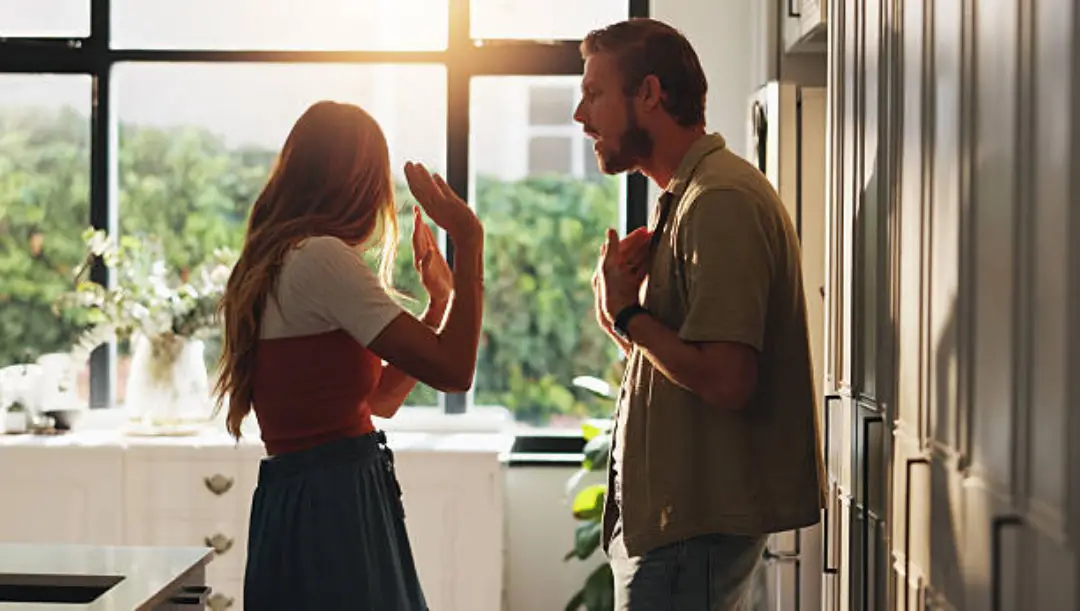
When Garrett came downstairs with damp hair and a beer, I was standing in the living room. “Brenda said she saw you here over the weekend. Saturday morning. Unloading groceries with a woman.”
Garrett blinked. “What?”
“She described her. Tall. Dark hair. Pretty. Laughing on our front steps.”
Garrett’s expression shifted into something practiced—confusion that wanted to be convincing. “Brenda’s confused. I was in Ohio.”
“Your brother says you haven’t seen him in months.”
Garrett went still for one second, then shook his head and laughed, but it didn’t sound right. “You texted my brother? He probably forgot. He’s got three kids and a crazy schedule.”
“I found a receipt,” I said. “Groceries. Saturday morning. Here.”
“I don’t know what you’re talking about,” he said sharply.
“I checked the bank account. You ate downtown Friday night. You went to a hotel Sunday.”
Garrett rubbed his face with both hands, exhaling like he was exhausted by my reality. “Okay, fine. I didn’t go to Ohio. I stayed home. I needed a break.”
“Who was the woman?”
“There was no woman,” he said immediately. “Brenda saw wrong.”
“Leonard across the street called her your girlfriend. Clare two doors down saw you grilling with her.”
Garrett’s face flushed. “They’re gossiping. People invent drama.”
“Then explain the hotel charge.”
“I needed space,” he snapped. “I got a room for one night to be alone. Is that a crime?” He didn’t deny the charges anymore. He just kept denying the woman. Then he went for the final move—the one that makes you doubt your own mind. “You’re paranoid. You’re exhausted. You travel nonstop. You feel guilty, so you’re inventing reasons to blame me.”
It was so clean, so confident, so cruel. And it almost worked for a second, because I wanted it to.
My friend Rachel met me for coffee two days later. She listened, looked at my photos of receipts and charges, read my text from Garrett’s brother. Then she said carefully, “You need proof. If you accuse him and you’re wrong, you’ll damage your marriage in ways you can’t undo.”
“I’m not wrong,” I whispered.
“Then prove it,” she said softly.
That night, I created a fake Instagram account. I searched local fitness accounts, hiking groups, yoga studios—filtered by the description Brenda gave. Two hours later, I found her. Jenna. Yoga instructor. Dark hair. Smile that looked like sunlight. Photos of breweries and trails and farmer’s markets.
And then three weeks ago, she was holding a glass of wine in a living room I recognized immediately. Our living room. Blue walls. Our couch. Our throw blanket. Caption: Cozy nights in with my favorite person.
My body went numb. I scrolled. A month ago, Jenna was laughing at our kitchen table, pasta in front of her. Caption: He cooks. He cleans. He makes me laugh. I’m so lucky.
I stared until my eyes burned. Then I messaged her from the fake account: That living room looks amazing. Where’d you get that couch?
She replied within an hour: Thanks! It’s his place. He has great taste.
My throat closed. How long have you two been together? I typed.
About 8 months. It’s been incredible. He’s been through a lot with his divorce but he’s finally in a place where he can move forward.
Divorce. Garrett and I had been married for over a decade. We’d just bought this house fourteen months ago. Garrett wasn’t just cheating—he was living two lives, and in both, he was the victim.
That night when Garrett came home, I followed him upstairs. “I know about Jenna.”
He froze mid-shirt removal. “What?”
“The yoga instructor. The one you’ve been seeing for eight months. The one you told you were divorced.”
Garrett’s face went pale, then red. “How do you know that name?”
“I found her online. She posted photos from our house.”
His eyes sharpened. He stepped toward anger fast, because anger is easier than shame. “You’ve been stalking her? You made a fake account and messaged her? Are you out of your mind? That’s harassment.”
“You brought her into our home,” I said, voice shaking.
“I didn’t tell her anything,” he said quickly. “She assumed. I never corrected her, but I didn’t lie.”
“You let her believe you were single.”
“I was lonely,” Garrett said, suddenly soft, trying a different angle. “You’re never here. You travel. You work. You’re always too tired. I felt like I didn’t matter.”
The audacity of blaming my ambition for his deception made something cold inside me crystallize. “So you started a relationship.”
“It wasn’t a relationship,” he insisted. “It was companionship. We talked. We watched movies. I never slept with her.” He looked pleading. “I swear. Emotional, not physical. That has to mean something.”
“It means you built a fake life in our real house,” I said.
Garrett reached for my hand. “I’ll end it. I’ll tell her the truth. I’ll go to therapy. Please. I don’t want to lose you.”
But he’d already lost me. He lost me the moment he brought another woman into the space I cried in the driveway for. He lost me the moment he tried to convince me I was crazy for noticing.
The divorce attorney’s office smelled like calm and paperwork. Fiona Reed had a steady voice and a yellow legal pad. “This is clear evidence of infidelity,” she said after I laid it all out. “Emotionally, it’s devastating. Legally, it’s less straightforward. No-fault state—the judge doesn’t care why, only how assets split.”
“The house,” I said, panic rising. “I can’t lose the house.”
“It’s jointly owned,” Fiona said gently. “To keep it, you’ll need to refinance into your name alone. Prove you can carry the mortgage. If you can’t, you sell and split proceeds.”
Ten years of sacrifice, and the house could still be taken from me because the law didn’t care that Garrett had used it as a stage for someone else’s fantasy.
“Document everything,” Fiona said. “Keep a timeline. File when you’re ready.”
I was ready. I just hadn’t admitted it yet.
When word spread, Garrett’s mother called. Her voice was sharp. “Is it true you’re threatening divorce over a misunderstanding?”
I explained. She didn’t listen. She repeated Garrett’s version: neighbor confusion, a poor woman being stalked, Garrett needing companionship because I traveled all the time.
Then she said it—the sentence that turned my stomach to ash: “Maybe if you were home more, he wouldn’t have needed someone else.”
I hung up.
Days later, I received a message from an unknown number: This is Jenna. I know you probably don’t want to hear from me, but I need to talk. I have proof.
We met at a coffee shop across town. Jenna looked exactly like her photos—tall, dark hair pulled back, posture like someone used to being watched.
“I didn’t know he was married,” she said immediately. “He told me he was divorced for two years. He showed me the house like it was his fresh start.” She pulled up a video and slid her phone across the table.
I watched Garrett walk through my living room, pointing at the blue walls. “Took forever to get the color right,” he said in the video, smiling. “But it finally feels like home.” Then he panned to my couch, walked into my kitchen, even showed my bedroom—my quilt, my lamp, my bed.
Jenna showed me text messages, timestamps matching my travel weekends. “He told me you were his crazy ex-wife,” she whispered. “He said you were harassing him. I believed him for about an hour. Then I looked up property records.”
She exhaled, angry tears in her eyes. “I talked to a lawyer. If you want, I’ll give a statement. I’ll give everything. I don’t owe you anything, but I’m so mad I can’t see straight.”
“Send it to my lawyer,” I said, voice steady.
Jenna nodded. “Done.”
The mediation was swift and brutal. Garrett’s lawyer demanded half equity and spousal support. Fiona slid Jenna’s statement across the table like a knife laid down calmly. The mediator read carefully, then looked at Garrett.
“Did you tell her you were divorced?”
“She assumed,” Garrett muttered.
“Did you tell her the home was yours?”
“I said it was my place.”
“Technically it was jointly owned by your spouse,” the mediator said flatly. “And you used marital funds for this relationship. That matters.”
The settlement protected me: refinance in my name, Garrett gets thirty percent of equity, no spousal support, fast-track the divorce. Garrett resisted until his lawyer whispered the truth—if he fought, he’d spend more on fees than he’d win.
He signed. His hand shook when he wrote his name. It wasn’t remorse. It was the shock of consequences landing.
Two weeks later, I signed refinance papers. The mortgage broker slid the deed across the desk. My name only. “Congratulations,” he said.
I drove home and stood in the living room with the blue walls that were now haunted by Jenna’s Instagram caption. I went to the hardware store and bought paint—warm gray, nothing like before. I taped edges and rolled the first coat, then the second. Every stroke felt like a boundary.
Neighbors brought casseroles and apologies. Brenda said, “I should’ve said something sooner.” I told her she had—that’s what mattered. Leonard texted offering help around the house. Clare apologized for assuming we had an arrangement. Everyone had assumed something because Garrett had made it easy to assume. That was part of his talent: he didn’t just lie, he made the lie plausible enough that other people helped it breathe.
Six months after filing, the divorce finalized on a rainy Tuesday. No court drama, just a judge’s signature and a clerk’s stamp. Fiona called. “It’s done. You’re officially divorced.”
I sat in my car outside my office, rain tapping the windshield. “Okay,” I said, voice smaller than expected.
“How are you feeling?”
I thought about it. I expected relief, celebration, that movie moment where you breathe free air for the first time. What I felt instead was emptiness. Not despair. Not regret. Just the hollow space where a decade of “we” had been.
“I don’t know,” I admitted. “Like I just woke up in someone else’s life.”
Fiona’s voice softened. “That’s normal. Go home. Do one kind thing for yourself today. Something small.”
After I hung up, I drove home slowly. When I pulled into my driveway, I sat for a moment staring at the porch. Then I went inside, changed into sweats, and did the smallest, most meaningful thing I could think of: I ordered a porch swing.
It arrived in a big cardboard box two weeks later. Leonard helped me install it, bolting the chains into the ceiling beam, testing it carefully. When it was done, he wiped his hands and nodded. “There. Now you’ve got your porch.”
I smiled—real, unforced. “Thanks.”
Leonard hesitated. “For what it’s worth, I should’ve told you sooner.”
“You did tell me when I asked,” I said. “And you offered help. That matters.”
That evening, I sat on the swing with iced tea and watched the sun set behind Maple Street. Brenda’s hydrangeas glowed soft in the golden light. Somewhere down the block, a kid rode a bike in circles, laughing.
I thought about the version of me who cried in this driveway when we bought the house, believing it meant safety. I thought about how safety isn’t a purchase, not a deed, not a mortgage. Safety is who you share your life with. And now—quietly, steadily—I was building safety with myself.
I pulled out my phone and texted my friend Brinn: Divorce is final. Want to come over Friday? I have a porch swing.
She replied immediately: YES. I’m bringing wine and a ridiculous amount of snacks.
I smiled at the screen, then set my phone down and let the swing move gently beneath me.
Sometimes when you survive someone’s lie, you walk away with an unexpected gift. Garrett didn’t give me wisdom intentionally or growth generously, but he gave me something by force: he made it impossible for me to ignore my own instincts ever again.
Now when something feels off, I don’t talk myself out of it. I don’t minimize. I don’t swallow it for peace. I don’t let someone tell me I’m paranoid when the evidence is sitting under the passenger seat. I trust myself.
And on certain summer evenings—when the porch swing creaks softly and the air smells like cut grass and the house behind me holds quiet instead of secrets—I realize the dream didn’t die. It just changed hands.
It’s still a house with a yard and a porch where I can sit on summer nights. Only now, I’m not waiting for someone else to share it correctly. I’m living it correctly myself.
The house on Maple Street was never about the address. It was about what I was willing to sacrifice to get there, and what I was finally willing to sacrifice to keep it. I gave up ten years of small pleasures for this place. In the end, I gave up a marriage too.
But what I got in return was something Garrett could never take from me: the knowledge that I can build something beautiful, lose it to someone else’s lies, fight to get it back, and still be standing when the dust settles.
The porch swing moves in the evening breeze. My tea grows cold in the glass beside me. And somewhere inside that house with my name on the deed, the walls I repainted wait for new memories—ones I’ll make on my own terms, with people who earn the right to be there.
I’m not waiting anymore. I’m not hoping someone will see my worth. I’m not explaining myself to people who benefit from misunderstanding me.
I’m just here, on my porch, in my house, living the dream I nearly let someone steal.
And that, finally, is enough.

Lila Hart is a dedicated Digital Archivist and Research Specialist with a keen eye for preserving and curating meaningful content. At TheArchivists, she specializes in organizing and managing digital archives, ensuring that valuable stories and historical moments are accessible for generations to come.
Lila earned her degree in History and Archival Studies from the University of Edinburgh, where she cultivated her passion for documenting the past and preserving cultural heritage. Her expertise lies in combining traditional archival techniques with modern digital tools, allowing her to create comprehensive and engaging collections that resonate with audiences worldwide.
At TheArchivists, Lila is known for her meticulous attention to detail and her ability to uncover hidden gems within extensive archives. Her work is praised for its depth, authenticity, and contribution to the preservation of knowledge in the digital age.
Driven by a commitment to preserving stories that matter, Lila is passionate about exploring the intersection of history and technology. Her goal is to ensure that every piece of content she handles reflects the richness of human experiences and remains a source of inspiration for years to come.