I woke to the sound of my own heartbeat thundering in my ears, loud and uneven, pounding against the inside of my skull. For several disoriented seconds, I couldn’t remember where I was or why everything hurt. The world was a blur of cold fluorescent light and the sharp smell of antiseptic, my tongue thick as cotton, my throat raw like I’d swallowed broken glass.
“She’s coming around.” A voice floated down from somewhere above me. “Hi, Holly. Can you hear me?”
My eyelids felt like sandbags. I managed to crack them open. A face leaned into view—blue surgical mask, kind eyes crinkling at the corners.
“There you are,” she said, smiling with her eyes. “I’m Kelly. I’ve been with you in recovery. Your surgery is all done. Nine hours. You did beautifully.”
Nine hours. Right. The spinal surgery I’d been dreading and desperate for over the past three years. My body felt wrong, like someone had disassembled me and put me back together with pieces that didn’t quite fit. My back was a line of fire. My legs felt like distant countries I used to live in. I tried to wiggle my toes and felt them respond—a small miracle.
“Pain?” Kelly asked, reading something on the monitor.
“Like a truck hit me,” I rasped, surprised at how thin my voice sounded. “Then backed up to check its work.”
She chuckled. “That’s about right. We’ve got you on morphine. We can adjust if you need.”
The words washed over me in waves. Somewhere a curtain rattled. Somewhere someone groaned. The whole place smelled like disinfectant and boiled linens.
“Your phone’s been going crazy,” Kelly said. “Your family’s been trying to reach you all day. Do you want it?”
The word family cut through the morphine fog like a blade.
My chest tightened. I remembered Megan’s wedding preparations—the frantic calls about centerpieces and flower arrangements while I tried to explain I might lose the ability to walk. I remembered their last call before surgery, too. Not to ask how I felt or if I was scared, but to ask for more money.
“Yeah,” I heard myself say. “Phone.”
She placed something cool and rectangular in my hand. Focusing on the screen felt like trying to read underwater. The numbers swam, then clarified.
73 missed calls. 47 unread messages.
My sluggish brain jumped to worst-case scenarios. Car accident. Someone dead. Something catastrophic.
I found the voicemail icon with clumsy fingers. At the top of the list, timestamped four hours into my surgery, was my father’s name.
I pressed play.
His voice poured into my ear—familiar, calm, almost cheerful. “Hey, Holly. It’s Dad. So, we had a family discussion and we’ve been working on something. Good news—we sold your condo. Found a cash buyer a few weeks ago, very motivated. We signed the final papers on your behalf today since you were unavailable.”
The world went very, very quiet.
“The money’s going toward Megan’s wedding. She deserves a beautiful day, and you weren’t using that place much anyway, being single and all. You’ll understand. Call us when you wake up. Love you.”
The voicemail ended with a little click.
My heart monitor started beeping faster.
I stared at the phone in my hand, fingers numb. For a moment I thought I must still be under anesthesia, still dreaming, still floating in some nightmare where parents stole houses and reality warped beyond recognition.
I hit play again. Same words. Same chipper tone, like he was announcing dinner reservations.
We sold your condo… money’s going toward Megan’s wedding…
I couldn’t feel my legs. Suddenly I couldn’t feel my face either.
“Holly?” Kelly’s voice cut in gently. “Your heart rate’s spiking. Are you in pain?”
I swallowed, sending knives down my raw throat. “I’m fine. Just… family stuff.”
She hesitated, clearly unconvinced, then adjusted my IV and patted my hand. “Press the call button if you need anything.”
After she left, I lay very still, staring at the ceiling tiles.
Four hundred and twenty-five thousand dollars. Eight years of my life. Gone while I was unconscious on an operating table.
I didn’t cry. It surprised me that I didn’t. No choking sob, no wail, no burst of hysteria. Just a cold, steady awareness sliding into place like ice reforming after being cracked.
This is who they are, something whispered inside me. And this is who you are now.
I lifted the phone with steadier hands than I had any right to have and pressed my father’s name.
He answered on the second ring. “Holly! You’re awake. Thank God. How are you feeling? How was the surgery?”
“You sold my condo,” I said.
A tiny pause. “Ah, so you got my message. Good. I didn’t want you waking up to surprises.”
I closed my eyes. A laugh almost escaped. “You sold my condo,” I repeated, tasting the words.
“We had to move fast. The buyer was ready to close. You were unreachable, so we handled it. It’s a great deal, honey. Full asking price. It all went toward Megan’s wedding. You know how important—”
“You forged my signature.”
Longer pause. A crack in his rehearsed script. “‘Forged’ is a strong word. We facilitated the transaction on your behalf. You would’ve said yes. It’s for family.”
“It wasn’t yours to facilitate,” I said. “It was my home.”
“You have a good job. You’ll earn it back. Megan and Daniel are starting a life together. This wedding will set them up. Connections matter in his circles.”
“Dad,” I said, deadly calm, “what you did is a crime.”
I heard my mother’s voice in the background, sharp and hissing. “What is she saying? Put it on speaker.”
“Don’t start,” he snapped away from the receiver, then back to me, oily again. “Holly, sweetheart, let’s not use words we can’t take back.”
“Forgery. Fraud. Identity theft.” I listed them like items on a menu. “Those aren’t words I’m making up.”
“You’re talking to your father like I’m some criminal?” His voice rose, taking that offended tone I’d heard my whole life. “After everything we’ve done for you—”
“You stopped doing anything for me when I was eighteen,” I said. “I’ve paid for my own life since then.”
“How ungrateful,” my mother cut in from the background. “We sacrificed everything for this family, and you’re lying there accusing us—”
“You sold my home while I was under anesthesia,” I interrupted. “You forged my name. You used the money for a party.”
“It’s not just a party,” my mother snapped. “It’s Megan’s wedding. The most important day of her life. Why can’t you ever be happy for her?”
There it was. The familiar script. I was the ungrateful one. The selfish one. The problem.
The heat that tried to rise in my chest hit something cold and solid and stopped. I realized with crystalline clarity that I was done playing my assigned role.
“You’re going to regret this,” I said quietly.
“Is that a threat?” my father demanded.
“It’s a fact.”
I hung up before he could respond.
The morphine hummed through my veins. The pain pulsed. The fluorescent lights buzzed. And I thought, unexpectedly, of the first time my father had told me I wasn’t pretty.
I was twelve, clutching a science fair ribbon. Megan, eight and already all limbs and eyelashes, had just come home from a modeling shoot. Mom had showered her with squeals and camera flashes. I’d stood to the side with my blue ribbon hanging awkwardly.
Dad had looked at us both and said, “She’s the pretty one. You’re the smart one, Holly. That’s okay. You’ll have to work harder, but you’ll be fine.”
Work harder.
I had. Scholarships. Double shifts at the diner to cover tuition gaps. Nights hunched over a laptop teaching myself programming languages because no one else would pay my bills. Years climbing from junior developer to senior engineer while my parents forgot what I actually did for a living.
But they’d remembered I had a condo. And that it was worth money. They always remembered what I had that they could use.
I let the anger move through me and out. Beneath it, something else remained—hard and steady as bedrock.
If family was the game, we’d play with all the cards on the table.
I scrolled to another name and pressed call. “Aunt Patricia.”
She picked up before the first ring finished. “Holly, sweetheart, are you okay? I’ve been calling—”
“They sold my condo,” I said.
A sharp inhale. Then silence. I could almost hear her grinding her teeth.
“Of course they did,” she said finally, voice tight. “Tell me everything.”
I told her about the voicemail, the forged signature, my parents’ reaction. Patricia didn’t interrupt except for occasional low, angry sounds.
When I finished, there was a long pause. “You did something,” she said slowly. “When they almost lost the house in 2021. What was it, exactly?”
I stared at the blank wall. “I bought it.”
The memory came back sharp and clear. Three years ago, sitting at my condo kitchen table when my phone rang. A college friend, Jenna, who’d ended up at the bank that held my parents’ mortgage.
“I probably shouldn’t tell you this,” she’d said, “but your parents are in serious trouble. Months behind on payments. We’re at foreclosure.”
“They told me they were fine,” I’d said, heat rushing to my face.
“They’re not. They’re a hundred eighty thousand in the hole. In sixty days, that house is gone.”
Part of me had wanted to do nothing. To let them feel consequences. They’d already burned through thirty thousand I’d given them the year before—money I’d been saving for a bigger place. “Just to get back on our feet,” Dad had said. They never mentioned it again.
But I couldn’t bear the image of them packing boxes, the “For Sale” sign in the lawn.
So I’d called Marcus Smith, a lawyer whose office smelled like leather and stale coffee.
“You want to buy your parents’ debt,” he’d repeated slowly. “Then become their landlord without them knowing.”
“Yes. Is that possible?”
“Through an LLC, yes. They’d sign a lease with the company. You’d own the company. They’d never have to know.”
“Good,” I’d said. “Because if they knew, they’d never stop asking for more.”
Three weeks later, my parents received a letter saying an investment firm had purchased their mortgage and wanted to offer them a chance to stay as renters.
They’d called me that night, bubbling with relief. “Some company saved us. An angel investor. God always provides.”
I’d sat on my balcony, wrapped in a blanket, staring at city lights. No, I’d thought. I did.
Every month after, their rent went into an account with my name on it. They never wondered whose pockets they were lining.
I’d done it because I still loved them. Because being the “smart one” meant saving everyone from themselves.
Now, three years later in that hospital bed, I realized that part of me had finally burned out.
“The house is still in your name?” Patricia asked.
“Yes.”
“And their lease?”
“Expires a week after the wedding.”
I heard dark amusement in her exhale. “Poetic.”
“I’m going to talk to Marcus. I need to know my options.”
“Holly,” she said gently, “if you go down this road, there’s no going back.”
“They sold my home while I was on an operating table,” I said. “There’s nothing left to go back to.”
She was quiet for a moment. “What do you need from me?”
“In three weeks, I’m going to give you an envelope. Bring it to the wedding. Don’t open it. If anything happens, you make sure it ends up in the right hands.”
“You’re actually going to that circus?”
“Oh,” I said. “I wouldn’t miss it.”
Three weeks later, I stood before my mirror in a simple navy dress, Patricia’s matching blazer reflected beside me.
“You look beautiful,” she said from my doorway.
“Is it bad I kind of want to show up in scrubs and a neck brace?” I asked.
She snorted. “Save the drama for the people who paid for it.”
The venue was a luxury hotel with manicured gardens that looked magazine-perfect. White chairs arranged in elegant curves. A string quartet playing under twinkling lights. Everywhere I looked, I saw money. Tall glass vases overflowing with roses. Custom programs on heavy cardstock. Uniformed staff gliding silently.
All I could think was: That’s mine. That’s mine. That’s mine.
People glanced at me as I walked in with my cane—some curious, some judgmental, some uncomfortable. The “jealous sister” had shown up after all.
At the back row, I lowered myself carefully into a chair. Patricia sat beside me, a steady presence.
“Ready?” she murmured.
“Ready as I’ll ever be.”
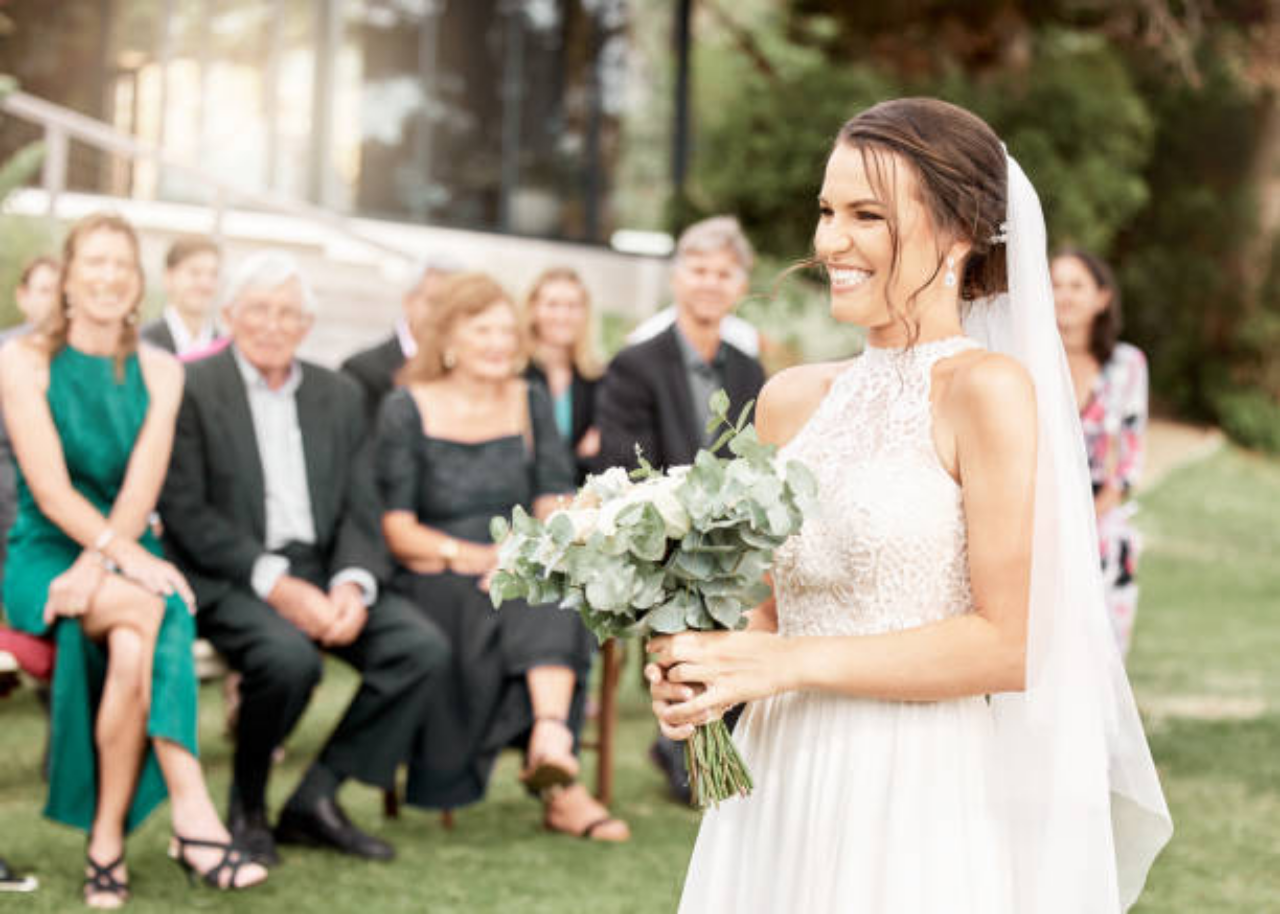
The ceremony passed in a blur. Megan appeared at the aisle’s end, a white confection of lace and tulle, looking exactly like a woman who’d been told her entire life this was the pinnacle. As she walked past, her eyes landed on me and her lips curled in a small, victorious smile.
I smiled back, wondering if it unnerved her that I didn’t look angry.
When the officiant asked if anyone had just cause why they shouldn’t be joined, several heads turned toward me, almost comically.
I sat perfectly still. I wasn’t there to stop the wedding. I was there to end something much bigger.
The reception tent glowed softly from within, enormous and elegant. The head table sat on a raised platform like a stage—Megan and Daniel in the center, flanked by parents.
I found my seat at table fourteen, near the service entrance. Siberia.
Dinner began. Perfectly seared steaks, delicate lobster tails. Wine flowed freely. At the front, my father stood, tapping his glass.
“First of all, I want to thank everyone for being here to celebrate this incredible union. Tonight is about family.”
He loved that word. It excused anything.
He talked about raising daughters, sacrifices, sleepless nights. He painted himself and my mother as tireless heroes.
“And of course,” he said, gesturing grandly, “none of this would be possible without contributions from many people.” His gaze slid across the room and landed on me like a spotlight. “In fact, I think it would be wonderful to hear from my eldest daughter. Holly, sweetheart, come give your sister a toast.”
The room turned in unison.
Under the table, Patricia squeezed my hand once.
I pushed my chair back and stood. The pain in my back flared. I gripped my cane harder and started toward the front.
The walk felt like a mile. My cane tapped against polished floor. Conversations faded until the only sound was the soft click of my heels.
I climbed the two shallow steps—no one had considered accessibility for their own daughter who’d just had spinal surgery—and my father handed me the microphone, his fingers cold and damp.
“Keep it short,” he muttered through gritted teeth.
I looked out at the sea of faces. Some expectant. Some wary. Some smug.
“Thank you, Dad,” I said clearly. “You’re right. I have contributed a lot to this wedding.”
Uncertain laughter.
“I’d like to tell you how much,” I continued.
You could have heard a pin drop.
“Six weeks ago, I went into surgery. Nine hours on the table while surgeons tried to repair my spine. I woke up unable to move my legs properly. I woke up in pain. I woke up with seventy-three missed calls and a voicemail from my father telling me that while I was unconscious, my parents had sold my home.”
A murmur rippled through the crowd.
“My condo,” I clarified. “The one I bought on my own at twenty-seven after years of working overtime and saving. They sold it without my knowledge or consent. They signed my name on documents I never saw. And they used the four hundred twenty-five thousand dollars to pay for this wedding.”
My father stepped forward. “Holly, that’s enough—”
“You had your turn,” I said without looking at him. “I’m taking mine.”
I pulled the manila envelope from my clutch. “In here are copies of the papers they used. A power of attorney I didn’t sign. A signature that doesn’t look like mine. A notary stamp from someone who never met me. All while I was under anesthesia.”
Someone gasped. Others whispered. I saw phones rise, recording.
“But that’s not the only secret in our family,” I said. “Four years ago, when my parents were about to lose their house to foreclosure, an investor swooped in to pay off the debt. They signed a lease and have been paying rent ever since.”
My mother’s face went waxy. My father’s skin flushed mottled red.
“They liked to tell people it was a miracle. A blessing. An anonymous savior. Tonight, I thought they deserved to know the truth.”
I pulled out another document. “The investor was me. Through an LLC. I’ve owned their house for four years. Every rent check they wrote was to me.”
The room seemed to tilt.
“I did it because I loved them. Because I wanted them to have a roof over their heads. They never asked who the landlord was. Tonight, I’m telling you because I’m done being the secret benefactor in a family that sees me as nothing but a wallet with legs.”
“Holly!” my mother burst out, stumbling to her feet. “How dare you humiliate us—”
“You forged my name,” I said. “You sold my home while I was in surgery and used the money for this party. You told people I was trying to ruin the wedding. I’m just telling the truth.”
A man in a gray suit stepped forward from the back. Marcus moved with professional calm. “I’m sorry to interrupt. I’m Marcus Smith, Ms. Sullivan’s attorney. I can confirm what she’s told you regarding ownership of 247 Maple Drive is accurate, and there are serious irregularities in the documents used to sell her condominium. Strong evidence of fraud.”
Daniel’s mother stood slowly, her eyes like ice as she turned to my parents. “Is this true?”
My father spluttered. “This is a family matter—”
“It has everything to do with us,” Daniel’s father interrupted, rising. “If the funds you provided were obtained illegally, we have a serious problem.”
Daniel stood as well, looking like he’d been hit. “You told me your family used savings. Investments.”
Megan’s face crumpled. “Baby, I didn’t know the details—”
“Did you know they sold your sister’s home?” he asked.
She hesitated. Just half a second. But it was enough.
“I knew they were thinking about it,” she admitted. “It was for us. For our future. Holly doesn’t need—”
“Did you know they did it while she was in surgery?”
Tears spilled down Megan’s cheeks. “Daniel, please. This is our wedding.”
He looked around the room—the centerpieces, the chandeliers, the cameras. “What I see is a celebration built on theft and lies.”
I lifted the microphone one last time. “I want to be clear—I didn’t bring this up to ruin a wedding. They chose this timing when they sold my home. I chose to stop keeping their secrets.”
I looked at Megan. “For what it’s worth, I hope you learn someday what love looks like when it isn’t measured in price tags.”
I set the microphone down carefully and walked off the platform. No one stopped me. The crowd parted as I moved through it.
Outside, the air felt different. Cooler. Cleaner. I found a bench in the garden and sat slowly. Patricia joined me without a word.
“How do you feel?” she asked eventually.
“Tired,” I said honestly. “Mostly tired.”
An hour later, Daniel found me, bow tie loose, hair mussed, eyes red-rimmed.
“Can I sit?”
“Yes.”
He dropped onto the bench. “You might have just saved me.”
He stared ahead for a long moment. “Three months ago, my laptop disappeared from Megan’s apartment. Just the laptop. Nothing else. My financial records were on it. Details about my family’s holdings. Information that would make it very clear what someone could gain by marrying me.”
He turned to look at me. “I don’t think I was just some guy she fell in love with. I think I was a project.”
“I talked to my parents’ lawyer,” he said. “We’re filing for annulment. Fraud. Misrepresentation.”
Something inside me loosened—not from malice, but from a sense that the universe was tilting toward fairness.
“What are you going to do?” I asked.
He laughed without humor. “Try to figure out who I am when I’m not being played.”
The fallout came quickly. Someone had recorded my speech. My father’s company put him on indefinite unpaid leave. My mother’s social circles evaporated. Megan’s influencer career nosedived as the story spread online.
Daniel’s annulment went through fast. Within weeks, Megan was unmarried and living back with my parents.
Then the eviction notice was delivered. Thirty days.
My father called two hours later. “What is this?”
“It’s a notice,” I said. “You have thirty days to vacate the property.”
“You can’t do this. We’ve lived here twenty years. This is our home.”
“It’s my home,” I said. “I bought it to save you from foreclosure.”
“You’re going to make us homeless. Your own parents.”
“The kind of parents who stole four hundred twenty-five thousand dollars from their daughter while she was unconscious,” I said. “The kind who never once asked how she was healing because they were too busy planning a party.”
“We made a mistake,” he said, trying to make it smaller.
“You thought I would just take it. Like I always have.”
Silence.
“Please,” he said, the word unfamiliar in his mouth. “Just give us more time.”
“I’m not destroying anything,” I said. “I’m refusing to be destroyed with you.”
“If you do this, you are no longer my daughter.”
“That’s the first honest thing you’ve said to me in a long time.”
I hung up.
Two years later, I turned thirty-four and signed papers on a modest townhouse. Smaller than the condo, less glamorous, but when I stood in the empty living room on the first night, I felt something I hadn’t felt in years: peace.
No one had helped me buy it. The down payment was mine. The mortgage was mine. The future was mine.
I unpacked slowly. Books. Mugs. A worn blanket. The cane leaned in my bedroom closet—a relic and a reminder that I could heal.
Late at night, I’d sit on my back step with tea, reading messages from strangers who’d seen my story online: “This happened to me too. Your story made me feel less crazy. Thank you.”
What I learned, standing in that hospital bed, at that wedding with a microphone, and every day since, was this: saying no isn’t cruelty. Walking away isn’t betrayal. Refusing to be used isn’t selfish.
Sometimes the most loving thing you can do for yourself is admit that blood is not a blank check.
I used to think if I worked hard enough, achieved enough, gave enough, my parents would see me as more than the “smart one” whose job was fixing their mistakes. They never did.
So I turned toward myself.
I stopped setting myself on fire to keep other people warm.
Sometimes when I pass a bridal shop and see a girl in white staring at herself in the mirror, I feel a pang—not of envy, but of hope. I hope she’s walking into something built on truth. I hope she has people who would rather shrink the guest list than steal her sister’s home. And if she doesn’t, I hope she has the strength to tell her own story anyway.
Because the stories we’re handed can cage us. The ones we tell ourselves can set us free.
And if there’s one thing I know now, it’s this: I deserve to be free.

Sophia Rivers is an experienced News Content Editor with a sharp eye for detail and a passion for delivering accurate and engaging news stories. At TheArchivists, she specializes in curating, editing, and presenting news content that informs and resonates with a global audience.
Sophia holds a degree in Journalism from the University of Toronto, where she developed her skills in news reporting, media ethics, and digital journalism. Her expertise lies in identifying key stories, crafting compelling narratives, and ensuring journalistic integrity in every piece she edits.
Known for her precision and dedication to the truth, Sophia thrives in the fast-paced world of news editing. At TheArchivists, she focuses on producing high-quality news content that keeps readers informed while maintaining a balanced and insightful perspective.
With a commitment to delivering impactful journalism, Sophia is passionate about bringing clarity to complex issues and amplifying voices that matter. Her work reflects her belief in the power of news to shape conversations and inspire change.