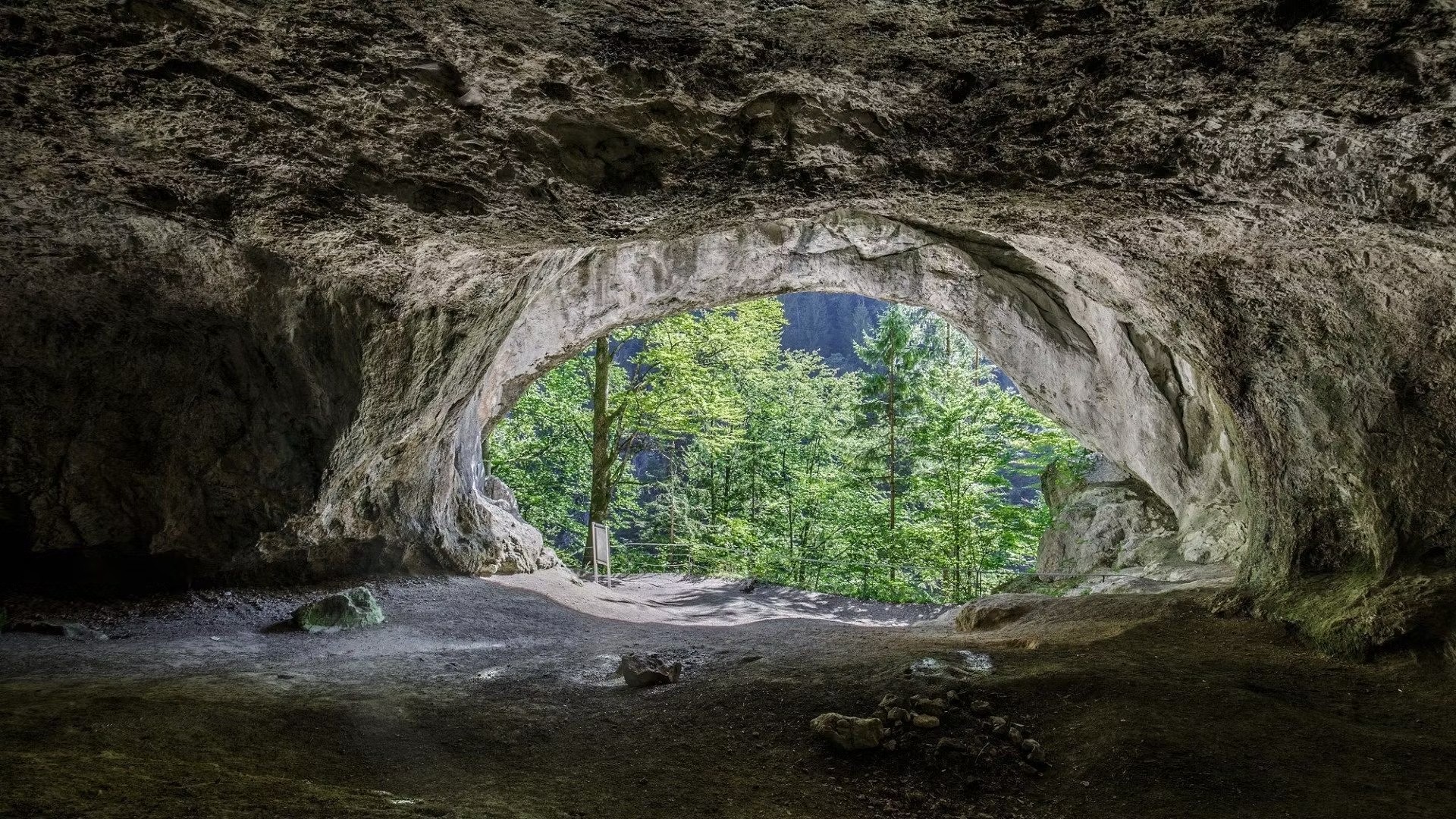
The last thing I saw was his silhouette standing in the sunlight just before the rocks came crashing down.
“These should keep you warm,” he said, his voice low and almost loving, as if he were tucking me in for the night instead of sealing my tomb.
And then darkness—not just absence of light, but a suffocating, crushing black that reached inside me and curled around my bones. The silence came next. Heavy, total.
And then the cold.
A deeper kind of cold that came not from the stone walls around me, but from the realization that Charles had left me to die.
Fifteen years. That’s how long we were married. Fifteen years of shared coffee cups, road trips, anniversaries that slowly turned into obligations. We were partners once.
Or maybe I only thought we were.
I was always the scientist, the one with dirt under her nails and minerals in her dreams. Charles was the smooth talker—marketing, pitches, investors. The face of charm, the voice that knew exactly what to say.
Until it didn’t anymore. Until it went quiet.
I should have noticed it sooner. The way he started looking at me like I was a burden instead of a partner. The way he’d go silent during dinner when I talked about research. The way he never once asked me why my latest discovery meant so much—not just to me, but to the entire field.
I found tantalum and niobium veins deep in the Sierra Nevada mountains. Strategic rare metals buried under centuries of forgotten earth, worth millions. Maybe more.
I didn’t think it would matter to him. I thought he’d be proud.
When I first showed him the map, he smiled. Said we should go check it out together, just the two of us, like old times. I remember laughing, thinking maybe we were finding our rhythm again.
He packed the bags. I brought the charts.
The drive up into the mountains was quiet but not unpleasant. We wound through forests turning amber with early fall. I pointed out rock formations. He nodded politely.
We reached the trailhead by noon. The site was remote, about two hundred meters uphill on foot. I’d marked the entrance of the cave five years ago during a previous survey, but never had time to go deeper.
That day, I felt something electric in my chest—the thrill of discovery, and maybe something like trust.
Charles carried two backpacks. Mine lightweight. His heavier than necessary.
I didn’t think to ask why.
The hike took about an hour. I led the way, stopping occasionally to check the topography. Charles stayed a few steps behind, quiet, watchful.
When we reached the plateau, I pointed toward the darkened mouth of the cave.
“There,” I said, breathless. “That’s where it starts. Locals call it Widow’s Hollow. Don’t worry—the name’s just folklore.”
He didn’t laugh.
Inside, the air was cool and metallic, like old coins and damp earth. We turned on our headlamps. My pulse quickened as I moved deeper into the cavern, tracing my fingers along the wall.
There it was—a glittering black seam across the stone.
Tantalum. Rich, untouched.
My throat tightened. “I was right,” I whispered. “This is it.”
I crouched carefully, collecting samples, labeling them one by one. Behind me, I heard Charles step back, then further back. The crunch of his boots echoing.
I didn’t turn. I should have, but I was too caught in the moment.
Until he called out.
“Nat,” he said softly. “Come here. I want to show you something.”
Something in his tone stopped me. I turned slowly, tucking the samples into their case.
“What is it?”
He smiled. Not the kind that warms you, but the kind that chills your spine.
“Just come here.”
I stepped closer. The light from his headlamp flickered over the jagged walls behind him. He reached for me, pulled me close.
“I love you,” he whispered into my ear, hands tightening around my waist. “You know that, right?”
My breath caught. “Charles, what are you doing?”
He pulled away just enough to look at me, eyes darker than I’d ever seen.
“I’m sorry.”
Then came the push.
Swift, calculated. My back hit the cavern wall hard, and before I could scream, he turned and sprinted toward the exit.
I scrambled up, shouting his name, tripping over rock and dust. That’s when I heard it—the first crack of falling stone. Then another, then the deafening roar as the entrance collapsed in a storm of granite and gravel.
I ran until my hands hit stone. Solid, immovable.
I pounded my fists, screamed until my throat tore. “Charles! What the hell are you doing? Open this!”
Silence.
And then his voice. Muffled, calm, almost kind.
“You always loved your rocks more than me, Natalie. Now you can stay with them forever.”
He was gone.
I pressed my forehead to the stone, breath coming in shallow bursts. This couldn’t be real. Not Charles. Not after everything.
But even as I told myself that, I knew the truth. He’d calculated every move. From the second we left Elkmont, this was his plan.
I collapsed onto the floor, flashlight beam flickering across the cave’s wet, glittering walls. Somewhere deeper in the tunnel, water dripped steadily, counting time in cruel rhythm.
Fifteen years of marriage ended in one act of cold, deliberate betrayal.
I was buried alive, and no one knew I was here.
Or so I thought.
I don’t know how long I lay there. Minutes. Hours. Time doesn’t behave the same way when you’re trapped underground.
Every sound feels amplified. Every silence feels infinite.
I forced myself to breathe, to stay calm, but my mind wouldn’t stop racing. I thought of everything. My team back at the institute. The grant committee waiting on updates. My sister who hadn’t heard from me in weeks.
And Charles. Always Charles.
My hands trembled as I fumbled with my flashlight, adjusting the beam. I had maybe half a bottle of water left and a couple of protein bars in my pack.
I wasn’t supposed to be gone long. Just a field scan, an update.
Not this.
The beam caught on something ahead. Not rock, not crystal.
Movement.
I froze.
There, maybe twenty feet away, a figure stepped slowly into the light. Tall, broad-shouldered, with a thick beard and sharp, alert eyes that caught mine like steel.
For a moment, I couldn’t move. My heart pounded so loudly I thought the cave itself would echo it back.
“Who—who are you?” My voice cracked from screaming.
He didn’t flinch. Just raised his hands, palms open.
“Easy,” he said quietly. “I’m not here to hurt you.”
He stepped into full view, revealing an old lantern in his left hand and a hunting knife strapped to his belt. His clothes were worn but functional—a canvas jacket, faded jeans, heavy boots caked in mud.
Not someone you expected to see in a sealed cave.
“My name’s Elias,” he said. “And I think you and I have a problem in common.”
I backed up against the wall, still gripping my flashlight like a weapon. “How the hell did you get in here?”
“There’s another way in,” he said. “And out. But it’s not easy.”
“You live here?” I asked, barely processing.
“More or less.” He gave a slight nod. “It’s been three years since I left the world outside. This place—it’s quiet. Safer, in its own way.”
I stared at him, trying to read his expression. There was nothing threatening in his tone, but something about his calm unsettled me.
“You heard everything,” I said.
He hesitated, then nodded once. “Most of it. Enough to know your husband’s not coming back.”
I clenched my fists. “He tried to kill me.”
Elias looked down, his jaw tightening. “People do awful things when they’re desperate. But that—that was calculated.” He stepped closer and knelt beside the pile of collapsed rock. “He didn’t just trap you in here. He blocked the only breathable air tunnel. We need to move soon.”
My breath hitched. “Move where?”
“There’s a system of chambers deeper in. I’ve mapped them out over the years. One of them connects to an underground river. That river flows to the base of the range.” He paused. “But the way is tight, wet, and dangerous. We’ll need gear, food, light. It’s our best shot.”
I blinked. “Why would you help me?”
He met my eyes. “Because I’ve been on the other side—the side where someone you trusted is gone.”
There was something raw in his voice, something I didn’t know yet, but felt.
For a long moment, I said nothing. I just stared at the man who appeared out of the shadows, offering not explanations but survival.
Finally, I nodded.
We started walking.
The tunnel narrowed, forcing us to move single file. The air was cold and damp, filled with the scent of mineral-rich water and something older, almost metallic.
I focused on Elias’s footsteps ahead of me, steady and deliberate.
After about ten minutes, we entered a larger chamber lit faintly by his lantern. It was a room—or as close as one could get to it underground.
There were shelves made of driftwood stacked with canned food, tools, flashlights. A rolled sleeping bag in the corner. A fire pit carefully constructed under a natural ventilation shaft.
“Welcome to my humble cave,” he said dryly, setting the lantern down. “Not much, but it does the job.”
I stared around, awestruck. “You’ve lived here for three years.”
“After I lost my family,” he said quietly, crouching by the fire pit. “There wasn’t much left to stay for.”
I didn’t push for details. I just sat down slowly on one of the makeshift stools and wrapped my arms around myself, the gravity of everything beginning to sink in again.
“I was supposed to be working,” I said, voice flat. “He offered to come with me. Said it would be romantic. Just us, no team, no distractions.”
Elias looked over but didn’t interrupt.
“I thought we were reconnecting,” I continued. “But he brought gear to seal the entrance. Rope, tools. He planned it.”
“Because of the discovery,” Elias said.
I nodded. “The site I found—it’s worth billions. Rare earth metals. He saw dollar signs. I saw science.”
Elias poked the fire to life, its glow painting his face in flickering golds. “You saw purpose. He saw escape.”
I looked at him. “And what did you see when you first came to this cave?”
His eyes held mine. “A reason to disappear.”
I didn’t answer. Couldn’t.
The warmth from the fire started to chase the cold from my fingers, but not from my thoughts. I sat in silence, listening to the occasional pop of embers, the drip of water echoing somewhere behind us.
He handed me a cup of tea brewed from something wild and herbal. I took it with a shaky hand.
“We’ll leave before dawn,” Elias said. “We’ll need all the time we can get.”
I stared into the cup. “You think we’ll make it?”
His voice didn’t waver. “We have to.”
And for the first time in hours, I didn’t feel alone.
We left the chamber before first light.
Elias had packed everything with quiet efficiency—canned food, water filters, spare batteries, rope, and a roll of waterproof tarp. I carried a small pack with my samples sealed inside.
It felt ridiculous to be thinking about rocks after nearly dying. But they were more than just specimens now.
They were evidence. Proof that Charles hadn’t just betrayed me—he tried to steal from me. Kill me. Erase me.
We moved through the narrow passages slowly. My body still ached from the impact of the fall, and my muscles screamed in protest with every step.
The flashlight beam bounced off the walls, illuminating mineral veins that shimmered like ghost trails in the dark.
“There’s a crawl space up ahead,” Elias warned. “About fifteen feet. It gets tight, and you’ll need to stay calm. If you panic, stop moving and call out.”
I swallowed hard. Claustrophobia had never been my issue until now.
He went first, slithering into the gap with the ease of someone who had done this a hundred times. I dropped to my belly and followed, my breath ragged, the sound of my own heartbeat pounding in my ears.
“Talk to me,” I whispered hoarsely.
“What do you want to know?” came his voice, steady and low, just a few feet ahead.
“Anything. Tell me why you came here. Why this place?”
Silence for a moment, then: “My wife’s name was Leah. And our daughter, Sophie—she was nine. Bright. Loved horses.”
The stone pressed cold against my chest, but his voice helped me focus.
“We were hiking in the Cascades. A rockslide came out of nowhere. I was trained in rescue. I knew the terrain. But I was twenty feet too far.”
I winced.
“They were buried before I could even get to them,” he continued. “I dug for hours with my bare hands. Broke them bloody. Found her necklace first, then her little boot.”
My stomach clenched, but I said nothing.
“I left my job after that. Left everything. Came here because I thought if I could live where the silence was loud enough, maybe the guilt would stop echoing.”
We emerged into another chamber. I gasped, partly from relief and partly from the strange beauty around us.
The walls were covered in long, delicate stalactites, their tips glittering with moisture. The floor rippled with mineral pools.
Elias turned to look at me. “You okay?”
I nodded. “Yeah. Thanks for talking. I needed that.”
“Talking keeps the panic away,” he said simply.
We kept moving.
The further we went, the more the air changed. Cooler, more humid. I felt it before I heard it—a low rumble, deep and constant.
“The river,” Elias said.
The chamber opened up abruptly into a jagged ledge overlooking an underground river—black and fast-moving. The sound of rushing water filled the air, echoing off every surface.
Elias pointed toward the far wall. “There’s a ridge trail that follows the river. We’ll move along that for a few hours, then take a narrow crossing.”
I peered down at the water. It looked like oil, thick and wild.
“Has anyone ever made it out that way?”
“Just me,” he said. “And now, hopefully, you.”
We descended carefully, placing each step with deliberate caution. The ledge was narrow, sometimes barely wide enough for one boot.
At times Elias had to turn and offer his hand, helping me balance as we edged past wet, slippery outcroppings.
I hated how much I had to rely on him. I was always the one people looked to—on the mountain, in the lab, in the boardroom. But now my life depended on the steady hand of a stranger.
When we reached a wider section of the ledge, Elias handed me a protein bar and a canteen. We sat, resting.
“You think he’s told anyone yet?” I asked. “Charles.”
He was silent for a beat. Then: “He’s probably already made his move. Told people it was an accident. That he tried to save you.”
I looked out at the water. “Do you think anyone would believe that?”
“They’ll believe what’s convenient,” Elias said. “Unless you give them a reason not to.”
I clenched my jaw. “I will.”
He watched me quietly. “You still have the samples.”
I patted my pack, waterproofed and intact.
“Good. You’ll need them.”
The thought of facing Charles again made my skin crawl. Seeing his smug, calculating face. Knowing he was out there spinning the narrative while I bled in the dirt.
But there was no turning back. I had survived. That meant something.
Elias stood and extended his hand. “We’ve still got a long way to go.”
The trail narrowed again, forcing us to walk single file. The river roared beside us.
At one point, the path disappeared entirely, and we were forced to wade thigh-deep through the icy current along the wall.
“Keep close to the rock,” Elias instructed. “Use the handholds. Step sideways, not forward.”
We moved inch by inch, the cold slicing through my clothes. Every muscle in my legs burned. My fingers went numb, gripping the rock.
By the time we pulled ourselves onto dry stone again, I was shaking uncontrollably.
Elias handed me a dry towel from his pack and set up a small heating packet under a thin mylar blanket.
“We’ll rest here,” he said. “Ten minutes.”
I huddled in silence, teeth chattering, mind racing.
And then, softly, I said, “Thank you.”
He didn’t respond right away. Just sat beside me. Close enough for warmth, far enough for space.
“You’re stronger than you think,” he said at last.
I turned to look at him. “So are you.”
He smiled—just barely. But it was the first time I’d seen one reach his eyes.
Somewhere ahead was the end of the tunnel. Maybe light, maybe wind, maybe birdsong.
But for now, there was only this: two strangers in the dark, walking toward something neither of us could name yet.
By the time we reached the crossing point, the sky above us had long since ceased to exist. All that remained was the river, the rock, and the echo of each other’s breath.
Elias stopped at a narrowing where the water pressed hard against both walls, forming a tunnel just wide enough to crawl through.
“We’ll have to go under,” he said quietly.
I stared at the current, black and churning like something alive. “How far?”
“Five, maybe six meters. It’s a tight swim, but I’ve done it before. I’ll go first. Make sure it’s clear.”
I hesitated. “And if it’s not?”
His eyes locked on mine. “It is. I know the signs—the airflow, the way sound carries. There’s light and oxygen on the other side. I can feel it.”
I wasn’t sure I believed him. But I believed in him.
He packed our bags into waterproof sacks, wrapped them twice, and tied them tight. Then he placed a hand on my shoulder.
“Keep your arms close. Don’t fight the current. Let it carry you until you feel the slope, then swim upward. I’ll be waiting.”
And then he was gone, slipping under with a practiced dive, vanishing into the roar.
I was alone.
One minute passed. Then two. I counted every heartbeat, every echo. The walls seemed to press in. I clenched my fists to stop them from trembling.
Still no sign of him.
What if something went wrong? What if he misjudged? What if I—
A splash broke the stillness.
Elias surfaced on the far side, soaking wet, but smiling. He raised a hand and shouted over the noise: “Clear! You’re up!”
I breathed in deeply—once, twice—and jumped.
The cold hit like a punch. My chest seized. The world vanished in bubbles and force. The current yanked me sideways, twisted me, shoved me forward.
I fought the urge to panic, keeping my body tucked, my head down. Seconds felt like hours.
Then—upward motion. I kicked hard, desperate, lungs screaming.
And then air.
Elias’s arms pulled me from the water and onto solid stone. I gasped, coughing, shaking, but alive.
“You did it,” he said, wrapping a dry blanket around my shoulders.
I laughed, though it came out like a sob. “I actually thought I’d die.”
“Not today,” he said. And something in the way he said it made me feel steady again.
We rested in a dry cavern for a while, sharing the last of our protein bars. The air smelled different here—less stale, more open.
Above us, I thought I heard birds.
I looked at Elias. “What do you think Charles is doing right now?”
He paused. “Crafting the perfect lie.”
I nodded slowly. “He always was good with words. Always knew how to spin something to his advantage.”
“He’s probably told them you slipped,” Elias said. “That he did everything he could. I bet he’s already back in Elkmont, giving interviews with a hero’s smile.”
“Then we give them the real story.”
We resumed our journey, climbing upward through narrow shafts and damp corridors that smelled of pine sap and minerals.
As we moved, I imagined what it would be like to walk into town again. To see his face when I appeared—not as a ghost, but as a reckoning.
A few hours later, we reached the final tunnel.
Light streamed in through a thick curtain of vines, filtered and golden. Elias pushed aside the growth, letting me step into the open first.
The sun hit my skin like something holy.
I squinted, eyes adjusting. The forest around us was alive—pine needles underfoot, wind through leaves, the sound of real, open space.
I turned slowly in a full circle, inhaling the scent of cedar and cold mountain air. Tears welled up in my eyes before I even realized it.
Elias joined me, blinking into the sun. “Welcome back,” he said softly.
We started down the slope. From this vantage point, I could see the ribbon of a highway and the faint outline of Elkmont nestled in the valley. Smoke rose from chimneys.
It looked small, distant, ordinary.
Three hours later, dusty and sore, we stepped into the outskirts of town.
I felt like a stranger walking into someone else’s dream. People stared. We must have looked like ghosts—clothes torn, covered in dust, eyes too wide.
We found the local diner first. I don’t know why. Maybe because I needed something real. The scent of frying eggs and cheap coffee was enough to ground me.
But what stopped me cold was the flicker of a TV on the far wall.
There he was.
Charles.
On the screen, he stood in front of a cabin I recognized. Our cabin. Dressed in black, speaking into a microphone, eyes solemn.
“It was an accident,” he said. “We were exploring a new section when the cave-in happened. I tried to save her. I did everything I could.”
I stared, heart hammering.
The waitress noticed me frozen in place and frowned. “Ma’am, are you all right?”
Elias stepped forward. “Is there a sheriff in town?”
She pointed. “Station’s two blocks over. End of Main Street.”
We didn’t wait.
By the time we reached the station, I was trembling. The officer on duty blinked at us as we entered, unsure of what to make of our arrival.
“I’m Natalie Vega,” I said. “And I need to report an attempted murder.”
That sentence shifted everything.
They took us into a side room. Another officer was called. Statements were made. I showed them the samples. Elias gave his account—the timeline, the exact words Charles said before sealing me inside.
The sheriff, a stocky man with tired eyes, looked at both of us and said, “This isn’t local anymore. We’ll contact the county.”
I nodded. “Do it fast. He’s moving on the discovery. He’s probably already filed a death certificate.”
As if to confirm it, the sheriff typed something into his computer, then swore.
“He did. Two days ago. Already petitioned for spousal inheritance of intellectual property.”
I closed my eyes for a second. Then: “I need to prove I’m alive, and that it was my discovery, not his.”
“You’ve got more than enough,” Elias said beside me.
I opened my eyes and looked at him. For the first time in four days, I believed he might be right.
The next morning, I woke up in a borrowed flannel shirt and jeans that didn’t fit.
The motel room smelled like old cedar and bleach, but after three nights in a cave, it may as well have been the Ritz.
Elias had taken the room next door. He knocked once, just after sunrise.
“They’ve set it up,” he said.
“Where?”
“Back at the site. County detectives will be there. Investors, too. He thinks he’s about to close the deal.”
I nodded. “Then let’s ruin the ending.”
It took two hours to drive back into the mountains. The authorities had arranged everything—officers in plain clothes, hidden cameras, marked vehicles just out of sight.
I rode in silence in the back seat of an unmarked cruiser, staring out the window at the winding roads and the trees that had almost become my grave markers.
Charles had no idea.
From behind a thicket of trees, I saw his Jeep parked near the site. Another black SUV sat nearby—probably the investors.
I could hear his voice before I saw his face. Laughing, charming, hands waving in that familiar pitchman rhythm.
God, he was good.
Detective Morgan leaned back in his seat beside me. “We’ll let him talk first. Once we hear enough, we move. When we give the signal, you come forward.”
I nodded once. I wasn’t shaking. I thought I’d be shaking.
Out of sight, a hidden microphone picked up every word.
“It was hard,” Charles was saying. “She was brilliant, passionate. But the cave-in was brutal. I barely made it out alive. I tried everything to get her out, but the rocks were unstable.” He paused, his voice breaking a little. “She died doing what she loved. And now I just want to honor her legacy.”
The investor’s voice came through the feed. “We’re very sorry for your loss.”
“The preliminary report shows a promising mineral yield,” Charles replied. “Once the inheritance clears, we’re close. Just waiting on the final paperwork.”
The detective leaned forward, whispered something into the radio.
“Time,” he said.
I opened the car door and stepped out onto the gravel. The sound of my boots startled the birds first, then the men.
Charles turned mid-sentence.
His face went white. Not pale—white. Ghost white. Eyes wide, mouth half open, breath caught in his chest.
“Hello, Charles,” I said evenly.
He took a step back. “Natalie—how—I don’t understand.”
“Surprised to see me?”
I walked toward him slowly, aware of the complete silence around us. The officers behind me fanned out quietly.
“I imagine you’ve already started planning my funeral. I caught the TV interview. Very moving.”
“I—I don’t understand,” he stammered. “You—there was a cave-in.”
“You caused it,” I cut in. “You brought rope, tools. You blocked the only exit and told me—and I quote—’These rocks should keep you warm forever.'”
He blanched.
“We have a witness,” Detective Morgan said, stepping forward. “We have physical evidence. We have recordings. Charles Vega, you are under arrest for the attempted murder of your wife, Natalie Vega.”
One of the investors swore under his breath.
Charles didn’t resist. He just stood there as they cuffed him, staring at me like I’d crawled out of his nightmare.
Maybe I had.
As they led him past, he tried one last time. “Natalie, it wasn’t supposed to be like this.”
“Don’t,” I said softly. “You buried me and thought no one would ever find the truth. But the truth was already in the walls. You just didn’t know it had a voice.”
The officers led him away.
I stood still. I thought I’d feel victorious, vindicated. But all I felt was tired.
I walked back to the SUV. The investors didn’t follow. One of them tried to speak to me—something about re-evaluating contracts, about possible collaboration.
I held up a hand and kept walking.
Later, as the site was being secured and the press began arriving, I found Elias by the treeline. He was leaning against a tree, arms crossed, watching me.
“You all right?” he asked.
I nodded. “It’s done.”
“Not quite,” he said gently. “But the worst part is.”
I looked back once more at the cavern entrance—the same place where Charles had tried to end me. And now it was just a pile of rock. Just geology, just matter.
He hadn’t won. He hadn’t even understood what he was trying to steal.
“Do you ever wonder,” I asked Elias, “if some places choose to protect us, even when people don’t?”
He tilted his head. “I don’t think it’s the place. I think it’s the people who find you in it.”
I looked at him, and for the first time since the cave, I let myself really feel what had happened.
I had lived. I had been saved. And maybe I had been seen.
The air was crisp that morning, tinged with frost and promise.
I stood at the edge of Widow’s Hollow, watching the first rays of sun spill into the canyon. The pile of stones that had once trapped me now lay silent, as harmless as any fallen rock.
Behind me, Elias unpacked our gear, folding tarps and stowing bottled water. The forest around us stirred—birds calling, needles rustling in a gentle breeze.
It felt alive.
I took a deep breath, tasting pine and possibility. For so long, this place had been my prison, then my passage to survival.
Now it felt like a threshold—a line between who I was and who I could become.
I turned to Elias. His beard caught the light. His eyes were clear and steady.
“Thank you,” I said softly. “For everything.”
He shrugged, almost sheepish. “You did the hard part.”
“No,” I insisted. “You came when no one else knew I was here. You guided me when I thought I’d never see light again. You trusted me.”
He met my gaze. “I did. Because I believed you deserved to live.”
My heart thumped. Live—more than mere breathing.
I remembered sinking into that icy stream, believing the darkness would be my end. But something inside me refused to give up.
And he honored that refusal.
“We should head back,” I said. “I have to reclaim my life.”
He nodded. “Whatever you need.”
We walked side by side down the trail, each step lighter than the last. At the parking area, my rental SUV waited, dust-coated but ready.
I opened the back door and loaded our packs, then turned to him.
“Will you come?” I asked. “To Elkmont. To the institute. I—”
He paused, eyes drifting to the winding road. “I never thought I’d leave these mountains.”
I swallowed. “I know. But maybe it’s time.”
He looked back at me, a slow smile forming. “For you, I’d try.”
Tears pricked my eyes. I touched his arm, surprised by the warmth of human contact after days in the cold underground.
“Thank you,” I whispered.
We drove in companionable silence, the car a bubble against the world. When we reached town, the streets were calm—locals going about their morning routines, unaware of the drama that had just unfolded up the mountain.
I pulled into a small lot beside the geology institute. The building looked the same, but I felt different.
Inside, Director Ramirez greeted me like a miracle. He clasped my hand and congratulated me on the evidence submitted.
In the back office, I signed papers restoring my name to the discovery. The weight of false death certificates, forged inheritance claims—they all vanished under the crisp seal of truth and justice.
Later, Elias and I walked through the halls lined with rock samples and mineral maps. I showed him the lab where I first analyzed my tantalum veins, the conference room where I would now present my findings.
He listened, genuine interest lighting his features.
“This is your world,” he said. “I’m honored to see it.”
I laughed—light, free. “And you? Where do you belong now?”
He considered, then replied, “Somewhere between the silence of the caves and the heartbeat of humanity. Maybe here, with you.”
My breath caught. This was not just gratitude or pity or convenience. It was something deeper—a choice to step forward together into uncertainty, because we had walked through fear and betrayal and come out stronger.
Over the next few weeks, I returned to fieldwork—this time with a full team, legal protection, and plans for sustainable extraction.
Elias stayed by my side, offering safety assessments and survival workshops for new recruits.
The institute renamed the discovery Vega Ridge in recognition of my work. I accepted the honor with quiet pride.
One evening, after the lab had emptied, Elias knocked on my door holding two steaming mugs of tea. Outside, twilight faded into stars.
I joined him on the balcony.
“I’ve been thinking,” he said, offering me a mug, “about what comes next.”
I sipped, savoring the warmth.
He met my eyes. “I want to stay. To build something with you. I don’t know the first thing about academia, but I know about loyalty and courage and finding light in the darkest places.”
A breeze stirred, lifting strands of my hair. I felt my heart open, as if the mountain itself had cracked me free.
“I’d like that,” I said truthfully.
He smiled, relief and hope mingling in his expression. “Then let’s start here.”
We clinked mugs, and the sound echoed softly under the night sky.
I thought of Widow’s Hollow—once my grave, now a symbol of resilience. And of the man who rescued me, who chose to believe in me before anyone else did.
The world beyond these mountains was vast and unpredictable. But for the first time, I wasn’t afraid.
I had my discovery back, my voice restored. And beside me was someone whose unwavering faith had saved my life.
As the stars wheeled overhead, I whispered a promise to honor this second chance. To live fully. To never let darkness bury my truth again.
And I knew this was only the beginning.

Lila Hart is a dedicated Digital Archivist and Research Specialist with a keen eye for preserving and curating meaningful content. At TheArchivists, she specializes in organizing and managing digital archives, ensuring that valuable stories and historical moments are accessible for generations to come.
Lila earned her degree in History and Archival Studies from the University of Edinburgh, where she cultivated her passion for documenting the past and preserving cultural heritage. Her expertise lies in combining traditional archival techniques with modern digital tools, allowing her to create comprehensive and engaging collections that resonate with audiences worldwide.
At TheArchivists, Lila is known for her meticulous attention to detail and her ability to uncover hidden gems within extensive archives. Her work is praised for its depth, authenticity, and contribution to the preservation of knowledge in the digital age.
Driven by a commitment to preserving stories that matter, Lila is passionate about exploring the intersection of history and technology. Her goal is to ensure that every piece of content she handles reflects the richness of human experiences and remains a source of inspiration for years to come.