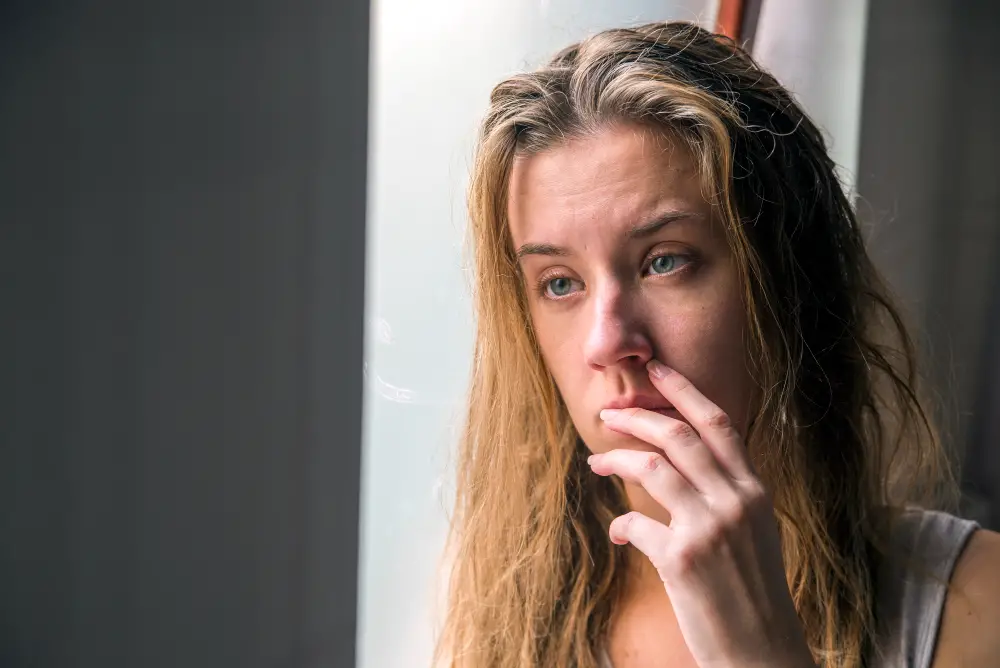
I Went Home for Car Papers and Overheard My Husband Say “I Messed with Her Brakes.” Then He Said, “See You at Your Sister’s Funeral.” That’s When I Realized the Accident He Planned Wasn’t Meant for Me Alone.
I drove to Megan’s house gripping the steering wheel so hard my knuckles turned the color of old bone.
My fingers locked into a claw shape around the leather, cramping, but I couldn’t loosen them. If I let go, I felt I might fly off the surface of the earth.
Every red light felt like a trap. Every black SUV in the rearview mirror made my pulse spike—a jagged hammering against my ribs. I checked the mirror once, twice, ten times a minute. Was that him? Was that the tilt of his head? Was that his personalized plate?
The world outside the windows was gray and blurred, a typical Thursday afternoon, but inside the car the air was thick with the smell of my own terror. Sweat. Something metallic. And underneath it, something I couldn’t name until later.
The phantom smell of brake fluid.
It had started two hours earlier, with a forgotten folder.
Logan and I had been separated for a week. Not officially—no lawyers yet, no papers—just me sleeping at my sister Megan’s house while Logan stayed in ours and the silence between us grew teeth. I’d gone back to the house that afternoon to grab my insurance documents. I had an appointment the next morning. I figured he’d be at work.
He wasn’t.
I heard his voice the moment I stepped through the garage door into the house. He was around the corner in the kitchen, on his phone, his back to me, completely unaware I’d come in.
“She won’t feel it until she hits the highway,” he said.
I stopped walking.
I stopped breathing.
“Yeah, I loosened the line. Clean. They’ll say black ice or driver error.” A pause while he listened. Then a low laugh that I had never heard from him before—something satisfied and cold. “I know. I’ll see you at her sister’s funeral.”
The folder I was holding hit the floor.
Logan’s voice cut off.
I didn’t wait. I turned, walked back through the garage, got in my car—the same car he’d just described—and pulled out of the driveway on pure adrenaline, forcing myself to stay below thirty miles an hour because if he had actually done what he said, then every pump of the brakes was a gamble.
I made it two blocks before I pulled over, hands shaking so badly I could barely dial the towing company.
“I need immediate pickup,” I said. My voice sounded like someone else’s. “Do not let the driver pump the brakes. The vehicle may have a tampered brake line.”
While I waited for the tow truck, I sat on a stranger’s front stoop and tried to think.
Her sister’s funeral.
Not mine. Megan’s.
The sentence had two subjects. Two targets. The logic of it slid into place with the horrible clarity of something I should have seen coming.
Logan hated Megan. He’d always hated her, though he’d hidden it for years beneath polite dinners and performative smiles. She was the one person who’d never been fooled by his charm, the one who’d pulled me aside at our engagement party and said, quietly, “He talks about you like you’re something he owns.” I’d defended him. I’d told her she didn’t understand him.
She’d understood him perfectly.
When I left last week, Megan was the one who came. She drove over with boxes and a look on her face that said she’d been waiting for this call. Logan had watched from the doorway, his jaw tight, his eyes moving between us like he was calculating something.
“You’re making a mistake,” he’d said to me.
But he was looking at Megan when he said it.
The tow truck driver asked where I wanted the car taken. And that’s when something shifted in me—some animal instinct, some survival reflex—because I didn’t say the mechanic’s shop.
I said: “1402 Oakwood Lane.”
His mother’s house.
I knew what I was doing, even if I couldn’t have explained it in complete sentences. If the car sat in my driveway, Logan could say anything. He could say a stranger tampered with it. He could say I tampered with it myself. But if it was sitting in his mother’s driveway and he went there to quietly “fix” what he’d done—
He’d hand them everything.
Before I got back in Natalie’s borrowed car and drove to Megan’s, I did one more thing. I went back to the house.
Logan’s car was gone. He’d left.
I had maybe ten minutes.
I went to his iPad, the one he left charging on the kitchen counter, the one he’d never bothered to password-protect because he’d always assumed I was too trusting to look. I opened his email. I scrolled.
The subject line hit me like cold water: Service Confirmation: S. Pierce.
S. Pierce.
Sarah Megan Pierce. My sister went by her middle name, but her legal first name was Sarah.
The email was from a funeral home downtown. An inquiry about pre-arrangement services. The name in the body of the form was listed as a female, approximate age thirty-four.
Megan was thirty-four.
I took a screenshot, forwarded it to my own email, and walked out.
Megan met me at the door before I could knock, phone in hand, face stripped of color. She looked like she’d seen a ghost.
“Okay,” she said, her voice barely audible. “Explain. Now.”
I pushed past her into the hallway. The house smelled of lemon polish and roasting chicken. Our mom was in the kitchen, humming something from the seventies, setting out dinner plates with rhythmic little clinks. Completely oblivious. Living in a world where daughters come over for dinner and husbands don’t plan funerals.
I pulled Megan into the shadow of the hallway, away from the kitchen warmth, and kept my voice low.
“I heard Logan on the phone,” I said. The name tasted like ash. “I was in the garage. He didn’t know I’d come back early.”
“On the phone with who?”
“Doesn’t matter. He said he messed with my brakes. Those exact words. ‘I loosened the line. She won’t feel it until she hits the highway.'”
Megan stared at me. Her brain seemed to stall—refusing to process the sentence, because it was too violent, too calculated, too far outside the boundaries of the life she thought we were living.
“That doesn’t even—Claire, maybe he was talking about a repair?”
“He said he’d see someone at my funeral,” I said.
The silence that followed pressed against our eardrums.
“Your funeral?” she whispered.
“Megan.” I kept my voice steady. I needed her steady too. “There was an email on his iPad. A funeral home inquiry. The name was S. Pierce.” I watched her face. “Your name.”
The denial in her eyes fractured completely.
“He told me two days ago,” she said slowly, “that you were a bad influence on me. That I spent too much time with you. He said I was enabling you.”
“He was laying the foundation,” I said. “Establishing that he warned people.”
Megan looked toward the kitchen, where Mom was now humming a different song, pouring ice water into glasses like it was any other evening.
“We’re calling the police,” she said.
“Yes,” I said. “But we do it smart.”
I told her about the tow truck. About Carolyn’s house. About the screenshot. About all of it.
Megan looked at me for a long moment.
“You came back for a folder,” she said.
“I came back for a folder,” I said.
We dialed 911.
When the dispatcher answered, I didn’t scream. I didn’t cry. I flattened my voice into something calm and precise, because I knew exactly what happened to women who sounded hysterical when they reported their husbands.
“My name is Claire Pierce,” I said. “I’m reporting a domestic threat and suspected vehicle tampering. I overheard my husband state that he had damaged my brake lines. The vehicle has been secured at a separate location. I’m at my sister’s house, and I believe he may come here.”
I didn’t say he’s trying to kill me. I let the facts sit there like stones, solid and immovable.
Two officers arrived within twenty minutes.
One—Sergeant Miller, tall, shaved head, eyes that had absorbed too much of the world—took my statement. The other stayed with Megan and eventually moved to the kitchen, where Mom had finally realized this was not a normal evening.
“Why are there police, Claire?” she asked from the doorway, clutching a dish towel.
“It’s Logan, Mom,” Megan said, guiding her to a chair.
I showed Miller the screenshot of the email. I watched his face change—the professional mask slipping just enough to show the disgust underneath.
“The ‘S. Pierce,'” he said quietly. “That’s her?” He nodded toward Megan.
“Her legal first name is Sarah,” I said.
Miller looked at his partner. Something passed between them.
“If the brakes fail and you die,” he said carefully, “and there’s already a funeral inquiry filed for your sister—he’s not planning to grieve. He’s planning to transition.”
“Logan loves efficiency,” I said. The words sounded hollow even to me.
I called Carolyn while the officers were still there.
She answered on the third ring, clipped and impatient. She had always treated me like a temporary fixture in her son’s magnificent life—a supporting character who’d somehow wandered into the wrong story.
“Claire. There’s a sedan in my driveway. What is this, some kind of dramatic statement?”
“Do not let Logan near that car,” I said.
A pause. Suspicious. “Why would Logan care about your car?”
“I overheard him say he tampered with my brake line. The police are on their way to you, Carolyn. That car is evidence.”
The composure cracked. Just slightly—a sharp inhale through the nose, the sound of someone recalibrating. “That’s ridiculous. Logan loves you. You’re having one of your episodes.”
“I’m not having an episode,” I said, my voice going flat. “I’m trying to stay alive. If you touch that car, or you let him touch it, you will be an accessory to attempted murder. Do you understand what I’m telling you?”
A long silence. Then, quietly: “He called me ten minutes ago. He asked if I’d seen you.”
“What did you tell him?”
“I told him no.” A pause. “He sounded different.”
“Different how?”
“Manic,” she said. The word seemed to cost her something. “Fine. I’ll wait outside. I’ll stay by the car until the police arrive.”
I hung up. Megan squeezed my hand.
“She might call him,” she said.
“She might,” I agreed. “But right now, she’s scared. And scared people make better witnesses than loyal ones.”
The hours between the call and full dark were the longest of my life.
We turned off the main lights, leaving only the hallway lamps on, making the house feel like a bunker. Mom sat on the couch, whispering prayers. Megan paced the hallway, checking the peephole every thirty seconds. I stood at the front window, peering through the blinds at the street.
Then my phone buzzed.
The sound was like a gunshot in the quiet room.
A text from Logan.
Where’s my wife?
Then, seconds later: You think you can embarrass me and walk away? Taking my car?
Then the one that froze the marrow in my bones:
Tell Megan I’m sorry she got dragged into this. But it ends tonight.
Megan read over my shoulder. “Oh God. He knows we’re here.”
Miller photographed the messages without a word. His face was grim. “Do not open the door. Do not engage. You call us.”
At 8:46 p.m., a dark sedan rolled past the house.
Too slowly.
It wasn’t Logan’s SUV. A rental, maybe. Or a friend’s car. The sedan continued down the block—then circled back.
Miller straightened up in his seat. His hand went to his radio. Moments later, I saw the reflection of another patrol car turning onto the street from the north end.
The sedan stopped half a house away.
A man stepped out.
Logan.
He wore a jacket like he was going somewhere nice—a dinner date, maybe. Hair combed, posture straight. A plastic grocery bag swinging gently in one hand, like he’d brought leftovers. Like he was the concerned husband showing up to collect his distressed wife.
He didn’t look like a monster.
He looked like the man I married.
Megan made a strangled sound from the hallway. “Why does he look so normal?“
“Because he’s performing,” I said. “He wants witnesses to see the calm, rational husband showing up for his hysterical wife. He’s building his narrative.”
Logan walked up to the porch and knocked once. Polite. Rhythmic.
“Claire.” His voice was pitched perfectly—loud enough for neighbors to hear, warm enough to sound concerned. “Open up, honey. We just need to talk.”
I didn’t move. I stayed in the shadow of the living room and watched him.
He knocked again. “Megan, come on. This is between me and my wife. Stop getting in the middle.”
Miller stepped out of his patrol car and moved up the driveway. “Sir. Step away from the door.”
Logan turned, surprised. Then the smile appeared—instant, practiced, and the most frightening thing I had ever seen on a human face. It materialized in under a second.
“Officer, thank God you’re here. My wife is having a breakdown. She stole a car and ran off. She forgot her medication.” He lifted the grocery bag. “I’m just trying to bring it to her.”
Miller kept his hand near his belt. “We’ve received a report of threats and suspected vehicle tampering. We have the texts, Mr. Pierce.”
Logan’s face tightened—a flash of pure rage, there and gone in less than a heartbeat. Then the smooth composure settled back over his features like a mask clicked into place. He laughed lightly. “This is insane. Carolyn has the car. She can confirm nothing’s wrong. My wife is in crisis. I’m worried about her.”
“Carolyn told him we were here,” Megan whispered. “She promised and she told him.”
My phone rang.
Carolyn.
I put it on speaker without thinking.
“Claire—” Her voice was breathless, frantic, nothing like the cool dismissal from earlier. “He showed up here. He said he just wanted to check something under the wheel well. I tried to stop him, I stood right there—”
My stomach dropped. “Carolyn. Did you let him touch the car?”
A silence that screamed the answer.
“He pushed past me,” she sobbed. “He took something. A wrench. Shoved it in his pocket and drove off in his friend’s car.”
My voice cracked despite myself. “You were supposed to stay there.”
“I know. I know. I’m so sorry. He’s my son and I—I’m sorry, Claire.”
The call was still going when Logan’s polite mask finally, completely, came apart.
Outside, Miller stepped toward him. “Back up. Sir. Now.”
And Logan’s voice rose—losing every trace of the concerned husband—raw and ugly and real for the first time all night.
“You can’t keep me from my wife! She’s sick! She did this! She turned everyone against me!”
Then Megan grabbed my arm. She was staring at her phone. Her home security app. The rear camera.
MOTION DETECTED: BACK DOOR.
“Someone’s behind the house,” she breathed.
Miller’s radio crackled. “Possible second subject, rear access—”
Logan heard it.
His eyes snapped to the side yard. And in that instant the performance was completely over—the concerned husband, the grocery bag, the measured voice—all of it gone. What was left was something I didn’t have a name for.
The rear patrol unit rounded the corner. “Police! Don’t move! Show me your hands!”
A figure bolted from the backyard. Hooded. Moving fast. He slipped on the wet grass and went down hard.
When they pulled him up and yanked back the hood, I recognized him even through Megan’s grainy camera feed.
Derek Voss. Logan’s oldest friend. The one who always showed up when Logan needed to feel powerful. The one who owed Logan money and had been paying it back in favors for years.
Megan’s voice was barely a whisper. “He was going in the back. While Logan kept them busy at the front.”
Two directions. One plan. The grocery bag was a prop. The polite knocking was a clock.
Logan was still shouting when Miller reached him—something about the dog, about the gate, about misunderstandings. Miller didn’t respond. He took Logan’s wrist, turned him around.
“Hands behind your back.”
Logan struggled. He called my name through the door, his voice twisting from rage to pleading and back again, like he was cycling through every tool he had left. “Claire! You did this! You’re sick! You need help!”
I stood in the hallway with Megan’s hand in mine and said nothing.
I listened to the cuffs click.
I listened to the story Logan had written for us finally fall apart under real light.
The detectives stayed late.
They told me the tow truck had logged timestamps. That forensics would examine the brake system. That the email, the texts, the funeral inquiry, Derek Voss’s presence at the back door—all of it mattered. They told me—carefully, in the way people tell you hard things—that what I had done likely saved lives.
Plural.
When the house finally went quiet, Megan slid down to the kitchen floor and started crying the way you cry when you’ve been holding your breath for hours and your body finally decides you’re allowed to exhale.
Mom sat beside her and put her arm around her shoulders, and the two of them stayed there on the tile floor while I stood by the window watching the last patrol car pull away from the curb.
“I didn’t know he was capable of this,” Mom said quietly.
I thought about that.
I thought about the cold efficiency of it—the timed coordination, the funeral inquiry filed in advance, the friend with the hoodie waiting at the back fence. I thought about how long it must have taken to build that plan, to make those calls, to decide that the cleanest solution was simply to remove the inconvenient people from the equation.
I thought about how many times I had described Logan to others as efficient, as organized, as someone who finished what he started.
I thought about how I’d meant it as a compliment.
I looked down at my phone. At Logan’s last text, still on the screen.
Tell Megan I’m sorry she got dragged into this. But it ends tonight.
And I understood the last piece with a clarity that didn’t feel like relief. Didn’t feel like victory. Felt more like standing in a house after the fire has gone out—the structure still standing, everything inside irrevocably changed.
Logan hadn’t been speaking in metaphors.
He hadn’t been angry and reckless, saying things he didn’t mean.
He had made a plan. He had made calls. He had made a reservation.
He just hadn’t accounted for a forgotten folder and a wife who finally, after years of trusting him with everything, decided to come home early.
In the weeks that followed, the picture assembled itself piece by piece.
Forensics confirmed the brake line on my car had been deliberately loosened—not damaged, not corroded, but carefully, precisely compromised in a way that would hold through neighborhood driving and fail under highway speed. A mechanic testified that whoever did it knew exactly what they were doing.
Derek Voss cooperated almost immediately. He told investigators that Logan had approached him three weeks earlier with what he described as “a plan to solve his problems.” In exchange for the debt Logan forgave, Derek agreed to serve as backup. His job at Megan’s house that night had been to come in through the back while Logan held attention at the front. The grocery bag contained paperwork Logan intended to leave at the scene—documents designed to suggest Megan and I had been involved in financial fraud, a detail he apparently planned to surface after the fact to muddy the investigation.
The funeral home inquiry was real. Logan had called them on a Monday, asked about pricing and timelines, and given Megan’s first name and approximate age. The intake coordinator remembered the call because the man on the phone had been unusually specific, and unusually calm.
The case against Logan built itself from the evidence outward, each piece interlocking with the next the way the plan itself had interlocked. The prosecution called it premeditated. The word felt both accurate and insufficient.
Carolyn testified for the prosecution. She sat in the witness box looking older than I’d ever seen her, and she told the truth about the phone call, about Logan arriving at her house, about watching him take the wrench from his jacket pocket and push past her to crouch beside my car. She was crying before she finished her second sentence. Logan, across the courtroom, didn’t look at her once.
The jury deliberated for eleven hours.
I still live in a different city now.
I moved six months after the trial ended, not because I was running but because I wanted to choose somewhere for the first time. I found an apartment with a window that faces east and a coffee shop two blocks away where nobody knows my last name or the details of the case or any of the things I spent years trying to explain to people who couldn’t quite believe it.
Megan visits every other month. She takes the train, and we spend the weekends doing ordinary things—farmers markets, bad movies, long dinners where we stay at the table talking until the candles burn down. She still checks her rearview mirror more than she used to. So do I. We don’t talk about it much, but we both know what the other one is doing.
Our mom calls every Sunday morning at nine. Sometimes we talk for twenty minutes. Sometimes an hour. She never brings up Logan by name. She says things like “you were so brave” and “I should have listened to Megan sooner.” I tell her she couldn’t have known. She tells me I’m being generous. Maybe we’re both right.
I think about the folder sometimes. The insurance documents I’d gone back to retrieve—the ones I never actually picked up, because they were still on the kitchen table the last time I walked through that house. I think about the particular combination of timing and chance that sent me through the garage door instead of the front, that put me in that hallway at exactly the moment Logan was on the phone, that made the distance between his words and my ears the length of a single room.
I think about all the ways it could have gone differently.
I don’t say this looking for something—not absolution, not pity, not the particular validation that comes from people telling you that you were smart or brave or lucky. I say it because it’s true, and because the truth of it sits in my chest like a small, permanent weight.
One conversation overheard. One screenshot taken. One decision about where to send the tow truck.
That’s what the distance was.
Some nights I lie awake and think about the version of events Logan planned. The one where I took the highway home at dusk, where the brake line let go at sixty-five miles an hour, where the investigation concluded it was weather or driver error. Where Logan put on his good jacket and drove to Megan’s house with a different kind of plan. Where my mother set out dinner plates and never knew what she was about to lose.
Those nights are harder.
But they’re also the reason I get up in the morning and mean it.
Because I did come home early. I did hear him. I did stand in that lawyer’s office and a police station and eventually a courtroom and say clearly, without apology, exactly what happened.
And Megan is still here.
And I am still here.
And that is everything.

Lila Hart is a dedicated Digital Archivist and Research Specialist with a keen eye for preserving and curating meaningful content. At TheArchivists, she specializes in organizing and managing digital archives, ensuring that valuable stories and historical moments are accessible for generations to come.
Lila earned her degree in History and Archival Studies from the University of Edinburgh, where she cultivated her passion for documenting the past and preserving cultural heritage. Her expertise lies in combining traditional archival techniques with modern digital tools, allowing her to create comprehensive and engaging collections that resonate with audiences worldwide.
At TheArchivists, Lila is known for her meticulous attention to detail and her ability to uncover hidden gems within extensive archives. Her work is praised for its depth, authenticity, and contribution to the preservation of knowledge in the digital age.
Driven by a commitment to preserving stories that matter, Lila is passionate about exploring the intersection of history and technology. Her goal is to ensure that every piece of content she handles reflects the richness of human experiences and remains a source of inspiration for years to come.