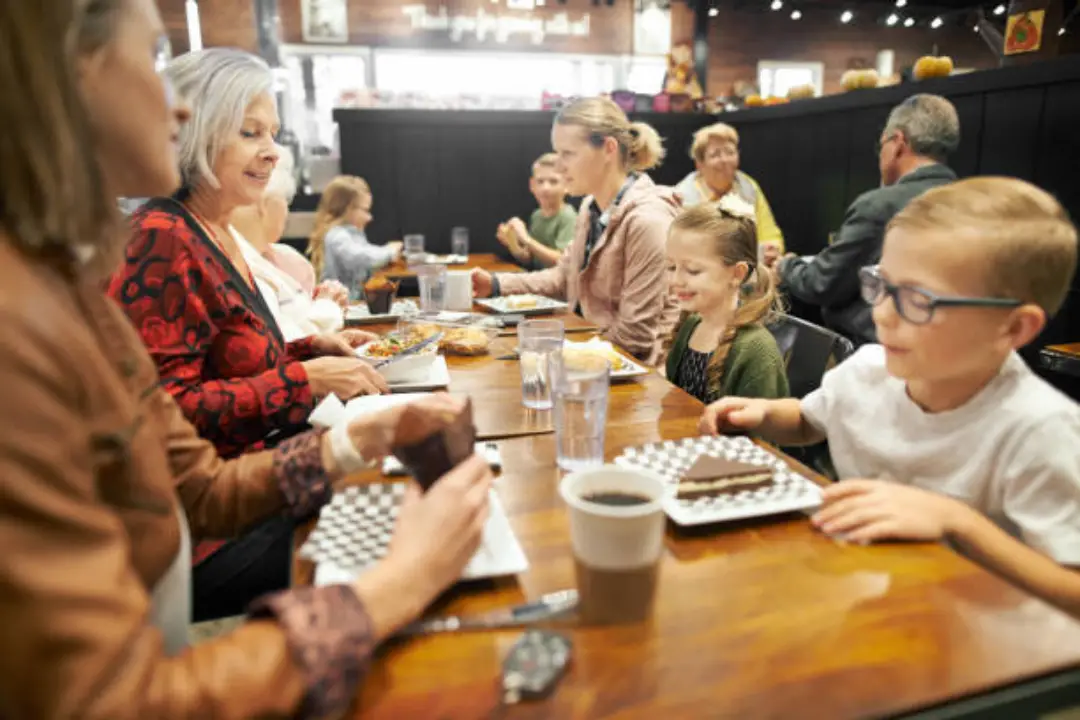
“Your kids can eat when they get home,” my dad said, tossing napkins across the table like he was dealing cards. My sister’s sons unwrapped seventy-two dollars’ worth of pasta and cake in gold-tied boxes while my children watched in silence. Her husband chuckled, “Next time, feed them first.” I just said, “Got it.” When the waiter came back, I stood up and said something that changed everything.
My name is Matthew Hale, and I’m thirty-four years old—the older sibling, the dependable one, the guy people describe with words like “steady” and “practical,” as if I’m a brand of sensible shoe. I sell insurance for a living, which fits me perfectly. I like clean dashboards, automatic payments, calendars that don’t surprise you. On paper, my life looks fine, maybe even boring to some people.
I have two kids who mean everything to me: Evan, who’s nine with a serious face like he’s constantly evaluating the world for weak spots, and Sophie, who’s six and believes every problem has a funny solution if you just tilt your head the right way. Their mother Erin and I split custody exactly down the middle—fifty-fifty, perfectly balanced like everything else in my carefully organized life. We share school logins and soccer schedules and the kind of small politeness that comes from accepting the marriage didn’t survive but the parenting partnership absolutely must.
My family has always called me “responsible” the way you might call a shovel useful—appreciated when needed, forgotten when not. My dad uses the word like a compliment whenever he needs something fixed or paid for. My mom says it like a prayer, as if my organization and reliability might somehow keep the rest of the family from falling apart completely.
Then there’s my sister, Jenna.
Jenna is two years younger than me, effortlessly prettier in that way some people just are, louder in every room she enters, and somehow always “in between things” while simultaneously living in apartments that look like they were styled for magazine photoshoots. She’s the kind of person who can forget to pay her car insurance for three months straight and still show up to family dinners with fresh manicures and a new designer phone case. My parents treat this contradiction like a charming mystery rather than a simple math problem with obvious answers.
Growing up, I told myself it wasn’t favoritism—it was just “different expectations,” which is what my dad called it whenever I pointed out the inequity. Jenna wasn’t good with details, he’d explain. Jenna was sensitive. Jenna had a lot going on emotionally. Meanwhile, I was mature for my age. I could handle responsibility. I didn’t need as much attention or help.
I did need it. I just learned very early that needing things didn’t change anything, so I stopped admitting I needed them at all.
There’s a memory that sticks in my mind like gum on a shoe, one of those formative moments that shapes everything that comes after. I was twelve, Jenna was ten, and we were at our school’s spring fair. She won a goldfish in one of those impossible ring-toss games and immediately dropped the plastic bag on the hot asphalt parking lot. The bag split open, water rushed out, and the fish flopped desperately on the ground while Jenna started crying hysterically.
I spent my entire allowance—money I’d been saving for a video game I desperately wanted—on a proper bowl and fish food because she was crying and the fish was dying and somebody had to do something. That night, Dad patted my shoulder and told me I was a good brother, that he was proud of how responsible I was. Jenna fell asleep with the bowl near her bed like it was a trophy she’d won through her own effort.
In the morning, the fish was floating belly-up. Mom sighed at me—at me, not at Jenna—for putting the bowl too close to the heating vent. As if I should have somehow known where the air currents in Jenna’s bedroom would create dangerous temperature fluctuations. As if Jenna’s hands hadn’t been the ones that let go in the first place.
That became the pattern that would define my childhood and follow me into adulthood: if Jenna messed up, someone else should have planned better, protected her more carefully, anticipated the problem she’d created.
Fast forward twenty-two years to last Saturday—my dad’s sixty-first birthday. He picked an upscale restaurant with heavy white tablecloths and a menu that makes you feel undereducated, the kind of place where the descriptions are longer than the portions. He said it was a celebration, but I knew what else it was. Jenna had been dropping hints for weeks about wanting photos in a nice restaurant, wanting “the vibe,” wanting to create the illusion that we were the kind of family that did this sort of thing regularly.
Erin and I had agreed to be civil, which we’ve gotten good at over the two years since our divorce finalized. Our kids don’t deserve weirdness or tension, and frankly, neither of us had the energy for drama. Erin even texted me the night before the dinner: “Boundaries. Practice them.” I replied with “I’ll try,” and she sent back a thumbs-up and a heart emoji.
We gathered around a large corner table: me, Evan, Sophie, and Erin. My parents Carl and Marie. Jenna and her husband Chuck, who has the easy laugh of someone who’s never had to seriously think about bills or consequences.
The waiter set down heavy water glasses that clinked against the table like small warnings. The room smelled expensive—butter and wine and herbs I couldn’t identify. Dad flipped open the leather-bound menu and announced with the magnanimous air of a king addressing his subjects, “Get whatever you want, everyone. It’s a celebration, so don’t hold back.”
I looked at the prices and felt my insurance-agent brain automatically start calculating. Steak with a number that made my eyelid twitch. Pasta dishes with the kind of elaborate adjectives that add ten dollars per fancy word. Side salads that cost as much as my kids’ soccer cleats.
Sophie leaned into me, her small voice hopeful. “Can I have the pasta with the twirls?”
“Pappardelle,” I corrected gently, and she repeated the word carefully like she was trying on a fancy hat that didn’t quite fit. “We’ll see, kiddo. Let’s look at the menu together.”
Jenna waved the waiter over like she owned the establishment, confidence radiating from her perfectly manicured hand. “Two of the truffle pastas,” she announced, tapping her phone case against the table. “Extra mushrooms on both. And we’ll need the lemon cake to go—a whole one.”
The waiter blinked, professional mask slipping slightly. “The cake… to go?”
“Yes, to go,” Jenna confirmed brightly. “And actually, make that another truffle pasta to go as well. My boys are very particular eaters.”
Her boys—Mason and Tyler—weren’t even at the restaurant. They were at Jenna’s friend’s house for the evening because, according to Jenna’s explanation from earlier in the week, “They absolutely hate sitting still in restaurants and they’d just complain about the food anyway.” Which was certainly convenient when you wanted to order expensive dishes without having to actually share the dining experience, only the leftovers.
When the food arrived, the first beautiful plate of truffle pasta was set in front of Jenna with a flourish. The second went to Chuck. Then the waiter carefully placed two pristine white boxes tied with gold string beside their elbows—one containing an entire lemon cake, the other containing a third serving of the expensive pasta.
I watched Evan’s eyes track those boxes like he was trying to decode the rules of a game nobody had explained to him. Sophie sniffed the air appreciatively and whispered to me with innocent confusion, “Is one of those for us to share?”
Jenna laughed, a light tinkling sound that felt dismissive. “No, sweetie. Those are for Mason and Tyler to have later at home. They get so cranky when they’re hungry.”
Dad watched my kids watching the boxes, and then he did the thing he does when he wants to be funny but ends up being cruel instead, when he mistakes mockery for wit. He picked up two paper napkins from the holder and flicked them across the table like a dealer distributing cards. One slid to a stop near Sophie’s small wrist, the other near Evan’s water glass.
“Your kids can eat when they get home,” Dad said with a grin that showed too many teeth. “No need to waste money filling them up on overpriced noodles here.”
Chuck chuckled in that easy way of his, completely oblivious to the tension suddenly crackling in the air. “Exactly, brother. Next time, feed them first before you bring them out. Saves everyone money.”
Evan stared down at his water glass like he wanted the floor to open up and swallow him whole. Sophie’s face went completely still, the usual sparkle in her eyes dimming as confusion took over.
My chest got hot, like a door inside me that had been locked for years had suddenly been kicked open by a boot.
I didn’t yell. I didn’t argue. I didn’t launch into the speech that was forming in my head about respect and dignity and what it means to treat children like human beings. I just looked at my kids’ faces—really looked at them—and said in a voice that sounded calm even to my own ears, “Got it.”
The waiter returned a moment later with that professionally polite smile that service industry workers learn to wear no matter what chaos is unfolding at their tables. “Can I get anyone anything else?”
My chair legs scraped against the floor as I stood up, the sound cutting through the ambient restaurant noise.
Every face at the table turned toward me with varying expressions of confusion and concern.
And for the first time in my entire thirty-four years of life, I didn’t feel myself automatically shrinking to keep the peace, to smooth things over, to be the easy one who never caused problems.
“Yes, actually,” I said to the waiter, my voice steady and clear. “Could we split the check by household?”
The waiter’s smile didn’t falter, but his eyes sharpened with understanding—he’d clearly seen family drama unfold over expensive meals before. “Of course, sir. I can absolutely do that.”
“One check for my parents,” I continued, nodding toward Dad and Mom. “One for Jenna and Chuck. And one for me and my kids.”
Jenna blinked rapidly, her face registering shock. Dad laughed like I’d told an absurd joke. “Sit down, Matt. Don’t be ridiculous. Put your card down and I’ll pay you back later like I always do.”
“No,” I said. Not loudly. Not angrily. Just a single word that landed with the weight of a brick. “We’re going to split it now.”
Chuck’s grin widened in that way that suggested he thought I was being entertainingly dramatic. “Dude, don’t be tacky about this.”
Erin’s hand slid under the table and found Sophie’s, giving our daughter’s fingers a gentle squeeze. She didn’t look at me, but I could feel her quiet support radiating across the space between us.
The waiter nodded professionally, already half-turned toward his computer terminal. “I can itemize everything for you, no problem at all.”
Dad leaned back in his chair and crossed his arms across his chest, his expression hardening. “Matthew, it’s my birthday.”
“I know,” I replied evenly. “Happy birthday, Dad. We’re still splitting the check.”
Mom’s mouth stretched into that tight, painful smile she deploys when she’s panicking inside. “Honey, please don’t make a scene in public. People are looking.”
“I’m not making a scene,” I said, keeping my voice measured. “I’m making a choice about how I spend my money.”
Jenna’s eyes flicked to the expensive boxes sitting beside her elbow. “Are you seriously going to be petty about this right now? Those meals are for my children.”
“Your children who aren’t here,” I pointed out, hating that I even had to say it out loud. “My kids are sitting right here at this table.”
Dad waved his hand dismissively like he could brush the entire moment away. “It was a joke, Matt. You know I was just teasing them.”
Sophie looked up at me with her big, trusting eyes. Evan stayed frozen in his seat, but his shoulders had gone tight like he was bracing for something terrible to happen.
“It wasn’t a joke to them,” I said, gesturing toward my children. “They’re six and nine years old. They don’t hear teasing in that. They just hear who matters and who doesn’t.”
Chuck snorted derisively. “Man, you are way too sensitive.”
Erin’s voice cut in, calm but firm as steel. “Stop, Chuck. Just stop talking.”
He shrugged as if he couldn’t possibly imagine a world where he needed to stop doing anything.
I turned back to the waiter, who was watching this family implosion with carefully neutral professionalism. “Can you also add two kids’ pasta meals to my check? Plain butter pasta, nothing fancy.”
The waiter looked genuinely relieved to have concrete instructions. “Absolutely, sir. I’ll get those started right away.”
Dad’s jaw tightened visibly. He didn’t like losing control of any situation, especially not in public, especially not at a celebration that was supposed to center him. “You don’t get to tell us how to spend our money.”
“I’m not telling you how to spend yours,” I replied calmly. “I’m telling you exactly how I’m going to spend mine.”
Mom’s eyes flashed with that old familiar warning I’d seen my entire childhood: Don’t make your father angry. Don’t ruin the evening. Don’t embarrass the family. Don’t.
I looked at my kids again. Evan’s face had that carefully blank expression he wears when adults are acting unpredictable and potentially dangerous. Sophie was twisting her small fingers together in her lap.
“I’m going to keep this very simple,” I said, and my voice stayed remarkably steady despite the adrenaline coursing through my system. “I am not paying for anyone else’s meal tonight. Not Jenna’s to-go boxes for children who aren’t even present. Not Chuck’s extra mushroom additions. Not anything beyond my own household.”
Jenna scoffed dramatically. “Oh my God, it’s just pasta. Why are you being so ridiculous?”
“It’s about respect,” I said quietly. “It’s about treating my children like they deserve to eat dinner at the table where they’re sitting.”
Dad leaned forward across the table, his voice dropping low and dangerous. “You’re embarrassing this entire family.”
I leaned forward too, matching his posture, meeting his eyes directly. “My family,” I said, nodding toward Evan and Sophie, “is these two kids. And they’re not an embarrassment. They’re children who deserve basic dignity and a meal.”
The buttered pastas appeared with remarkable speed—the kitchen staff had clearly seen family drama before and knew how to expedite an exit. Sophie’s face lit up like Christmas morning when the plate was set in front of her, as if she’d been holding her breath and could finally exhale. Evan’s shoulders loosened just slightly.
“Thanks, Dad,” Evan murmured quietly, meant only for me.
“You’re very welcome,” I replied.
The separate checks arrived. The waiter placed them carefully on the table like he was handling explosives. Dad didn’t reach for his check. Instead, he slid it toward me with one finger, his eyes hard.
“Last chance to do the right thing,” he said.
I didn’t touch his check. I didn’t even look at it.
“No,” I said again.
There was a long, heavy pause where I could feel my father’s offense building like a thunderstorm.
Instead of the explosion I expected, Mom spoke, her voice sharp and hurt. “You’re walking out on your father’s birthday celebration.”
“I’m walking out with my children,” I corrected her. “We’ll call you tomorrow and wish Dad a happy birthday then.”
“You’re going to regret this,” Dad said, and it sounded like he was handing down a legal verdict.
I looked at him—really looked at the man who’d raised me to always fix things, always smooth things over, always be the easy one—and something inside me felt strangely clear and calm. “I used to think that,” I said honestly. “But it turns out I regret all the times I didn’t do this sooner.”
We left. The restaurant door whooshed shut behind us, and the cool evening air hit my face like baptism. In the parking lot, Sophie bounced slightly on her toes, uncertain. “Are we in trouble, Daddy?”
“No, sweetheart,” I said, buckling her carefully into her booster seat. “We’re not in trouble. We’re just starting some new rules.”
Evan climbed into the back seat and stared out the window at nothing. “Grandpa was mean,” he said softly, like he was confessing something forbidden.
“He was,” I agreed, not sugarcoating it.
Erin shut her car door and walked around to my driver’s side window. She leaned in, her expression serious but warm. “That was good, Matt,” she said quietly.
I exhaled, only then realizing how hard I’d been holding my breath. “I don’t feel good. I feel kind of sick, actually.”
“You don’t have to feel good,” Erin replied with a small smile. “You protected them. That’s what matters.”
On the drive home, my phone started buzzing with incoming texts before we’d even reached the freeway. I didn’t look. I kept my eyes on the road and my mind on the quiet sound of my kids eating their simple buttered pasta in the back seat.
When I tucked Sophie into bed later that night, she asked with sleepy confusion, “Do we have to eat at home next time we go to a restaurant?”
I sat on the edge of her small bed, smoothing her hair back from her forehead. “No, baby. Next time we’re at a table, we eat at the table. That’s the rule now.”
She smiled, reassured. “Okay, Daddy.”
Evan lingered uncertainly in the doorway, arms crossed over his thin chest. “Are Grandpa and Grandma going to be mad forever?”
I thought about my dad’s hard face, Jenna’s dramatic scoffing, Mom’s tight smile. I thought about the years I’d spent paying for things and apologizing for boundaries and being the easiest person to lean on.
“I honestly don’t know,” I told him. “But we’re not going back to the old way, where you and Sophie don’t matter.”
He nodded slowly, like he understood more than I wanted him to.
When I finally looked at my phone later that night, it was a wall of notifications. Thirty-two texts. Eighteen missed calls. Eleven voicemails. The family group chat had exploded from “Dad’s birthday dinner at 6:00 p.m.” to “How could you do this?” by 6:12.
I set the phone face down on my kitchen counter.
For once in my life, the noise didn’t get to decide my next move.
The following days brought exactly what I expected: pressure from every direction. Mom called crying about how I’d humiliated Dad. Jenna posted vague drama on social media about “people who abandon their family when times get hard.” Dad sent a text that managed to be both demanding an apology and asking me to bring over my pressure washer to clean his siding.
I said no to all of it.
I stopped by my parents’ house one afternoon to pick up some old tax documents I needed, and Mom tried a different approach. “Your father wants his Costco card back,” she said, her voice carrying an edge of spite.
The Costco card was under my account because Dad’s had been declined for nonpayment years ago. It was one of those things I’d done automatically because it was easier than dealing with his anger.
“Sure,” I said calmly. “I’ll cancel the sub-cards today.”
Mom’s expression shifted to shock. She’d expected me to fight, to cave, to negotiate. “There’s no need to be vindictive about this.”
“I’m not being vindictive,” I replied. “I’m being consistent.”
She didn’t have a response to that.
I went home and systematically reviewed every account, every subscription, every service where I’d added my parents or Jenna “just to help out.” I removed my payment methods from all of them. I documented everything in a spreadsheet, because that’s who I am—even in revolution, I stay organized.
When Jenna’s car got towed and the towing company called me as the “backup payment method,” I politely told them I wouldn’t be paying. When Dad demanded I come to a “family meeting” to discuss my “behavior,” I replied with a single word: “No.”
Each time I set a boundary, I expected to feel guilty. Instead, I felt lighter.
Six months later, things had changed in ways I couldn’t have predicted. Not overnight transformation—that only happens in movies. But slow, grinding change, the kind that comes from consistently holding a line you’ve drawn.
Dad eventually apologized to Evan and Sophie at a park meeting I insisted on. It wasn’t poetic or warm, but it was something. Jenna started actually handling her own crises instead of calling me to fix them. Mom began catching herself mid-sentence when she was about to volunteer me for something.
The biggest change was in my kids. Evan started speaking up when something felt unfair instead of going silent. Sophie stopped apologizing for taking up space.
One evening, about eight months after the restaurant incident, Jenna invited us over for dinner. Just spaghetti, she said. Nothing fancy. All the kids at the table—no boxes.
When Sophie asked for seconds, Jenna served her without hesitation. Dad was there too, watching quietly. Then he stood up and brought out a cheap grocery store cake with too much frosting.
“For all the kids,” he announced, setting it in the middle of the table.
No one waited. No one was told to eat later. No napkins were tossed.
And sitting there watching my daughter eat cake at a table where she was welcomed, I felt something unclench in my chest that I hadn’t even realized was still tight.
It wasn’t a fairy tale ending where everyone became perfect. It was something better: a new pattern, built on respect instead of obligation.
My phone buzzed with a text from Erin: “Heard dinner went well. Proud of you.”
That word—proud—hit differently than when my parents used it. They’d used it like a leash. Erin used it like a light.
I looked at Evan helping Sophie wipe frosting off her chin. I looked at Jenna actually parenting her own kids instead of performing for an audience. I looked at Dad, uncomfortable but trying.
Two years after the napkin incident, my life looked different in small but crucial ways. I’d bought a modest townhouse. Started therapy. Learned that “no” was a complete sentence. Watched my kids grow up knowing they mattered not because they were convenient, but because they were loved.
Sophie taped a new drawing to our refrigerator. It showed a big table with stick figures, everyone with plates, everyone with cake.
At the top, in her wobbly handwriting: “WE EAT TOGETHER.”
I stood there staring at it, feeling the weight of what had changed. Not just in my family dynamics, but in what my children were learning about their own worth.
That’s what the napkin incident gave us. Not revenge. Not victory. Just a table where everyone who belongs gets fed, gets seen, and gets treated like they matter.
And that, it turns out, was worth every uncomfortable moment it took to get here.

Adrian Hawthorne is a celebrated author and dedicated archivist who finds inspiration in the hidden stories of the past. Educated at Oxford, he now works at the National Archives, where preserving history fuels his evocative writing. Balancing archival precision with creative storytelling, Adrian founded the Hawthorne Institute of Literary Arts to mentor emerging writers and honor the timeless art of narrative.