The Kids’ Table
My brother’s wedding was supposed to be the kind of event people talked about for months—the kind that ended up in glossy lifestyle magazines with headlines like “Tech Meets Elegance” or “A Power Couple’s Perfect Day.”
That’s how Caleb described it, anyway, during one of his many phone calls in the weeks leading up to the ceremony.
“This isn’t just a wedding, Lena,” he’d said, his voice crackling with the particular enthusiasm he reserved for things that advanced his career. “It’s a launchpad. A power room. Do you understand what I’m saying?”
I didn’t realize until I was standing in the marble foyer of a country club that cost more per night than my monthly rent that when my brother said “power room,” what he really meant was “room in which you will be reminded how little power you have.”
My name is Lena. I’m twenty-eight years old. Last Saturday, my older brother humiliated me at his own wedding by seating me at a table with three toddlers, a crying baby, and a half-asleep great-aunt who’d apparently given up on the entire day before it even started.
The part that stung wasn’t the seating arrangement itself. It was how casually he did it, like relocating me to the children’s section was just another item on his detailed wedding checklist, somewhere between “confirm floral arrangements” and “make sure the ice sculpture doesn’t melt before photos.”
The ballroom looked like something out of a movie about people who never worry about money. Crystal chandeliers hung from vaulted ceilings, raining soft light onto round tables draped in cream linens and set with gold-rimmed plates that probably cost more individually than my entire kitchen. The floral arrangements were massive architectural events—towers of white roses and orchids that looked like they had their own insurance policies. A string quartet played in one corner, their music delicate and expensive-sounding, while servers in crisp black vests glided silently between tables with trays of champagne that caught the light like liquid gold.
I had followed all of Caleb’s instructions to the letter. I was wearing the pale blue dress he’d emailed me a photo of two weeks earlier, accompanied by a message that read: “This one. Don’t improvise.” I’d spent what felt like an irresponsible amount of money on a professional blowout so my hair fell in glossy waves instead of its usual chaotic bun secured with whatever pen or pencil happened to be nearby. I’d brought the exact gift from the registry he’d specifically “recommended”—a state-of-the-art espresso machine that cost as much as my laptop and came in packaging that weighed approximately forty pounds.
I’d even arrived early, because Caleb had made it abundantly clear that I should not “clutter the entrance” when the important guests walked in.
I was standing just inside the ballroom doors, clutching my small silver clutch a little too tightly and trying to pretend I was comfortable in heels that were clearly designed by someone who hated human feet, when I saw him approaching.
Caleb. My older brother by three years, my senior in smugness by about a decade. He cut through the crowd in his perfectly tailored tuxedo like he owned not just the room but the entire concept of celebration. His dark hair was styled with the kind of precision that requires multiple products and possibly a team meeting. His jaw was freshly shaved, his boutonniere pinned at the exact correct angle, and he radiated the energy of a man who believed this day was the beginning of his own legend.
When his eyes landed on me, his face tightened in a way I recognized from childhood—the expression that meant I’d done something wrong simply by existing in his vicinity.
He didn’t hug me. He didn’t say “hey, you made it” or “thanks for coming” or any of the normal things people say to their siblings at major life events. He straightened his tie, stepped directly into my personal space, and lowered his voice just enough that only I could hear.
“What are you doing here?” he hissed.
The words hit me like cold water. I blinked, recalibrating. “I’m… attending your wedding,” I said, forcing what I hoped was a pleasant smile. “Nice to see you too.”
He exhaled sharply through his nose like I’d just told the world’s worst joke. “I meant here,” he said, gesturing around the marble foyer with an impatient flick of his wrist. “In the main entrance area. The VIPs are arriving any minute. You’re cluttering the visual.”
I stared at him, certain I’d misheard. “Cluttering the visual?”
He nodded, completely serious. “Yes. The photographers are going to be positioned right here to capture key arrivals. Investors, partners, board members, C-suite executives. We can’t have…” He paused, his eyes scanning me from head to toe in a way that made my skin prickle. “We can’t have any distractions in the background.”
I looked down at myself—at the dress he had personally approved, at the perfectly neutral heels, at the discreet clutch and subtle makeup. My anger stirred like something waking up after a long sleep.
“I’m your sister,” I said quietly.
“Exactly,” he replied, as if that explained everything. “Which is why I already moved your seat to somewhere more appropriate.”
He pulled a folded seating chart from his inside jacket pocket with the flourish of a magician revealing a trick. Names and table numbers covered the page in tight, precise rows that suggested someone had spent way too much time on the arrangement.
“You were supposed to be at Table Five with the cousins,” he said, tapping a spot near the front of the room. “But I needed that table for the VP of Marketing. She’s bringing her husband, and he owns a venture fund that’s looking at a Nebula expansion, so logistics.” He flicked his eyes back to me. “I put you at Table Nineteen instead.”
He traced his finger to the absolute bottom corner of the chart.
I followed the line. Table Nineteen. Far back, positioned near the service doors. Marked with a tiny sticker shaped like a balloon.
The kids’ table.
I felt heat rising in my face. “Caleb. That’s the children’s table.”
“It’s not just children,” he said with the smooth ease of someone who’s told this lie before. “Great Aunt Marge will be there too. She’s mostly deaf, so you won’t have to engage in much conversation. It’s actually perfect for you—low pressure, casual atmosphere.”
“You’re seating me with toddlers,” I said, my voice dangerously level.
“You don’t fit the vibe, Lena,” he snapped, his tone rising just enough that one of the bridesmaids glanced over curiously. “This is a power room. High-stakes networking. It’s not personal—you’re just… barely employed. You’ll be more comfortable in the back. Just sit down, eat your chicken, and please, for once in your life, don’t embarrass me.”
A knot formed in my throat—not from hurt, because those bruises were old and calloused over, but from pure, crystalline rage.
“I am employed,” I said. “I—”
He rolled his eyes dramatically. “Oh my god, your little blogging thing doesn’t count. Look, I don’t have time to argue about this. Table Nineteen. Back corner. Near the kitchen doors. Stay there.”
Then he leaned closer, his breath warm and sharp with what smelled like expensive whiskey and nerves.
“And if you see Silas Vance,” he whispered with fierce intensity, “do not talk to him. I’m dead serious. He’s way out of your league. You’ll scare him off with your… weirdness.”
He straightened up, pasted on his networking smile, and walked away before I could formulate a response.
Just like that.
I watched him go, watched him glide toward a cluster of men in suits that probably cost more than my car, watched him activate his charm like flipping a switch.
He had absolutely no idea that the man he’d just warned me away from—the billionaire CEO of Nebula, the tech giant Caleb worshipped like a deity—was my biggest client.
He had no idea that the “legendary” speech Silas had delivered at the UN last week, the one that had gone viral and sent Nebula’s stock climbing, had started on my laptop at two in the morning while I ate cold pad thai and wore pajamas with coffee stains on the sleeve.
To Caleb, I was just his awkward little sister who “spent too much time typing in coffee shops and calling it a career.”
He had no idea I was the ghost behind the words people quoted in boardrooms and conference halls around the world.
I took a slow, deliberate breath. My fingernails dug into the soft leather of my clutch hard enough to leave marks.
“Fine,” I murmured to myself, turning toward the back of the ballroom. “I’ll sit at the kids’ table.”
Table Nineteen was exactly what the seating chart had promised, and then some.
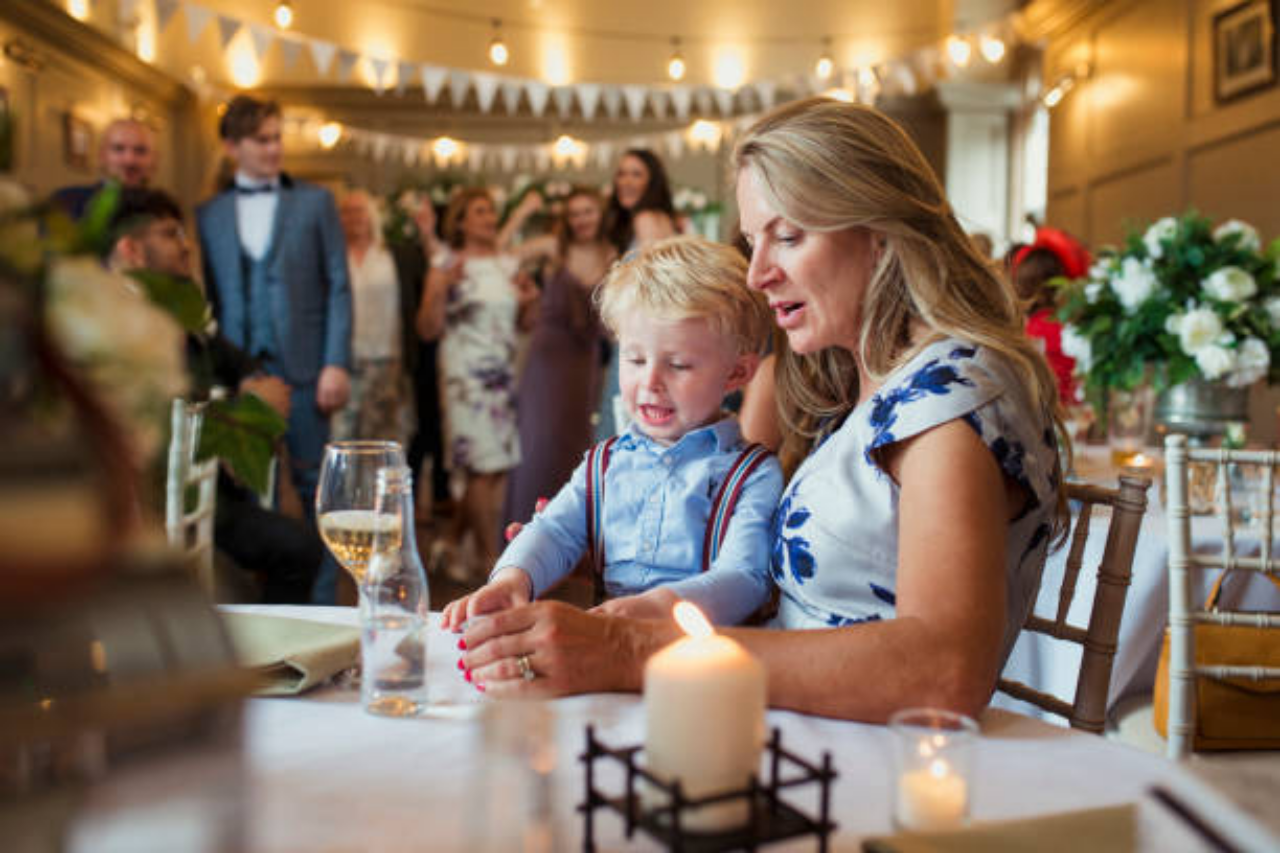
It was tucked into the far corner near the swinging kitchen doors, positioned close enough that every time a server pushed through with a loaded tray, a rush of hot, garlic-scented air hit our table and ruffled the paper placemats. Instead of the towering floral centerpieces that adorned every other table, we had a plastic bucket filled with crayons. The white tablecloth was already decorated with enthusiastic scribbles—rainbows, stick figures, what appeared to be a monster truck. One of the chairs had a booster seat strapped to it with fraying velcro. Another spot featured a high chair pulled right up to the table’s edge.
Four small boys in tiny tuxedos were engaged in what sounded like an extremely intense debate about which type of truck could beat which type of dinosaur in a fight. A baby in an elaborate lace dress was fussing in a stroller parked beside the table. Great Aunt Marge sat with her head tilted back against her chair, mouth slightly open, completely and utterly asleep.
I stood there for a moment, still clutching my clutch like it was the only solid thing in a spinning world.
Then a small face looked up at me with enormous brown eyes.
“I like your dress,” said a little boy with a crooked bow tie and what appeared to be chocolate smeared across his cheek in an impressive arc.
The tension in my chest eased just slightly. “Thank you.”
“I like trucks,” he announced with the absolute certainty of someone who has found their life’s passion at age five.
“Me too,” I replied, because there are moments when diplomacy is wasted and the only reasonable response is to lean into chaos.
I sat down carefully, smoothing my expensive dress under the flimsy folding chair. The woman at the table—early thirties, exhausted, with her hair pulled back in a practical bun and the hollow-eyed look of someone who hasn’t slept properly in months—gave me a sympathetic smile.
“They stuck you with us?” she asked quietly, bouncing the fussy baby with the automatic rhythm of someone who does this in their sleep.
“Apparently I don’t fit the vibe,” I said.
She snorted, a quick burst of genuine amusement. “Their loss. Want to help me cut up chicken nuggets when the food comes?”
And just like that, I made a decision. If I was going to be exiled to the kiddie corner of my own brother’s wedding, I was going to rule it.
I helped distribute plastic cups of apple juice and those impossibly tiny ketchup packets that refuse to open unless you threaten them with violence. I drew a dragon on a napkin for Leo—the truck enthusiast—and he immediately requested three more dragons plus a dinosaur for his baby sister, who was too young to appreciate art but apparently needed representation anyway.
From Table Nineteen, I had a perfect view of the “power room.”
The rest of the ballroom looked like a stage production of “Important People Being Important.” Guests laughed too loudly at jokes that probably weren’t funny. Men leaned in close, gripping each other’s shoulders with performative camaraderie. Women adjusted their dresses constantly and scanned the room with calculating eyes, tracking who was talking to whom, whose conversation lasted longest, who got the most attention.
My brother floated through it all like he was conducting an orchestra, shaking hands, clapping backs, laughing his polished, practiced laugh. I recognized the gleam in his eyes even from this distance. He was measuring everything. Calculating. Ranking people in his internal hierarchy.
He’d been doing it his whole life.
Growing up, our family revolved around Caleb like planets orbit a sun. He was loud, performative, standing on our coffee table as a toddler delivering “speeches” with a hairbrush microphone. By high school: class president, debate champion, awards filling my parents’ mantel.
Caleb was the star. He liked it that way.
I was quiet. The library kid with ink-stained fingers. “Observant,” teachers said diplomatically.
Our parents worshipped Caleb’s volume.
“Your brother knows how to network,” Mom would say. “He puts himself out there. You just… sit.”
“She’s shy,” Dad would add while carving turkey.
I wasn’t shy. I just didn’t speak without purpose.
“Why can’t you be more like your brother?” Mom would sigh whenever Caleb presented another certificate. “You’re smart. You just hide. Life isn’t a writing contest—you have to talk to people.”
What they didn’t understand: while Caleb talked at people, I listened to them. Really listened.
I noticed Uncle Joe’s voice lowering when discussing job layoffs, Grandma’s eyes drifting when someone mentioned her hometown. I learned speech rhythms, the cadence of insecurity, the words people chose when lying to themselves.
At thirteen, I started writing. By seventeen, I’d discovered persuasive writing—speeches, op-eds, letters that made people sit straighter. Words became my way into rooms I couldn’t physically enter.
By twenty-five, the gap between how my family saw me and who I was had become a canyon.
Caleb had landed at Nebula, the tech company everyone obsessed over. He wore his ID badge like a medal.
“I’ll be VP in two years,” he’d declare at dinners. “Silas loves people who think big.”
He said “Silas” like they were friends, though they’d exchanged maybe three emails total.
I worked from my studio apartment, ghostwriting for senators and CEOs. I’d signed countless NDAs binding me to invisibility.
I made six figures in pajamas. Set my own hours. Took walks when parks were quiet.
To my family? Still undefined. Still failing to launch.
“So you’re still doing that blogging thing?” Caleb would ask with barely concealed amusement, twirling his fork at Sunday dinners.
“It’s freelance writing,” I’d say, already knowing it wouldn’t register.
He’d grin that infuriating grin. “Freelance is just code for unemployed. Don’t worry—when I make VP, I’ll see if they need an administrative assistant. Someone to fetch coffee and write the occasional memo. You’d be great at that, right? Very organized, taking orders, writing sticky notes.”
Everyone would laugh. My parents, my aunt, my uncle who I barely knew. It was easier for them to laugh. The joke had a rhythm we were all used to.
I learned to smile through it, to swallow the sting like bitter medicine.
Sometimes my phone would buzz under the table with an encrypted message from a client asking for emergency edits to a speech that would air on national television in six hours. I’d glance down, mentally rearrange entire paragraphs, and then look back up at the table where my brother was pontificating about stock options and quarterly earnings.
This was our dynamic: he took up space and demanded attention. I quietly made other people sound smarter than they actually were.
Then I met Silas. Through email. “Heard you’re the best at making people sound like they know what they’re talking about.”
A senator I’d worked with recommended me. Nebula needed a UN speech on tech infrastructure.
First meeting: Zoom, cameras off. He talked about vision and responsibility. I listened—really listened—and heard the pressure, the isolation, the awareness that every phrase would be dissected.
I asked sharp questions. “No one’s ever asked me that before,” he said.
Then I wrote. Multiple drafts, late nights. He pushed me. I pushed back. When his assistant wanted to “dumb down” a section, I refused. He backed me.
The UN speech rippled across the internet. Stock jumped twelve percent.
Two hours later, he emailed: “Next one?”
We’d worked together ever since, always behind the curtain.
So when Caleb called me six months later, practically hyperventilating with excitement about his wedding guest list and the fact that “Silas freaking Vance is actually coming—like, confirmed RSVP,” I had to bite the inside of my cheek hard enough to draw blood to keep from laughing.
“This isn’t just a wedding, Lena,” he said, his voice pitched high with barely contained excitement. “It’s a networking event. The entire C-suite is coming. The board of directors. Major investors. I need everything to be absolutely perfect.”
“I’m happy for you,” I said, because despite everything, some small part of me still wanted him to be happy.
“Yeah, well,” he said, his tone shifting, “just… try not to be yourself too much, okay?”
I switched my phone from one ear to the other. “I beg your pardon?”
“I’m serious,” he said. “No weird conversation topics. No correcting people’s grammar like you always do. No talking about whatever obscure writing stuff you’re into this month. Just smile, blend into the background, be neutral. Can you do that?”
I let the silence stretch long enough to make a point.
“I can do that,” I said finally, my voice completely flat.
“Good.” He exhaled with audible relief. “I’m emailing you a dress code. Stick to it exactly. And Lena? No cardigans.”
That was Caleb in a nutshell: the human embodiment of a corporate compliance memo.
Back at Table Nineteen, a small hand tugged insistently on my sleeve.
“Can you draw a dragon eating a truck?” Leo asked, his eyes wide with the kind of violent joy that only five-year-olds can access so completely.
“Absolutely,” I said, picking up a crayon. “That’s an excellent commission.”
I was halfway through sketching flames coming out of the dragon’s mouth when I felt the energy in the entire ballroom shift.
There are certain moments when a crowd collectively inhales. You can’t see it happen, but you feel it—the way conversations stutter and die mid-sentence, the way heads turn in unison like a flock of birds changing direction.
I looked up from my dragon.
Silas Vance had arrived.
Even from across the room, he was unmistakable. Tall and trim, mid-forties, wearing a perfectly tailored charcoal suit that somehow managed to look both understated and impossibly expensive. Sharp cheekbones, sharp eyes, sharp focus. He radiated the particular energy of someone who’s used to being the most intelligent person in any given room and finds it exhausting.
The transformation in the crowd was immediate and almost comical. Executives who’d been casually networking suddenly stood straighter, laughed louder, adjusted their ties and smoothed their jackets. Several people practically hovered near the entrance like planets being pulled into orbit by gravitational force they couldn’t resist.
Caleb was among them, naturally.
He practically sprinted across the polished floor, nearly colliding with a server carrying a tray of champagne flutes.
“Mr. Vance! Silas!” Caleb’s voice was too loud, too eager. “I’m so glad you could make it. This means everything.”
Silas took his outstretched hand, gave it one efficient shake, and his eyes immediately began scanning the room.
“Congratulations, Caleb,” he said in that measured way of his. “Nice venue.”
“Thank you, sir,” Caleb beamed like he’d just won an award. “We have a seat reserved for you at the head table, right next to the bride’s father. Prime location. Amazing sight lines. I think you’ll really—”
“I’ve had a long week,” Silas interrupted quietly. “I’d prefer somewhere quieter if that’s an option.”
Caleb faltered, his smile freezing in place. “Quieter? Oh, of course. We have a VIP lounge area in the—”
But Silas wasn’t listening anymore.
His gaze moved methodically from table to table, taking in the clusters of executives practically vibrating with networking energy, the board members, the carefully orchestrated social hierarchy.
Then his eyes landed on the far back corner of the room.
On Table Nineteen.
On me.
For a second, he frowned like he was trying to place a face from a dream. Then recognition flashed across his features and the corners of his mouth curved into a slow, genuine smile.
I watched this unfold from our crumb-covered outpost, feeling my heartbeat accelerate.
He started walking. Toward us.
Caleb, still mid-pitch about seating arrangements, scrambled to follow. “Sir, the head table has much better—”
Silas walked past Table One with its cluster of executive partners. Past Table Five where the VP of Marketing was holding court. Past the table where Nebula’s CFO was in the middle of a booming laugh that sounded like it had been practiced in front of a mirror.
He walked straight toward the kids’ table like he’d been planning it all along.
“Leo, watch your juice,” I murmured automatically as a shadow fell across our crayon drawings.
The plastic cup wobbled dangerously. I steadied it with one hand and looked up.
“Hello, Lena,” Silas said.
His voice was warm and genuine—completely different from the cool, measured tone he used in boardrooms and conference calls.
“Hello, Mr. Vance,” I replied, because I wasn’t about to switch to first names in front of my brother and half the company’s executive team.
Behind him, Caleb skidded to a stop, his eyes widening in what looked like genuine horror.
“Sir,” Caleb said quickly, panic edging into his voice, “I am so sorry. My sister, she’s obviously confused about where she should be. She shouldn’t be bothering you. Lena, get up right now. We have your actual seat over at—”
Silas raised one hand in a small, dismissive gesture that somehow contained more authority than my brother’s entire vocabulary.
“She’s not bothering me, Caleb,” he said, still looking directly at me. “In fact, she’s the only person here I actually wanted to talk to.”
He pulled out the tiny child-sized chair next to mine and sat down in it.
The image was simultaneously ridiculous and perfect: a billionaire CEO folding his tall frame into a chair designed for a kindergartener, his knees almost level with his chin, his elbows resting carefully on the edge of a paper placemat decorated with crayon trucks and dinosaurs.
There was a collective intake of breath from the surrounding tables that sounded like air being sucked out of the room.
“That’s… that’s the kids’ table,” Caleb managed to choke out, his face cycling through several shades of red.
“I know,” Silas said calmly, reaching for a green crayon. “It has the best company in the room.”
He looked at Leo and smiled. “What are we drawing?”
“A dragon eating a truck,” Leo announced with absolute seriousness.
“That makes sense,” Silas said, equally serious. He began carefully shading in flames with the green crayon. “Dragons need proper nutrition.”
The ballroom had gone eerily, unnaturally quiet. The string quartet had actually stopped playing mid-piece. Somewhere in the silence, a fork clinked against a plate with the sharp clarity of a punctuation mark.
I could feel hundreds of eyes on us from every direction.
Silas, apparently completely unconcerned with the minor social earthquake he’d just triggered, leaned slightly closer to me.
“I got your draft for the Tokyo keynote this morning,” he said conversationally, but loud enough for the nearest tables to hear clearly. “The section about innovation emerging from stillness rather than constant noise? Brilliant. Genuinely brilliant. I think it might be your strongest work since the UN speech.”
He said it like it was the most natural, obvious thing in the world.
Caleb’s mouth fell open so wide I could count his fillings.
“The UN speech?” he croaked, looking from Silas to me and back again like we were speaking a language he’d never encountered. “You… you wrote that speech, sir. That was your speech.”
Silas laughed—a short, sharp sound that cut through the stunned silence like a knife.
“Caleb,” he said, his voice still pleasant but with an edge underneath, “nobody at this level writes their own speeches. We hire the best. And your sister is the best.”
He turned his gaze fully on my brother, and his eyes went from warm to arctic in the span of a heartbeat.
“You told me she was unemployed. That she worked in coffee shops doing some kind of hobby blogging.”
Color drained from Caleb’s face so rapidly I genuinely thought he might pass out on the spot.
“I—I didn’t—I mean—I didn’t know she—” he stammered helplessly.
“You didn’t ask,” I said quietly, taking a sip from Leo’s abandoned apple juice box because my hands needed something to do and I was enjoying this far more than I probably should. “You just assumed.”
Caleb stared at me like he was seeing a completely different person wearing his sister’s face.
“You… write for him?” he finally managed. “For Silas Vance?”
“I write for a lot of people,” I said with a small shrug. “Senators. CEOs. Policy institutes. Corporate boards. I’m fully booked through 2027 at this point.” I paused, then added, “But I made time for Mr. Vance’s projects because he actually values the work.”
Silas nodded. “Worth every penny. And then some.”
A ripple of nervous laughter moved through the nearest tables like a wave—people who weren’t sure if they were allowed to find this funny but decided they’d better play it safe.
Silas turned back to Caleb, his expression pleasant but final. “Now, if you don’t mind,” he said, “the groom should probably be with his bride. Lena and I have some preliminary ideas to discuss for my memoir project. Unless”—he raised one eyebrow—”you think I don’t fit the vibe here at Table Nineteen?”
Caleb’s face transformed from pale to a blotchy, mortified crimson that clashed badly with his boutonniere.
“No, no, sir. Of course not. Please, sit wherever you’d like. Enjoy!” His hands fluttered uselessly in front of him like confused birds. “I’ll just… I’ll be… over there.”
He retreated toward the head table, and I watched half the room’s eyes track his walk of shame.
For the next two hours, Table Nineteen became the unexpected center of gravity at my brother’s carefully orchestrated wedding.
Waiters who had been instructed to prioritize the front tables suddenly bee-lined toward us with the best champagne, the crispest appetizers, cake slices with the most generous amounts of frosting. I drank champagne from a plastic cup featuring cartoon characters and felt more powerful than I had in years.
People drifted toward our table like moths to flame, then hesitated just close enough to observe but too far to actually interrupt.
The VP of Marketing, a woman in a sleek black dress with a smile that looked professionally installed, approached with her venture capitalist husband in tow.
“Silas,” she said warmly, “so wonderful to see you outside the office. I just wanted to mention—”
“We’re coloring,” Silas said without looking up from the dragon he was carefully shading. “Email me Monday.”
Her smile froze in place, then cracked slightly at the edges. She backed away with a tight laugh that sounded like glass breaking.
Leo, blissfully oblivious to corporate politics, nudged my arm with sticky fingers. “Make the dragon breathe more fire,” he commanded.
“You heard the boss,” I told Silas.
He obediently added more flames.
We talked about his memoir project, about the central tension of his story: how do you remain fundamentally human when the entire world keeps trying to transform you into a machine, a symbol, a stock price?
We discussed my career trajectory: how I chose which projects to take on, how I built narrative frameworks that felt true instead of manufactured, whether I should accept work from a particular political figure whose values made my stomach twist uncomfortably.
“Don’t take it,” Silas said immediately, with absolute certainty. “You can’t write words you don’t believe in and expect them not to stain everything else you create. Your voice is your instrument. Keep it clean.”
He said it so simply that the answer clicked into place in my chest like the final piece of a puzzle I’d been working on for months.
The nanny at our table kept glancing at me with increasingly wide eyes, like she was trying to determine whether this was an elaborate prank show and cameras would appear at any moment.
The children, meanwhile, accepted the situation without question. To them, a grown man in an expensive suit hunched over crayon drawings was just another adult who finally understood the correct priorities in life.
Across the ballroom, Caleb looked like a man being forced to watch his own carefully constructed world collapse in real-time slow motion.
Every time his eyes found our table, his jaw tightened visibly. At one point, I watched him start toward us with a forced smile, only to be intercepted by his new father-in-law, who clapped him on the back and said something that made Caleb nod frantically and laugh with slightly manic energy.
When the person you’re desperately trying to impress is using crayons at the kids’ table, traditional networking loses its power pretty quickly.
The ceremony itself, when it finally happened after countless photos and orchestrated moments, was genuinely lovely.
Jessica, my new sister-in-law, looked radiant in her dress that caught light like water, tears streaming down her face in the good way as she walked down the aisle. When she reached Caleb, he softened for a moment—looked less like he was calculating angles and more like he was actually present in his own life.
I held onto that image. People are rarely all one thing. Maybe somewhere under his obsession with appearances and advancement, there was still the brother who used to read me bedtime stories, who once punched a kid who made fun of my glasses in third grade.
Then Caleb slipped the ring on Jessica’s finger and shot a quick glance toward where Silas sat at our table, checking if he was watching, measuring the moment for its networking value, and that softness evaporated like morning fog.
By the time the DJ announced the first dance, the ballroom had shifted back into its power-room mode.
Except for Table Nineteen. We remained our own small, autonomous orbit.
After dessert—the children got ice cream while the adults got something architectural involving spun sugar and edible flowers—Silas pushed back his tiny chair and stood, smoothing his jacket.
“I’m heading out,” he said, checking his watch. “Early flight tomorrow. Lena?”
I looked up from where Leo and I had been having a serious debate about whether dragons would prefer chocolate cake or vanilla.
“Yes?”
“My driver’s outside,” he said. “Come with me. We can discuss the memoir contract on the drive. I’m thinking we start at double your usual rate and negotiate up from there.”
I blinked once, rapidly calculating how many months of rent “double your usual rate” represented.
“That sounds… very acceptable,” I said, because my brain had briefly short-circuited trying to do the math.
We started toward the exit together.
We made it maybe ten feet before Caleb intercepted us, appearing with the sudden desperation of someone who’s just realized they’re standing on crumbling ground.
He looked different than he had earlier in the evening. Less polished. There was a sheen of sweat on his forehead, his tie was slightly askew, and his smile was stretched so wide it looked painful.
“Lena,” he said, slightly breathless. “Wait. Silas, sir. I— I had no idea. I mean, I genuinely didn’t realize she was—”
“That’s exactly the problem, Caleb,” Silas said, his voice calm and cold as winter. “You never bothered to look. You were so busy trying to impress people that you completely missed the actual talent sitting right in your family.”
Caleb swallowed audibly. “It’s just a family misunderstanding,” he said quickly, words tumbling over each other. “You know how it is with siblings—just joking around, teasing. I didn’t mean any—”
“Maybe,” Silas said, cutting him off cleanly. “But I don’t like people who hide genuine ability in corners. It makes me question their judgment in other areas. Their instincts. Their values.”
The words landed like a judge’s gavel striking wood.
Caleb’s eyes widened with barely controlled panic. “Sir, please. I—”
“We’ll discuss your role at Nebula on Monday,” Silas said. His tone wasn’t angry, which somehow made it worse. “Come prepared to talk about your future with the company. Bring a box.”
He didn’t explicitly say “you’re fired.” He didn’t need to. Anyone who’d ever worked in a corporate environment understood exactly what “bring a box” meant.
Silas turned to me, offering his arm with old-fashioned courtesy. “Shall we?”
I paused, taking one long moment to look my brother directly in the eyes.
“Congratulations on the wedding, Caleb,” I said softly. “The vibe was… incredibly illuminating.”
His mouth opened and closed silently. No words emerged.
I took Silas’s arm and we walked out of the ballroom together, past clusters of executives who suddenly found the carpet absolutely fascinating, past the elaborate floral arrangements that had their own spotlights, past the photographer who snapped a picture I knew would never make it into the official wedding album.
Outside, the night air was cool and sharp and clean. A sleek black car waited at the curb, engine humming quietly.
As the driver opened the door, I glanced back through the glass doors of the country club one final time.
Inside, I could see the swirl of expensive dresses, the flash of chandeliers, the carefully curated power room my brother had tried so desperately to control.
From out here, it all looked very, very small.
I slid into the car’s leather interior.
Silas settled beside me as we pulled away.
“Your brother will be fine,” he said. “Not firing him—just transferring to our Ohio office for regional management. He needs to learn to see people instead of using them as props.”
I nodded. “That’s generous.”
“I don’t enjoy punishing people. I enjoy teaching them.”
We drove in comfortable silence, city lights streaming past.
“Can I ask you something?” I said finally.
“Of course.”
“Why did you really come? You hate these events.”
Silas smiled. “You mentioned your brother putting you at the kids’ table. The way you said it—you tried to sound funny, but I heard what was underneath. So I decided to come. To find you. To make it very clear who actually matters.”
My throat tightened. “You didn’t have to.”
“The best people are usually being underestimated,” he said. “They’re watching from corners, listening instead of talking, doing real work while everyone else performs. When you find someone like that, you don’t leave them at the kids’ table. You pull up a chair and stay.”
I looked out the window.
“Besides,” he added, “Leo was an excellent collaborator. Very decisive about dragon design.”
I laughed, the sound breaking free.
Behind us, the wedding continued. The power room kept networking. The music played on.
And I realized something simple: being underestimated is only a problem if you need their estimation to know your worth.
I’d spent years invisible to my family while being indispensable to people who shaped policy and moved markets.
The kids’ table wasn’t punishment. It was where pretense died and real connection happened.
So if anyone tells you that you don’t fit the vibe, that you need to sit in back, that you’re cluttering the visual—let them.
Sit down. Observe. Draw dragons. Help kids with juice boxes. Listen to what people say when they think you don’t matter.
And when the person who actually sees you walks across the room and pulls up a chair, you’ll know you’re exactly where you need to be.
Not center stage. Not in the spotlight.
But at a table where you never have to prove you belong.
Because you already do.

Lila Hart is a dedicated Digital Archivist and Research Specialist with a keen eye for preserving and curating meaningful content. At TheArchivists, she specializes in organizing and managing digital archives, ensuring that valuable stories and historical moments are accessible for generations to come.
Lila earned her degree in History and Archival Studies from the University of Edinburgh, where she cultivated her passion for documenting the past and preserving cultural heritage. Her expertise lies in combining traditional archival techniques with modern digital tools, allowing her to create comprehensive and engaging collections that resonate with audiences worldwide.
At TheArchivists, Lila is known for her meticulous attention to detail and her ability to uncover hidden gems within extensive archives. Her work is praised for its depth, authenticity, and contribution to the preservation of knowledge in the digital age.
Driven by a commitment to preserving stories that matter, Lila is passionate about exploring the intersection of history and technology. Her goal is to ensure that every piece of content she handles reflects the richness of human experiences and remains a source of inspiration for years to come.