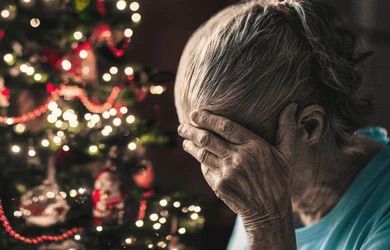
The Christmas I Finally Stopped Saying Yes
I’ve been a mother for forty-one years. I know what it looks like when someone needs something from you before they even say hello.
What I didn’t know — what I had to drive two hundred miles to a gray winter beach to finally understand — was how long I had been mistaking that need for love.
Part One: The Sentence That Changed Everything
It was a Tuesday, the kind of cold December Tuesday that arrives without ceremony and leaves without being remembered. I was in the hallway, carrying a basket of towels I’d just folded, not thinking about anything in particular — not about Christmas, not about the dinner I’d already paid for, not about the grandchildren’s gifts stacked in boxes in my spare room. I was thinking about nothing, which is the precise mental state required to hear something you were never meant to hear.
My daughter was on the phone in the kitchen. She didn’t know I’d come back inside.
“Just leave all eight grandkids with her to watch,” she said, her voice carrying the easy confidence of someone making arrangements that have always, reliably, worked out. “We’ll go relax at the resort. She won’t mind. You know how she is.”
You know how she is.
I stood in that hallway for what might have been ten seconds or ten minutes — I genuinely cannot tell you. The basket of towels was still in my hands. The Christmas lights outside blinked through the window at the end of the hall, red and green and cheerful and entirely indifferent to what was happening inside me.
My hands started to shake.
Not from cold. Not from anger — not yet. From recognition. The particular, awful recognition of hearing a sentence that names something you have known, without language, for a very long time.
You know how she is. Meaning: she’ll say yes. Meaning: she always says yes. Meaning: we don’t even need to ask anymore, because asking would imply that “no” is a possible answer, and we all know it isn’t.
I set the basket down on the hallway floor. Quietly, so she wouldn’t hear. Then I went to my bedroom and sat on the edge of my bed, and I thought about the word invisible.
I had become invisible. Not in the way people use that word loosely — not unnoticed at a party, not overlooked for a promotion. Invisible in the specific, domestic way of a woman who has made herself so reliably present for everyone else’s needs that she has ceased, in the minds of the people she loves most, to be a person who might have needs of her own. I had become a function. A service. A house that was always open and always stocked and always warm, because I had never once let it be otherwise.
Sixty-seven years old. A widow for four of them. And I had not yet figured out that love is not the same as usefulness.
That was about to change.
I lay back on my bed and stared at the ceiling and let myself do something I hadn’t permitted in a very long time: I went further back. Further than that morning’s phone call. I went back through the years and I looked at them honestly, without the soft filter I had always applied to the evidence.
The birthdays they had forgotten. Not one — several, over several years, acknowledged eventually with a text that said sorry, things have been crazy, which I had always received with a warmth I did not entirely feel and a response that said don’t worry about it, really. The Mother’s Days reduced to a heart emoji and, on a good year, a gift card to a store I didn’t particularly like. The winter I had the flu so badly I couldn’t get out of bed for three days — not the regular flu, the kind that makes the ceiling spin and the walls breathe — and I had called my daughter twice, texted once, and received a reply the second day that said so sorry, we have so much going on right now, drink lots of water. As if I had not been drinking water. As if what I needed was hydration advice and not simply someone to ask if I needed anything.
I had told myself, each time, that they were busy. That young families are busy. That this is how it goes, this is the normal drift of generations, this is the price of raising independent children and you should be proud they don’t need you. I had told myself these things with the practiced fluency of a woman who has spent decades becoming an expert in her own reassurance.
But lying on my bed in December, with the sound of my daughter’s casual, confident arrangements still fresh in my ears, I could not make the reassurance work anymore. The mechanism was broken. And in the silence where the usual comfort should have been, the truth sat down beside me and made itself comfortable.
Somewhere along the way, you stopped being a person and became a solution.
I lay there for a long time. Then I got up. And I went to my kitchen table, and I spread out the receipts.
Part Two: The Receipts on the Table
My kitchen table has four chairs, which is one of those small, domestic facts that contains a whole history if you let it. When my husband Arthur was alive, we needed all four. When the kids were teenagers, we sometimes pulled in chairs from other rooms. Now I eat most of my meals at one end, with a book or the television for company, and the other three chairs wait.
That night I sat at my usual end and spread the receipts out in front of me.
Nine hundred dollars to a large grocery chain — a prepaid order for a Christmas dinner that would have fed twelve people comfortably: a glazed ham, a standing rib roast, sides and sauces and two kinds of pie and a chocolate Yule log because my youngest grandson had requested one and I had written it down three weeks ago so I wouldn’t forget. Twelve hundred dollars in toys and clothes from the mall for eight grandchildren, saved up from my modest pension over the preceding four months — toys I had researched, because I know what each child likes, because I pay attention to what each child likes even when they are not in the room with me.
Two thousand, one hundred dollars. On a pension that Arthur and I had always called comfortable, which meant we never went without but we also never wasted. Two thousand, one hundred dollars, and not one of them had asked what I needed this Christmas. Not one had called to say Mom, let me know if there’s anything I can do to help with the dinner, or with the shopping, or with the eight children you’ll be minding while we take a holiday at a resort. Not one had thought to wonder whether sixty-seven-year-old widows sometimes find large family Christmases exhausting. Whether grief changes things. Whether four years is long enough to stop wondering what Arthur would have thought about the woman his wife was becoming, slowly, in a quiet house outside Seattle, for want of anyone noticing she was becoming something.
I looked at those receipts for a long time.
Then I thought about something my mother told me once, when I was in my thirties and starting to understand that relationships have patterns and patterns can be changed. She said: The problem with being someone who always picks things up is that eventually everyone stops bending down.
I had become a woman who always picked things up. Every dropped ball, every forgotten obligation, every gap that opened in the family calendar where someone responsible needed to stand — I had filled it. Not because I was asked. Because I was me, the kind of person who does not easily tolerate seeing a gap go unfilled, especially when the people she loves are near it. I had trained them, through years of reliable yes, to never seriously consider the possibility of no.
And now I was sixty-seven, and tired in ways that sleep doesn’t reach, and it was a week before Christmas, and I was sitting at a table with three empty chairs looking at receipts for money I’d spent on a celebration that was being treated as a staffing arrangement.
I picked up my phone.
I did not call my daughter. I did not call my son. I called Paula.
Paula and I have been friends for thirty-four years, since our children were in grade school together and we were young mothers in the same neighborhood, navigating the particular chaos of small children and limited budgets and the persistent sense that we were making everything up as we went. She moved to a small beach town on the Washington coast about a decade ago, after her own divorce — chose the ocean the way some people choose a therapist, deliberately and with the understanding that it would require consistent visits. She had been telling me for years: Come for Christmas. Let the ocean do the talking and forget about everyone else for a while.
I had always said maybe next year.
Her phone rang twice.
“Is the invitation still open?” I asked, when she answered. My voice was steadier than I expected.
A pause — brief, warm. “I was wondering when you were going to call and ask me that,” she said. “Yes. Come tonight if you want.”
“Tomorrow morning,” I said. “I have some things to do tonight.”
The things I did that night were practical and took less time than I expected. I canceled the grocery order. I called the mall and arranged to return what I hadn’t yet given. I wrote a short note to myself — not to anyone else, just to myself — that said: You are not punishing anyone. You are stopping the punishment of yourself. I folded it in quarters and put it in my purse.
Then I went to bed at nine o’clock and slept better than I had in months.
Part Three: The Road to the Coast
I packed light. That surprised me — I am normally a heavy packer, a woman who brings two pairs of shoes for every one she’ll actually wear, who travels with backup plans for her backup plans. But that morning I moved through my house with a clarity I hadn’t felt in years, selecting only what I actually needed, setting down what was habit.
Comfortable clothes. A book I had started eighteen months ago and never found time to finish. A swimsuit I had owned for two summers and worn exactly once, on a July afternoon when everyone else had been busy and I had decided, on a small impulse, to go to a public pool by myself, and had liked it more than I’d expected. A blank notebook with a blue cover that I had bought with vague intentions of writing things down and never opened.
I folded everything into my small suitcase with the careful attention of someone doing something deliberate. Every item felt like a choice. Every choice felt like a version of the note I’d written myself: You are allowed to want things. You are allowed to go.
My phone had been active since six in the morning — messages from my daughter about logistics, about drop-off times, about whether I’d confirmed the grocery order, about a side dish someone couldn’t eat for dietary reasons she’d apparently mentioned once and expected me to have retained. I read them without responding and set the phone face-down on my nightstand while I finished packing.
When I locked my front door, I stood on the porch for a moment. The neighborhood was quiet in the particular way of cold December mornings — a few cars on distant streets, someone’s Christmas lights still on from the night before, blinking steadily. The house behind me was clean and warm and dark. I had left no note on the door, no notice on the table. The only thing different from any other morning I’d left the house was that I was not planning to be back by nightfall.
I put my suitcase in the trunk and got in the car.
The drive from the outskirts of Seattle to the Washington coast takes somewhere between two and three hours depending on the route and the traffic and how many times you stop. I stopped once, at a small gas station that sold coffee from a machine and had a handwritten sign in the window advertising homemade jam. I bought the coffee, which was serviceable, and a jar of blackberry jam, which I chose because Arthur had loved blackberry jam and because buying it felt like a small, private tribute to the parts of my life I was done apologizing for.
The highway opened up as the city fell behind. The coffee cooled in the cupholder. My phone lit up every few minutes with names I loved, calling because they needed something — not calling to ask how I was, or what I was doing, or whether the drive was going well. Calling because the logistics machine had encountered an error: the woman who was supposed to be at her house, preparing food and making beds and readying herself to absorb eight grandchildren for the weekend, was not at her house.
I let it ring.
The coast appeared in the way it always does if you approach it from the right angle on the right road — suddenly, between two hills, a glimpse of gray-silver water that seems both expected and, every time, slightly miraculous. I had loved the ocean since childhood. I had not been to see it in almost three years. This too was something I had stopped doing without fully noticing I’d stopped: going to the places that restored me, because there was always something more immediately needed somewhere else.
Paula’s house was small and painted a faded blue that might once have been brighter, set fifty yards from a public beach access path between two taller homes. She was at the door before I’d finished parking — Paula, who has never been the type to wait inside when she could perfectly well wait outside, in her old green coat with her silver hair doing what it wanted in the coastal wind.
She didn’t say anything ceremonious. She just said: “You look tired.”
“I am tired,” I said. It was the most honest thing I’d said out loud in a very long time.
She took my suitcase. “Come inside and drink something warm. Then we’ll figure out the rest.”
Part Four: Christmas Eve by the Ocean
Paula’s house smelled like woodsmoke and coffee and the faint, pervasive salt that comes with living near the sea long enough that it seeps into everything. The walls were covered in the kind of organized chaos that accumulates in a life fully lived in one place — photographs, a hand-drawn map her granddaughter had made of the beach at low tide, a row of coat hooks by the door bearing jackets for every weather condition the coast could offer. It was a home that was clearly lived in by one person who liked it exactly as it was.
We spent Christmas Eve the way I hadn’t spent Christmas Eve since I was young: doing whatever we felt like doing, without reference to a schedule or an obligation or anyone else’s preference. We walked the beach in the cold afternoon, wrapped in coats, our shoes leaving prints in the wet sand near the waterline. We ate lunch at a small diner that had been there since the 1970s, run by a woman named Connie who knew Paula by name and brought us hot chocolate without being asked. We talked for hours — about Arthur, about Paula’s divorce, about our children and the particular, complex love you feel for people who simultaneously exhaust and define you. About what it means to come to the end of a way of living and have to figure out what comes next.
By late afternoon I was sitting alone on a folding chair Paula had carried down to the beach, wrapped in an old cardigan, watching gray winter waves come in under a pale sky. The light was failing. Behind me, the diner’s windows glowed amber. The beach was mostly empty — a man walking a dog in the distance, a couple standing near the waterline, nobody paying any attention to a sixty-seven-year-old woman sitting in a chair watching the water.
My phone had been in my pocket all day.
I had checked it more than I expected to. Not because I wanted to respond — I didn’t — but because there is a particular, uncomfortable sensation in watching people worry about you when their worry is made complicated by the fact that they are also worrying about their own convenience. My daughter’s messages had shifted in tone across the day. The early ones had been logistical, then confused, then irritated. By mid-afternoon they had become something closer to alarmed.
Mom, where are you? We drove to the house. Nobody’s home. Please call.
Mom, the kids are asking. We need to know what’s happening.
Mom, I’m getting worried. This isn’t like you. Please just let me know you’re okay.
I read that last one twice. This isn’t like you. She was right. It wasn’t like me — the me she had come to rely on, the me who was always at home and always prepared and always, always available. But it was very much like the me I was trying to remember how to be: the me who drove to the coast when she needed the ocean, who bought blackberry jam because she liked it, who read books all the way to the end instead of setting them down to go do something for someone else.
The phone rang. My daughter’s name filled the screen.
I watched it ring three times. Four. Then I pressed accept and lifted it to my ear.
“Mom.” Her voice was urgent and slightly breathless, the voice of a woman who has been managing her anxiety all day and is now done managing it. “Where are you? We’ve been trying to reach you since this morning. The kids are—”
“I’m at the beach,” I said.
A pause. “What? What beach? Why? Mom, it’s Christmas Eve.”
“I know what day it is.”
“We’re at your house. We drove all the way to your house. There’s nothing here, no food, the gifts aren’t there, nothing is—”
“I know,” I said. “I canceled the dinner. I returned the gifts.”
The silence on the other end of the line was the kind that has weight to it. I could hear, faintly, the sound of children in the background — my grandchildren, whom I love completely and who are not to blame for any of this.
“Mom, I don’t understand. Are you angry with us? Did we do something?”
I watched a wave come in and spread itself thin and white across the sand, then pull back. Then another. The ocean has no memory and no grievance. It just keeps doing the thing it does.
“I’m not angry,” I said, and it was true. The anger had burned off somewhere on the highway, leaving behind something cleaner and quieter. “But I need you to listen to me, and I need you to actually hear what I’m saying.”
“Okay,” she said. Quieter now. Uncertain.
“I’ve changed the plans,” I said. “There’s no dinner, there are no gifts, and I’m not at home. I’m at the beach with Paula, and that’s where I’ll be for Christmas.”
“Mom—”
“I’m not finished.” I said it gently, but firmly — the voice of a woman who has been interrupted mid-sentence for four decades and has decided, on a cold beach on Christmas Eve, to finish her thought. “I’ve been saying yes to everything for years. To every ask, every assumption, every time something needed doing and someone looked around for who would do it. I never minded. I wanted to be useful. I wanted to be needed. But I made a mistake, and the mistake was that I let needed start to replace loved, and I didn’t notice until it was too late to make the switch quietly.”
The ocean was very loud in the silence between us.
“I overheard you,” I said. “Last week. Leave all eight grandkids with her, she won’t mind. I know you didn’t mean to be unkind. I don’t think you even knew you were. But I need you to understand what it felt like to hear myself described that way — not as your mother, not as someone to be considered, but as a resource. Something to be utilized.”
My daughter’s voice, when it came, was smaller than I’d heard it in a long time. “Mom. I’m so sorry.”
“I know you are,” I said. “But I need more than sorry. I need you to understand that I am a person. That I have needs too — not constant needs, not dramatic needs, but ordinary human ones. I need sometimes to be asked how I am before I’m asked what I can do. I need someone to remember my birthday not because I’ll be hurt if they forget, but because it matters. I need to know that the people I love see me as a person they love, not a service they use.”
I paused. A gull flew overhead, slow and indifferent.
“I’m not punishing you,” I said. “Or the children. I want to be clear about that. I’m just — for the first time in a very long time — choosing myself. And I need you to be okay with that, even when it’s inconvenient. Especially when it’s inconvenient.”
Another long silence. Then: “Where did you say you were?”
“Paula’s. On the coast.”
“Are you okay?”
“I’m better than I’ve been in years,” I said. And I meant it fully, sitting in a folding chair on a cold beach with the ocean running its unceasing conversation in front of me and the truth of the last two days warming something in my chest that had been cold for a very long time. “Merry Christmas, sweetheart. I love you.”
I ended the call before she could fill the space with logistics.
Then I sat very still and watched the water come in and go out, and I let myself feel the whole complicated shape of what I’d just done: not small, not punishing, not dramatic. Just true. Just necessary. Just mine.
Part Five: The Morning After
Christmas morning on the Washington coast is a particular thing.
Paula made coffee at six and we drank it sitting in her living room with the curtains open, watching the sky lighten over the water — first gray, then a pale silver-pink, then the thin, clean blue of winter morning. We didn’t talk much. There wasn’t much that needed to be said. Paula has the particular wisdom of someone who has already been where you are and come out the other side, and she knows that some mornings the best company is just presence, not words.
My phone had been quieter since the previous evening. My daughter had sent one more message after we hung up — I love you too, Mom. We’ll talk properly when you’re back — and then, somewhat to my surprise, she had let it be. No further calls. No escalating messages from the wider family network. Just the quiet, which I hadn’t expected and which moved me more than further protests would have. She had heard me. Maybe not completely, maybe not yet — these things take time to fully land — but she had heard enough to give me the space I’d asked for, and that was not nothing.
I thought about my grandchildren on and off through the day, the way I always did — the way that specific love runs like a background program, always partly on, even when you’re doing other things. I hoped they had a Christmas that felt special despite the disruption. I hoped my daughter had found a way to make something out of an unexpected day. Children are resilient and adaptable in ways that adults sometimes forget. They do not require perfection, or elaborate preparation, or $1,200 worth of carefully selected gifts. They require presence and attention and someone who is genuinely glad to be with them.
I would be that person again. I would see them, hug them, play with them, love them without reservation. But I would do it as myself — as a full person with her own tiredness and her own limits and her own need, occasionally, for a trip to the beach. Not as a function. Not as a resource. As their grandmother, who loves them and who also, it turned out, had things worth protecting about herself.
Paula and I walked the beach in the morning and ate a late Christmas lunch at the diner — Connie had put tinsel along the counter and was playing old holiday records from a portable speaker — and in the afternoon I sat in the small spare room Paula had given me and I opened the blue notebook and wrote for the first time in years. Not anything with a beginning and middle and end. Just things I wanted to remember. Things I wanted to say to the version of me who had stood in that hallway with a basket of towels and finally, finally let the long-familiar comfort of not noticing fall away.
You are allowed to need things. You are allowed to be tired. Love does not require you to be perpetually available. The people who love you for who you are will still love you when you have a limit. The people who only love you for what you do will have to learn something new.
I wrote until the light faded and then I made a cup of tea and sat by Paula’s window and watched the ocean go dark, and I felt, for the first time in a long time, like a woman who was fully present in her own life.
Part Six: What Comes After
I drove home three days after Christmas.
My daughter called the morning I was leaving — not to ask for anything, which I noticed immediately, that absence of a request at the start of the conversation. She called to ask how the drive had been, how Paula was doing, how I was feeling.
“Better,” I said. “Really better.”
“I’ve been thinking about what you said,” she told me. Her voice had the careful quality of someone measuring their words not because they’re performing carefulness but because what they’re saying actually matters to them and they want to get it right. “About how I’ve been treating you. About all of us, I suppose. I talked to your son. And to some of the others.”
“And?”
“And I think we got comfortable,” she said. “The way you get comfortable with something that always works — you stop thinking about it. You stop seeing it. And I know that’s not an excuse. I just want you to know I understand what I did. What we did.”
“What I let happen too,” I said. “I’m not putting it all on you. I trained you. For a long time, saying yes was easier than the conversation we needed to have.”
“Yeah.” A pause. “I want to have those conversations. From here on. The real ones.”
“Me too,” I said.
It was not everything — not the full restructuring of decades of family pattern, not the resolution of all the ways we had settled into our respective roles and stopped questioning them. Those things take time and repetition and the occasional difficult holiday, and I had no illusions about the journey being finished. But it was a beginning. A real one, made of honest words and genuine discomfort rather than the comfortable performance of connection.
When I got back to my house, it was exactly as I’d left it: clean, quiet, a little cold from three days of lowered heat. I turned the thermostat up and unpacked my suitcase and found the blackberry jam in the bag from the gas station and put it in the refrigerator. I sat at my kitchen table — just me and the three empty chairs — and I made a cup of tea and I let the quiet be what it was, which was not loneliness but solitude: the chosen, inhabitable kind.
I thought about what the new year would look like. Not dramatically different, I suspected, in its daily texture — but different in the ways that matter. I would say yes when I meant yes. I would say no when I meant no, and I would say it without apology and without elaborate justification, because no is a complete sentence and I had spent too many years treating it like a first draft that required revision. I would visit my grandchildren with my whole self present, including the part of me that gets tired, and I would leave when I needed to leave. I would book a trip to the beach in summer. I would finish the book.
I would be, as fully as I could manage, a person who was living her life rather than running other people’s lives at the expense of her own.
Epilogue: What the Ocean Taught Me
There is something the ocean does to your sense of scale.
Not in the defeating way people sometimes describe it — not the you’re so small and meaningless version, which has always struck me as a misreading of what large things actually communicate. More like: here is something that has been doing its own work, in its own way, since long before you arrived, and it will continue doing so after you’re gone, and that continuity has nothing to do with whether you stand here and watch it, but while you do, you might as well really watch.
The ocean doesn’t need you to be useful. It doesn’t need you to have prepared anything. It’s simply there, doing what it does, and your only job, when you sit down in front of it, is to be there too.
I thought about that a lot in the days after Christmas. About what it means to simply be there rather than perpetually performing arrival. I had been arriving at my own life for years — bags packed, contributions prepared, role understood and executed — without ever quite sitting down in it. The way you go to a party and spend the whole evening helping in the kitchen rather than being at the party, and when you leave you’ve technically been there but you haven’t been there.
My daughter called on New Year’s Eve. My son called on New Year’s Day. My grandchildren sent me drawings through their parents’ phones — not requested, just sent. A cluster of crayon cats from my youngest granddaughter, who is four and has recently decided that all animals are cats. A carefully printed note from my oldest grandson, nine years old and newly interested in the gravity of things, that said: We missed you at Christmas Grandma. Can we visit soon?
Can we visit soon. Not can you host us, not will you be available to take all eight of us — just can we visit. A small distinction that felt large.
I wrote back to him directly — typed it in a message his mother would pass along: I would love that very much. Come when you can. We’ll make blackberry jam.
He didn’t know why blackberry jam specifically. That was all right. It was for me.
I have been a mother for forty-one years and a grandmother for nine, and I have loved both of those things in ways I do not have the words for. They are not diminished by what I learned in December. They are clarified. The love I have for my children and their children is not something I was protecting by making myself smaller for it — it was something I was, slowly, obscuring. You cannot truly reach someone you cannot fully see, and you cannot be fully seen when you have spent years making yourself into a backdrop.
I am done being a backdrop.
I am sixty-seven years old. I have arthritis in my left knee and a pension that requires some care and four empty chairs at my kitchen table and a jar of blackberry jam in my refrigerator and a view of a neighbor’s Christmas lights that are still on in January because they have always been the sort of family that leaves them up too long, and I used to find that slightly annoying and now I find it quietly wonderful.
I have a blank notebook that is no longer blank. I’ve been writing in it every morning — not dramatically, not with any pretense of it becoming something bigger than it is. Just notes. Observations. The things I notice when I’m paying attention to my own life instead of managing everyone else’s. The way the light in my kitchen is particularly good on winter mornings, slanting in at an angle that makes the table look warmer than it is. The names of two neighbors I’ve lived beside for six years and only just properly introduced myself to last week, over a fence conversation that went forty-five minutes and left me with a recommendation for a garden center I didn’t know existed and an invitation to a book club that meets on the second Thursday of every month. I went last Thursday. I’ll go again.
I have a swimsuit I am going to wear this summer, at the beach, with or without company.
I have a recipe for blackberry jam that Paula texted me because she said it wasn’t fair to reference the jam without giving me the means to make it myself, and she was right. I’m going to make it in June when the berries are right. I’m going to make too much of it, the way you do when you’re making something for pleasure rather than necessity, and I’m going to give jars of it to the neighbors I now know by name, and keep the rest for myself.
I have a best friend who knows when to offer the invitation and when to simply hold it open and wait.
I have a list — not written down, just held in my mind, clear and unambiguous the way things become when you’ve finally let yourself look at them — of the things I want to do in the years I have left. Not a bucket list in the grandiose sense. Just things. A road trip up the coast, stopping wherever the road looks interesting. A proper attempt at learning to paint, which I have been saying I might like to try for approximately twenty years. A Christmas, eventually, that is exactly what I want it to be — which may be large and loud and full of grandchildren, if I choose that, or may be small and quiet and coastal, if I choose that instead. The choosing is the part that matters. The choosing is what I’d given away.
And I have the knowledge — hard-won, real, mine — that saying yes to everyone else is not the same as being loved, and that the love worth having does not require you to disappear into it.
I spent forty-one years believing that being a good mother meant being an inexhaustible one. I have come to understand that what I modeled for my children, in all those years of relentless giving, was not grace or generosity — it was self-abandonment dressed up as love. And if I hope for anything now, it is that the lesson they take from that December is a more useful one: that their mother is a person, fully and without qualification, and that people deserve to be treated as such. That need is not the same as love. That the people who matter will still be there when you need rest. That yes means more when no is genuinely possible.
My grandson’s visit is planned for February, a Saturday in the middle of the month. Just him and my daughter — not all eight, not a production. He wants to help me make the blackberry jam, even though it is very much the wrong season for it and we will have to use frozen berries, which I’ve told him will work fine. He doesn’t care about the berries. He cares about the project, the standing-at-a-stove-together part, the explaining what each step does and why. He is nine and completely earnest about learning things, and I find him, honestly, one of the most interesting people I know.
I am looking forward to it in the simple, uncomplicated way of someone who has something good to look forward to and has stopped treating that feeling as a luxury.
The ocean said so. I was listening.
THE END

Ethan Blake is a skilled Creative Content Specialist with a talent for crafting engaging and thought-provoking narratives. With a strong background in storytelling and digital content creation, Ethan brings a unique perspective to his role at TheArchivists, where he curates and produces captivating content for a global audience.
Ethan holds a degree in Communications from Zurich University, where he developed his expertise in storytelling, media strategy, and audience engagement. Known for his ability to blend creativity with analytical precision, he excels at creating content that not only entertains but also connects deeply with readers.
At TheArchivists, Ethan specializes in uncovering compelling stories that reflect a wide range of human experiences. His work is celebrated for its authenticity, creativity, and ability to spark meaningful conversations, earning him recognition among peers and readers alike.
Passionate about the art of storytelling, Ethan enjoys exploring themes of culture, history, and personal growth, aiming to inspire and inform with every piece he creates. Dedicated to making a lasting impact, Ethan continues to push boundaries in the ever-evolving world of digital content.