The Underwear
The first time I noticed, I told myself I was wrong.
It was a Tuesday—I remember because Tuesdays were when the medical supply company delivered the catheter kits and the antiseptic wipes, and I always tried to be home for those deliveries because the driver had a habit of leaving packages on the porch in the rain. I was sorting through the plastic-wrapped supplies in the kitchen when I went upstairs to put away Mark’s fresh linens, and I opened the drawer where I kept his clean clothes.
The underwear was wrong.
Not dramatically wrong. Not the kind of wrong that makes you gasp or call someone. Just… off. A pair of men’s boxer briefs, burgundy, from a brand I didn’t recognize—something European-sounding with a serif font on the waistband. They were folded neatly among Mark’s other things, which were plain cotton basics I ordered in bulk from the same medical supply catalog I used for everything else. Practical fabric. Easy to change on a body that couldn’t help you change it.
These were not practical. These were chosen. Expensive. The kind of underwear a man buys for himself when he wants to feel like a particular version of himself.
I held them for a moment, turning the fabric over in my hands, and then I put them back in the drawer and closed it. I told myself the day nurse, Gloria, must have mixed something up. Maybe they belonged to her husband, got tangled in a load of laundry she’d brought over. Gloria sometimes did Mark’s laundry at her own house when our machine was being repaired, which happened more often than it should have because the house was old and everything in it was slowly surrendering to gravity and rust.
I went back downstairs and signed for the delivery and didn’t think about the underwear again for three days.
Then I found another pair.
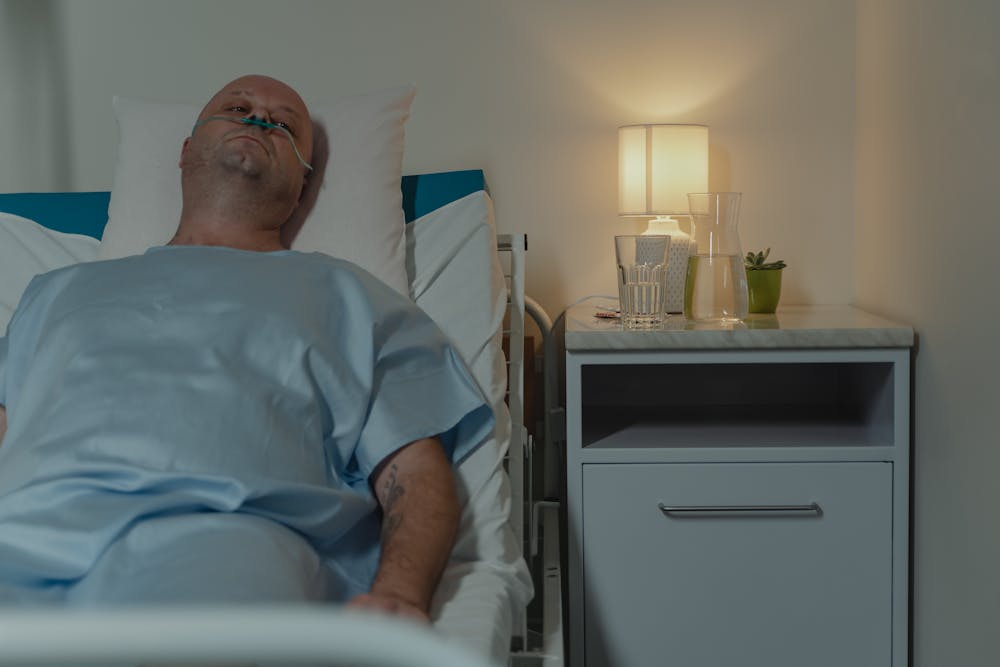
My name is Claire Ashworth, and for six years I have been married to a man who lies in a hospital bed in our second-floor bedroom and does not move.
That sentence sounds simple. It is not. Six years of caring for a person in a persistent coma is not a single experience—it is a thousand small experiences repeated until they blur into atmosphere. The sound of the ventilator becomes the sound of your house. The schedule of medications becomes the rhythm of your days. The person in the bed becomes something between a husband and a piece of furniture—still present, still occupying space, still requiring attention, but no longer participating in any of the exchanges that make a marriage a marriage.
Mark’s accident happened on a November night six years ago. He was driving home from a work dinner—the kind where the wine flows freely and nobody counts glasses because the company is paying. A two-lane road outside the city, wet from earlier rain. He took a curve too fast. His car crossed the center line and hit an oncoming vehicle head-on.
The other car held a family. David and Maria Chen, both thirty-four. Their daughter, Lily, who was seven. They died at the scene—David and Lily instantly, Maria in the ambulance before they reached the hospital. Mark survived. He was pulled from the wreckage with severe head trauma, a collapsed lung, and blood alcohol three times the legal limit.
He never woke up.
Or that’s what we believed.
The doctors explained it to me in that careful, modulated tone they use when the news is terrible but not immediately fatal: traumatic brain injury, swelling, coma of undetermined duration. They couldn’t say when he might wake up. They couldn’t say if. They used phrases like “persistent vegetative state” and “meaningful recovery unlikely” and “quality of life considerations,” each one landing like a stone dropped into water that was already over my head.
I chose to keep him home. I don’t know if that was love or obligation or simply the inability to make a different decision when every option felt like a form of surrender. We converted the upstairs bedroom into something between a hospital room and a shrine—medical bed, monitoring equipment, IV stand, the mechanical hum of machines that breathed for him when his body forgot to breathe for itself. I hired nurses for daytime care. I handled the nights myself, sleeping in the guest room across the hall with the monitor receiver on my nightstand, waking to every beep and alarm like a new mother listening for a cry.
The insurance covered some of it. The rest came from savings, then from my salary as a project manager at a civil engineering firm, then from a home equity line of credit that I tried not to think about because the numbers had started to feel like a slow hemorrhage.
The criminal investigation into the accident was handled while Mark was unconscious. His attorney—hired by his parents before they passed—argued that prosecution of a comatose defendant served no purpose. The DA’s office, overwhelmed and pragmatic, agreed to suspend proceedings pending Mark’s medical status. The case sat in a file somewhere, dormant but not dead, waiting for a recovery that everyone assumed would never come.
I visited the Chens’ grave once, alone, on the first anniversary. I left flowers and stood there for a long time, trying to figure out what I owed to the dead when the person who killed them was technically still alive but functionally gone. I never went back. Not because I didn’t care, but because the guilt was so large and so shapeless that I couldn’t find the edges of it, and without edges, I couldn’t hold it properly, so I set it down and walked away and tried to focus on the mechanical work of keeping a body alive.
That was my life. Six years of it. A slow, heavy repetition of the same day, where every step was ruled by schedules, medications, and machines. The house stopped feeling like a home and started resembling a ward. I stopped feeling like a wife and started resembling a caretaker. The distinction mattered less than you’d think.
The underwear kept appearing.
After the second pair—black this time, same European brand—I searched the house more carefully. In the bathroom connected to Mark’s room, I found a bottle of men’s cologne I had never purchased. Heavy scent, woody notes. I opened it and smelled it, and the fragrance was so aggressively alive, so obviously belonging to a man who wanted to be noticed, that holding it in Mark’s sterile bathroom felt like a hallucination.
In the kitchen trash, buried under coffee grounds and a takeout container from Gloria’s lunch, I found a cigarette butt. Crushed flat, lipstick-free, with a brand name I associated with a type of man Mark used to be before the accident—the kind who smoked outside bars and called it social.
Nobody in this house smoked. Gloria didn’t smoke. The night nurse, a quiet woman named Priya who came three evenings a week so I could sleep properly, didn’t smoke. I didn’t smoke. And Mark—Mark hadn’t moved his hands in six years.
I started paying closer attention.
I noticed that Mark’s hair, which I trimmed myself every few weeks, sometimes looked different in the mornings—not dramatically, but as if it had been towel-dried and finger-combed by someone who wasn’t me. I noticed that the level of food in the refrigerator didn’t always match what I’d eaten and what Gloria reported preparing. A container of leftover pasta that should have lasted two days was empty after one night. A bottle of water I’d just opened was half gone by morning.
I noticed, once, that the sheets on Mark’s bed were slightly rumpled in a pattern that didn’t match how a motionless body would crease them. The wrinkles suggested someone had sat on the edge of the mattress—not on the side where I sat to check his vitals, but on the far side, near the window, where no one ever went.
Each observation was small enough to explain away. Laundry mix-ups. Forgetful caregivers. My own exhaustion manufacturing patterns from noise. But together, they formed something I couldn’t dismiss—a quiet accumulation of wrongness, like finding sand in places where sand shouldn’t be.
I didn’t confront anyone. I didn’t call Gloria or Priya and demand explanations. I’d learned something about suspicion over six years of living with a secret I couldn’t name: the fastest way to lose the truth is to announce that you’re looking for it. People who have something to hide become better at hiding when they know they’re watched.
Instead, I made a plan.
I told Gloria I had a business trip—a three-day conference in Denver that couldn’t be rescheduled. I told Priya I’d need her for extra nights. I packed a bag, kissed Mark’s forehead the way I always did—a gesture that had long since stopped being affection and become ritual, the way you touch a doorframe on your way out without thinking about why—and I called a taxi.
The taxi took me to a supermarket two kilometers from the house. I left my bag in a locker, bought a thermos of coffee and a granola bar, and walked back along the old path behind the neighborhood—a maintenance trail that ran along the back fences, overgrown and rarely used, ending at a copse of trees that faced our house from the rear.
From there, I could see the second-floor bedroom window.
It was November again. Cold, dark, the kind of night where the air feels like it’s made of something heavier than air. I wore a dark coat and sat on a concrete drainage cap behind a hedge and waited.
I felt ridiculous. I felt like a woman in a bad thriller—the suspicious wife, crouching in bushes, watching her own house for evidence of something she couldn’t articulate. What was I expecting? That Gloria had a boyfriend she was sneaking in? That Priya was hosting midnight visitors? The explanations that made sense were all banal, and the one that didn’t make sense—the one I hadn’t let myself form into words—was impossible.
A man who hadn’t moved in six years could not be getting up at night.
That was the thought I kept circling, the thought I kept poking at and pulling back from, the way you’d probe a bruise to test if it still hurt. Of course it still hurt. The thought hurt because it was absurd—and because a small, terrible part of me recognized that absurdity was what made it the perfect hiding place.
At eleven, the bedroom light went off. Standard. Gloria’s routine: final check at ten-forty-five, lights off at eleven, monitor active.
At eleven-thirty, Gloria’s car left the driveway. She’d gone home for the night, which was normal when I was traveling—Priya would arrive at midnight for the overnight shift.
At twelve-fifteen, Priya’s headlights appeared. She parked, went inside. The downstairs lights flickered—she was settling in, making tea, checking the monitor from the living room station.
At one o’clock, the bedroom light turned on.
My breath stopped. I told myself it was Priya checking vitals. A routine check. Nothing unusual.
But Priya didn’t go upstairs for routine checks at one AM. She checked the monitor from downstairs and only went up if an alarm triggered. No alarm had sounded—I was close enough to hear the system’s alert tone, and the night was silent.
I watched the window.
For a few seconds, nothing happened. The bed was visible from my angle—the mechanical bed with its rails and its white sheet, Mark’s shape beneath it, motionless as always.
Then Mark moved.
Not the way a coma patient might twitch—not a reflex, not a spasm, not the involuntary jerk of a body operating on residual electrical signals. He turned onto his side. Calmly. Deliberately. He braced his hand against the mattress and pushed himself upright.
And sat up.
I pressed my hand over my mouth. The sound I was holding back wasn’t a scream—it was something worse, something that didn’t have a name, the noise your mind makes when the architecture of your reality collapses and you’re standing in the rubble trying to figure out which pieces were ever real.
Mark stood up from the bed. He removed the monitoring leads from his chest with the casual efficiency of someone who had done it a thousand times—unclipping sensors, detaching the pulse oximeter, silencing the machine with a practiced sequence of button presses that prevented the alarm from reaching the downstairs station.
He knew the system. He knew how to disable it without alerting Priya.
He walked across the room. His gait was slightly uneven—a limp, subtle but present, the kind of residual damage you’d expect from the accident—but it was confident. Functional. The walk of a man who had been walking in secret for longer than I wanted to calculate.
He opened the closet. He took out clothes—real clothes, not the hospital gowns and loose cotton I dressed him in every morning. A shirt. Pants. The burgundy underwear. He dressed standing up, buttoning buttons, zipping zippers, performing the small mechanical acts of self-presentation that I had been doing for him, on him, to the inert weight of his body, every single day for six years.
He went into the bathroom. The light flickered in the frosted window. I heard water running—a shower. He was showering. Standing upright, under hot water, washing a body I had been sponge-bathing on a medical bed with careful, practiced strokes, turning him on his side to reach his back, changing his catheter bag, maintaining the dignity of a man who I believed had none to maintain because he wasn’t there to experience it.
He came back to the bedroom toweling his hair. He sat on the edge of the bed—on the far side, near the window, in the spot where I’d noticed the wrong wrinkles—and put on shoes.
Then he went downstairs.
I watched through the kitchen window as he opened the refrigerator, reheated food, ate standing at the counter with the ease of a man having a midnight snack. He drank water. He washed his dishes. He dried them and put them away.
Then he went to the back door, opened it, and stepped onto the patio.
And lit a cigarette.
He stood there in the November cold, smoking, looking up at the sky, and I watched from thirty meters away in the dark and felt something pass through me that wasn’t anger or grief or shock but all three compressed into a single, impossible weight.
This was not a sick man. This was not a coma patient experiencing miraculous lucid episodes. This was a grown man who had been performing helplessness for years—performing it for me, for the doctors, for the nurses, for the legal system that had suspended his prosecution because prosecuting a vegetable seemed pointless.
And then the final piece fell into place, the piece I hadn’t wanted to assemble because assembling it meant understanding something about the person I had married that couldn’t be walked back or explained away.
Six years ago, Mark had killed three people while driving drunk. He’d survived with injuries that were real—the head trauma was real, the initial coma was real, the medical emergency was genuine. But at some point—weeks in? months?—he had woken up. And he had made a choice.
He chose to stay down.
He chose to let the world believe he was gone because a man in a coma can’t be tried, can’t be sentenced, can’t be held accountable for the family he’d erased from the world on a wet road at seventy miles an hour with a blood alcohol level that should have killed him too.
The coma was his verdict. Not guilty by reason of absence.
And I had been his alibi for six years without knowing it.
He finished his cigarette, crushed it out, and went back inside. I watched through the bedroom window as he undressed, reconnected the monitors in the same practiced sequence, and lay back down. Within minutes, the bed looked exactly as it had before—white sheets, motionless figure, the soft hum of machines doing their impersonation of medical necessity.
By one-forty-five, the performance was complete.
I sat in the dark for another hour, not because I needed more evidence, but because I needed time to understand what I was going to do with evidence this heavy.
The cold had seeped through my coat and into my bones, but I barely felt it. What I felt was something harder to name—a strange, nauseating vertigo, as if the ground I’d been standing on for six years had turned out to be painted canvas over a void. Every memory I had of Mark since the accident was rearranging itself in my mind, each one acquiring a new, sickening dimension. The morning I’d sat beside his bed and told him about my mother’s death, weeping into his unresponsive hand—had he been listening? The night I’d confessed to him, in the privacy of what I thought was a one-sided conversation, that I’d considered letting him go? Had he heard me say, “Sometimes I think you’d want me to stop all this,” and known that the “this” I meant was his life?
Had he felt my hands when I bathed him? Had he been awake, eyes closed, while I changed his catheter and talked to him about the weather and apologized for the indignity of it all?
The thought made me physically ill. I leaned against the hedge and pressed my forehead to my knees and breathed until the nausea passed.
The options arranged themselves with brutal clarity. I could confront Mark. I could walk into that room, turn on the lights, and watch his face as he decided whether to keep pretending or admit the truth. But confrontation assumed he would respond honestly, and a man who had maintained a six-year deception—who had lain motionless while doctors examined him, while I bathed him, while I wept over him—was not a man who would surrender to a conversation.
I could tell his doctors. But doctors would examine, test, document—a process that would take weeks and give Mark time to adjust, to claim sudden recovery, to control the narrative. He’d been controlling narratives his whole life. It was what made him good at his job before the accident, and apparently what made him good at this.
I could call the police. But calling the police with “my comatose husband is secretly walking around at night” would sound exactly as insane as it was, and without evidence, I’d be the one who seemed unstable.
So I chose the option that felt the most like something Mark would understand, because it was the thing he feared most: I chose to build a record.
The next night, I returned to my hiding spot with my phone and a small tripod I’d bought at the supermarket. I filmed everything. The lights coming on at one AM. The silhouette sitting up, standing, walking. The shower. The kitchen. The cigarette on the patio. Forty-seven minutes of footage, timestamped and geotagged, showing a man who was supposed to be in a persistent vegetative state performing the ordinary activities of daily life.
The third night, I filmed again—this time from a different angle, catching his face clearly as he stood at the kitchen window eating leftovers. His expression was relaxed. Content, even. The expression of a man who believed he was unwatched and therefore free.
On the fourth morning, I went to see a lawyer—not Mark’s attorney, not the family lawyer who had handled the accident’s legal aftermath, but a criminal defense attorney named Ruth Okafor who I’d found through a referral from a colleague. I chose her because she had no connection to Mark, no history with the case, no reason to protect anyone except me.
I sat in her office and said, “My husband has been faking a coma for years to avoid prosecution for vehicular manslaughter.”
Ruth stared at me for three seconds, which is a very long time when you’re sitting across from someone who thinks you might be delusional. Then she said, “Show me.”
I showed her the videos. I showed her the underwear photos. I showed her the cologne, the cigarette butts, the food discrepancies I’d been documenting for weeks.
Ruth watched all of it without speaking. When the last video ended—Mark on the patio, smoking, face lit by the kitchen light behind him—she closed her laptop and looked at me.
“This changes everything about the suspended case,” she said. “If he’s been conscious and functional while prosecution was deferred based on his medical condition, that’s not just fraud. That’s obstruction. And the statute of limitations on the vehicular manslaughter charges may have been tolled—paused—during the period the court believed he was incapacitated.”
“Meaning?”
“Meaning the clock may not have been running. The charges could still be live.”
I sat with that for a moment. Six years of care. Six years of vigils and sponge baths and crying in the guest room across the hall. Six years of financial ruin and social isolation and the slow erosion of every part of myself that wasn’t defined by his body in that bed. And underneath all of it—underneath the grief I’d been carrying for a marriage I thought had been taken from me by tragedy—was this: a man who was awake the whole time, lying still while I broke myself keeping him alive, waiting for the world to forget what he’d done.
“I want to take this to the district attorney,” I said.
Ruth nodded. “I’ll make the call.”
The DA’s office moved faster than I expected. The videos were compelling—irrefutable, really, once a medical expert reviewed the footage and confirmed that the movements shown were inconsistent with any known coma presentation. Voluntary, coordinated, purposeful motor activity. Not reflexes. Not sleepwalking. Conscious behavior.
A warrant was issued for Mark’s medical records, and a team of independent neurologists was assembled to conduct an evaluation—unannounced, at a time when Mark would expect to be performing his role.
They came on a Wednesday morning at seven AM, arriving with the DA’s investigators and two uniformed officers. I was there, standing in the hallway outside the bedroom, when they walked in and found Mark in his bed, eyes closed, motionless, monitors beeping their mechanical lullaby.
The lead neurologist, Dr. Adaora Eze, conducted the evaluation with the kind of quiet thoroughness that left no room for performance. She tested reflexes, response to stimuli, pupil dilation, motor function. She watched his face while her assistant dropped a metal tray behind his head—a sudden, loud crash designed to trigger a startle response in any conscious person.
Mark didn’t flinch. He was good. Six years of practice had made him very, very good.
But Dr. Eze was better. She ran an EEG—a portable electroencephalogram that measured his brain’s electrical activity in real time. The readings showed something his body couldn’t fake: normal waking-state brainwave patterns. Alpha waves. Beta waves. The neural signature of a conscious, alert mind hidden behind closed eyelids and practiced stillness.
“This man is awake,” Dr. Eze said, removing her gloves. “He has been awake for some time.”
Mark didn’t open his eyes. Even then—even with the neurologist’s verdict hanging in the room, even with investigators standing at the foot of his bed—he kept the performance going, because admitting consciousness meant admitting everything that consciousness had been concealing.
The investigator leaned close to the bed. “Mr. Ashworth,” he said clearly. “We have video evidence of you walking, eating, showering, and smoking in this house on multiple nights. We have EEG data confirming you are currently conscious. You are being placed under arrest for obstruction of justice and fraud. You have the right to remain silent.”
Mark’s eyes opened.
Not slowly. Not with the confused flutter of a man waking from a long sleep. They opened the way eyes open when someone has been listening to every word and has simply decided that the game is over—a conscious choice to stop performing, the final curtain dropping not because the show had ended but because the audience had stormed the stage.
He looked at the ceiling first. Then at Dr. Eze. Then at the investigator. Then, finally, at me.
I stood in the doorway and met his gaze, and what I saw there wasn’t shame or fear or remorse. It was calculation. Even now—even caught, even surrounded, even with the EEG printout showing the neural signature of a fully conscious mind—he was calculating. Assessing the situation. Running scenarios. Looking for the angle that would let him survive this the way he’d survived everything else: by finding the path that cost him the least.
For six years, I had looked at that face and seen tragedy—a man taken from me by a terrible accident, a life interrupted, a marriage frozen in amber. Now I looked at the same face and saw the person who had actually been there all along: a man who had killed a family, survived, and decided that the most efficient way to avoid consequences was to let his wife destroy herself caring for a lie.
He didn’t speak. There was nothing to say that wouldn’t make it worse, and Mark—whatever else he was—had always been smart enough to know when silence served him better than words. He’d built an entire second life on that principle.
They helped him out of bed. He stood on his own—the limp visible now, a concession to the injuries that had been real even if the coma hadn’t—and walked out of our bedroom for the last time.
The legal proceedings took months. Mark was charged with obstruction of justice, insurance fraud, and—as Ruth had predicted—the original vehicular manslaughter charges, which the court ruled had been tolled during the period of fraudulent incapacity. His attorney argued diminished capacity, psychological trauma, fear of prosecution. The jury didn’t buy it. The videos helped. The EEG helped. The cigarette butts helped.
The testimony of Dr. Eze—calm, precise, devastating in its simplicity—helped most of all. “Coma patients do not disable monitoring equipment,” she said. “They do not select clothing. They do not smoke. Mr. Ashworth was conscious and functional for an extended period, and his deception required sustained, deliberate effort.”
Mark was convicted on all counts. The sentence reflected both the original crime and the years of fraud that followed: twenty-two years.
I didn’t attend the sentencing. I’d said what I needed to say in my victim impact statement, which I’d written at the kitchen table in the house that still smelled faintly of antiseptic and, underneath it, the ghost of woody cologne.
In the statement, I didn’t talk about the money I’d spent or the years I’d lost or the loneliness that had hollowed me out like water eroding stone. I talked about the Chens. David. Maria. Lily. The family that had been driving home on a wet road, doing nothing wrong, and had been erased by a man who then spent six years erasing himself to avoid the consequences.
“He didn’t just kill them,” I wrote. “He made their deaths disappear. Every day he lay in that bed, every day the case stayed suspended, every day the world forgot about that accident—he was killing them again. He was making it so that their deaths didn’t matter enough to pursue. And I helped him do it, because I didn’t know. I didn’t know, and I will carry that for the rest of my life.”
After the trial, I sold the house. I couldn’t sleep there anymore—not because of Mark, but because of the bed. The empty medical bed that I couldn’t bring myself to dismantle, sitting in the upstairs room like a stage that had lost its actor, the machines silent now, the sheets still white, still neatly tucked, still holding the shape of a man who had never really been gone.
I moved to a smaller place across town. I sent a check to the Chen family’s surviving relatives—not enough, never enough, but something. A gesture toward a debt I hadn’t incurred but couldn’t stop feeling responsible for, because I had been the infrastructure of his lie, the caring wife whose devotion made the deception credible.
Some nights I still wake at three AM and listen for the monitor. The beeping that isn’t there anymore. The machine breathing for a man who was breathing perfectly well on his own.
And I think about the underwear. The burgundy boxer briefs that started everything. Such a small vanity—such a tiny crack in an otherwise flawless performance. He could have worn the plain cotton I bought him. He could have kept his nights simple and safe. But somewhere in the elaborate architecture of his deception, he’d wanted one thing that was his. One small luxury that reminded him he was still a person with preferences, still alive in the ways that mattered to him.
That’s what gave him away. Not guilt. Not carelessness. Vanity.
The desire to feel like himself, even in secret, even at one in the morning, even while the family he killed stayed dead and the wife he deceived stayed loyal and the world kept turning around a lie that was held together by nothing more than stillness and the assumption that no one would ever think to watch.
THE END.

Lila Hart is a dedicated Digital Archivist and Research Specialist with a keen eye for preserving and curating meaningful content. At TheArchivists, she specializes in organizing and managing digital archives, ensuring that valuable stories and historical moments are accessible for generations to come.
Lila earned her degree in History and Archival Studies from the University of Edinburgh, where she cultivated her passion for documenting the past and preserving cultural heritage. Her expertise lies in combining traditional archival techniques with modern digital tools, allowing her to create comprehensive and engaging collections that resonate with audiences worldwide.
At TheArchivists, Lila is known for her meticulous attention to detail and her ability to uncover hidden gems within extensive archives. Her work is praised for its depth, authenticity, and contribution to the preservation of knowledge in the digital age.
Driven by a commitment to preserving stories that matter, Lila is passionate about exploring the intersection of history and technology. Her goal is to ensure that every piece of content she handles reflects the richness of human experiences and remains a source of inspiration for years to come.