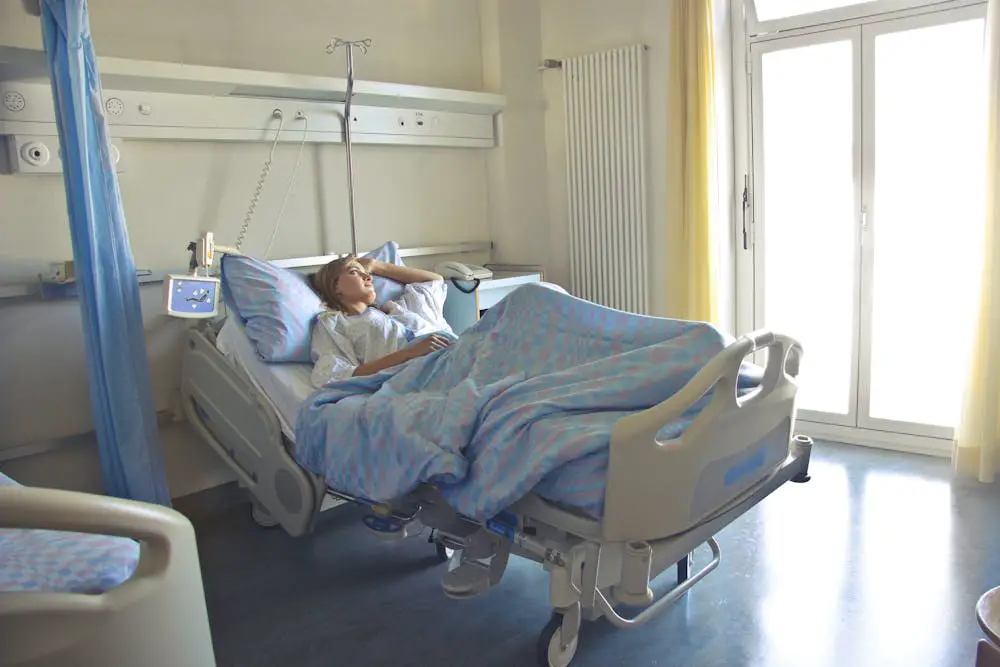
The Hospital Room
Tuesday evenings in our house are usually loud in the normal way. Homework across the kitchen table, the dog nosing around for crumbs, my daughter Lily narrating her day like she’s a sports commentator—thirteen years old and already convinced that everything that happens to her is both unprecedented and worth reporting in detail.
I was halfway through making spaghetti when the front door opened and she didn’t say a word.
She just stood there. Her backpack slid off one shoulder and hit the floor. Her face was the color of paper. One hand pressed hard into her lower right side, fingers curled like she was trying to hold something in.
“Mom,” she said, and her voice was small, which is how I knew this wasn’t a normal complaint. Lily could be dramatic about math tests and cafeteria food. This wasn’t that. “Something’s really wrong.”
I came around the counter and when I touched her stomach—barely a brush—she screamed like I’d stabbed her. That scream did something to my whole body. It yanked every thought into a single straight line: hospital, now.
The emergency room moved fast. Blood draw, blood pressure, CT scan. Within an hour, the doctor came back with the kind of face people wear when they want to soften a cliff before they show you the drop.
“Appendicitis,” he said. “It’s about to rupture. We need to operate immediately.”
They handed me forms. Consent. Risks. Anesthesia. All the words you don’t want to read when your kid is curled up on a hospital bed biting her lip so hard it’s turning white.
Lily looked at me with glassy eyes. “Mom,” she whispered.
“I’m right here,” I said. I kissed her forehead and tasted sweat. “I’m not going anywhere.”
They wheeled her out and the hallway swallowed her—bright lights, swinging doors. Her hair was in a loose ponytail and the strap of her hospital gown slid down her shoulder, making her look even smaller than thirteen. She called my name once before the doors closed.
The surgery was supposed to take an hour. It took three.
I sat in the waiting room with my legs bouncing hard enough to shake the chair. I watched an old man do a crossword puzzle. I listened to someone else’s phone conversation about a work meeting like the world was still normal. I tried not to imagine Lily on an operating table with strangers holding her body open.
When the surgeon came out, his scrubs were clean, his expression tired. “It started to rupture,” he said. “We caught it, but it was close. There was infection. We cleaned it out. She’s stable, but she’ll need IV antibiotics and observation.”
Relief hit first—hot and dizzy. Then fear came right behind it, like a shadow catching up.
And that’s when I called my parents.
Not because I needed them, exactly—though some small, stubborn part of me still wanted them to show up the way parents are supposed to. But because Lily loved them. She had a picture of her and Grandpa in her room from when she was seven, both of them holding fish at a lake, smiling like the world was safe. She still believed they were a solid thing in her life.
My name is Rachel. I’m a single mother—divorced three years ago from a man who drifted away so slowly I didn’t notice he was gone until I was already doing everything alone. My parents had hated my ex, not because he was absent but because he didn’t play their game well enough. He didn’t make my mother feel like the most important person in the room.
I’d learned early that their love came with conditions. Be pleasing. Be easy. Be quiet. Don’t embarrass us. Don’t be needy. Don’t be complicated. Don’t be human in a way that requires work.
Lily, with her big feelings and anxious spirals and honest questions, was everything they didn’t know how to pretend to accept.
My mom answered on the third ring.
“Mom. It’s me. Lily’s in the hospital. Emergency surgery—her appendix ruptured.”
A pause. “Is she alive?”
“Yes. She’s alive.”
“Then it’s fine,” my mom said, as if that concluded the matter. “You’re being dramatic.”
“Mom. The doctor said if we’d waited—”
“But you didn’t wait. So what’s the problem?”
“The problem is my daughter just had major surgery. She’s thirteen. She’s scared. Are you coming?”
She sounded genuinely confused. “Why would we do that?”
My dad’s voice clicked onto the line—the second phone, the one they still used like it was 1998. “Rachel. Your mother’s right. This isn’t a big deal. We’re not driving two hours for an appendix. Call us when it’s actually serious.”
They hung up.
I sat there staring at my phone like it had betrayed me. Then I stood up, because Lily was still in a hospital bed without anyone but me, and whatever my parents had become, I wasn’t going to let it leak into her room.
When Lily came out of recovery, she looked like she’d been wrung out and folded into herself. A clear tube ran from her arm to a bag of antibiotics. Bandages on her belly, neat and small, like the world was pretending the inside of her hadn’t almost turned into poison.
“Did Grandma and Grandpa know?” she asked, eyes heavy and unfocused.
My throat tightened. “They know.”
“Are they coming?”
The hope in her voice was so pure it made me angry—not at her, but at the world, at them, at the particular cruelty of adults who can’t be bothered to show up for a child who still believes they will.
“They couldn’t make it tonight,” I said. “But they’ll call.”
They didn’t call.
On day two, the doctor said the infection was worse than expected. Another day of IV antibiotics and monitoring. Lily looked at me with watery eyes and said, “I want to go home.”
I stepped out for ten minutes to grab coffee. I was standing in line when my phone buzzed with a text from the charge nurse: Your parents are here visiting Lily.
My stomach dropped. I left my coffee on the counter and ran.
When I reached Lily’s room, the door was half open. My parents stood on either side of the bed like they belonged there. Lily looked startled but happy—a flower turning toward sun even after someone keeps stepping on it.
“Grandma!” she said, voice weak but bright.
My mom smiled her performance smile—the one she used at church and PTA meetings, the one that made strangers think she was sweet. “Well, you look fine,” she said. “I told your mother this wasn’t serious.”
Lily’s face faltered. “It was pretty serious. The doctor said my appendix almost—”
My dad made a dismissive sound. “Doctors always exaggerate.”
I stepped in. “Hi,” I said, and my voice was too calm for how fast my heart was pounding.
My mom didn’t look at me. She sat on the edge of the bed like she owned it, the way she sat on every surface in every room she entered—as if the space owed her something for arriving. “Lily, sweetie, we need to talk to you about something.”
Every alarm bell in my body went off. Not because I knew what was coming—I didn’t, not exactly—but because I recognized the tone. It was my mother’s intervention voice, the one she used when she’d decided someone needed correcting and had rehearsed the correction in the car. She’d used it on me my whole life: when I chose the wrong college, the wrong husband, the wrong way to grieve my grandmother. It was the voice of a woman who believed she had the right to edit other people’s lives, and who mistook that belief for love.
“Mom. Not now.”
She ignored me. “Lily, your mother tells us you’ve been seeing a therapist.”
Lily glanced at me nervously. “Yeah. For my anxiety.”
My mom nodded slowly, as if confirming a suspicion she’d been carrying like evidence. “And that’s been going on for how long?”
“Almost a year,” Lily murmured.
My dad crossed his arms. “That’s what we thought.”
I moved between them and the bed—not touching anyone, just placing my body as a shield, the way you step between a child and a dog whose posture has changed. “You need to leave.”
My mom blinked. “We’re having a conversation with our granddaughter.”
“You’re upsetting her. She just had surgery. Get out.”
My dad’s face hardened. “We drove two hours. We didn’t drive two hours to say hello and leave. We’re not going until we say what we came to say.”
And there it was—the admission I should have caught before they entered the room. They hadn’t driven two hours out of concern. They’d driven two hours with a purpose. The surgery was an opening, not an emergency. Lily was captive, medicated, vulnerable—the perfect audience for whatever script they’d prepared.
My mom looked directly at Lily, and I watched my daughter’s face—still soft with pain medication, still young enough to believe that people who loved her wouldn’t use that love as a delivery system—tilt toward her grandmother like she was waiting for comfort.
“Lily, honey,” my mom said, in that calm voice like she was reading a recipe, “you need to understand something. Your anxiety, your depression, all of this mental illness stuff—it’s very hard on your mother. It’s hard on all of us. You’re only thirteen. You shouldn’t be this much work.”
Lily’s eyes filled fast. “I’m trying,” she whispered.
My dad nodded. “She’s right. And honestly, Lily, when we heard about the surgery, we thought maybe it would have been better if—”
“If what?” I demanded.
He looked at Lily, not me. “If you hadn’t made it.”
The room went silent in a way that felt unreal, like sound had been sucked out through a vent.
Lily’s face crumpled. “What?”
My mom leaned in as if she were being kind. “If the surgery had gone wrong, it would have solved a lot of problems. You’re very difficult, Lily. You’re expensive. You’re bad for this family.”
Lily made a sound I’d never heard from her before—broken, stunned, grief coming out as a sob that didn’t know where to go.
Something in me snapped clean. I didn’t scream. I didn’t cry. I moved.
I grabbed my mother’s forearm and pulled her away from the bed. “Get out right now, or I’m calling security.”
My dad started, “Rachel—”
I pointed at the door. “Out. Now.”
They walked out—my mom looking offended, like I’d spilled wine on her dress; my dad looking irritated, like I’d interrupted something important.
Lily folded into herself and sobbed into her pillow. I climbed onto the edge of the bed and wrapped her up as best I could around the IV lines and the soreness.
She clung to me. “Why do they hate me?”
“They don’t get to decide your worth,” I said, pressing my lips to her hair. “They are wrong. They are wrong. They are wrong.”
But between sobs she whispered, “Are they right? Am I bad? Would everyone be better without me?”
That was the moment something hardened inside me into a decision.
When Lily finally fell asleep—exhausted, medicated, wrecked—I stepped into the hallway and made one phone call.
Not to my parents.
To my lawyer.
My lawyer answered on the second ring. I told her everything—every word, the sentence about it being better if Lily hadn’t made it, the way my mother said she was bad for the family, the way Lily cried like her world had cracked open.
She didn’t interrupt. When I finished, she said, “We’re going to document this, protect Lily, and build a paper trail that makes it impossible for them to claim any right to access her.”
“I want no contact,” I said. “Completely.”
“Done. Cease-and-desist first. We notify the hospital staff if they return. We notify the school. If they violate it, we pursue a restraining order.”
The next morning, I asked the hospital to flag Lily’s file so my parents couldn’t visit without my explicit consent. The charge nurse didn’t blink. She’d heard enough stories in her career to know that “family” sometimes meant “threat.”
I asked the nurse who’d texted me about my parents’ visit if she’d be willing to provide a statement confirming they were in the room during the incident. She agreed. The hospital security log showed the time they arrived and left. Documentation is a strange comfort. It doesn’t erase harm. But it draws a line in ink that says: this was real, and it matters.
My parents called that afternoon. I let it go to voicemail.
My mom’s voice was irritated: “Rachel, this is ridiculous. Call us back. We need to talk. You embarrassed us in front of hospital staff. Lily needs to understand we were only trying to help.”
Trying to help. She’d told a child in a hospital bed that the world would be better without her, and she called that helping. The distance between what my mother believed she was doing and what she actually did was so vast you could lose entire years inside it—and I had. I’d spent my whole life inside that gap, telling myself the words didn’t mean what they meant, that she didn’t intend what she said, that if I just explained it differently she’d understand.
I forwarded the voicemail to my lawyer.
When Lily was discharged, she walked slowly, clutching a pillow to her abdomen like armor. The fall air outside the hospital smelled like wet leaves. At home, she slept a lot. She watched comfort shows. She ate crackers and broth. She let me sit beside her on the couch like I was part of her healing, and I sat there for hours, not because she needed me every minute but because I needed to be close enough to hear her breathe.
One night, after the nurse adjusted her final round of at-home antibiotics, Lily whispered in the dark, “Do you think they wished I died?”
I didn’t lie. I didn’t soften it in a way that would make her question her own reality.
“I think they said something cruel,” I answered. “And I think cruelty says more about them than it ever will about you.”
Her therapist met with her twice that week and helped her name what happened: emotional abuse. Betrayal. Cruelty. Not truth.
That language mattered—because Lily’s brain, like many anxious brains, wanted to make a pattern, wanted a rule that explained pain: if someone hurt me, I must deserve it. If someone leaves, it must be my fault. We built new rules instead. People can be wrong. People can be cruel. Cruelty is not a measure of your worth.
Two weeks later, the no-contact order was granted. It wasn’t dramatic—a judge reading paperwork and signing a document. But to me it felt like a door being installed in a house that had never had one. For the first time in my life, there was a legal boundary between my parents and the people I loved. Not a suggestion. Not a hope. Not a conversation I’d have to win every time. A door, with a lock, that I controlled.
I sent copies to Lily’s school. I met with the principal. I explained that my parents were not allowed to pick Lily up, visit, or contact her through staff. The principal didn’t ask for gossip. She asked for the order and promised compliance.
The silence that followed was new—soft instead of tense. No guilt calls. No surprise visits. No performative apologies. Lily began to breathe again.
In therapy, she learned to separate facts from interpretations. Fact: I have anxiety. Interpretation: that makes me a burden. They practiced pulling the interpretations away like weeds.
She joined the drama club. Her first audition, her hands shook holding the script. Then she took one deep breath—a technique she’d practiced—and did her lines. When she walked out, she looked dazed.
“How was it?” I asked.
She blinked and smiled. “I didn’t die,” she said.
She got a small role. Two lines. A background scene. But she came home from rehearsals with spark in her eyes. “I like being someone else for a little while,” she told me one evening. “It’s like my brain shuts up.”
Meanwhile, my parents behaved exactly like the kind of people who’d say a child should have died: they acted like victims.
My mom posted vague statuses on social media about heartbreak and being “kept from a grandchild.” Extended relatives called me. “Your mom’s really hurting,” my aunt said. “She didn’t mean it like that.”
“She said the words out loud to a child in a hospital bed,” I replied. “That’s exactly how she meant it.”
The calls slowed after that. Some people don’t want truth. They want comfort.
On a Friday in late November, the no-contact order was tested. I was in the grocery store with Lily when she froze, hand tightening on the cart handle.
My parents were at the end of the aisle.
My mom started walking toward us, performance smile already forming. I stepped in front of Lily.
“Stop. You’re violating the order.”
My dad’s eyes narrowed. “This is ridiculous.”
My mom tried the soft voice. “Lily, sweetheart—”
“Do not speak to her.” I pulled out my phone and called the non-emergency line. My dad’s jaw tightened. “You’d call the police on your own parents?”
“I’ll call the police on anyone who endangers my child.”
My mom looked around at the shoppers, suddenly aware her performance had an audience she couldn’t control. She grabbed my dad’s sleeve and hissed, “Fine. Come on.”
They left. In the car, Lily stared at her lap and said quietly, “Thank you for being mean to them.”
“I’m not trying to be mean.”
“I know. I just—it feels like someone finally picked my side.”
I squeezed her hand. “I picked you the second you were born. And I’ll pick you every time.”
Four months later, a letter arrived from a law office. Grandparent visitation rights.
The phrase felt like a threat wearing a suit. My parents’ lawyer gave a speech about family bonds and emotional wellbeing and the importance of maintaining relationships. It painted them as devoted grandparents being unfairly cut off by a spiteful daughter.
My lawyer responded with everything: the no-contact order, the hospital incident documentation, the grocery store violation, the school attempt where they’d shown up smiling like doting grandparents and been turned away, the nurse’s statement, the security log, the voicemails I’d saved and forwarded. Pattern after pattern after pattern—not a single dramatic incident but a sustained campaign of intrusion, each attempt more creative than the last, each one demonstrating that my parents’ interest wasn’t in Lily’s wellbeing but in their own access.
On the day of the hearing, Lily stayed home with a trusted neighbor. She didn’t need to sit in a courtroom while adults argued about her like she was property.
I walked into the courthouse in a simple dress and flat shoes that didn’t click too loudly. My lawyer walked beside me, calm and prepared.
My parents sat across the room. My mother wore a cardigan and a soft expression—the costume of a gentle grandmother, carefully assembled, as convincing as any role she’d ever played. My father looked stern, like he was there to correct a misbehaving child. Neither of them looked at me as a person. They looked at me as an obstacle between them and what they wanted.
Their lawyer gave a speech about misunderstandings and stress and the importance of family forgiveness. He described my parents as loving grandparents who’d made one regrettable mistake under difficult circumstances. He used the word isolated three times, as if cutting off contact with people who’d told your child she should have died was an act of cruelty rather than basic protection.
My lawyer spoke about safety, harm, and documented violations. She referenced Lily’s therapist’s letter—a careful, clinical assessment of the damage the hospital incident had caused and the measurable improvement since no contact. The therapist had written that Lily’s anxiety scores had decreased significantly in the months without her grandparents’ presence, and that reintroducing contact posed a demonstrable risk to her mental health.
Then I stood and told the truth. I didn’t embellish. I didn’t dramatize. I just said what happened—what they said, where they said it, how old Lily was, what she was recovering from, and what she’d asked me afterward: Are they right? Am I bad? Would everyone be better without me?
The judge’s expression changed gradually—from polite neutrality to something sharper, something that looked like controlled anger.
My mother shook her head during my statement, as if I were lying. My father stared at the ceiling like he was bored—a posture I recognized from my childhood, the way he’d check out whenever feelings were discussed, as if emotions were a language he’d never learned and resented being expected to speak.
The judge asked my parents one question: “Did you tell your granddaughter it would have been better if she died?”
My mother’s performance faltered. “We didn’t mean—”
“That’s not what I asked.”
My father cleared his throat. “We were under stress.”
The judge’s eyes narrowed. “You were under stress in a hospital room with a recovering child?”
The silence that followed was the loudest silence I’d ever heard in a room full of people. It was the silence of two people who had no answer that wouldn’t make things worse, and who were only now beginning to understand that the charm and deflection that had worked on family members and acquaintances for decades had no effect on a judge who’d read the file.
“Petition denied. Given the documented evidence of emotional harm and repeated violations of a no-contact order, the court finds that forced visitation is not in the best interest of the child.”
Outside the courthouse, my mother hissed, “You’ve ruined us.”
“You ruined yourselves,” I said.
That night, Lily met me at the door. “It’s done,” I said.
She sagged with relief, hugged me hard. “Thank you,” she whispered.
The years that followed moved the way years do when you’ve stopped bracing—steadily, imperfectly, with the ordinary rhythms of laundry and homework and arguments about curfews and days when Lily’s anxiety flared for no clear reason and days when it didn’t. Neither kind of day meant she was broken. Both kinds of day meant she was alive.
Lily kept a small notebook in her backpack where she wrote grounding reminders: I can feel scared and still be safe. I can need help and still be strong. I am allowed to exist loudly. Sometimes she left the notebook on the kitchen table, and I’d see the handwriting—neat, deliberate, the penmanship of a girl who was teaching herself to believe things by writing them down—and I’d have to turn away so she wouldn’t see my face.
She made a small box, painted it the green of her bedroom walls, and filled it with things that meant safety: a bracelet from her best friend, a note from her drama teacher that said I’m proud of you, a photo of us at the coast, and a folded piece of paper with one sentence: I survived.
When she showed it to me, I had to swallow hard. “That’s powerful,” I said.
Lily shrugged, trying to act casual, but her eyes were shiny. “I wanted something that’s mine. Not their words.”
One evening in spring, she sat at the kitchen table and asked, quietly, “Were they always like that with you?”
I didn’t want to pour my whole childhood into her lap. But I didn’t want to lie.
“They were,” I said. “Not always the same words. But the same feeling.”
Lily nodded slowly. “So it wasn’t me.”
“No,” I said. “It was never you.”
“Then why did you keep them around?”
The shame rose—not because she was accusing me, but because she deserved the truth.
“Because I kept hoping,” I admitted. “I kept thinking if I did the right thing, if I explained it the right way, they’d become the kind of parents they were supposed to be.”
Lily’s eyes were steady, older than her age. “That’s not fair. It shouldn’t be your job to fix them.”
“You’re right,” I said. “It shouldn’t.”
When my father died—a short letter from my aunt Denise, typed, formal, like she was reporting a scheduling change—grief didn’t arrive the way I expected. There was no wave of sadness. Something emptier, like a door closing softly in a hallway I’d stopped walking down years ago. I felt the reflex of grief without the substance of it—the old programming trying to run on hardware that had been rewired.
I called Lily at college. She answered on the second ring with her usual warm “Hey, Mom,” and I told her simply: “Your grandfather died.”
Silence. Then, carefully: “Do we have to go?”
“We don’t have to do anything.”
“I don’t want to,” she said. “Not because I’m trying to be cruel. Just because he already left us a long time ago.”
I felt tears sting—not from grief for him, but from pride in her clarity. She understood something that had taken me decades to learn: that death doesn’t create an obligation to forgive, and that funerals are for the living, and the living had made their choices long before the dying began.
Denise called that night, voice sharp. “You’re really not coming? After everything?”
“After everything,” I said.
“You’ll regret this when your mother dies too.”
“Maybe,” I said calmly. “But regret isn’t a reason to let people hurt us.”
I sat at my kitchen table that evening and wrote a letter to my father that I never intended to send. It was short: You taught me that love was conditional. I unlearned you. Your granddaughter is alive and thriving without your approval. That is your legacy, whether you accept it or not. I folded it and put it in Lily’s green box, which she’d left at home for safekeeping during college breaks. The letter didn’t belong to my father, but it belonged to the story.
My mother’s final attempt came months later, by letter. No lawyer. Just her handwriting—the rounded letters she used for thank-you notes and passive aggression.
Rachel, I am alone now. I don’t remember saying what you claim I said. But if I did, it was never meant that way. I want to see Lily before it’s too late. A mother shouldn’t have to beg. Please be reasonable.
The letter ended with Love, Mom, as if love were a stamp you could apply to anything to make it valid. As if signing the word was the same as doing the work. As if a mother who’d told her granddaughter she should have died could write love at the bottom of a page and have it mean something, the way she’d always believed that saying the right words was the same as being the right person.
I handed it to Lily without comment. She read it, expression unreadable.
“She said ‘what you claim,'” Lily said quietly.
“Yes.”
“She’s still doing it. Denying. Minimizing. Making you the problem.”
“Yes.”
Lily took her phone and typed slowly, with the deliberate calm of someone who has practiced saying difficult things until the difficulty is no longer in the saying but only in the remembering:
Grandma, I remember exactly what you said to me in the hospital. I don’t accept your version. I’m alive. I’m doing well. I don’t want contact. Please do not write again.
She printed it, signed her name, sealed the envelope. No softness. No apology. No invitation for argument. No door left open for a woman who had spent years trying to pry open doors that had been locked for good reason.
We mailed it together.
The next morning, Lily taped a new quote to her corkboard, next to I am not a problem to solve.
Closure is something I give myself.
By her second year of college, Lily had started a support group at the community center—not therapy, just a safe place for teenagers whose brains got loud. A youth counselor supervised. The first meeting had six kids in folding chairs with nervous hands.
“My brain lies to me sometimes,” Lily told them, voice steady. “It tells me I’m too much. That I don’t deserve space. I’m here because I learned those lies aren’t facts.”
A girl across the circle started crying silently. Lily didn’t rush her. She just nodded, like to say: I see you.
In the car afterward, Lily stared out the window and said, “I feel like I did something right.”
“You did,” I said.
When she came home for winter break, she stood in the doorway with snow in her hair and hugged me.
“Thanks for picking me,” she said—the same words she’d used at thirteen in a hospital bed, at sixteen on a graduation day I’d watched from the bleachers while security escorted my parents away from the entrance, at eighteen when she left for college with her green box on the passenger seat like a flag claiming territory.
“Thank you for letting me,” I said.
The real ending wasn’t the restraining order. It wasn’t the courtroom. It wasn’t my parents walking away from our door or the letters returned unopened or the voicemails forwarded to my lawyer.
The real ending was a beginning: my daughter learning she was not a burden, and me learning that love doesn’t require permission from people who confuse cruelty with truth.
We built a life that didn’t revolve around their approval. We built a family that chose each other, again and again, on purpose. And if my parents ever wondered why they were no longer part of it, the answer was simple and permanent.
Because Lily lived.
Because she mattered.
Because I picked her, every single time.
THE END.

Lila Hart is a dedicated Digital Archivist and Research Specialist with a keen eye for preserving and curating meaningful content. At TheArchivists, she specializes in organizing and managing digital archives, ensuring that valuable stories and historical moments are accessible for generations to come.
Lila earned her degree in History and Archival Studies from the University of Edinburgh, where she cultivated her passion for documenting the past and preserving cultural heritage. Her expertise lies in combining traditional archival techniques with modern digital tools, allowing her to create comprehensive and engaging collections that resonate with audiences worldwide.
At TheArchivists, Lila is known for her meticulous attention to detail and her ability to uncover hidden gems within extensive archives. Her work is praised for its depth, authenticity, and contribution to the preservation of knowledge in the digital age.
Driven by a commitment to preserving stories that matter, Lila is passionate about exploring the intersection of history and technology. Her goal is to ensure that every piece of content she handles reflects the richness of human experiences and remains a source of inspiration for years to come.
Good story. I had to overcome some of the same feelings up through 8th grade. I had a stepmother who ran hot and cold. A trucker dad, hardly ever home. Was allowed to spend the pre-high school summer with my birth mother, 2 siblings, and alcoholic stepfather. When dad & stepmom came to take me back I refused to go.
After all their cajoling she said “But I love you” I looked her in the eye and said,”Well I never heard that before” with years of hate in my voice. I stayed with my birth mother. Years later I realized my father had never said it either.
I forgave them in my 30’s. Life’s been easier since.
This June I’ll become a Great Grandfather & a Great Uncle to 2 boys @ 85 years old. I may not live long enough for them to hear me say I love them, but their parents will, and hopefully pass it along.