The Mother Who Demanded Perfection: How Love Became the Ultimate Rebellion
My mother didn’t cry when my father left us. She didn’t sob or wail or collapse into a broken heap on the kitchen floor. She just watched him slam the door, then walked to the mantle, pulled their wedding photo from its silver frame, and dropped it into the fireplace.
I was five years old, already learning the dangerous art of silence in our house, when she turned to me with that cold smile that would define my childhood.
“Now it’s just us, Jonathan,” she said with chilling calm. “And we don’t fall apart, son.”
That became her mantra, her religion, her obsession. We don’t fall apart. We don’t show weakness. We don’t give anyone ammunition to use against us.
My mother, Margot, didn’t raise me to be happy. She raised me to be bulletproof.
Every aspect of my upbringing was calculated for maximum effectiveness and minimum vulnerability. The best schools, piano lessons that started at age six, etiquette classes that taught me perfect posture and perfect thank-you notes. I learned to make eye contact that projected confidence, to shake hands with authority, to navigate social situations like a diplomat defusing bombs.
Her love wasn’t warm or soft—it was strategic and efficient. Every hug came with conditions. Every “I’m proud of you” was followed by “but you could do better.” Perfection wasn’t the goal; it was the minimum acceptable standard.
By the time I turned twenty-seven, I’d stopped trying to impress her. In reality, there was no way to impress Margot. Every achievement just moved the goalposts further away. Every success became evidence that I hadn’t been trying hard enough before.
But I still told her when I started seeing someone.
The Introduction
We met at one of her favorite restaurants—a hushed, expensive place with dark wood paneling and starched linen napkins folded into geometric perfection. She wore navy blue, her signature color when she wanted to project authority, and had already ordered wine before I’d even reached the table.
“So,” she said, tilting her head with predatory interest, “is this a real update, Jonathan, or are we just making small talk?”
“I’m seeing someone, Mom.”
Her face brightened with genuine enthusiasm for the first time in months. “What’s she like?”
“Anna’s a nurse,” I said. “She works nights at a trauma center downtown.”
I watched the spark of approval flicker across my mother’s features. A nurse—respectable, educated, someone who saved lives. This was promising territory.
“Smart, capable,” she nodded approvingly. “I like that in a woman. What about her family?”
“Both parents are still together. Her mother’s a high school principal, and her father’s a cardiologist. They live in Oregon.”
“Excellent pedigree,” my mother said, actually clapping her hands once in satisfaction. “When do I meet her?”
I took a deep breath. “There’s something else you should know. Anna’s a single mother. Her son Aaron is seven.”
The pause was nearly invisible, but I caught it. My mother lifted her wine glass with that same perfect posture she’d drilled into me, took a measured sip, and recalibrated.
“That’s quite a responsibility for someone your age,” she said, her voice suddenly cooler.
“Anna’s incredible,” I said, maybe too quickly. “She’s the most devoted mother I’ve ever seen. And Aaron… he’s an amazing kid. Last week he told me I was his favorite grown-up.”
My mother dabbed the corner of her mouth with surgical precision. “I’m sure she appreciates having a good man around. They’re hard to find these days.”
There was no warmth in her voice anymore, and no invitation for me to elaborate. We talked about other things after that—work, weather, a new gallery exhibition downtown—but she never said Anna’s name again.
I didn’t force it. Not yet.
The Meeting
A few weeks later, I brought them to meet her anyway. We arranged to meet at a quiet coffee shop near my apartment. Anna was ten minutes late, and I could feel my mother’s irritation building with each passing minute.
Anna didn’t have a choice. Aaron’s babysitter had canceled at the last moment, and she’d had to bring him along to our meeting.
When they finally arrived, Anna looked flustered. Her dark hair was pulled back in a loose bun, she wore jeans with a pale cotton blouse, and one side of her collar was slightly wrinkled. Aaron clung to her hand, his eyes wide as he scanned the pastry display case.
“This is Anna,” I said, standing to embrace them both. “And this is Aaron.”
My mother rose from her seat, extended a perfectly manicured hand, and offered Anna a smile that contained absolutely no warmth.
“You must be exhausted,” she said—not a greeting, but an observation delivered with clinical detachment.
“I am,” Anna replied with a soft laugh that didn’t quite hide her nervousness. “It’s been one of those days.”
My mother asked Aaron exactly one question: “What’s your favorite subject in school?”
When he brightened and said “Art class!” she actually rolled her eyes before ignoring him completely for the remainder of the visit. When the check arrived, she paid only for her own coffee.
In the car afterward, Anna looked over at me with those honest brown eyes.
“She doesn’t like me, Jon.”
She wasn’t angry or hurt—just stating a fact.
“She doesn’t know you yet,” I said.
“Maybe. But it’s pretty clear she doesn’t want to.”
The Ultimatum
Two years later, my mother summoned me to meet her at the old piano showroom uptown. It was a place from my childhood—she used to take me there on Saturday mornings, claiming the acoustics were “clean enough to hear your mistakes.” She called it her favorite place to “imagine legacy,” as if owning the right piano could somehow guarantee greatness.
The showroom smelled like wood varnish and faded dreams. Gleaming pianos lined the walls like expensive horses waiting to be chosen.
“So, Jonathan,” she said, running her fingers along the polished lid of a concert grand, “is this relationship going somewhere, or are we all just wasting time?”
I didn’t hesitate. “I asked Anna to marry me.”
My mother’s hand froze mid-caress before falling to her side. “I see.”
“She said yes.”
My mother smoothed invisible wrinkles from her salmon-colored blazer, her eyes fixed on everything except my face.
“Well then,” she said with deadly calm, “let me be very clear about something. If you marry her, don’t ever ask me for anything again. You’re choosing that life, Jonathan. Choose it completely.”
I waited for something else—a tremor of doubt, a crack in her composure, any sign that this ultimatum was costing her something. But her expression remained carved from marble. She didn’t plead, didn’t negotiate, didn’t fight for me.
She just let me go.
So I left.
Building a Life
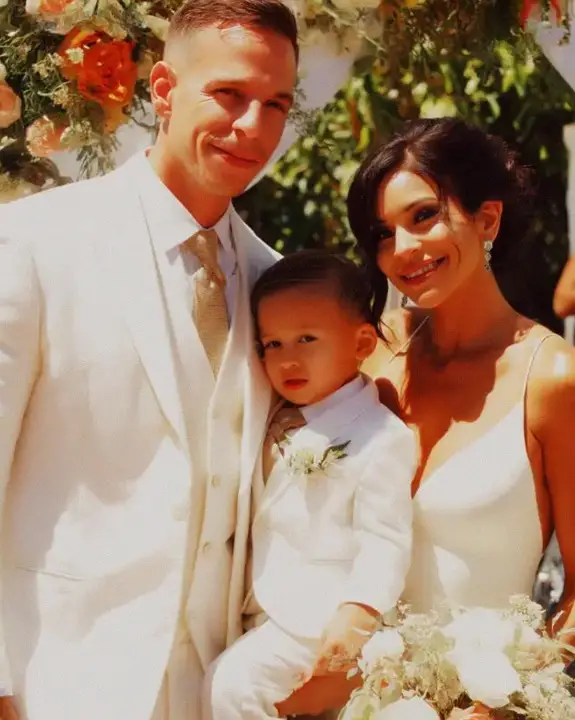
Anna and I married four months later in the backyard of her best friend’s house. There were string lights wound through the trees, mismatched folding chairs borrowed from the church, and the kind of genuine laughter that comes from people who know how to live without performing.
We moved into a small rental house with sticky kitchen drawers and a lemon tree in the backyard that dropped fruit we never quite got around to picking. Aaron painted his bedroom bright green and left handprints on the walls that we decided looked better than any professional art.
Three months into our marriage, something magical happened. We were at the grocery store, standing in the cereal aisle, when Aaron looked up at me with milk-mustached innocence.
“Can we get the kind with marshmallows, Dad?”
He didn’t even realize what he’d said. But I did. That night, I found myself crying into a basket of clean laundry—the first time I’d cried in years. Grief and joy, I discovered, could occupy the same space in your chest without destroying each other.
We lived quietly and fully. Anna worked her night shifts at the hospital while I handled school pickups, packed lunches, and reheated dinners. We watched Saturday morning cartoons in our pajamas, danced in socks across the hardwood living room floor, and bought mismatched coffee mugs at yard sales for no reason except that they made us smile.
My mother never called. Not to ask how I was, not to inquire where I’d moved, not to acknowledge that I existed. The silence stretched for three years—until last week, when her name suddenly lit up my phone screen.
Her voice was sharp and controlled, as if no time had passed at all.
“So this is really the life you chose, Jonathan.”
I balanced the phone between my shoulder and ear while drying a dinner plate. “It is, Mom.”
“I’m back in town from my European vacation. I’ll stop by tomorrow afternoon. Send me your address. I’d like to see exactly what you gave everything up for.”
When I told Anna about the impending visit, she didn’t even look up from her cup of tea.
“You’re thinking about deep-cleaning the entire house, aren’t you?” she asked with knowing amusement.
“I don’t want her walking in here and twisting what she sees into ammunition against us.”
“She’s going to twist it no matter what, Jon. This is who we are. Let her see it.”
I cleaned anyway, but I didn’t stage anything. The refrigerator covered in Aaron’s artwork and soccer schedules stayed exactly as it was. The chaotic shoe rack by the front door remained untouched. If my mother wanted to see our real life, she was going to get it.
The Visit
My mother arrived precisely on time the next afternoon, wearing a camel-colored wool coat and heels that clicked against our cracked walkway like a countdown timer. Her signature perfume reached me before she did.
I opened the door, and she walked past me without saying hello. She stood in our small entryway, surveying the scene like a crime scene investigator cataloging evidence.
“Oh my God,” she breathed, reaching for the doorframe as if she needed support. “What is this place?”
She moved through our living room like the floor might collapse beneath her expensive shoes. Her eyes absorbed everything: the secondhand couch with the faded arms, the coffee table scarred with water rings, the pale crayon marks Aaron had drawn along the baseboards months ago that we’d never bothered to scrub away.
She paused in the hallway outside Aaron’s room, staring at the green handprints he’d pressed against the wall after we painted together. Her gaze moved to the corner of the living room where my old upright piano sat—the lacquer worn thin in places, one of the keys permanently stuck halfway down.
That’s when Aaron wandered in from the kitchen, clutching a juice box and wearing a t-shirt with a ketchup stain on the sleeve. He glanced at my mother with curious politeness, then walked over to the piano and climbed onto the bench.
Without saying a word, he began to play.
The melody was slow and careful—Chopin’s Minute Waltz, the same piece my mother had drilled into my fingers hour after hour until my hands went numb from repetition. Aaron’s version was tentative, imperfect, but filled with something mine had never possessed: pure joy.
“Where did he learn that?” my mother asked, her voice suddenly smaller.
“He asked me to teach him,” I said. “So I did.”
Aaron finished the piece, climbed down from the bench, and walked over to my mother holding a folded piece of paper.
“I made you something,” he announced with seven-year-old solemnity.
He unfolded a crayon drawing of our family standing on our front porch. In one of the upstairs windows, he’d drawn a figure surrounded by colorful flower boxes.
“I didn’t know what kind of flowers you liked,” he explained, “so I drew all different kinds.”
Then, with the devastating honesty that only children possess, he added, “Daddy says we don’t yell in this house because yelling makes homes forget how to breathe.”
My mother’s jaw tightened. She blinked rapidly but said nothing.
The Kitchen Table Confession
Later, we sat at our scratched wooden kitchen table while Anna heated leftover soup. My mother barely touched the coffee I’d made her, just stared into the mug like it might contain answers.
“This could have been different,” she said finally. “You could have been someone important, something great. You had so much potential, Jonathan.”
“I am someone, Mom,” I replied steadily. “I just stopped performing for the one person who never applauded.”
My mother’s mouth opened, then closed. Across the table, Aaron smiled at me over his grilled cheese sandwich. Next to me, Anna squeezed my knee under the table.
“My father said the exact same thing when I brought your father home,” my mother said unexpectedly. “He told me I was throwing my life away on a dreamer with no prospects. And when your father eventually left…”
She swallowed hard before continuing.
“I built a life you couldn’t question, Jonathan. I thought if everything was perfect, flawless, controlled—no one would ever leave again. I thought control meant safety.”
“You lost us anyway,” I said gently. “Because you didn’t give us any choice in the matter.”
She flinched—barely, but I caught it. For the first time in my adult life, my mother looked at me without trying to fix something she found lacking.
Anna, who had remained mostly quiet throughout the visit, finally spoke.
“Jonathan chose us,” she said, meeting my mother’s gaze directly. “But we’re not a punishment, Margot. And you don’t have to be the villain in this story—not unless you keep insisting on playing that role.”
My mother didn’t respond. She left thirty minutes later without hugging anyone, without apologizing, without acknowledging that anything fundamental had shifted.
But as she gathered her coat, she watched Aaron attempt to pour orange juice into an already-full glass. He spilled some onto the counter, and she opened her mouth as if to correct him—then closed it again. Her expression softened for just a moment before the mask slipped back into place.
The Note
That evening, I found an envelope tucked under our doormat. Inside was a gift card to the music store downtown, and behind it, a small note written in my mother’s precise, slanted handwriting:
“For Aaron. Let him play because he wants to—not because anyone expects him to.”
I stood on our front porch for a long time, holding that note in the growing darkness. For the first time in years, I didn’t feel like something inside me was fundamentally broken.
It wasn’t closure—not yet. My mother hadn’t apologized for the years of conditional love or acknowledged the damage her ultimatums had caused. We hadn’t hugged or cried together or promised to rebuild our relationship.
But maybe that was okay. Maybe this was something better than a dramatic reconciliation. Maybe it was the quiet beginning of understanding—the first crack in a wall that had stood between us for decades.
The Real Victory
Three years ago, my mother disowned me for choosing love over legacy. She expected me to crumble, to come crawling back, to prove that her way of living—armored, controlled, emotionally bulletproof—was the only way to survive.
Instead, I discovered something she’d never learned: that the opposite of falling apart isn’t staying perfectly composed. It’s allowing yourself to be held together by people who love your imperfections as much as your achievements.
I found strength in Aaron’s sticky hugs and Anna’s quiet courage. I found purpose in Saturday morning pancakes and bedtime stories, in teaching a seven-year-old boy to play piano not because it would impress anyone, but because music makes him smile.
My mother built a fortress to keep pain out, but she also kept love at bay. I chose to live in a house with crayon marks on the walls and handprints in the hallway—a house where joy was more important than perfection, where laughter mattered more than appearance.
When she walked into our small, imperfect home and saw us dancing in our socks, sharing mismatched mugs, celebrating the beautiful mess of an ordinary family—she witnessed the life she’d convinced herself was impossible.
Some rebellions are fought with weapons and warfare. Others are won with wedding vows whispered in backyards, with juice boxes shared at kitchen tables, with love notes tucked into lunchboxes.
I didn’t defeat my mother’s expectations. I simply outgrew them.
My name is Jonathan. I chose love over legacy. And for the first time in my life, I don’t need anyone’s permission to be happy.

Sophia Rivers is an experienced News Content Editor with a sharp eye for detail and a passion for delivering accurate and engaging news stories. At TheArchivists, she specializes in curating, editing, and presenting news content that informs and resonates with a global audience.
Sophia holds a degree in Journalism from the University of Toronto, where she developed her skills in news reporting, media ethics, and digital journalism. Her expertise lies in identifying key stories, crafting compelling narratives, and ensuring journalistic integrity in every piece she edits.
Known for her precision and dedication to the truth, Sophia thrives in the fast-paced world of news editing. At TheArchivists, she focuses on producing high-quality news content that keeps readers informed while maintaining a balanced and insightful perspective.
With a commitment to delivering impactful journalism, Sophia is passionate about bringing clarity to complex issues and amplifying voices that matter. Her work reflects her belief in the power of news to shape conversations and inspire change.