The Text
My dad texted me at 2 a.m.
Grab your sister and run. Don’t trust your mother.
The phone screen burned my eyes in the darkness—three sentences that made no sense until they made all the sense in the world. My father had been in Seattle for four days on a consulting trip, the kind he took monthly, always professional and predictable. He never texted after ten at night. He never used urgent language. He never said anything that would alarm us, because alarming us was the opposite of how Kevin Brennan operated. He was a man who measured his words the way an engineer measures load-bearing walls—carefully, precisely, with full awareness of what they held up.
This message violated everything I knew about him, which meant something had gone catastrophically wrong.
My name is Zoe. I was seventeen, and I was responsible enough to know the difference between adults overreacting and adults who were genuinely terrified. This read like genuine terror compressed into twelve words.
I threw off my blankets and grabbed clothes from the floor—jeans, sweatshirt, sneakers—while my brain tried to process what don’t trust your mother could possibly mean. Mom was downstairs in the living room where I’d left her an hour ago, watching a crime documentary and drinking wine like she did most nights. Normal suburban behavior. Nothing threatening, nothing suspicious—except Dad wouldn’t send this message without reason, and the specificity of grab your sister suggested immediate danger, not paranoid delusion.
I shoved my feet into sneakers and grabbed my backpack, dumping out textbooks and replacing them with my laptop, phone charger, and the emergency cash I’d kept hidden in my desk drawer since I was fifteen—three hundred dollars in twenties that I’d never been able to explain the impulse behind, the same way you can’t explain why you check for exits in a restaurant or why you memorize the license plates of cars parked outside your house. Some part of me had always been preparing for something I couldn’t name. That part was awake now and running the show.
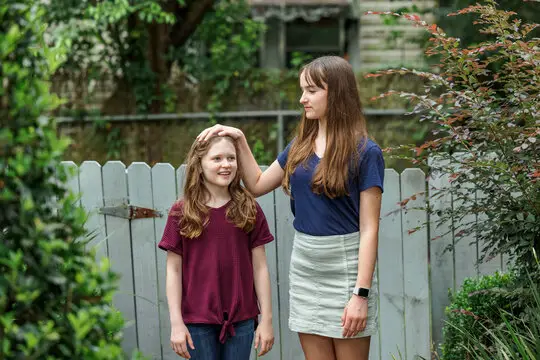
My sister Becca was twelve and slept like the dead, buried under blankets with just her dark hair visible. Waking her quietly would be nearly impossible, but waking her loudly would alert Mom downstairs.
I knelt beside her bed and pressed my hand over her mouth before shaking her shoulder. Her eyes flew open in panic, and I felt her try to scream against my palm.
I put my finger to my lips and whispered directly into her ear. “Dad sent an emergency message. We need to leave right now without Mom knowing. I’ll explain everything once we’re safe. Trust me.”
Becca’s eyes were huge—the particular hugeness of a twelve-year-old whose world has just tilted without warning—but she nodded against my hand. I released her and she sat up, reaching for her glasses on the nightstand with the automatic precision of a girl who can’t see beyond arm’s length without them.
I pressed clothes into her hands. She pulled them on over her pajamas, hands shaking, and I stuffed her feet into the nearest shoes without tying the laces.
The window in Becca’s room faced the backyard. I’d removed the screen dozens of times for sneaking out to meet friends—a skill I’d never imagined would matter beyond avoiding curfew. I popped it free and looked down at the eight-foot drop to the garden below.
I threw both our backpacks out first, then helped Becca through the window frame. She hesitated at the edge, looking down with visible fear—not fear of the height, but fear of everything the height represented: the fact that we were climbing out of our own house in the dark because our father had told us to run from our mother.
I gripped her wrists and lowered her as far as I could reach before letting go. She fell the remaining four feet with a muted thump that sounded explosively loud in the quiet night.
I followed, dropping and rolling, my ankle twisting slightly on landing but holding my weight. Becca was staring at me with questions written across her face, but I grabbed her hand and pulled her toward the back fence.
We scaled it by stepping on the decorative crossbeam. Becca struggled with the height, but I coached her through—one hand on the top rail, step up, swing your leg over, I’ve got you—catching her when she dropped down on the other side. We ran through three backyards before emerging onto a street two blocks from our house, both of us breathing hard, both of us suddenly aware that we were standing in the cold at two in the morning with nowhere to go and no understanding of why we’d left.
The neighborhood looked different at night. The houses I’d grown up walking past—the Hendersons’ place with the overtended garden, the Morrisons’ perpetual Christmas lights, the vacant lot where kids used to build bike jumps—all of it looked foreign, as if Dad’s text had rearranged not just my understanding of my family but my understanding of the geography surrounding it. Everything familiar had become unfamiliar, because the person who’d made it familiar was the person I’d just been told not to trust.
I pulled out my phone and read Dad’s message again, looking for details I’d missed. The timestamp showed 2:03 a.m. No follow-up messages. No missed calls. Just those twelve words hanging in digital space like a grenade with the pin already pulled.
I tried calling him. Straight to voicemail. His professional outgoing message—calm, measured, the voice of the man I knew—was incongruous with the emergency he’d declared. His phone was off, which meant either he’d turned it off deliberately or someone had turned it off for him.
Becca was pulling on my sleeve. “What does he mean, don’t trust Mom? What’s happening?”
“I don’t know yet. But Dad wouldn’t say this unless it was serious.”
I was trying to sound calm and in control despite having no plan beyond the twenty-foot radius of streetlight we were standing in. Two teenage girls alone at two in the morning, running from one parent on the instructions of another, with nowhere to go and no way to contact the one who’d warned us.
My phone buzzed. Mom.
Where are you girls? I heard noises upstairs.
The casual tone felt wrong—like she was performing normalcy, the way you perform normalcy when you already know the answer to the question you’re asking.
Another text before I could respond: This isn’t funny. Come downstairs right now or I’m calling the police.
The threat landed strangely. What would she tell them—that her teenage daughters had left the house at night? We weren’t kidnapped. We’d left voluntarily. Unless Mom had reasons to want police involvement, reasons to force us back under official authority before we could talk to anyone about Dad’s message.
I kept walking, pulling Becca toward the twenty-four-hour convenience store three blocks away. Lights. Potential witnesses. Minimal safety while I figured out next steps.
The convenience store was nearly empty—a bored clerk behind bulletproof glass, fluorescent lights humming, the smell of old coffee and floor cleaner. Becca and I huddled in the back corner near the refrigerated drinks, two girls in mismatched clothes with untied shoes, trying to look casual at an hour when nothing about our presence was casual.
I called Dad again. Voicemail. I texted him: We got out. Where are you? What’s happening? Please call.
The message sat there, delivered but unread, a green bubble floating in digital space between a daughter and a father who might already be beyond reaching. I stared at it and tried not to think about why his phone was off, tried not to run the scenarios that a lifetime of crime documentaries—Mom’s crime documentaries, I realized with a chill—had equipped me to imagine.
My phone rang. Mom’s name on the screen. I stared at it through three rings before answering on speaker so Becca could hear.
“Where are you? What’s going on?” Mom’s voice was tight with barely controlled emotion. “I wake up and both my daughters are gone, windows open—you’re scaring me, honey.”
She sounded genuinely frightened. Nothing in her tone suggested danger. But Dad’s message kept echoing—the urgency, the specificity.
“Dad texted us,” I said carefully. “He said to leave the house and not trust you. We need to know why.”
The silence stretched long enough that I thought the call had dropped. Then Mom laughed—a brittle sound that raised every hair on my neck, because it wasn’t the laugh of someone who’d just heard something absurd. It was the laugh of someone who’d just heard something inconvenient.
“Your father texted you at two in the morning telling you to run from me? That’s insane. He’s in Seattle, probably drunk at some hotel bar.”
But I’d never seen Dad drunk. He barely drank at parties. And the message hadn’t read drunk. It had read terrified.
“Why would he specifically say not to trust you?” I asked. “What’s he afraid you’re going to do?”
Mom’s breathing changed—faster, shallower—and when she spoke again, her voice had transformed into something harder, something I recognized from watching her negotiate real estate deals: the voice she used when a situation was slipping away from her and she needed to regain control.
“Listen to me carefully. Your father is having some kind of mental break. He’s been paranoid for weeks, accusing me of things that aren’t true. I didn’t want to worry you, but he’s been seeing a therapist for delusions. Whatever he told you is part of that. Come home right now so we can handle this as a family.”
The explanation was reasonable—except for the timing. If Dad had been delusional for weeks, why send the emergency text tonight? Why was his phone off? And why did Mom’s voice sound like a performance of concern rather than the real thing?
“I want to talk to Dad first,” I said. “I want to hear from him that the message was a mistake. Then we’ll come home.”
I heard movement on her end—footsteps, the jingle of car keys.
“Fine. Stay where you are and I’ll come get you. Where are you exactly?”
Every instinct I had screamed not to answer. “We’re at a friend’s house. We’ll come home when we’ve talked to Dad.”
I hung up before she could respond and powered off my phone. Becca did the same without being asked—both of us operating on the same frequency of distrust, the shared understanding of sisters who can read each other’s fear without translation.
We needed to move. I grabbed two water bottles, paid with cash, and we stepped outside.
Becca grabbed my arm. A car was driving slowly down the street, headlights off, moving like it was searching.
Mom’s silver SUV. I recognized it from two blocks away—the car she drove to her real estate office and soccer practices. She was hunting for us, and she’d either guessed our direction or tracked our phones before we’d powered them off.
We ducked behind a parked truck and watched the SUV cruise past. Mom’s face was illuminated by her phone screen, and the expression I saw—calculated, focused, without any trace of the worried-mother voice she’d used on the phone—confirmed everything Dad’s message had implied.
That wasn’t a mother looking for lost children. That was a woman looking for a problem to contain.
She turned the corner and we ran.
We ran low behind parked cars to the next intersection. A bus stop shelter provided temporary cover, and I powered my phone back on just long enough to check for messages.
Most were from Mom, escalating from confused to angry to threatening. But one was from an unknown number, and when I read it, the ground shifted under me.
This is Special Agent Victoria Reeves with the FBI. Your father asked me to contact you if anything happened to him. Call this number immediately from a secure line. Do not go home. Do not trust local police.
FBI. The word sat in my mind like a stone dropped into still water, ripples spreading outward into every assumption I’d held about my family, my mother, my life.
Becca read over my shoulder and went pale. “Why would Dad be talking to the FBI? What did Mom do?”
I found a pay phone at the strip mall across the street—an artifact from another era that suddenly felt like the most secure technology available. A woman answered on the second ring, her voice professional and alert despite the hour.
“This is Agent Reeves. Who am I speaking with?”
“Zoe Brennan. You sent a message about my father, Kevin Brennan. He texted us tonight to leave and not trust our mother. We need to know what’s happening.”
Keyboard clicking in the background. Files being pulled up. A life being verified through data.
“Your father has been cooperating with a federal investigation into financial crimes for three months,” Reeves said. “He discovered evidence that your mother is involved in a sophisticated fraud scheme—money laundering through her real estate business. We’ve been building a case, but tonight our surveillance team lost contact with your father. His last communication was sending you that text before his phone went dark.”
The words landed like physical blows. I grabbed the pay phone cradle to steady myself while the fluorescent light of the strip mall buzzed overhead like a dentist’s drill.
Mom wasn’t having marital problems or acting strange. She was a criminal under federal investigation, and Dad had been secretly gathering evidence against his own wife—living in the same house, eating at the same table, sleeping in the same bed as the woman he was building a case to imprison, while maintaining the performance of normalcy so completely that his own daughters hadn’t noticed.
“Where is he?” I asked. “Is he safe?”
Reeves hesitated—the particular hesitation of someone choosing between honesty and mercy. “We don’t know. He was supposed to check in three hours ago from his hotel in Seattle and didn’t. His phone went offline. We have agents at the hotel now, but his failure to communicate combined with that text to you suggests he believed himself to be in immediate danger.”
“What kind of danger?”
“The people your mother works with don’t leave witnesses if they think their operation is compromised. If they learned your father was cooperating, he’d become a liability. And if they’ve gotten to him—” she paused, and I could tell she was calculating how much truth a seventeen-year-old could absorb at two-thirty in the morning, “—you and your sister are potential witnesses who could identify associates. That’s why his message told you to run.”
The full weight of it settled over me. We weren’t running from family dysfunction. We weren’t navigating a divorce or a mental health crisis. We were running from people who eliminated witnesses to financial crimes, and our mother was one of them.
Becca was gripping my sleeve so tight her knuckles were white. She’d been listening to my half of the conversation—hearing every pause, every shift in my voice—and her face had the expression of a child who has just learned that the person who made her breakfast this morning is the person she needs to hide from tonight.
Reeves gave me an address for an FBI field office thirty minutes north. “Get there without using credit cards or phones except for emergencies. If you see your mother, call 911 immediately. I’m dispatching agents, but they’re forty-five minutes out.”
A taxi company operated across the street. The driver was annoyed at being woken, but he pocketed the cash and pulled out of the lot.
We’d made it three miles when headlights appeared behind us, coming up fast.
“Someone’s tailing us,” the driver said. “Probably drunk idiots.”
I twisted around and recognized the silver SUV. Close enough now to see her face through the windshield—set, determined, stripped of every maternal expression I’d ever associated with it.
“That’s our mother,” I said. “She’s dangerous. We need to lose her.”
The driver looked at me like I was insane—right up until the SUV rammed us from behind, hard enough to throw both Becca and me forward against the front seats.
He swore and floored it. Mom hit us again. We were on a semi-rural road with no traffic—exactly the wrong place for what was happening. Mom pulled alongside and I could see her clearly now, her face twisted into something I didn’t recognize: the face of a woman who had spent years building an operation worth millions and who was watching it unravel because her husband had developed a conscience and her daughters had believed him.
She slammed into our passenger side, trying to force us off the road. The driver swerved wildly. Becca was screaming—not the kind of screaming you do on a roller coaster, but the screaming of a child who has just understood that her mother is trying to hurt her, that the hands which braided her hair this morning are connected to the same person ramming a car at sixty miles an hour. I was on my phone shouting our location to a 911 dispatcher who kept asking me to slow down and repeat myself, as if emergencies came with volume controls and pause buttons.
One final hard slam and the taxi spun—rotating twice before sliding into a shallow ditch. The impact threw us against our seat belts. My head hit the window hard enough to see stars. The driver slumped over the steering wheel. Becca was crying beside me, a thin keening sound that didn’t seem to come from her throat but from somewhere deeper, somewhere that had just broken.
Through the cracked windshield, I watched Mom’s SUV screech to a stop. She climbed out and walked toward us with purpose—not running, not panicking. Walking. The calm, measured stride of a woman who had dealt with problems before and knew how to deal with this one.
I kicked open the far door, grabbed Becca, and dragged her into the drainage ditch running alongside the road. We ran through brush and darkness while Mom shouted behind us.
“Girls, stop! I’m trying to protect you! The FBI is lying. Your father is lying. I just need to talk to you.”
But her actions didn’t match her words. You don’t ram a taxi carrying your children off the road and then claim you’re protecting them. You don’t hunt your daughters through the dark with the focused determination of a woman who has decided that family is a problem to be managed rather than a relationship to be honored.
The ditch connected to a culvert under the road. We crawled through it—muddy, scraped, Becca’s breathing ragged with sobs—and emerged on the other side just as sirens became audible in the distance.
Mom heard them too. Her shouting stopped. Her SUV engine started. Tires squealed as she fled.
Police arrived with lights flashing. We emerged from the culvert with hands raised, and I explained everything in a rush while Becca pressed against my shoulder. The officer looked skeptical until I mentioned Agent Reeves by name and showed him Dad’s text. His expression changed. He radioed something coded and told us to wait in his patrol car.
Twenty minutes later, black SUVs arrived. Agent Reeves was a woman in her forties with sharp eyes and the bearing of someone who’d seen too much to be surprised by anything, but who hadn’t let that make her cold.
She wrapped emergency blankets around both of us and said immediately: “Your father is alive.”
Something in my chest unclenched so violently I nearly buckled.
“He was attacked in his hotel room tonight but fought off his assailants and escaped. He’s in protective custody. Your mother’s associates failed to reach him, so they shifted to you—probably hoping to use you as leverage to prevent his testimony.”
“Where is she?” I asked. “Did you arrest her?”
Reeves shook her head. “She fled before police could detain her. We have warrants for attempted murder, assault, fraud, and a dozen other charges. Every agency in the state is looking for her.”
Dad arrived at the field office around dawn, looking worse than I’d ever seen him—face bruised, left arm in a sling, moving like his ribs hurt, wearing clothes that weren’t his because his had been taken as evidence. But when he saw us in the conference room—two girls wrapped in emergency blankets, drinking bad coffee, alive and unharmed in a building full of federal agents—he broke down completely, pulling both of us into a careful hug that favored his injured ribs but didn’t let go, that lasted so long the agent standing in the doorway looked away to give us privacy.
“I’m so sorry,” he kept saying into our hair. “I thought I could handle it quietly. I thought I could protect you without you ever knowing.”
Becca was sobbing so hard she couldn’t speak. I held onto him and felt, for the first time since his text had lit up my phone in the dark, the specific relief of a body that has been running on adrenaline for hours and has finally been given permission to stop.
The full story emerged over the next hours, told in fragments between cups of terrible coffee and long silences where Dad stared at the table like it might contain answers to questions he’d been asking himself for months.
Mom had been running a real estate fraud scheme for five years—using her license to launder money for a criminal organization, moving millions through shell companies and inflated property transactions. Dad discovered evidence by accident while helping her with a tax filing. He found communications that made it clear she wasn’t peripheral to the operation. She was central.
He’d gone to the FBI rather than confronting her, because confronting a woman connected to people who eliminated liabilities wasn’t a conversation—it was a death sentence. He’d spent three months gathering evidence while sleeping beside the person he was building a case against, eating dinner with her, watching her help Becca with homework, listening to her laugh at television shows while his laptop held files that would put her in prison for decades.
“She was never planning to hurt you directly,” Dad said, his voice breaking on the word directly, as if the qualifier made it better. “She wanted to grab you before the FBI could—before you could talk to anyone about what I’d been doing. When you ran, when you didn’t come home, she panicked. The woman who chased you tonight wasn’t your mother protecting her children. She was a criminal protecting her operation.”
I thought about the woman who’d helped me with college applications two weeks ago. Who’d made pancakes on Sunday. Who’d asked about my chemistry exam and listened to my answer with what I’d believed was genuine interest.
“Was any of it real?” I asked, and the question wasn’t really about the pancakes.
Dad closed his eyes. “I’ve been asking myself that for three months. I think parts of it were. I think she loved you in whatever way she was capable of. But there was always something underneath—something she was building that mattered more to her than the family she’d built on top of it.”
Becca, who’d been silent for hours, spoke for the first time. “She made me a birthday cake last month. From scratch. She spent all day on it.”
Dad looked at her, and the pain on his face was the pain of a man who understood that his daughter was trying to reconcile a birthday cake with a woman who’d rammed a taxi off the road, and that the reconciliation was impossible, and that Becca would spend years trying anyway.
“I know,” he said. “I know she did.”
The trial happened eight months later.
Mom was arrested at the Canadian border with false documents and substantial cash—still running, still calculating, still treating escape as a logistics problem rather than a moral one. She’d been living under a false name in a rented apartment in Montreal, working as a real estate consultant for a company that didn’t know her real identity. Even in hiding, even with her family destroyed and her operation dismantled, she’d gravitated back to the same industry, the same skills, the same fundamental pattern of turning property into profit through channels that wouldn’t bear scrutiny. She couldn’t stop being what she was. The performance was the person.
The evidence Dad and the FBI had gathered was overwhelming: years of fraud and money laundering involving millions of dollars, seventeen co-conspirators, and a trail of documentation so thorough that her defense attorney’s strategy amounted to challenging procedure rather than disputing facts. The prosecutor laid out the scheme in clinical detail—shell companies, inflated appraisals, wire transfers routed through six states and two countries—and as each exhibit was entered into evidence, I watched the courtroom slowly understand what Dad had understood alone for three months: that the suburban real estate agent with the good hair and the PTA involvement had been running an operation sophisticated enough to move twelve million dollars without triggering a single alarm.
She received twenty-five years. The longest sentence of any defendant in the case—not just for the fraud, but for the attempted murder charges from the night she’d tried to run us off the road. The night she’d chosen her operation over her daughters and made the choice visible in a way that couldn’t be explained away or softened into something survivable.
She never looked at us during the trial. Not once. Not during Dad’s two days of testimony, when his voice cracked describing how he’d found the first suspicious file. Not during the victim impact statements, when Becca read a letter she’d written in her therapist’s office about what it felt like to learn that safety was a costume someone had been wearing. Not when the sentence was read and the courtroom exhaled and the gavel came down on twenty-five years of consequences for a life built on the conviction that consequences were for other people. The woman in the defendant’s chair was a stranger wearing my mother’s face, and I understood finally that we’d been living with a performance our entire lives—that the mother I remembered was a character played by a woman whose real life happened in accounts and transactions and meetings we were never meant to know about.
Dad testified for two days with steady voice and visible pain, describing how he’d fallen in love with someone who didn’t exist—a role performed so convincingly that even the person sleeping beside her hadn’t seen through it until a tax filing revealed the architecture underneath.
Becca and I sat in the gallery and watched our family be entered into the public record as evidence. Exhibit A through whatever letter they’d reached by the end—each one a piece of the life we’d thought was ours, reframed as a piece of someone else’s crime.
We live with Dad now, in a different state, under partial witness protection. Not full relocation—no new names, no erased histories—but enough security that we sleep without listening for car engines in the driveway.
Becca keeps her bedroom window locked. She checks it before bed every night, a ritual she performs with the careful attention of someone who learned at twelve that open windows mean escape routes and escape routes mean your life has a shape you didn’t choose.
I’m in college now—pre-law, because watching the legal system process my mother’s crimes taught me something about the distance between what people do and what happens to them for doing it, and I want to understand that distance better. I want to stand in it and make it smaller.
Dad is rebuilding his consulting business in the new city, working from a home office where he can hear us come and go, where the front door is always in his sight line. He blames himself—not for cooperating with the FBI, but for not seeing the truth sooner, for building a life with someone whose life was built on lies, for exposing us to danger that existed long before we knew about it.
I tell him what I’ve learned in therapy, which is that you can’t protect people from things you don’t know exist, and that the courage it took to go to the FBI when he found out—to risk everything, including the family he loved, because the truth was more important than the comfort of pretending—was the thing that saved us. Not just physically, not just legally, but in the way that matters most: he taught us that when the world splits open at two in the morning and everything you believed turns out to be built on someone else’s crime, the right thing to do is grab the people you love and run toward the truth, even when the truth is the hardest direction to face.
Becca asked me once if I ever think about what would have happened if I hadn’t believed Dad’s text. If I’d assumed he was drunk, or delusional, or overreacting—if I’d gone back to sleep and let the message sit unanswered until morning.
I think about it all the time. I think about how close we came to being leverage instead of witnesses, collateral instead of survivors. I think about how twelve words on a phone screen at two in the morning were the difference between the life we have now and a life I can’t bear to imagine.
And I think about my father—bruised, arm in a sling, standing in an FBI conference room at dawn, pulling his daughters into a hug that said everything his carefully measured words never could: that love isn’t a performance. That it doesn’t launder. That the real thing—the imperfect, terrified, middle-of-the-night version—looks like a man sending a text he prayed his daughter would trust, and a daughter who did.
THE END.

Lila Hart is a dedicated Digital Archivist and Research Specialist with a keen eye for preserving and curating meaningful content. At TheArchivists, she specializes in organizing and managing digital archives, ensuring that valuable stories and historical moments are accessible for generations to come.
Lila earned her degree in History and Archival Studies from the University of Edinburgh, where she cultivated her passion for documenting the past and preserving cultural heritage. Her expertise lies in combining traditional archival techniques with modern digital tools, allowing her to create comprehensive and engaging collections that resonate with audiences worldwide.
At TheArchivists, Lila is known for her meticulous attention to detail and her ability to uncover hidden gems within extensive archives. Her work is praised for its depth, authenticity, and contribution to the preservation of knowledge in the digital age.
Driven by a commitment to preserving stories that matter, Lila is passionate about exploring the intersection of history and technology. Her goal is to ensure that every piece of content she handles reflects the richness of human experiences and remains a source of inspiration for years to come.