Not All Doors Open Just Because You Brought a Key
There is a moment, arriving home after a long day of work, when you turn the key in your own front door and feel — before you’ve seen anything, before your eyes have registered a single detail out of place — that something is wrong. It’s a sensation more instinct than thought, the way an animal knows before it knows. The air carries a different weight. There’s a scent that doesn’t belong. A quality of stillness that isn’t the stillness you left behind that morning.
That moment happened to me on an otherwise unremarkable Tuesday, and by the time I finished processing what I was looking at, everything I thought I understood about trust, family, and the meaning of home had started to shift beneath my feet.
This is the story of what I did next. And what happened after that. And what it cost me, and what it gave me, and what I finally learned about the difference between a key and permission.
Part One: Who I Am and What Home Meant to Me
My name is Alicia Bennett. I’m thirty-four years old, and I have been taking care of myself, in one way or another, since I was nineteen.
That’s not a complaint. It’s just context. Some people grow up in families where the current flows toward them — resources, encouragement, the quiet assumption that their needs will be considered. Others grow up learning early to build their own current. I was the second kind, and while that kind of upbringing leaves marks, it also produces a particular clarity about what you’ve earned and what it means to you.
The house was the most concrete expression of that clarity I had ever managed to produce.
I bought it at thirty-one, after four years of disciplined savings that required choices I won’t pretend were comfortable. I gave up things. I made decisions that other people my age considered unnecessarily austere. I drove the car with the rust along the wheel wells for two years past the point when it would have been reasonable to replace it. I packed lunches for work with a consistency that my coworkers found both admirable and slightly tragic. I declined vacations. I said no to things that would have made the years feel lighter.
But I was building toward something, and I knew what it was: four walls that were mine. A space where no one could rearrange things without my knowledge, where the decisions about what came through the front door were mine to make, where the particular peace I had been chasing my entire adult life could finally exist in a physical form.
When I closed on the house, I sat in the empty living room on moving day — before the furniture came, before anything was arranged — and felt something I had never quite felt before. It was such a specific feeling that I’ve spent considerable time since trying to describe it accurately.
It felt like arriving somewhere I had been trying to reach for a very long time.
I spent the first year making it mine in every sense of the word. Not extravagantly — I had paid for the house and wanted to continue paying it off responsibly, so I worked within constraints. But thoughtfully. The paint colors were chosen over the course of several weekends, tested in small patches against the walls in different lights, morning light and afternoon light and the particular honey-colored light of early evenings in fall. The furniture was accumulated gradually, each piece selected because it belonged in the specific life I was building rather than because it was available or cheap or whatever someone else had decided I should have.
The kitchen became my particular obsession. I cooked in a way that required space and order, and I organized it with the seriousness of someone who understands that the quality of daily life is made and unmade in small, repeated rituals. The coffee station was positioned near the window that caught the morning light. The knives were arranged by size. The herbs I grew in small pots on the sill and tended with the quiet attention that people give to things they have decided to keep alive.
This house was not just real estate. It was the physical embodiment of fifteen years of choices. Of the version of myself I had worked very hard to become.
And I gave my mother a spare key, because that’s what you do. You give your mother a spare key. It’s what trust looks like in material form — a small piece of metal that says: I believe in your judgment. I believe you would only use this for the right reasons. I believe that this access is for emergencies, for the kinds of moments that life occasionally produces when being able to get inside quickly matters, not for anything else, never for anything else.
I should have been more specific about what “emergencies” meant.
Part Two: Rachel
My sister Rachel is three years younger than me and has always occupied a different position in our family’s geography. This is not bitterness — it’s just accurate. Every family has its arrangements, its allocations of attention and energy, and ours was no different in having them, only in the particular shape they took.
Rachel is charming in the way that certain people are charming — genuinely, effortlessly, with a warmth that makes people want to help her. This is a gift, and I don’t say that dismissively. But charm, as a primary survival strategy, has a structural weakness: it optimizes for getting other people to solve your problems rather than developing the capacity to solve them yourself. And over time, this creates a pattern where the charming person moves from one form of support to the next, each transition managed smoothly and with good feeling all around, and the people providing the support come to feel that this is simply how things are.
Rachel had been living with our mother for the previous eight months. Before that, she’d been in an apartment with two roommates — a situation that had dissolved under circumstances that were complex in their telling and simple in their outcome: she needed somewhere to go, and our mother’s house was the answer.
I knew, in the abstract, that this arrangement had its limits. My mother’s house was not large. Their relationship had always been close in a way that became, at close quarters and over extended time, somewhat combustible. I had heard versions of their friction in phone calls over those eight months — not dramatic blow-ups, just the accumulated static of two people living together who had different ideas about noise and schedules and how dishes should be washed.
What I did not know was that my house had entered the conversation as a solution to this friction.
What I did not know was that my spare key had been considered, evaluated, and deployed — all without my name on any part of that discussion.
What I did not know, until I stood in my own doorway and smelled Rachel’s floral perfume in the hall, was that someone had already decided.
Part Three: The Boxes
RACHEL.
Written in bold black marker on the side of a cardboard box that sat beside my sofa like it had been there for years and intended to stay.
I stood in my doorway and catalogued what I was seeing with a kind of careful, deliberate attention — the way you look at something when you need to be very sure of what you’re seeing before you react to it. The boxes stacked neatly, as though the neatness conferred some kind of legitimacy. The shoes by the entry rug, a pair of ankle boots I recognized from a birthday dinner two years ago. The faint floral perfume that had been Rachel’s signature since we were teenagers.
I did not raise my voice. I want to be clear about this because it’s important to the story, and because it was important to me in that moment. There was a version of this moment that could have involved shouting, that could have become an immediate eruption of the anger that was absolutely present and absolutely justified. I chose not to go there, not because I wasn’t feeling it, but because I had learned — slowly and through experience — that eruption is expensive. It costs you clarity. It gives the other party something to respond to, something to manage, something to characterize later as overreaction. Silence, by contrast, is a form of power that most people don’t recognize as such until it’s being used on them.
So I set my keys down on the entry table — slowly, deliberately, making contact with the surface in a way that communicated exactly as much as I needed it to communicate — and I waited.
A drawer opened somewhere in the house. A soft clink of ceramic on wood, someone setting down a mug on my kitchen table. Small sounds that had no business existing in my space.
Rachel appeared first from the hallway. She was in leggings and a sweatshirt, the universal uniform of someone who has already unpacked and made themselves comfortable — who has already, at some cellular level, decided they live here now. She looked at me with an expression that occupied the strange territory between guilty and inconvenienced.
My mother was right behind her, holding a blanket she had taken from my linen closet. My linen closet, which she would only know to look in if she had made herself quite at home during whatever period they had been here before I arrived.
She lifted her chin when she saw me. Aimed for casual.
“You’re home early.”
This was incorrect — I was home at my usual time — but I recognized the strategy immediately. It’s a very old one: reframe the wronged party as the disruptive element. Make the person who has just walked into her own home feel like the one who has arrived unexpectedly, who is creating inconvenience, who needs to adjust.
I didn’t engage with it.
“Why are your boxes here?” I asked.
My mother’s voice shifted into the smooth, reasonable register she uses when she has already made a decision and is delivering it for ratification rather than discussion. It’s a tone I have known my entire life — calm, certain, slightly exhausted by the need to explain something obvious.
“Rachel’s going to stay for a while,” she said. “It just makes sense.”
Rachel lifted one shoulder in a half-shrug that was either agreement or detachment, it was impossible to tell which.
“Mom said it was handled,” she offered.
The word “handled” sat in the air of my living room for a moment while I processed it. Handled. As though my home were a logistics problem that required management. As though the appropriate steps had been taken and the outcome was simply a matter of everyone accepting the conclusion.
I looked at both of them — my mother with her borrowed blanket, my sister in her comfortable leggings — and felt something happen inside me. Not explosion. Not the hot surge of anger that the situation would have fully justified. Something quieter than that, and in certain ways more powerful.
Clarity.
The kind of clarity that comes when a situation strips away all ambiguity and reveals itself in its actual, unadorned form. There was no complexity here. There was no nuance I was missing. My home had been entered without my permission, occupied without my consent, and arranged around an outcome I had not agreed to. The people who had done this were standing in front of me, holding my blanket and waiting for me to accept the situation as handled.
“This is my house,” I said. Even. Steady. Not loud. “You don’t get to arrange my home for me.”
My mother exhaled through her nose, the exhalation of a person whose patience is being tested by someone else’s failure to grasp the obvious.
“Don’t make this dramatic,” she said.
Part Four: The Call
I did not argue.
This is the part that surprises people when I tell this story. They expect — reasonably, given the circumstances — that what followed was a confrontation. An escalation. That I matched my mother’s certainty with my own, that voices were raised, that the conversation became one of those grinding family arguments that moves in circles and resolves nothing and leaves everyone feeling worn down and righteously aggrieved.
None of that happened.
Because I had learned — and this is perhaps the most important thing I have learned in my adult life — that some arguments cannot be won through argument. They can only be resolved through documentation.
I picked up my phone. I made a call. I was calm and factual and gave the necessary information without theater, without drama, without any of the emotional performance that my mother was waiting for and had already prepared her response to. Just the relevant facts, stated clearly, to the relevant party.
When I ended the call, Rachel was staring at me with an expression I hadn’t seen on her face before. Something between shock and disbelief, a rearranging of her understanding of who her sister was.
“You’d do that to your own family?” she said.
I met her eyes.
“I’m protecting my space,” I said. “That’s all.”
The truth is that the question itself revealed everything about how she understood the situation, and how I understood it differently. From her perspective, I was doing something to my family — taking an action directed against them, using mechanisms of authority against people who loved me. From my perspective, I was doing something for myself: asserting, through the only means available in that moment, that the boundaries of my home were real and had consequences.
These are not the same thing, even though they look similar from the outside.
That night, they left. Not explosively — there was no scene, no screaming, no dramatic exit. Just the careful, quiet process of boxes being moved back to the car, shoes gathered from the entry rug, my mother’s borrowed blanket returned to the linen closet. Someone explained to them, gently and with full clarity, that a spare key is access for emergencies, not open-ended permission. That entering someone’s home and establishing occupancy without their consent is not something that family relation excuses.
They heard this. They complied with it. My mother’s expression, when she finally walked out my front door, was unreadable — the face of a woman who had expected one kind of evening and received a different kind entirely.
I thought, watching the taillights disappear down my street, that this was finished.
I was wrong.
Part Five: Two Days Later
I am a light sleeper. I have been a light sleeper my entire adult life — a function, I’ve always assumed, of the years when I was responsible for getting myself up and to school and later to work without anyone else managing those logistics for me. My body learned early to stay lightly connected to consciousness, the way a person keeps one hand on a rope in uncertain water.
So when I heard the sound at my front door on the morning two days later, I was awake before I could have told you what woke me.
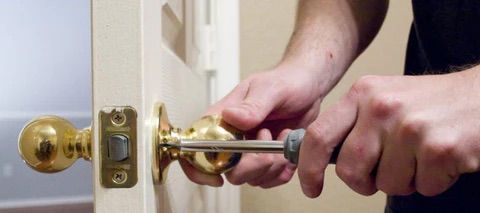
Metal on metal. Measured. Patient. The sound of a tool being applied to a lock with professional purpose.
I lay still for approximately three seconds, processing what I was hearing and what it meant. Then I picked up my phone from the nightstand, opened the doorbell camera app, and looked at the screen.
My mother was on my porch. She was standing slightly to the left of the door, holding herself with the posture of someone who has arrived for a scheduled appointment — not furtive, not hurried, but deliberate and composed. Beside her stood a man with a bag of tools, currently engaged with my front door lock with the focused attention of a professional doing a job he’d been hired to do.
She had brought a locksmith.
Let me be clear about what this means, because I think it’s important to say it plainly: my mother had decided, two days after being asked to leave my home, to attempt to have my lock changed. To have the lock on my door — the door that led to the home I owned and paid for and had spent years working to make mine — replaced with one for which she would have the key.
The plan, as I understood it in that moment, was remarkably bold in its simplicity. If the key she had didn’t work after last time, she would arrange for a new situation in which it did. If access could not be assumed, she would manufacture it. Because — and this is the part that still takes my breath slightly when I think about it — she still, fundamentally, believed she was entitled to it.
I got up. I went to the kitchen. I turned on the coffee maker and stood at the window that looks out toward the front porch, the one that is set back enough that I can see without being easily seen.
I watched my mother on my porch with her locksmith. I drank my coffee. And I made a phone call.
Part Six: Questions on the Porch
The thing about authority is that it has a particular effect on situations that are built on assumed privilege. When you are operating on the assumption that you are entitled to do what you’re doing — that your relationship, your history, your conviction that you know best grants you some special dispensation from the rules that apply to other people — you rarely think through what happens when those rules arrive in person and start asking questions.
My mother had not thought through what happened next.
She was still on the porch, the locksmith still working, when the nature of the morning changed. I watched from my window as my mother’s posture shifted — the composed, appointment-keeping certainty giving way to something more cautious. She was now the one answering questions. Explaining her presence. Providing her name, her relationship to the property, the basis on which she believed she had the authority to authorize changes to the locks of a home she did not own.
The locksmith had stopped working. He was standing with his tools, listening to the exchange with the practiced neutrality of a professional who has learned not to be in the middle of situations whose dimensions are becoming clearer.
I sipped my coffee.
There is something I want to say carefully here, because I am aware of how this moment could be read — as triumphant, as the satisfying reversal of a power dynamic, as a scene designed to produce the feeling of vindication. I’m not going to pretend that there wasn’t something in it that felt, in some specific way, like resolution. That watching my mother on my porch, in the position of the one who had to explain and justify, rather than the one who arrived with decisions already made, didn’t produce some feeling of being seen in a way I hadn’t been seen before.
But the predominant feeling, standing there at my kitchen window with my coffee, was something quieter. Something closer to grief than triumph. This was my mother. This was someone I loved, who I had once handed a small piece of metal as a gesture of trust, who I had believed would understand what that gesture meant. The fact that I was watching her on my porch like this, that it had come to this, was not something I celebrated.
It was something I mourned, a little, even as I recognized that I had done what I needed to do.
Part Seven: The Conversation We’d Never Had
My mother looked up at some point — looked up toward the window where I was standing — and saw me.
I didn’t move. I didn’t gesture or make any expression I was aware of. I just stood there with my coffee and met her eyes through the glass. And I watched something happen in her face that I had not seen there before.
Not anger. Not defiance. Not the particular expression she wears when she believes she is managing a situation that requires her management.
Something else. Something that took a moment to name.
She was realizing something.
The locksmith packed his tools without having made any changes to my door. He left the porch and walked to his van with the careful pace of a professional who asks no further questions about jobs that have not, in the end, been completed. My mother stood on the porch for a moment after he left, alone now, looking at the door.
Then she rang the doorbell.
I set down my coffee. I walked to the front door and opened it, and we stood looking at each other through the storm door.
“Can I come in?” she asked.
It was the first time she had asked.
I pushed the storm door open and stepped back, and she came inside, and we sat in my living room — the one that, two days earlier, had been reorganized around boxes that weren’t mine — and had the conversation that probably should have happened years before. Maybe decades before.
She talked about Rachel. About the worry that accumulated in her as a mother watching one of her daughters move through life without the stability she wanted for her. About the way that worry, over time, had developed a kind of momentum — a need to solve, to fix, to arrange — that she had not always directed carefully.
She talked about me, too. About the ways she had, over the years, read my self-sufficiency as not needing her, as independence that closed a door she wanted kept open. About the ways she had perhaps confused her own access to my life with connection to it.
I listened. I said the things I needed to say, and I tried to say them without the edge they sometimes carried in my head, because she was telling me something genuine and it deserved a genuine response.
“The spare key was trust,” I said. “Not permission. Those are different things.”
She was quiet for a long time after that.
“I know that now,” she said.
Whether the conversation repaired anything permanently, I can’t tell you. Families are not problems that get solved; they’re relationships that get tended, or don’t, and even when they do get tended the work is ongoing and the progress is not linear. What I can tell you is that something shifted in the room that morning — something in the weight and distribution of things between us.
I gave her my new key before she left. The key to the new lock.
She looked at it in her palm for a moment, and I could see her understanding, fully and without any remaining ambiguity, what it meant and what it didn’t.
“For emergencies,” I said.
“For emergencies,” she agreed.
Part Eight: What Home Actually Means
Rachel found an apartment three weeks later. She called me about it — not our mother, me — and asked if I’d come look at it with her before she signed the lease. I went. It was a modest place, smaller than she was used to and in a neighborhood she’d previously have dismissed, but it had good light and solid walls and the kind of potential that you can only see if you’re willing to look past the current surface.
“It needs some work,” she said, standing in the empty living room.
“It has good bones,” I told her.
She laughed at that, uncertain why it was funny. I didn’t explain.
I helped her move in on a Saturday, and we ordered pizza afterward and sat on the floor of her new living room, surrounded by the organized chaos of beginning — boxes and tape and the particular smell of a space that hasn’t yet been lived in — and it was one of the better evenings I can remember with my sister.
There is something about watching someone claim a space for themselves, genuinely and for the first time, that is moving in a way that’s difficult to articulate. Rachel had always had places to land — our mother’s house, other people’s apartments, situations arranged by someone else’s logistics. This was different. This was a door with her name in the intercom. A key that was hers because she had signed papers and paid a deposit and made the choice to be responsible for what was behind it.
“How does it feel?” I asked her.
She looked around the room — at the boxes with her name on them, the shoes she’d kicked off near the entry, the pizza box on her floor.
“Like mine,” she said. There was a note of surprise in it, like the feeling had arrived before she expected it.
“That’s the only way anything ever really feels,” I told her. “When you’ve actually chosen it.”
Part Nine: The Door
There’s a philosophy I’ve developed, across the years and the experiences that led to that morning with the locksmith and everything before and after it, about what doors actually mean.
A door is not simply a physical object. It’s a declaration. It says: here is where outside becomes inside. Here is where public becomes private. Here is the line at which the world ends and a specific, protected space begins. Every door has someone on one side of it who has the right to decide who comes through, and everyone else on the other side who does not have that right regardless of how long they’ve known the person who lives there, regardless of how certain they are that they know what’s best, regardless of what key they may have acquired along the way.
I had handed my mother a key without having that philosophy clearly in place. Without having communicated, in the explicit way that apparently needed to happen, what that key meant and what it didn’t. I assumed she would understand, because the distinction seemed so obvious to me that I couldn’t imagine it being anything other than obvious.
But what seemed obvious to me — that access is not the same as authority, that a key is not the same as permission, that someone giving you the means to enter their space in an emergency has not given you the right to make decisions about it — was not obvious to everyone. To my mother, who had spent decades operating from the conviction that her role as a mother granted her certain dispensations when it came to her daughters’ lives, the spare key may have felt like something different. Like an acknowledgment that the door was, in some sense, still hers to use.
What changed on that morning, when she looked up from my porch and saw me standing at the window with my coffee, watching with the calm steadiness of someone who had already made her calls and knew exactly how things would proceed, was not just the immediate situation. What changed was that understanding.
Not all doors open just because you brought a key.
Some doors open only because the person inside chose to open them. And when you forget that — when you start treating access as something you own rather than something you’ve been given — the person inside will eventually remind you of the difference.
The way I reminded my mother. Not with raised voices. Not with anger, though the anger was there and was justified. Not with any of the dramatic performances that the situation might have seemed to call for.
With documentation. With a camera at my door. With calm phone calls made from the kitchen window while the coffee got cold. With the quiet, absolute certainty of someone who knows exactly what is hers, exactly why it is hers, and exactly what she is willing to do to protect it.
I still have the house. It’s more mine now than it has ever been — not in any legal sense, which was never in question, but in the way that places become ours through the events that happen in them, through the version of ourselves we discover we are capable of being when the moment calls for it.
The coffee station is still by the window that catches the morning light. The knives are still arranged by size. The herbs on the sill are still alive, still tended, still reaching toward whatever they’re reaching toward.
And the spare key I gave back to my mother, the new one, for emergencies — she has never once used it without asking first.
That, in the end, is what I was asking for all along.
Not war. Not estrangement. Not the severing of anything.
Just the asking.
THE END

Lila Hart is a dedicated Digital Archivist and Research Specialist with a keen eye for preserving and curating meaningful content. At TheArchivists, she specializes in organizing and managing digital archives, ensuring that valuable stories and historical moments are accessible for generations to come.
Lila earned her degree in History and Archival Studies from the University of Edinburgh, where she cultivated her passion for documenting the past and preserving cultural heritage. Her expertise lies in combining traditional archival techniques with modern digital tools, allowing her to create comprehensive and engaging collections that resonate with audiences worldwide.
At TheArchivists, Lila is known for her meticulous attention to detail and her ability to uncover hidden gems within extensive archives. Her work is praised for its depth, authenticity, and contribution to the preservation of knowledge in the digital age.
Driven by a commitment to preserving stories that matter, Lila is passionate about exploring the intersection of history and technology. Her goal is to ensure that every piece of content she handles reflects the richness of human experiences and remains a source of inspiration for years to come.