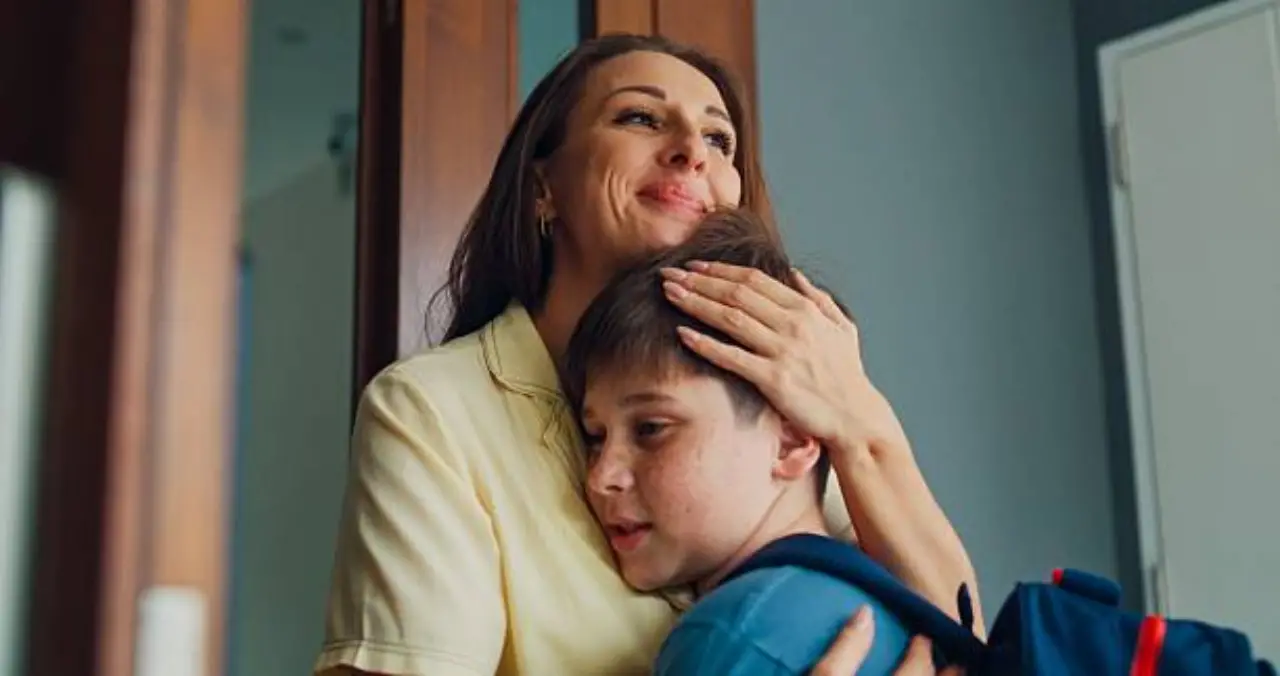
The afternoon had settled into the particular kind of dull exhaustion that makes you believe nothing remarkable can happen, because the worst challenge in front of you is a budget spreadsheet and the cold coffee you forgot to finish two hours ago. I was still at my desk in the downtown St. Louis office, still trying to reconcile quarterly projections that refused to balance, when my phone rang with an urgency that didn’t match the quiet around me.
Janice at reception never transferred calls without her cheerful preamble—even when she was annoyed, she maintained her bright professional veneer—so when her voice came through thin and careful, stripped of its usual warmth, my shoulders locked before she said anything useful.
“Megan, it’s Maple Grove Elementary. They said you need to come immediately.”
I stood so fast my chair hit the filing cabinet behind me. “What happened? Is Miles okay?”
“They wouldn’t tell me. They just said it’s urgent and you need to come now.”
The voice that came on the line next belonged to Dr. Patricia Kline, the principal I’d met twice at orientation events, a woman who radiated competent warmth and remembered every child’s name. But that warmth was gone now, replaced by the careful, measured tone people use when they’re trying to guide you across ice without letting you see how deep the water underneath might be.
“Mrs. Carroway, I need you to come to the school immediately. There’s been an emergency involving Miles.”
For one disorienting second, my brain refused the sentence entirely. Miles had been fine that morning—cheerful in his bright blue hoodie with the dinosaur on the front, humming a made-up theme song about velociraptors as he tied his sneakers. If something had been wrong, if he’d been sick or upset or in any kind of distress, I would have noticed. I would have known.
“Is he hurt?” The question came out steadier than I felt. “Dr. Kline, please—what happened?”
The pause lasted just long enough to scrape my nerves raw. “He is physically safe at this moment,” she said, each word placed with surgical precision. “But you need to be here now. Please drive carefully.”
I grabbed my purse and keys, told my supervisor I had an emergency without waiting for permission, and made it to my car without any clear memory of navigating the hallways or taking the elevator down. My hands shook as I started the engine.
The drive should have taken twelve minutes. It became a blur of traffic lights I barely registered and turns I couldn’t later recall, because my mind kept trying to construct scenarios that would make sense—a playground injury, a behavioral incident, anything with a clear resolution that didn’t involve the word “emergency” delivered in that particular tone of controlled alarm.
When I turned into the school parking lot, what I saw made my stomach drop with immediate, physical force.
Two ambulances sat near the main entrance, their lights silent but their presence unmistakable. A police cruiser was angled across the lane leading to the front doors as if the building itself needed protecting. Parents clustered near the fence in small, anxious groups, watching with faces that combined curiosity and fear—the look people wear when they know something terrible is happening but don’t yet know whose life it belongs to.
A uniformed officer waved me toward a space close to the entrance, and that small courtesy, that deliberate accommodation, made everything feel more real. It meant my name had been spoken multiple times, in serious voices, by people making decisions.
Dr. Kline met me at the doors before I’d fully stopped walking. She usually had the brisk, friendly energy of someone who genuinely loved working with children while maintaining perfect administrative control, but now she looked pale enough to blend into the beige hallway walls. Her hands hovered at her sides as if she didn’t know what to do with them.
“Mrs. Carroway.” She stepped close enough that our conversation would stay private. “Before we go any further, I need to ask you a very specific question, and I need you to think carefully about your answer.”
I nodded, though my throat had gone tight.
“Who made Miles’s lunch today?”
The question was so domestic, so ordinary compared to ambulances and police presence, that for a moment I couldn’t process why it mattered. “My mother-in-law,” I said. “Elaine. She watches him on Tuesdays and Thursdays, and she takes him to school those mornings.”
Something shifted in Dr. Kline’s expression—not relief, but confirmation, as if I’d just provided the piece of a puzzle that made the rest of it fall into a terrible, coherent picture.
“Please come with me.”
She guided me past the main office, past walls decorated with children’s artwork that suddenly looked painfully innocent, down a corridor I’d never walked before, to a small conference room with frosted glass and a door pulled mostly closed. Two police officers stood outside—one younger, one middle-aged with the steady bearing of someone who’d done this kind of work for years. The older one, a woman with silver at her temples and calm, intelligent eyes, stepped forward.
“Mrs. Carroway, I’m Sergeant Ramirez. Your son is in the nurse’s office being evaluated by paramedics as a precaution, but I want you to know first that he appears to be stable and unharmed.”
The relief that flooded through me was so intense I swayed slightly. Sergeant Ramirez’s hand moved toward my elbow but didn’t quite touch.
“Before you see him,” she continued, “we need you to look at something we found, and we need to ask you some questions about it.”
She opened the conference room door. The fluorescent lighting inside was harsh, reflecting off a long table where items had been laid out with the kind of careful organization you see in evidence photographs. Latex gloves sat beside sealed plastic bags. A camera rested on a tripod in the corner.
In the center of the table sat Miles’s lunchbox—the green one with the T-Rex on the front that he’d begged for because it looked, in his words, “like a dinosaur who protects snacks.”
It was surreal how quickly something familiar could become wrong simply because of where it was placed and who was looking at it.
“Did you pack this lunch yourself?” Sergeant Ramirez pulled on gloves as she spoke.
“No.” The word came out too quickly, defensive in a way I couldn’t control even though I hadn’t done anything wrong. “Elaine packed it. My mother-in-law. I dropped Miles at her house early this morning because I had a major presentation at work, and she offered to handle breakfast, lunch, and the school drop-off.”
Ramirez nodded once, processing. Then she unzipped the lunchbox with slow, methodical movements and began removing items one by one, laying them on the table as if the sequence mattered, as if there were protocols for approaching something that might have hurt your child.
A sandwich in a clear zipper bag. An apple. A juice pouch. A small plastic container that appeared to hold chocolate chip cookies.
Everything looked completely normal until Sergeant Ramirez opened the sandwich bag.
My breath stopped.
Between the slices of whole wheat bread, scattered across the turkey and cheese with a deliberateness that made my skin crawl, were small white tablets. Not crumbs. Not seasoning. Pills. Pressed into the layers of the sandwich as if they belonged there.
“Those are—” My voice came out strange, distant, like I was narrating a scene I didn’t understand. “Those are pills.”
“They appear to be prescription sedatives,” Ramirez said, her tone carefully neutral. “We’re having them analyzed, but preliminary identification suggests they’re a moderate-strength sleep aid. There were enough tablets here”—she paused, meeting my eyes—”to create a very dangerous situation for a child Miles’s age.”
The room tilted. I reached for the edge of the table, needing something solid.
Dr. Kline’s voice came from beside me, quiet and steady. “One of the lunch monitors noticed Miles hesitating before eating, and another student at his table pointed out that his sandwich ‘looked weird.’ The monitor investigated before he took a bite. That’s why we called you immediately.”
Relief crashed into horror with such force that my eyes burned. “He didn’t eat any of it?”
“Not that we can determine,” Ramirez said. “The paramedics are checking him thoroughly as a precaution, but right now he appears physically fine.”
“Who—” I couldn’t finish the sentence because my mind was still trying to reject what my eyes had seen. “Who would do this?”
“That’s what we’re trying to establish.” Ramirez’s gaze was steady, not unkind but absolutely unwavering. “You said your mother-in-law, Elaine Carroway, prepared and packed this lunch?”
“Yes. This morning. She was alone with him from seven-thirty until she dropped him off at eight-fifteen.”
“And no one else had access to the lunch between the time she packed it and the time Miles brought it to school?”
“Not that I know of.” My voice was shaking now. “Miles rode with her directly here. She would have put the lunchbox in his backpack herself.”
Sergeant Ramirez made a note. “We’re going to need to speak with Mrs. Elaine Carroway. Do you have her contact information?”
I pulled out my phone with hands that felt like they belonged to someone else and scrolled to Elaine’s number. As I read it aloud, the reality of what I was doing—giving police my mother-in-law’s information because pills had been found in my son’s lunch—settled over me with a weight that made it hard to breathe.
“Mrs. Carroway,” Dr. Kline said gently, “would you like to see Miles now?”
I nodded, not trusting my voice.
They led me down another corridor to the nurse’s office, a cheerful room with cartoon posters and a child-sized exam table. Miles sat on the table swinging his legs, chatting with a paramedic about whether velociraptors were actually smart enough to open doors like in the movies. His voice was animated, completely normal, blissfully unaware of how close he’d come to something terrible.
When he saw me, his face lit up with a mixture of excitement and confusion. “Mom! Why are there so many police cars? They took my lunch and now I’m really hungry. Can we get McDonald’s?”
The normalcy of the question—the pure, innocent concern about food and treats—nearly broke me. I crossed the room and wrapped my arms around him, pulling him close, breathing in the familiar smell of his strawberry shampoo and the faint scent of playground dirt that clung to his clothes.
“We’re going home early,” I said, working to keep my voice steady and light. “And yes, we can get something to eat.”
“Chicken nuggets?” His voice was hopeful.
A laugh tried to escape me and came out as something closer to a sob. I pressed my cheek against his hair. “Yes, buddy. We can get nuggets.”
The paramedic, a kind-faced woman in her forties, gave me a reassuring nod. “He’s completely fine, Mrs. Carroway. We’ve checked him thoroughly. But keep an eye on him for the next twenty-four hours—any unusual drowsiness, confusion, anything that seems off, you bring him straight to the ER.”
“I will. Thank you.”
My phone had been buzzing insistently in my purse. When I finally checked it, I saw fourteen missed calls from Owen, my husband. My hands were still shaking as I stepped into the hallway and called him back.
He answered on the first ring. “Megan, what the hell is going on? The school called me saying there was an emergency but wouldn’t give me details. Are you both okay?”
I looked through the doorway at Miles, who was now asking the paramedic whether she’d ever had to help someone who’d been bitten by a shark. “Miles is okay. He’s physically fine. But something was found in his lunch, and the police are involved.”
There was a beat of silence. “What do you mean, something? What was found?”
“Pills, Owen. Sedatives. Hidden in his sandwich. Mixed into his cookies.” I kept my voice low, aware of the open door, the listening adults. “Dr. Kline asked me who packed his lunch, and it was your mother.”
The silence stretched longer this time. When Owen spoke again, his voice had changed—tighter, defensive, the tone of someone trying to hold reality at arm’s length. “That doesn’t make any sense. My mother would never hurt Miles. There has to be an explanation.”
“I’m telling you what’s happening,” I said, and my voice cracked despite my efforts to control it. “The police found pills in his food. The food your mother packed this morning when she was alone with him.”
“There could be—maybe someone at school tampered with it. Kids trade food all the time. Maybe—”
“Owen.” I cut him off, sharper than I intended. “I need you to hear what I’m saying. This is being treated as a serious criminal matter. Your son almost ate food that had been laced with sedatives. The police are going to want to talk to your mother. And right now, I need you to care more about protecting Miles than protecting her.”
His breath came harsh over the line. “I’m leaving work now. Don’t talk to anyone else until I get there.”
“Owen, this isn’t about—”
“I’m on my way.” He hung up.
I stood in the school hallway, phone still pressed to my ear, and felt the first stirrings of something that would grow over the coming weeks into a much larger problem: my husband and I were not going to agree about what had just happened, and that disagreement was going to cost us something neither of us could yet measure.
By the time we got home—after a drive-through stop for nuggets that Miles treated like a completely normal Tuesday treat—Owen’s car was already in the driveway. He met us at the door, and the relief on his face when he saw Miles was genuine and desperate.
“Hey, buddy.” He crouched down, inspecting Miles with the intensity of someone checking for visible damage. “You doing okay?”
“I’m fine, Dad. But they wouldn’t let me eat my lunch and I was really hungry.” Miles held up his McDonald’s bag. “Mom got me nuggets though.”
Owen’s eyes met mine over Miles’s head, and in them I saw the question he couldn’t ask in front of our son: How bad is it really?
I gave him a look that meant: Worse than you want to know.
Owen set Miles up in the living room with his nuggets and cartoons turned up slightly too loud, then pulled me into the kitchen with a hand on my elbow that was just firm enough to convey urgency.
“Tell me everything,” he said quietly. “From the beginning.”
I told him. The call from Dr. Kline. The ambulances in the parking lot. The conference room with the gloves and the evidence bags. The contents of the lunchbox laid out on that table like an accusation. The pills pressed into the sandwich, scattered across the surface of the cookies. The numbers Sergeant Ramirez had shared after they’d examined the prescription bottle found in Elaine’s purse, the one she’d apparently forgotten in our hall closet that morning—a bottle that should have contained sixty pills but held only fourteen.
Owen’s face went through several transformations as I spoke—disbelief, shock, denial, and finally something that looked like the scaffolding of his certainty beginning to collapse.
“I talked to her,” he said when I finished. “While I was driving. She’s terrified, Megan. She swears she packed his normal lunch. She has no idea how anything could have gotten into his food.”
I stared at my husband, feeling something cold settle into my chest. “She was alone with him all morning, Owen. She packed the lunch. No one else touched it.”
“You don’t know that for certain. Maybe someone at school—”
“The lunch monitor caught it before he ate,” I interrupted. “Do you understand what that means? It means we got lucky. We got saved by a detail, by a child noticing something looked wrong. But if they hadn’t noticed, if Miles had eaten that food, he would have—” My voice broke. I couldn’t finish the sentence.
Owen pressed his hands to his face. When he lowered them, his eyes were red. “I can’t believe my mother would deliberately hurt him. There has to be another explanation.”
“Then you explain it,” I said, and the anger finally broke through the shock. “You explain how forty-six pills from your mother’s prescription ended up in our son’s lunch. You explain why Miles told the detective—yes, Owen, there was a detective, and yes, he interviewed our son—that Grandma Elaine put ‘special vitamins’ on his sandwich and told him it was a secret and he shouldn’t tell us because we ‘worry too much.'”
Owen went very still. “He said that?”
“Word for word.” I moved closer, lowering my voice because Miles was only one room away. “So this is not a mix-up. It’s not tampering by a stranger. It’s not some bizarre accident. Your mother put pills in our child’s food, and she told him to keep it secret from us.”
“Why would she—” He couldn’t finish the question because he didn’t want to hear the answer I was already forming.
“Because we told her about the move,” I said. The words tasted bitter. “Because three weeks ago we sat in her living room and told her we were relocating to Raleigh for my promotion, and she looked at us like we’d announced we were taking her grandchild to another planet.”
Owen shook his head, but it was the gesture of someone trying to physically dislodge an unwanted truth. “She was upset, yes, but that doesn’t mean—”
“She said Miles would forget her,” I pressed. “She said children that age don’t maintain relationships across distance. She made comments every time we saw her after that—little digs about us ‘stealing’ her grandson, about how we were ‘so busy with our careers’ we couldn’t see what we were destroying. Owen, she’s been building toward something. This is what she built toward.”
My husband sank into one of the kitchen chairs and put his head in his hands. For a long moment, neither of us spoke. From the living room came the bright, cheerful sounds of Miles’s cartoon, a laugh track playing over animated chaos, and the horrible contrast between that innocence and what we were discussing made me want to scream.
“The police are going to search her house,” I said quietly. “Sergeant Ramirez told me before we left. They’re getting a warrant.”
Owen looked up. “They’re searching my mother’s house?”
“Yes. Based on the evidence in Miles’s lunch and the prescription bottle they found in her purse—the one she left here this morning—they have probable cause.”
“This is insane.” He stood abruptly, pacing to the window and back. “My mother is a retired librarian. She volunteers at the community center. She’s not some—some criminal who poisons children.”
“She put pills in our son’s sandwich,” I said, and my voice came out harder than I intended. “That’s not a metaphor. That’s not an exaggeration. That’s what happened, and you need to accept it before the police have to prove it to you in a way that hurts all of us worse.”
Before Owen could respond, the doorbell rang. We looked at each other, both knowing what it meant. Sergeant Ramirez stood on our porch with another detective, a younger man in plain clothes who introduced himself as Detective Morrison.
“We need to ask your son a few more questions,” Ramirez said. “With your permission, and with you present.”
We brought them into the dining room, away from the television, and Miles came in looking curious rather than frightened—still treating this like an interesting disruption rather than something that should scare him.
Detective Morrison had a gentle manner, the kind you develop when your job regularly requires you to interview children about traumatic events. He let Miles hold his favorite dinosaur toy while they talked, and he phrased his questions with the careful neutrality of someone who knows how easily children can be led.
“Miles, do you remember what happened at lunch today?”
“The lunch lady took my lunchbox before I could eat,” Miles said, swinging his feet under the chair. “She said it looked weird and I had to wait.”
“Did you notice anything unusual about your lunch before that?”
Miles thought about it with the serious concentration of a six-year-old being asked to remember details. “Tommy said my sandwich looked different. But Grandma always makes them different.”
“Different how?”
“She cuts them in triangles. Mom cuts them in squares.” He looked at me as if to confirm this was accurate information.
I nodded, not trusting my voice.
“Did Grandma Elaine make your lunch this morning?” Morrison asked.
“Yeah. She made eggs too, and she put the special vitamins on my sandwich.”
The room went very quiet. Owen’s hand found the edge of the table and gripped it.
“Special vitamins?” Morrison’s tone didn’t change, but I saw him exchange a glance with Ramirez. “Can you tell me more about those?”
“Grandma said they were to help me be strong and not miss her when we move. She said it was our secret and I shouldn’t tell Mom and Dad because they worry too much and it would make them sad.”
Owen made a sound—quiet, choked, somewhere between denial and devastation.
Morrison smiled gently at Miles. “You did a really good job remembering that, buddy. You’re being very helpful.” He looked at us. “We’ll need to record an official statement, but that corroborates what we found. Mrs. Carroway, Mr. Carroway, we’re going to be moving forward with this investigation quickly.”
“What does that mean?” Owen asked, his voice rough.
“It means we have probable cause to believe that Elaine Carroway knowingly and deliberately placed prescription medication in a child’s food with intent to cause harm or impairment,” Ramirez said. “We’ll be placing her under arrest tonight.”
The words hung in the air like something solid that we all had to navigate around.
“Can I go back to my show?” Miles asked, oblivious to the weight of what he’d just said, still holding his dinosaur and looking between the adults with mild impatience.
“Yes, sweetheart,” I managed. “Go ahead.”
He hopped down from the chair and trotted back toward the living room, and I watched him go—this small, trusting person who had nearly been seriously harmed by someone who claimed to love him, who had no framework yet for understanding that love could be weaponized.
Owen stood abruptly and walked to the far end of the dining room, his back to all of us. His shoulders were shaking.
The detectives gave us their cards, explained what would happen next—the arrest, the charges, the likely court proceedings—and left with careful professionalism, closing the door quietly behind them as if volume might shatter whatever fragile stability was holding our house together.
When they were gone, I went to Owen. He was crying silently, his hands braced against the wall, and when I touched his shoulder he flinched.
“I should have known,” he said, his voice muffled. “I should have seen something.”
“You couldn’t have predicted this,” I said, though part of me wasn’t sure I believed it. “No one could have.”
“She’s my mother.” He turned to face me, and the anguish in his expression was raw and complicated. “How do I—what am I supposed to do with this?”
“You choose Miles,” I said, and my voice came out firmer than I felt. “Every time, in every way, you choose protecting our son over protecting her feelings or your memories of who you thought she was.”
He nodded, but slowly, and I could see that this was going to be a choice he’d have to make again and again, and not all of those choices would come easily.
The arrest happened that night. We didn’t witness it, but we heard about it through phone calls from Owen’s sister, who was horrified and disbelieving, and through a brief, professional update from Sergeant Ramirez confirming that Elaine was in custody and would be arraigned in the morning.
The case moved with the particular speed that high-profile family cases often achieve—not because the system suddenly works efficiently, but because the story was catnip for media and public fascination. Within three days, there were news cameras outside the courthouse. Strangers online debated whether a grandmother could really do something so calculated. Our names appeared in articles with headlines that made our private nightmare into public entertainment.
Elaine appeared smaller in court, diminished somehow by the orange jumpsuit and the handcuffs, but when her eyes found me across the courtroom, what I saw there wasn’t remorse. It was resentment. Wounded pride. The look of someone who believed she’d been wronged.
Owen sat in the gallery, positioned between rows as if he couldn’t decide which side he belonged to, and when the prosecutor asked him to confirm certain facts about the timeline, he spoke with visible reluctance, each word clearly costing him something.
“Your mother was aware that you were planning to relocate to North Carolina?” the prosecutor asked.
“Yes.”
“And how did she respond to that news?”
Owen swallowed. “She was upset. She said Miles would forget her.”
“Did she make other comments in the weeks following?”
“She—yes. She made comments about us not understanding what we were giving up. About careers not being more important than family.”
“Did those comments concern you?”
“I thought she was just processing change,” Owen said, and his voice cracked slightly. “I didn’t think she would ever hurt him.”
The prosecutor’s next question was quiet but devastating. “Mr. Carroway, your son told police that his grandmother gave him ‘special vitamins’ and told him to keep it secret from you. Do you believe your child was lying?”
Owen’s hesitation—that single, awful pause—carved a line through our marriage that I would not forget. “No,” he finally said. “I believe Miles was telling the truth.”
But the pause had already told me everything I needed to know about how hard this was going to be, and how long the recovery would take, and how much we would both have to choose, again and again, whether protecting our child mattered more than protecting the family we’d grown up believing was safe.
The pretrial proceedings stretched across weeks, but the evidence was overwhelming. The prescription bottle with Elaine’s name and the missing pills. Miles’s testimony, delivered in a child-friendly interview room with a forensic psychologist, detailing exactly what his grandmother had told him. Security footage from the pharmacy showing Elaine filling the prescription ten days before the incident. Her own text messages to friends complaining about “losing” Miles to our “selfish ambition.”
She accepted a plea deal rather than face trial—three years in prison, with credit for time served, followed by five years of supervised probation and a permanent restraining order preventing contact with Miles.
Owen cried when the sentence was read. I did not. I felt hollowed out, emptied of the capacity for any emotion except exhausted relief.
But the legal resolution didn’t end the harder, slower work of rebuilding what had broken. Miles started therapy with a child psychologist who specialized in trust repair, and we learned that he’d been having nightmares—not about the pills themselves, which he still didn’t fully understand, but about secrets and hiding things from us and whether adults could be trusted.
He began asking to watch me pack his lunches, not because he wanted to help but because his sense of safety had developed a watchful edge that no six-year-old should carry. We moved to a rental across town, not because our house was structurally unsafe but because it held too many memories of casual trust, and I needed Miles to sleep without feeling monitored by the past.
Owen and I entered couples therapy in addition to the family sessions, and he did the uncomfortable, essential work of naming his failure out loud in a room where denial couldn’t hide.
“I should have believed you immediately,” he said one evening, his voice rough with shame. “The moment you told me what happened, I should have been focused entirely on protecting Miles. Instead I was trying to protect my mother, trying to protect my own image of her, and that wasn’t fair to either of you.”
I didn’t offer easy forgiveness, because easy forgiveness would have taught the wrong lesson. Our son needed to learn that adults were accountable for their failures, even—especially—when those failures came wrapped in family loyalty.
But Owen showed up. Not with grand gestures or dramatic promises, but with the daily, almost boring proof that he could be trusted: he packed Miles’s lunches himself every morning and texted me photos of what he’d packed. He didn’t argue when I said Elaine’s letters—sent from prison, pleading for understanding—needed to stay unopened. He stopped trying to soften the truth for his own comfort and started sitting with the hard reality that his mother had deliberately tried to harm his child.
Slowly, across months, we rebuilt. Not back to what we’d been, because that version of us had been built on assumptions that no longer held. But into something different, more honest, grounded in the recognition that safety required vigilance and trust required demonstration.
Six months after the incident, Miles and I stood in the grocery store aisle looking at cookies. He’d been quiet since we entered the store, more watchful than usual, and when we reached the cookie section he stopped completely.
“Buddy?” I crouched down beside him. “What’s on your mind?”
He pointed at the chocolate chip cookies—the same brand Elaine had packed in his lunch that day. “Can we get the normal kind instead?”
My throat tightened, but I kept my voice steady. “We can get whatever kind you want. You get to choose.”
He studied the shelves with the serious concentration of someone making an important decision, then picked a different brand—vanilla sandwich cookies with rainbow sprinkles. He held the package like it meant something more than dessert.
“These ones?”
“Perfect choice,” I said, and I meant it.
At the checkout, he insisted on putting them on the belt himself, and as we walked to the car I realized that survival isn’t a dramatic moment of rescue. It’s the slow return of ordinary choices. The quiet rebuilding of trust through thousands of small, careful days. The gradual understanding that you get to decide what goes into your own body, and that the adults around you will respect that boundary.
Nothing would ever erase what happened. The fact would always exist that someone who claimed to love Miles had tried to hurt him. But we could still choose, over and over, through actions rather than words, to build a life where our child felt protected, believed, and safe.
We took the job in Raleigh six months later. Miles started first grade at a new school where no one knew our story, and he made friends easily—tentatively at first, then with growing confidence. Owen found a support group for family members of people who’d committed crimes against children, and he did the hard work of grieving the mother he’d thought he had while accepting the one who’d actually existed.
On Miles’s seventh birthday, we had a small party at a park. Just a few friends from school, some neighbors from our new street, and the three of us. As I watched Miles run through the playground laughing, chasing his friends with absolute, unguarded joy, I felt something in my chest unknot.
He was safe. He was loved. He was learning that he could trust again, carefully and selectively, with adults who earned it through consistency.
Owen stood beside me, holding my hand, and when he spoke his voice carried the weight of someone who’d learned something essential the hardest possible way.
“He’s going to be okay,” he said.
“Yes,” I agreed. “Because we’ll make sure of it.”
And in that moment, in a park in a new city, watching our son play without the shadow of secrets, I believed it.
Ethan Blake is a skilled Creative Content Specialist with a talent for crafting engaging and thought-provoking narratives. With a strong background in storytelling and digital content creation, Ethan brings a unique perspective to his role at TheArchivists, where he curates and produces captivating content for a global audience.
Ethan holds a degree in Communications from Zurich University, where he developed his expertise in storytelling, media strategy, and audience engagement. Known for his ability to blend creativity with analytical precision, he excels at creating content that not only entertains but also connects deeply with readers.
At TheArchivists, Ethan specializes in uncovering compelling stories that reflect a wide range of human experiences. His work is celebrated for its authenticity, creativity, and ability to spark meaningful conversations, earning him recognition among peers and readers alike.
Passionate about the art of storytelling, Ethan enjoys exploring themes of culture, history, and personal growth, aiming to inspire and inform with every piece he creates. Dedicated to making a lasting impact, Ethan continues to push boundaries in the ever-evolving world of digital content.
One more awesome family story. Thank you for sharing. Loved it