Three months before my due date, I inherited twenty million dollars, and I didn’t tell my husband.
I want to be precise about why, because the reason matters. It wasn’t strategy. It wasn’t the early stages of a plan I’d been assembling in secret. It was that my attorney, Margaret Sloan, had called me on a Tuesday afternoon while I was sitting in the parking lot of my prenatal appointment, too tired to drive yet, and told me that the trust my grandfather had established years earlier had finalized, that there were tax matters requiring careful handling before any transfers moved, and that the wisest course was to stay quiet until everything was properly documented. I was seven months pregnant. I was already managing enough. I said fine and went inside for my appointment and sat in the waiting room thinking about iron levels and not about money.
The twenty million stayed in its paperwork. My marriage stayed in its performance of being fine.
Jason was a man who used the word stressed the way other people use punctuation — constantly, in every sentence, as the explanation for everything that required an explanation. Stressed was why he came home late without texting. Stressed was why his phone stayed face down on every surface he set it on. Stressed was why he sat through my prenatal appointments with the body language of someone serving a sentence, sighing at timed intervals as if the ultrasound technician were personally inconveniencing him.
I had been interpreting stressed as a weather condition I needed to wait out. A difficult season. Something that would lift when the pressure at work eased or the quarter closed or some external variable resolved itself. I had been interpreting it this way for months because the alternative interpretation — that my husband was not stressed but checked out, not temporarily unavailable but permanently deciding — was not something I had the energy to face while also being heavily pregnant and trying to hold myself together.
We had been married for four years. We had tried for this pregnancy for almost two of them. I had wanted it with the particular fierceness of someone who has been told wanting it might not be enough, and when the test finally came back positive I had cried in the bathroom by myself for twenty minutes before walking out to tell him. He had hugged me. He had seemed, for a period, genuinely present.
That period had ended. I was still trying to understand when, exactly.
The night the contractions started, Jason was on the couch watching something on his laptop with headphones in, which was how most evenings had been going — him on the couch, me in the kitchen or the study or anywhere that wasn’t in his immediate space, the apartment maintaining a careful geography of separation that we both navigated without acknowledging.
The contractions had been building for an hour before I said anything. They weren’t overwhelming, but they had that steady, purposeful quality that my body understood before my mind was ready to. I gripped the kitchen counter through one and then went to the doorway of the living room.
“I think it’s time,” I said.
Jason pulled one earbud out.
“Don’t start,” he said, not unkindly, just flatly. “I have a call in an hour.”
I told him my doctor had been clear about going in early given my blood pressure. I told him I was scared — which was true, and which I said in the particular voice you use when you’re trying to reach someone who has gone further away than they look.
Jason stood up.
The movement was so sudden the coffee table rocked, and his expression, when I saw it, was something I had never quite seen on him before — not anger exactly but the look of a man who has been holding something back and has made the decision to stop holding it.
“You are dead weight,” he said.
The words came out with the practiced clarity of something that had been composed and rehearsed and saved for a moment that felt sufficient to deploy it.
“Do you hear me? Dead weight. I can’t keep carrying you.”
He walked to the closet. He pulled my overnight bag from the shelf — the bag I had packed six weeks earlier following the hospital’s checklist, the bag with the onesies and the toiletries and the printed birth plan — and he threw it at my feet.
“Get out,” he said. “Go have your dramatic moment somewhere else.”
I stood in our living room with a contraction building and my bag on the floor at my feet and my hands shaking too badly to close the zipper, and I understood, in the particular clarity that arrives in moments of acute shock, that there was no version of this night in which Jason was going to drive me to the hospital. There was no version in which he held my hand or timed contractions or sat in a waiting room chair. That version of events required a man who had been present in our marriage, and that man had apparently been a fiction I had constructed from hope and insufficient evidence.
I called my neighbor, Mrs. Alvarez, with one thumb. My other hand was on my stomach. She arrived in less than three minutes, barefoot in a cardigan, her face moving through confusion and then horror as she took in the bag on the floor and me bent forward against the doorframe.
Jason watched from the hallway, leaning against the wall with his arms crossed.
“Don’t come back,” he said, as we left.
Mrs. Alvarez’s hand on my shoulder in the car was the most human contact I had felt in weeks.
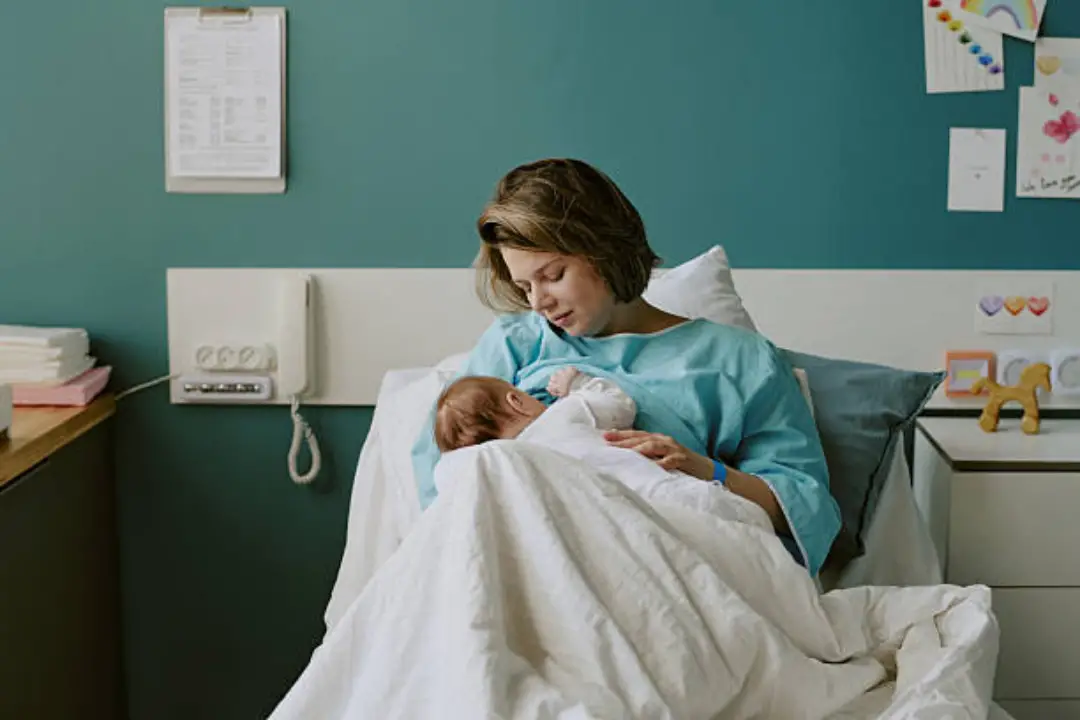
My daughter was born at 4:47 in the morning. I will not perform the sentiment of that moment for a narrative, except to say that she was placed on my chest and I held her and the noise of everything else — Jason, the bag, the contraction in the kitchen, dead weight — went completely silent for a while.
The silence didn’t last. It rarely does.
The next afternoon, the hospital room door opened. I had been expecting a nurse. The woman who walked in was not a nurse.
She was around my age, dressed precisely, with a wedding band I did not recognize and the composed bearing of someone who has prepared herself for a difficult scene. Jason followed her into the room. His expression was complicated in the way that expressions are when someone has constructed a version of a situation in their head and is encountering the actual version and processing the gap.
He looked at me in my hospital bed with our daughter in the bassinet beside me, and something moved across his face that I did not know how to read.
The woman looked at the nurse adjusting something near my IV.
“She’s my CEO,” she said quietly.
Jason took a visible step backward.
The three words landed in the room and rearranged it.
I had spent four years being the person Jason described to other people — the wife who worked on her “little business,” who kept herself busy with what he called her side project in the particular dismissive tone that communicates both fondness and condescension. I had spent four years building something he had never taken seriously, because Jason’s framework for seriousness was calibrated to his own ambitions, and anything outside that framework was decorative.
The woman’s name was Madeline Cole. She was an attorney at a firm that had been retained to handle certain legal components of an acquisition. The acquisition, as she had recently discovered by tracing names through documentation she’d been handed by a colleague, belonged to my holding company. The platform being acquired was the logistics software company where Jason was a senior manager. The deal he had been describing to people in his professional circle as something that would “change his life” was, at its foundation, mine.
He had not known.
That is a sentence I want to be careful with, because I am aware of how it sounds — like something constructed for effect. But the truth is that I had not known either, not exactly. The acquisition had been running through a subsidiary structure that my attorney managed, and the intersection with Jason’s employer had surfaced only recently in due diligence. Margaret had notified me two days before the birth, which is why she had already been moving, which is why she arrived at the hospital room door not fifteen minutes after Madeline.
Margaret Sloan had the kind of professional presence that rearranges a room without raising her voice. She carried a slim folder and moved with the measured certainty of someone who has spent thirty years doing exactly this work and has developed a complete immunity to being rushed by people who are accustomed to rushing others. A hospital security officer accompanied her.
She looked at me first, then at my daughter, then at Jason with the specific quality of a woman taking inventory.
“Emily,” she said, for me only. “Are you able to proceed?”
I said yes.
Margaret turned to the security officer and stated, clearly and without performance, that the man in the room had forced a woman in active labor out of her home the previous evening, that he was not authorized to be present, and that she was requesting his removal from the floor.
Jason said he was her husband. Margaret noted that his entry into a second legal marriage would be addressed in the appropriate proceedings. He said he had rights to see his child. Margaret said rights follow procedure and that his conduct of the previous evening would be reviewed accordingly.
I watched him look at me while Margaret was speaking — the particular look of a man searching for the version of me he knew how to manage, the version that apologized for his anger and softened his edges and found ways to minimize his cruelties into misunderstandings.
“Emily,” he said, dropping his voice into the register I recognized — softer, the old manipulative warmth, the version that said trust me, we’re on the same side. “Don’t let them turn you against me.”
My daughter made a small sound in her bassinet. I did not look away from him.
“You already did that,” I said.
His face changed. The warmth closed like a shutter. “So this is about money.”
No one spoke.
He laughed, sharp and brittle. “You’ve been sitting on a secret fortune. Hiding it. Pretending to be helpless.”
Madeline, who had been standing at the periphery of all of this with the careful positioning of someone reassessing every decision that had led her to this room, flinched at that sentence.
Jason pointed at her. “And you — my wife — standing here like this? After everything I’ve done for you?”
“You didn’t do anything for me,” Madeline said, with the controlled precision of someone who has recently finished a long, private inventory. “You told me a version of events. I believed it until I saw her name.”
Jason’s confusion was genuine. “What name?”
“The acquisition you’ve been telling everyone will change your life,” Madeline said. “It’s hers. Her company is buying your employer’s platform. I’m working on the legal component. I found her name in the documentation and I pulled the thread.”
The realization moved through him visibly. The “cute little business.” The late nights he’d dismissed. The ambition he’d managed by minimizing it. It had grown past the boundaries of his comprehension and was now intersecting with his livelihood in a way he had no framework to process.
“So what,” he said, his voice changing into something unstable. “You’re going to destroy me? Take my job?”
“Your employer will make decisions based on your performance and conduct,” Margaret said. “Ms. Carter will not be conducting HR matters from a hospital bed.”
The security officer opened the door.
Jason left. But as he passed through the doorway, he turned back one more time with the expression of someone delivering a sentence he needs to feel true.
“This isn’t over,” he said.
The door closed.
The room held the silence for a moment. Then Margaret sat down beside me and opened her folder, and we began the actual work.
I had underestimated what Jason was capable of, which was my own failure. I had spent four years watching him manage situations through force of personality and had perhaps unconsciously believed that his aggression had a ceiling — that there was a point beyond which he would not go because some functional sense of consequence would stop him. I was wrong about that.
My phone showed me an image of my front door. Wide open.
Margaret studied the photo and her expression, which was already not warm, went cooler. “Did you authorize access to anyone?”
“No.”
She made two phone calls, each brief and clipped, while Madeline stood at the window with her arms folded and I held my daughter against my chest and focused on the small weight of her as a method of staying inside my own body.
Police were dispatched. A private security firm Margaret maintained a relationship with was contacted. The timeline for protective and occupancy orders was accelerated.
Two hours later, the report came back: front door forced, bedroom disturbed, filing cabinet opened, jewelry scattered, closet searched. Officers found printed documents scattered in the kitchen. He had been looking for something.
The trust documentation was secured in a locked drawer he hadn’t found. But he had been looking not to steal — he had been looking for leverage. For something he could take into a narrative and reframe, the way he had always reframed things, turning his cruelties into misunderstandings and my responses into overreactions until the original event was buried under enough revision that I doubted my own memory of it.
He had been doing that for years. He was doing it now, in real time, from inside my house.
“This demonstrates escalation,” Margaret said. “It strengthens everything.”
I remained in the hospital an extra day. Security doubled the hallway patrols. Jason attempted to reach me through a cascade of messages that traced the full arc of his emotional range over twelve hours: fury, justification, victimhood, desperation, threat, and back again. You can’t keep my child from me. You’re blowing this up. I didn’t mean it like that. We can fix this. You owe me.
In none of them did he ask about the baby’s health.
When I came home, it was with an escort and new locks and cameras on every entrance and the physical sensation of walking through a space that had been violated by someone who had once slept there by invitation. The doorframe had been repaired but the wood still held the faint marks of forced entry — a scar the fresh paint hadn’t fully covered. Mrs. Alvarez was waiting outside with a casserole and the expression of a woman who has decided to be useful because grief and fury need somewhere to go.
“He came back,” she told me. “Before police arrived. I saw him from my window. He had a bag.” She paused. “He called you ungrateful. Then he saw me watching.”
Ungrateful.
As if the home he’d thrown me out of had been a gift he was reconsidering.
The legal proceedings moved with the methodical acceleration of cases that are well-documented. My attorney presented chronology: the night of the expulsion, the secret remarriage, the hospital intrusion, the forced entry, the messages, the pattern traced across time. Temporary protective orders were granted. Visitation was made conditional and supervised. All communication between Jason and me was routed through a monitored app that created a permanent record of every word sent.
Jason’s professional life did not require my intervention to begin unraveling. He provided that himself. He missed significant meetings. He sent communications to colleagues that read like a man in active crisis. He confronted someone in a parking lot in a manner that produced a formal HR complaint. The acquisition closed on schedule with his employer fully absorbed, and the restructuring that followed was handled by new leadership that had no particular reason to retain a senior manager whose conduct had become a documented liability.
Madeline had quietly withdrawn from the legal components of the acquisition to avoid conflicts of interest. She had also, without announcement, begun annulment proceedings. I received an email from her one evening that I read twice before I understood it was genuine — not positioned, not strategic, just a person attempting to account for herself honestly: I won’t pretend I wasn’t complicit. But I won’t remain tied to him. If there’s anything I can do to clarify the truth, I will.
I didn’t respond for two days. Then I wrote back simply that I appreciated her saying so, and left the door open without making any promises. That seemed sufficient. Some things don’t require a resolution so much as an acknowledgment.
In the courtroom, Jason tried one last version of events. He painted me as a woman who had strategically concealed assets, engineered a narrative, manipulated circumstances to make him look like the aggressor when he was merely a man who had made some mistakes in a difficult period.
Margaret did not raise her voice. She presented the record.
The labor expulsion, with Mrs. Alvarez’s testimony. The secret remarriage, with its documentation. The hospital intrusion, with security logs. The forced entry, with the police report and photographs. The messages, printed and submitted in full. The escalating pattern, traced across weeks, consistent and documented at every stage.
The judge’s expression remained measured throughout. The rulings did not require drama to be significant.
When I walked out of the courthouse with my daughter in her carrier against my chest, the November light hitting the concrete steps felt like something I had been waiting for a long time without knowing that’s what I was waiting for. Not triumph — I want to be careful about that word, because what I felt was not triumphant. Triumph implies a contest you were trying to win, and I had not been trying to win anything. I had been trying to survive something, and surviving is a different category of accomplishment.
What I felt was unburdened.
Like a weight had been removed that I had been compensating for so long I had restructured my entire posture around it and forgotten that posture hadn’t always been necessary.
My daughter was four months old by the time the proceedings fully concluded. By then she had a face I was learning the way you learn a landscape — by returning to it daily, by the different light it held at different hours. She had her own preferences already, small and absolute: she liked to be carried facing outward, liked the particular song I made up for her that had no real lyrics, did not like Tuesdays for reasons she had declined to explain.
I had moved back into the house with the repaired doorframe and the new locks, and I had slowly made it mine again — not through renovation but through the accumulation of daily life in it. Meals cooked. Music played. Her things arranged in what had been the guest room, which I had painted a color I chose myself for no reason except that I liked it in the light from the east window at eight in the morning.
The business had continued to run through everything, which was a fact I found both practical and clarifying. The acquisition had closed. New projects were in early stages. Margaret had begun advising me on a fund structure that would convert some of the inherited capital into operational investment — not because I needed the money merged, but because the two halves of my financial life had stopped needing to be separate now that there was no one I needed to hide anything from.
I sat at the kitchen table one night after my daughter had finally gone down, and I opened my laptop to the quarter’s projections, and I thought about Jason standing in the hospital room saying this is about money with that sharpened, certain expression, as if he had found the true explanation, as if naming a motive made the behavior that preceded it coherent.
It had never been about money.
It had been about the fact that he had spent four years looking at a person and seeing a surface. He had seen someone to organize his life around his comfort, to manage the domestic friction, to be present in ways that served his needs and absent in ways that didn’t inconvenience him. He had seen dead weight. He had not seen what was actually there — which was a woman who finished what she started, who had been quietly building something for years, who had saved and structured and persisted and was prepared.
He had stumbled backward in my hospital room not because of the money. He had stumbled because the version of me he thought he had catalogued and contained had turned out to have dimensions he had never bothered to look for.
People who reduce you to a function tend to be surprised by your depth. They experience it as a revelation. It is not. It was always there. They simply chose not to look.
My daughter made a sound from her room — not distress, just the small self-talking sounds she made in her sleep, conversations with whatever infants have conversations with. I closed the laptop and went down the hall and stood in the doorway of her room, and she was fine, just moving, just present, just herself.
The doorframe I was standing in had been repaired. The scar in the wood was there if you looked for it, a thin line where the new paint met the old.
I had decided to leave it.
Not as a monument to anything. Not as a reminder of a hard time, or a scar I was proud of, or a lesson I was preserving. Simply because the house was real and the things that happened in it were real and pretending otherwise would require more energy than the truth, and I had learned to spend my energy on things that produced returns.
My daughter slept. The house held its quiet. Outside, the city continued its indifferent, constant movement.
I had been called dead weight in my own home while in labor, and I had left with a backpack and made a phone call and held my daughter in a hospital at five in the morning and walked out of a courthouse in November light and come home to a life that was mine in every dimension — built by my own work, protected by my own will, structured around nothing except what I had decided mattered.
That is not a small thing.
It is, in fact, the only thing.

Lila Hart is a dedicated Digital Archivist and Research Specialist with a keen eye for preserving and curating meaningful content. At TheArchivists, she specializes in organizing and managing digital archives, ensuring that valuable stories and historical moments are accessible for generations to come.
Lila earned her degree in History and Archival Studies from the University of Edinburgh, where she cultivated her passion for documenting the past and preserving cultural heritage. Her expertise lies in combining traditional archival techniques with modern digital tools, allowing her to create comprehensive and engaging collections that resonate with audiences worldwide.
At TheArchivists, Lila is known for her meticulous attention to detail and her ability to uncover hidden gems within extensive archives. Her work is praised for its depth, authenticity, and contribution to the preservation of knowledge in the digital age.
Driven by a commitment to preserving stories that matter, Lila is passionate about exploring the intersection of history and technology. Her goal is to ensure that every piece of content she handles reflects the richness of human experiences and remains a source of inspiration for years to come.