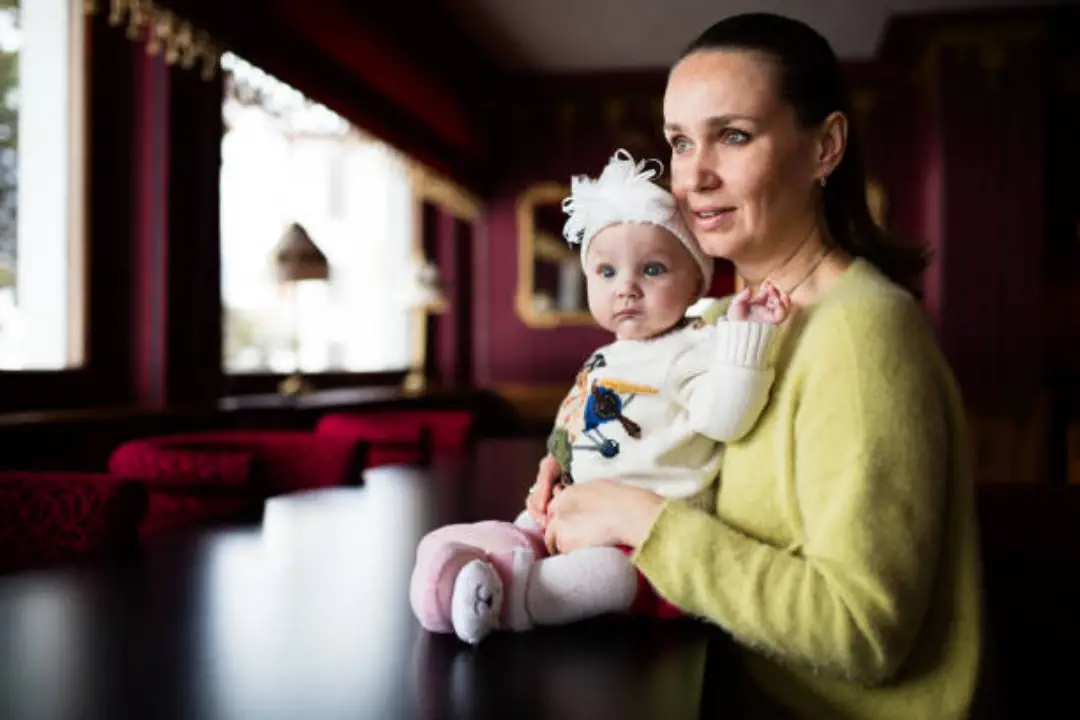
My name is Wanda Calloway, and the day my family decided to remind me exactly where I belonged, Portland was doing what Portland does in late October — raining in that quiet, persistent way that feels less like weather and more like the city is thinking something it hasn’t decided to say yet.
I had been ready for an hour before I needed to leave. This is a thing I do before events with my family: I give myself extra time, which I then spend second-guessing whatever I’ve chosen to wear. I’d bought the dress specifically for today — navy wrap, mid-length, the kind of thing that says I tried without saying I’m trying too hard. I’d borrowed pearl earrings from a box in my closet that I only opened for occasions where my mother’s voice was likely to be louder than my own internal one. I’d spent forty minutes on my hair and another fifteen talking myself out of going back to the store and hiding behind my inventory until the whole afternoon passed.
I’d told myself I was going because I loved my sister. I told myself that every time. I kept going, and I kept telling myself that, and somewhere in my chest I was always aware that these two things were not the same as being loved in return.
Elmeander occupied a building on the kind of downtown Portland block that looks like it was assembled by someone who had very specific feelings about exposed stone and ambient lighting. The valet who opened my car door had the composed, slightly apologetic expression of someone accustomed to performing equality for people in vehicles of very unequal distinction. My Honda Civic was eight years old and the color of a decision made quickly. He took my keys with the practiced grace of someone who has never let a flicker of judgment show.
The shoes were protesting the wet sidewalk before I’d made it to the door.
Across the street, O’Sullivan’s Pub sat in the rain with the comfortable indifference of a place that has never needed to prove anything. Its green sign was modest, the brick darker from the wet. Someone had propped the door open, and warm light spilled through it along with the faint smell of onions on a grill and something frying in the back — the smell of a place where people stayed longer than they planned and didn’t feel obligated to explain why.
Elmeander was the opposite. Inside, it announced itself with chandeliers and white linen and the particular shimmer of a room that costs a great deal to feel effortless. Crystal caught the light and scattered it. Flower arrangements sat at the center of tables dressed with a formality that required advance planning and someone’s undivided aesthetic attention.
I stood in the doorway for a moment with rain still drying in my hair and let myself believe, the way I always let myself believe at the beginning of these things, that I was simply a woman arriving at her sister’s baby shower.
The private room was through a door to the right, and I heard Rebecca before I saw her — that specific variety of bright, performative laughter that belongs to women who are aware of being watched and have decided to perform joy rather than feel it. The room itself looked like the photographs Rebecca would post to mark the occasion: pink and gold balloons, a long table with gold-rimmed plates, name cards standing upright at each setting like small proclamations of belonging.
Rebecca stood near the head of the table with one hand resting on her rounded belly and the other holding a crystal flute. She wore a pale silk maternity dress that appeared to have been selected by someone with training. Her hair was in soft waves. She had been, as she usually was at events like this, curated.
My mother stood beside her in tailored cream and pearls she had been wearing to charity events for the better part of two decades. Her lipstick was the particular shade of red that she applied with the precision of someone who has decided that the world should have no ambiguity about whether she has taken it seriously.
“Wanda,” she said when she saw me, with the smile that lived in the lower half of her face only. “You’re late.”
I was three minutes early. I had checked twice.
“Traffic,” I said, because this was true enough and because correcting her version of events had never, in thirty-four years, produced any outcome worth the expenditure.
Rebecca turned. Something crossed her face in the half-second before she arranged it — surprise, a flicker of irritation, and then the soft, pleasant expression of a woman dealing smoothly with an unexpected variable.
“You came,” she said, as though I were a distant acquaintance who had appeared at a party she’d forgotten she’d invited me to.
I held out the gift bag. Inside was a hand-embroidered baby blanket made by a local artist who came into my bookstore every Thursday — tiny constellations stitched in pale yellow on soft cotton, the kind of thing that takes careful hands and unhurried time. She had smiled when I asked her to make it, the way people smile when they’re asked to do something they find genuinely worthwhile.
Rebecca took the bag with two fingers and set it at the edge of the gift table without looking at it. Not at the far end by accident. At the far end on purpose, away from the pile of branded boxes in coordinated tissue paper, where it would not complicate the aesthetic.
I smoothed my dress and told myself I was imagining things.
I began to walk the length of the table, reading the name cards.
Travis’s mother. His two sisters. His cousin from Seattle. Rebecca’s Pilates instructor. A woman I recognized from social media as the founder of a wellness startup that had been profiled in two local magazines. An influencer whose content involved expensive candles and morning routines. Eight more women whose names I read carefully, twice, the full length of the table.
Not one of them said Wanda.
I did the mental arithmetic without wanting to: twenty-three women, a table that sat twenty-five, my invitation with its RSVP confirmed, and no chair. The mathematics were not complicated.
Rebecca appeared beside me with the particular ease of a person who has choreographed this moment.
“Something wrong?” she asked, in a voice calibrated to sound like concern.
“I can’t find my place card,” I said, giving her the opportunity to flush and apologize and fix it.
She sighed with the specific quality of someone who has been mildly inconvenienced by your confusion.
“Right,” she said. “About that.”
The explanation she gave was unhurried and practiced: venue capacity restrictions, a final guest count finalized weeks in advance, an assumption — stated plainly, without apology — that I probably wouldn’t come. Her eyes were steady and her voice was kind, in the way a person’s voice can be kind while the words it carries are not.
Women at the near end of the table were listening without looking like they were listening. One of them tilted her head slightly toward her neighbor.
“I RSVP’d yes,” I said.
“These things slip through,” she said. “With your schedule—”
My schedule. Owning a bookstore. Apparently this was a schedule that slipped through.
My mother arrived then, as she always arrived when Rebecca needed reinforcement — quick, precise, reading the landscape before she spoke.
“These rooms have limits,” she said. “It’s not like your little shop where you can drag in an extra chair. Everything here has to be exact.”
Your little shop. Said with a softness that was not soft.
Rebecca’s hand touched my elbow, brief and deliberate.
“We didn’t want you to feel out of place,” she said, and her gaze drifted to the window, past the rain on the glass, to the street below where O’Sullivan’s sign flickered. “There’s that pub across the street. You like those kinds of places, right?”
“Dirty pub,” my mother added, with a quick sharp laugh I had heard my entire life. “It suits you perfectly.”
A few women at the table glanced over. One smiled into her champagne in the particular way of someone enjoying a small, vicarious cruelty at someone else’s expense.
I stood in my navy dress with the rain still in my hair and the earrings I’d borrowed from a box I only opened for occasions like this, and I felt the old machinery of myself begin to engage — the reflex toward explanation, justification, the shrinking, the finding of a smaller shape that might fit the available space.
I thought of my father’s voice, the way it had sounded the first time I told him about the bookstore. Build it solid enough that it doesn’t collapse the first time someone leans on it wrong.
Something in me went very still.
“Okay,” I said.
Rebecca blinked. “Okay…?”
“I’ll go across the street.”
For a fraction of a second, my mother’s practiced smile did something unintended at the edges.
“Wanda, don’t be—”
I was already turning.
I did not reach for my gift. I did not apologize. I did not ask if there was perhaps a way to fit an extra chair somewhere that wouldn’t disturb the precision of their arrangements. My heels clicked against the marble floor in a rhythm that seemed, in the hush that opened behind me, louder than the room expected.
I pushed through the doors and the city’s damp grayness wrapped around me like something I recognized.
The rain had picked up. It dotted my dress and made the sidewalk slick and turned the downtown street into a painting of itself — smeared and luminous and more honest than the room I had just left. I crossed to O’Sullivan’s without looking back at Elmeander, and the propped door opened around me and the smell arrived all at once: warm wood, old brass, onions, something frying, spilled beer absorbed into decades of floorboards, and underneath all of it the particular comfort of a place that has been the same kind of place for a very long time.
The light was low and forgiving. A game played silently on the television in the corner. Two older men argued at the bar with the easy heat of people who have argued this way for years and would not have it otherwise. A woman in a green sweater threw her head back laughing at something her companion had said, her face bare of anything except the fact of being amused.
I stood just inside the door in my carefully ironed dress and borrowed earrings, rain drying in my hair, mascara beginning to assert its independence at the edges of my lashes, feeling entirely conspicuous in the best possible way — the way you feel conspicuous in a place that isn’t performing anything at you.
That was when I saw him.
He was in a corner booth, half-turned from the door, a spread of papers in front of him and a pen moving over them with the focused attention of someone working on something that requires actual thought. Dark hair slightly too long, sleeves rolled to the elbows, tie loosened in a way that suggested the tie had been an obligation he’d made peace with rather than enjoyed.
James O’Sullivan looked up, found me in the doorway, and stood.
“Well,” he said, with a slow smile that arrived at the edges before it reached the middle. “The book dealer.”
Book dealer. Not shopgirl. Not hobbyist. Not the polite condescension of phase.
“James,” I said, managing something that was approximately a smile back. “I didn’t know this was your place.”
“It says O’Sullivan’s on the sign,” he said. “We’re not subtle.”
“I always assumed that was coincidence,” I said, moving closer. “Like how some people are named Baker and can’t cook.”
He laughed — genuinely, not for show, the kind of laugh that comes from something actually striking him as funny rather than from the social calculation that laughter is expected here. I had liked that about him from the first time he came into my bookstore, eight months ago, and wandered through the stacks the way people wander through old buildings — not looking for anything specific, just paying attention.
He’d stood in the poetry section for twenty minutes and bought three first editions. On his way out he’d paused at the door and said, without turning around: “There’s nothing in the world that smells better than a room full of old books.” I’d told him we had excellent ventilation. He hadn’t seemed to hear me.
Now, in the pub his family had operated for seventy years, his gaze moved past me to the rain-streaked window, to the glow of Elmeander across the street.
“What happened?” he asked. Not curious the way people are curious about drama. Curious about me.
“No seat,” I said.
His expression changed.
“My sister’s baby shower,” I said. “They didn’t put a place card out for me. When I pointed this out, my mother told me this place would suit me better.” I paused. “She called it a dirty pub.”
His jaw tightened, just slightly. “Dirty,” he repeated, with the tone of a man trying the word in his mouth and finding it entirely wrong for its intended purpose.
I pressed my lips together against the sting that had been building since the marble floor of Elmeander.
“I’m tired,” I said.
“Tired of what?” he asked, and something in the directness of the question — no softening, no preemptive sympathy — loosened something in me.
The true answer slipped out before I’d decided to give it.
“Tired of being treated like a mistake,” I said. “Like everything I’ve chosen is evidence of poor judgment. Like love is another thing you have to qualify for, and I keep failing the entrance exam.” My voice wavered and I steadied it. “I built my shop from nothing. I know what I’m doing. They just don’t care.”
James looked at me for a moment with the specific quality of attention that is different from being looked at — the kind that involves actually seeing rather than simply registering.
“Do you trust me?” he asked.
The question was unexpected enough to almost make me laugh. Trust was not a thing I distributed freely, not after years of watching it used as leverage. But the way he asked — straightforward, no charm in it, no flattery — made the instinct to deflect feel unworthy of the question.
I thought about the time I’d called him, panicked, about shipping a fragile rare collection across the country. He’d sent his own driver without being asked. I thought about how he carried boxes himself even though he owned a building full of people he could have delegated the task to. I thought about how he had never, not once, referred to my bookstore as cute.
“Yes,” I said. “I think I do.”
“Okay,” he said, as if something had just been settled. He reached for his phone. “Then let’s fix this.”
What followed was swift enough to feel slightly impossible. A phone call — Bridget, family emergency, ten minutes, bring the garment bag and the good makeup — and then James closing the folder in front of him and pouring me a glass of water and talking to me quietly while we waited, not about what had just happened but about a book collection he’d recently acquired from an estate sale, about whether a particular nineteenth-century poetry volume was worth what the seller was asking.
He was giving me somewhere to put my attention that was not my family.
Bridget arrived in exactly ten minutes, sharp-eyed and efficient, a garment bag over one arm and the expression of someone who has accepted that James is going to do things like this and has chosen to find it charming rather than exhausting.
She introduced herself, looked me over with the practiced eye of someone for whom assessing what a person needs is a professional skill, and said: “How attached are you to what you’re wearing?”
Twenty minutes later I walked out of O’Sullivan’s bathroom — which was, somewhat startlingly, spotless and softly lit and smelled of citrus, because James had at some point decided that a pub bathroom should not be a source of shame — in a dress the color of deep water at night. Simple, clean lines. A neckline that showed my collarbones without announcing them. Fabric that moved with the confidence of something made by someone who understood what clothing was actually for.
Bridget had pinned my hair in a way that looked like I’d done it without thinking about it, which I understood required a great deal of thought. She’d redone my mascara with something she described as waterproof and non-negotiable.
“There,” she said, stepping back. “You look like yourself.”
I looked in the mirror and saw, not a stranger, but a sharper version of the woman I actually was — as opposed to the softened, apologetic version I’d been carrying into family events for years.
The private dining room James had opened was through a door off the main pub, and it was the kind of room that surprises you — exposed brick, wooden beams with simple white lights strung between them, a long table dressed in linen, crystal catching what light there was and multiplying it. Tall windows at the far end faced directly across the street.
Directly to Elmeander.
I could see the glow of it through the rain, the chandeliers, the shapes of women gathered near the glass.
“Subtle,” I said.
James pulled out a chair at the center of the table — not the head, not the edge — and said: “Your seat.”
I sat, and my fingers found the small folded card in front of my plate.
My name. In clean script.
Just Wanda. Not a family name. Not a footnote. Just the name I’d been given and had spent years trying to make mean something.
I swallowed and looked at James.
“Who’s coming?” I asked.
He set a folder on the table and flipped it open. “Margaret Reynolds. David Chen. Patricia Aldridge.” He said the names matter-of-factly, as though they were people he’d simply called and who had simply agreed to come, which — I would later understand — was almost exactly what had happened.
Margaret Reynolds had been trying to reach me for consulting work for months. Her messages had been routed through my mother, who had a habit of forgetting to pass them along. David Chen, who ran three of the city’s best restaurants and had been into my bookstore twice without my knowing who he was, had been looking for a retail partner in my neighborhood. Patricia Aldridge was building a private library and needed someone to curate it honestly.
James had called them, explained that he was hosting a small gathering, and they had come — because he had spent years hosting their events, tasting their wine, providing the kind of loyalty that creates genuine obligation rather than the performed variety.
“You’ve been doing this for months?” I asked.
He shrugged. “I’ve been watching you get underestimated for months. At some point, watching becomes complicity.”
Margaret arrived first — ink-stained fingers, the firm handshake of someone accustomed to making decisions, a direct manner that had no patience for the performative modesty of people who know exactly how good they are but pretend otherwise.
“Wanda,” she said. “I’m glad he finally put us in the same room. I’ve been trying to get your number for months.”
“My mother keeps forgetting to pass messages along,” I said.
She looked at me with the expression of someone who has encountered this dynamic before and has feelings about it that she is too professional to voice in full.
“Twenty hours a month,” she said. “Authentication and provenance work for high-value acquisitions. You name your rate. I’ll negotiate from there, but I won’t insult you.”
David Chen arrived ten minutes later and shook my hand and told me he’d booked a trip to Iceland because of a travel essay collection I’d recommended to him. He wanted to discuss a coffee bar adjacent to my bookstore: shared revenue, his expertise, my foot traffic and the loyalty of customers who came not because they happened to be walking past but because they’d made a decision to be there.
Patricia Aldridge came last, slightly breathless, already talking before she’d fully entered the room, describing a collection that had outgrown the rooms available for it and required someone with genuine judgment to make it coherent. She’d read a piece I’d written for a small literary blog about the ethics of collecting — about what it meant to accumulate stories without engaging with them — and had apparently decided on the basis of that alone that I was the person she wanted.
Three business opportunities. One afternoon. Across the street from the baby shower where there had been no chair with my name on it.
A photographer from Portland Monthly had arrived with Margaret, camera bag over one shoulder, moving around the edges of the room with the unobtrusive attention of someone documenting something authentic. James had mentioned to him, apparently, that something interesting was happening in the neighborhood. Journalists, he observed, were not unlike cats in their relationship to the suggestion of something worth noticing.
We were midway through the first course when I heard voices in the main room — one of them familiar in the way that certain sounds become embedded in your nervous system over a lifetime of exposure.
James excused himself quietly and closed the door behind him.
I heard the muffled exchange — his voice steady, another voice cutting in with the particular quality of my sister when she has decided she is being wronged. Margaret sipped her tea. David made a note in his small book. Patricia either didn’t hear or elected not to acknowledge it.
I stood.
“I’ll be right back,” I said.
James was standing in the hallway between the private room and the main pub with the positioned calm of someone who has decided that this threshold is not being crossed. Rebecca stood two feet away with the slightly frizzed hair of a woman who has walked through rain without noticing it, her silk dress still immaculate. My mother stood slightly behind her, lips compressed.
“She’s not available right now,” James was saying. “You’re welcome to leave a message.”
“She is my daughter,” my mother said. “I have—”
“Access,” James said pleasantly, “is different from rights. One is legal. The other is earned.”
Rebecca saw me and pushed past him, the instinct toward access overriding the calculation that had governed everything else about her afternoon.
“What are you doing?” she demanded, low and fierce.
I looked at her — my sister, in her silk dress, with her perfect hair and her perfect shower and her long table of women who had been given seats without having to look for their names — and I felt something I had not expected: not triumph, not vindication, but the strange and specific sadness of finally seeing a thing clearly that you had spent a long time half-seeing.
“I’m having lunch,” I said.
“You’re humiliating me,” she said. “There are photographers. People are watching from the restaurant. You walked out of my shower—”
“You didn’t give me a seat,” I said.
The words were quiet. They didn’t require volume.
“It was an oversight,” she said. “A mistake. We can talk about this later, privately—”
“You invited me,” I said. “You confirmed the invitation. You gave a seat to your Pilates instructor and didn’t make one for me. When I pointed that out, you told me the dirty pub across the street would suit me better, and you laughed.” I paused. “That’s not an oversight.”
My mother stepped forward. “You are being dramatic, Wanda. This is not the time or the place—”
“I told you where and when,” I said. “My shop. Tomorrow. No audience. If you want to have a real conversation, that’s where I’ll be.” I looked at her steadily. “Not today.”
For the first time in my memory, I watched the instruction land on her face and remain there without producing the expected outcome. She opened her mouth. She closed it.
Rebecca’s expression had shifted into something more difficult to read — not quite guilt, not quite anger, but the specific discomfort of a person who has always been able to rewrite the story and is encountering someone who is no longer available to accept the revision.
“You’ve changed,” she said, finally.
“Maybe,” I said. “Or maybe I just stopped performing the part you wrote for me.”
I turned and walked back into the private room, my heart beating harder than I wanted it to. James closed the door behind us.
“Are you alright?” he asked — not gingerly, not like someone handling breakable material, but like someone who wanted an honest answer.
I took a breath and checked.
“Yes,” I said. “Actually, I think I am.”
Margaret lifted her glass when I sat down.
“To women,” she said, “who stop asking for permission to take up space.”
Patricia raised hers. “To women who build tables instead of begging for chairs.”
I raised my water glass. It was all I had and it was sufficient.
The evening settled into the particular warmth of a room where genuine conversation is happening — about books, about neighborhoods, about what cities owe their independent businesses and what independent businesses owe their cities. The photographer moved quietly through the edges, capturing things that had not been arranged for his benefit, which meant they were worth capturing.
Through the tall windows, I could see the shapes of women at Elmeander’s glass, looking out. I didn’t look back for long.
The following morning, Portland had the clean, scrubbed appearance of a city that has been given a thorough rain and is now trying to make a good impression. I walked down the back stairs from my apartment to the bookstore, key cold in my hand, and opened the door into the smell of paper and ink and the faint ghost of yesterday’s coffee — the smell of a place I had built with my own effort and my own choices, from a space that had previously been used to store seasonal decorations and excess restaurant supplies.
The bell chimed once when I stepped inside. Banjo the cat, occupying his usual territory among the paperbacks in the front window, cracked one eye at me and decided I did not require immediate attention.
My phone had accumulated thirty-seven missed calls and a voicemail from my mother whose careful tone barely contained its urgency: We need to discuss your behavior, Wanda. You embarrassed your sister. Call me as soon as you get this. No acknowledgment of what had preceded my departure. No consideration of what it meant to invite someone and then erase them from the table. Just the management of consequences, as though consequences were the only thing that had happened.
I deleted the message and opened the notebook I kept by the register and wrote three lines on a fresh page:
Private. Honest. No audience.
The terms under which I was willing to continue.
The emails arrived through the morning. Margaret’s consulting contract — terms straightforward, rate more than I would have had the nerve to request on my own. David’s draft proposal for the coffee bar — revenue sharing, clearly structured, exciting in the specific way that things are exciting when they represent genuine possibility rather than just hope. Patricia’s offer — detailed, generous, the number at the bottom requiring me to read it twice before I believed it was the number she had intended.
I printed them and laid them on the counter and smoothed the pages the way you smooth the pages of something you want to treat carefully, which is to say the way you treat things that matter.
James came in at noon with two coffees in a cardboard carrier and a paper bag balanced on top, moving through the door with the ease of someone for whom the bell above it is already a familiar sound.
“No speeches,” he said, setting things on the counter. “Just coffee.”
He pulled a chair up without asking if it was alright, which meant he already knew it was.
“How are you?” he asked.
I thought about it genuinely.
“Clear,” I said. “Not fixed. Just clear. The way things look after rain.”
He nodded as if this were a perfectly sensible unit of measurement. “Clarity’s worth more than most things people chase.”
We sat in the quiet of the bookstore, the heater doing its job, Banjo’s chest rising and falling in the window, the city moving past the glass at its own unhurried pace.
“Why did you do all of it?” I asked. “The room, the calls, all of it. Really.”
He considered this, not rushing toward an answer.
“Because I could,” he said. “And because it needed to be done. Because I’ve watched you walk into my pub a dozen times with a book under your arm and something behind your eyes that looked like someone had told you your life was a consolation prize. And I disagreed with that assessment.” He paused. “Also, if Reynolds Books and the Aldridge Collection both owe you favors, my chances of getting notable authors to do readings at the pub go up considerably.”
I laughed — a real laugh, the kind that comes from somewhere that had been held tight for a long time and was now, apparently, releasing.
“There it is,” I said. “The real motive.”
“I’m a businessman,” he said, unapologetically.
We sat for a while longer with our coffee, not talking about everything that needed eventually to be talked about — the family conversations ahead, the contracts on the counter, the question of what James and I were in the process of becoming. There would be time for all of it. The morning was already providing more than enough.
The bell above the door chimed. A regular came in — a retired literature professor who arrived every Thursday to spend twenty minutes deciding between two books and leave with both. He greeted Banjo first, as everyone did, then nodded in my direction.
“Morning,” he said. “Something that’ll make me reconsider everything I thought I knew before lunch?”
“I have several options,” I said, sliding off my stool.
I found him what he needed and wrapped it in brown paper and watched him carry it out the door with the particular satisfaction that comes from knowing you gave someone the right thing. That satisfaction did not appear on my mother’s list of acceptable achievements. It did not map to her understanding of what a life well-built looked like.
But it was real, and it was mine, and it had been mine for eight years, built from nothing, shelf by shelf, customer by customer, Thursday by Thursday.
The place cards at Elmeander had not included my name. But every book on every shelf in this room had passed through my hands. Every recommendation I had made had come from genuine knowledge. Every relationship I had built with the people who came through the door had been built on honesty rather than on the careful management of what they were allowed to know about me.
I did not need a seat at their table.
I had built a room of my own.
The missed calls could wait. My family, if they decided they wanted a version of this relationship that was honest and mutual rather than hierarchical and conditional, knew where to find me — in a bookstore on Alberta Street, above which a woman named Wanda lived in a small apartment with overcrowded bookshelves and a cat who considered himself the establishment’s primary employee and was not entirely wrong about this.
The bell chimed again. Another customer. Another person who had come, by their own decision, to be here.
I went to help them.

Lila Hart is a dedicated Digital Archivist and Research Specialist with a keen eye for preserving and curating meaningful content. At TheArchivists, she specializes in organizing and managing digital archives, ensuring that valuable stories and historical moments are accessible for generations to come.
Lila earned her degree in History and Archival Studies from the University of Edinburgh, where she cultivated her passion for documenting the past and preserving cultural heritage. Her expertise lies in combining traditional archival techniques with modern digital tools, allowing her to create comprehensive and engaging collections that resonate with audiences worldwide.
At TheArchivists, Lila is known for her meticulous attention to detail and her ability to uncover hidden gems within extensive archives. Her work is praised for its depth, authenticity, and contribution to the preservation of knowledge in the digital age.
Driven by a commitment to preserving stories that matter, Lila is passionate about exploring the intersection of history and technology. Her goal is to ensure that every piece of content she handles reflects the richness of human experiences and remains a source of inspiration for years to come.
Loved this story. Sometimes i feel the same. But I realize I don’t need permission to be me