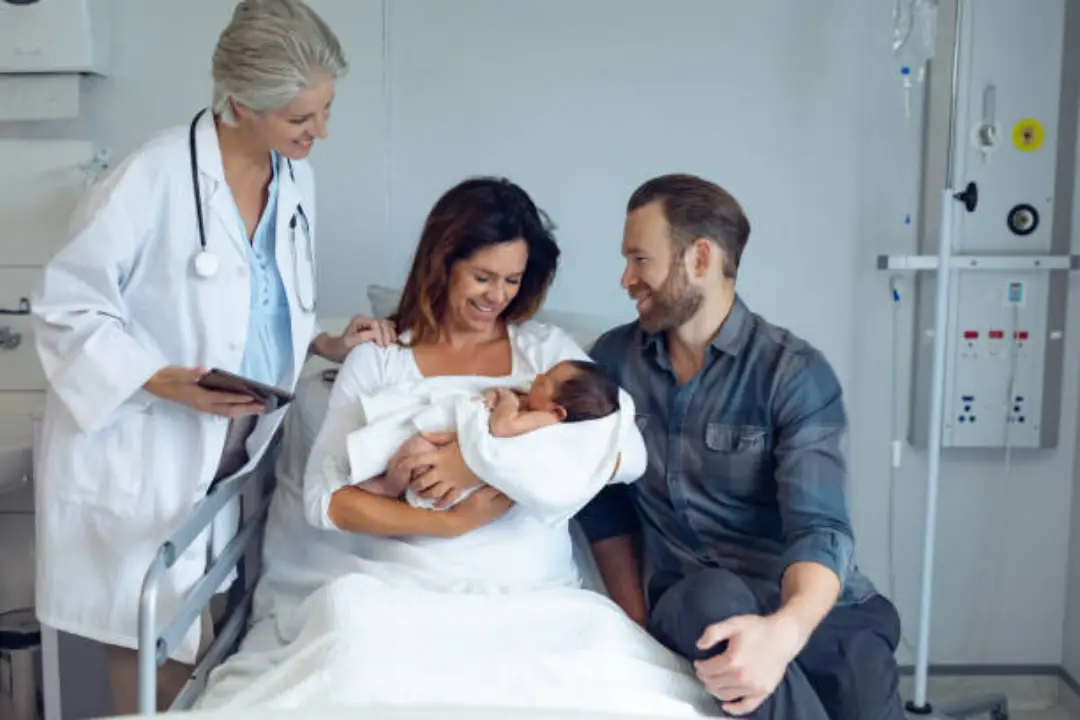
The exam room smelled of antiseptic and fluorescent light—the kind of sterile quiet that makes you feel more exposed than any open field ever could. I sat on the edge of the examination table, the paper cover crinkling softly beneath me each time I shifted, twisting the leather strap of my handbag until my knuckles went pale. Outside the narrow window, the morning sun fell in slanted bars across the linoleum floor, cutting the room into neat strips of light and shadow. It looked, I thought absently, like a cage.
I was fifty-eight years old, freshly retired from thirty-one years of teaching English at Millbrook High School, and I had come in for nothing more alarming than an annual physical. A box to tick. A formality. I had lived, for the last eighteen years, in the careful discipline of routine—and routine, I had long since learned, was armor.
Dr. Evans sat across from me, her gold-rimmed glasses perched low on her nose as she studied the monitor with an expression I did not like. She was a warm-faced woman in her late fifties, the kind of doctor who remembered her patients’ names without glancing at her chart. That morning, she was not warm. She was careful.
“Mrs. Miller,” she began, and the deliberateness of her tone sent a quiet tremor through me. “You’re fifty-eight, correct?”
“Yes,” I said. “I just retired from the district last month.”
She swiveled her chair toward me and slipped her glasses from her face, holding them loosely in both hands. It was the gesture of someone preparing to say something difficult.
“Susan, I need to ask you something personal.” She paused. “Have you and your husband maintained a typical intimate relationship over the years?”
The question landed in me like a stone dropped into still water. I felt the ripples move outward, touching everything.
“No,” I said, after a long moment. “We haven’t. Not for eighteen years.”
She nodded slowly, as if this confirmed something. I gripped my purse tighter.
“Is something wrong?” I asked. “Did you find something in the results?”
She turned the monitor so I could see it, though the imaging meant nothing to me—a gray landscape of interior topography, shapeless and clinical.
“There is significant uterine scarring,” she said carefully. “It’s consistent with a surgical procedure. A dilation and curettage, most likely. Mrs. Miller, are you certain you’ve never had any uterine surgery?”
“Absolutely certain,” I said. “I’ve never had surgery of any kind.”
Dr. Evans was quiet for a moment. Then: “The imaging is clear. Whatever this was, it happened a long time ago. I’d estimate fifteen to twenty years.”
I drove home in a daze, the radio playing something I couldn’t hear. The world outside the windshield looked ordinary and incomprehensible, the way it does when something inside you has shifted on its axis.
And somewhere beneath the numbness, a memory stirred. Something I had never looked at directly. Something I had always let remain in the dark.
It had begun in the summer of 2008, the year our son Jake left for college and the house acquired a hollow quality we had never noticed before—an echo, as if the rooms themselves had grown larger overnight. Michael and I had been married for twelve years by then, high school sweethearts who had moved from infatuation into partnership with the natural momentum of two people who had simply always been beside each other. He was an engineer—measured, methodical, a man who expressed love through acts rather than words, who fixed things before you noticed they were broken. I taught literature, the kind of woman who underlined her favorite sentences and cried at films he considered sentimental. We were different in the ways that make marriages work, until they become the ways that make them ache.
The ache, I had told myself for years, was ordinary. The way a long-worn shoe eventually grows uncomfortable—not because it was ever the wrong size, but because you’ve worn it in ways that changed its shape. We were polite to each other. We shared meals and calendars and the occasional Sunday walk. But somewhere in the ordinary machinery of our life, the warmth had quieted to something more like tolerance, and I had stopped noticing the difference.
Then Ethan joined the faculty in September.
He was thirty-five, the new art teacher, arriving with paint perpetually stained into the creases of his knuckles and a habit of placing fresh wildflowers in a glass jar on his desk each Monday morning. He moved through the world with the particular ease of someone who had made peace with his own desires—unhurried, present, unguarded in a way I had nearly forgotten people could be. He laughed too loudly and apologized for nothing and asked questions as though the answers genuinely interested him.
He had come into my classroom one October afternoon with a small watercolor painting—a hillside in full bloom, bolder and wilder than any real hillside I had seen.
“What do you think?” he asked, holding it up.
“It’s beautiful,” I said, and felt it.
“Then keep it. You remind me of those flowers—quiet, but full of life. Just waiting for the right season.”
I knew, even then, what those words were doing. I knew the way you know when you’ve leaned too far over a railing—the knowledge doesn’t stop you from leaning. What Ethan offered was not love, not really. It was attention of the specific and particular kind I had been slowly starved of. He saw me. Not as Michael’s wife, not as Jake’s mother, not as the reliable English teacher who always had the room ready before the bell—but as a woman with her own interior life, her own hungers, her own capacity to be desired. That recognition was more intoxicating than anything else he could have offered.
The affair lasted three months. Looking back now, I see it clearly for what it was: a series of small surrenders, each one easier than the last. Coffee became wine became long afternoons became dishonesty on a scale I had not believed myself capable of. I told Michael there were faculty workshops. I told him there were curriculum meetings. He believed me, or appeared to, and that, too, became something I used against him in the quiet court of my own conscience. If he cared so little that he didn’t question me, I reasoned, then I was owed the warmth I was finding elsewhere.
It was a coward’s logic. I understood that later. But in the autumn of 2008, I believed it with the fervor of someone who has found a way to survive.
The afternoon it ended, I had told Michael I was attending a Saturday curriculum planning session. Instead, I was at Lake Addison with Ethan, sitting on the bank while he sketched the water and I read aloud from a Mary Oliver collection. The day had the golden, unhurried quality of borrowed time. We had not yet said the things we felt; we were circling them, the way you circle something you know you shouldn’t touch.
As the sky bruised purple at the edges, Ethan set down his sketchbook and reached for my hand. “Susan,” he began. “I think—”
“Mom.”
I turned. Jake stood twenty feet away, his face the color of old ash, drained of something that had lived there before this moment and would not return. He was nineteen. He had come home from college to surprise me.
Behind him stood Michael.
I had seen my husband angry before—the controlled, compressed sort of anger that presented itself as disappointment, that was worse for its quiet. But the face he wore at Lake Addison that evening was something else. It was the face of a man watching the floor dissolve beneath him.
He said only one word: “Home.”
Then he turned and walked back toward the car without looking at me again.
The drive back was the longest forty minutes of my life. Jake sat in the back seat and stared out the window. Michael drove with both hands on the wheel, his jaw set, his eyes fixed on the road. When we arrived, Michael sent Jake upstairs, then sat down on the living room sofa, and—in a gesture that shocked me more than anything else he could have done—removed a cigarette from his breast pocket and lit it. He had quit smoking years before. For me.
He looked at me through the haze. “How long?”
I knelt on the floor. I think I believed that lowering myself physically might communicate something that words could not—contrition, perhaps. Genuflection. “Three months,” I said. “But it wasn’t physical at first. We only talked.”
“Enough,” he said. He crushed the cigarette.
What he offered next was not rage. It was architecture. Two options, delivered in the tone of a man who had already thought through both carefully.
“Option one: divorce. You leave with nothing. Everyone will know the reason.” He paused. “Option two: we remain married. But we are roommates only. You will behave as a normal wife in public. At home, nothing. I will not touch you again. I will not forgive you. But Jake’s future will be protected. The choice is yours.”
I said: “The second option.”
He gathered his pillow and a spare blanket from the hall closet and made his bed on the living room sofa. I lay alone in our room and listened to the springs settle as he lay down, and I understood that this was now my life. I had built the walls. I would live inside them.
Eighteen years is a long time to share a house with a stranger you were once intimate enough to recognize by the sound of their breathing. Michael never raised his voice to me again. He never raised a hand—never would have, was never that kind of man. What he did instead was something subtler and, in its way, more complete. He erased me from his emotional life while keeping me present in the logistical one. He left coffee for me each morning on the kitchen counter. He paid the bills on time. He attended Jake’s graduation and our grandchild’s birth and every holiday dinner with the composed, courteous demeanor of a man who has chosen to endure rather than escape.
We posed for photographs at family events, standing close enough to appear united. We greeted neighbors with warmth. We were, to everyone who knew us, a married couple of long standing—a little quiet perhaps, as long marriages sometimes become, but solid. Reliable. The picture of endurance.
Inside the house, we were ghosts.
I accepted this as earned. I told myself the punishment was just. I told myself that I had traded intimacy for security and that security, at least, was real. On the worst nights—the anniversaries of things, the holidays when Jake and his wife left and the house returned to its particular silence—I would lie awake and feel the full weight of what I had made of my own life. But I did not let myself grieve it as a loss. I had no right to grief, I believed. Only to endurance.
Then came Dr. Evans’ office, and the word that unraveled everything: scarring.
I drove home from the appointment and sat in the parked car in the driveway for a long time. Then a memory surfaced—one I had long kept in the category of things too painful to examine. The week after the confrontation at the lake, I had fallen into a depression so total it felt like submersion. I had stopped eating. I had stopped speaking. And then, one night, I had taken too many sleeping pills. Not deliberately—or so I had always told myself. An accident born of numbness.
I had woken in a hospital bed with a dull pain low in my abdomen. Michael had sat in the chair beside me, not holding my hand, but present. He had told me the pain was from having my stomach pumped. I had believed him. I had not asked questions because I had not, in that season of my life, felt entitled to ask questions. I had taken my punishment and swallowed it.
Now I walked into the house and found Michael in his armchair with the newspaper folded on his knee.
“Michael,” I said. “Did I have surgery in 2008? After the hospital?”
The newspaper slipped from his hands. The color left his face with a completeness I had never seen before—not in thirty years, not even that night at the lake.
“What kind of surgery?” I pressed. “What did they do to me?”
He was quiet for a long time. Then: “Do you really want to know?”
“Yes. I have a right to know.”
He set the newspaper on the table with great care, as if even this small motion required deliberation.
“When they brought you in that night,” he said, “they ran a full panel of labs. You were pregnant.”
The room tilted.
“Three months,” he continued. “We hadn’t been together in six.”
I sat down on the sofa without meaning to. My legs simply stopped holding me.
“You were unconscious,” he said. “I was your legal husband. I authorized the procedure.”
“You ended my pregnancy,” I said. The words came out very quietly. “Without telling me. Without asking me.”
“It was evidence!” He stood now, eighteen years of compression finally splitting open. “What was I supposed to do? Let you come home carrying another man’s child? Let Jake find out that way? I was trying to protect this family—the family you had already set fire to!”
“You had no right,” I said. “Whatever I did—you had no right to make that choice for me.”
“And you had no right to betray everything we had built together. We both made choices that year, Susan. I made mine. You made yours.”
I wanted to say more. I had eighteen years of silence stored inside me. But the phone rang.
It was Sarah—Jake’s wife. There had been an accident. A serious one. We needed to come to the hospital now.
In the emergency room, the surgeon came to find us within the hour. Jake needed blood. He was losing too much, too fast.
“I’m O positive,” Michael said immediately, already reaching for his sleeve.
“And I am as well,” I said.
The surgeon looked at us, then at her chart. She frowned—a small, careful frown, the kind doctors make when the math doesn’t work.
“Your son is B negative,” she said. “If both parents are type O, that’s not genetically possible.”
The corridor went very still around me.
Sarah, who was B negative herself, donated blood without hesitation. Jake survived the surgery. He came home three weeks later to his own house, thinner and quieter, but alive.
A week after he was released, sitting in the hospital garden while Sarah went to get coffee, Jake told us what he had known for eleven years. He had found a home DNA kit at a friend’s house when he was seventeen, used it on a whim, and received results he had not known how to carry. Michael was not his biological father. He had confirmed it through a proper test shortly after—alone, without telling either of us.
“You are my father,” Jake said to Michael, with the quiet conviction of someone who has rehearsed this sentence and found it still true. “In every way that has ever mattered.”
Michael pressed his mouth together and looked at the middle distance and said nothing for a long time. Then he nodded, once, and put his hand briefly on Jake’s shoulder.
Afterward, Michael turned to me and asked: “Who?”
I had to go further back than Ethan—further back than 2008—to a night I had long quarantined in memory. My bachelorette party, the spring before our wedding. I had been drunk, genuinely and entirely drunk, in the way you rarely permit yourself once you become a mother and an educator and a responsible adult. Mark Peterson had driven me home. Michael’s best friend. Mark, who had moved away within the year, quietly and without ceremony, who had eventually dissolved from our lives the way peripheral people sometimes do.
I had always told myself I had passed out in the car. I had always let that version stand unchallenged.
“Mark,” I said. “I didn’t know. I was unconscious—or I thought I was. I’ve always thought that. I swear to you.”
Michael looked at me for a long time. His face held not fury now but something exhausted and final—the face of a man who has arrived, at last, at the outer limit of what he can carry.
“Get out,” he said softly. “Please.”
I spent a week in a motel on the edge of town, in a room that smelled of old carpet and industrial soap. Jake called daily. Sarah brought me a casserole. Michael did not call at all.
Eventually, for reasons neither of us entirely articulated, I returned to the house. We moved through it like before—careful, quiet, maintaining the habits of coexistence—but the architecture had changed. There was no longer even the illusion of permanence.
One night, three weeks later, I found Michael on the balcony. He was standing with his hands on the railing, looking out over the backyard—the garden he had tended for years, the apple tree he had planted the summer Jake was born.
“I’m flying to Oregon next week,” he said, without turning. “I bought a cabin there, years ago. I always meant it for retirement.”
I said: “Take me with you. We can start over. Whatever that means—whatever form it takes. I’m not asking for what we had. I’m asking for something real.”
He was quiet for a long time. Then he turned, and the look on his face was the saddest thing I have ever seen—not cruelty, not contempt, but something more honest and more devastating than either. It was the look of a man who has finally, truly let go of something he loved.
“I ended your pregnancy without consent,” he said slowly. “You conceived a child with a man who may have assaulted you, and I never once asked you about that night—I just took the secret and used it as more ammunition. We have done profound damage to each other, Susan. The foundation of this marriage isn’t cracked. It isn’t even there.”
“But wasn’t there love?” I asked. “Somewhere in all of it—wasn’t there real love?”
“Yes,” he said. “There was. That’s what makes it tragic.”
He left on a Tuesday morning. He said goodbye to Jake and held his grandson for a long time. He left a note on the kitchen counter—addressed not to me, but to the house itself, it seemed, in the way that his final communications had begun to feel. A quiet settling of accounts.
He did not say goodbye to me.
That was eight months ago. I still live in the house. Some mornings, moving through the rooms in the early quiet, I catch a trace of the particular cedar and tobacco smell that belonged to his study, and I stand very still and let it be what it is. A ghost. A remainder.
I have been thinking, in these months, about what punishment actually means. For eighteen years I believed I was being punished—that the silence was my sentence, that the distance was what I deserved. I endured it with a grim sort of integrity, as if endurance itself were a form of penance that might eventually add up to something.
What I understand now is that I mistook the nature of the punishment entirely. The silence was not the worst of it. The distance was not the worst of it. The worst of it was this: I spent eighteen years in a marriage and never once asked the honest question. I never said to Michael, What are we doing to each other? I never said to myself, What do I actually believe is true about the night before my wedding? I never allowed the real accounting, because the real accounting was too frightening. I took the shape of penance without ever doing the actual work of it.
And Michael—I have had to hold this too—was not innocent in that silence. He could have asked about Mark. He could have told me about the pregnancy. He could have chosen, at any of a hundred junctures over eighteen years, to exchange his cold control for something more difficult and more human. He chose architecture over honesty, structure over feeling, and called it protection. We were, the two of us, very skilled at building walls and calling them shelter.
Jake calls every Sunday. We talk for an hour, sometimes more. He never mentions his father unless I ask, and when I ask, there is always a pause before he answers—not cruel, just careful. The pause of a man navigating between two people he loves in a landscape where love has caused a great deal of damage.
“Does he ever ask about me?” I say, each time.
And Jake says, gently, always gently: “No, Mom. He doesn’t.”
Last week, I drove past the high school where I taught for thirty-one years. I parked across the street and sat for a while, watching the students file out at the end of the day—messy and loud and bright with the particular energy of people who do not yet know how much of life is irreversible. I thought about all the books I had taught them. All the stories about love and consequence and the terrible cost of chosen blindness. I had stood in front of classrooms and talked about Edith Wharton and Anna Karenina and all the women destroyed by the things they would not look at directly.
I had thought I was teaching them literature. I had been, without knowing it, reading my own story aloud.
I am fifty-eight years old. I live alone in a house that still holds the shape of a family that has dispersed. I have one son who loves me and a grandchild who calls me Grandma Su and doesn’t yet understand that life can be complicated in the specific and irreparable ways it becomes when adults make choices they cannot take back.
I have lost a husband. I have lost, I learned too late, a child I never knew I carried. I have lost the careful architecture of decades—the polite fiction, the staged photographs, the shared corridors, all of it.
What I have instead is this: clarity. Not comfort, not consolation—but finally, after fifty-eight years, the willingness to see what is actually there.
I have started writing again, for the first time since college—not for anyone, not toward any purpose, just the act of putting words in order and watching them tell something true. Some mornings it feels unbearable. Some mornings it feels like the first honest thing I have done in years.
The wildflower painting Ethan gave me in 2008 has hung in my bedroom for all these years. I thought about taking it down when Michael left, but I haven’t. I stand in front of it sometimes and look at those bold, chaotic blossoms, the ones he said reminded him of me—quiet, but full of life. Just waiting for the right season.
I used to find that romantic. Now I find it something more complicated and more honest: a description of potential that went unrealized for a very long time. Potential that may, if I am very careful and very intentional in what remains of this life, still amount to something.
Not happiness, necessarily. I am no longer naive enough to believe in happiness as a destination.
But perhaps something like integrity. Perhaps something like peace.
Perhaps, after all of this—the silence, the loss, the reckoning, the long and necessary unraveling—perhaps that is enough.

Adrian Hawthorne is a celebrated author and dedicated archivist who finds inspiration in the hidden stories of the past. Educated at Oxford, he now works at the National Archives, where preserving history fuels his evocative writing. Balancing archival precision with creative storytelling, Adrian founded the Hawthorne Institute of Literary Arts to mentor emerging writers and honor the timeless art of narrative.