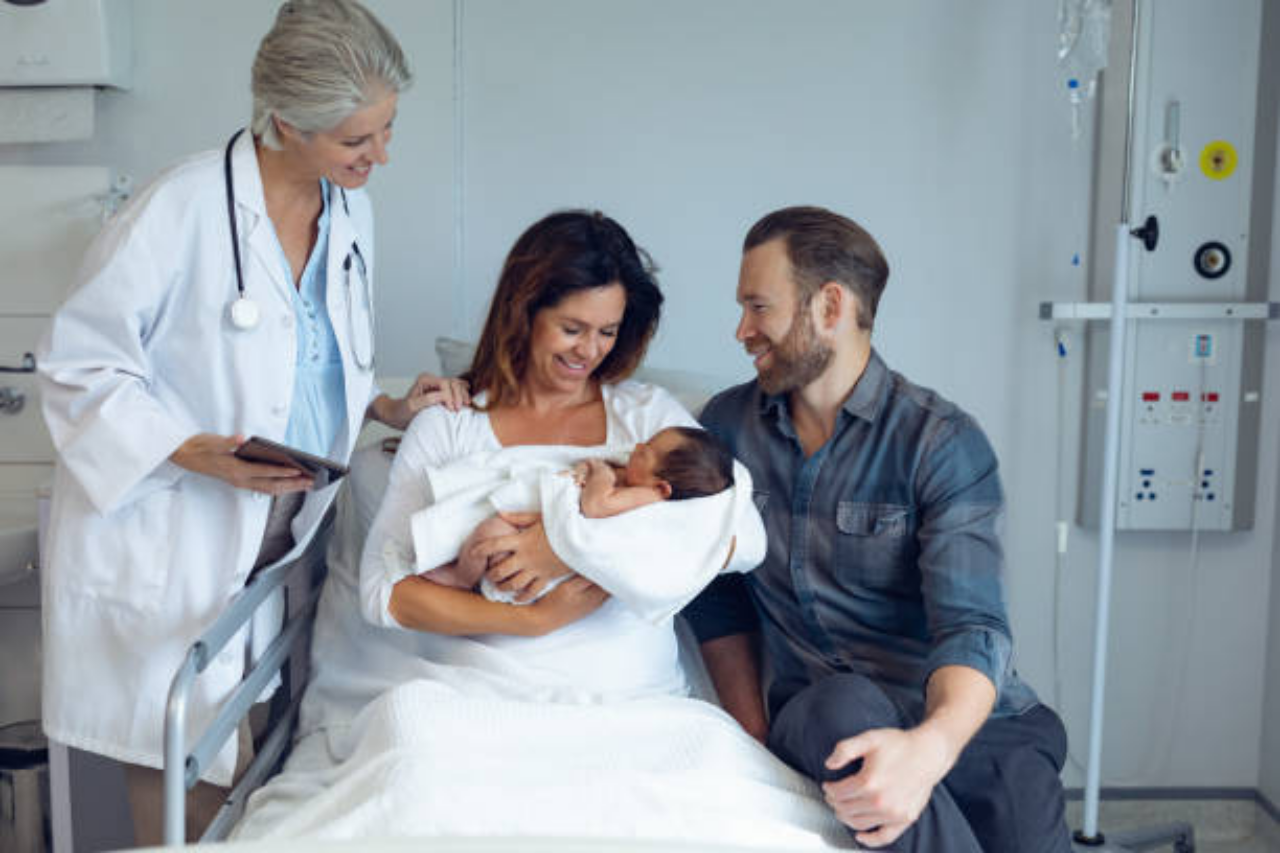
The private maternity suite smelled wrong. It should have smelled like new life, like hope, like the beginning of something beautiful. Instead, it smelled like rubbing alcohol, expensive lilies someone had sent without bothering to check if I was allergic, and something else I couldn’t name but would later recognize as the particular scent of impending abandonment.
I sat propped against pillows that cost more than most people’s monthly rent, the incision from my emergency C-section pulling tight across my abdomen like barbed wire every time I shifted. In my arms, Henry and Lucas slept—two impossibly tiny humans wrapped in the hospital’s standard-issue blankets, the only things in this room that didn’t have designer labels or price tags attached. They were three hours old. Their faces were still red and slightly swollen, their fingers curled into miniature fists, and every few seconds one of them would make a small sound that seemed to reach directly into my chest and squeeze.
I had imagined this moment a thousand times during the pregnancy. Daniel would be here, eyes wet with emotion, whispering about how perfect they were, how lucky we were, how our family was complete. His mother Margaret would soften when she saw them, would realize that bloodline and legacy meant continuing forward, not holding tight to the past.
The door opened, and I looked up with what I’m sure was pathetic hope on my face.
It wasn’t the nurse. It wasn’t the lactation consultant who’d promised to come back.
It was Margaret Carter, and behind her, like a shadow of the man I’d married, was Daniel.
Margaret didn’t walk so much as glide, propelled forward by decades of absolute certainty that the world would move aside for her. She wore a Chanel suit in deep plum—a color that made me think of bruises—and the famous Carter pearls gleamed against her throat like teeth. Her shoes, I noticed with the strange clarity that comes from shock, probably cost more than the security deposit on my first apartment.
Daniel followed three steps behind. My husband. The man who had proposed on a beach at sunset, who had promised me that his family’s money and social position didn’t define him, who had sworn that loving me was the first real decision he’d ever made. He wore a charcoal suit that fit him perfectly, tailored to hide the fact that there was nothing substantial underneath. He wouldn’t meet my eyes. He stared at a scuff mark near the door with the intensity of someone who’d discovered the meaning of life written in floor wax.
“This family,” Margaret said, her voice low and precise, each word landing like a carefully placed knife, “has built the Carter name over three generations. We have holdings in seventeen states. We employ four thousand people. We have endowed wings of hospitals, funded scholarships, preserved historic properties.”
She paused, looking at me with the kind of assessment usually reserved for poorly executed acquisitions.
“You, Rachel, are a mistake. And you are certainly not worth the Carter fortune.”
I tightened my arms around my sons instinctively, as if she might try to physically remove them. “These are your grandsons, Margaret. They’re Carters.”
She glanced at the bassinets positioned near my bed—empty because I’d wanted to hold my babies, wanted them close after the fear of the surgery—and her expression didn’t change. She looked at them the way someone might look at a problematic inheritance, something that creates more trouble than value.
“They are liabilities,” she said. “Daniel. Tell her.”
I turned to look at my husband, searching his face for any sign of the man I’d fallen in love with. “Daniel, please. Look at them. Henry has your nose. Lucas has your hands. They’re your sons.”
Daniel finally raised his eyes, and what I saw there was worse than anger or cruelty. It was nothing. He looked at me with the blank expression of someone who’d already made a decision and was just going through the required motions before execution.
“Rachel,” he said, and his voice was thin, reedy, nothing like the confident tone he used in board meetings. “I… I can’t do this. Mother’s right. The board, the trust fund stipulations—I married too quickly. I didn’t consider the implications for the legacy. We need to be realistic.”
“Realistic?” The word came out strangled. The heart monitor beside me started beeping faster, numbers climbing as my pulse raced. “I had surgery three hours ago to bring your children into the world. Our children. Your sons.”
“And we appreciate the effort,” Margaret interrupted smoothly, opening her designer clutch with a soft click. She withdrew a thick envelope made of cream-colored vellum, the expensive kind people use for wedding invitations or legal documents that will change your life. She placed it on the bedside table next to a cup of water that had gone lukewarm hours ago. “This is a settlement offer. It’s generous—more money than a nurse like you could earn in two lifetimes.”
The words “a nurse like you” hung in the air, dripping with disdain for the profession that had been deemed essential when I was caring for their family members but was apparently worthless when determining my value as a human being.
“I don’t want your money,” I said, though my voice trembled with rage and shock and the hormones still flooding my system. “I want their father. I want my husband.”
“He isn’t your husband anymore,” Margaret said, smoothing an invisible wrinkle from her skirt. “Daniel has agreed to relinquish all parental rights. In exchange, you will sign the non-disclosure agreement inside that envelope. You will revert to your maiden name. The boys will carry your surname, not ours. They will never step foot on Carter property, and they will never claim a single cent of the family trust.”
I stared at Daniel, silently begging him to look at his sons, to hold them, to remember the night we’d found out we were having twins and he’d spun me around the kitchen laughing. To be, for just one moment, the man I’d believed I was marrying.
He reached into his pocket, pulled out his phone, and checked the time.
“I’m sorry, Rachel,” he said quietly, already turning toward the door. “This is just… it’s a lot of pressure. I’m not ready to be a father. Not under these circumstances.”
“Then you’re not a man,” I whispered.
Margaret’s expression didn’t flicker. “Let’s go, Daniel. The legal team will handle the rest of the paperwork.”
They left. The door clicked shut with a sound that seemed to echo in my bones, final as a coffin closing. I stared at that cream-colored envelope sitting on the table like a bomb, then looked down at Henry and Lucas, still sleeping peacefully, completely unaware that their father had just sold them for his inheritance.
“You’re not liabilities,” I whispered, tears finally spilling over to land on their hospital blankets. “You’re everything. And I swear to you, I will make them regret this.”
Three days later, the hospital discharged me with a folder full of post-surgical care instructions and a social worker’s worried expression following me down the hallway. The transition from the high-security, luxury accommodations of the maternity suite—paid for by the Carters before they’d decided I wasn’t worth the investment—to my new reality was jarring enough to give me whiplash.
I had nowhere to go. My parents had died in a car accident when I was twenty-three. The friends I’d made while trying to fit into Daniel’s social circle had evaporated the moment Margaret made her position clear—apparently their loyalty to country club memberships outweighed their fondness for me. The apartment Daniel and I had shared was, according to the documents his lawyer had messengered over, “Carter family property” and I had seventy-two hours to remove my personal belongings.
I rented a duplex on the south side of the city with money from my savings account—the one I’d kept separate despite Daniel’s periodic suggestions that we “simplify” our finances. The place was small, drafty, with walls so thin I could hear my neighbor’s television through the plaster and carpet that smelled like decades of other people’s struggles and cheap cleaning solution.
I sat on the living room floor surrounded by boxes of diapers I’d bought in bulk at a discount store, cans of formula I’d had to price-compare because I couldn’t breastfeed after the complications, and that envelope. The cream-colored envelope with its check for five hundred thousand dollars and its contract that essentially stated my children didn’t exist.
I stared at that check for a long time, running calculations. Five hundred thousand could buy a house. It could buy security. It could pay for daycare and college funds and everything I couldn’t provide on a nurse’s salary. It could buy silence and survival.
But every time I looked at the numbers, I heard Margaret’s voice: You are not worth the Carter fortune.
If I cashed that check, I was agreeing with her. I was admitting that my silence had a price, that my sons’ heritage could be bought off, that I was exactly what she thought I was—someone who’d gotten pregnant to trap a wealthy man and would settle for a payoff when the trap failed.
I stood up, ignoring the sharp pull of surgical staples still healing. I walked to the kitchen counter, found the scissors I’d bought at the dollar store, and I cut the check. Once, twice, three times, until it was nothing but confetti raining onto the chipped linoleum.
My hands shook as I found a piece of paper—one of my discharge instructions—and wrote a message on the back in red marker:
My sons are not for sale. Keep your fortune—it’s the only thing you have left. You called me a mistake, but you’re wrong. I’m a lesson you haven’t learned yet.
I swept the check pieces into the vellum envelope, sealed it, and walked three blocks to a courier service, paying extra for same-day delivery to Daniel’s office.
Later, through a former coworker who still had connections to the Carter social circle, I heard that Margaret had been apoplectic. She’d told anyone who would listen: “She thinks she’s being noble. She’ll be begging at our gates within six months when the medical bills start piling up. A nurse can’t raise two Carters on a duplex salary.”
She wasn’t entirely wrong about the difficulty. It was brutal.
I returned to work six weeks after the C-section, my body still healing, my heart fracturing every time I left Henry and Lucas with Mrs. Gable, the retired teacher next door who charged reasonable rates and smelled like lavender and reliability. I took every double shift I could get at City General, my feet swelling inside my nursing shoes, my incision aching, tears leaking out in the supply closet when I had three minutes between patients.
I missed their first smiles because I was checking a patient’s vitals. I missed the first time Lucas rolled over because I was working a sixteen-hour shift to cover the emergency room shortage. I missed Henry’s first laugh because I was too exhausted to stay awake past seven p.m.
But in those quiet hours after midnight when I should have been sleeping, when the twins were finally settled, when the duplex was silent except for the rattle of old pipes and distant sirens, I didn’t sleep.
I studied.
Before Daniel, before the whirlwind courtship and quick wedding, I’d been working on a master’s thesis in genetics. My focus had been pediatric genetic markers—specifically, developing algorithms to detect autoimmune diseases and metabolic disorders in infants before symptoms appeared, when intervention could actually prevent lifetime complications.
The research had been shelved when I’d gotten married, when Daniel had suggested I “take a break from school stress” and focus on “us.” I’d been so eager to please him, to prove I wasn’t with him for money, that I’d abandoned something I loved.
Now, sitting at my thrift-store kitchen table with my refurbished laptop and instant coffee that tasted like batteries, I poured all my grief into data. I channeled my rage into research. The Carters had made their fortune in commercial real estate and private medical facilities. They owned the buildings, but they didn’t understand the science that happened inside them.
I did.
I worked through the night, building models, testing theories, writing code to analyze genetic sequences. I contacted researchers I’d worked with before, proposed collaborations, submitted grant applications with trembling hope.
And then, on a Tuesday night when I was so tired I could barely see straight, an email appeared in my inbox from Apex Ventures, a Silicon Valley firm known for aggressive investments in medical technology.
Dear Ms. Evans,
Your preliminary findings on early-detection biomarkers are provocative, to say the least. If your data holds up under scrutiny, you’re not proposing incremental improvement—you’re proposing a fundamental shift in how we approach pediatric diagnostics. We’re not interested in funding a research paper. We’re interested in funding a company. Can you fly to Palo Alto on Thursday?
I read it three times to make sure I wasn’t hallucinating from exhaustion. Then I looked at Henry and Lucas sleeping in their shared crib, at my bank account with forty-seven dollars in it, at the stack of medical bills I’d been paying off five dollars at a time.
“We’re going to California, boys,” I whispered into the darkness.
Seven years passed.
Time moves differently depending on where you’re standing. For the Carters, I imagined, time moved in predictable circles—the same charity galas, the same board meetings, the same stagnant money being shuffled between the same accounts, generating the same modest returns.
For me, time was a rocket ship, and I was holding on with both hands.
We didn’t stay in California long—just long enough to secure the initial funding, file the patents, and assemble a core team of researchers who understood the vision. Then I moved back. I wanted to build my empire in the same city that had watched me fail, in the same skyline where the Carter name was still printed on buildings.
I founded Aegis Health.
We didn’t compete with the Carters directly—that would have been too obvious, too petty. Instead, we created the technology that hospitals needed to function in the modern age. We built diagnostic software that could predict patient outcomes with unprecedented accuracy. We developed genetic screening protocols that caught diseases six months before traditional testing could. We created the invisible architecture that made healthcare work.
I operated under a veil of anonymity. To the press, to investors, to everyone outside my core team, I was “R. Evans, Founder and CEO.” I gave no video interviews. I never appeared on magazine covers. I was a ghost in my own company, and I liked it that way. I wanted the work to speak before anyone saw my face.
Meanwhile, I kept tabs on the Carters. It wasn’t difficult—they were always in the society pages, always making announcements about endowments and acquisitions and Daniel’s new marriage to Vanessa, a shipping heiress with the kind of vacant smile that suggested she’d been selected by committee.
But the tabloids also reported trouble. No children from the new marriage. Rumors of separate bedrooms, of Daniel drinking too much at charity events, of Margaret’s iron grip on the family business creating rifts with other board members.
More interestingly, the Carter empire was bleeding money. They’d overleveraged in commercial real estate right before the pandemic shifted everything to remote work. Their medical buildings—once considered prime assets—were now outdated facilities losing contracts to newer, more technologically advanced competitors.
They needed a savior. They just didn’t know I was offering.
Seven years after that hospital room, I sat in my office on the forty-second floor of the Aegis Tower—a building of glass and steel that looked down, quite literally, on Carter Holdings three blocks away. My assistant Sarah buzzed through on the intercom.
“Ms. Evans? The acquisition team from Carter Holdings is on line one again. They’re very persistent.”
I swiveled my chair to face the window, watching afternoon light glint off the building where Daniel probably sat in meetings, oblivious. “What’s their offer?”
“They want to license the Aegis Diagnostic Suite for their entire hospital network. They’re calling it a ‘strategic partnership’ that would combine their ‘brand prestige’ with our technology for ‘mutual benefit.'” Sarah’s tone made it clear what she thought of that pitch.
I laughed—a cold, sharp sound. “Prestige. They still think their name is currency.”
“What should I tell them?”
“Tell them Aegis doesn’t do partnerships,” I said, watching shadows move across the Carter building’s facade. “Tell them if they want our technology, they’ll need to sell us their medical division. Complete acquisition.”
“Ms. Evans, that division is their crown jewel. Margaret Carter would never—”
“She will,” I interrupted. “Because in two weeks they have their quarterly earnings call, and without a technology upgrade, their stock drops to junk status. Set up the meeting. But I won’t be attending. Send the legal team.”
“You don’t want to face them?”
“Not yet,” I said. “I want them to sign the preliminary agreements first. I want them contractually bound before they know who holds the pen.”
That evening, I drove home to my penthouse—not a sterile museum like the Carter mansion, but a space full of life. Lego constructions covered the coffee table. Science fair projects took up half the dining room. Drawings were magneted to the refrigerator alongside honor roll certificates and permission slips.
Henry and Lucas ran to the door when I entered, seven years old now, all long limbs and endless questions. They looked like Daniel—I couldn’t deny that—but they had my stubbornness, my curiosity, my refusal to accept that closed doors meant the end of possibility.
“Mom! Did you buy the robotics company?” Lucas asked breathlessly.
“Better,” I said, kissing his forehead. “I bought the factory that makes the robots they want.”
“Does that mean we get free robots?” Henry asked with complete seriousness.
“It means,” I said, pulling them both into a hug, “that nobody can ever tell us we’re not worth something. Not ever again.”
The Aegis Health IPO was announced on a Tuesday morning and became the financial event of the decade. Who was R. Evans? What was the face behind the company that had revolutionized diagnostic medicine?
I decided to reveal myself on the biggest stage possible: The Summit, a nationally televised business conference where CEOs and thought leaders discussed the future of American industry.
I knew Margaret and Daniel would be watching. They had to. They’d just signed preliminary agreements to sell their medical division to Aegis, pending final valuation from the IPO. They were probably celebrating, thinking they’d found a way to save themselves by latching onto the next big thing.
I stood backstage, heart hammering not with fear but with the particular adrenaline that comes right before you change everything. I wore a white suit, perfectly tailored, sharp as a blade. No jewelry except diamond studs—diamonds I’d bought myself with my first major paycheck, a reminder of what I’d built.
“And now,” the announcer’s voice boomed through the auditorium and into millions of homes, “please welcome the founder and CEO of Aegis Health… Rachel Evans.”
I walked out into blinding lights and thunderous applause. I crossed the stage and sat down opposite Diane Sawyer, who looked at me with the sharp interest of someone who’d just realized this interview was about to become legendary.
“Rachel,” Diane said, clearly recalibrating, “the industry has speculated about your identity for years. Why the secrecy?”
I looked directly into the camera, imagining my words traveling through fiber optic cables into the Carter mansion drawing room. “Because sometimes, when you’re building something of real value, you have to protect it from people who don’t understand what value means.”
“Your company is valued at four point two billion dollars as of this morning’s opening,” Diane continued. “That’s an extraordinary journey. What drove you?”
The auditorium went completely silent.
“Seven years ago,” I began, leaning forward slightly, “I gave birth to twin boys. On that day, my husband’s family told me that my children and I were liabilities. I was told explicitly that I was not ‘worth’ their fortune.”
I heard the collective intake of breath from the audience.
“I was offered a settlement—money in exchange for silence, for disappearing, for agreeing that my sons didn’t exist in their world. I could have taken it. I could have accepted their valuation of my worth.” I paused. “I chose differently. I chose to prove that value isn’t inherited—it’s created. That legacy isn’t about protecting wealth—it’s about building something that matters.”
“And the Carter family?” Diane asked, making the connection. “The real estate dynasty? There are rumors Aegis is acquiring their medical holdings.”
I smiled. “We’re not just acquiring their medical division, Diane. As of this morning, Aegis Health purchased the distressed debt of Carter Real Estate Holdings. We are now their primary creditor.”
I looked directly into the camera again.
“Which means I’m their landlord.”
The fallout was immediate and spectacular.
Carter Holdings’ stock price collapsed as investors realized the family had lost control of their own empire. The board, finally understanding the scope of Margaret and Daniel’s incompetence, voted to remove them from leadership positions. But it didn’t matter—they didn’t answer to the board anymore.
They answered to me.
Two days after the broadcast, Daniel showed up at Aegis Tower without an appointment. Security called my office to say he was in the lobby, looking disheveled, insisting he needed to see me.
I watched him on the security feed—tie askew, eyes hollow, looking like he’d aged a decade in two days.
“Send him up,” I told security.
When he walked into my office, he stopped just inside the door, taking in the floor-to-ceiling windows, the view of the city, the quiet hum of success.
“Rachel,” he breathed. “You look… incredible.”
“Sit down, Daniel.”
He sat, fidgeting with his watch—a Rolex, I noticed, though it looked cheap now against the backdrop of genuine achievement.
“I saw the interview,” he said. “Rachel, I had no idea you were capable of this. If I’d known—”
“If you’d known I could make you rich, you would have stayed?” I finished. “That’s not the compliment you think it is.”
“I made a terrible mistake,” he said, leaning forward desperately. “Mother poisoned my thinking. She told me you were weak, that you’d drag down the family name. But I see now—you’re brilliant. And Henry and Lucas, they deserve to know their father. They deserve the Carter name.”
I looked at him for a long moment. “They already have a name. Evans. A name that means resilience, integrity, and the refusal to quit. That’s worth more than Carter ever was.”
“Rachel, please.” His voice cracked. “Vanessa left me this morning. Mother’s in shock. The board is forcing us out of the estate. You own the debt. You can stop the foreclosure.”
“Why would I do that?”
“Because we’re family!”
I stood up slowly. “You told me I was a mistake. You told me I wasn’t worth your fortune. Now you want me to believe we’re family?”
“I can change!”
“No,” I said. “You can’t. And I have other plans for the estate.”
“What plans?”
“I’m repurposing it,” I said calmly. “The Carter mansion is becoming the headquarters for the Aegis Foundation—a medical center and transitional housing for single mothers abandoned by their partners. I think the symmetry is beautiful, don’t you?”
His face went white. “You can’t. That house has been in our family for generations.”
“And now it will actually serve a purpose,” I said. “Get out of my office, Daniel. And if you ever contact my sons again, my legal team will bury you so deep you’ll need archaeological equipment to find sunlight.”
He left without another word, shoulders hunched, looking smaller than I’d ever seen him.
Fifteen years later, I stood on the front steps of what had once been the Carter estate and was now the Evans Pediatric Center. The gardens that had been manicured for exclusive parties were now filled with children playing. The ballroom where Margaret hosted her carefully curated galas was now a state-of-the-art rehabilitation wing.
The sun was brilliant, the air was warm, and I stood at a podium facing a crowd of doctors, donors, grateful families, and journalists.
“Wealth isn’t what you inherit,” I told them, my voice carrying across the lawn. “It’s what you build when everyone expects you to fail. It’s what you create when the world tells you you’re not worth the investment. It’s proving that value isn’t about bloodlines—it’s about impact.”
I stepped back and gestured to the two young men standing behind me.
Henry and Lucas, twenty-two years old, had just graduated from medical school at the top of their class. They were tall, confident, kind, brilliant, and completely unaware that they could have been raised in mansions and trust funds if I’d made different choices.
They were better for it.
As the crowd applauded, my eyes caught movement near the iron gates. An elderly woman in a wheelchair, pushed by a nursing aide, watched from the public sidewalk.
Margaret Carter, looking frail and diminished, her famous pearls long since sold, living now in a state-subsidized care facility. She watched the ceremony with an expression that might have been regret or might have been incomprehension—I couldn’t tell and didn’t particularly care.
Our eyes met for one brief second. I didn’t feel triumph. I didn’t feel vindication. I felt only the quiet satisfaction of knowing that the legacy she’d tried to protect had flourished in the hands of the people she’d thrown away.
I turned back to my sons. Henry handed me the ceremonial scissors, grinning. “Ready?”
“Ready.”
I cut the ribbon, and the Evans Pediatric Center officially opened its doors.
The crowd cheered. Cameras flashed. My sons stood on either side of me, solid and real and proof that worth isn’t given—it’s earned.
And somewhere behind me, the ghost of the woman I’d been—terrified in a hospital bed, holding two newborns and a terrible choice—finally found peace.
“Let’s go to work,” I said to Henry and Lucas.
We walked through the doors together, leaving the past exactly where it belonged.

Sophia Rivers is an experienced News Content Editor with a sharp eye for detail and a passion for delivering accurate and engaging news stories. At TheArchivists, she specializes in curating, editing, and presenting news content that informs and resonates with a global audience.
Sophia holds a degree in Journalism from the University of Toronto, where she developed her skills in news reporting, media ethics, and digital journalism. Her expertise lies in identifying key stories, crafting compelling narratives, and ensuring journalistic integrity in every piece she edits.
Known for her precision and dedication to the truth, Sophia thrives in the fast-paced world of news editing. At TheArchivists, she focuses on producing high-quality news content that keeps readers informed while maintaining a balanced and insightful perspective.
With a commitment to delivering impactful journalism, Sophia is passionate about bringing clarity to complex issues and amplifying voices that matter. Her work reflects her belief in the power of news to shape conversations and inspire change.