“Don’t Ruin the Wedding with Your Emotional Infertility”: How My Husband’s Cruelest Moment Became His Downfall
My name is Mara Hale, and for twenty-one years I thought I was married to a successful businessman who simply didn’t know how to love me properly. I was wrong about everything except the part where he didn’t love me. That part, it turned out, was the only honest thing about our entire marriage.
The revelation came at my sister’s wedding, in the most beautiful setting imaginable and the most humiliating moment of my life. But what my husband Victor didn’t know—what he could never have anticipated—was that the priest conducting the ceremony wasn’t just any priest. He was my brother Gabriel, a former federal prosecutor who had been quietly building a case against Victor for months.
And the warrant in Gabriel’s pocket already had Victor’s name on it.
The Perfect Wedding, The Perfect Insult
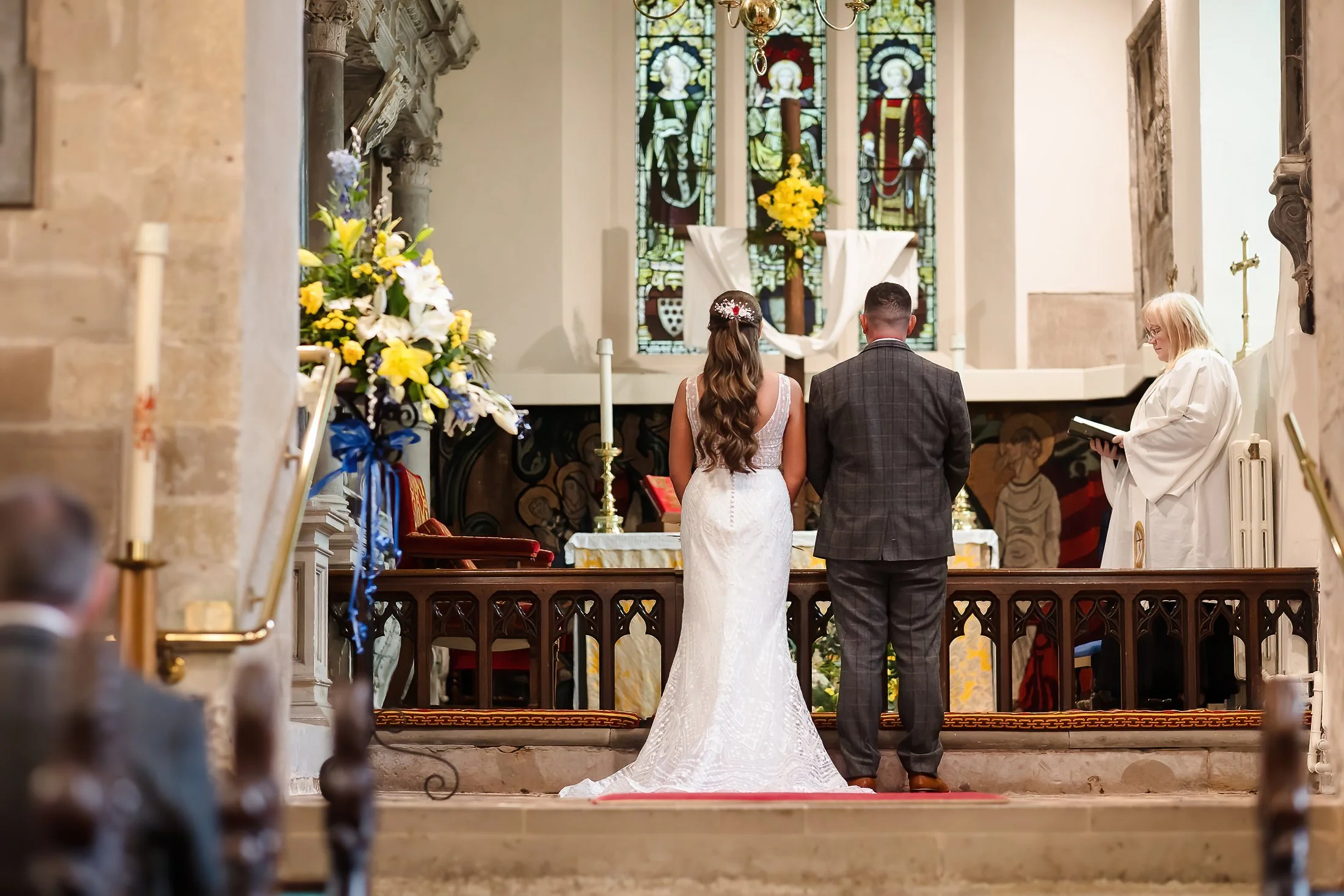
The Basilica of St. Augustine had been reserved eighteen months in advance. Its Roman columns scrubbed to sterile perfection, its vaulted ceilings draped with imported lilies that cost more than most people’s cars. The organ rolled through the nave with a sound so heavy it felt like history itself was breathing, and I stood in the second pew wearing a dress chosen not for comfort or beauty, but for the message Victor wanted to send: that I was polished, expensive, silent, and completely under his control.
We were there for my younger sister Iris’s wedding. She stood at the altar in a gown that looked almost modest beside the cathedral’s grandeur, her hands resting unconsciously over the gentle curve of her stomach—five months pregnant and glowing with something that had nothing to do with wealth. She radiated peace, the kind that comes from being loved without conditions.
Victor noticed it immediately. He always noticed things that threatened his carefully constructed narrative about what made people valuable.
As the priest—my brother Gabriel, though Victor had no idea—spoke about unity and sacrifice and the holiness of vows, Victor leaned close to my ear. To anyone watching, it would look intimate, romantic even. His fingers tightened around my forearm just enough to remind me of the hierarchy we performed so perfectly in public.
“Smile, Mara,” he murmured, his voice smooth and cultured in the way that made people trust him with their money. “You look fragile.”
I didn’t respond. Twenty-one years of marriage had taught me that responding only gave him more ammunition.
“You’re not the bride today,” he continued, his tone still pleasant for anyone who might be listening. “Don’t contaminate the atmosphere with your emotional infertility.”
The words sliced into me with surgical precision. Victor never wasted language, and he knew exactly where to cut deepest.
We had tried to have children for nearly a decade. Endured specialists with cold hands and warm bills, treatments that left me bruised and bloated and constantly apologizing for my body’s failures. Victor had grown more distant with every negative pregnancy test, every failed procedure, until he stopped pretending it was “our” problem at all.
In his world, everything that didn’t produce returns was a liability. And I had become the biggest liability of all.
The Sister Who Had Everything I’d Lost
The ceremony continued around us. Iris said her vows with a trembling voice that cracked only once. Her fiancé Daniel wiped away tears without shame. When they kissed, the cathedral erupted in applause that sounded like a language I had once spoken fluently and then forgotten.
Victor clapped politely, already scanning the room for donors, judges, senators—men whose names appeared in articles about “market confidence” and “economic resilience.” He didn’t attend weddings to witness love. He attended them to harvest proximity to power.
At the reception in the Crystal Ballroom of the Astoria, beneath chandeliers heavy enough to crush cars, Victor abandoned me entirely. He drifted from cluster to cluster of important people, laughing too loudly with men who controlled vast sums of money, charming women who wore ambition like expensive perfume.
I sat at a corner table, a decorative afterthought wrapped in silk and diamonds, watching my sister dance barefoot with her husband as if the world had shrunk to the precise size of their shared happiness.
They weren’t rich. They weren’t powerful. But they were free.
That’s when my brother approached.
The Brother I’d Forgotten Was Dangerous
Father Gabriel Rowan didn’t look like the priests Victor liked to donate to—the kind who smiled vaguely and avoided asking uncomfortable questions. Gabriel had presence, the kind that comes from years of cross-examining people who thought they were untouchable.
Before he took his vows, before he learned to speak about mercy with the restraint that frightened people who relied on secrets, Gabriel had been a federal prosecutor. And a devastatingly good one.
He sat beside me without asking permission, his presence somehow both comforting and unsettling.
“Mara,” he said quietly, his eyes tracking Victor across the room. “We need to talk.”
I forced the smile I’d perfected over two decades of public appearances. “Is now really the time?”
“No,” he replied, watching Victor laugh with his executive assistant—a young woman in a champagne dress whose hand rested far too comfortably on my husband’s arm. “But time stopped being a luxury for you weeks ago.”
My stomach dropped to the floor.
“Come to the rectory tomorrow morning,” Gabriel continued. “Alone.”
“Why?” I asked, though part of me already knew the answer would change everything.
“You haven’t sinned, Mara. But you’re married to a man who has, and he’s about to make you pay for all of it.”
He squeezed my hand once and disappeared into the crowd before I could ask another question, leaving me with the sudden awareness that everything I thought I knew about my life was built on sand.
Across the room, Victor leaned close to his assistant, his hand on her lower back in a gesture so practiced it made my chest ache. For the first time in years, I allowed myself to wonder not whether he was cheating, but how long he’d been planning to destroy me.
The Evidence That Changed Everything
The rectory the next morning smelled of old books and coffee reheated too many times. Gabriel placed a thick folder on the desk between us—color-coded, meticulously organized, and absolutely devastating.
“This isn’t a confession,” he said before I could speak. “This is evidence.”
The photographs hit me first. Victor laughing on a beach I’d never seen, his arm around the same young woman from the wedding. Her name was Lila Brooks—twenty-six, recently promoted to senior analyst, and three months pregnant.
There were ultrasound images. Property contracts in countries with complicated extradition treaties. And then the bank statements that made my hands shake.
My bank statements. Accounts my parents had established to protect me long before Victor entered our lives. Money he’d once called “our safety net” that he’d systematically drained over the past year, transferring over thirty million dollars into shell corporations I couldn’t pronounce, much less access.
“He’s leaving tomorrow night,” said a woman stepping out from near the door. She had the alert posture of someone accustomed to catching people in lies.
Naomi Pierce introduced herself as a former Treasury investigator turned private consultant. The kind of professional men like Victor underestimated until it was too late.
“He’s not just abandoning you,” she explained with clinical precision. “He’s framing you. All the joint accounts are now implicated in a tax evasion scheme he designed to collapse after his departure. Your signature is on everything. From the government’s perspective, you’re either his co-conspirator or his useful idiot.”
“He always preferred the useful idiot version of me,” I whispered.
Gabriel’s jaw tightened. “We have forty-eight hours before he disappears and you become the story that explains where all the money went.”
I stared at the papers, my entire marriage reframing itself in real time. What I’d interpreted as emotional neglect had actually been calculated exploitation. Every dismissive comment, every cruel joke about my “inability to understand finance,” every time he’d made me feel stupid for asking questions—it had all been preparation for this moment.
“What do I do?” I asked.
Naomi smiled, though there was nothing warm about it. “You remind him who you used to be. And you let him confess.”
The Setup
Their plan was precise and dangerous. They fitted a recording device into a strand of pearls Victor had given me years earlier—a symbol of his ownership repurposed as a witness against him. The irony wasn’t lost on any of us.
“Provoke him without showing fear,” Naomi instructed. “Men like Victor mistake emotional control for moral superiority. They get careless when they think they’re untouchable.”
That evening, I prepared our penthouse the way I’d been trained to prepare myself for decades: perfectly. I dressed in black silk, poured his favorite bourbon, and waited.
Victor arrived late, smelling of Lila’s perfume, irritated by my mere existence. When I mentioned the bank transfers, his mask slipped with startling speed.
“You shouldn’t concern yourself with finances, Mara. You’re not built for that kind of thinking.”
“I’m built for survival,” I replied quietly. “And you’re stealing from me.”
That’s when he laughed. Actually laughed, like I’d told him the funniest joke he’d ever heard.
“Yes,” he said, grabbing my wrist hard enough to leave marks. “I am stealing from you. And you’re going to take the fall for all of it, because that’s what you’re for. That’s what you’ve always been for.”
The words poured out of him then. Twenty-one years of contempt finally given voice. He told me about the offshore accounts, the fake humanitarian charities, the systematic theft of disaster relief funds. He explained how he’d used my grief over our childlessness to isolate me from anyone who might ask inconvenient questions.
“The beautiful thing,” he said, pouring himself more bourbon, “is that everyone will believe you were too stupid to know what you were signing. Poor, barren Mara, manipulated by her clever husband. You’ll go to prison feeling sorry for yourself, and I’ll be raising my real family somewhere the government can’t touch us.”
He was still talking, still confessing, still destroying himself with his own arrogance, when the penthouse door opened.
Not with drama. With authority.
Federal agents filled our living room. Naomi stood at the center, no longer playing the role of concerned consultant. Behind them came Gabriel, and in that moment he wasn’t a priest at all—he was the prosecutor who had never lost a case.
I removed the pearls with steady hands and set them on the coffee table.
Victor’s face went white. “Mara, what did you do?”
“I survived,” I said.
The Truth He Never Saw Coming
What Victor didn’t know—what he could never have imagined in his narcissistic certainty that he was the smartest person in every room—was that the warrant for his arrest had been signed weeks earlier.
Gabriel had been investigating Victor’s hedge fund for months, following a pattern of money laundering through humanitarian fronts. Victor had been stealing disaster relief funds, profiting from famine and war while accepting awards for his charitable contributions.
The wedding insult hadn’t triggered the investigation. It had simply been the moment when Gabriel decided Victor had proven, beyond any doubt, that he was exactly the kind of person who would steal from earthquake victims and then blame his wife for the paperwork.
Lila was arrested at the airport two hours later, pregnant and screaming that she’d been lied to, that Victor had promised her they were just going on vacation. The ultrasound photos in her purse told a different story—she’d known exactly what kind of man she was running away with.
Victor screamed my name as they led him out in handcuffs. I didn’t answer. After twenty-one years of responding to his voice, I’d finally learned the power of silence.
The Aftermath
The headlines were brutal. “Society Wife Brings Down Financial Empire.” “The Heiress Who Wore a Wire.” “From Penthouse to Prison: The Victor Hale Scandal.”
My name was everywhere, dissected by reporters who wanted to know how I’d played the long game so perfectly. They couldn’t understand that there had been no long game. There had only been survival, and a moment when survival meant fighting back.
I lost friends who couldn’t reconcile the quiet, compliant woman they’d known with someone capable of bringing down a man like Victor. I lost invitations to galas and charity luncheons where my presence would now be awkward. I lost the identity I’d performed for over two decades.
But I didn’t lose myself. For the first time in years, I found her.
The trial lasted eight months. Victor’s lawyers tried to paint me as the mastermind, a brilliant manipulator who had used her husband’s love against him. The prosecution’s response was simple: they played the recordings.
Victor’s voice, explaining in detail how he’d systematically stolen from me and planned to frame me. His contempt for my “emotional infertility.” His certainty that I was too broken to fight back.
The jury took four hours to find him guilty on all counts.
Victor Hale was sentenced to eighteen years in federal prison. Lila cooperated with prosecutors and received two years. She gave birth to Victor’s son in minimum security and gave the baby up for adoption.
The stolen money, what they could recover of it, was returned to the relief organizations Victor had robbed. My inheritance, what remained after legal fees and restitution, was enough to start over.
What Grows After Everything Burns Down
Two years later, I sit in a modest office teaching women how to read contracts, how to recognize financial abuse, how to trust their instincts when love begins to feel like a transaction. My nonprofit organization is small but growing, funded by women who understand that knowledge is the only protection that can’t be stolen from you.
I wear no diamonds now. I don’t need them. I wear my voice instead, and it turns out that’s been enough all along.
Iris’s daughter Emma is three now, and she calls me Aunt Mara like it’s the most important title in the world. She holds my hand like it matters, like I matter, and sometimes when I watch her play I think about the children I never had and feel grateful instead of broken.
Victor writes me letters from prison. Long, rambling things where he alternates between apologizing and explaining why everything was really my fault. I don’t read them anymore. My lawyer keeps them in case they’re ever useful, but I’ve learned that some voices don’t deserve an audience.
Gabriel performs marriages now at a small church in the suburbs. He tells couples that love requires vulnerability, not dominance. That marriage is partnership, not ownership. Sometimes I attend his services and watch him give communion to people who have no idea they’re being served by someone who once sent white-collar criminals to prison with the same steady hands.
The Lesson Hidden in Plain Sight
Sometimes when I walk past the Basilica of St. Augustine, where Victor thought he was humiliating me into permanent silence, I smile. Because I learned something that day that changed everything: redemption doesn’t come from accepting cruelty as love.
It comes from recognizing that cruelty wrapped in elegance is still cruelty. That love requiring your erasure isn’t love—it’s colonization. That the moment you stop performing your own smallness for someone else’s comfort is the moment their power over you collapses completely.
Victor built his empire on my silence, my compliance, my willingness to believe that his success somehow justified my suffering. He mistook my grief for weakness and my kindness for stupidity.
He was wrong about everything.
Control only survives as long as you believe you deserve it. The moment you stop believing—the moment you remember that you have value that can’t be stolen or destroyed—that’s when you discover what you’re actually capable of.
Victor spent twenty-one years teaching me to be small, quiet, and invisible. He succeeded so completely that he never saw the danger coming.
He forgot that before I became his decorative wife, I was Mara Rowan. The daughter of parents who taught me to read financial statements before I could drive. The sister of a man who became a federal prosecutor because he believed justice was worth fighting for. The woman who had learned to survive by staying quiet, but had never actually forgotten how to speak.
The pearls he gave me to mark my submission became the wire that recorded his confession. The wedding where he tried to break me became the moment his own destruction began. The emotional infertility he weaponized against me couldn’t compete with the spiritual infertility that had consumed his capacity for human decency.
In the end, Victor Hale discovered what bullies always discover when their victims stop playing along: that cruelty is actually a very fragile foundation for a life.
And love—real love, the kind that doesn’t require anyone to disappear—is indestructible.
Even when you think you’ve lost it forever, it turns out it was just waiting for you to remember that you were worth saving all along.

Lila Hart is a dedicated Digital Archivist and Research Specialist with a keen eye for preserving and curating meaningful content. At TheArchivists, she specializes in organizing and managing digital archives, ensuring that valuable stories and historical moments are accessible for generations to come.
Lila earned her degree in History and Archival Studies from the University of Edinburgh, where she cultivated her passion for documenting the past and preserving cultural heritage. Her expertise lies in combining traditional archival techniques with modern digital tools, allowing her to create comprehensive and engaging collections that resonate with audiences worldwide.
At TheArchivists, Lila is known for her meticulous attention to detail and her ability to uncover hidden gems within extensive archives. Her work is praised for its depth, authenticity, and contribution to the preservation of knowledge in the digital age.
Driven by a commitment to preserving stories that matter, Lila is passionate about exploring the intersection of history and technology. Her goal is to ensure that every piece of content she handles reflects the richness of human experiences and remains a source of inspiration for years to come.