By the time the first drop of wine hit the paper, I already knew something was wrong. I just didn’t know yet that the next ten minutes would crack open thirty years of carefully maintained silence and leave my family scattered like shrapnel across the pine floors of my father’s cabin.
The afternoon pressed against the windows with the particular heaviness of late summer—Labor Day weekend, the unofficial funeral of another year, and we were gathered at the lake house the way we always gathered, performing the ritual of family togetherness with the dedication of actors who’ve been playing the same roles so long they’ve forgotten they’re acting. The cabin smelled like old wood and leftover gravy and my mother’s perfume, that expensive floral scent she wore like armor against any suggestion that she wasn’t holding everything together perfectly. The ceiling fan stuttered overhead, pushing warm air in lazy circles, its chain rattling with each rotation in a rhythm I’d memorized over thirty summers.
Outside, the lake stretched flat and gray under a bruised sky, the water thick and still, waiting for the storm that had been threatening since morning. Distant boat motors growled from across the cove. Occasionally someone would shout from a neighboring dock, the sound carrying strangely across the water, too close and too far away at the same time.
Inside, we were doing what we always did: pretending everything was fine.
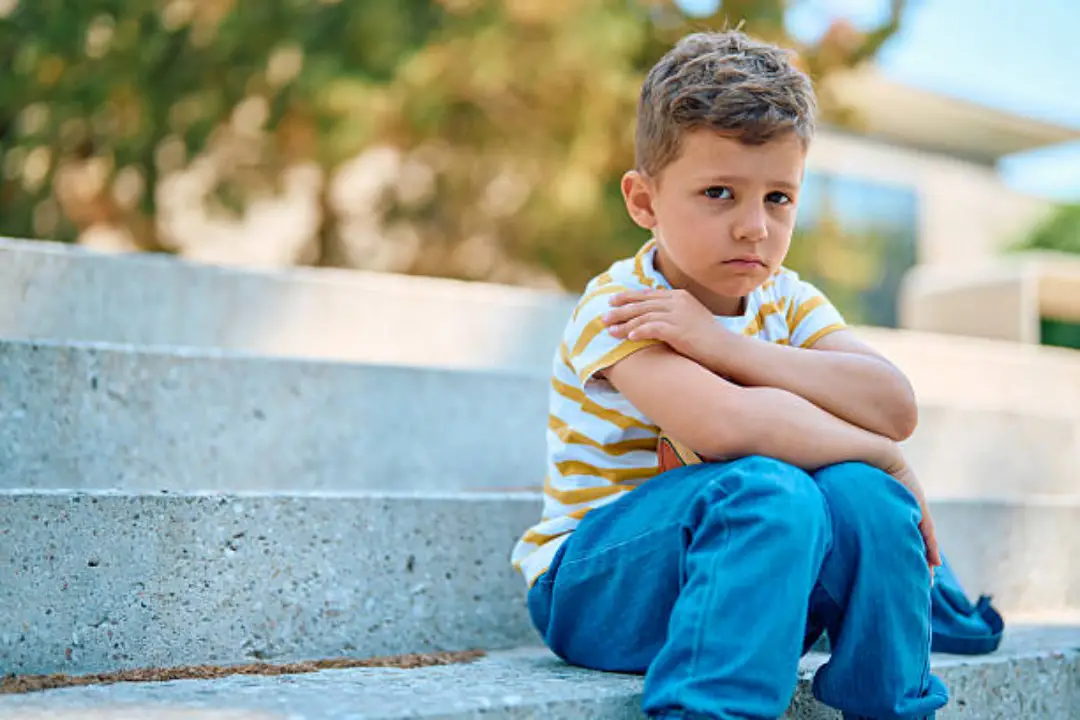
My son Jacob sat at the far end of the dining table, his thin legs swinging beneath the chair, not quite reaching the floor. His shoulders hunched forward in concentration, his tongue poking out between his teeth the way it always did when he was completely absorbed in something. Six years old, small for his age, with my dark hair and my ex-husband’s light eyes and a seriousness that sometimes made my chest ache because I recognized it as the same careful watchfulness I’d learned at his age.
In front of him lay the painting he’d been working on for three days.
Three days of waking before anyone else, tiptoeing through the cabin’s narrow hallway so he wouldn’t disturb the adults, slipping out onto the deck with his small plastic palette of watercolors and the battered brush set we’d bought at a craft store for seven dollars. Three days of sitting cross-legged on the weathered boards, staring at the lake with his eyes narrowed in study, trying to mix the exact shade of blue-gray that captured the way the water went dark near the pilings and lighter where the morning sun touched it.
“Do you think Grandpa will like it?” he’d asked me that morning while the coffee maker sputtered and choked in the kitchen, his voice barely above a whisper because we could hear my mother already moving around upstairs and both of us knew better than to be too loud before she’d had her coffee.
“He’s going to love it,” I’d said, smoothing his sleep-mussed hair. “You worked really hard on it.”
But I’d known even as I said it that the truth was more complicated. My father, David, did love Jacob—I never doubted that. But he loved things in a particular way. He was a structural engineer, a man who trusted weight and mathematics and the predictable behavior of load-bearing walls. He loved the intricate Lego bridge Jacob had built last Christmas and refused to let anyone disassemble. He loved the school report Jacob had rewritten twice because he’d misspelled “foundation” the first time.
This painting, though—this soft, imprecise watercolor with its uncertain edges and bleeding colors—I wasn’t sure what my father would see in it. Whether he’d see three days of dedicated effort or just another piece of childhood art that would eventually be recycled.
Jacob wanted it to be the first thing my father hung in the cabin. “Right there,” he’d told me yesterday, pointing to a blank stretch of knotty pine paneling near the big window. “So when Grandpa sits in his reading chair, he can look up and see the lake even if the curtains are closed. He’ll have two lakes then—the real one and the painting one.”
The logic had delighted him, and he’d laughed at his own cleverness, that pure, uncomplicated joy that children have before the world teaches them to question whether their ideas are good enough.
Now, at quarter past four on the last day of the long weekend, he sat at the same table where we’d eaten rubbery scrambled eggs that morning, adding tiny brushstrokes with absolute focus, unaware that the predator had already chosen its prey.
My sister Jessica stood beside him, one hip cocked against the table’s edge, swirling a glass of pinot noir like she was at a wine tasting instead of slouching around our family’s cabin. Thirty-three years old and still somehow the loudest presence in any room, the gravitational center around which everyone else orbited. She’d arrived that morning in designer athleisure and oversized sunglasses, her hair professionally highlighted, her nails done in that glossy red that matched the wine in her glass—the kind of details that required time and money and suggested a life more curated than lived.
Her phone lay face-up on the table beside Jacob’s painting, mercifully silent for once. Her perfume—something expensive and aggressively floral—mixed with the smell of wine and the remnants of the roast chicken we’d had for lunch, creating a cloying thickness in the air that made my head pound.
I noticed all of this in fragments, disconnected details that hadn’t yet assembled themselves into a warning.
Jacob looked up at her, his expression careful and hopeful in equal measure. He always watched Jessica with a kind of wary fascination, the way some children watch big dogs—half drawn to the energy, half afraid of being knocked over by it.
“What are you working on, kid?” she asked, though her tone suggested she was already bored with whatever answer might come.
“It’s the lake,” he said softly, his voice barely carrying over the murmur of conversation from the living room where my uncle and cousins were watching football. “For Grandpa’s birthday tomorrow.”
“Oh,” Jessica said, her eyes flicking down to the painting with the kind of dismissive glance you’d give something stuck to your shoe. “That.”
That. One word, delivered like a judgment.
I opened my mouth to intervene, to redirect her attention elsewhere, but before I could speak, she moved.
It wasn’t an accident. There was no stumble, no “oops” that could be laughed off and smoothed over with apologies and paper towels. She tilted her wine glass slowly, deliberately, watching with detached interest as the dark liquid rolled toward the rim, balanced there for one impossible second, and then spilled over in a thick red arc.
The first drop hit the sky Jacob had painted—that careful, hopeful blue he’d worked so hard to get right—and spread instantly, a dark stain blooming across the watercolor paper. Then the rest followed in a viscous stream, splashing across boats and trees and the distant shoreline he’d rendered in careful, uncertain strokes.
The sound was soft—just the patter of liquid hitting paper—but it seemed to fill the entire cabin, louder than the television, louder than the ceiling fan, louder than my own heartbeat.
Jacob flinched as if he’d been struck.
I watched the wine spread, dark red veins bleeding through the blue and green, destroying in seconds what had taken three days to create. The paper buckled immediately, curling up at the edges as it absorbed the liquid, the fragile structure of the painting surrendering under the assault. Colors separated and ran together in ways Jacob hadn’t intended, the careful layering he’d worked so hard to achieve dissolving into muddy chaos.
Jacob’s hand froze in mid-air, still holding his brush. A dot of blue trembled at the tip but never fell. His breath hitched—one sharp inhale that caught in his throat and stayed there.
Jessica held the glass inverted over the painting until the last drops fell, then set it down deliberately in the center of the ruined paper with a wet thud.
“He needs to learn that the world doesn’t care about his little doodles,” she said, her words slightly slurred but disturbingly steady, her eyes fixed not on Jacob but on me. “It’s taking up space.”
She reached for the wine bottle on the sideboard behind her, her movements casual, unhurried, as if she’d just cleaned up a minor spill instead of destroying something a child had poured his heart into.
“Besides,” she added, refilling her glass, “Jacob needs to toughen up. Can’t be so sensitive all the time.”
From across the room, my Uncle Mark—my mother’s brother, a man who’d made a career out of saying the cruelest thing in the loudest voice—slapped his knee and wheezed out a laugh that sounded like it hurt.
“That’s a fifty-dollar lesson right there, kid,” he crowed, delighted by his own wit. “Better learn it now—toughen up or get eaten.”
The laughter spread. My cousin Brian smirked over his beer. Someone muttered something about kids being too soft these days, and someone else agreed with the sage nodding of people who believe casual cruelty builds character.
My mother, Susan, gave a high, thin giggle from her position near the kitchen—that nervous, placating sound she made when something uncomfortable was happening and she desperately wanted it to stop being uncomfortable, preferably without her having to do anything about it.
The air in the cabin changed. It went tight and dense, pressurized, the way the atmosphere feels in the minutes before a summer storm when the clouds are swollen and ready to split open and dump everything they’ve been holding.
I didn’t scream. I didn’t rush forward to save the painting or comfort my child. For several seconds, I couldn’t move at all. My lungs simply forgot how to pull in air, my body frozen in a kind of shocked paralysis while my mind tried to process what I’d just witnessed.
But I watched my son.
Jacob’s shoulders trembled once—a tiny, suppressed shiver that ran through his whole frame. His eyes stayed locked on the painting, on the spreading red stain that was still bleeding outward, and he didn’t make a sound. His face flushed pink, then red, then a mottled, alarming scarlet. His bottom lip quivered, then disappeared as he bit down on it hard enough to turn it white.
He didn’t look at me. He didn’t look at anyone.
He pulled his elbows tight against his sides, hunched his shoulders forward, made himself smaller in the chair—shrinking, contracting, trying to disappear into the wood grain. He was waiting out the laughter the way prey waits out a predator, hoping that if he stayed very still, if he made himself small enough, they would lose interest and move on to something else.
He wasn’t looking for comfort. He was looking for invisibility.
And in that moment, with crystal clarity that felt like ice water in my veins, I saw something I’d been too close to see before.
I saw the chain.
The invisible chain being forged around my son’s neck, link by link, moment by moment. The chain made of lessons he was learning without anyone teaching them explicitly:
Don’t make a fuss. Your pain is inconvenient to others. Swallow it. Hide it. Disappear. Your worth is measured by how little trouble you cause. Be grateful for scraps. Don’t ask for what you deserve. Other people’s comfort matters more than your dignity.
I’d worn that chain for twenty-nine years. I’d polished it until it gleamed. I’d added links myself, voluntarily, because I’d learned that being low-maintenance, being easy, being the daughter who didn’t need much meant being the daughter who got to stay at the table, even if my place was always at the far end where the conversation didn’t quite reach.
And now I was watching it happen to my son.
I was watching him inherit my trauma like it was a family heirloom, passed down lovingly from generation to generation, the way some families pass down silver or china or recipes.
If I didn’t break that chain right now, in this exact moment, he would carry it for the rest of his life. He would learn to apologize for existing. He would become an expert at making himself small. He would grow up believing that his value was directly proportional to how little space he took up, how few needs he had, how silently he could absorb humiliation.
I couldn’t let that happen.
My chair scraped back suddenly, a harsh grinding sound that cut through the laughter like a blade. Every head in the cabin turned. Even the ceiling fan seemed to pause mid-rotation.
I stood.
I didn’t grab paper towels. I didn’t say “it’s okay, it’s just a painting” the way part of me—the trained, obedient part—wanted to say. I didn’t smooth anything over or make a joke to ease the tension or apologize for making things awkward.
I walked around the table with deliberate steps, each one ringing on the old pine floorboards, and positioned myself between Jessica and Jacob. My body became a wall, a shield, my back to my son, my face to my sister.
I didn’t look down at the ruined painting. I looked at her.
Jessica’s smirk widened, anticipating the performance she loved: me using my “teacher voice” to scold her, her theatrical apology, everyone laughing it off, the whole thing packaged into an anecdote about Jessica being “such a character.”
But I didn’t scold her. I didn’t use my teacher voice. What came out was something else entirely—something colder and harder and more final than anything I’d ever said to her before.
“You enjoyed that,” I said.
My voice was quiet but absolutely steady. No quaver, no upward inflection turning it into a question, no softness inviting negotiation. It lay between us like a ledger, flat and factual.
“You enjoyed watching a six-year-old work for three days on something that mattered to him, and you enjoyed destroying it.”
Jessica’s eyes narrowed. She laughed—that dismissive huff she’d perfected over three decades—and lifted one elegant shoulder in a shrug as she reached for the wine bottle again.
“Don’t be so dramatic, Sarah,” she said, dragging out my name like it embarrassed her to be related to me. “It’s watercolor paper. It cost, what, two dollars? I did him a favor—now he can learn to do something useful instead of making messes at the table.”
Useful. That word landed in my chest like a blade finding a familiar scar.
We both knew what “useful” meant. Useful like fetching Jessica’s water when we were kids so she didn’t have to get up from the TV. Useful like giving up my turn for the car because “your sister has plans and you don’t really need it, do you?” Useful like rearranging my work schedule to watch her apartment while she went on brand trips to places I couldn’t afford to visit.
The room had gone completely silent. Even Uncle Mark had stopped mid-laugh, his mouth hanging open slightly, sensing that something had shifted in a way he didn’t quite understand.
Jessica’s smirk faltered.
Before I could respond, my mother rushed in with the inevitability of weather.
“Oh, Jessica, you’re so clumsy,” she said, already bustling toward the table with a handful of paper napkins, her voice pitched high and false-bright the way it always was when she was trying to defuse something. “Look at this mess! The table, it’ll stain the wood—”
She began blotting frantically, her hands moving in quick, anxious circles, carefully avoiding the destroyed painting in the center like it simply didn’t exist, like if she didn’t acknowledge it then it wasn’t really ruined, wasn’t really a problem.
“Sarah, don’t make that face,” she said without looking at me, still scrubbing at the wine. “It was an accident. These things happen. We can get him a new coloring book, one of those nice ones with the thick paper. Jacob loves coloring books, don’t you, sweetheart?”
She didn’t wait for his answer. She was too busy erasing evidence, managing the situation, protecting the image of family harmony she’d spent thirty years carefully maintaining.
“Let’s just have a nice dinner,” she pleaded, glancing up with eyes that were too bright, too desperate. “Please. It’s a holiday weekend. We’re family. Can’t we just—”
“We’re family.” The magic words. The incantation she’d used my entire life to make hurt disappear, to smooth over cruelty, to demand forgiveness without requiring apology.
But the spell didn’t work this time. The words just lay there, exhausted and impotent.
I watched her wipe and wipe, ignoring the crumpled, bleeding paper at the center of the table, and something inside me that had always felt like pity—poor Mom, caught in the middle, just trying to keep everyone happy—transformed into something harder and clearer.
She wasn’t caught in the middle. She was maintaining a system.
My mother had made a choice decades ago about which daughter mattered more, which daughter’s tantrums were worth preventing, which daughter’s needs should be prioritized. And she’d been asking me to subsidize that choice ever since—with my silence, my compliance, my willingness to be the easy one, the one who didn’t require protection because that freed her up to focus all her energy on managing Jessica.
She’d let me be hurt, again and again, because my pain was quieter and easier to ignore than Jessica’s rage.
Jessica, emboldened by our mother’s intervention, leaned back in her chair with renewed confidence, swirling her wine.
“See?” she said to the room, as if the matter were settled. “It’s not a big deal. Sarah’s just being oversensitive, like always. Kid needs to learn that the world doesn’t coddle people. I’m doing him a favor.”
That was the final thread. I heard it snap with an almost audible sound.
My father stood.
He didn’t slam his chair back or raise his voice. He rose with slow, grinding deliberation, the way a building settles under its own weight, the way structural supports finally shift after years of bearing too much load. The movement drew every eye more effectively than shouting ever could have.
He walked to the fireplace without speaking, to the rough wooden mantel where a decorative sign hung—one of those mass-produced rustic plaques my mother loved, the kind you buy at home goods stores that proclaim sentimental slogans in curling script. This one read: FAMILY IS FOREVER.
He stood looking at it for a long moment, his face unreadable.
Then he turned to my mother.
“You cleaned the table,” he said.
His voice was low, so low I almost didn’t hear it, but it cut through the cabin like a dark current underneath still water.
Susan froze, wine-soaked napkins clutched in her hands, her eyes going wide.
“You didn’t check on the boy,” my father continued, his tone absolutely flat. “You worried about the wood.”
“David, don’t be dramatic,” she said automatically, her voice taking on that placating lilt. “I’m just trying to—”
“You’re trying to keep the peace,” he interrupted, and there was something terrible in his calmness. “You’ve been trying to keep the peace for thirty years. There is no peace, Susan. There’s just silence. And I’m done paying for it.”
He looked down at his left hand.
The gold wedding band had lived on his fourth finger for forty years. I’d only seen it off once, when he’d had a skin rash and needed to apply medication. It had looked wrong then, his finger pale and indented where the metal had pressed, as if the ring were still there in ghost form.
Now he twisted it.
The ring didn’t move easily. It had settled deep into the soft flesh, the skin grown around it over decades. He walked to the kitchen sink, his footsteps heavy and deliberate, and pumped dish soap onto his finger. The plastic bottle squeaked—an absurdly loud sound in the suffocating quiet.
He worked the ring back and forth, his jaw clenched with effort. I saw the tendons in his wrist stand out, saw the way his hand trembled slightly with the strain. For a moment I thought it might not come off, that it would resist and he’d give up and the moment would pass.
Then it slid over the knuckle with a wet, painful pop.
He held it between his thumb and forefinger, soap shining on the gold, and walked back to the table with the same measured, unstoppable pace.
No one spoke. No one moved. The only sound was the rain that had finally started outside, a soft patter against the windows that would build into a downpour within minutes.
He stood over Jacob’s ruined painting, over the spreading puddle of wine, and held the ring above it.
My mother whispered, “David—” like a prayer, like a plea, like the last word before a bridge collapses.
He dropped it.
The wedding band hit the soaked paper with a dull, heavy sound, sinking into the red-stained fibers. Wine splashed up in tiny droplets, spattering the white tablecloth and my mother’s trembling hands.
“I am done keeping your peace,” he said, looking directly at Susan. “And I am done protecting you from the consequences of your choices.”
The silence that followed wasn’t empty. It was a vacuum that pulled at everything, sucking the air out of the room, making it hard to breathe.
My mother stared at the ring like it was a live grenade. Jessica laughed—a sharp, barking sound that cracked in the middle.
“Are you having some kind of breakdown?” she said, though her eyes darted around nervously, looking for an exit that wasn’t there. “You’re going to divorce Mom over a five-dollar watercolor set? That’s insane. That’s actually pathetic.”
My father didn’t look at her. Didn’t acknowledge her at all. He walked past both of them to his travel bag in the corner—the gray canvas duffel he’d had since before I was born, worn leather handle, small embroidered initials fading on the side.
He knelt, unzipped it, and pulled out a black leather-bound notebook.
I’d seen that notebook my entire life. It lived in his office, or sometimes by his recliner, or tucked into his briefcase. He’d write in it on planes, during commercial breaks, at the kitchen table after everyone else had gone to bed. I’d always assumed it was work notes—calculations, project details, the kind of technical record-keeping engineers do.
He carried it to the head of the table and set it down with a solid thud that made the wine glasses tremble.
“I’ve been a structural engineer for forty years,” he said, his palm pressed flat against the worn leather cover. “My job is to identify stress fractures before buildings collapse. To find the cracks, measure the displacement, calculate when failure becomes inevitable. I document everything.”
He opened the notebook.
The pages were dense with his small, neat handwriting—columns of dates and numbers and brief notations. It didn’t look like a diary. It looked like a maintenance log, like the records he kept for bridges and buildings, tracking the slow progression of structural decay.
“Three years ago,” he said, running his finger down one margin, “you told me you needed five thousand dollars for a business opportunity.”
He looked at Jessica.
“You said your influencer platform was taking off but you needed new camera equipment.”
Jessica rolled her eyes, arms crossing over her chest defensively. “Yeah, and I paid you back. Mostly. What is this, an audit?”
“You didn’t pay back a single dollar,” David said without raising his voice. That made it worse somehow. “But that’s not the point. That’s when I started documenting. Not just the big transfers. Everything.”
He turned the book around so we could see the pages.
“Every time your mother said she needed extra money for groceries,” he continued, tapping the columns, “every withdrawal for ’emergency house repairs’ that never had corresponding receipts, every unexplained dip in our savings—I tracked it. The dates. The amounts. Where the money actually went.”
My mother made a small, choked sound, her hand moving toward the notebook like she might slam it shut, but she dropped it halfway, fingers curling back against her chest.
“David, please,” she whispered. “Don’t do this. Not in front of everyone.”
“Everyone needs to know,” he said, his eyes finding mine with an expression of raw, undiluted remorse that made my throat tighten. “Because everyone has been watching Sarah and Jacob be treated like they don’t matter, and everyone has been silent. But the two of them aren’t weak—they’re the ones who’ve been paying the price for keeping this family’s fiction intact.”
He turned back to the notebook.
Receipts were taped to pages—bank transfer confirmations, printed emails, photocopies of checks. Some were highlighted in yellow or pink. Some had notes in red pen in the margins.
“This isn’t an allowance, Jessica,” he said quietly. “This is extortion. This is a ransom your mother has been paying for years to keep you from burning everything down.”
He found a specific entry and read, “August fourteenth, two years ago. Twelve thousand dollars. You said it was for a brand partnership investment.” He flipped another page. “April third, last year. Eight thousand. Medical bills, you said.”
My mother’s shoulders shook. Her mascara was starting to run, black tracks down her cheeks.
“But the largest one,” David said, his voice dropping to something barely above a whisper, “was three years ago. Labor Day weekend. The party we didn’t attend because your mother said Jessica was sick.”
He looked at Susan, and I saw something in his face I’d never seen before—not anger, but a kind of tired, devastating disappointment.
“You told me she had food poisoning,” he said. “You said she was too ill to call herself. Too weak. So I wired the money without question. One hundred and seventy-four thousand dollars.”
The number hit like a physical blow. I actually swayed on my feet, my hand gripping the back of Jacob’s chair to steady myself.
“The money wasn’t for business,” David said. He turned to another page, and this time what was taped there wasn’t a receipt. It was a copy of an official document—black and white, the state seal visible at the top, neat typed lines below.
A police report.
“Three years ago,” my father said, his voice steady despite the tremor in his hands, “Jessica drove home drunk from a party and hit a parked car. Then she hit a pedestrian. A nineteen-year-old girl walking her dog.”
The floor tilted. I remembered that weekend vaguely—a phone call from my mother saying Jessica was “taking some time for herself,” maybe traveling to Europe, working through some things. Nothing to worry about.
“She fled the scene,” David continued. “Hit and run. The girl survived, but barely. Traumatic brain injury. Months of rehabilitation.”
My mother broke, her face crumpling like wet paper, hands covering her mouth as sobs shook her whole body.
“I was protecting her,” she wailed. “I was protecting our family, our name—”
“You stole our retirement,” David said, and for the first time his voice shook with real emotion. “You took one hundred and seventy-four thousand dollars—money we saved for forty years—and you paid lawyers to bury it. You paid a settlement to the victim’s family to keep it out of civil court. You paid an auto shop to fix the damage off the books. And then you lied to me about all of it. You said it was a resolved parking dispute.”
He slammed the notebook closed.
The sound echoed through the cabin like a gunshot.
“You stole our future to protect her from consequences,” he said. “And then you let her sit at this table, year after year, destroying a child’s artwork and calling it a life lesson. You created a monster and fed her with other people’s dignity.”
He looked at Jessica, whose face had gone chalk-white, all color drained from her lips.
“You’re not an entrepreneur,” he said. “You’re a liability. And your mother has been your enabler and your accomplice.”
Jessica stood abruptly, her movements jerky and uncoordinated. She smoothed her dress with shaking hands, lifted her chin in that familiar gesture of defiance, the mask scrambling back into place.
“So what?” she spat. “It was an accident. Mom helped me because that’s what mothers do. That’s what family does. Unlike you, apparently.”
She turned that glare on David, eyes glittering with tears and fury.
“You’ve always been cold,” she said. “Mom loves me more than you ever could. More than she loves Sarah. That’s just a fact.”
The words were childish, absurd even, and yet utterly sincere. She believed them with the conviction of someone who’d been told it was true for so long it had become foundational reality.
My father looked at her with something that wasn’t quite pity but also wasn’t quite anger—more like an engineer examining a condemned building and knowing there was no saving it.
“You have nothing,” he said simply.
He reached into the back of the notebook and pulled out a folded document—thick paper, official, important. He unfolded it carefully and laid it on the table next to the wedding ring and the ruined painting.
“This cabin is solely in my name,” he said. “It was my inheritance from my father. Your mother’s name appears nowhere on the deed.”
He smoothed the paper flat with his palm, the ring glinting dully in the gray light from the window.
“You have one hour to vacate,” he said. “All of you. Susan included. I’m listing this property for sale tomorrow to begin recouping the retirement funds that were stolen. The proceeds will be placed in a new account. In Sarah’s and Jacob’s names.”
My mother let out a sound somewhere between a wail and a gasp.
“You can’t kick us out,” she cried, clutching at her chest theatrically. “It’s pouring rain. Where will I go?”
“I don’t know,” David said, and his voice was almost gentle in its finality. “Perhaps you could stay with the daughter you invested everything in.”
He turned to Jessica.
“Ten minutes ago, while you were busy destroying my grandson’s painting, I called the bank. I’ve reported the fraudulent transfers and initiated an investigation. All joint accounts are frozen pending review. The money you’ve been funneling through your business account is being examined for tax compliance.”
Jessica lunged for her phone, her hands shaking so badly she could barely unlock it. She pulled up her banking app, typed frantically, and I watched all the color drain from her face.
“It’s—” she choked. “Access denied. My cards are—”
The structure she’d built her entire identity on—the influencer lifestyle, the curated image, the expensive clothes and trips and accessories—all of it had been scaffolding held up by other people’s money. Without the steady infusion of capital from my parents, without the safety net she’d never acknowledged but always assumed would be there, she was nothing but debt and delusion.
“Your power was rented,” my father said quietly. “And the lease just expired.”
He walked to the door and opened it wide.
Rain poured down in heavy sheets now, hammering the porch roof, driven sideways by wind that sent spray through the open doorway. Thunder rumbled in the distance.
“Get out,” he said.
The words weren’t shouted. They were stated as simple fact, like announcing the weather or reading a measurement.
Jessica looked around wildly, seeking allies, escape routes, some foothold that would stop this from happening.
“Uncle Mark,” she said, laughing desperately. “Tell him he can’t do this. You’re a lawyer. Tell him—”
Mark studied his beer bottle with sudden, intense fascination, shoulders hunched, clearly wanting no part of this.
She turned to our mother. “Mom. Say something. Make him stop. Tell him he’s being crazy.”
Susan’s face was destroyed by tears and running makeup, her mouth opening and closing soundlessly. For once in her life, her ability to rewrite reality, to spin comfortable narratives that made everyone feel better, failed her completely.
Finally, Jessica’s eyes found mine.
“Sarah,” she whispered, and my name had never sounded like that in her mouth before—not like an insult or an afterthought, but like a lifeline.
“Tell him he’s wrong,” she begged. “Tell him he can’t do this to me. We’re sisters.”
I thought about all the times she’d used those words to justify taking what she wanted. We’re sisters, of course you’ll cover my rent this month. We’re sisters, obviously you’ll watch my dog while I’m on vacation. We’re sisters, why are you being so difficult about this?
I thought about my son’s shoulders folding inward when the wine hit his painting, the way he’d tried to make himself invisible because he’d learned that being small was safer than being seen.
I looked at my sister—this woman who had terrorized me for thirty years, who had never once apologized for genuine harm, only demanded more cushioning from the world whenever she fell.
“Traffic’s going to be terrible in this rain,” I said. My voice sounded strange to my own ears—calm, clear, final. “You should probably hurry.”
She stared at me like I’d struck her. Then something in her expression shifted—hurt, rage, and disbelief mixing into something toxic—and she spun away, grabbing her coat with sharp, angry movements.
My mother followed, still sobbing, snatching random items—her purse, a framed photo, a cardigan—moving on autopilot, as if maybe if she gathered enough objects it would prove this wasn’t really happening.
They left without another word, rain immediately soaking their clothes and hair the moment they stepped off the covered porch.
The cabin door closed behind them, and the silence that rushed in to fill the space they’d occupied felt like a physical presence—heavy and ringing and strange.
For a long time, no one moved.
Then Jacob slipped from his chair and came to stand beside me, pressing his face against my hip. Only then did I realize my own face was wet, tears I hadn’t felt start now running freely down my cheeks.
My father walked slowly back to the table, picked up the soaked painting with the wedding ring still embedded in its center like a sunken coin in dark water, and held it carefully in both hands.
“I think,” he said quietly, “we might be done with family holidays.”
Six months later, I stood in my father’s new apartment holding a cup of coffee and watching late winter sunlight stream through windows that overlooked the city park. The apartment was small—two bedrooms, one bathroom, a galley kitchen—but it was peaceful in a way the cabin had never been peaceful, in a way my childhood home had never been peaceful.
No one walked on eggshells here. No one sighed dramatically to signal displeasure or slammed cabinets to make a point. The air wasn’t thick with unspoken resentment and carefully managed tensions.
It was just quiet. Genuinely, restfully quiet.
My father and Jacob were kneeling on a tarp spread across the living room floor, surrounded by sawdust and pine boards and the sharp, clean smell of freshly cut wood. David held a tape measure, pulling it taut across a piece of lumber while Jacob watched with absolute focus, a pencil poised over his notebook.
“Measure twice,” my father said, handing the tape to Jacob.
“Cut once,” Jacob finished solemnly, like he was reciting sacred text.
They were building custom frames for Jacob’s paintings—a project they’d started after my father mentioned that Jacob’s latest work “deserved better than a dollar-store frame.”
“We could make our own,” Jacob had suggested. “Like your buildings. Strong frames to protect the art.”
Now they were on their fourth frame, working in comfortable companionship, and I watched Jacob handle the small saw with careful confidence, no longer afraid of making mistakes, just trying his best.
The ruined painting hung in my father’s apartment now, mounted in a deep shadow box David had built himself, the wine-stained paper visible behind glass that was set back so it wouldn’t touch the damaged surface. The wedding ring sat in the center, exactly where it had fallen, preserved like evidence.
Not a shrine to suffering. A record. Proof that something had broken and we’d survived.
My mother lived in a small condo two towns over. She’d sent letters at first—pages of elegant handwriting on expensive stationery explaining that she didn’t understand why we had to “make such a spectacle” and “embarrass” her.
I burned them all, one by one, in my kitchen sink, and told Jacob we were getting rid of things that hurt us.
Jessica I heard about only through the occasional social media post from distant relatives—glimpses of a life that had contracted considerably without the constant infusion of other people’s money. The influencer career had withered. The designer clothes had been sold. She lived in a studio apartment now and worked retail.
I didn’t hate her. Hate would have required energy I wasn’t willing to spend. Mostly I felt a distant, tired sadness, and a firm conviction that I would never again allow her anywhere near my child.
Breaking the chain meant guarding the door.
“Mom!” Jacob called, pulling me back to the present. He held up a piece of wood with a slightly rough edge but a solid angle. “Look—we did the corner!”
“You did,” I corrected gently. “Grandpa supervised. You did the work.”
David glanced up, and in his eyes I saw an apology that would probably never fully fade, but also relief. He’d told me once, late one evening, about the years he’d watched the cracks forming in our family and done nothing, told himself I was strong enough not to need protection, used my resilience as an excuse for his own inaction.
“I’m trying to be the person you thought I was,” he’d said.
Watching him now with Jacob, patient and present, I believed him.
Jacob climbed into my lap despite being almost too big for it, his legs dangling long and bony, and said, “After this frame, can we make one for my new lake painting?”
“Your new one?” I asked.
He nodded, eyes bright. “I want to paint it again, but different. Half sunny, half storm. And us in the window—just little dots. You, me, and Grandpa.”
He paused, thoughtful. “Not them. Just us.”
I held him tighter, blinking back tears. “Yeah, baby. We can absolutely do that.”
The price of this peace had been high—shattered family myths, sold property, holidays with only three place settings, relatives who thought we were cruel for “abandoning blood.”
But watching my son laugh as he spilled wood glue and reached confidently for a rag to clean it up, not flinching, not freezing, not bracing for screaming—I knew it had been worth it.
We hadn’t broken the family. We’d broken the cycle.
For the first time in my life, I didn’t feel like a problem to be managed or a supporting character in someone else’s drama. I felt like the main character of my own story—a woman who chose her child over comfortable lies, a daughter who demanded better from her father and got it, a mother who broke the chain.
Jacob glanced back at me and grinned, sawdust dusting his hair. “When we’re done, can we hang it above the couch? So when we sit here, we can look up and see the lake?”
Two lakes, I thought. The one we left behind and the one we’re painting now, framed by hands that know how to measure and build and protect.
“Yes,” I said. “Right where we can always see it.”
Because this time, if anyone tried to pour wine on his world and call it a lesson, they’d discover very quickly that I wasn’t quiet anymore.
And neither was my father.
We’d learned, finally, that the people worth protecting are the ones who don’t demand it loudest, but the ones who suffer it most quietly.
The chain was broken.
And we were finally, finally free.

Lila Hart is a dedicated Digital Archivist and Research Specialist with a keen eye for preserving and curating meaningful content. At TheArchivists, she specializes in organizing and managing digital archives, ensuring that valuable stories and historical moments are accessible for generations to come.
Lila earned her degree in History and Archival Studies from the University of Edinburgh, where she cultivated her passion for documenting the past and preserving cultural heritage. Her expertise lies in combining traditional archival techniques with modern digital tools, allowing her to create comprehensive and engaging collections that resonate with audiences worldwide.
At TheArchivists, Lila is known for her meticulous attention to detail and her ability to uncover hidden gems within extensive archives. Her work is praised for its depth, authenticity, and contribution to the preservation of knowledge in the digital age.
Driven by a commitment to preserving stories that matter, Lila is passionate about exploring the intersection of history and technology. Her goal is to ensure that every piece of content she handles reflects the richness of human experiences and remains a source of inspiration for years to come.
Loved this story!
A lesson learned. A lesson that A lot of family need too learn and correct before it comes to this and with honest and God love this world would be a better place. Love the story and hoped it helps others.
Ms Hart,
This story was well written. Correct spelling and feelings expressed in true form. I’m going to find your books so there’s no interruptions of sales adds. Looking forward for more of your books.