I almost didn’t go.
I stood at my kitchen counter that Tuesday morning, the flowers already wrapped in paper on the table, and I told myself for the tenth time that maybe my husband was right. Maybe this was unnecessary. Maybe some things are better left alone.
But the feeling wouldn’t leave me. It hadn’t left me in months.
So I picked up the flowers, got in my car, and drove to the cemetery.
By the time I got home that afternoon, my life would never be the same.
When Marcus and I first met, he told me the truth about his past — or what I believed was the truth.
He’d been married before. Her name was Elena. She had died three years earlier in a car accident on a mountain road, late at night, in bad weather. He said the grief had nearly broken him. That for a long time he hadn’t been able to imagine loving anyone again.
He told me all of this on our third date, quietly, over dinner, with the kind of careful honesty that made me trust him completely. He wasn’t hiding it. He was offering it to me, painful and unpolished, as proof that he was serious about us.
I reached across the table and took his hand.
“I’m so sorry,” I said. “You don’t have to talk about it.”
“I want you to know,” he said. “Before anything else between us, I want you to know.”
I fell a little more in love with him that night.
We dated for eight months. We got engaged in the spring, at a restaurant overlooking the river, with his grandmother’s ring. I said yes before he’d finished asking. We were planning a fall wedding — not too large, not too small, something that felt like us. I was happier than I’d been in years.
But through all of it, one thought stayed with me like a stone in a shoe.
Before I became his wife, I needed to visit her grave.
I can’t fully explain the impulse. It wasn’t guilt, exactly — I hadn’t taken anyone from anyone. But there was something about stepping into the life of a man who had already loved and lost someone that made me want to acknowledge her. To stand at her grave and lay flowers and say, quietly, in my own heart: I see you. I respect what you were to him. I’m not trying to erase you.
I brought it up to Marcus once, early on. His reaction surprised me.
“It’s not necessary,” he said quickly. Too quickly.
“I know it’s not necessary,” I said. “I want to.”
“She wouldn’t want that. She wouldn’t want anyone making a big production of—”
“It’s not a production. I just want to pay respects.”
He shook his head and changed the subject. I let it go.
I brought it up again a few months later. Same response, but sharper this time. A tension in his jaw. His eyes moving slightly away from mine.
“Marcus, why does this bother you so much?”
“It doesn’t bother me. It’s just pointless. Let the past stay in the past.”
But his voice said something different. His voice said: please don’t go there.
I told myself it was grief. That some wounds are so deep that even talking around them causes pain. I told myself I understood that, and I should be gentle with him.
I still believed him then. I still trusted him completely.
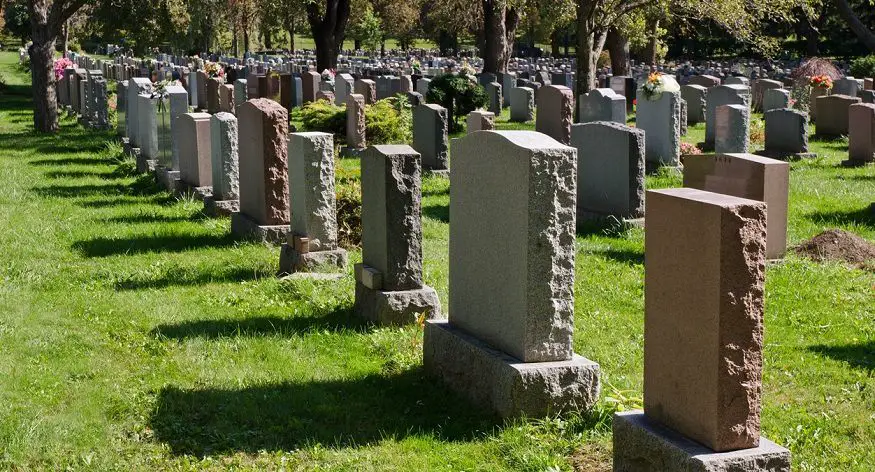
The cemetery was about forty minutes outside the city, set back from the road behind a stone wall and old iron gates. It was a gray Tuesday morning, the kind of early autumn day that can’t decide if it wants to be summer or winter. The trees were just beginning to turn.
I followed the map I’d printed — Marcus had once mentioned her name and the town where she’d grown up, and it hadn’t been hard to find the cemetery records online. He didn’t know I’d looked.
The grave was in the older section, under a copper beech tree that had already gone deep red. A simple headstone, pale gray granite, clean and well-kept.
I stood in front of it for a moment with my flowers, composing myself. I was a little emotional already — being in a cemetery will do that, even when you didn’t know the person.
I looked down at the headstone.
And my heart stopped.
I don’t mean that figuratively. I mean that for a moment, the world went absolutely silent and still, and the only thing that existed was the photograph mounted on that granite stone.
She had dark hair, worn loose, falling just past her shoulders. A wide smile. Bright eyes.
My dark hair. My smile. My eyes.
The flowers fell. I didn’t feel them leave my hands. I was staring at the photograph with a kind of focused, desperate attention, scanning every feature, searching for the difference that would make this a coincidence. Different nose. Different jaw. Something.
But the longer I looked, the more my body understood what my mind was refusing to accept.
We didn’t just resemble each other. We looked like the same person photographed years apart.
I don’t know how long I stood there. Long enough that my feet went cold on the ground. Long enough that a groundskeeper walked past, glanced at me, and kept walking.
Finally, I bent down and picked up the flowers. I set them against the stone carefully, the way I’d planned. My hands were shaking.
I said nothing. I’d planned to say something — whatever small private words I’d imagined in the car on the drive over. But standing there, looking at that face that was somehow my face, I had no words left.
I walked back to my car. I sat inside without starting the engine for a very long time.
And then I started thinking.
The drive home felt different than the drive there. The landscape was the same. The gray sky, the turning trees, the familiar highway. But I was different inside it. Something had shifted, the way the ground shifts before an earthquake — invisibly, deep down, with consequences you can’t yet see.
I kept thinking about Marcus’s face when I’d asked to visit her grave.
That tension. That subtle, insistent fear underneath his calm exterior.
Let the past stay in the past.
Why? Why would a grieving man not want his future wife to visit his late wife’s grave? It was a small, gentle gesture. A respectful one. What was there to be afraid of?
Unless there was something there to find.
I got home before Marcus. I sat at the kitchen table and stared at nothing for a while. Then I opened my laptop.
I want to be clear about how slowly this happened. It wasn’t a dramatic overnight revelation. It was weeks of small discoveries, each one individually explainable, collectively impossible to ignore.
I started with the accident itself. Elena had died on a mountain road about sixty miles from where they’d lived at the time. The official account was straightforward — bad weather, dangerous curve, single vehicle. The case had been ruled accidental.
But when I dug into the local newspaper archives, I found something that nagged at me. The investigation had closed in eleven days. Eleven days for a fatal accident on a mountain road with no witnesses and no surviving driver.
I’m not an investigator. I don’t know how these things typically work. Maybe eleven days is normal. But something about it felt rushed.
I kept going.
I found a former neighbor — a woman named Patricia — through an old community forum. She had lived next door to Marcus and Elena for two years before Elena’s death. I sent her a careful message, introducing myself, saying I was engaged to Marcus and trying to learn more about his past.
She didn’t respond for four days. When she did, her message was short.
I’m not sure I should talk to you. But I’m also not sure I should stay quiet. Can we speak by phone?
We spoke the following Saturday, when Marcus was at his brother’s house.
Patricia talked for almost an hour. She spoke carefully, the way people do when they’re telling the truth about something that frightened them. She talked about Elena — bright, funny, warm. She talked about how the relationship had changed in the year before Elena’s death. How Elena had grown quieter. How she’d stopped having friends over. How Patricia had once seen bruises on her wrists and Elena had said she’d fallen, and Patricia had not believed her but hadn’t pushed.
“She was afraid of him,” Patricia said. Not dramatically. Just plainly, as a fact. “She didn’t say it in those words. But I knew.”
I asked if she’d told anyone this at the time of the accident.
A pause.
“I told one of the officers. He wrote something down. Nothing ever came of it.”
After we hung up, I sat with that for a long time.
I want to say something here, because I’ve thought about it a great deal since.
There is a version of this where I’ve made terrible mistakes. Where I’ve taken fragments of information and assembled them into a story that isn’t true. Where Patricia’s memory is shaped by hindsight. Where the investigation was fast because it was straightforward. Where the resemblance between Elena and me is a coincidence that I’ve inflated in my own terrified mind.
I want to be honest: I considered all of that. I turned it over carefully. I’m not someone who jumps to conclusions.
But then I spoke to Elena’s cousin — a woman named Diane, who had been close to her. And Diane told me something that Patricia hadn’t.
“She called me,” Diane said. “About six weeks before she died. She said she needed to talk to me about Marcus. She said she’d found something — I don’t know what. She was going to come visit me the following weekend.” Diane paused. “She never came.”
I asked what she thought had happened.
“I think he found out she was planning to leave,” Diane said quietly. “I think he couldn’t let that happen.”
And then she said: “What does he look like now? Is he the same?”
I said yes. Same dark eyes, same easy charm, same careful thoughtfulness.
“Be careful,” she said. Simply. “Please be careful.”
I still haven’t told Marcus what I found.
I know I need to. Or rather — I know I need to act. What I don’t know yet is exactly how, or in what order, or who I trust enough to involve.
I have spoken to an attorney. Not dramatically — I walked into a consultation office on a Tuesday afternoon and said I needed advice on a sensitive personal matter, and I laid out what I knew, and I watched the attorney’s face grow very still as I talked.
She helped me understand what I could do next.
I am not living in fear, exactly. I am living in a kind of hyperaware clarity that I have never experienced before. Every conversation with Marcus now has two layers — what he’s saying, and what I’m watching for underneath it. I have become very good at seeming normal.
I know that this situation cannot stay the way it is. The wedding is two months away. Something has to happen before then.
But I’ve also learned something from Elena’s story, and from Diane’s, and from Patricia’s. The thing I’ve learned is that acting out of fear is dangerous. Acting without a plan is dangerous. Elena may have tried to leave without enough support around her, without enough documentation, without enough protection.
I am not going to make that mistake.
There are things I know now that I didn’t know three months ago.
I know that Marcus did not fall in love with me by accident. I’ve pieced together, carefully, the story of how we met — a party, a mutual friend, what felt like a spontaneous, electric connection. But the mutual friend, I’ve recently learned, had known Marcus for years. And Marcus had, quietly, through that mutual friend, made his way into my social circle for months before that party.
He positioned himself to meet me.
Because I looked like her.
I think about that sometimes — standing at her grave, staring at her photograph, and understanding for the first time that he didn’t choose me for who I am. He chose me for what I look like. He had been searching the world for her face, and when he found it on me, he decided I would do.
I don’t know whether to feel grief or rage. Most days I feel both.
I loved him. Whatever else is true, that is also true. The man I thought I knew — the honest, quiet, thoughtful man who told me about his loss over dinner and trusted me with his past — I loved that man completely.
But I don’t think that man exists.
I went back to the cemetery once more. Alone again, on a morning when Marcus thought I was visiting my sister.
I stood at Elena’s grave and this time I did say something.
I said: I see you now. I understand what happened to you. I’m going to be smarter than you were able to be. I’m going to be safe.
I don’t know if that means anything. I’m not a particularly spiritual person. But standing there, looking at her face — my face — I felt something that I can only describe as a kind of determination on her behalf.
She didn’t get the chance to save herself.
I still have mine.
I’m writing this because I need to get it out of my body and onto a page. Because carrying it alone is its own kind of weight, and I’m tired of the weight.
I’m also writing this because somewhere, there might be a woman reading this who has noticed something she can’t quite name. A tension in a voice where there shouldn’t be tension. A resistance to simple questions. A story that sounds almost right, but not quite.
Trust that feeling.
Don’t let anyone tell you the past should stay in the past. Don’t let anyone talk you out of what your instincts are telling you.
And if you find yourself standing at a grave, looking at a photograph that looks like your own face — please don’t stand there alone.
Get safe first. Get help. Make a plan.
And then, when you are ready, and when you are protected — act.
That’s what I’m doing.
I’ll let you know how it goes.

Ethan Blake is a skilled Creative Content Specialist with a talent for crafting engaging and thought-provoking narratives. With a strong background in storytelling and digital content creation, Ethan brings a unique perspective to his role at TheArchivists, where he curates and produces captivating content for a global audience.
Ethan holds a degree in Communications from Zurich University, where he developed his expertise in storytelling, media strategy, and audience engagement. Known for his ability to blend creativity with analytical precision, he excels at creating content that not only entertains but also connects deeply with readers.
At TheArchivists, Ethan specializes in uncovering compelling stories that reflect a wide range of human experiences. His work is celebrated for its authenticity, creativity, and ability to spark meaningful conversations, earning him recognition among peers and readers alike.
Passionate about the art of storytelling, Ethan enjoys exploring themes of culture, history, and personal growth, aiming to inspire and inform with every piece he creates. Dedicated to making a lasting impact, Ethan continues to push boundaries in the ever-evolving world of digital content.