The phone screen glowed harsh in the darkness: 1:01 AM. Mom’s name and photo—a picture from last Christmas where she actually looked happy—illuminated my nightstand. My husband Matt slept through the buzzing like he slept through everything, his breathing steady and oblivious beside me.
I should have let it go to voicemail. Nothing good happens at one in the morning. But forty years of conditioning doesn’t dissolve just because you know better, so I swiped to answer with a hand that already knew it was making a mistake.
“Hello? Mom?”
The voice that came through sounded like my mother’s, but stretched thin, pulled tight over panic like skin over bone. “Olivia—oh my God, honey—”
My chest tightened immediately, that old familiar clench of dread. “Are you okay? What’s wrong?”
“Twenty thousand,” she gasped, and the number landed like she’d thrown it at my face. “We need twenty thousand dollars right now.”
I sat up, the sheets pooling around my waist, my heart already racing ahead of my brain. “For what? What happened?”
“Mark,” she cried, and there it was—my brother’s name, the magic word that was supposed to make me forget every question and just act. “Your brother’s in the ER. They won’t—he’s in so much pain—”
The ER. Mark. Pain. The words tumbled over each other in that specific way designed to short-circuit logic and trigger pure panic. I’d heard variations of this script my entire adult life, though never quite like this, never at one in the morning, never with twenty thousand dollars attached.
“What hospital?” The question came out sharper than I intended. “What happened to him?”
There was a pause. Tiny, barely a heartbeat, but wrong in the way your body recognizes danger before your brain can name it. The pause was a skip in the rhythm, a missed beat in a song I’d been hearing my whole life.
Then my father’s voice cut in—not panicked like my mother, but commanding, that particular tone of authority he uses when he wants obedience instead of conversation, compliance instead of questions.
“Stop asking questions and do it,” he snapped. “If you don’t wire the money right now, he’ll suffer all night. Is that what you want? Your brother in pain because you’re being difficult?”
He said it like I was personally withholding morphine, like I was the one causing the suffering by having the audacity to ask basic questions before sending twenty thousand dollars to an unnamed hospital in the middle of the night.
I stared at the digital clock: 1:03 AM. The house was silent except for Matt’s breathing and the pounding of my own heart. Outside, the street was dark and empty. Inside my chest, something was shifting, rearranging itself into a shape I didn’t quite recognize yet.
“Dad,” I said, forcing my voice to stay level, controlled, the opposite of what they wanted, “tell me the name of the hospital.”
My mother’s voice jumped back in, louder now, tears coating every word. “Why are you doing this? He’s your brother! He’s in pain and you’re playing games! Just wire the money!”
That line used to work. For forty years, that line—he’s your brother, she’s your sister, we’re family—had worked like a switch, flipping me instantly into Fix-It Mode, into Save-Everyone Mode, into Sacrifice-Yourself-Because-That’s-What-Good-Daughters-Do Mode.
My brother Mark is forty-two years old. He’s been “the one with so much potential” since childhood, the golden boy who could do anything if only the world would stop being unfair to him. He crashes cars and walks away. Burns through jobs like tissue paper. Ruins his credit and then everyone else’s. Somehow, no matter what explosion of consequence he creates, he always lands back at my parents’ house like their gravity is custom-built for catching him.
In our family, gravity doesn’t pull equally.
My little sister Emily—ten years younger than me, which made her the baby when I was already expected to act like an adult—is thirty-two now but still “our baby” in my parents’ vocabulary. Emily gets softness. Emily gets patience. Emily gets “it’s okay, honey, we all make mistakes.” I get midnight phone calls demanding twenty thousand dollars.
The math had never added up. The equation had never been balanced. But I’d spent four decades pretending not to notice, smoothing over the inequality, telling myself that being the responsible one was its own reward.
Now, standing at the edge of another crisis that wasn’t mine to solve, something shifted.
“Call your favorite daughter,” I said. The words came out calm, clear, final.
Silence crashed into the line. Not the silence of a dropped call, but the shocked, offended silence of people who cannot believe you’ve just said the unspeakable thing, the true thing, the thing everyone knows but nobody mentions.
My father’s voice when it returned was tight with anger, with the warning tone that used to make me backpedal immediately. “Don’t you start with that. Don’t you dare—”
“Good night,” I said.
And I hung up.
No debate. No negotiation. No explanation. I pressed the red button, set the phone face-down on the nightstand, and lay back down in the darkness. My heart was pounding, adrenaline flooding my system like I’d just jumped off a cliff, but underneath the fear was something else—something that felt like relief, like the first breath after being underwater too long.
I went back to sleep. Not easily, not peacefully, but I went back to sleep because I was done being terrorized into obedience at one in the morning by people who knew exactly which buttons to push.
Morning came with cruel normalcy—sunlight slanting through the curtains, the coffee maker clicking on downstairs, Matt asking about clean mugs from the kitchen. I dressed for work, my hands going through familiar motions while my mind replayed the phone call in fragments, trying to decide if I’d done something brave or something terrible.
Then came the knock.
It wasn’t a friendly knock. It wasn’t the postal worker or a package delivery. It was the kind of knock that makes your body tense before your brain even registers what’s wrong—authoritative, insistent, official.
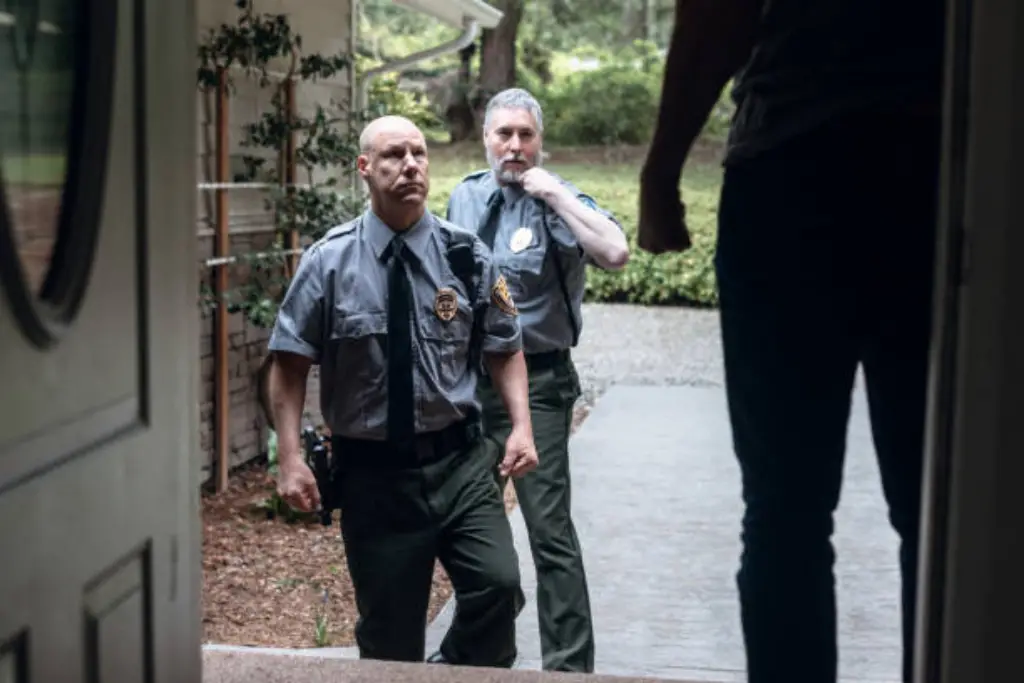
I opened the door in my work clothes, hair still damp from the shower, coffee mug in one hand. Two police officers stood on my porch. The taller one held a notepad. The shorter one watched my hands with the wary alertness of someone who’d seen too many situations go sideways too fast.
“Ma’am,” the tall officer said, his nameplate reading Ramirez, “are you Olivia Wilson?”
My throat went dry. “Yes.”
“Did you receive a phone call last night around one AM demanding you wire twenty thousand dollars?”
The world tilted slightly. The coffee mug felt suddenly heavy in my hand.
That call snapped back into focus with brutal clarity—my mother’s voice, my father’s commands, Mark supposedly dying in some unnamed ER, the twenty thousand dollars they needed right now or consequences would be my fault.
“Yes,” I managed. “My parents called.”
Officer Hensley, the shorter one, asked with careful neutrality, “Did you wire the money?”
“No.”
Ramirez scribbled something in his notepad. “We’re here because that call was reported as a suspected fraud attempt. The number it came from doesn’t match your parents’ registered phone number.”
My skin prickled with sudden cold. “If it wasn’t them… who was calling me?”
Ramirez didn’t answer immediately. He glanced past me into my entryway, assessing, evaluating. “Can we come in, ma’am? We’d like to ask you some questions.”
I let them into my living room, which smelled like coffee and toast and the morning news murmuring about weather patterns. Everything felt surreal—police officers in my space, asking about my family, treating my midnight panic call as a crime scene.
Ramirez settled onto the edge of my couch, notepad ready. “Tell me exactly what the caller said. Word for word if you can remember.”
I repeated it: Mark in the ER, twenty thousand dollars, wire it immediately, stop asking questions, just do it or he’ll suffer.
“Did they give specific wiring instructions? A bank name? Account number?”
“Not during the call,” I said. “They just kept saying I needed to send it right away.”
“May we see your phone?”
I unlocked it with trembling fingers, the muscle memory of the passcode feeling strange under the weight of official scrutiny. Ramirez scrolled with practiced efficiency.
“Here,” he said, turning the screen toward me. “Incoming call at 1:01 AM. It displays as ‘Mom’ in your contacts.”
Underneath the contact name was a phone number I’d never seen before.
“That’s not her number,” I whispered.
“They spoofed it,” Ramirez explained, his voice carefully neutral, delivering information without judgment. “Made the call appear to come from your mother’s phone. It’s a common tactic in emergency scams—they use panic to bypass critical thinking.”
Hensley added, “Usually they target elderly victims, but this one seems to have known your family structure well enough to use your brother’s name.”
Ramirez scrolled again. “You also received a text message at 1:07 AM.”
“I didn’t see any text.”
“You might not have,” he said gently, “if you hung up and put the phone down face-first.”
He read it anyway, and each word felt like a small punch:
Wire to this account immediately. Don’t waste time asking questions. He’s in pain. Every minute you delay is another minute he suffers.
Then a routing number, an account number, and a name I didn’t recognize.
My hands were shaking. “I swear I didn’t see that message.”
“We believe you,” Ramirez said. “But we’re here because your bank flagged an attempted wire transfer template created in your name early this morning. Someone tried to set up a transfer using your personal information.”
The room felt like it was shrinking. “Someone tried to access my bank account?”
Ramirez’s gaze held mine, professional but not unkind. “Do your parents have access to your banking information? Your passwords? Any shared accounts?”
“No,” I said quickly, perhaps too quickly. “Not anymore.”
“What about your brother? Does he have your Social Security number? Access to any of your personal documents?”
I swallowed hard. The honest answer was complicated. Because my family collects pieces of me like they’re entitled to them—SSN “for paperwork” years ago, passwords “just temporarily” for some now-forgotten reason, devices borrowed and returned slightly different, information shared because “we’re family” and family doesn’t keep secrets.
“I don’t know,” I admitted. “Maybe. Probably.”
Ramirez nodded slowly, like this was an answer he’d expected. “This particular scam has hit several people in the area this week. Middle-of-the-night emergency call, immediate wire demand, threat of suffering or death. It specifically targets people who respond to fear and family obligation.”
Hensley’s voice dropped lower. “But this one used your brother’s name. That suggests the caller knows your family dynamics. Knows who you’d panic about.”
Ramirez closed his notepad with quiet finality. “We’d like you to come down to the station and make a formal statement. We’d also like to trace the account information in that text message.”
“What if…” I couldn’t quite finish the sentence. What if it was someone I knew? What if it was family?
Ramirez didn’t sugarcoat it. “Then the truth comes out either way. And you deserve to know who’s willing to do this to you.”
He paused at my front door, hand on the frame. “One more thing: don’t contact your parents yet. Not until we’ve verified a few things.”
After they left, I stood in my living room holding my phone like it was evidence, like it might explode. Because if I called my parents now, I’d be breaking police instructions. But if I didn’t call them, the anxiety would eat me alive—that old, familiar guilt that came from not being available, not being helpful, not being the good daughter who fixed everything.
The phone stayed silent in my hand.
At the police station, fluorescent lights buzzed overhead and everything smelled like old coffee and copy machine toner. Ramirez led me into a small interview room—metal table, plastic chairs, a box of tissues that looked like it had been there since 1995.
He brought me water and said something unexpected: “I want you to hear this officially—you did the right thing by not wiring money in the middle of the night based on a panicked phone call.”
“It didn’t feel right when you showed up on my porch,” I muttered.
“It rarely does,” he said. “People feel accused when they’re actually being protected.”
He had me write everything down—times, exact words, who said what, how the voices sounded. Turning my nightmare into lines on an official form.
Then he showed me a printed screenshot of the text. “Do you recognize the name on this account?”
I stared at the initials. Something tugged at the edge of my memory, familiar but wrong, like seeing someone you know in an unexpected place.
“No,” I said too quickly.
Not because I was certain. Because my first reflex has always been loyalty, even when loyalty is the thing that’s hurting me most.
Ramirez didn’t push. He just nodded. “Okay. We verify things one piece at a time.”
A woman in a plain blazer entered—Detective Green, she introduced herself. Sharp eyes, calm demeanor, the air of someone who’d seen every variation of human awfulness and stopped being surprised.
“We’re not calling anyone yet,” she said. “Not your parents, not your brother, not your sister. First, we verify the hospital claim.”
She had me search for the hospital number manually—not from contacts, not from memory, but looking it up fresh. “Call County General’s main line.”
I did, my finger hovering over the call button like the phone might bite. A receptionist answered, professional and distant.
“Hi, I’m trying to locate a patient admitted last night. Mark Wilson.”
Keyboard clicks. A pause that felt like years.
“I’m sorry, ma’am. We don’t have anyone by that name in our emergency department. We haven’t had any admissions under that name in the past seventy-two hours.”
Relief hit first—he’s not hurt, he’s not dying—followed immediately by rage so pure it made my vision blur.
Detective Green nodded once, satisfied. “Now we trace the money. This account information isn’t random. Someone either knows you, or knows enough about your family to sound convincing.”
She offered a plan that made my stomach drop. “We run a controlled response. You reply to the text like you’re cooperating—but you don’t send money, don’t click links, don’t do anything except ask questions. Let them expose themselves.”
“You want me to engage with them?”
“With us monitoring,” she clarified. “It’s safer than you doing it alone later when they try again.”
I nodded because something in me had shifted from fear to focus, from victim to investigator.
Green dictated while I typed:
I can wire it. What hospital is he at? What room number? Who’s the doctor treating him?
We waited. Five minutes felt like five hours. The fluorescent lights hummed. My coffee went cold.
Then my phone buzzed.
Stop asking questions. Just send the money. He’s suffering while you waste time.
No hospital. No doctor. No room number. Nothing specific, just more pressure, more manufactured urgency.
Green’s eyes sharpened. “Good. That confirms this isn’t about your brother. This is about controlling you through fear.”
She leaned forward. “Now ask for something they can’t resist giving—something that creates a trail.”
I typed with shaking hands:
I’m at the bank right now. They need the full legal name on the account to process the wire. What is it?
Seconds crawled. Then the response arrived like a bomb:
Emily Wilson. Now send it.
The air left my lungs. Emily. My sister. My parents’ baby.
Green didn’t look surprised—she looked satisfied, like a detective who’d just confirmed a theory. “Now we have something concrete.”
Ramirez leaned in, reading over my shoulder. “That’s your sister’s name.”
“Next step,” Green said crisply, “we verify whether that account truly belongs to her or if someone’s using her identity. Either way, we do a welfare check on your brother.”
Fifteen minutes later, two police cruisers pulled up outside my parents’ house—the same tidy suburban home where I’d grown up, same trimmed hedges, same flag hanging from the porch, same carefully maintained illusion that everything was perfect.
Ramirez told me to wait in the car. I watched through the windshield as they knocked.
My mother opened the door quickly, too quickly, like she’d been hovering near it. And there—right there in the background—was Mark. Alive. Uninjured. Holding a coffee mug. Looking annoyed at the interruption, not dying, not even remotely close to an emergency room.
Even from the car, I could see my mother’s face change when she registered the uniforms. Her practiced smile tried to appear and failed halfway.
The officers spoke. My mother’s hands fluttered. Mark’s frown deepened.
Then Emily appeared in the hallway behind them, peeking around the corner like a child caught doing something forbidden.
Ramirez returned to the car. “Your brother is not at any hospital. He’s fine.”
“I know,” I said quietly, my voice empty of surprise.
Green came back next, face unreadable. “We need you inside. We’re going to ask questions with you present.”
Part of me wanted to run—get in my car, drive away, pretend none of this was happening, maintain the comfortable fiction that my family loved me in ways that didn’t involve fraud.
Another part wanted to finally stop pretending.
I stepped out of the car and walked up those familiar porch steps while my mother’s voice inside was already constructing a story, fast and trembling and practiced, before anyone had even accused her of anything.
Inside, everything looked exactly as it always did—framed family photos arranged like a museum exhibit, throw pillows positioned just so, the sharp scent of lemon cleaner. But with police in the room, the carefully maintained normalcy felt obscene, like walking into a crime scene decorated for a dinner party.
Detective Green spoke with professional calm. “We’re following up on an attempted wire fraud using spoofed calls that impersonated your phone numbers. The call claimed Mark Wilson was in the emergency room and demanded twenty thousand dollars immediately.”
My mother laughed—too quickly, too nervously. “That’s ridiculous! Mark’s been right here all night.”
Mark lifted his coffee mug like it was exhibit A in his defense. “Yeah. I’m fine. Obviously.”
Emily stood rigid near the wall, mascara smudged under her eyes, looking like she hadn’t slept.
My father tried to step into authority mode, his default setting when confronted. “Officer, we don’t know anything about any calls—”
Green lifted one hand—polite but firm, a gesture that said I’m speaking now. “We have the call log, the spoofed number, the text message with wire instructions, and we have a response identifying the account holder as Emily Wilson.”
Emily flinched like she’d been slapped.
My mother whipped toward her. “Emily? What is she talking about?”
My father jumped in fast, protective. “Anybody could type her name. That doesn’t mean—”
Green nodded agreeably. “True. That’s why we’re verifying. But I’ll ask directly: did any of you contact Olivia last night requesting money?”
My mother’s face crumpled into shaky sincerity, the performance she’d perfected over decades. “We didn’t call her. I swear we didn’t.”
Mark made a small sound—not quite a laugh, more like a snort of derision.
I turned to him. “What was that?”
He shrugged, deliberately casual. “Nothing.”
Green continued, unruffled. “Olivia’s bank flagged an attempted wire template created in her name this morning. That suggests someone had access to enough personal information to initiate a transfer.”
My father’s jaw tightened defensively. “Are you accusing us?”
“I’m stating facts,” Green said evenly. “Facts clear the innocent and reveal the guilty.”
Then she added, “We can request your phones voluntarily. Cooperation resolves this faster. Or we can get a warrant.”
Silence dropped like a curtain.
Emily’s breathing went shallow. Mark shifted, annoyed. My mother looked between them frantically.
Then Emily whispered, barely audible: “Mom…”
My mother turned, desperate. “What, honey? What is it?”
Emily’s voice cracked. “I didn’t think it would—”
My father’s voice cut like a knife. “Emily. Don’t.”
Green’s gaze sharpened. “Emily, what didn’t you think?”
Emily looked from my mother to my father to Mark, her eyes begging someone to rescue her from the hole she’d dug. No one moved. Mark stared at the wall, already detaching. My mother’s hands fluttered helplessly.
Then Emily looked at me—the person they’d always sent to clean up disasters, to absorb consequences, to make problems disappear.
Her voice broke. “It was supposed to be just a loan.”
My mother gasped like she’d been shot. “Emily!”
Mark snapped, “Are you serious?”
My father’s face went gray.
Green nodded once, calm as stone. “Tell me exactly what happened.”
Emily wiped at her face with shaking hands. “Mark needed money.”
Mark cut in sharply, “I didn’t—”
Emily flinched. “You did. You said if you didn’t pay by Friday you’d be evicted—”
Green lifted her hand. “Mark. Be quiet.”
It was the first time in my life I’d ever seen anyone shut Mark down in that house and have it actually hold. He closed his mouth, jaw working.
Emily swallowed hard, tears streaming. “He said he’d be in real trouble. Mom and Dad said they didn’t have it. They always say they’ll figure it out, and then…” She looked at me with something like resentment. “Then they call you.”
My chest felt tight. Every breath hurt.
“I found a service online,” Emily continued, her voice small and ashamed. “It showed how to make calls look like they’re from someone else. I thought… if it looked like Mom calling, if it sounded urgent enough, you’d just do it. You always do.”
Heat rushed up my neck. “You used our mother’s voice. You made me think Mark was dying.”
Emily flinched. “I didn’t mean for it to sound like that. I just needed you to send the money fast.”
Green’s voice was precise, clinical. “Emily, did you send the wire instructions in the text message?”
Emily’s shoulders sagged in defeat. “Yes.”
Green looked at my parents. “Did you know about this plan?”
My mother sobbed, eyes wide with what looked like genuine shock. “No. I swear I didn’t know.”
My father didn’t answer fast enough.
Green’s gaze pinned him. “Sir?”
He exhaled like a man accepting inevitable defeat. “Emily told me Mark needed money urgently. But I didn’t know she was going to… do it like that.”
So he knew she planned to call me. He just didn’t know she’d use a spoofed number and fabricate an emergency. The distinction felt meaningless.
Green stepped aside briefly, spoke quietly into her radio, then returned. “We’ve confirmed the account details match an account registered under Emily Wilson’s name.”
Emily made a broken, animal sound.
Green kept her voice even, professional. “No money was transferred, so the district attorney may offer a diversion program for a first-time offense. But this is a criminal matter. There will be a report filed. The account will be frozen pending investigation. There may be restitution fees and mandatory fraud education. If program conditions are violated, the case proceeds to prosecution.”
My mother swayed like she might faint. Emily looked at me with desperate, pleading eyes—the same look she’d given me a thousand times before when she’d gotten in trouble and needed me to fix it.
I didn’t move.
Not anymore.
After the police left, the house felt like a stage after the audience goes home—props still carefully arranged, but the illusion completely shattered.
My mother paced, hands fluttering at her chest like trapped birds. My father sat at the table staring at nothing. Mark slouched on the couch scrolling his phone like none of this concerned him. Emily cried into her hands.
I stood by the door with my keys clenched so tight they bit into my palm.
My mother rushed toward me, reaching. “Olivia, honey, please—”
“Don’t,” I said.
The single word stopped her cold. She stared like she didn’t recognize my voice, like I’d spoken in a foreign language.
“This wasn’t desperation,” I said quietly. “This was a plan. A deliberate plan to manipulate me through fear.”
My mother’s tears flowed freely. “We were scared for Mark—”
“Mark wasn’t in the ER,” I said. “Mark was drinking coffee. Mark is fine.”
Mark scoffed. “Everybody’s overreacting. It was a misunderstanding.”
Emily’s laugh came out ugly, bitter. “It wasn’t a misunderstanding.”
My mother turned on her. “Then why would you do this to your sister?”
Emily’s response was sharp, cutting through decades of polite fiction. “Because you taught me it works! When Mark crashes his car, you call Olivia. When Mark quits another job, you call Olivia. When Mark needs money, you call Olivia. You trained her to fix everything, so I thought she’d fix this too!”
The truth hung in the air, naked and undeniable.
I looked at Emily steadily. “You thought I’d pay because I always do.”
Emily whispered, “I thought we’d pay you back eventually.”
“With what?” I asked. “With what money were you planning to pay me back twenty thousand dollars?”
Emily had no answer. Mark looked away. Because there had never been a real plan—just the comfortable assumption that I would absorb the damage and they would continue as if nothing had happened.
I turned to my father. “Did you know she was going to pretend Mom was calling?”
My mother jumped in quickly. “I didn’t know. I didn’t!”
My father hesitated—just long enough to tell me everything.
“I knew she was going to ask you,” he admitted quietly. “I didn’t know she was going to use that method.”
“So you knew,” I said flatly.
He looked older suddenly, diminished. “I didn’t think—”
“Don’t,” I interrupted. “Don’t say Mark’s name like it explains everything. I’m your child too. Did you forget that?”
Mark finally looked up, genuinely irritated. “You’re acting like someone died.”
I stepped toward him, and something in my face made him lean back. “You know what died? The version of me that you could scare into obedience. That version is gone.”
Then I spoke the words I’d been composing in my head for years, waiting for the right moment. This, apparently, was it.
“Here’s what happens now,” I said. “I’m cutting off all financial support. No loans. No ’emergencies.’ No ‘just this once.’ If you need help, I can provide information, resources, phone numbers for agencies. But no money. Ever.”
My father frowned. “That’s extreme.”
“No,” I said. “Extreme is pretending someone’s dying to commit fraud against your own daughter.”
I continued, my voice steady. “I’m putting a fraud alert on my credit. Changing every password. Locking down all my accounts. No one in this family has access to my financial information, my devices, or my personal data. Ever again.”
Emily whispered through tears, “I’m so sorry.”
“You’re sorry because you got caught,” I said. “Not because you understand what you did.”
She shook her head frantically. “No, I’m sorry because I hate what I became. I hate that I did this.”
I didn’t soften. The time for softening based on apologies instead of changed behavior was over.
I looked at my parents. “If you want any relationship with me going forward, we start with honesty. You stop calling enabling ‘love.’ You stop treating consequences like they’re optional. And you stop treating me like a resource instead of a person.”
Then I walked out. No dramatic exit, no slammed door. Just a quiet departure from a role I’d been playing since childhood—the role of the responsible one, the fixer, the person who sacrificed herself so everyone else could stay comfortable.
In my car, I sat with both hands on the steering wheel and breathed slowly while grief washed over me. Not grief for a single moment, but grief for the role I’d inhabited my entire life, grief for the family I’d wished I had, grief for all the times I’d set myself on fire to keep them warm.
At home, I changed every single password. Added two-factor authentication to everything. Called my bank and added extra verification steps for any wire transfers. Froze my credit with all three bureaus.
And I created a code word—something only my real family in a real emergency would know. A way to verify truth from manipulation.
I texted Matt: New rule. Any family emergency requires the code word. No exceptions.
His response was immediate: Thank God.
That night, my phone stayed silent. And for the first time in my life, silence felt like safety instead of abandonment.
Two weeks later, Emily’s diversion agreement arrived in the mail—formal criminal report, account frozen pending restitution, mandatory fraud education classes, court-ordered counseling. If she violated any terms, the case would proceed to prosecution and she’d have a criminal record.
My mother called crying about Emily “having a record.”
I told her the truth. “The record isn’t the tragedy. What she did is the tragedy.”
They wanted me to attend a “family therapy session” where we could all “heal together.” I refused. I agreed to individual therapy first, because I was done being assigned responsibility for fixing a system I didn’t break.
My therapist named what had happened with clinical precision: I had been parentified as a child, assigned adult responsibilities while my siblings were protected and coddled. The dynamic wasn’t an accident or a series of unfortunate events—it was a system, carefully maintained, that benefited everyone except me.
My aunt Dana, my mother’s sister who’d always been the black sheep of her own family, called me after hearing what happened. “They’ve been using you like a spare tire,” she said bluntly. “Except they never put you back in the trunk. They just kept you inflated and ready.”
Eventually, months later, I agreed to one joint session with my parents—without Mark or Emily present, and only under strict conditions: no yelling, no guilt-tripping, and if manipulation started, I would leave immediately.
In that session, my mother finally admitted something real. “We called you because you always handle things. You’re the one who can fix problems.”
“That’s not a reason,” I said. “That’s a habit you developed. And I’m breaking it.”
My father, stiff and uncomfortable with emotions, said quietly, “We were wrong to put so much on you.”
It wasn’t poetry. It wasn’t a Hallmark card moment. But it was the first genuine acknowledgment I’d ever received that maybe, possibly, I hadn’t been treated fairly.
Months passed. Emily got a steadier job, paid her fees and restitution in installments, completed her fraud education course. She asked to meet me—public place, one hour, no demands, no expectations.
At the coffee shop, she slid an envelope across the table. Inside was a check for two thousand dollars.
“It’s not twenty thousand,” she said, voice trembling. “But it’s real. And there’s no strings. I know this doesn’t fix anything. But I want you to know I’m trying to be someone different.”
I looked at the check, then at her. “This is a start. Not an ending. Do you understand the difference?”
She nodded, tears in her eyes. “I do now.”
My parents stopped giving Mark money. Mark got angry, called them ungrateful, threatened to cut them off. He didn’t apologize to me. But the pattern had shifted because I’d stopped feeding it.
A year after the phone call, another attempt came—different number, same script: “It’s your father. Emergency. Call now.”
My body still jolted with that old, trained panic response. But instead of obeying, I called my father’s verified number.
He answered, groggy and safe. “Olivia? It’s six in the morning. What’s wrong?”
“Just checking,” I said. “Go back to sleep.”
I didn’t feel shame for verifying. I felt calm.
Later, my father told me quietly, “I’m proud of you.”
I printed out a document titled FAMILY EMERGENCY PROTOCOL and gave copies to everyone:
- Hang up immediately on any emergency call
- Call back using verified contact information
- Use the family code word for real emergencies
- No money transfers under any pressure, ever
- If someone won’t verify through proper channels, they don’t get help
My mother folded hers into her wallet like it was important. My father posted his on their refrigerator. Emily framed hers, which seemed excessive, but I didn’t comment.
The ending wasn’t that my family became perfect. The ending wasn’t even that everyone apologized and we had a tearful reconciliation.
The ending was that fear stopped being the language that could control me. Guilt stopped being the currency I traded in. Obligation stopped masquerading as love.
Now when my phone rings at unusual hours, I check caller ID. I verify. I ask questions. I don’t send money based on panic. I don’t sacrifice myself based on other people’s emergencies that somehow always require my immediate financial intervention.
And if someone genuinely needs me, they can prove it. They can tell me the truth through proper channels. They can use the code word. They can act like people who actually respect me instead of people who see me as an ATM with emotions they can exploit.
If they can’t do that, they don’t get my money, my panic, or my peace.
They can call whoever they want.
Just not the old version of me.
Because she doesn’t live here anymore.

Adrian Hawthorne is a celebrated author and dedicated archivist who finds inspiration in the hidden stories of the past. Educated at Oxford, he now works at the National Archives, where preserving history fuels his evocative writing. Balancing archival precision with creative storytelling, Adrian founded the Hawthorne Institute of Literary Arts to mentor emerging writers and honor the timeless art of narrative.