The call came on a Tuesday afternoon, the kind of ordinary Tuesday that has no reason to become memorable until it does.
Derek’s voice was careful in the way voices get when someone is delivering information they know will land badly. “Mrs. Chen — your mother-in-law just booked The Grand Maple for this Saturday. Fifty guests. Four-course dinner.”
I almost said something unremarkable, something like that’s nice, because my mind hadn’t yet reached the part that made it not nice.
“She paid the deposit in cash,” Derek continued. “And she made one specific request.” A pause. “That no one tells you. She said you shouldn’t be informed.”
I was standing in my home office, facing the photograph from our tenth anniversary — Marcus and I on the terrace of the first real vacation we’d taken together, both of us laughing at something the photographer had said to get the shot. Behind us, out of focus, was the city we’d built our life in.
I set the photo face-down on the desk. Not dramatically. Just so I wouldn’t have to look at it while I thought.
“Which location?” I asked.
“The Grand Maple,” Derek said. “The flagship.”
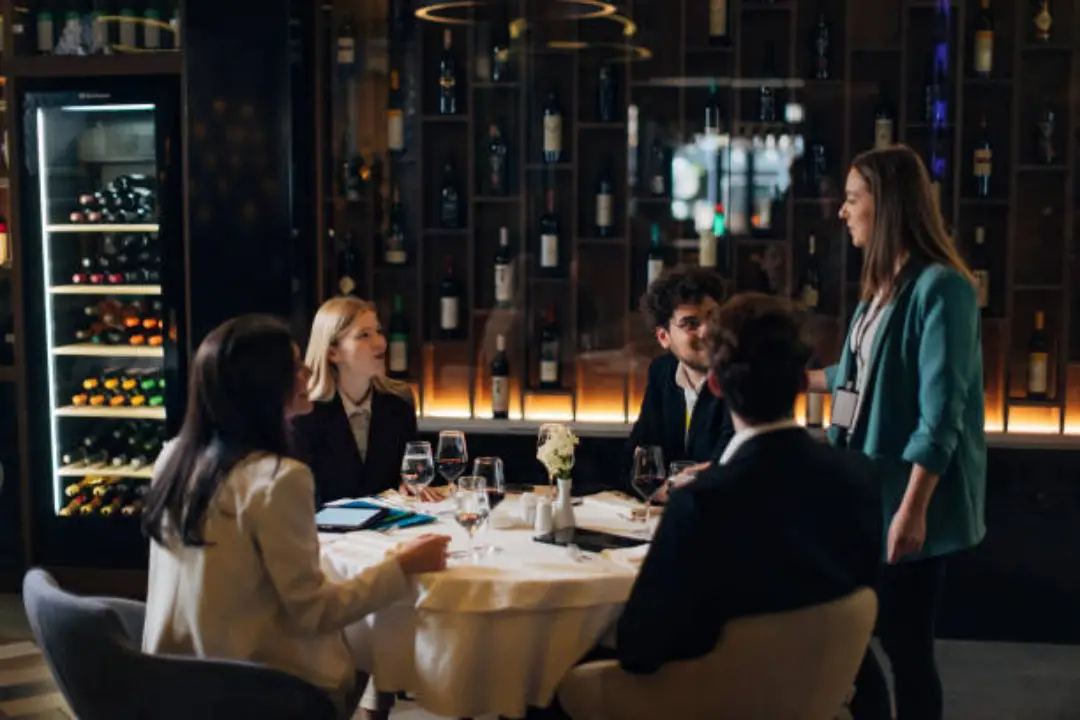
The Grand Maple. The restaurant that had been featured in three national magazines, that carried a six-week waiting list for weekend reservations, that food critics drove two hours to review. The place I had put more of myself into than I had put into almost anything else in my adult life. Five years of obsessive, exhausting, exhilarating work, from the lighting design to the menu architecture to the sourcing relationships I had built with twelve different farms and producers.
“She told the coordinator she was family of the owner,” Derek added, his voice dropping. “Said her son’s wife could pull strings for the booking.”
The shape of it assembled itself with a clarity that was almost elegant in its ugliness. She had used my name to open the door and then requested that I be kept outside it. She had invoked the relationship in order to access what I’d built, then asked my own staff to ensure I wouldn’t know she was there.
“She also requested the owner’s table,” Derek said. “The window seat. And she asked that — she used the phrase — ‘staff family members’ not be working that night. Said it would be awkward.”
Staff family members. Me. The owner.
“Thank you for telling me,” I said. “I know she asked you not to.”
“Of course,” Derek said.
“Don’t do anything yet. I’ll call you back.”
I sat in my office for a while after that, not doing anything, just letting the information settle into the space it was going to occupy. The thing that surprised me was not the request itself — I had understood Diane Chen’s feelings about me with considerable precision for most of the twelve years I had been married to her son. What surprised me was the specific architecture of what she had done: the cash deposit, the explicit instruction, the studied erasure. She had planned this. It had required effort.
You don’t accidentally put that much thought into making someone invisible.
My name is Vivian Chen. Professionally, the name is on four restaurant doors, at the bottom of a dozen industry awards, in the acknowledgments of a food memoir written by a chef I mentored three years ago. I own four restaurants — five by the time this story ends — and I built every one of them from income I generated, reputation I accumulated, and risk I absorbed myself.
My mother-in-law described me, at family events, as Marcus’s wife who worked in food.
I had absorbed this characterization for twelve years with the particular patience of a woman who has decided that the arena that matters is her own work, not other people’s perceptions of it. I had smiled through holidays where Diane introduced me without my name. I had listened to her describe other women she wished Marcus had married, not to me directly but in rooms where I was present, which is a specific kind of cruelty that requires the target to either react and be labeled sensitive or absorb and be assumed complicit. I had watched her give credit for my success to Marcus, as though he were the source of everything I had built rather than a man who had largely been supportive but also largely absent from the work itself.
I had managed all of this with a control I was privately proud of.
But this was different. This was the deliberate use of my name to access something I had built, combined with an explicit instruction that I not be allowed to know about it. It was a transaction she had designed to require my resources and exclude my awareness simultaneously, which is a particular kind of contempt that deserves a particular kind of response.
When Marcus came home that evening, he went straight to the kitchen and poured himself scotch from the bottle he kept for difficult days. He didn’t meet my eyes.
He already knew.
“Your mother booked The Grand Maple for Saturday,” I said.
He took a long sip.
“I heard.”
“Did you know I wasn’t included?”
The ice shifted in his glass. His hand, I noticed, was not entirely steady.
“She thinks it’ll be more comfortable,” he said finally. “Without tension.”
“Tension,” I repeated. “Is that what we’re calling it?”
“Viv.” He set the glass down with slightly more force than the surface required. “You know how she is. She has her way of doing things. It’s not personal.”
I looked at him for a moment. “She booked my restaurant, used my reputation to secure the reservation, paid the deposit in cash so it would be harder to trace, and specifically instructed my staff not to tell me she was there. Walk me through which part of that is not personal.”
“She just wants one night without—” He stopped himself at the edge of the sentence.
“Without what?”
He didn’t answer.
“Marcus. Without what?”
“Without the dynamic being what it is,” he said, which was not an answer but was, in its avoidance, its own kind of one.
“When was the last time your mother came to one of my restaurants?” I asked.
He looked at the window.
“When was the last time she mentioned to anyone that her daughter-in-law owns four restaurants? When was the last time she asked me about my work, asked anything about it, acknowledged that it exists as a thing I built rather than a hobby I have?”
“She’s not really—”
“A foodie. You’ve said that. Everyone eats, Marcus. That’s not the reason.”
He was quiet.
“She talks constantly about her friends’ children’s accomplishments,” I said. “She has an entire vocabulary for other people’s success. She simply does not apply it to me. And tonight I’m being asked to accept that she has used my name to book my restaurant while paying my staff to keep me away from it, and to characterize this as not personal.”
“I’m asking you to be the bigger person,” he said. “Just this once.”
“I’ve been the bigger person for twelve years,” I said. “I’ve been the bigger person at every holiday where she introduces me without using my name. I’ve been the bigger person every time she’s made a comment about women you might have married instead, in rooms where I was present. I’ve been the bigger person when she attributed my success to you, as though you were the reason any of this exists. Twelve years of being the bigger person, and now I’m being asked to accept being erased from my own restaurant. At what point does being the bigger person simply mean accepting whatever is done to me without objection?”
He looked at me then — genuinely looked, the way he sometimes did and then didn’t for long stretches — and I saw something I had been watching accumulate for years, the specific resignation of a man who had made a choice he was not going to unmake.
“What do you want me to do?” he asked, and his voice was very tired.
“I want you to tell your mother that if I’m not welcome, you won’t be there either.”
The silence that followed was its own answer.
“I can’t do that,” he said.
“Can’t, or won’t?”
He didn’t respond.
I left the room.
I drove to The Grand Maple the following morning, through the glass doors I had designed, past the tables I had selected, under the lighting I had spent six weeks getting right. I had learned, building this restaurant, that lighting was the most underestimated variable in hospitality — that the quality of light in a room determines how people feel about themselves and each other and the food in front of them, that warmth and intimacy and appetite were, in some measurable percentage, a function of how many lumens hit a surface and at what angle.
I had spent six weeks on it. Diane had never seen it.
Carmen, my general manager, met me in the office. She had been with me since the second location, a woman of precise operational instincts and zero tolerance for incompetence, which made her, in my experience, the most valuable person in any room she occupied.
“I heard,” she said.
“Let the reservation stand,” I told her. “Honor it exactly as booked. Don’t change anything.”
She watched me carefully. “And?”
“Brief the full staff. On Saturday, I’ll be here. Not in the kitchen. Not in the office. Here.”
“As?”
“As the owner,” I said. “Hosting.”
The smile that moved across her face was small and sharp. “Understood.”
We spent three days preparing. Not for the party — my staff could execute a fifty-person four-course event in their sleep; this was not what they had been hired for and not where their attention needed to be. We were preparing for something more precise. I pulled my most experienced servers. I scheduled my best chef, the one who had trained in Paris and could make the simplest dish feel like a considered act. I reviewed the menu and made one small modification — a lemon tart for dessert, the one that had been featured in the last magazine profile, the one that required a technique most kitchens wouldn’t attempt for a party booking.
If she was going to celebrate inside my walls, it was going to be with the full force of what I had built. No one would be able to say the evening was anything but perfect.
Friday night, Marcus and I had dinner. He had been sleeping in the guest room, leaving early, arriving late, occupying the house with the specific absence of someone who is physically present and emotionally already somewhere else.
“Are you going tomorrow?” I asked.
“It’s her birthday.”
“And you’re comfortable with me not being invited.”
“I talked to her,” he said. “She said it was a misunderstanding. That of course you’re welcome.”
“Did she call me?”
Silence.
“Did she text? Email? Send anything at all to indicate that her original request — the one where she paid cash to avoid a paper trail and specifically instructed my staff to keep me uninformed — was not what she meant?”
“Viv—”
“She didn’t invite me, Marcus. The thing she told your staff was not a misunderstanding. It was a plan. And you know that.”
He stood up from the table and left. He spent that night at his brother’s.
I lay awake in our bedroom and thought, not for the first time and not with any particular drama, about the shape of our marriage. About how a relationship could be genuinely loving in some of its parts while being structurally wrong in others. About how a man could love his wife and still, repeatedly, choose comfort over her dignity, and what that meant over time, what it accumulated into.
I did not arrive at any conclusions that night that I hadn’t already been moving toward for years.
I arrived at The Grand Maple at four on Saturday afternoon, two hours before the party.
I dressed carefully, with full intention. Not my chef’s whites, not casual. A black dress with a high neck and long sleeves — elegant, precise, the kind of clothing that communicates professional authority without asking for attention. My grandmother’s pearl earrings, the ones she had left me along with the inheritance that had funded the first location. My hair back. My makeup exact.
Carmen met me at the door. “The food is going to be exceptional. Chef Bernard has been in since eleven.”
“Good.”
“Staff is briefed and ready. Everyone knows you’ll be visible tonight.”
“Not circulating,” I said. “Hosting. There’s a difference.”
“Yes,” she said. “There is.”
I positioned myself near the entrance at five forty-five. Not blocking it, not staging anything theatrical. Simply present, in the manner of an owner in her own establishment, which was what I was.
The guests began arriving at six.
Marcus’s family, largely. People I had met over years of holidays and celebrations, people who knew my face and my name and had, in most cases, only the vaguest understanding of what I actually did. They walked in with the particular ease of people who have been told this is a nice restaurant, who are prepared to enjoy a nice restaurant, who have not been told whose restaurant it is.
I greeted each one.
“Welcome to The Grand Maple. Thank you so much for celebrating with us tonight.”
The responses ranged from comfortable to confused. One of Marcus’s aunts stopped entirely.
“Vivian? I didn’t know you worked here.”
“I own it,” I said. “All four locations. This is the flagship.”
Her eyes widened. “I — I had no idea.”
“Most people don’t,” I said, with a smile I had practiced until it felt like my face. “Please, enjoy the evening.”
She moved on, looking back once.
Marcus arrived at six fifteen. He came through the door mid-conversation with his brother and saw me before he had processed where he was, and I watched the awareness move across his face in stages — recognition, surprise, calculation. He held my gaze for approximately two seconds.
Then he walked past without speaking.
I kept my face arranged into the same expression it had been holding. I moved to the next arriving guest.
Diane arrived at six thirty, surrounded by her inner circle — four women who had known her for decades and who laughed at everything she said with the practiced ease of people who have decided that their proximity to a particular personality is worth whatever it costs. She was mid-story as she came through the door, something about a Napa vineyard and a restaurant that was absolutely divine, darling, and she had the particular glow of a woman who has dressed for an occasion and knows she has succeeded.
She saw me.
The story stopped.
We looked at each other across the entrance of the restaurant I owned, in the light I had spent six weeks perfecting, and the glow went out of her expression like a switch thrown.
I extended my hand.
“Diane. Welcome to The Grand Maple. I’m so glad you chose to celebrate here.”
She looked at my hand with the specific expression of a person confronting something they had made a plan to avoid and find has materialized anyway.
“What are you doing here?” Her voice was low, controlled by effort.
“I own this restaurant,” I said. “I’m here to ensure your evening is everything it should be.”
“I specifically requested—”
“That I not be informed of the booking,” I said. “Yes, my staff told me. Unfortunately, it’s standard policy to notify the owner of all major events. I apologize for any inconvenience.”
The pause before inconvenience was minimal. She heard it anyway.
“This is inappropriate,” she said.
“What I find inappropriate,” I said, “is the use of my name to secure a reservation in my restaurant, combined with a request that I not be allowed to know about it. But I don’t want to discuss that tonight. Tonight is for celebrating your birthday, and I intend to make sure it’s perfect.”
Her friends were watching. They had been watching since I extended my hand. They had the expressions of women who have arrived at a party and discovered it has an unexpected subplot.
“You’re not welcome at this party,” Diane said, her voice dropping.
“I’m not attending your party,” I said. “I’m hosting my restaurant. Those are different things. Please, enjoy your evening.”
I stepped aside and gestured toward the dining room.
She walked past me with her jaw set and her friends trailing behind her, most of them glancing back at me in a way that suggested they were revising their understanding of the evening.
I gave them a moment to settle and then I did what I had said I would do: I hosted.
Between courses, I moved through the dining room with the same attention I gave any important event at The Grand Maple. I checked on food, inquired about wine, spoke with guests who had questions or comments. I introduced myself to the people who didn’t know who I was.
“I’m Vivian Chen. I own The Grand Maple.”
“Marcus’s wife? I didn’t realize—”
“Yes. And this is mine.”
I watched the recalibration happen at table after table. The mental reframing — this is not a restaurant Diane’s family has access to; this is a restaurant that belongs to the woman Diane has been characterizing for years as Marcus’s quiet wife who works in food. The two things were not reconcilable, and watching people reconcile them was one of the more honest experiences of the evening.
The food was exceptional. Bernard had outdone himself — each course constructed with the kind of precision that makes people stop mid-conversation to acknowledge what they’re eating. The service was flawless. The lighting, as always, was exactly right.
Between the second and third courses, I stood at the front of the room and tapped my glass.
Diane’s color shifted when she understood what was happening.
“I just want to take a moment to welcome everyone to The Grand Maple,” I said, addressing the room with the ease of someone who has given a hundred speeches in her own spaces. “For those who don’t know me — I’m Vivian Chen. I opened this restaurant five years ago, and there’s nothing that gives me more genuine pleasure than hosting celebrations like this one.”
I smiled at the room, which was giving me its full attention.
“Birthdays are specific things. They’re the occasions when we stop and mark time, when we look at what a life has accumulated. I’m honored to be the space where that happens for people. Tonight, we’re celebrating Diane’s birthday — and I want to toast to many more years of celebrations in beautiful rooms.”
I raised my glass.
Thirty people raised theirs. Social obligation is a powerful force.
Diane raised hers after a two-second delay. Her eyes were on me with an expression that had moved past fury into something more complex, something that looked, underneath the anger, like the specific discomfort of a person being seen clearly for the first time in a long time.
I drank. I set my glass down. I returned to my circulation.
After the third course, she found me in the hallway near the restrooms. She had composed herself from the outside in the careful way of women who have been performing composure for decades, but her hands weren’t entirely steady.
“How dare you,” she said.
“How dare I provide excellent service in my own restaurant?”
“You knew you weren’t invited. You knew this was meant to be family.”
“I am family,” I said. “Twelve years of it. The fact that you keep forgetting that is a choice you’re making, not a fact about the situation.”
“You’re embarrassing yourself.”
“I’m standing in a space I built, talking to guests who came here because of a reputation I created. If that’s embarrassing, I think we have different definitions of the word.”
She stepped closer, her voice dropping into the register she used when she wanted words to cut without witnesses.
“You think you’ve accomplished something tonight. All you’ve done is confirm what I’ve always known about you. That you’re small. That you need to make yourself feel important at other people’s expense.”
I looked at her for a moment.
“I haven’t made myself feel important,” I said. “I am important, in this room and in this industry, because of work I did over fifteen years. You have had access to this restaurant tonight because you used my name to book it. The recording of that call — my staff records all reservation calls for quality assurance — makes that very clear.”
Her expression shifted.
“I’m not going to play it for anyone,” I said. “I don’t do public humiliation, even when it’s been done to me. But I want you to understand something with complete clarity: what happened tonight is the last time. You do not get to use what I built while pretending I don’t exist. You don’t get to stand in my restaurant, at my table, eating food prepared by my chef, and treat me as a problem to be managed or a person to be hidden. Those days are finished.”
“Marcus will hear about this,” she said, and the weakness of it — the falling back on his name as a threat — told me more about her understanding of the situation than anything else she had said.
“I hope you tell him everything,” I said. “I hope you describe the evening in full detail, and I hope he asks himself, finally, whose side he’s on.”
I straightened my shoulders.
“Enjoy the rest of your birthday, Diane.”
I walked back into the dining room.
The party ended at ten. Diane left without speaking to me again, her friends around her like a wall, her composure reassembled into something that looked like dignity from the right angle. Several guests stopped to thank me on their way out, complimenting the food with the specificity of people who had genuinely been surprised by it.
“We’ve been trying to get a reservation here for months,” one of Marcus’s cousins said, pressing my hand. “We had no idea. This is extraordinary.”
“Thank you,” I said. “Come back anytime. Use the main line — no pull strings required.”
She laughed, not entirely sure what I meant.
Marcus found me in my office at eleven, after the guests had gone and the staff were beginning the close. He stood in the doorway looking at me reviewing the night’s receipts, and his expression held the particular exhaustion of a man who has been watching something approach for a long time and has finally arrived at the moment of collision.
“That was cruel,” he said.
I set down the receipts. “I welcomed guests and ensured quality service. I gave a speech thanking your mother for choosing my restaurant for her celebration. Which part was cruel?”
“You know what you did.”
“I know what I did. I stood in my own space and refused to be invisible in it. If that felt cruel to her, I think the question worth asking is why my visibility is something she experiences as an attack.”
“She’s my mother, Viv.”
“And I’m your wife. I’ve been your wife for twelve years. When does that start to carry comparable weight?”
He came into the office and sat down, not across from me but off to the side, the way someone sits when they’re not there to negotiate. “I don’t know if I can keep doing this,” he said.
“Doing what?”
“Being in the middle.”
“Then don’t be,” I said. “That’s what I’ve been asking for years. Don’t be in the middle. Make a decision.”
He looked at his hands. “She’s not going to change.”
“I know. But you could. You could decide that your wife’s dignity is worth more than the avoidance of a difficult conversation with your mother. That’s not asking you to choose between us — it’s asking you to do what a partner does, which is to draw a line and hold it.”
“And if I draw a line and she stops seeing me?”
“Then you’d be learning something true about the conditions her love operates on,” I said. “Which is information worth having.”
He was quiet for a long time.
“I need to think,” he said finally. “I’m going to stay at Patrick’s for a while.”
“Okay,” I said.
He left.
I stayed in my office until midnight, the restaurant emptying around me until it was just the hum of the coolers and the sound of the last servers finishing the close, and I sat in the quiet of the space I had built and thought about what I was willing to carry forward and what I was not.
What came next arrived slowly, without drama, in the small incremental way that endings actually happen outside of the stories we tell about them later.
Marcus did not come back. Not because of a fight or a final scene, but because we had both understood, in the way that honest people eventually understand things, that the marriage had been built on an architecture that required one of its members to accept diminishment as a condition of peace, and that condition was no longer acceptable to me and was, apparently, not something he was prepared to renegotiate.
We filed for separation. Then, six months later, divorce. The lawyers called it amicable, which was accurate in the specific sense that we did not fight over things, partly because there was nothing to fight over that wasn’t already clearly mine. The restaurants, built on my capital and my work, remained mine without discussion. He kept the house. I bought a loft downtown with floor-to-ceiling windows and exposed brick and filled it entirely with things I had chosen.
Diane never contacted me. Never sent a word. Through the extended family I heard she characterized Marcus’s situation as the result of my being too career-focused, which was so precisely the inversion of what had actually happened that I spent a moment genuinely admiring the architecture of it before moving on.
The letter that mattered came six weeks after the party, from Marcus’s younger sister Emily, who had spent years attempting to build a bridge between me and her mother before concluding it couldn’t be built from her end. The letter was handwritten, which was an unusual enough choice to signal that it was meant.
She wrote: I heard what happened. Marcus gave me his version, and I talked to Aunt Sarah, who was there. I know what the truth is. I’m sorry I didn’t speak up over the years. I told myself it wasn’t my place. Silence is complicity, and I was complicit. What you did took a kind of courage I hadn’t understood until I saw it. You stood in your own space and refused to be erased, and that’s not cruelty — that’s self-respect. I’m working on my own now. With love and respect, Emily.
I read it three times and cried, not from sadness, but from the specific relief of being witnessed accurately by someone who had been present for the years in question. It was the only apology I received from the Chen family, and it was the one that was offered without expectation of anything in return, which made it the most genuine one I had ever received from anyone in that circle.
I opened the fifth location eight months after the party, in a building I had been watching for two years. A sixth followed fourteen months after that, in a neighborhood that deserved better food than it had been offered. I started a mentorship program for women entering the culinary industry who came from backgrounds that the industry’s standard networks didn’t reach — women who had no contacts, no institutional access, no name to trade on.
I hired Carmen as Chief Operating Officer. I promoted from within wherever the talent warranted it. I built a culture that valued the work over the performance of the work, which required constant maintenance because the tendency to reward performance is structural in most industries, but it was the culture I wanted and I had enough authority to build it.
Diane continued coming to The Grand Maple occasionally. She made reservations under her maiden name, sat with her friends, did not acknowledge me. She was always given excellent service. I made sure of that specifically, not out of warmth but out of principle — the principle being that the quality of what I had built was not conditional on whether the person eating it had treated me with respect. The food was what it was regardless. That consistency was its own kind of statement.
I am forty-three now. Single, which took some adjustment and then became simply a condition of my life rather than a fact that required explanation. Successful in ways that are measurable — the industry awards, the review coverage, the waiting lists — and in ways that are not, which are the ways I find more interesting. The mentorship program has placed twenty-seven women in positions they would not otherwise have accessed. Three of them have gone on to open their own restaurants. One of those restaurants has a waiting list.
I think about the Saturday night often, not obsessively but with the recurring attention you give to a moment that rearranged something important. What I was doing that night was not revenge — revenge requires the primary goal to be the other person’s suffering, and that was not my primary goal. My primary goal was to occupy my own space fully, to refuse the role of ghost in the house I had built, to be visible in the precise location where someone had worked carefully to make me invisible.
The restaurant where I was not welcome is still mine.
The name that was meant to be a courtesy, something borrowed from a marriage and returnable on demand, is on five doors and in thirty years of industry relationships and in the acknowledgments of a book someone else wrote and in the minds of the people who work for me and the people who eat the food and the twenty-seven women who have a career because I decided to do something with what I had built besides protect it.
Diane Chen used my name to open a door and asked my staff to keep me on the other side of it.
She miscalculated one thing, which is that the door belonged to me, and I had the key, and I was not the kind of woman who waits outside what she has built because someone else found her presence inconvenient.
I never have been.
I understand that more completely now than I did the night I stood in my own entrance in my grandmother’s pearl earrings and watched my mother-in-law’s certainty encounter the fact of me.
It was the clearest I had ever felt.
It is, still, the clearest I have ever been.

Sophia Rivers is an experienced News Content Editor with a sharp eye for detail and a passion for delivering accurate and engaging news stories. At TheArchivists, she specializes in curating, editing, and presenting news content that informs and resonates with a global audience.
Sophia holds a degree in Journalism from the University of Toronto, where she developed her skills in news reporting, media ethics, and digital journalism. Her expertise lies in identifying key stories, crafting compelling narratives, and ensuring journalistic integrity in every piece she edits.
Known for her precision and dedication to the truth, Sophia thrives in the fast-paced world of news editing. At TheArchivists, she focuses on producing high-quality news content that keeps readers informed while maintaining a balanced and insightful perspective.
With a commitment to delivering impactful journalism, Sophia is passionate about bringing clarity to complex issues and amplifying voices that matter. Her work reflects her belief in the power of news to shape conversations and inspire change.