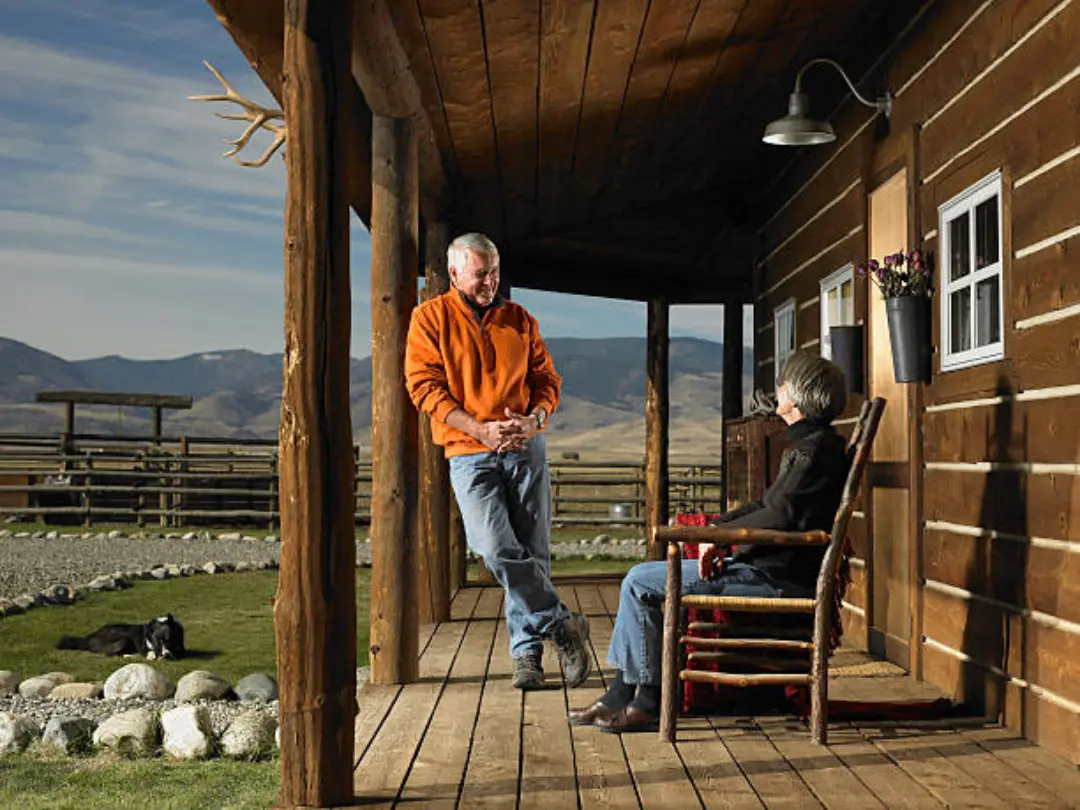
The cabin had always been the place I went to remember who I was.
Not who I was to my family — the reliable one, the successful one, the one who had figured out how to make money in ways that remained vaguely abstract to everyone else in the household — but who I was to myself. A woman who liked morning light on pine floors and coffee made slowly and hours of silence that didn’t require filling. I had bought it three years earlier with my own money, signed my own name on the deed, and driven the four hours from New York without telling anyone where I was going, because I had learned early that privacy, in my family, had to be created rather than assumed.
I had made one mistake.
When my mother asked for a spare key — just in case of an emergency, Emma, you know how things happen — I had given her one, because she was my mother and because it felt like the kind of small, easy kindness that costs nothing and means something.
I had been wrong about the cost.
My father’s voice reached me before I was fully out of the car.
“Emma, you came at the right time.” Daniel Parker stood on the wooden porch with his hands in his pockets and the comfortable expression of a man announcing good news. “I was thinking of making this place Haley and her family’s new home.”
The aspen air I had been anticipating for four hours went stale in my lungs.
I shut the car door and walked toward him slowly, the gravel of the path precise under my feet, because moving slowly was the only way I had of slowing down what was happening.
“What do you mean, Dad?” I said. “Why are you here?”
He didn’t blink. “I used the spare key. We’re family, so I didn’t think I needed to ask permission.”
There was no guilt in his voice. Not even the performance of it. He had let himself into my home with a key I had given to my mother for emergencies, and he was standing on my porch telling me he had decided to give it to my sister, and the expression on his face was the one he wore when he was explaining something obvious to someone who was being unnecessarily slow.
I walked past him, pushed open the heavy oak door, and stepped inside.
The dust hit me first — a thin white layer across the walnut floors I had chosen with the particular attention of someone furnishing a space that is entirely for themselves. Fine renovation dust, the kind that settles into everything. My chest tightened with a specific, cold clarity.
I went to the bathroom.
The warm natural stone tiles I had selected — chosen for the way they held the morning light, for the way they connected the space to the mountain outside — were gone. In their place, cold glossy white marble covered everything from floor to ceiling. The wooden vanity that had smelled faintly of cedar had been replaced by something with gold claw feet that belonged in a different building entirely, in a different person’s idea of luxury.
I stood in the doorway of the bathroom I no longer recognized and understood that this was not a proposal. It was not a conversation I had been invited to participate in. It was an announcement of something already in motion, the renovation scheduled around my absence because my presence would have been an inconvenience.
I went to the bedroom.
The earth-toned walls I had chosen for their specific quality of calm — the color of the canyon walls visible from the window, the color of unhurried things — were gone, covered in pink damask wallpaper I recognized as Haley’s preference from her Manhattan condominium. The leather armchair by the window where I had read through entire afternoons was replaced by a vanity surrounded by Hollywood-style lights.
I looked at the room for a long time.
There is a specific kind of violence in having your space redesigned according to someone else’s preferences. It leaves no bruises. It produces no evidence that would satisfy anyone’s definition of harm. But it communicates something with perfect efficiency: your choices do not matter here. Your taste does not matter. Your ownership is a technicality that can be overlooked when it becomes inconvenient.
“How wonderful, Dad,” I said, turning from the doorway. I kept my voice even and pleasant, which was something I had years of practice with. “It’s very much Haley’s style.”
He nodded, missing it entirely. “Right. It’s my gift to celebrate her new beginning. She’s going to love it.”
I took my phone from my pocket and called the construction company. I found the number through the building permit posted in the kitchen — they had filed one, which meant there was a paper trail, which was useful.
“This is Emma Parker,” I said when someone answered. “I’m the property owner. I’m on site right now. I need you to stop all work immediately, effective today.”
Daniel’s face went from pride to confusion to anger in the space of that sentence.
After I hung up, the silence in my renovated bathroom was substantial.
“How dare you,” Daniel said.
“I’m the owner,” I said. “I’m instructing the contractors I hired. That’s not how daring works.”
I picked up my keys.
I drove away with the cabin disappearing in the rearview mirror, and the thought that had been forming for years — not weeks, not since the bathroom tiles, but years — finally arrived at its conclusion.
If I did not change the structure, it would not change. You cannot negotiate your way out of a system that benefits from the negotiation. You cannot be reasonable with people who have decided that your reasonableness is a resource.
What had to change was the ground beneath it.
I need to go back eight years to explain what that ground actually was.
My name is Emma Parker. I am thirty-eight years old, and I built a company called Clearwater Holdings — named for the reservoir three miles from my childhood home, which I had always found more honest than anything inside that house — from the proceeds of a consulting business I started at twenty-six with two clients, a secondhand laptop, and the specific fearlessness of someone who understands that the worst possible outcome is not failure but remaining in a situation designed to diminish you.
The company grew. I was careful about who knew the extent of it, because I had watched, from childhood, the way my family processed other people’s success: as a shared resource, available on demand, to be accessed without acknowledgment of its source. My success was never the result of my own effort in their accounting. It was luck, or timing, or the natural flowering of the family’s general capability. And luck, in their framework, belonged to everyone equally.
Eight years ago, my father’s investment portfolio collapsed.
Daniel Parker had operated on the conviction — common to certain men of his generation — that he understood risk better than the people warning him about it. He had put the family’s entire financial foundation into overleveraged real estate during a period of sustained optimism that ended with the kind of sudden clarity that markets occasionally produce. The debts accumulated on a schedule that his optimism had never accounted for.
I heard about it through my mother, whose voice on the phone grew progressively darker with each passing week until the night she called me and said the bank was going to take everything.
I could not abandon them. I understood this about myself without drama or resentment — they were my family, and I was not the kind of person who leaves people in a burning building regardless of how they came to be there. But I had also watched what happened when my father received unconditional help: he accepted it as confirmation that his instincts had been sound and the problem had been external, and he became more confident in the next set of decisions. Unconditional rescue was not rescue. It was tuition for the next disaster.
What they needed was not a bailout. It was a structure.
I called Jordan Reed, who had been my attorney since the company’s first year and who had the particular quality of understanding not just what was legal but what was architecturally sound.
“I want to establish an asset management company,” I told him. “I want to purchase my father’s properties and his debts. I want my name nowhere on the registration documents. And I want the family to pay a nominal rent to stay in their homes — enough to maintain the fiction that they’re managing independently, not enough to actually cost them anything meaningful.”
Jordan reviewed it from every angle, asked the questions worth asking, and determined that it was entirely legal and, in his assessment, entirely rational.
Clearwater Holdings was established with Jordan as the registered agent. Through the company, we acquired the Parker family home in the New York suburbs, my brother Lucas’s Connecticut residence, and my sister Haley’s Manhattan condominium. We paid the debts. We took the titles.
I visited the family home shortly afterward and told them that an investor group I knew had agreed to purchase all three properties, anticipating future land value. The new owners would require nominal rent to stay — a minimal amount, a fraction of market rate, enough to allow everyone to maintain the story that they were functioning as independent adults.
They were relieved. They signed the agreements without reading them with the care they merited, which was not surprising — my family had a long history of accepting favorable arrangements without examining their terms.
I then called my father and told him I would contribute a fixed monthly amount to cover family living expenses. He could make do with that and no more.
What this meant in practice was that the rent they paid went directly into Clearwater Holdings, and the living expenses I provided were approximately equal to that rent, which meant that for eight years my family had been living essentially for free in homes I secretly owned, maintained by repair and insurance costs I quietly absorbed, in a structure invisible to everyone except Jordan and me.
I had done this because I loved them, which was true. I had also done this because I understood that if I had simply given them money and told them the properties were mine, they would have treated those properties as family assets available for any purpose anyone chose — including, as had now become apparent, renovating my private mountain sanctuary for my sister’s occupancy without consulting me.
For eight years, the system had worked in the sense that they were housed and stable and not in debt. It had not worked in the sense that they had mistaken the stability for entitlement, had mistaken my invisible generosity for unconditional supply, and had gradually arrived at the conviction that my resources — all of them, including the cabin I had bought privately with money they didn’t know about — were available for allocation by family consensus.
My father’s announcement on my porch had not been the first evidence of this conviction. It had been the most unambiguous.
Three days after the cabin, I sat across from Jordan in my office with a list of properties on the table between us.
“Everything is accurate,” he said, reviewing the documents with the careful attention he brought to everything. “Ownership is entirely under Clearwater Holdings. Nothing prevents you from proceeding.”
He slid another stack across the table — formal notices to vacate, drafted in standard legal language, clean and unambiguous. One for each property. Each addressed to a specific member of my family.
“Once these are sent,” Jordan said, and his voice shifted from attorney to the older friend he had also become, “there’s no reversal available. They may resent you for the rest of your lives.”
I had made peace with that possibility during the drive down from the cabin.
“What I can’t survive,” I told him, “is becoming someone I hate in order to keep people comfortable who have decided my existence is a resource. That’s the thing that doesn’t recover.”
He nodded, and we scheduled the letters for the following morning.
The calls began two days later.
My mother called first, her voice at a volume that communicated the depth of her distress before any of the words did. A letter had arrived. It said they had to leave the house within thirty days. Was I involved? Her question was rhetorical in the specific way of people who already know the answer and are hoping that saying it out loud will somehow make it wrong.
“Yes,” I said. “The notice means what it says. This Sunday at two, I need everyone in the living room — Dad, Lucas, Haley. I’ll explain everything then.”
I ignored everything else. The calls from Lucas, the messages from Haley, the secondary wave of calls from relatives who had been briefed on some version of events before I had the opportunity to offer another one. I spent the remaining days with Jordan, reviewing the final documentation and preparing for what I knew was coming.
Sunday arrived with the particular clarity of an inevitable thing.
I pulled into the driveway of a house that legally belonged to me — that had belonged to me for eight years, through the fiction of an investor group, through the invisible labor of maintaining it — and walked through the front door into the concentrated pressure of my family’s expectation.
Daniel stood at the fireplace with his arms crossed, performing the authority he had been performing my entire life. My mother sat on the sofa with a handkerchief. Lucas paced near the window. Haley sat beside her husband with her jaw set and her eyes carrying the specific expression of someone who has decided they are the aggrieved party before hearing a single word.
I placed three documents on the coffee table.
The deed to the family home. The deed to Lucas’s Connecticut residence. The deed to Haley’s Manhattan condominium.
On the line marked owner on each one: Clearwater Holdings LLC.
“Let’s start with the facts,” I said. “The homes you’ve been living in for the past eight years have belonged to my asset management company since I purchased them.”
The silence had a specific quality — not the silence of people processing new information, but the silence of people watching a story they had always known to be true beginning to become available for examination.
Lucas broke it first. “Your asset management company,” he said slowly. “The investor group — that was you.”
“Yes.”
“The rent we’ve been paying—”
“Has been going into Clearwater Holdings’ account. Yes.”
Lucas’s processing of this information moved through disbelief and arrived at fury with remarkable speed. “You deceived us,” he said. “You orchestrated this for eight years and let us believe—”
“Let you believe what?” I asked. “That you were paying nominal rent to an investor group? That’s accurate. Let you believe that you were living independently? That’s less accurate, since the rent you paid was approximately equal to the living expenses I transferred each month, which means you’ve been living at no net cost in homes I own and maintain.”
I looked at each of them in sequence.
“Eight years ago, the bank was going to take everything. Dad’s debt had reached a stage that didn’t have a conventional solution. I provided one. I couldn’t simply give you the money, because I had watched, throughout my entire life, what happened when money was given to this family without structure: it was absorbed without acknowledgment, and the appetite it was meant to satisfy grew rather than diminished.”
No one said anything. My mother’s crying had gone quiet in the particular way crying goes quiet when the person doing it understands that it isn’t changing what is being said.
“So I built the structure privately,” I said. “And it worked, in the sense that everyone was housed and stable and not in debt. What it didn’t do was change the underlying assumption — that what I build belongs to everyone, that my success is a shared resource, that any space I purchase can be allocated by family decision without my involvement.”
I thought about the pink damask wallpaper. The gold claw-footed bathtub.
“Dad stood on the porch of my private property, which I purchased with my own money and which has never been part of Clearwater Holdings, and announced that he had decided to give it to Haley. He used a key he was not given permission to use. He had engaged contractors to renovate the interior according to Haley’s preferences without contacting me. When I asked him to stop, he told me I was being cold.”
I set my bag on the table.
“I am not cold,” I said. “I am the person who spent eight years preventing this family from losing everything, invisibly, without credit, while being told that I was the unfeeling one when I failed to offer my remaining private property on demand. Those are different things.”
Haley’s voice came from the corner, shaking with something she had organized into righteous fury. “Where are we supposed to live? You’re throwing us onto the street. You’re cruel.”
“I’m giving you thirty days,” I said. “Thirty days from the date of the notice, with full knowledge of the situation, to find housing. That is more than most people receive in comparable circumstances, and considerably more than I received when my cabin was being renovated without my knowledge.”
Lucas slammed his hand on the table. “You wanted control. That’s what this was about. You kept us dependent so you could do exactly this.”
I looked at him steadily. “I kept you housed,” I said. “The dependency was not something I created. I inherited it when Dad’s portfolio collapsed. The question I had to answer was how to address it without enabling it to continue indefinitely, and the answer I arrived at was imperfect. But the alternative — simply handing over the money and the properties and watching the same pattern reproduce itself — wasn’t something I was willing to do.”
Daniel, who had been building toward something for the past twenty minutes, arrived at it.
“I paid for your education,” he said, his voice shaking with a tremor I recognized as the specific frequency of a man who has run out of other arguments. “I taught you the fundamentals of business. This house belongs to the Parker family. You don’t have the right to make this decision alone.”
“You paid for my undergraduate degree,” I said. “I paid for everything after that, and I paid for everything in this house for the past eight years, and I paid for your debts when they came due. Those are the facts.”
I picked up my bag.
“I understand you’re all frightened,” I said. “I understand this is not the outcome anyone in this room wanted. But the notice is legally valid, the documentation is complete, and what you’re describing as cruelty is an end to an arrangement that was always going to have to end.”
I walked to the door.
My father called after me: “This conversation isn’t over.”
“My part of it is,” I said, and left.
Haley’s response arrived on social media within forty-eight hours, which I had anticipated and for which Jordan and I had already prepared.
She posted a detailed account of a ruthless, successful sister evicting her elderly parents and her children from their homes. She posted a photograph of my mother crying, which had clearly been composed for the purpose. She captioned it with the specific language of public victimhood — unbelievable, torn apart our family bonds, please share — and within hours the comment section was populated by strangers performing outrage at events they understood only through her version of them.
I read it without flinching, which was the advantage of having been preparing for it.
Jordan called to tell me that Lucas was consulting attorneys about contract validity and potential claims of psychological abuse. He asked what I wanted to do.
“The truth,” I said.
I wrote a post under my own name and published it that evening.
I titled it simply: About the Truth.
I wrote it the way I wrote business documents — calmly, factually, with supporting evidence. I attached scanned copies of property deeds, redacted bank transaction records sufficient to establish the timeline, and the original debt documentation from eight years prior. I explained the structure of Clearwater Holdings, the reason it had been established, and the eight-year history of the arrangement in terms that anyone could verify.
I concluded with this: I am not evicting my family from their home out of cruelty. I am ending an eight-year arrangement in which they lived at no net cost in properties I purchased, maintained, and quietly supported. I did this because I loved them and because I could see no other way to prevent a complete financial collapse. I am ending it because the pattern it was designed to temporarily address has not changed, and because I was not willing to extend it indefinitely at the cost of my own remaining private property. If you believe that a person’s financial success obligates them to unlimited, unconditional provision for their family without any reciprocal acknowledgment or respect for boundaries, then yes — I have done something wrong. If you believe otherwise, I hope you’ll read the attached documents before forming a conclusion.
I published it and went to bed.
By morning, the current in the comment sections had reversed.
The strangers who had been condemning me were quiet, or walking back what they had said. The people now speaking were saying different things — that’s the real story, being family doesn’t mean unlimited access to someone else’s resources, she built all of that herself. The documentation was being shared and discussed in terms that were factual rather than emotional, which was the only kind of discussion I was interested in having.
Haley’s post, which had been circulating on a wave of sympathetic outrage, was now surrounded by questions. Is this accurate? Are those property records real? What’s the full story?
I watched this without satisfaction, because what I felt was not triumph. What I felt was the quiet exhaustion of a person who has done something difficult that needed doing and is now waiting for the consequences to finish arriving.
They arrived slowly, in the shape of new circumstances.
My parents found a small apartment on the outskirts of town. The move was difficult for people who had occupied a spacious property in a neighborhood they had built their social identity around, but they managed it, which was the point — they were capable of managing it. They had always been capable of it. The arrangement I had built had been designed to provide them support while they recovered their footing, but footing, unlike stability, requires you to stand on something.
Lucas found an apartment he could afford on his actual income, which required recalibrating his understanding of what his actual income supported. He resigned from his position after the social media circulation of the story made his workplace uncomfortable, which was a consequence I had not engineered and could not have predicted, and which I found genuinely sad in the way I found all of this genuinely sad. He found another position. It took six months.
Haley and her husband moved to the suburbs. It was quieter than Manhattan. Her children adjusted with the uncomplicated resilience of children who are fed and loved and housed and do not yet understand that the size of their apartment is supposed to indicate something about their worth.
I did not hear from my parents for four months.
When my mother called, in the fifth month, her voice was different in a way I needed a moment to identify. It was smaller, which sounds like a diminishment but was not — it was the voice of a person who had set down a performance they had been carrying for a long time. She said she had been thinking about things. She asked if she could come to New York and have lunch.
We met at a restaurant near my office, a quiet place I had chosen because quiet places are better for difficult conversations. We talked for two hours. She told me about the apartment, the neighborhood, the routine she and my father had settled into. She asked about my work.
She did not apologize, not explicitly, not in words that named what had happened and acknowledged it directly. But she asked about my work in the way she had never asked about it before — not as prologue to a request, not as context for something she wanted, but as actual curiosity about what her daughter did and who her daughter was.
It was a small thing. It was not a small thing.
My father called three weeks later. He started the conversation by talking about his new neighborhood, a subject that lasted longer than it needed to before arriving at what he had actually called to say.
“I want you to know,” he said, “that I understand now what you were doing. Eight years ago.” He paused. “I didn’t understand it at the time. I thought the investor group was luck, or timing. I didn’t think about what it had cost you.”
He said nothing after that, which was its own kind of statement, and I said I understood, which was true.
I did not go back to the cabin immediately. I waited another month, then drove up alone on a Thursday in early spring, the aspens just beginning to leaf in that pale, specific green that only lasts a week.
The contractors had completed the restoration I had ordered — the natural stone, the wooden vanity, the earth-toned walls, the leather armchair by the window. It had cost me what it cost me, and it was mine again.
I made coffee slowly, the way I did when I was alone in that space, and I sat in the chair by the window, and I looked at the mountains.
What I understood, sitting there, was that the structure I had built eight years ago had been an act of love expressed through engineering rather than language, which was perhaps consistent with how I had always worked. It had also been, I could see now with the clarity of distance, a kind of avoidance — a way of providing without requiring the relationship to become honest, without requiring the dynamic to be examined, without asking of my family anything as uncomfortable as acknowledgment.
That honesty, when it arrived, had been structural rather than conversational. It had arrived in the form of legal documents and vacate notices and a post on the internet that laid out eight years of documented facts. It was not, perhaps, the gentlest possible approach.
But the gentler approaches had been tried for decades, and they had produced the bathroom with the gold claw-footed bathtub and my father’s voice on the porch announcing a decision he had made about my property as though my preferences were a minor obstacle.
I had been the reliable one, the capable one, the one who figured things out, for my entire adult life. The problem with being reliably capable is that the people who depend on it stop distinguishing between what you offer and what you are. They begin to treat you not as a person who makes choices but as a condition of their lives, like weather, like infrastructure.
The cabin was returned to me. The structure had been dismantled and replaced with something that required everyone to stand on their own. The relationship with my family, whatever it would become, was now between adults who had been required to understand each other honestly.
I did not know, sitting in my armchair with the spring light coming through the window and the aspen leaves catching what the mountains offered them, whether what my family and I had was something that could be rebuilt into the shape I had always wanted it to be — warm and honest and mutual and free of the particular weight of endless extraction.
I did know, with a clarity that the mountain air had always been good for producing, that the version I had been maintaining was not that. It had been something smaller and sadder — a managed dependency, an invisible generosity, a relationship built on a fiction that had served everyone’s comfort at the expense of everyone’s honesty.
That version was finished.
What came next would be something else — something that would have to be built between people who had finally, uncomfortably, seen each other clearly.
I poured more coffee. I opened a book. The mountains outside the window were entirely indifferent to all of it, which was one of the things I had always loved most about them.
The morning went on, quiet and clean and entirely mine.
That was enough.
For now, that was everything.

Ethan Blake is a skilled Creative Content Specialist with a talent for crafting engaging and thought-provoking narratives. With a strong background in storytelling and digital content creation, Ethan brings a unique perspective to his role at TheArchivists, where he curates and produces captivating content for a global audience.
Ethan holds a degree in Communications from Zurich University, where he developed his expertise in storytelling, media strategy, and audience engagement. Known for his ability to blend creativity with analytical precision, he excels at creating content that not only entertains but also connects deeply with readers.
At TheArchivists, Ethan specializes in uncovering compelling stories that reflect a wide range of human experiences. His work is celebrated for its authenticity, creativity, and ability to spark meaningful conversations, earning him recognition among peers and readers alike.
Passionate about the art of storytelling, Ethan enjoys exploring themes of culture, history, and personal growth, aiming to inspire and inform with every piece he creates. Dedicated to making a lasting impact, Ethan continues to push boundaries in the ever-evolving world of digital content.