My name is Stephanie. I own a small specialty store in town, the kind of place that smells like beeswax and cedar, where people come in looking for candles and handmade soaps and gifts that feel intentional rather than grabbed off a pharmacy shelf. I built it from nothing, and I mean that in the way that people mean it when grief has taken everything else and building becomes the only alternative to disappearing.
My daughter died four years before any of this happened. I don’t lead with that because I want sympathy. I lead with it because you need to understand what kind of person I was when my family started using her name as a punchline, and what kind of person I became when I finally stopped letting them.
My brother Mike’s son Tyler is fourteen years old, tall and confident in that particular way boys get when every adult in their life tells them the world owes them an apology for existing. In my mother’s universe, Tyler is not just a grandson. He is her proof of success, her do-over baby, the child whose cruelty gets called honesty and whose deliberate meanness gets called a phase. I had watched it for years before the birthday party. Tyler called me “the aunt who used to be a mom,” and when I told Mike, he shrugged and said Tyler was testing limits. When I told my mother, she smiled and said, “Oh, he doesn’t mean it. He’s just a kid.”
Funny how that phrase only ever applied when the kid was hurting me.
My mother called two days before her birthday dinner, voice sweeter than usual, which was always the sign that she wanted something she suspected I might not give. “I’d really love it if you’d come, Stephanie,” she said. “Tyler’s been asking if you’ll be there.”
That sentence alone should have told me everything I needed to know. Tyler didn’t ask about me unless he was planning something. The last time he’d “asked” about me, he’d spent two weeks calling my cooking elite and my store kind of cool, and then told a friend that I used to be a mom but failed at it. But I went anyway. I kept going anyway. Because grief makes you soft in the wrong places, and for a long time I’d been soft exactly where my family was sharpest.
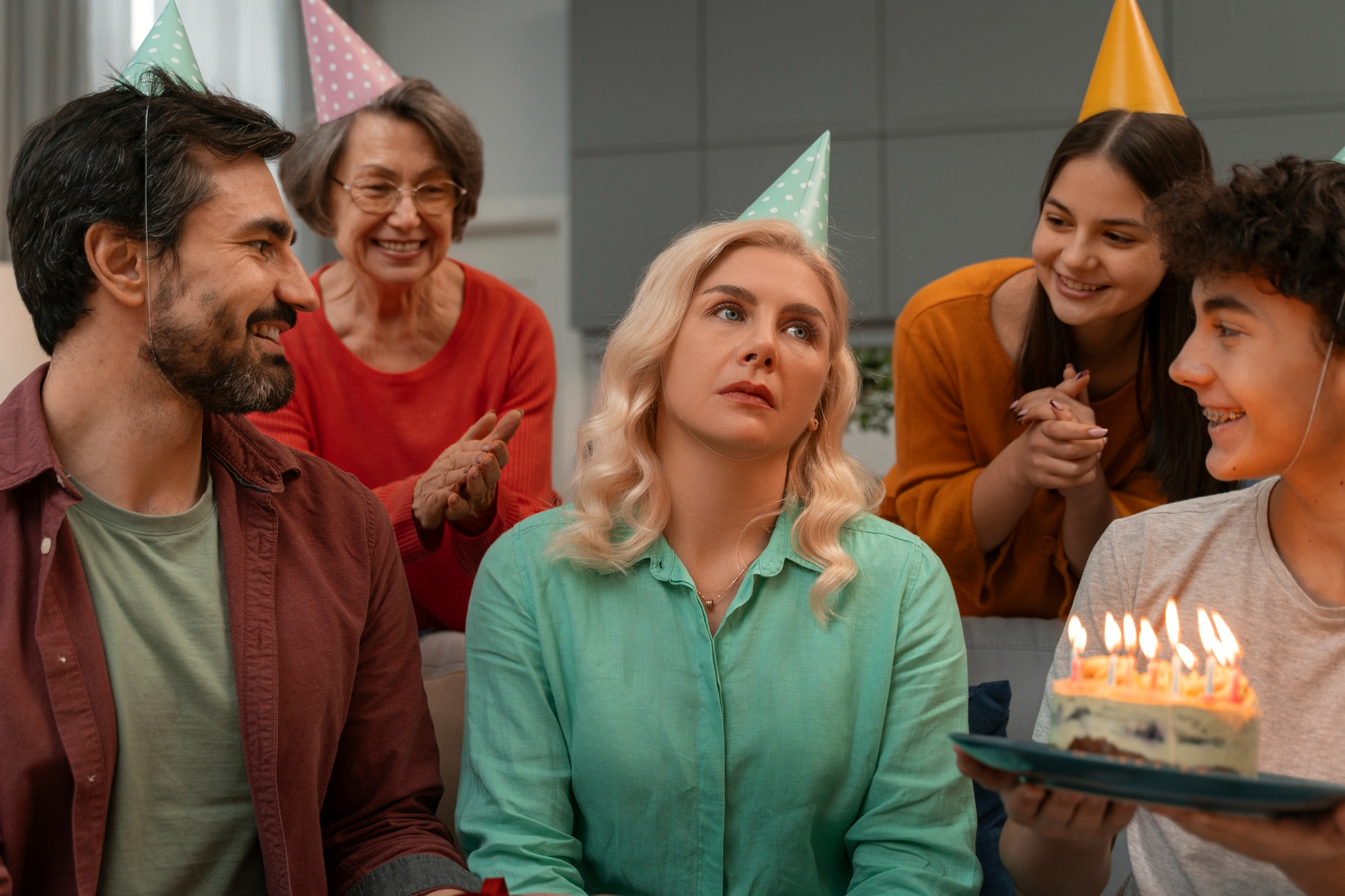
The party was at Mike’s house, loud before I even opened the door. Balloons crowded the entry, and two store-bought cakes sat on the counter looking like afterthoughts. Tyler already had a pile of gifts near his chair, which was its own commentary on whose birthday this actually was. When I walked in, nobody noticed me at first. I stood in the doorway holding a small gift bag with a silver necklace I’d picked out carefully for my mother, and I waited. Finally Mike’s wife Jenna looked up and said, “Oh, hey, Stephanie,” in the tone people use for delivery drivers. She gestured toward a chair squeezed between two of my mother’s friends near the edge of the table. My mother glanced up just long enough to register my arrival, then turned back to Tyler and told him to tell everyone what his teacher had said. He launched into it with the practiced ease of a boy who had been the center of every room he’d ever entered.
I tried to let it roll off the way I always had. Smile, nod, stay small, be pleasant. The old survival routine. I’d been running it for years.
Then Tyler stood up with a full cup of soda, the kind that sweats cold water down the sides, and walked toward me with the unhurried confidence of someone who already knew the room was on his side. He stopped close enough that I could smell the sugar and body spray, and he looked directly into my face.
“Grandma says you don’t belong here,” he announced.
The room went still for half a second, the way it does before a joke lands.
And then he tipped the cup and poured it into my lap.
Cold soda soaked through my jeans instantly. The shock hit first, then the humiliation, sharp and hot, the kind that makes your ears ring and your face flush and your body freeze in the terrible hope that someone, anyone, will stop what is happening. I looked up waiting for it.
My brother laughed. Not nervously. Not uncomfortably. A proud laugh, the kind a father makes when his kid has done something clever.
My mother laughed too, turning to the woman beside her and saying, “He just says what’s on his mind.”
The whole table laughed. Jenna covered her mouth like it was adorable. Someone said, “Oh my God, Tyler.” Someone else said, “He’s savage.”
I picked up a paper napkin and dabbed at my jeans, which made them laugh harder.
I smiled. Not because anything was funny, but because it was the smile you make when you are trying to survive the next sixty seconds without giving anyone the satisfaction of watching you break. I kept my voice even. I didn’t accuse anyone. I didn’t cry. I didn’t stand up.
Because in that moment, underneath the cold and the shame and the ringing in my ears, something clicked into a terrifying kind of clarity.
They didn’t want me there.
They never had.
And now they had made it so obvious that even I could not pretend otherwise.
I waited five minutes, long enough for the laughter to settle. I excused myself quietly, said I had a headache, walked out with my shoulders straight and soda drying sticky against my skin, and I drove home with both hands steady on the wheel.
When I got home, I did not shower. I did not sit on the bathroom floor and spiral. I walked to my desk, opened my laptop, and pulled up the documents I had been putting off for a year.
The loan papers.
My name was on everything.
A year earlier, Mike had come to me wearing the expression he always wore when he had already decided I would say yes. He used the phrase “family business” the way people use abracadabra, like consequences could be made to disappear by framing the request correctly. He wanted to expand his auto shop, a second location with better equipment, and the bank wanted a co-signer with solid credit. Mike’s credit was not solid. Not because life had been cruel to him, but because Mike treated bills the way some people treat suggestions: as optional, as starting points for negotiation, as things that would sort themselves out eventually.
He needed someone steady.
He needed me.
I said no at first. I said I didn’t want my name attached to something I couldn’t control. Then my mother called, voice soft and reasonable, asking me to just help him this once, for the family, for Tyler’s future, for stability. I was still raw then. My daughter had been gone less than two years, and grief will make you reach for anything that looks like purpose. Signing those papers felt, in some confused and desperate way, like contributing to something living. Like buying belonging with my credit score.
So I signed.
Every month after that, I watched Mike’s payments wobble. I covered shortfalls. I paid late fees once without telling him because I didn’t want the bank calling. I told myself it was temporary, that he would level out, that things would stabilize. Temporary became a year.
And then came the soda, and the laughter, and Tyler’s voice delivering my mother’s private opinion like a weather report.
I sat at my desk that night in damp jeans and stared at my name on those loan documents the way you stare at something you did not fully understand until this moment.
I called the bank’s after-hours line and left a message requesting an immediate co-signer release review and a freeze on any new draws. Then I emailed the loan officer directly with my written request to withdraw as co-signer per the clause we had all signed at Mike’s insistence on moving quickly. There was a path out. I followed it. Then I went through every account connected to the shop loan, changed passwords, removed my linked payment methods, and documented everything with screenshots and timestamps. When you have spent years being told you are too emotional, you learn the power of being impossible to dismiss.
At two in the morning, I finally showered. The soda smell clung like an insult. I scrubbed my skin too hard and watched the water swirl down the drain and thought about how long I had been letting them pour things on me and call it a joke.
I slept three hours.
At 7:15 in the morning, my phone buzzed with a message from the bank: Please call as soon as possible. At 7:45, a notification came through a neighborhood app: a grainy photo of a tow truck outside Mike’s shop. The caption read, “Anyone know what’s going on at Mike’s Auto?”
I did not feel triumph. I felt inevitability.
Because when my name came off that loan, the bank stopped being patient. The terms Mike had been ignoring for a year, the ones I had quietly cushioned him from, enforced themselves.
By eight in the morning, there was a knock at my door.
Sharp. Insistent. The kind of knock that demands.
I opened it and saw Mike standing there in yesterday’s clothes with bloodshot eyes and a jaw so tight his face twitched. He looked like a man who had finally run into a wall he’d assumed was made of paper.
“You need to fix this,” he said immediately. No good morning. No apology. No mention of the soda. No mention of Tyler. No mention of my mother laughing while her grandson humiliated her daughter.
He shoved a crumpled stack of papers toward me. “The loan’s frozen. They said the co-signer pulled out. If I don’t replace you, I’m in breach. My car’s gone. The shop is screwed.”
I leaned against the doorframe and did not take the papers.
Mike kept talking, words spilling faster, as if urgency alone could drag me back into the role I had just walked out of. The shop rent. Payroll. Tyler’s football fees. Jenna’s boutique. His mother. He stopped when he realized I still was not speaking.
His eyes narrowed. “You’re doing this over a joke.”
A joke. Not over the soda soaking through my clothes. Not over my mother’s voice saying I didn’t belong. Not over years of being treated like an afterthought in my own bloodline. A joke, as if naming it that removed everything it had revealed.
I looked at him calmly. “It wasn’t a joke to me. It was the truth. And I’m done financing your truth.”
His face twisted. “You’re going to tear everything apart because you can’t take a little teasing?”
“You tore it apart when you clapped.”
Mike’s mouth opened and closed. For a split second, something like fear moved behind his eyes, not guilt, fear, because he understood exactly what I meant.
I stepped back and began to close the door.
“Stephanie! Mom’s going to lose it. She’s going to—”
I shut the door. The click of the lock sounded like relief.
My phone lit up immediately. Mike. Jenna. My mother. A cousin. Tyler sent a TikTok of someone fake crying, no words, just the footage and a laughing emoji, as if he had not already done enough.
I did not respond to any of it.
That evening, after closing the store, I walked out to my car and stopped.
Both sides had been keyed, deep to the metal. The rearview mirror was knocked off. The back window was spiderwebbed as if someone had swung something hard at it.
I stood in the empty parking lot and listened to the silence. The air felt like it was waiting to see what I would do. This was where they expected me to break, to call Mike crying and beg for it to stop, to demonstrate that I needed their goodwill more than my own dignity.
Instead I walked back inside and pulled up my security feed.
I rewound and watched Tyler and a friend, hoods pulled up, laugh their way down the side of my car. Tyler spray-painted two words across the passenger door in red, posed for his friend’s phone like he was being filmed for something important, then kicked a flower pot off my steps as a finale.
I watched it twice. Then I called Uncle Ray.
For the first time in my life, I did not ask anyone for permission to protect myself.
Ray showed up in under thirty minutes, took one look at the footage, and said, “You’re calling the police. Don’t argue.”
I didn’t.
The officer was efficient and unsurprised. He took my statement, copied the footage, and mentioned almost casually that this was not the first complaint involving Tyler. At school, he said, there had been incidents. Vandalism. Misunderstandings that had been quietly smoothed over by adults who confused managing consequences with eliminating them.
The next morning, Mike stood across the street from my apartment pacing like he was waiting for a miracle to fall from the sky, and when I didn’t come out, he started yelling. My mother left a voicemail bright with offended disbelief about me letting money come between family over a childish prank. She still did not mention the soda. She still did not say Tyler’s name in connection with what he had done to my car. She treated my humiliation as a minor inconvenience compared to Mike’s missing vehicle, as if the car was the real casualty of the evening.
It wasn’t about the soda, I had understood by then. It wasn’t about the keyed paint or the broken window. Those were just the moments when the truth finally stopped hiding itself. This was about years of being treated like a guest in my own bloodline. Tolerated when useful, invisible when not.
They had assumed that because I didn’t explode, I wasn’t paying attention.
They were wrong.
I sat down with a notebook and made a list of every place my name had been used as scaffolding for their lives. The business loan. The lease on Mike’s second location, which I had co-signed because he needed credibility. The payment accounts for Jenna’s boutique, the PayPal and Stripe registrations and tax ID, all tied to my information because she was “just not good with paperwork” and I had been trained to make things easier for everyone except myself.
I started taking it all back. Methodical. Clinical. By the book. I called the landlord and removed myself from the lease per the contract terms. I notified the payment processors that my information had been used improperly and revoked access. I sent formal notices, not emotional speeches. By the end of the week, Jenna’s boutique couldn’t process payments and Mike’s landlord had posted an eviction notice on the shop door.
Mike called seventeen times in one day. His voicemails cycled through stages like a storm moving across a map. Pleading, then guilt-tripping, then rage, then something that sounded close to tears. My mother called too, sharper now, invoking my father’s name the way she always did when she needed a bigger weapon. Dad had been gone five years, a fast heart attack with no warning and no closure, and Mike and my mother had been using his memory as leverage ever since. I did not let it work this time.
When Tyler was formally charged as a minor for the vandalism, they smashed my store window with a rock. A note was rubber-banded to it that read, “You’ll be alone forever.” I picked up the rock, taped the note to my office wall as evidence, and called Ray. He came the next morning with a lawyer named Ms. Kline, who had the calm voice of someone who did not find family drama particularly unusual and was very good at turning it into paperwork.
Within days, additional people came forward. Hannah, who had worked for Mike at the second location, reached out to say she had overheard conversations about making me look unstable, and that she had texts to prove it. A vendor contacted me with screenshots of invoices that used my business name as if I were a partner in dealings I had known nothing about. A third person sent documentation of supplier agreements made under my business identity without my consent.
I forwarded everything to Ms. Kline. Within hours, the case grew teeth.
Court was on a Thursday morning. Our lawyer carried a thick binder with seven exhibits: video footage, the livestream transcript, screenshots, vendor statements, Hannah’s receipts, every message Mike and Jenna had assumed would disappear into the air. When Mike walked in, he looked rough in a way that had nothing to do with the early hour. Jenna stayed close behind him, whispering, checking her phone as if scrolling could fix anything. My mother was not there. A cousin sent me a photo from her favorite brunch spot, laughing with a church friend, which told me everything I needed to know about how seriously she took what had been done in her name.
The judge was professional and efficient. When she read Mike’s livestream words aloud in her measured voice, calling me a parasite, mocking my daughter’s death for public entertainment, the flatness of her delivery made it worse than yelling would have. She looked up at Mike’s lawyer and said something I will never forget: “If this is how your family handles things privately, I’m grateful it became public.”
We won every claim. Restitution for property damage, business interference, defamation, legal fees, and emotional distress. Over twenty-eight thousand dollars and a formal no-contact order barring Mike and Jenna from reaching me directly.
Tyler’s juvenile ruling came separately: community service, mandatory counseling, and a written apology submitted through the court. The email arrived polished and careful, clearly drafted by an adult. I did not respond. I needed his behavior to change, not his words on a page.
Their world contracted in the months that followed. Vendors stopped returning Mike’s calls. Landlords asked for co-signers. One church elder quietly told a cousin that Mike was not in good standing. My store, meanwhile, expanded into the neighboring unit. We knocked out a wall and added shelf space. I hired two more employees and gave everyone raises, because I refused to build something that treated people the way my family had treated me.
In December, on the weekend my mother’s birthday used to happen, I hosted a fundraiser for the children’s ward at the hospital. I called it The Emma Table, after my daughter, because she deserved a table where she was honored and not weaponized. The store filled with people: families, nurses, teachers, customers who had known Emma. Uncle Ray stood near the entrance. A local baker donated cupcakes. My staff worked like a team that had chosen each other.
In the middle of it all, there was a long table covered in donations and handwritten notes from people who had come because they wanted to, not because they owed me anything. One note read, “You belong here.”
I stood at that table for a moment alone at the end of the night, running my fingers across the wood, and I thought about the birthday dinner, about the cold soda, about the laughter, about driving home with steady hands while my jeans dried against my skin.
And I understood something I had not been able to put into words until that moment.
They did not get to own this season anymore.
That following year, my mother’s birthday came and went without an invitation. The absence had a familiar sting for about thirty seconds. Then it felt like confirmation: the only way she knew how to win was to pretend I didn’t exist. So I let her.
I spent that day the way I chose. I opened the store late and took my staff to breakfast. We ate pancakes and talked about ordinary things and laughed about nothing in particular. At home that evening, I set a small photo of my daughter beside a cup of tea and let her be present the way she always was, as quiet love rather than a wound someone else kept reopening.
Tyler came to my door once, in the early morning, alone, without the crowd that had always made him brave. He stood with his hands in his hoodie pockets and his shoulders hunched, and he looked like a boy who had finally understood that the world could push back.
I kept the chain latched and called Uncle Ray, who stayed on the line while I listened.
Tyler said he was not supposed to be there, that his counselor had advised against it, but that he needed to say something. He pulled a handwritten note from his pocket and asked if he could read it. I told him yes.
His voice cracked on the words. He said he was sorry for pouring the soda, for repeating what his grandmother said, for wrecking my car and my store. He said he had done it because he wanted the room to laugh, because the room always laughed when someone went after me, and he thought that meant it was acceptable.
I didn’t soften. “What did you think it meant for me?”
Tyler looked up. “I didn’t think about you,” he said. “I just wanted them to like me.”
There it was. Not an excuse. A confession. A fourteen-year-old boy who had been raised in a house where cruelty bought approval, telling me exactly what that had cost us both.
He swallowed and added, more quietly, “Grandma did say you don’t belong. She says it. I repeated it because it makes her happy when people laugh at you.”
My hands tightened on the edge of the door. The old hurt rose, hot and familiar. Underneath it was the same clarity that had come to me the night of the dinner, sitting at my desk in damp jeans. This was not new information. This was confirmation.
“I’m not here to make you feel better, Tyler,” I told him. “You don’t get to apologize your way back into my life. You earn change by changing. Over time.”
He nodded like a person absorbing a new rule of physics. “Okay.”
“And you don’t come to my home again without permission. Understood?”
“Yes, ma’am.”
I watched him walk away, shoulders still hunched, steps less certain than they used to be. Then I closed the door and slid the chain free and stood in the quiet of my own apartment.
Ray’s voice came through the phone. “You okay?”
“Yeah,” I said.
“You handled it right.”
I leaned my forehead against the door for a moment and let my body settle. Outside, the town moved on the way towns do, indifferent to private wars. Inside me, something had finished turning, a gear that had been catching for years finally finding its place.
My mother never reached out again after the protective order. Neither did Mike. Their silence did not feel like remorse. It felt like defeat, and I was at peace with that distinction.
I hosted The Emma Table again the following December, bigger than before, more sponsors, more community, more notes on the table from people who showed up because they wanted to and not because I had earned their presence by making myself useful. At the end of the evening, after everyone had gone, I stood alone in the store with the lights still on and the donation table still covered in small folded pieces of paper.
I read them one by one.
“Thank you for staying.”
“You turned pain into purpose.”
“You belong here.”
“Your daughter would be proud.”
I placed my hand flat on the table and breathed in.
My family had spent years trying to make me small. They had laughed at my grief, planted my name on their debts, used my longing for belonging as a lever to keep me cooperative and quiet. They thought that because I kept showing up, they could keep taking. They thought that because I smiled through the soda and the laughter and the shame, I was not watching. They thought the door to me would always be open because I had never been the one to close it.
What they never understood was that I had been building, quietly and steadily, a life that did not require their permission.
My store. My staff. The community that formed around The Emma Table. Uncle Ray. Ms. Kline. Ms. Delgado and the youth program and even, in his slow and uncertain way, Tyler, who was trying to become someone different from the boy his grandmother had been shaping.
I set a table every year now. I set an extra chair. Not for my family. Not for the people who poured soda in my lap and called it a joke. For myself. Because for too many years I had confused their cruelty for my smallness, and I needed the reminder, visible and physical and unmistakable, that I decided where I belonged.
Nobody decides that for you.
Not your grandmother. Not your brother. Not the table that laughs when someone humiliates you.
You pull your name off the loan. You document everything. You call Uncle Ray. You open the door with the chain latched and you tell a fourteen-year-old boy that sorry is a beginning, not an ending.
And then you set the table, you put out the extra chair, and you sit down like someone who was always supposed to be there.
Because you were.

Ethan Blake is a skilled Creative Content Specialist with a talent for crafting engaging and thought-provoking narratives. With a strong background in storytelling and digital content creation, Ethan brings a unique perspective to his role at TheArchivists, where he curates and produces captivating content for a global audience.
Ethan holds a degree in Communications from Zurich University, where he developed his expertise in storytelling, media strategy, and audience engagement. Known for his ability to blend creativity with analytical precision, he excels at creating content that not only entertains but also connects deeply with readers.
At TheArchivists, Ethan specializes in uncovering compelling stories that reflect a wide range of human experiences. His work is celebrated for its authenticity, creativity, and ability to spark meaningful conversations, earning him recognition among peers and readers alike.
Passionate about the art of storytelling, Ethan enjoys exploring themes of culture, history, and personal growth, aiming to inspire and inform with every piece he creates. Dedicated to making a lasting impact, Ethan continues to push boundaries in the ever-evolving world of digital content.
I really do enjoy your stories. You are at least someone that takes the time to finish the story, so thank you!