What Was Hidden in the Chair
Emma almost didn’t go out that evening.
She’d been on her feet since seven in the morning, the kind of day that accumulates weight as it goes: a difficult client call at nine, a miscommunication about a project deadline that took two hours to untangle, a commute home where every traffic light seemed to catch her personally. By the time she changed out of her work clothes and ate the leftover soup Daniel had reheated, she was ready to declare the day finished and disappear into the couch with a book she’d been meaning to read for three months.
But the trash bag was sitting by the door looking reproachful, and Daniel had already done the dishes, and so she knotted the bag, slipped on her shoes, and took the elevator down.
The courtyard was quiet in that particular early-evening way, the light gone soft and gray, the day’s noise settling into itself. Two kids were doing something complicated on bikes near the far fence. Somewhere above, a window was open and a television murmured. The trash area was at the back corner of the lot, half-screened by a low concrete wall that had been painted green at some point and was now mostly weathered to a tired gray.
She dropped the bag in the container and was turning to go when a small truck pulled up to the curb beside the enclosure. Two young men got out, both in their twenties, moving with the brisk efficiency of people who have somewhere else to be. They dropped the tailgate, hauled out an armchair, and set it down beside the containers without ceremony. Neither of them looked around. They were back in the truck and gone in under two minutes.
Emma stood still for a moment, watching the taillights disappear.
Then she looked at the chair.
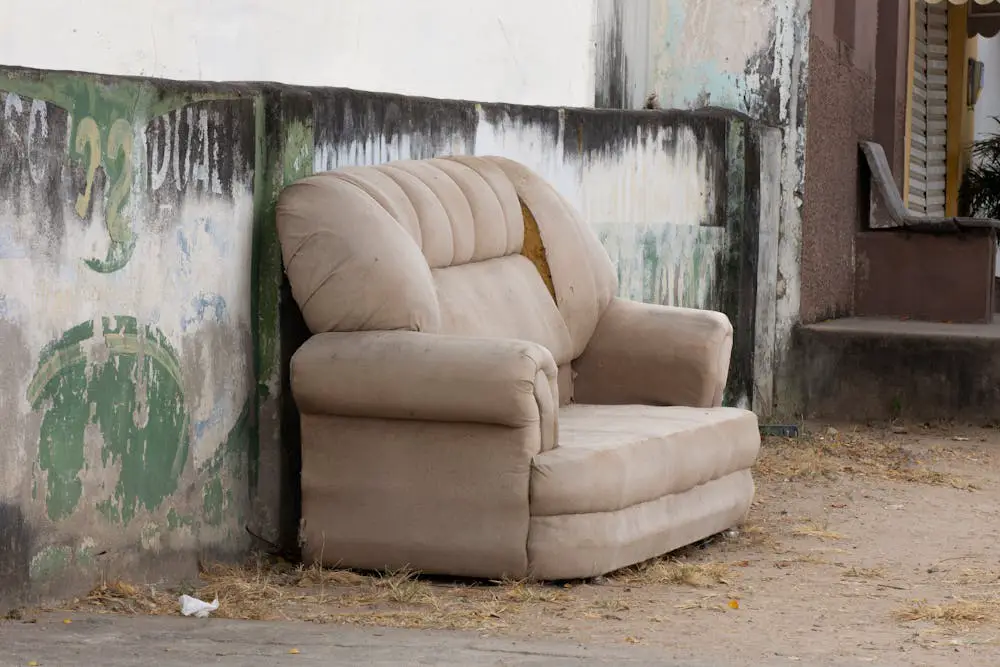
It was old, clearly, the kind of piece that had been someone’s living room anchor for fifteen or twenty years. The fabric was worn and faded, a dark burgundy that had gone the color of dried roses. One armrest had pulled away from its frame, the fabric hanging loose. There was a tear along one side seam. But she could see, even from where she stood, that the lines of the thing were good. The frame sat level and solid. The proportions were right, the kind of proportions that furniture manufacturers had stopped bothering with sometime in the mid-nineties in favor of things that looked fine in a showroom and sagged within eighteen months.
She walked closer and pressed down on the armrest with both hands. Firm. She pressed the back. Firm there too. She crouched and looked at the legs, which were dark wood, scratched but not split, all four of them making solid contact with the pavement.
“Why would anyone throw this away,” she said to nobody in particular.
She stood there for another minute or two, doing the calculation. The fabric would need to go. That was obvious. But she had the sewing machine she’d inherited from her mother, and a decent eye for it, and there was that bolt of heavy linen she’d bought two summers ago for a project that never quite materialized. The frame needed nothing. Maybe a few staples, a little wood glue along the armrest joint.
She made up her mind the way she usually made decisions: quietly, without drama, and then completely.
Getting it upstairs was less dignified than the decision-making had been. The elevator was too narrow to angle it through comfortably, so she took the stairs, which meant heaving it up three flights with rest stops at each landing where she stood breathing and reconsidering her life choices. She was sweating and slightly out of dignity by the time she got it to their door.
Daniel opened it before she could knock. He looked at her. He looked at the chair. He looked back at her.
“Are you serious,” he said.
It wasn’t quite a question.
“Look at the frame,” Emma said, not wasting breath on preamble. “It’s solid. Change the upholstery and it’ll last another twenty years. You won’t want to get out of it.”
He stood there for a moment with the expression he got when he was deciding whether to spend energy objecting to something that was clearly already decided.
“If there are cockroaches,” he said, “it goes straight back out.”
“Agreed,” Emma said.
They moved it into the living room, where it sat looking slightly incongruous next to the clean lines of their existing furniture: a little large, a little time-worn, a little like a well-traveled person who had arrived without warning and expected to stay.
Daniel got his tools. Emma set up the sewing machine on the kitchen table and went to find the linen, a warm cream color, heavier than it looked, the kind of fabric that would hold a shape and age well. She spread it on the table and started taking measurements while Daniel began working the staples out of the chair’s frame with a flat-head screwdriver and something he muttered periodically at whoever had assembled it originally.
“Not a professional,” he announced, working at a stubborn staple near the corner of the seat. “You can tell. Whoever did this was improvising. The staples are too close together in some spots and too far apart in others. And they used two different kinds of batting.”
“Does it matter?” Emma called from the kitchen, making a note about the dimensions.
“It matters to me,” he said, which she knew meant he was getting interested in the problem despite himself. Daniel worked in systems administration, a job that required the kind of patience that came from caring about details no one else noticed.
She heard him working steadily, the scrape of the screwdriver, the small metallic sounds of staples giving way, the occasional commentary on the chair’s construction history. She was pinning the first section of fabric when she heard the sounds stop.
Then: “Emma. Come here. Quickly.”
Something in his voice made her put down the pins.
He was crouched beside the chair, the seat fabric peeled back, his hands still. He was looking at something inside the chair’s frame, something that should have been batting and springs and the ordinary stuffing of an ordinary piece of furniture.
She came around beside him and looked.
He reached in carefully and lifted something out. It was a bundle, tightly wrapped, secured with a rubber band. He set it on the floor and reached back in and lifted out another. And then a third.
They were neatly banded stacks of hundred-dollar bills.
Emma and Daniel looked at the money on the floor of their living room. They looked at each other. The television was off. The street sounds from three floors below were faint and distant. The apartment had gone very quiet.
“Where did that come from,” Emma said, which was not really a question so much as the only sentence her brain would produce at that particular moment.
Daniel sat back on his heels and ran a hand through his hair. “If the chair was thrown away,” he said slowly, working it out as he spoke, “there are two possibilities. Either whoever threw it out didn’t know the money was there. Or they knew exactly what was there and were trying to get rid of it.”
Emma looked at the bundles. She thought about the two young men, the efficient way they’d unloaded the chair and driven away without looking back, the total absence of any hesitation.
“If they knew it was there,” she said, “they wouldn’t have driven a truck to a residential courtyard in the evening. They would have burned it, or buried it, or found some other way.” She paused. “Or they’d have come back for it.”
“Unless the chair was someone else’s and they were just moving it. Unless they had no idea what they were carrying.”
Daniel picked up one of the bundles and turned it over in his hands. The bills looked real. They looked like they’d been handled, used, accumulated over time and then stacked and wrapped and pushed deep into the frame of a chair by someone who didn’t trust banks, or couldn’t use them, or needed to keep something close that no one else could find.
“How much?” Emma asked.
He counted the first bundle. Counted the second. The third. He went through each stack carefully, twice, and then sat back and said the number.
Emma did the mental arithmetic. Her throat went slightly dry.
It was not a life-changing amount in the abstract, the kind of number that sounded enormous in theory. But in the reality of their apartment, their ordinary Tuesday evening, the monthly budget and the savings account and the small but persistent anxiety that comes from being one major unexpected expense away from a difficult conversation: it was more money than they kept in their bank account. More than they’d managed to save in the past two years combined.
“We should call the police,” Emma said.
Daniel didn’t answer immediately.
“Should we,” he said, after a moment.
“Yes,” Emma said. “We should call the police.”
“They’re going to take it.”
“They’re supposed to take it. It’s not ours.”
“We don’t know whose it is.”
“That’s exactly why it’s not ours.”
He looked at the money again. She could see him doing the thing people do when unexpected good fortune appears: building the case for keeping it. Telling himself the story where they deserved this, where the universe had left this for them specifically, where finders keepers was a moral philosophy rather than something children say on playgrounds.
She understood the impulse. She felt it too, a warm and dangerously comfortable pull toward the idea of the money simply being theirs now.
“Daniel,” she said.
He looked up.
“Think about it carefully,” she said. “Not about the money. About where the money came from. Nobody wraps cash in rubber bands and hides it inside a chair because they earned it at a job and couldn’t find a savings account. That money is connected to something. We don’t know what. We don’t want to know what. But whatever it is, it’s the kind of thing that might come looking for its money.”
He was quiet.
“And even if it never does,” she continued, “even if we kept it and spent it and nothing bad ever happened, I’d know. And you’d know. And it would sit in the middle of every ordinary good thing we had and poison it a little.”
Daniel set the bundle down on the floor. He looked at it for a long moment. Then he nodded, once, the way he nodded when he’d genuinely changed his mind rather than just conceded the argument.
“Okay,” he said. “We call.”
She made the call at 9:14 in the evening. The dispatcher was professional, asked three clarifying questions, and told them an officer would arrive within the hour. Emma and Daniel sat on the couch while they waited, not touching the money, not talking about it very much. They drank tea. The armchair sat beside them with its insides exposed, its secret aired, looking smaller somehow, more ordinary.
Two officers arrived at 9:47, a woman in her forties named Officer Carla Reyes, and a younger man who mostly listened and took notes. Reyes looked at the chair, looked at the money on the floor, looked at Emma and Daniel in the way of someone who has seen enough situations to read them accurately.
“You pulled this from the trash enclosure?” Reyes asked.
“Yes,” Emma said. “This evening. Around eight o’clock. Two men in a truck dropped it off. I watched them leave.”
“And you found the money while you were reupholstering it.”
“While my husband was removing the old fabric, yes.”
Reyes crouched beside the money and looked at it without touching it. She looked at the chair. She looked at the two different types of batting Daniel had mentioned, the mismatched staples, the way the seat had been put back together over whatever was hidden inside.
“This wasn’t original to the chair,” she said.
“No,” Daniel said. “Someone took it apart and put it back together. Not carefully, but well enough.”
Reyes stood and looked at them steadily.
“You know that most people, in your situation, wouldn’t have called,” she said.
“We know,” Emma said.
“Is there anything else you need to tell me about the chair? How you found it, who you might have seen?”
Emma described the truck, the two men, the time, the direction they’d driven. The officer with the notepad wrote everything down. Reyes photographed the money in place, then bagged it and documented everything with the methodical patience of someone who had done this many times. She left them a case number and her card and told them they’d be contacted if there were developments.
At the door, she paused.
“You made the right call,” she said. Not warmly, exactly, but sincerely, in the way of someone who means a thing without needing it to sound like a compliment.
When they’d gone, the apartment felt different. Lighter, Emma thought, though she wasn’t sure if that was the right word for it. The armchair sat in the middle of the room still stripped down to its bones.
“Well,” Daniel said.
“Well,” Emma agreed.
He looked at the chair. Then he picked up the screwdriver again.
“We’ve still got the frame,” he said. “If we’re going to do this, we might as well do it right.”
She went back to the kitchen and picked up her pins.
They worked for another two hours, falling into a comfortable parallel rhythm, the sounds of her sewing machine and his tools making a kind of domestic music against the quiet of the late evening. He replaced two of the legs’ screws and reinforced the armrest joint with proper wood glue and a clamp he’d had in the storage closet for years. She cut the linen and began sewing the new cover panels with the particular focused satisfaction of work that is difficult enough to require attention but not so difficult that it becomes frustrating.
Around midnight, they stepped back and looked at what they’d made.
The chair looked like itself, but better. The cream linen was clean and tailored, the proportions the same good proportions Emma had noticed in the courtyard, now presented properly. The armrest joint was solid. The legs were level.
“All right,” Daniel said. “I’ll admit it.”
“You’ll want to get out of it?”
“I’m not promising anything,” he said. “But I see why you carried it up three flights of stairs.”
She laughed, and he laughed, and they stood in their living room at midnight looking at a chair they had rebuilt from the inside out on a Tuesday evening for no practical reason except that it seemed worth saving.
Three weeks later, Officer Reyes called.
The money, she explained, had been traced to an insurance fraud investigation that had been running for fourteen months. The suspects had been using a network of low-profile storage methods for cash while the case was built against them. The chair had apparently been moved between storage locations several times by people who didn’t know what they were transporting, which explained the two young men and their efficient, incurious departure. When the operation moved locations in a hurry, the chair had apparently been incorrectly marked and sent to disposal along with a load of other furniture.
“The case has been closed,” Reyes said. “And per state law, abandoned property turned in by a civilian, once it’s been used as evidence in a concluded case, becomes eligible for a finder’s claim. You’d need to file paperwork. There’s no guarantee, and it’s not immediate, but I thought you should know it exists.”
Emma thanked her and sat with the phone in her hand for a while after they hung up.
She told Daniel that evening. He was sitting in the armchair, which had migrated to the corner of the living room where it turned out to belong, between the bookshelf and the window, in the good afternoon light.
He listened. He was quiet for a moment.
“What do you want to do?” he asked.
Emma thought about it honestly. About the money, about what it would mean, about all the conversations they’d been not quite having about savings and the future and the things they’d been postponing until things were more stable.
“File the paperwork,” she said. “If it comes to anything, we put half into savings. Real savings, the kind we actually leave alone. And we use the other half for something we’d remember.”
“What kind of thing?”
She looked at the chair, the cream linen catching the lamp light, the wood legs solid on the floor, the whole thing brought back from a courtyard and restored by two people with tools and a sewing machine and a willingness to do the work.
“Something we’d have to build,” she said. “Not buy. Build.”
Daniel nodded slowly, and she could see him thinking about it the way he thought about good problems: carefully, with genuine interest, already starting to look forward.
Outside, the city went on with its evening, ordinary and alive, completely unaware of the armchair in the corner and the two people who had looked at unexpected money on a Tuesday night and chosen, without very much drama, to simply be the people they already were.
That, Emma thought later, turning off the lamp, was probably the best thing about it.
Not the money. Not even the chair, though she did love the chair.
Just the small, clear knowledge of what they were made of, confirmed in the most ordinary possible way.

Laura Bennett writes about complicated family dynamics, difficult conversations, and the quiet moments that change everything. Her stories focus on real-life tensions — inheritance disputes, strained marriages, loyalty tests — and the strength people find when they finally speak up. She believes the smallest decisions often carry the biggest consequences.