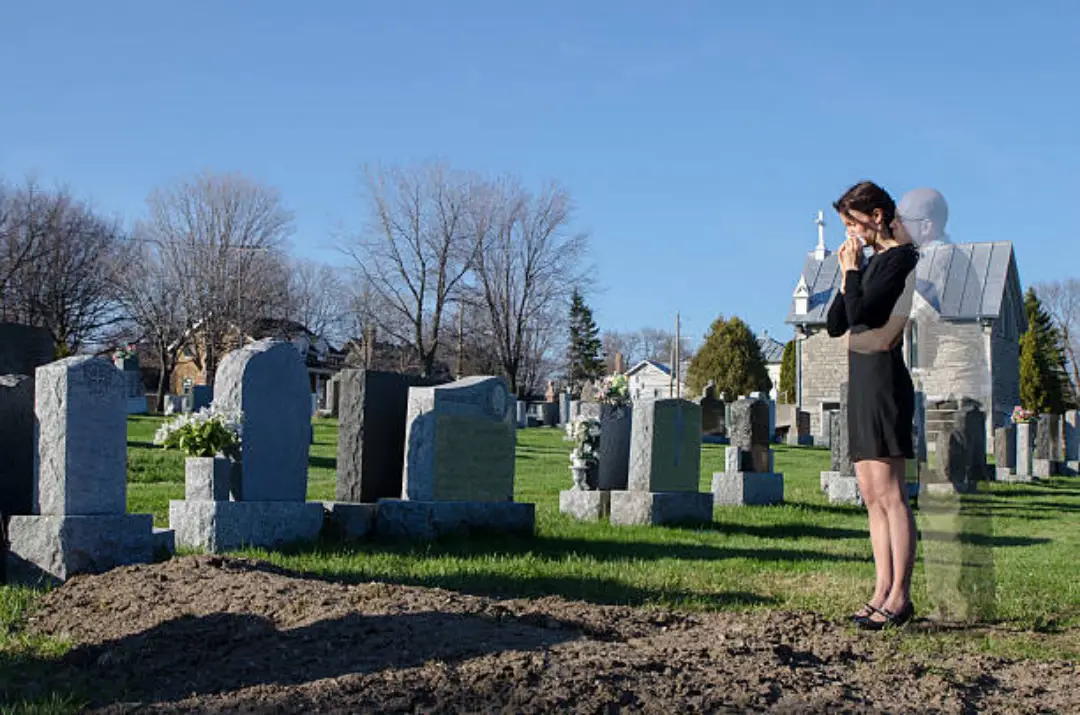
The Empty Section
We had been married for five years when I drove to the cemetery alone.
I want to explain why I went, because the reason matters. It wasn’t jealousy — I want to be clear about that from the beginning. I wasn’t the kind of woman who obsessed over her husband’s past or measured herself against someone who was gone. I had accepted, early in our relationship, that Andrei had loved someone before me and lost her, and I respected that the way you respect any grief you don’t fully understand.
Her name was Natasha. That was all I knew. Natasha, his first wife, who had died suddenly about eight months before Andrei and I met. He had told me this early on, in the careful way people tell you difficult things — measured, contained, offering the basic facts without the texture of them. She had been ill. It had been quick. He had been devastated.
I hadn’t pushed. I told myself this was kindness, and I think at the time it was. He was clearly still carrying something heavy, and I had no wish to make him carry it in front of me if he wasn’t ready. I was a patient person. I could wait.
But there was something else, underneath the patience. Something I didn’t talk about with anyone because I wasn’t sure how to explain it without sounding strange.
From almost the beginning of our life together, I had felt an impulse to visit her grave.
Not from morbid curiosity. Not from competition or insecurity. Something more like — obligation. Courtesy. The particular instinct of a woman who has moved into a life that was once someone else’s and wanted to acknowledge that in some small, private way. To stand at her grave and say: I know you were here before me. I’m not pretending otherwise. I’m sorry if this is a betrayal of something.
It sounds foolish, written down. It felt real.
Andrei’s reaction, whenever I raised it, was the thing that eventually stopped making sense to me.
Not sadness. Not the gentle deflection of someone who isn’t ready. Something sharper. Something that had edges to it.
The first time I suggested we might visit together — laying flowers, just to mark the anniversary of her death — he changed the subject so abruptly it felt physical. Like a door closing. I noticed but didn’t press.
The second time, months later, he said he didn’t see the point. “It doesn’t change anything,” he said. “She’s gone. Going to stand over a piece of ground doesn’t make it better.” I thought this was grief logic. I’d heard people say similar things. Some people don’t believe in cemetery visits. I accepted it.
The third time, I asked more directly: “Have you ever been back? Since the funeral?” He looked at me in a way I couldn’t quite read. Then he said he hadn’t. That it was too painful.
I stored this away. Too painful is a reason. Too painful makes sense.
But something about his face didn’t match the words, and that was the thing I kept coming back to in quiet moments. Not the fact of his avoidance, but the quality of it. It wasn’t the avoidance of grief. It was the avoidance of something else — something that had the texture of wariness rather than sorrow.
I told myself I was imagining it. I was good at telling myself things.
We had a good marriage. I want to say that because I don’t want to make it sound like I spent five years in a house of obvious warning signs, ignoring clear evidence of wrongdoing. Our life together was warm. He was attentive, interested in my days, generous with his time and his affection. We laughed often. We had built routines that felt like home — Sunday markets, long drives for no reason, the particular shorthand of two people who have lived alongside each other long enough to communicate in half-sentences.
There was nothing obviously wrong.
There was just this one thing that didn’t fit the rest of the picture. This one door that stayed shut no matter what I did.
In the fourth year of our marriage, I found a photograph.
I wasn’t searching for anything. I was helping Andrei clear out a box from the back of a closet — old documents, cables he’d saved for equipment he no longer owned, the kind of accumulated debris that fills boxes in the backs of closets everywhere. And at the bottom, wrapped in a piece of cloth that seemed deliberate, was a photograph.
A woman. Dark-haired, laughing, standing in front of what looked like a dacha in summer. Young — mid-twenties, maybe. The photograph wasn’t dated, but something about the clothes suggested it wasn’t recent.
I held it for a moment without saying anything. Then I showed it to Andrei.
He went very still.
“Is this Natasha?” I asked.
He took the photograph from me carefully. “Yes,” he said.
“She’s beautiful.”
“Yes,” he said again.
He put the photograph in his pocket and didn’t mention it again. I waited to see if he would bring it up later — that evening, the next day, any time in the following week. He didn’t. I didn’t ask.
But I thought about her face. The way she was laughing. The particularity of a person caught in a moment of genuine happiness by someone who loved them.
And I thought about the fact that a woman who had been married to my husband and died before I met him had no grave he ever visited. No date he marked. No mention beyond those initial measured facts.
Something had been growing in me for months, quiet and persistent, and that photograph was the thing that made it impossible to ignore any longer.
The decision felt less like a decision than a moment of clarity.
A Tuesday afternoon in October, leaving work slightly early, passing a flower stall I walked past every day. I stopped. I bought a bouquet — white chrysanthemums, the traditional kind, the kind you bring to graves. I got in my car and I drove to the cemetery where Andrei’s family was buried.
I knew the location because it had come up once, obliquely, in a conversation about his grandmother. He had mentioned the name of the cemetery without meaning to — one of those casual references that people make without realizing they’ve given you information. I had filed it without intending to.
The drive took forty minutes. I didn’t call him. I didn’t tell anyone where I was going. I sat with the radio off and thought about what I was doing and why, and the further I drove the more certain I felt that I needed to do it.
The cemetery was large and well-kept, sections organized by family name and era. I walked for a while, reading inscriptions, following the logical progression of the section where Andrei’s family name appeared. His grandmother’s grave was there — I recognized the name from the conversation. His grandfather beside her.
I walked the rows looking for Natasha’s name. His surname. Dates that would fit — a woman who would have been in her late twenties or early thirties, who died roughly six years ago.
I walked the rows twice.
Then I stood in the section where she should have been and looked at the space that was there instead.
Empty.
Not an unmarked grave — not a simple stone without ornamentation. Empty ground. Grass growing undisturbed. No marker of any kind, no indication that anyone had been laid here or was expected to be.
She was not buried here.
I stood there for a long time with the chrysanthemums in my hands and I tried to come up with the explanations. Maybe he’d had her buried elsewhere — in her family’s plot, in a different city, in a different country. Maybe there had been a religious consideration, a family conflict, a practical reason I didn’t know about.
Maybe. Possibly. Perhaps.
But the quality of my certainty, standing in that empty section in the October cold, was different from the quality of those maybes. I could feel the difference between the uncertainty of someone who has simply encountered something she doesn’t yet have context for and the certainty of someone who has, in some part of herself she hadn’t been fully listening to, already understood.
I drove home.
I put the chrysanthemums in a vase because I didn’t know what else to do with them.
I didn’t say anything to Andrei.
What I did instead was begin to ask questions in a direction I had never pointed them before.
Not to him. To the periphery. The places where information accumulates without being guarded.
His older sister Vera had always been kind to me — the generous, including kind that some sisters-in-law are, who accept you into the family warmly without making it a performance. We had lunch occasionally, talked easily about ordinary things. I trusted her.
I called her three days after the cemetery.
I told her I’d been to visit Andrei’s family graves and that I had hoped to find Natasha’s grave but couldn’t locate it. I kept my voice neutral, curious. I said I hoped she could help me understand where she’d been buried.
The silence on the other end of the line lasted long enough that I knew, before she said a word, that something was wrong.
“Where did you say you went?” Vera asked. Carefully.
“The family cemetery. I found your grandparents. But I couldn’t find Natasha.”
Another silence.
“Natasha,” Vera repeated. And then, slowly, as if she were choosing each word from a small and very careful selection: “Olya, can we meet?”
We met the following day at a café neither of us usually went to — not a neutral choice, I realized afterward. She had suggested a place where we were unlikely to run into anyone we knew.
She arrived before me. When I sat down across from her, I saw that she looked tired in a way that had nothing to do with sleep.
She ordered tea she didn’t drink. I waited.
“How long have you known?” she asked.
“Known what, specifically?” I said. Because I needed her to say it.
She looked at her cup. Then she said: “Natasha is alive.”
The words landed in a particular way — not as a shock exactly, because something in me had been building toward this for days, maybe longer. More like the sound a key makes when it finally turns in a lock you’ve been struggling with. The click of something opening.
“Tell me,” I said.
What Vera told me took the better part of an hour.
Andrei and Natasha had married young — both in their mid-twenties, a quick engagement, a wedding their families had reservations about but supported anyway. By their third year, the marriage was failing. Not dramatically — no violence, no single catastrophic event. Just the gradual erosion of two people who had grown in directions that were no longer compatible, or perhaps had never been as compatible as they’d believed.
They separated. Natasha moved back to her family’s city — a six-hour drive away. The intention was a formal divorce, but the paperwork had been complicated by property, by disagreement, by the particular inertia that sometimes grips people when a formal ending feels too final to be processed quickly.
And then Andrei had met me.
I sat with that. He met me.
He met me while his marriage was technically still in existence — separated, stalled, but not legally dissolved. And rather than tell me this, rather than say I need to sort out my previous situation before we can build something together — rather than any honest version of the facts — he had told me his wife was dead.
It was, in its way, an extraordinarily complete lie. Not a half-truth, not an omission. A specific, detailed fabrication with a beginning and an end. She was ill. It was quick. He was devastated.
He had described his living wife’s death to me.
“Does Natasha know about me?” I asked.
Vera looked at me in a way that told me the answer before she gave it.
“No,” she said quietly.
I have thought many times about how to describe what I felt in the car driving home from that café, and I keep arriving at the same inadequate conclusion: there is no accurate language for discovering that your life is built on a lie of that particular shape.
It wasn’t like anger, though I was angry. It wasn’t like grief, though I was grieving. It was something more fundamental — the sensation of reaching for solid ground and finding that what you put your weight on has a different composition than you believed. Everything you built on it is still there, but the foundation is not what you were told it was.
Five years. Five years of a life I had understood to be real, to be mine, to be built in good faith on both sides.
He had described this woman’s death to me. He had given her an illness, a timeline, a cause. He had performed grief at the beginning of our relationship — that careful, measured pain — and I had responded to it with tenderness and patience, with deliberate care not to push, with the particular generosity of someone trying not to wound a person who is already wounded.
I had been tender with a lie.
I need to tell you what I did not do.
I did not go home and confront him immediately. I know that might be surprising — it surprises me a little, even now, looking back. But I understood in the car that if I walked through the door that evening with what I knew, the conversation would happen entirely on his terms. He would shape it, defend it, explain it in directions that served him. He was good with words. He was, I now understood, very good with constructed narratives.
I needed to be clear first. I needed to know what I actually knew before I walked into a room with him.
I called a lawyer that evening — a woman I’d met professionally years before who practiced family law. I explained the situation. She listened without interrupting.
“If he told you his wife was deceased when she was alive, your marriage may not be legally valid,” she said. “Depending on the status of his previous marriage at the time of your wedding — whether they had actually filed for divorce or whether it was never finalized — there are several possible legal situations here. We need to establish the facts.”
I asked how we would establish them.
She told me.
Over the following week, while continuing to live in my house and sleep beside my husband and conduct my life with complete apparent normality, I gathered information with the focused efficiency of a person who has discovered that their entire situation requires reassessment.
The marriage records were accessible. With the lawyer’s help, we found what we were looking for: Andrei and Natasha’s divorce had never been finalized. There had been filings, initial steps, and then nothing. The process had simply stopped.
At the time of our wedding, he was still legally married to her.
Our marriage was not valid.
I want to pause here and tell you something about the quality of those days — the week between the café and the conversation I knew was coming.
I cooked dinner every evening. I watched television with Andrei on the couch. I answered his questions about my day with the same detail I always had. I slept beside him every night.
I don’t know entirely what to make of this, looking back. There is an argument that it was a kind of dishonesty — that I was performing normalcy while secretly building a case, that this made me no better than him.
I’ve sat with that argument.
Where I’ve landed is here: what I was doing was protecting myself. I had discovered that I was in a situation I had not consented to — that the foundation of my life had been falsified by someone I trusted absolutely. Taking a week to understand my circumstances before confronting that person is not deception. It is self-preservation. The two things are not equivalent.
He had five years to tell me the truth.
I took seven days to understand what the truth meant for my life.
I chose a Sunday.
He was home. It was late morning. I had made coffee the way I always did, and we were sitting at the kitchen table, and it was, on the surface, exactly like every other Sunday morning.
I put my cup down.
I said: “I went to the cemetery last week. The family section. I was looking for Natasha’s grave.”
He went very still. The kind of stillness that is not calm but its opposite — the stillness of a person whose entire system has just registered threat.
“I didn’t find one,” I said. “There’s no grave. Because there’s no grave.”
He didn’t say anything.
“I spoke to Vera,” I said.
Something crossed his face. It was not a simple expression — it had several things moving through it at once, and I watched them without trying to read them too quickly. Then he said, quietly: “How long have you known?”
“A week,” I said. “I’ve spent the week understanding what it means.”
“Olya—”
“I’m going to tell you what I know,” I said. “And then you can tell me what you want to tell me. But I need you to understand that I know the shape of this already, and I need you to be honest because we are past the point where anything else will serve you.”
I told him what I knew. The facts, in order, without emotion in my voice — not because I didn’t feel emotion, but because emotion would have moved us into territory I didn’t want to be in, where he could manage my feelings instead of being accountable for his choices.
He sat across from me and he listened.
When I finished, the silence between us lasted a long time.
“I didn’t know how to tell you,” he said finally.
“You had five years,” I said.
“I know.”
“You told me she was dead. You gave her an illness. You described grief that wasn’t real. You let me be careful with you — for years, Andrei. You let me avoid the subject and tread lightly and never push, because I was trying to protect your feelings about a woman who was alive.”
He didn’t try to argue with any of this.
“She doesn’t know about me,” I said.
“No.”
“She’s been living her life thinking her marriage ended in separation. Not knowing her husband remarried. Not knowing any of this.”
He nodded.
“We were both lied to,” I said. “That’s what I need you to understand. You didn’t just lie to me. You took her life and made it into a story you told to someone else without her knowledge or consent. Both of us have been living in a reality you constructed.”
His face, in that moment, was the face of a man who has been seen completely and does not know what to do with being seen. Not defensive. Not strategic. Just — exposed. The way people look when there is nowhere left to put the weight of something.
“I’m sorry,” he said.
“I know,” I said. “I believe you. But I need you to understand that sorry is the beginning of a very long road, not the end of a short one. And I need you to understand that the first step on that road is not anything you do for me. It’s contacting Natasha. She deserves to know.”
I moved out two weeks later, into a friend’s spare room while I figured out what came next.
The legal situation was, in its way, clarifying. Because our marriage had not been legally valid, there was no divorce to file. There were other proceedings — financial matters, questions about property, the practical arithmetic of a life that needed to be separated. My lawyer was competent and calm and navigated all of it without drama.
I heard from Vera that Andrei had contacted Natasha. I don’t know what was said. I don’t know how she received the information that her estranged husband had told a woman she was dead and built a second life on the lie. I imagine there are no adequate words for that particular discovery, and I found that I didn’t need to know the details. Her experience was her own. I hoped she was alright. I hoped the people who loved her were close.
The chrysanthemums I’d bought that Tuesday — the ones I’d put in a vase when I came home from the empty section of the cemetery — wilted and I threw them away during the second week.
I bought new ones before I moved out. I put them on the kitchen table because the kitchen looked bare without flowers and I had always been the one who kept flowers in the kitchen.
Then I took my bags and I left.
There is something I want to tell you about the cemetery visit, now that I have enough distance to see it clearly.
I went to find a grave and offer something to the woman buried there. To acknowledge her. To say: you were real and your life mattered and I am not pretending you didn’t exist.
There was no grave.
She was real, she was alive, and she had existed in a life that had been folded up and put away by someone who needed her gone in order to have the version of himself he wanted.
In a strange way, the instinct that brought me to that cemetery — the sense of duty, the need to acknowledge what came before — was not wrong. It was only misdirected by the false information I’d been given. I had gone to pay respect to a story, and I’d found instead that the story wasn’t true.
What I stood over in that empty section wasn’t her grave.
The truth of what it was arrived in stages, but by the time I was in the car driving home from Vera’s café, I understood it completely.
I had stood at the grave of a marriage.
The ceremony had been held without my knowledge. The burial had been quiet and ongoing for five years. And I had arrived at the end of it, flowers in hand, to find that the ground was empty — that what I’d been told was buried there had never existed.
I am forty-one years old. I am living in my own apartment now, a place I chose for myself and furnished with things I chose and arranged the way I want them. I have a job I’m good at and friends who know the whole story and didn’t flinch at any of it. I have been told by more than one person that I am handling this with remarkable composure, and I don’t entirely know what to do with that observation except to say that composure is sometimes just the form grief takes in people who don’t have the luxury of falling apart.
I have cried. I want to be honest about that. There have been evenings where the specific shape of the loss — not just the marriage but the version of myself who lived in it, who was careful and patient and tender toward a lie for five years — arrives with a weight that requires sitting with in the dark for a while.
I sit with it.
And then I get up the next morning and I go to work and I buy flowers for my kitchen and I keep building the life that belongs only to me.
That is the only thing, in the end, that makes sense.
Not the empty box where someone should have been buried. Not the man who needed her gone so badly he killed her in a story.
Just the morning. Just the flowers. Just the life I am building on ground I have checked myself.
That ground holds.

Specialty: Emotional Turning Points
Rachel Monroe writes character-driven stories about betrayal, second chances, and unexpected resilience. Her work highlights the emotional side of family conflict — the silences, the misunderstandings, and the moments when someone quietly decides they’ve had enough.