After my husband passed away, I sold our apartment and moved back into the old family house at the edge of the village.
I had inherited it years earlier and never quite known what to do with it. It had belonged to my grandparents, and before them to their parents, a two-story wood-and-stone house with thick walls and small windows and a yard that backed up almost directly against the forest. The kind of house that holds heat well and sound poorly, where you can hear the wind finding every small gap in the frame and the pipes singing when the temperature drops below a certain point.
I had spent summers there as a child. I knew the way the kitchen smelled in the morning when the stove had been burning overnight. I knew which step on the staircase creaked and which floorboard in the hallway shifted slightly under your weight. I knew that the forest went dark an hour before the sky did, and that after a certain time in the evening, you didn’t walk to the tree line alone.
When my husband died, the city apartment we had shared for eighteen years felt like a museum dedicated to someone who no longer existed. Every room held a version of us I couldn’t live inside anymore. I needed somewhere that predated the life I had lost — somewhere my grief hadn’t reached yet, somewhere that belonged to a self I remembered being before everything changed.
So I packed what mattered, sold what didn’t, and drove four hours to the house at the edge of the village where my grandmother used to braid my hair at the kitchen table and tell me stories I was too young to fully understand.
The Quiet That Comes Before
The days were manageable. Barely, but manageable.
I kept the stove burning because it gave me something to tend. I sorted through the boxes and trunks full of old things — faded photographs of people I recognized only by resemblance, mismatched dishes wrapped in newspaper from decades ago, curtains that smelled like a life that had ended before I arrived. I walked in the yard in the mornings, even in the cold, because movement helped. I let the silence settle over me the way you let a room air out after something has gone wrong in it — with the windows open, waiting.
Grief does something strange to time. The days moved both too slowly and too fast. I would look up from sorting through a box of old letters and realize three hours had passed without me noticing. Then I would lie in bed at night unable to sleep, and an hour would feel like a week.
The neighbors were kind in the distant, practical way of village people. They left bread on the step twice. The old man across the lane cleared the snow from my path without being asked, without making a thing of it. Nobody pushed, nobody pressed. They understood, I think, that I had come there to be quiet, and they respected that.
But by evening, every evening, the quiet changed its character.
The forest darkened faster than the sky. There was something about the way the trees absorbed the last light — pulling it in rather than releasing it, the shadows thickening between the trunks until the whole tree line became a single dark wall. The wind came in from the open fields and moved differently at night, not the occasional push of daytime breezes but something more determined, more sustained, throwing itself against the walls as though testing which parts might give.
At night I heard things. Branches cracking — the sudden sharp sound of wood under pressure, different from the gradual creaking of the house itself. Long howls that started low and rose and held and then dropped away, answered sometimes by something farther off, sometimes by silence. Sharp cries I could never quite identify — animal arguments in a language I didn’t speak, settling disputes I’d never understand.
The frost worked its way into the window frames and made them creak. The door trembled under strong gusts. The fire in the stove popped and hissed.
More than once I sat completely still in the kitchen chair, hands around a mug of cooling tea, and just listened. Not afraid exactly. Just aware, in a way that felt old and animal and honest, that I was very small inside a very large dark, and that things were moving out there in the night that had nothing to do with me and no interest in my grief.
I told myself that was actually comforting.
Some nights it was.
The Night the Storm Came
It announced itself in the afternoon — the sky going the color of old iron, the pressure dropping in that specific way that makes your ears feel full. By four o’clock the light was already wrong, too flat, too gray, the shadows disappearing because everything had become shadow.
I brought in extra wood from the pile by the shed. I filled the kettle and left it on the stove. I checked the latch on the door and the shutters on the windows and did all the small, practical things that feel like prayers when you’re alone in a house at the edge of a forest with a serious storm building.
By evening the wind was not occasional gusts but a continuous force, bending the taller trees at the edge of the property, sending something rattling across the yard — a bucket, I thought, though I couldn’t see it. The snow came sideways. The temperature dropped fast enough that I could hear it happening in the sounds the house made, the wood contracting, the windows going tight in their frames.
I stoked the stove until the kitchen was almost too warm. I made dinner and ate it at the kitchen table, watching the window, which showed me nothing but my own reflection against the dark. I found an old book on the shelf — something from my grandmother’s collection, a novel I’d never read. I read the same paragraph four times without retaining a word of it.
The howling started around midnight.
I had heard wolves before. The sound travels on cold air in ways it doesn’t in warmer months, and I had been in that house for three weeks by then. I knew what it sounded like coming from a distance, how it rose and fell with the wind, how it could seem right outside the window one moment and kilometers away the next depending on which direction the air was moving.
This was different.
This was not distant. This was not the sound of something moving through the forest on its own business. This was close — low and prolonged and coming from directly outside the house, and when it stopped, the silence it left behind felt like a held breath.
I got up from the chair and went to the window.
What Was Standing in the Yard
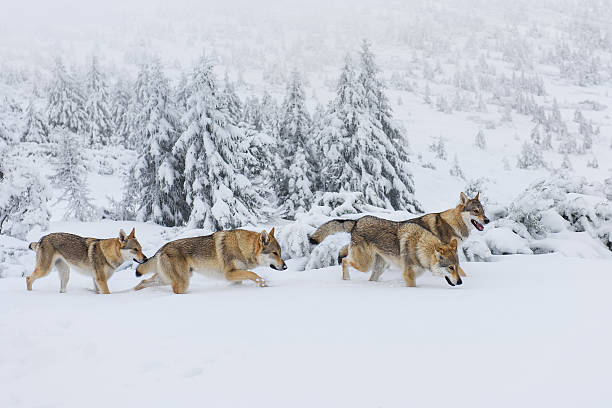
Four wolves. Standing in the snow, maybe eight meters from my door, positioned in a loose, natural grouping that had no particular formation to it — they hadn’t arranged themselves, they had simply arrived and stopped.
I stood very still and looked at them, and they looked at the light coming through my window.
They were not pacing. They were not circling the house in the way animals sometimes circle something they mean to take. They weren’t growling — I could see that much, even through the glass, even in the dark made intermittently brighter by the moving snow. No exposed teeth, no lowered heads, no raised hackles. Their tails were not raised in the way that means aggression.
What they looked was exhausted.
Their fur was thick with frost — I could see it even at that distance, the ice crystals catching what little light came from my window and from the snow itself. Their movements were slow, deliberate, the careful movements of animals that had been pushing against weather for a long time and had used up most of what they had. They looked like things that had been driven by the storm rather than wolves who had chosen to come here for any particular purpose.
They looked the way I had felt when I first arrived at that house. Displaced. Pushed by something large and indifferent to a place that wasn’t home, standing in the cold trying to figure out what came next.
I stood at the window for a long time.
Every sensible thing in me said: Do not open the door. You do not open your door to wolves. Not in any version of this situation. Not under any circumstances. I understood this. I was not unaware that these were wild animals, apex predators, creatures that could cover ground faster than I could think and do damage that I did not want to think about.
But I had grown up at the edge of forests. I had been told stories about these animals my whole life. And I had been living alone for three weeks in a dead man’s grief, listening to the dark every night, sitting very still and waiting for something I couldn’t name.
I went to the door.
I stood there with my hand on the latch for what felt like a long time. I was listening to my own breathing, to the sound of my own heartbeat, which was calm in a way that surprised me. Outside, the wind pushed against the door, and somewhere in the sound of the wind, low and very near, I could hear them.
Not threatening. Just present.
I lifted the latch. I pulled the door open slowly and stepped back to the wall, keeping my face toward the opening, not turning away, not showing my back. I said nothing. I made no sound, no invitation, no beckoning gesture. I just opened the door and stepped back and waited.
What Happened When I Let Them In
The first wolf came to the threshold and stopped.
It stood there for a moment — three seconds, maybe five — and looked into the kitchen. Its nose worked constantly, reading everything in the warm air pouring out of the house. Then it stepped inside.
No rushing. It moved along the wall with its head low, tracking the baseboard, then the legs of the table, then the front of the stove. Mapping the space with its nose in the methodical way of an animal gathering information before deciding anything. It did not look at me. It did not approach me. It moved around the kitchen’s perimeter and then lay down near the stove, setting its head on its front paws.
The second came in and did the same thing — different path, same unhurried attention to every surface, every smell. It ended up near the window, curling once before going still.
The third settled near the entrance, just inside the door.
The fourth was different.
It came in last and it did not settle. It moved through the kitchen and into the hallway — the narrow passage between the front door and the kitchen, with its old pine floorboards that had been laid down before anyone currently alive could remember — and it stayed there, moving back and forth with focused, persistent attention.
It kept stopping in one particular spot. Returning to it, moving away, returning. Its nose pressed to the floorboards repeatedly, inhaling something I couldn’t detect, something that was apparently significant and located precisely in the center of the hallway floor. It spent a long time there before finally coming back to the kitchen and lying down near the door.
They barely looked at me. All four of them breathed slowly in the warmth, eyes half-closed. Outside, the storm continued its argument with the house. Inside, the fire crackled, and for the first time since I had moved into that house, I did not feel alone in a way that hurt.
I did not sleep. I sat in my chair and dozed in the shallow way you do when part of your mind refuses to fully let go, drifting in and out of a watchful half-rest. Somewhere deep in the night I heard scratching — quiet, rhythmic, coming from the hallway. I told myself it was restlessness. Animals in unfamiliar spaces, uncomfortable with floors and walls and the smell of old human lives pressed into the wood.
I did not get up to check.
Morning
When the gray light came through the windows, the house was silent.
Not the usual quiet of early morning, which carries the small sounds of the house settling and the birds beginning and the distant movement of the village starting its day. This was a specific, complete silence, the kind that tells you before you’ve consciously registered anything that something in the space has changed.
I got up from the chair. Every joint protested — I had been sitting in the same position most of the night, and I was not as young as I used to be. I stood in the kitchen doorway and looked at the room.
The wolves were gone.
The door was still latched from the inside. The windows were closed. I checked the whole house — kitchen, hallway, the small room off the kitchen that had once been a pantry, the staircase, the rooms upstairs — and found nothing. No sign of how they had left. No broken window, no unlatched back door I had forgotten about.
I have no explanation for this. I have thought about it many times in the months since, and I have no explanation.
What I found instead was the hallway floor.
The old pine boards — the originals, the ones that had been there since before my mother was born, darker than the boards in the other rooms and slightly uneven from a century of footsteps — had been torn up in the center. Several were broken, their edges splintered from the inside, pushed upward as though from below. The earth beneath them had been excavated, scooped and pushed aside, dark soil piled against the wall and scattered across the surrounding boards.
I stood in the doorway of the hallway and looked at the destruction and felt, for a moment, nothing but the flat practical shock of someone whose floor has been destroyed. That thought that comes before all other thoughts: this is going to need to be repaired.
Then I saw what was sticking out of the earth.
The Sack
It was old burlap, or something like it — dense, dark cloth so compressed by years and soil that it had taken on the character of the earth around it. Tied at the top with rope that had once been functional and was now more like petrified fiber, its color faded to the same gray-brown as everything else that had been underground since the war.
I knelt on the broken floorboards and worked the knot loose with my fingers. The rope resisted — stiff, unyielding, the resistance of something that has been in one position so long it has forgotten how to be otherwise. I worked at it for several minutes, my knees on the splintered wood, my breath visible in the cold hallway air, and finally the knot gave.
I pulled the neck of the sack open.
The light in the hallway was not good — a single small window at the end, north-facing, letting in the gray winter morning. But even in that light, there was no mistaking what I was looking at.
Gold chains — thick, old-fashioned, the links large and heavy in a way that modern jewelry isn’t. Rings, several of them, set with stones that I couldn’t identify clearly in the dim light but that caught it and held it in the way that real stones do, not paste or glass. Earrings with delicate hanging elements, the kind that would have been formal, saved for occasions. Antique brooches with intricate metalwork — flowers, I thought, and one that might have been a bird, though the tarnish made the details hard to read.
Everything was darkened with age. The gold had gone from its original warm color to something almost brown in places, oxidized and dulled by decades underground. But the weight was unmistakable. I held one of the chains and felt what it was — not imitation, not base metal under gilding, but the real dense heaviness of gold that has been gold for a long time.
I sat back on my heels on the broken floorboards in the cold hallway of my grandmother’s house and held a dead woman’s jewelry in my hands, and I remembered the story.
What Had Been Buried
I had heard it my whole life, in the way you hear family stories when you’re a child — half-listening, fitting them in alongside everything else competing for your attention, storing them in the part of your memory reserved for things that feel more like legend than fact.
My great-grandmother had hidden gold during the war.
When the Germans came to the village — came through it, was the way people said it, as though an occupying army was something like weather, something that passed over and then was gone — she had gathered everything of value that the family owned and hidden it somewhere inside the house. Everything accumulated over a lifetime and the lifetime before that. The jewelry her mother had given her, the pieces she had received when she married, things that had been in the family long enough that nobody remembered their full history anymore.
She had hidden it and she had not survived long enough to tell anyone where.
She died before the war ended. Not in any dramatic way — not as a direct consequence of the occupation, or at least not in any way that could be cleanly documented — but she died, and the knowledge of where she had put the gold died with her, one of those countless small secrets that disappear with the people who hold them.
The family had searched for years afterward. My grandmother told me about it — how her own mother, my great-grandmother’s daughter, had spent years going through the house systematically, tapping walls and pulling up boards in the cellar and checking behind the plaster in every room. How later generations had continued in a more sporadic, less organized way, checking the attic when they thought of it, digging in the yard around the apple trees where rumor had occasionally placed it, knocking on surfaces and listening for hollow sounds.
My mother had participated in one of these searches when she was young. She had mentioned it to me once with the particular tone of someone who has stopped hoping — fond of the story, long past believing anything would come of it.
No one had ever looked under the hallway floor.
The hallway was load-bearing, structurally significant in ways the cellar and the attic were not. The floorboards were original to the house, hundred-year-old pine, the thought of tearing them up presumably outweighing any realistic expectation of finding something beneath them. Or perhaps no one had ever thought of it. Perhaps it was simply the spot that no one’s imagination had reached, the obvious hiding place that was obvious only in retrospect.
My great-grandmother had chosen it for exactly that reason, I think. The hallway everyone walked through every day. The floor that bore the weight of every person who entered or left the house. Right there, in the open, impossible to suspect precisely because it was impossible to suspect.
What I Cannot Explain
I had the floorboards repaired. A carpenter from the village came and replaced the broken ones and matched the wood as closely as he could — a slightly lighter pine that will darken over time, close enough that you have to know what you’re looking at to see the difference. The hallway looks almost the same as it did before, just a little newer in the center.
I took the jewelry to a specialist in the city — a woman who dealt in antique pieces, estate contents, things with history. She cleaned everything carefully and assessed each piece. The brooches were the oldest, she told me, probably late nineteenth century. The rings were from various periods, the most recent possibly from the 1930s. All of it was genuine. Some of it was quite valuable, though I had not been thinking about value when I spread it on her table. I had been thinking about my great-grandmother’s hands putting each piece into that sack, one by one, in a hurry, or maybe not in a hurry, maybe very deliberately, pressing them into the cloth and tying the rope with hands that knew she might never untie it.
I wear one of the rings now. A simple gold band with a small red stone — a garnet, the specialist told me. It fits as though it was made for my hand, which it was not, which means my hand and my great-grandmother’s hand were the same shape, which means I carry something of her in my body that I didn’t know about until a storm brought four wolves to my door.
There is a reasonable version of this story. I understand that there is always a reasonable version.
Wolves have senses of smell that operate on a scale humans cannot fully comprehend — tens of thousands of times more sensitive than ours, capable of detecting scents through earth and wood and time. Old cloth and leather, even buried for eighty years, even sealed beneath heavy floorboards, would still emit something. Metal has a smell. The materials used to preserve and wrap things have smells. An animal moving through a house and sniffing every surface it encounters might plausibly detect something under a floor that no human standing in the same hallway would ever know was there.
They were seeking warmth and shelter from the storm. They found an open door and came inside. One of them detected something interesting in the floor and spent the night investigating it, the way animals investigate anything unfamiliar, anything that carries a scent they want to understand. By morning the accumulated effort of scratching and pawing had broken through boards that were a century old and therefore not at full structural strength, exposing what was beneath.
That is the reasonable version. I believe it is probably mostly true.
But.
Four wolves stood in a blizzard outside a widow’s door and did not growl, did not threaten, did not behave in any way like animals that had come to that place for any purpose that had anything to do with hunger or territory or survival. They waited until she opened the door. They came inside with a patience and a calm that felt, in the experiencing of it, less like animal behavior and more like intention. One of them spent the entire night focused on a single spot on the floor — not broadly interested in the room, not scratching randomly, but returning to the same place, over and over, with the focused attention of something that knows what it has found and is trying to reach it.
And then they left without any evidence of how they left, through a latched door in a sealed house, in the early morning before I was fully awake, leaving behind only what they had uncovered.
My great-grandmother’s gold. Eighty years in the dark under the hallway floor, waiting for someone who knew where to look.
After
I have lived in that house for almost a year now. The grief has not gone — grief doesn’t go, I have learned. It changes shape. It moves from the center of your vision to the edge of it. You stop running into it every time you turn around and start only encountering it occasionally, when the light is particular or the smell is familiar or you reach for your phone to tell someone something and remember.
The house helps. It turns out that inhabiting a space that existed before your loss is different from inhabiting a space that was built around it. These walls held lives before mine, held sorrow before mine, held the ordinary dailiness of people who are now gone and whose absence has itself become a kind of presence. I am one story in a long accumulation of stories, and there is something steadying about that.
I leave water outside now. A wide bowl near the tree line, replenished every morning when I check it. It is empty most days when I come out — sometimes immediately, sometimes by midday, sometimes the bowl has been moved slightly from where I placed it.
I do not see them. I am not waiting to see them. I think whatever that night was, it was complete in itself, a thing that happened once and was not an invitation for anything ongoing.
But I leave the water. It seems like the right thing to do.
Last week my mother came to visit. She is the first family member I have had here since I moved in. I showed her the house — the changes I had made, the things I had sorted and kept and found, the room I had turned into a proper sitting room with the furniture arranged to catch the afternoon light.
In the hallway I showed her where the boards had been replaced.
I told her the whole story. She listened without interrupting, which is not her usual way. When I finished, she stood there for a long time looking at the floor.
Then she said, “My mother looked for that gold for thirty years.”
I said, “I know.”
She was quiet for another long moment. Then she asked to see the jewelry.
I brought it out and laid it on the kitchen table, and she stood over it and looked at each piece carefully, the way you look at something that has existed in the family as a story for so long that seeing it as a physical object requires adjustment. She picked up one of the brooches — the bird one, which the specialist had identified as a swallow — and turned it over in her hands.
“My grandmother wore this,” she said. Not a question. A recognition.
She put it down carefully and covered her eyes with her hand.
We stood in the kitchen of the house at the edge of the village for a while, the two of us, with eighty years of hidden things spread out on the table between us, and outside the window the forest sat in the early winter light, quiet, unremarkable, giving nothing away.
That is where the story ends. Or rather, that is where this part of it ends — because stories like this don’t really end, they just continue in ways you don’t get to watch.
What I know is this: I came to that house trying to find a self that predated the life I had lost. I did not expect to find my great-grandmother’s hands in the shape of my own hands, or her gold in the floor I had been walking across since I was a child, or the particular peace that comes from understanding that you are part of something that was already long in motion when you arrived.
I did not expect wolves.
But the forest at the edge of the property goes dark early, and at night you can hear things moving through it that you cannot name. And one night, in the worst storm of a bad winter, four wolves came to my door and gave back something my family had lost before I was born.
I leave water by the tree line every morning.
It is empty by nightfall.
I do not think that is a coincidence. I do not think very many things are coincidences anymore.

Laura Bennett writes about complicated family dynamics, difficult conversations, and the quiet moments that change everything. Her stories focus on real-life tensions — inheritance disputes, strained marriages, loyalty tests — and the strength people find when they finally speak up. She believes the smallest decisions often carry the biggest consequences.