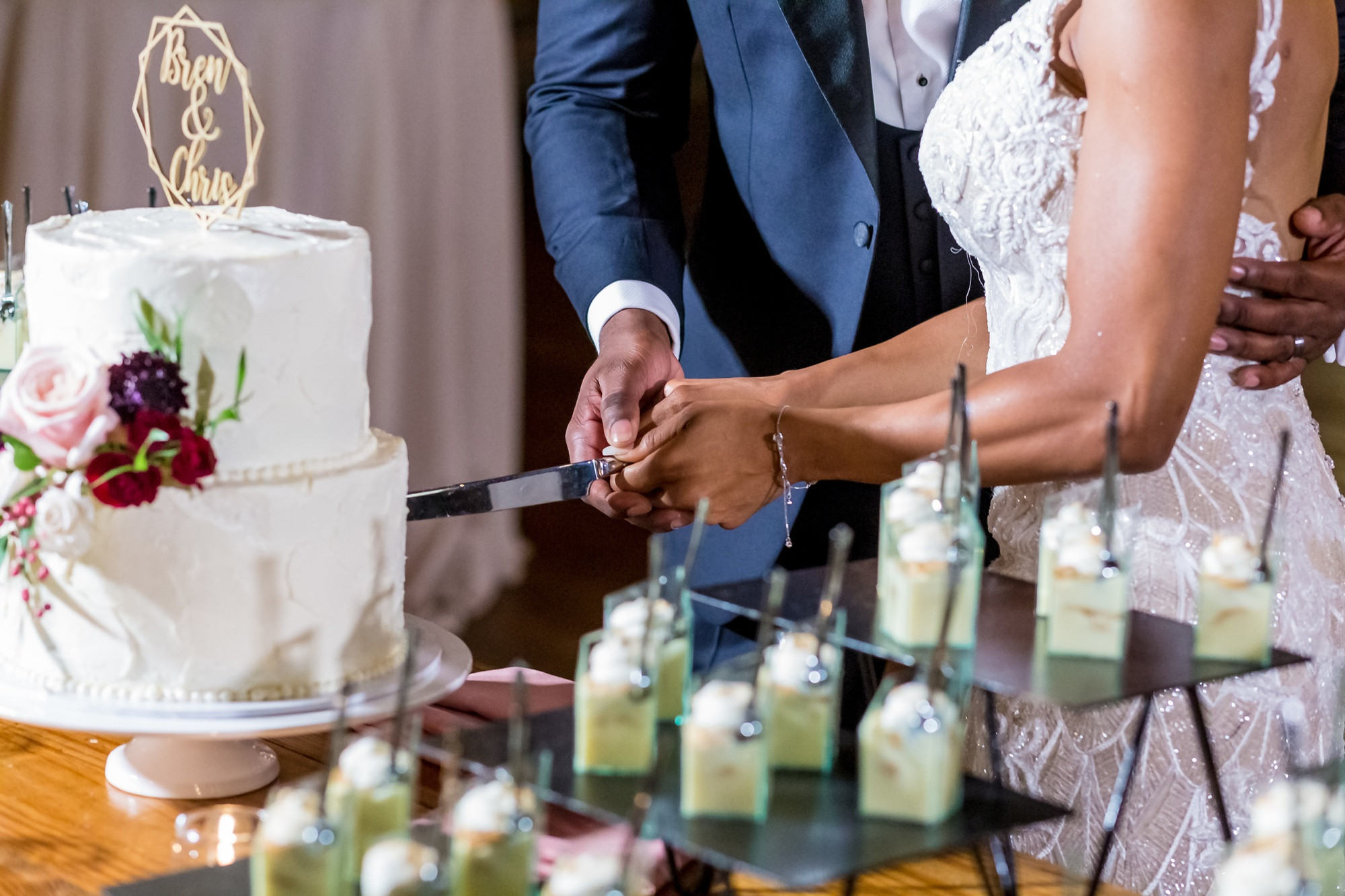
If you ask anyone who attended my wedding what they remember about it, they will not mention the venue, even though it had chandeliers like inverted crystal waterfalls and cost more than my first two cars combined. They will not mention the string quartet, or the centerpieces, or the way the late afternoon light turned the reception hall windows rose-gold at exactly the right moment.
They will tell you about my sister.
Specifically, they will tell you about the moment Madison stood up in her emerald bridesmaid dress, raised her champagne flute, and announced to two hundred guests that she was pregnant with my husband’s child. And then, if they are telling the story the way it deserves to be told, they will tell you what happened next.
But the night didn’t start with the scandal. It started with hope, the way most important nights do.
My name is Olivia Peterson, and I had been planning my wedding for fourteen months with the particular intensity of a woman who knows that the details matter and that no one else will care about them as much as she does. I had pinned things to inspiration boards at two in the morning. I had tasted seventeen varieties of cake frosting. I had changed my mind about the napkins three times, finally landing on ivory, which is not the same as champagne no matter what the venue coordinator tries to tell you.
When I stepped into that reception hall for the first time as Mrs. Peterson, my gown brushing the polished marble floor, Daniel’s fingers laced through mine, I felt something settle inside me that had been vibrating with tension for months. Not just the wedding tension, though there was plenty of that. Something deeper, older.
The room stood and cheered. My grandmother did her little shimmy, the one she reserved for weddings and bingo wins. Cameras flashed from every direction, strangers and cousins and my college roommate Jen who had already announced she was going to document everything on her phone.
Daniel squeezed my hand as we reached the head table, leaning close. “We made it,” he whispered, and I heard the weight he put into those three words, because we both knew they meant more than the obvious thing.
“We did,” I said back.
From my seat I could see the whole room laid out like a painting. My parents near the front, my father in his navy suit sitting exactly as upright as he always did, my mother already flushed with wine and sentiment. My cousins in the back, laughing too loud the way they always did. A table of children in their miniature formalwear, apparently conducting secret negotiations about the cake situation.
And Madison.
My sister sat just to my left at the head table, in a dress the precise shade of polished envy. Emerald, technically, but I had my own reading of that color by then. Her dark hair was pinned in a sleek chignon. Her lipstick was the aggressive red she wore when she wanted people to look at her, which was always, but especially tonight.
Madison was beautiful in the way that stops a room, with our mother’s cheekbones and a kind of deliberate glamour that made her feel like a main character wherever she went. Growing up alongside her, I had always felt softer by comparison, more approximate, as though someone had sketched me out while Madison had been rendered in high definition. People would stand in front of us and say things like “you’re both so pretty,” meaning it as a compliment and not realizing they were also delivering a ranking.
She had always needed to be the best. Not just to win, but to win against me specifically. Grades, friends, attention, relationships. It was never enough that she had something good; she needed mine to be lesser. Over the years I had watched her flirt with boys I liked in high school, undermine friendships, insert herself into moments that were supposed to be mine. Each time, I had told myself this was what sisters did, that underneath the competition there was love, that the core of it was unbreakable.
I kept believing that until she tried to break it on purpose.
The best man’s toast came first. Ethan, who had known Daniel since they were ten and had the easy, slightly rumpled warmth of a lifelong best friend, told a story about a camping trip that ended with a raccoon stealing their food and Daniel attempting to defend the camp with a cast-iron pan. It was exactly the right kind of speech: warm, silly, genuinely fond. The room laughed in the open way people laugh when they are comfortable and happy and want to stay that way.
I was still smiling when Ethan sat down.
Madison stood.
We hadn’t planned a toast from her. She had already fulfilled her role in the ceremony, had stood beside me and fixed my train and held my bouquet and smiled beautifully for every photograph. There was no reason for her to stand now. She stood anyway, and she moved with the particular deliberateness of someone who has practiced their entrance.
“I have an announcement,” she said.
The room quieted in stages. The string quartet stopped mid-phrase. Silverware was set down. A laugh in the back of the room trailed away like a question that suddenly realized it had no answer.
I set my champagne flute down carefully. My fingers had gone cold against the glass.
Madison’s gaze swept the room the way she always swept a room she had decided belonged to her. She thrived on attention the way some people thrive on sunlight, and there was something in her expression right then, a kind of illuminated certainty, that made the cold in my fingers spread up into my arms.
“As most of you know,” she began, her smile wide and warm and perfectly constructed, “Olivia and I have shared everything over the years. Clothes, secrets, even crushes in high school.”
A ripple of laughter moved through the room. Nervous laughter. The kind that surfaces when people can sense an edge beneath the words but would prefer to believe they imagined it.
At the family table, I saw my mother’s shoulders go rigid. My father stared at Madison with an expression I had never seen on his face before.
Madison lifted her glass toward the chandeliers, letting the light hit the bubbles. “So it only seems fair,” she said, “that I share this moment too.”
She paused, letting the silence stretch. She had always known exactly how long to hold a pause. It was one of the things she was genuinely gifted at.
“I’m pregnant.”
The room reacted in a way that only rooms full of people receiving unexpected news can react, a cascade of different responses colliding into a chaotic muddle. Delighted gasps from people who respond to the word “pregnant” with automatic joy. A stifled sob from my Aunt Helen, who cried at anything that gestured toward new life. A confused clap from somewhere near the back that stopped abruptly, unsupported.
My heart was hammering, but not for the reason anyone in that room imagined.
I watched Madison’s face. I watched the very small, very deliberate shift in her smile, the way satisfaction moved beneath the surface of the sweetness like something swimming under ice.
“By the groom,” she said.
What followed was not the cinematic silence of dramatic movies. It was more physical than that, more bodily. It was the sound of every comfortable assumption in the room being simultaneously knocked loose. Forks hovered. Ice settled in glasses. Somewhere, cutlery clattered against a plate. My mother’s wine glass tipped from her hand and shattered on the floor. My father’s face went white in the way I had only ever seen in the faces of people receiving devastating medical news.
Two hundred people swung their attention between Madison, me, and Daniel, like spectators at a match they hadn’t expected to find themselves inside.
Madison stood with her chin elevated, her gaze on me, waiting. She wanted to see me fracture. She had built this moment specifically to fracture me, in front of every person who loved me, on the one day of my life I had spent fourteen months trying to make perfect. She wanted the humiliation to be so complete, so public, so irrevocable, that there would be no coming back from it.
It would have been the performance of her life.
Except that I had known this was coming for six months.
Beside me, Daniel had not moved. His hand was still wrapped around mine, steady as the first night he had come to me with his phone in his hand and his face drawn with worry and said, “Liv, I think we have a problem.”
He took a breath beside me now. He sat up straighter. And then, into the silence Madison had constructed so carefully, he laughed.
It was not a guilty laugh. Not the broken sound of a man caught. It was short and incredulous, the laugh of someone watching a card trick they already know the mechanics of.
“Finally,” he said, his voice carrying clearly across the hall. “The truth comes out.”
That was not what Madison had rehearsed. I watched the confusion move across her face, chasing the satisfaction away. She had anticipated guilt, or panic, or denial. She had not anticipated her target sitting perfectly still beside his wife, their hands still linked, looking faintly amused.
I slid my hand from Daniel’s and reached under the table. The small black remote was exactly where I had left it, muscle memory from the hours I had spent rehearsing this sequence. I had asked the venue coordinator three separate times about the AV system. I had been thorough.
I stood, smoothing an imaginary wrinkle from my dress, and let the silence go taut as a wire.
“You’re right, Madison,” I said. “The truth does deserve the spotlight.”
I pressed the button.
The projectors around the room flickered to life. The slideshow of childhood photos we had planned for dessert blinked away, replaced by a video frame. A timestamp in the corner read six months earlier. A location label below it: Madison’s apartment.
Her voice filled the reception hall, unmistakable.
“I’m not really pregnant,” she said, laughing, pacing her living room as she spoke on the phone, apparently unaware that the conversation was being captured. “But Olivia believes it. She’s so gullible.”
The room drew a collective breath that sounded like a wave pulling back from a shore.
At the head table, Madison’s champagne glass slipped from her fingers and struck the linen-covered surface, sloshing over the rim. Her composure, so carefully maintained all evening, went the color of chalk.
“What is this?” she demanded, her voice jumping an octave from its earlier controlled warmth.
My cousin Marcus, six-foot-three and built like the linebacker he had once been, moved quietly into her path as she started toward the AV setup.
“Just stay where you are,” he said, in the tone of someone who means it.
On screen, Madison continued, oblivious to her future audience.
“The plan is simple,” she said, dropping onto her couch. “Get close to Daniel, fake the proof. A few texts, some pictures. Public humiliation. Olivia got engaged first. It’s only fair.”
The word fair landed in the room like something dropped from a great height.
A faint voice from the other end of her phone call asked what would happen if Daniel refused to cooperate.
“He won’t,” Madison replied, with the breezy certainty of someone who has never been wrong in her own estimation. “Be nice, play helpless, and men usually go along with it. That’ll be enough to make it look real.”
A murmur ran through the hall. Genuine shock. Whispers that were appalled rather than merely surprised. My Aunt Helen, who had wept at the pregnancy announcement two minutes earlier, made a sound that was emphatically not a happy sob.
I clicked the remote.
The video cut to a second clip. Madison at a dim bar, leaning over a cocktail, her manicured nails tapping against the glass. The timestamp placed this two weeks after the first recording.
“Phase two is in motion,” she told the women clustered around her, her eyes bright with a kind of mean excitement that was very different from the face she had shown the room tonight. “Texting him, asking for help with things. Olivia’s too busy wedding planning to notice.”
“Aren’t you worried about karma?” one of her friends asked.
Madison shrugged. “Karma’s for people who wait around.”
I clicked again.
The screen filled with screenshots. Text messages between Madison and a contact saved as “Photo Guy.”
Madison: need realistic photos of me with my sister’s fiancé in compromising positions.
Photo Guy: $500 for basic package. $1,000 for pregnancy test photos and ultrasound mock-ups.
Madison: deal. sending photos now.
What followed were photographs taken at family gatherings, holidays, backyard barbecues. Joel at the outdoor table reaching for a platter, his arm near Madison in the frame. A group selfie from Christmas, carefully cropped to isolate bodies near each other, stripped of their original context. Raw material for manipulation.
I could feel people looking at Daniel now, trying to reconcile the man sitting quietly beside me with the accusation that had been leveled at him ninety seconds ago. He sat with his jaw set and his eyes clear and did not flinch. That helped.
“We can continue,” I said, to no one in particular and everyone in general, my voice steadier than I had dared hope it would be. “There’s more. The fake pregnancy test purchased online. The pillow worn under tight dresses to run into family friends at the right moments. The acting coach hired to work on convincing crying for tonight.”
Madison’s mouth opened and closed.
I clicked to the final video.
This one was grainier than the others, the angle slightly off, the audio a touch less crisp. It had been filmed from a hidden camera tucked into the centerpiece of a restaurant table. The timestamp said last week.
On screen, Madison sat across from a man who was carefully forgettable: medium build, brown hair, unremarkable features assembled in the most average possible configuration. The kind of man who would not be closely examined in a moment of chaos. The kind of man who, in dim lighting and confusion, might pass for someone else for the few crucial minutes required.
She pushed an envelope across the table toward him.
“Here’s half,” she said. “You’ll get the rest after.”
“Just to be clear,” the man replied, his voice carrying an unease that his employer apparently found inconvenient. “You want me to pretend to be Daniel. Claim the baby’s mine. Cause a scene.”
“Exactly.” Her tone was breezy. Almost bored. “Olivia’s never met you. In the chaos, no one will notice you’re not actually the groom until it’s too late.”
The man shifted in his seat. “Lady, this is seriously messed up. Are you sure you want to do this to your own sister?”
On screen, Madison’s face changed. The performance dropped entirely. What showed through was something I recognized from our childhood, from the moments she had thought no one was watching: the raw, corrosive version of her. The one that had nothing pleasant in it.
“I don’t just want to destroy her wedding,” she said. “I want to destroy her. Everything she has. Everything she is. She thinks she’s better than me with her perfect relationship and her stupid happiness. We’ll see who’s happy after tonight.”
I paused the video.
The silence in the hall had a physical quality, something you could press against. I turned to Daniel. He reached up and removed the small microphone concealed in his boutonniere, holding it up briefly so the room could see.
“When Madison first started texting me six months ago,” he said, his voice even, “I thought it was innocent. Then the messages changed. They became flirtier. More inappropriate.” He looked directly at Madison, who had gone so still she might have been painted there. “I showed every single one of those messages to Olivia the day I received them. Every one.”
He glanced at me, a glance that contained the whole of the past six months.
“We could have confronted her immediately. But we know Madison. She would have denied it, reframed it, cried until the whole thing turned around and Olivia was somehow the villain for doubting her own sister. So instead,” he said, “we documented.”
I had not been ready for this, not the first time. The night Daniel slid his phone across our kitchen table and said, “Read this,” I had spent the first thirty seconds looking for a way to interpret it innocently. His texts from Madison about small, harmless things: a car repair, a headache, casual conversation that had gradually tilted in a direction I did not want to name.
“Maybe she’s just lonely,” I had said.
“Maybe,” he had said. “But I wanted you to see it.”
What came after was not maybe. The messages escalated. Late-night texts about how different her life might be if she had met someone like him first. Screenshots of positive pregnancy tests sent with winking emojis. And then the morning at my parents’ house when Madison sat across from me at the kitchen table, stirring sugar into her coffee with unnecessary force, and said she might be pregnant, watching my face when she added, “Just someone you know.”
Something had gone cold in me that morning that had not fully thawed since.
A private investigator named Carl had been my idea, which had felt absurd until it didn’t. He was a quiet man with a face you would forget thirty seconds after seeing it, and he was extraordinarily good at his job. He listened to our story, took copies of the messages, and said, “This is going to get ugly. Are you sure you want to see it through?”
I had thought about all the small things before this: the boys she had flirted with in high school while watching me from the corner of her eye, the friendships she had seeded doubt into, the way she had taken every category of comparison between us and made it sharper, more pointed, until I had spent years apologizing internally for things I had not done wrong.
“This is my wedding,” I had said. “My marriage. Yes.”
Carl had followed Madison. He had documented the fake pregnancy props, the pillow she wore under her clothes when running into family friends in a performance designed to be reported back to us, the online orders for positive test kits and manufactured ultrasound images. Our lawyer, Janet, a woman roughly my age with a precise manner and a wardrobe of excellent suits, had reviewed the evidence as it accumulated and told us that if Madison followed through on what we were seeing, she would be committing multiple crimes, including fraud, identity theft, harassment, and conspiracy.
“Do we cancel?” I had asked. “Postpone? Do we confront her privately and keep this inside the family?”
Janet had looked at me across the pile of printouts and said, “What do you care about more: justice, or revenge?”
“Is there a difference?” I had asked.
She had smiled, not unkindly. “That’s for you to decide. But if she does this at your wedding, in front of witnesses, with law enforcement already briefed and the evidence ready to present, she will have done it entirely to herself. You won’t have manufactured a thing.”
What decided me in the end was not justice or revenge. It was refusal. I refused to let Madison take my wedding day away from me even by forcing me to cancel it. She had already taken enough. If she wanted to walk onto a stage she had built, I would let her, and I would make sure the lights were pointed in the right direction when she did.
The officers who had been waiting outside the reception hall entered quietly from the back of the room as I addressed the remaining charges to the assembled guests, hearing myself from a strange distance, my voice calm and almost conversational as I listed the legal categories of what Madison had done.
“Entrapment!” Madison’s voice broke on the word. “You set me up. This is entrapment.”
“Entrapment,” Janet said from table twelve, rising just enough to be clearly visible, “requires law enforcement to induce someone to commit a crime they would not otherwise have committed. No one asked you to do any of this, Madison. It was all your idea, your planning, your money. They simply documented.”
The officers reached the head table. The guests parted for them without being asked. My cousin Marcus stepped quietly aside. Madison’s eyes went to our parents, doing what they had always done when she was caught, reaching for the shelter that had always been available.
My mother was crying. My father had the look of a man seeing something clearly for the first time that he had been declining to see for many years.
“Mama,” Madison said, her voice cracking, the performance splintering beneath the pressure of what was actually happening. “Daddy. Tell them to stop. You can’t let them do this.”
“You tried to destroy your sister’s marriage,” my mother whispered, her voice barely carrying, her eyeliner in ruins. “Her wedding. Her happiness. For what, Madison? What was the point?”
“She stole everything from me!” The words came out raw, stripped of the polish, the real thing finally surfacing. “Everyone always loved her more. She got the good grades and the friends and the husband and she just gets everything, she always gets everything, and I—”
“I worked for those things,” I said, and my voice surprised me with its steadiness. “I treated people with kindness. I didn’t destroy anyone who had the nerve to be happy in front of me.”
It was not the time for eighteen years of accumulated family reckoning. But the truth did not check the time before it arrived.
My father’s shoulders dropped. He looked at Madison in the way parents look at their children when they finally, unavoidably, see them clearly. “I don’t recognize you right now,” he said quietly. It was the saddest thing he said all evening, and it was the truest.
The officer nearest to Madison spoke in a low voice. Madison pulled away, but there was nowhere to go. Chandeliers above. Two hundred witnesses around. A cake in the corner that a table of sugar-addled children had been conspiring toward all evening.
“You’ll regret this,” she said, looking at me. “I’m your sister.”
The word had a hollow quality, like something tapped and found empty inside.
“No,” I said. “You’re someone who happens to share my DNA. Family doesn’t try to destroy family.”
They led her toward the doors, past the stunned guests, past the plates of half-eaten salmon, her heels catching slightly on the polished floor, the emerald skirt of her dress swishing around her ankles in what should have been a dramatic exit and was instead simply a conclusion.
The doors closed behind her.
The hall was silent for a count of five, maybe six. Then from the front table, my eighty-year-old grandmother rose slowly from her chair, lifted her champagne glass in a hand that was slightly unsteady with age and not at all unsteady with purpose, and cleared her throat.
“Well,” she announced to the room, her voice carrying the full authority of a woman who has outlasted most of her problems. “That was considerably better than cable.”
The nervous laughter that broke loose was followed almost immediately by something warmer. My Uncle Tony started clapping, and others joined until the sound filled the vaulted ceiling of the reception hall with something that sounded very much like relief.
“I paid good money for this dress,” my grandmother continued, settling back into her chair with the satisfaction of someone who has made her point, “and I have no intention of leaving before the cake.”
The bandleader, who had been standing at his microphone with his mouth slightly open for the past several minutes, seemed to locate himself again. “Ladies and gentlemen,” he said, a grin spreading across his face with the air of a man who knows he is witnessing something he will tell people about for the rest of his career, “I have played a lot of weddings. But I have never seen anything quite like what I just witnessed. Please raise a glass to the happy couple, who have demonstrated tonight that honesty, trust, and a very good private investigator are the actual foundations of a successful marriage.”
The laughter came easier this time.
Daniel stood and pulled me onto the dance floor for the song we had chosen months ago, when the only problem in my life had been the napkin question. As he pulled me close and we began to move, the rest of the room blurred at the edges.
For the first time all evening, I felt something other than adrenaline. Relief. Gratitude. And underneath those, quieter and more complicated, grief. Not for Madison as she was now, but for the version of a sister I had spent so many years hoping she might someday become. The grief for an illusion is real grief, even when you are glad the illusion is gone.
“You okay?” Daniel murmured into my hair.
“No,” I said. “But I will be.”
“You were extraordinary tonight.”
“We were,” I said, and I meant it. He had chosen me, transparently and completely, from the very first message she sent. That was the thing I would keep.
The rest of the evening unfolded in the way of evenings that have been through something and come out the other side: a little looser, more real, with the kind of warmth that surfaces when people have survived something together and are relieved to find themselves still standing.
Aunt Helen hugged me so hard she displaced the pins in my hair. Uncle Tommy, who had clapped reflexively at the pregnancy announcement, came to find Daniel with the expression of a man who needs to explain himself. “Births, weddings, funerals,” he said. “I just clap at all of them. I can’t help it.” Daniel told him it was fine, and it was.
My mother found me between dances, her lipstick worn away to a faint stain, her eyes swollen. She took my hands and said she was sorry, and that she should have seen it coming, and that she was sorry again. I told her we would talk properly later, that tonight I just wanted to be married. She nodded and retreated to her seat. My father cleared his throat and said I had done what I had to do. It was the closest to an apology I had ever heard from him, and I accepted it.
Madison, released on bail considerably faster than I would have expected, posted on social media from what I assumed was a car in a parking lot somewhere. A black-and-white photograph of herself, expression mournful, one hand resting protectively over the flat plane of her stomach. Family betrayal cuts deepest. The real victim is here.
I took a screenshot, forwarded it to Janet with the words for the file, and turned my phone off for the first time in months without feeling the pull to keep checking it.
In the limo afterward, the doors closing behind us and sealing out the light and noise, Daniel loosened his tie and exhaled, and we looked at each other in the quiet, and then we started to laugh. The real kind, the uncontrolled kind, the kind that comes from the sheer absurdity of having survived something you still cannot quite believe actually happened.
“My sister got arrested at our wedding,” I said, when I could breathe again.
“You are going to have the single best answer to ‘how was the wedding?’ for the rest of your life,” he replied.
When the laughter settled, I reached into my bag and pulled out my phone one last time. Then I told him about the honeymoon.
I had changed the booking a month earlier, quietly, without telling anyone. We were not going where I had originally announced. We were going to the resort Madison had been posting about on social media for three years, the one she had curated on her Pinterest boards, the one she saved pictures of and tagged with someday and goals and the kind of aspirational longing she displayed publicly to build a particular image of herself.
I had booked the best suite they had. An hour before the ceremony, I had posted the confirmation publicly on Instagram, tagging the resort.
Daniel stared at me.
“You didn’t,” he said.
“I did,” I said.
He laughed so hard the driver glanced at us in the rearview mirror.
“Remind me,” he said, when he could speak, “to never genuinely upset you.”
“Deal,” I said. “Be good and we’ll have a perfectly lovely honeymoon.”
The city moved past the windows outside, lights blurring gold and red against the dark. I leaned into Daniel’s side and watched them go.
Madison had spent six months constructing something she believed was foolproof. She had planned carefully, enlisted strangers, rehearsed her moment. She had never imagined that every step she took toward my destruction was also a step illuminated by a light she didn’t know was following her. That was the particular vulnerability of elaborate schemes: they were fragile. One hard truth, delivered at the right moment, and they came apart like paper in water.
People ask me sometimes whether I regret how I handled it. Whether I wish I had chosen the quieter path, cancelled the wedding, kept it private, protected the family from the exposure.
I think about Daniel coming to me with his phone the first night, saying I want you to see this, I don’t want there to be anything between us you don’t know. I think about my grandmother standing up with her champagne glass and the room beginning to breathe again. I think about my parents, finally without the option of pretending that Madison’s behavior was just Madison being Madison, something to smooth over and excuse and contain.
Then I think about the envelope sliding across the restaurant table. I want to destroy her.
I don’t regret it.
There were court dates after the wedding, and lawyers’ offices, and one restraining order when the late-night messages to my phone crossed from melodramatic into threatening territory. There were family dinners so strained they required the conversational equivalent of structural supports. There were therapy sessions where I worked through what it means to love someone and finally accept that love is not the same as unlimited tolerance, that caring about a person does not obligate you to absorb their cruelty indefinitely.
But that is a different chapter.
This one is the one people always ask for. The one that has become the story told at every subsequent family gathering, the one my grandmother ends the same way every time, lifting her glass with those slightly unsteady hands and those very steady eyes.
“In the end,” she says, “the right person walked out of that hall in handcuffs. And that’s what matters.”
And I sit beside my husband with my fingers laced through his and I think she’s right, but not quite complete. Because what mattered most was not who walked out in handcuffs.
It was who walked out together.

Specialty: Legal & Financial Drama
Michael Carter covers stories where money, power, and personal history collide. His writing often explores courtroom battles, business conflicts, and the subtle strategies people use when pushed into a corner. He focuses on grounded, realistic storytelling with attention to detail and believable motivations.