The Cola and the Consequences
The dinner was at Sergei’s apartment, and I knew from the moment I walked through the door that something was off.
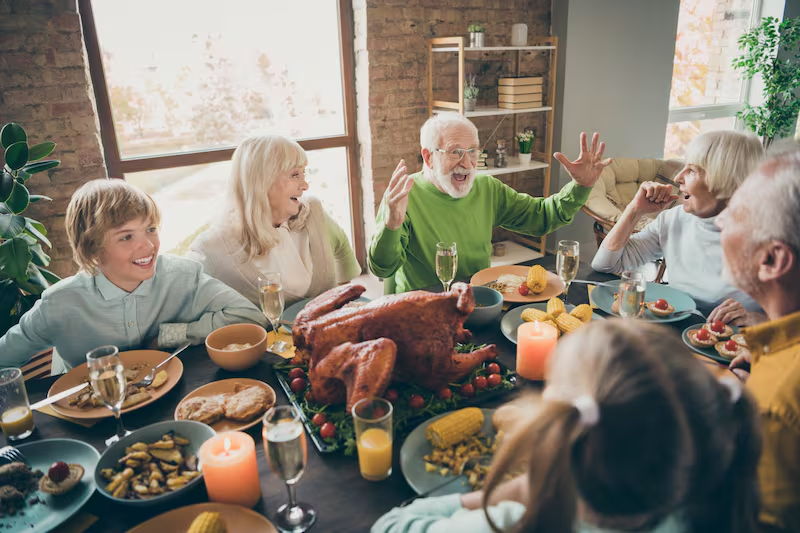
It was our grandmother’s birthday. The table was full — relatives I saw twice a year, neighbors who’d somehow become regulars at family events, my brother’s friends who always seemed more comfortable in his home than I did. I found my seat, poured myself a glass of water, and told myself to get through the evening.
Ilya was twelve. He’d always been a difficult kid — not in the way children are difficult when they’re testing limits, but in the way children are difficult when no one has ever installed any. He watched people the way certain animals watch other animals, calculating distance and vulnerability.
He approached me from the side of the table, moving slowly, deliberately, holding a bottle of cola.
He stopped beside my chair.
He looked me directly in the eyes.
Then he tilted the bottle and poured it onto my lap.
The dark liquid spread fast — cold, sticky, immediate. It soaked through my skirt in seconds, pressed against my skin, ran down to the backs of my knees. That particular sensation of cold wet fabric is difficult to describe if you haven’t felt it in public, in a room full of people who are supposed to love you. It’s physical, but it’s also something else.
“You don’t belong here,” Ilya said. Loud enough for everyone to hear. “Grandma says so.”
One second of silence.
Then laughter.
Not nervous laughter, not the uncomfortable kind that fills a room because no one knows what else to do. Real laughter — rolling, delighted, almost relieved, as if this was the entertainment everyone had been waiting for.
Someone snorted. Someone clapped.
Larisa leaned back in her chair with the ease of a woman who is very comfortable. “He just says what he thinks,” she told the woman beside her. “Kids today, no filter.” She was smiling.
Sergei glanced at me briefly — one glance, the kind you give a TV screen when something mildly amusing happens — and then he was talking to someone else.
I looked down at my lap.
I reached for the paper napkins on the table and pressed them carefully against the fabric. Slowly. Without making a face. The laughter continued around me, louder now, as if my composure was the funniest part — as if calmness in the face of humiliation was itself a joke.
I understand now what was happening in that room. They had done this before, in smaller ways, over years. Little moments where I was made to feel outside the circle. Little tests to see how much I would absorb before I reacted. And my silence had always been interpreted as permission. As evidence that I could be handled this way, that I would straighten my back and pretend it was fine because that was what I did.
What they didn’t understand — what no one at that table understood — was that I had been quiet for years because I was choosing my ground. Not because I had none.
I waited for a natural pause in the noise. Then I put on a calm smile, said I needed to leave, apologized as if nothing significant had occurred, and walked out.
I drove home.
I changed my skirt.
I opened my laptop.
Three years earlier, Sergei had come to me with a problem.
He needed a credit line for his business — a vehicle import operation he’d been running with a partner. The bank required a personal guarantor. His credit history was complicated. His partner’s was worse.
He came to me because I was the responsible one. The one with the good credit history, the stable income, the clean record. He asked if I would put my name on the guarantee.
I said yes. Because he was my brother. Because family is supposed to help family.
The credit line was substantial. The kind that keeps a business running — vehicles, logistics, fuel, maintenance. Without it, the operation didn’t function.
I had never once asked him for anything in return.
That evening, sitting at my kitchen table with my laptop open and the taste of a family dinner I’d left early still in my mouth, I thought about the word guarantee. What it means to put your name on something. What it means to stake your credibility on someone else’s choices.
I logged into my account.
I withdrew the guarantee.
It took less than four minutes.
Then I closed the laptop, made tea, and went to bed.
The tow truck arrived at Sergei’s apartment building the next morning.
I wasn’t there to see it. I heard about it later, in pieces, from several frantic phone calls. The car was the collateral — the moment the guarantee was removed, the bank’s automated processes began, and the vehicle that served as security on the credit line was reclaimed.
Sergei stood in the yard holding his phone, unable to reach me, unable to reach the bank, unable to understand how the solid ground of the previous evening had dissolved overnight.
That was the first call I didn’t answer.
I want to be clear about the second thing I did, because it requires more explanation.
Ilya was eighteen. Not twelve — I may have thought of him as the child he’d always been in my memory, but he was a legal adult who had made a deliberate choice to humiliate me in front of forty people while his mother smiled and his uncle looked away.
He had a military deferment.
In our country, a deferment can be obtained through documentation of medical conditions. I had known for some time — not from any official source, but from family conversations, the kind that happen at dinners and on phone calls — that Ilya’s deferment documentation had been processed with certain assistance. That the condition documented may not have been entirely accurate.
I want to be precise about what I did: I called the military office. I gave my name. I said that I wanted to flag some information for review — that based on my personal knowledge of my nephew, he appeared to be in good health, and that it might be worth reviewing whether his deferment documentation accurately reflected his medical status.
I did not fabricate anything. I did not file a false report. I stated what I observed and suggested a review. What the office did with that information was their process, not mine.
But I knew what a review would likely find.
And I knew what the consequences of that finding would be.
The calls started that evening.
Larisa first. Her voice was completely different from the woman who had leaned back in her chair and smiled — trembling now, words running together, desperate in the particular way of someone who has realized the floor is not as solid as they believed.
“It was a joke,” she kept saying. “You misunderstood. He’s a boy, he says stupid things, kids are like that—”
I listened. I didn’t argue with any of it.
Then Sergei. He didn’t start with apologies — he started with accusations. I was being dramatic. I was ruining his livelihood over nothing. You don’t destroy a man’s business because a kid spills a drink. That’s not proportional.
I let him say all of it.
Eventually he shifted to begging. His voice cracked at the edges. He said I would ruin his son’s life. He said you can’t do this to family.
I thought about the paper napkins. The way I had pressed them carefully against my skirt while forty people laughed. The way my brother had glanced at me once and looked away.
Then my grandmother called.
She was the one I had come to celebrate. The woman whose birthday had provided the occasion for this particular evening. She was crying — not the strategic tears of the others, but genuinely distressed, the kind of crying that comes from someone who has lived long enough to understand that some damage doesn’t repair.
“I never meant for it to go this far,” she said. “The boy just said too much. You have to fix it, you have to call them back, please—”
I sat with the phone against my ear and listened to my grandmother cry and thought about what she had said at the dinner. What Ilya had said she said.
You don’t belong here. Grandma says so.
I didn’t know if she had said it in those words. Maybe she had. Maybe Ilya had overheard a comment and weaponized it, the way children do when adults are careless with what they say in front of them. Maybe she had never said it and he invented it entirely, knowing he would face no consequences either way.
What I knew was that when the cola poured and the room laughed, she had not stopped it. She had not said his name sharply. She had not looked at me with apology.
She had been silent in the way my family had always been silent about the things done to me — the comfortable silence of people who benefit from the arrangement.
Last came Larisa again, later that evening.
Her tone had shifted from trembling to something harder — not quite negotiating, but testing. Finding the edge.
“Tell us what you want,” she said. “We’ll do anything. He’ll apologize, we’ll make him apologize properly, whatever you need, just tell us and we’ll do it.”
I understood what she was doing. She was looking for the price. She had spent the day afraid, and now she wanted to know the number she could pay to return to the world as it had been that morning.
The world as it had been that morning was one where she smiled when her son poured a drink on a woman’s lap. Where the family laughed. Where no one said stop.
That world had a cost, it turned out.
She just hadn’t known she was accumulating the debt.
“I’ve already seen what you’re capable of,” I said. “There’s nothing left to fix.”
I’ve thought about that sentence in the days since.
Some people hear it as cold. Final. Disproportionate — a nuclear response to a childish act.
What those people don’t understand is that the cola was not the thing.
The cola was the clearest possible expression of something that had been building for years. Every holiday where I was the one who had to adjust. Every conversation where my discomfort was described as sensitivity. Every moment where something unkind was done in front of witnesses and everyone decided, collectively, not to notice.
Ilya poured the drink because he had been taught that he could. Because he had watched his mother smile at small cruelties and absorbed it as permission. Because he had observed that I would absorb it quietly and that nothing would follow.
He was wrong about the last part.
I don’t know exactly what will happen to my brother’s business. The guarantee was the foundation of his credit line, and without it, the structure is uncertain. He has options — other guarantors, renegotiation, restructuring. I didn’t destroy anything he can’t potentially rebuild.
I know what will happen with Ilya’s deferment review because I know how these reviews work. I know that if the documentation doesn’t hold up, he will face the standard process that every other young man in the country faces. He will not be singled out for special treatment — he will simply lose the special treatment he had.
Which is perhaps the most honest thing I can say about all of it.
He wanted me to feel that I didn’t belong. That I had no standing. That the rules that applied to other people didn’t apply to him.
I wanted him to understand what it feels like to lose a protection you assumed was permanent.
I’m not proud of every element of what I did. I sat with it for a long time. I thought about my grandmother’s voice on the phone, genuinely distressed. I thought about the distance between the twelve-year-old I remembered and the eighteen-year-old who made a choice in front of forty people.
But I keep coming back to the room. To the forty people. To the laughter.
To my brother’s single glance and his smile.
Some lessons are only learned one way. Not because the teacher is cruel — but because nothing gentler has ever worked.
I changed my number that weekend. Not completely dark, not disappeared — but a clean break. A new number for the people who deserved to have it.
My grandmother doesn’t have it yet.
Maybe someday.
When I’ve seen what she’s capable of — the better version, the one that stops the room instead of sitting quietly in it — I’ll consider giving it to her.
For now, I am done being the person who absorbs what others pour out and calls it family.
Some things, once you see them clearly, you cannot choose to unsee.
I saw my family clearly on that evening.
And I made my choices accordingly.

Specialty: Quiet Comebacks & Personal Justice
David Reynolds focuses on stories where underestimated individuals regain control of their lives. His writing centers on measured decisions rather than dramatic outbursts — emphasizing preparation, patience, and the long game. His characters don’t shout; they act.
Enjoyed all of the post that I have read by Mr. Reynolds.