The Cookies
The first time Emma didn’t finish her breakfast, I blamed the math test. She was ten years old, anxious about fractions, and kids lose their appetites over smaller things than long division. I fixed her collar, kissed her forehead, and told her she’d be fine because she’d practiced for an hour the night before and knew the material cold. She gave me a small, unconvincing smile and climbed onto the stool at the kitchen island, and I poured her milk and moved on with the morning because that’s what mothers do. We triage. We assess, reassure, and file the worry away for later.
I should have paid more attention. A pediatric nurse of fourteen years should have known better than to dismiss a symptom just because the patient was her own child.
My name is Sarah Johnson. I was thirty-seven, working the pediatric ward at St. Mary’s Hospital in Seattle, married to Michael Johnson, a senior sales executive who had been my husband for twelve years and a stranger for the last six months. And Emma—golden curls, blue eyes, a laugh that could fill a room—was the center of everything I had left.
Michael had changed gradually, the way a photograph fades when you leave it in sunlight. You don’t notice the color draining until one day you pick it up and realize the image is barely there. He used to spend hours in the backyard playing catch with Emma. Saturdays were strictly family days—movies, picnics at the lake, the three of us sprawled on a blanket while Emma read aloud from whatever book she was devouring that week. He was the kind of father who showed up. Who remembered. Who once drove forty-five minutes in a rainstorm to retrieve a stuffed rabbit Emma had left at a restaurant because she couldn’t sleep without it.
Then the showing up stopped. His work hours stretched past dinner, past bedtime, past the point where Emma stopped asking when he’d be home because the answer was always the same: late. His phone buzzed constantly with what he called urgent client issues, even during Sunday meals. He left before sunrise and returned after Emma was asleep, and somewhere in the accumulation of absences, the man I’d married was replaced by someone who moved through our house like a tenant fulfilling the minimum terms of a lease.
I tried to be the supportive wife. I told myself his dedication was for our future—that the late nights and the missed school events and the Sunday dinners where his chair sat empty were the temporary cost of ambition. That’s the story I maintained for months, and I was good at it, because nurses are good at maintaining calm in the presence of deterioration. We smile at patients’ families and say the doctor will explain everything while knowing exactly what the doctor is going to say. We project reassurance as a professional skill. I applied that same skill to my marriage, and it worked, right up until the moment it didn’t.
“Has Daddy already left?” Emma asked that morning, scanning the empty hallway.
“He had an early meeting, sweetheart. But he promised he’ll be at your science presentation this afternoon.”
He wouldn’t be. I already knew that, the way you know a flight is going to be canceled before the airline announces it—something in the silence, in the absence of the confirmation text he would have sent if he’d actually intended to come. But I smiled for Emma because that was my job now: maintaining the architecture of a family that was quietly collapsing from the inside.
Over the next few weeks, I watched my daughter diminish. Not dramatically—not the way illness announces itself with fever and vomiting, the kind of sick I was trained to recognize and treat. This was subtler, and its subtlety was what made it so insidious.
Emma, who normally ate everything on her plate and asked for seconds, started pushing food around with her fork. She’d take two bites of toast and set it down, claiming she wasn’t hungry. She complained of headaches—dull, persistent ones that didn’t respond to children’s Tylenol and that she described, in the limited vocabulary of a ten-year-old, as feeling like “something heavy is sitting on my brain.” She was tired in a way that sleep didn’t fix, the kind of fatigue that sits behind the eyes and makes a child look like she’s watching the world from very far away.
At first I attributed it to what was happening between Michael and me. Children have an emotional radar far sharper than adults give them credit for. Emma was absorbing the tension the way a sponge absorbs water—silently, completely, until the weight of it changes everything about the shape.
But a nurse’s instinct doesn’t switch off because the patient is your own child. It nags. It whispers. It keeps a running tally of symptoms even when your conscious mind is busy constructing explanations. I made a list one night after Emma fell asleep: appetite loss (three weeks). Headaches (intermittent, two weeks). Fatigue (persistent, worsening). Pallor (new). Occasional nausea (new). I looked at the list and felt the gap between “stress-related” and “something else” widen just enough to be frightening.
I took her to Dr. Williams, the pediatrician who’d cared for her since infancy. He examined her carefully, ran a standard blood panel, and sat me down in his office afterward with the particular gentleness doctors use when they’re about to say something a parent doesn’t want to hear.
“The physical symptoms—appetite loss, lethargy, dizziness—can be manifestations of severe psychological stress,” he said. “Has there been any significant disruption in her home environment?”
I felt the guilt land like a stone in my chest. “My husband’s work has become very demanding. He’s rarely home. The family dynamic has shifted.”
“Children act as emotional sponges, Sarah. Especially sensitive ones like Emma. She’s likely internalizing the tension.”
I accepted that explanation because it made sense and because the alternative—that something else was wrong, something I couldn’t see—was too frightening to sit with. The blood work came back clean. No infections, no deficiencies. Dr. Williams advised observation. I observed. Emma continued to fade.
The calls from the school nurse became routine. Mrs. Johnson, Emma is dizzy again. She had to lie down during recess. I’d leave my shift early, pick her up, bring her home, make soup, sit with her on the couch while she leaned against me with the heavy, boneless weight of a child who doesn’t feel well and doesn’t know why.
One evening, she walked into the kitchen clutching her blanket and looked up at me with hollow eyes.
“Mom, am I the reason you and Dad are so angry at each other?”
I dropped the spoon I was holding and knelt in front of her. “No. Oh, Emma, absolutely not. You are the best part of our lives.”
“But you used to smile so much,” she whispered. “Now neither of you smile. The house feels so cold.”
I pulled her into my arms and held her, and while I was rocking her back and forth, trying to hold the pieces of our family together with nothing but the pressure of my own body, I made a decision. I was going to confront Michael. Not about the late nights or the phone that never stopped buzzing or the text message I’d seen on his lock screen weeks ago—Can’t wait for our next trip. Miss you—followed by a heart emoji from an unsaved number. I’d been filing those details away the way I filed Emma’s symptoms, cataloging evidence I wasn’t ready to act on. But Emma’s question—am I the reason—broke something in me. My daughter was disappearing, and I was letting it happen because I was afraid of what I’d find if I looked too closely at the cause.
That night, I confronted him. I told him Emma had been to the doctor, that her symptoms were stress-related, that Dr. Williams had specifically asked about our home environment.
“Home environment?” Michael said, finally looking up from his phone. “Nothing has changed. We have a nice house, food on the table. What is she stressed about?”
“She’s stressed because you’re a ghost, Michael. She’s lonely. She needs her father.”
“I am working to provide for this family. You’re a nurse—you handle the caretaking. I have my limits.”
He said it with such practiced detachment that I understood, standing there in our hallway, that I wasn’t arguing with a husband who was overworked. I was arguing with a man who had already left. The body was still showing up most nights, sleeping in our bed with his back turned to me, but the person I’d married had relocated to wherever he went when he said he was at the office on Saturday mornings in casual clothes, wherever the phone calls went when he stepped onto the porch to take them, wherever the heart emoji lived.
I didn’t press further. Not because I was weak, but because I was recalculating. Nurses triage. We assess, prioritize, and act. The emotional processing happens later.
The collapse happened on a Tuesday afternoon. I was at St. Mary’s, mid-shift, preparing an IV line in the pediatric ward, when my phone rang. The school nurse.
“Mrs. Johnson, Emma collapsed in the middle of her classroom. She’s conscious but her vitals are very weak. You need to get her to an emergency room immediately.”
My training overrode my panic. I handed my charts to the charge nurse, gave a breathless explanation, and ran for the parking garage. The drive to Madison Elementary was a blur of traffic lights and adrenaline. When I burst into the school clinic, Emma was lying on the examination cot, her skin translucent, her normally rosy cheeks the color of ash.
“Mom,” she whispered. Her voice was barely there.
“I’ve got you, baby. We’re going to my hospital right now.”
I wrapped her in a blanket and carried her to the car. She felt terrifyingly light—not the lightness of a small child but the lightness of something being hollowed out from the inside.
At St. Mary’s, my colleagues sprang into action with the focused urgency that comes from treating one of their own. Dr. Martinez, the lead emergency physician, took charge.
“Blood pressure dangerously low. Heart rate highly irregular. Push fluids and run a full toxicology and metabolic panel.”
Emma clutched my hand while the monitors beeped around us. “Mom, it hurts inside. I’m scared.”
“I’m right here. I’m not letting go.”
I called Michael from the corridor. Voicemail. I left a message that was more command than request: Emma has collapsed. St. Mary’s ER. Get here now. Then I stood against the wall with my phone pressed to my chest and felt the particular helplessness of a medical professional who can recite every protocol in the textbook and can’t do a single thing to help her own child.
An hour later, Dr. Martinez found me in the hallway. His face told me everything before he spoke.
“The rapid blood panel found abnormal enzymatic reactions. There are foreign substances in her bloodstream that should not be there.”
My medical mind spun through possibilities. “Accidental ingestion? A household cleaner?”
“No. The pattern suggests a highly dangerous, targeted toxin. Has Emma been eating or drinking anything unusual? Has she been anywhere out of the ordinary?”
“No. Just home, school, and the park.”
“Given the presence of a targeted toxic substance in a minor’s bloodstream,” Dr. Martinez said carefully, “hospital protocol requires that I contact the authorities.”
“The authorities?” I heard myself say the words from very far away. “Who would want to harm a ten-year-old?”
Michael arrived thirty minutes later, tie askew, face white. Dr. Martinez met us together.
“We’ve isolated the substance. It’s a refined arsenic-based compound. Today’s exposure wasn’t a singular lethal dose, but the chronic accumulation in her tissue proves she’s been ingesting it in small, calculated amounts over the past several weeks.”
Michael slumped against the wall. “Continuously? How?”
“That’s what we’re here to find out,” said a voice from down the hall.
Detective Brown was a sharp-eyed woman in a tailored coat who moved with the quiet authority of someone accustomed to entering rooms where the worst has already happened. She ushered us into a private family room.
“I need to know who has had access to Emma recently. Anyone outside her normal routine.”
“No one,” I said. “It’s just been us.”
She turned to Michael. “Mr. Johnson, does anyone in your professional life hold a grudge? Have you brought any new associates around your family?”
“No. Absolutely not.” His eyes darted toward the door. “My professional life is completely separate.”
A nurse knocked. “She’s conscious and asking for her parents.”
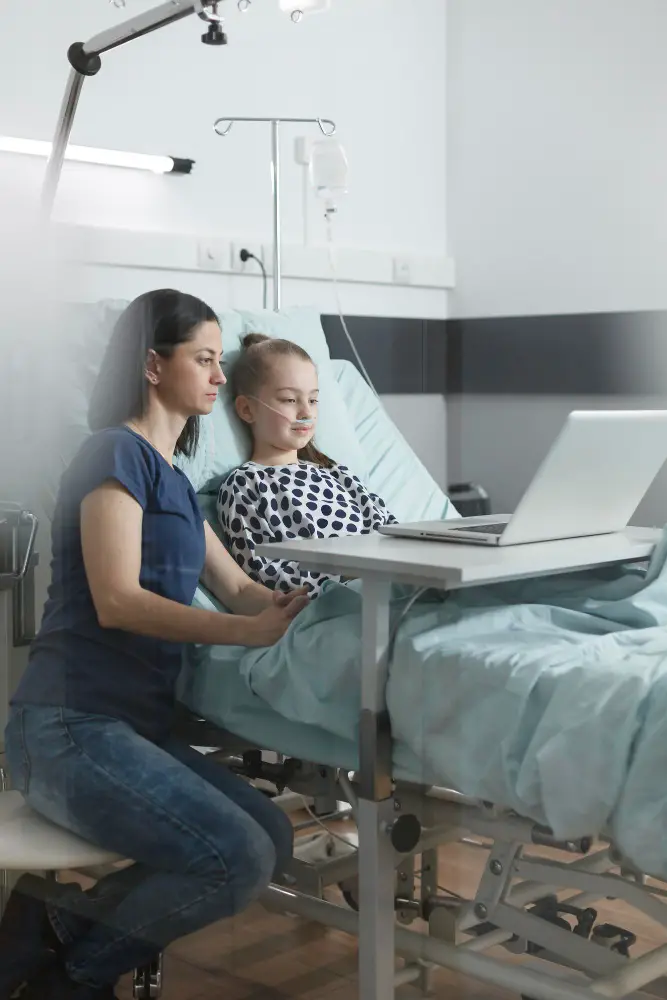
We rushed to the ICU. Emma lay exhausted under the fluorescent lights, oxygen tube under her nose, looking so small in the hospital bed that my chest physically ached. I leaned over, stroking her hair.
“Emma, my brave girl. The doctors need to know—did anyone give you anything strange to eat or drink recently?”
She blinked slowly, her medicated gaze drifting from me to Michael, who stood frozen at the foot of the bed.
“Just Dad’s friend,” Emma whispered. “The lady. She was really pretty. She always gave me those special sugar cookies when you guys hung out.”
The heart monitor beeped. The fluorescent lights hummed. The world continued to operate on its normal mechanical schedule while mine stopped completely.
I straightened up slowly and looked at my husband. “Michael. What lady?”
He took a step backward. His hands were shaking. His face was a confession before he said a word—the particular expression of a man who has been maintaining two realities and has just watched them collide.
“Emma,” Detective Brown said gently, stepping forward. “When did you see this lady?”
“Last Saturday at the park. And the weekend before that.”
Last Saturday. When Michael said he was at the office handling an emergency. I could feel the architecture of every lie he’d told me over the past six months rearranging itself into a structure I could finally see clearly—not a husband overwhelmed by work, but a husband maintaining a second life, and he’d brought my daughter into it.
“Who is she, Michael?”
“Her name is Jessica,” he said, his voice cracking. “Jessica Williams. She works in my division.”
I stared at the man I’d been married to for twelve years and felt something I hadn’t expected. Not rage—not yet. Clarity. The cold, diagnostic clarity of a nurse reading a chart and understanding, for the first time, the full scope of the illness.
“You’ve been having an affair, and you brought her around our child.”
“She loves kids,” Michael stammered. “She just wanted to meet Emma. She brought cookies. They were just cookies.”
“They were laced with a cumulative toxin, Mr. Johnson,” Detective Brown said, her voice stripped of sympathy. “I think you and I need to have a very detailed conversation at the precinct.”
Michael was escorted out by uniformed officers. I stayed with Emma through the night, holding her hand in the dim light of the ICU while Dr. Martinez ran the detoxification protocol, watching the numbers on the monitors slowly stabilize, and feeling the betrayal burn in my chest like something caustic—appropriate, I thought, given the circumstances.
At some point in the small hours, a nurse brought me coffee. I held it with both hands and stared at my daughter’s face—the golden curls against the white pillow, the oxygen tube, the IV line, the bruises on her arm where they’d drawn blood—and I thought about all the mornings I’d dismissed her symptoms. The half-eaten breakfasts. The headaches. The fatigue. I’d attributed it to stress, to the tension of a fracturing household, to the emotional sponge theory that Dr. Williams had offered and I’d accepted because it was easier than the truth.
The truth was that someone had been feeding my daughter poison, and the person who’d made it possible was the man who was supposed to protect her.
I went through the timeline in my head, mapping it against what I now knew. The cookies had started a few weeks ago—around the same time Michael’s “work emergencies” began falling on Saturdays. He’d been taking Emma to the park to meet Jessica, introducing his daughter to his mistress under the guise of a casual outing, and Jessica had brought homemade cookies every time. Sugar cookies. Emma loved sugar cookies. She would have eaten them eagerly, happily, trusting the way children trust when an adult they’ve been told is safe offers them something sweet.
Small doses. Calculated amounts. Weeks of accumulation. Jessica Williams hadn’t been trying to kill Emma in a single act. She’d been erasing her slowly, incrementally, in a way designed to look like a childhood illness—the kind of thing a pediatrician might chalk up to stress or growing pains or a persistent virus. The kind of thing a mother might watch with concern but not alarm, because the decline was so gradual it looked natural.
And it had almost worked. It had almost worked because I’d been so focused on holding my marriage together that I’d accepted a plausible explanation for my daughter’s suffering instead of interrogating the improbable one. That guilt—the specific, lacerating guilt of a medical professional who missed what was happening to her own child—would stay with me for years. Dr. Reeves, Emma’s therapist, would eventually become my therapist too, and she would tell me that guilt was not the same as responsibility, that I had done everything a reasonable person would have done with the information available. She was right. But in the dark of that ICU, holding my daughter’s hand while the antidote dripped through the IV, reasonable felt like a very thin defense.
Detective Brown returned the next afternoon. She asked to speak with me privately.
“We’ve taken Jessica Williams into custody. She’s facing severe felony charges for premeditated harm against a minor.”
“Why?” I asked. The word came out hollow. “Why would a woman I’ve never met want to destroy my child?”
“She developed a dangerous, obsessive fixation on your husband. According to the digital evidence we recovered—emails, journals, search history—she was enraged that Michael refused to leave his family. She formulated a plan to systematically remove the obstacles.”
“She thought eliminating Emma would make Michael leave me.”
Detective Brown paused. The pause was the kind professionals use when the next piece of information is worse than everything that came before it.
“That was phase one,” she said. “We found plans on her hard drive for phase two. She’d mapped out your daily route to the hospital. She was planning to stage a traffic accident. You were next.”
I stood very still. The fluorescent hallway light buzzed overhead. Somewhere down the corridor, a child was crying and a nurse was speaking in the calm, measured tone I used a hundred times a day. The machinery of the hospital continued to function around me while I absorbed the information that a woman I’d never met had been methodically planning to erase my family from existence so she could have my husband.
I didn’t scream. I didn’t collapse. I stood in that hallway and felt something settle inside me—not peace, but resolution. The particular stillness that comes when you’ve been circling a decision for months and finally understand there’s only one path forward.
That evening, Michael appeared in the doorway of Emma’s room.
“Sarah. Please. Can we talk?”
I stepped into the hallway and pulled the door shut behind me. I looked at the man I’d loved for twelve years and felt nothing but the cold, finished clarity of a diagnosis confirmed.
“I was manipulated,” he said. Tears streaming. “I was a fool. I had no idea she was capable of this. We can go to therapy. We can move. We can start over.”
“Start over,” I repeated. The words sat in the air between us, absurd and offensive in equal measure. “You brought a predator to our daughter’s playground. You watched her feed Emma cookies—cookies, Michael—while you stood there playing the devoted father on a weekend outing with your mistress. You are not a victim. You are the reason my daughter is in an ICU bed with arsenic in her bloodstream.”
“I didn’t know what Jessica was—”
“You didn’t know because you didn’t care enough to find out. You were so consumed with maintaining your secret that you handed our daughter to a stranger and watched her eat whatever that stranger put in front of her, and you did it because it was convenient. Because having Emma there made you feel like less of a liar. Because you could tell yourself you were still a good father if you were at the park with your kid on a Saturday, even if the reason you were at the park was to spend time with your mistress.”
He flinched. Every sentence landing like a clinical finding. This is what you are. This is what you did. These are the consequences.
“I love you, Sarah—”
“My daughter almost died because of your selfishness. Do not say that word to me. I’m taking Emma, and you will not see us again. If you try to fight me for custody, I will make sure every detail of your negligence is read into the public record. Every text, every lie, every Saturday you told me you were at the office while you were introducing our child to the woman who was poisoning her.”
He opened his mouth. The look on my face closed it. He stepped backward—one step, then another—and I watched the realization move through him like a wave. Not remorse. Comprehension. The understanding that he hadn’t just lost a marriage. He’d incinerated everything.
I turned around and went back into Emma’s room and closed the door and sat down and held her hand and breathed.
The next three months were a series of endings and beginnings, each one overlapping the last like waves.
Jessica Williams was indicted and held without bail. Her digital records—the journals, the search history, the mapped routes—provided the prosecution with an airtight case. She was eventually sentenced to twelve years for premeditated harm against a minor, the judge noting the chilling, calculated nature of the evidence.
Michael was terminated from his company within a week of the story reaching the news. The corporate world he’d prioritized over his family expelled him with the same cold efficiency he’d shown us. He tried to contact Emma twice. Both times, the restraining order held.
I filed for divorce. I sold the house. I packed our lives into boxes in record time because I’d learned something important in those weeks at Emma’s bedside: the things that matter fit in a surprisingly small number of containers. Photo albums. Emma’s books. The quilt my mother made. Everything else was furniture and architecture—the scaffolding of a life that no longer existed.
We moved to a small apartment on the coast, south of the city, where the windows faced the water and you could hear the waves from every room. I chose it for the windows. After months of watching Emma in windowless hospital rooms and fluorescent-lit clinics, I wanted her to wake up every morning to natural light and open sky.
The transition was hard. Emma had nightmares for the first month—not about Jessica, whom she barely remembered, but about the cookies. The sweet, buttery taste of something that was supposed to be safe and wasn’t. Her therapist, Dr. Reeves, was patient and skilled, and slowly the nightmares thinned and then stopped.
I found a position as head pediatric nurse at the community hospital. My own experience had changed the way I worked. When parents sat in my ward with that specific expression—the one that combines terror and helplessness and the desperate need for someone to tell them it’s going to be okay—I understood them in a way I hadn’t before. I’d been on the other side of the clipboard. I knew what the beeping sounded like when it was your child.
Emma joined the junior marine biology club at her new school. She made a best friend named Sophia within the first week—the kind of instant, fierce childhood friendship that operates on a frequency adults can’t hear. She started eating full meals again. The color came back to her face. She laughed—not the careful, performative laugh of a child trying to reassure her mother, but the real kind, the kind that fills a room and makes you believe the world is fundamentally repairable.
One evening, I sat on the edge of her bed, tucking the duvet around her.
“How are you really liking it here?” I asked.
“I love it, Mom,” she said, her eyes heavy with sleep. “The teachers are nice, the ocean is beautiful, and our home is quiet. Good quiet.”
She reached for my hand. “Mom? I don’t hate Dad anymore. My therapist helped me let that go. But I don’t want to see him. I just like it when it’s you and me.”
“That’s okay, sweetheart. You and me is plenty.”
She was quiet for a moment, and I thought she’d fallen asleep. Then:
“Mom. I’ve decided what I want to be when I grow up.”
“Marine biologist?”
“No. A nurse. Like you.” She looked at me with the clear, unguarded certainty that only children possess. “I want to help people who are scared and hurting, and tell them it’s going to be okay. Because you did that for me.”
I leaned down and pressed my forehead against hers and let the tears come—not the ones I’d been holding back for months, the frightened ones, the furious ones, the ones that tasted like hospital coffee and sleepless nights. These were different. These were the kind that come when something broken has healed stronger than it was before, and you can finally feel it.
“You’ll be magnificent,” I said.
Later, after she was asleep, I stood at the living room window and watched the dark water move under the moon. I thought about the cherry blossoms on our old street in Seattle, the ones that bloomed every spring outside a house where I’d tried to hold a family together by absorbing all the damage myself—the way nurses do, the way mothers do, the way women do when they’ve been taught that keeping the peace is the same as keeping people safe. It isn’t. I know that now.
Family isn’t a structure you maintain by refusing to acknowledge the cracks. Family is what remains after you’ve had the courage to tear down the parts that were poisoning you, and it turns out that what remains—a mother and a daughter, a small apartment by the ocean, the sound of waves through an open window—can be more than enough.
It can be everything.
THE END.

Specialty: Emotional Turning Points
Rachel Monroe writes character-driven stories about betrayal, second chances, and unexpected resilience. Her work highlights the emotional side of family conflict — the silences, the misunderstandings, and the moments when someone quietly decides they’ve had enough.