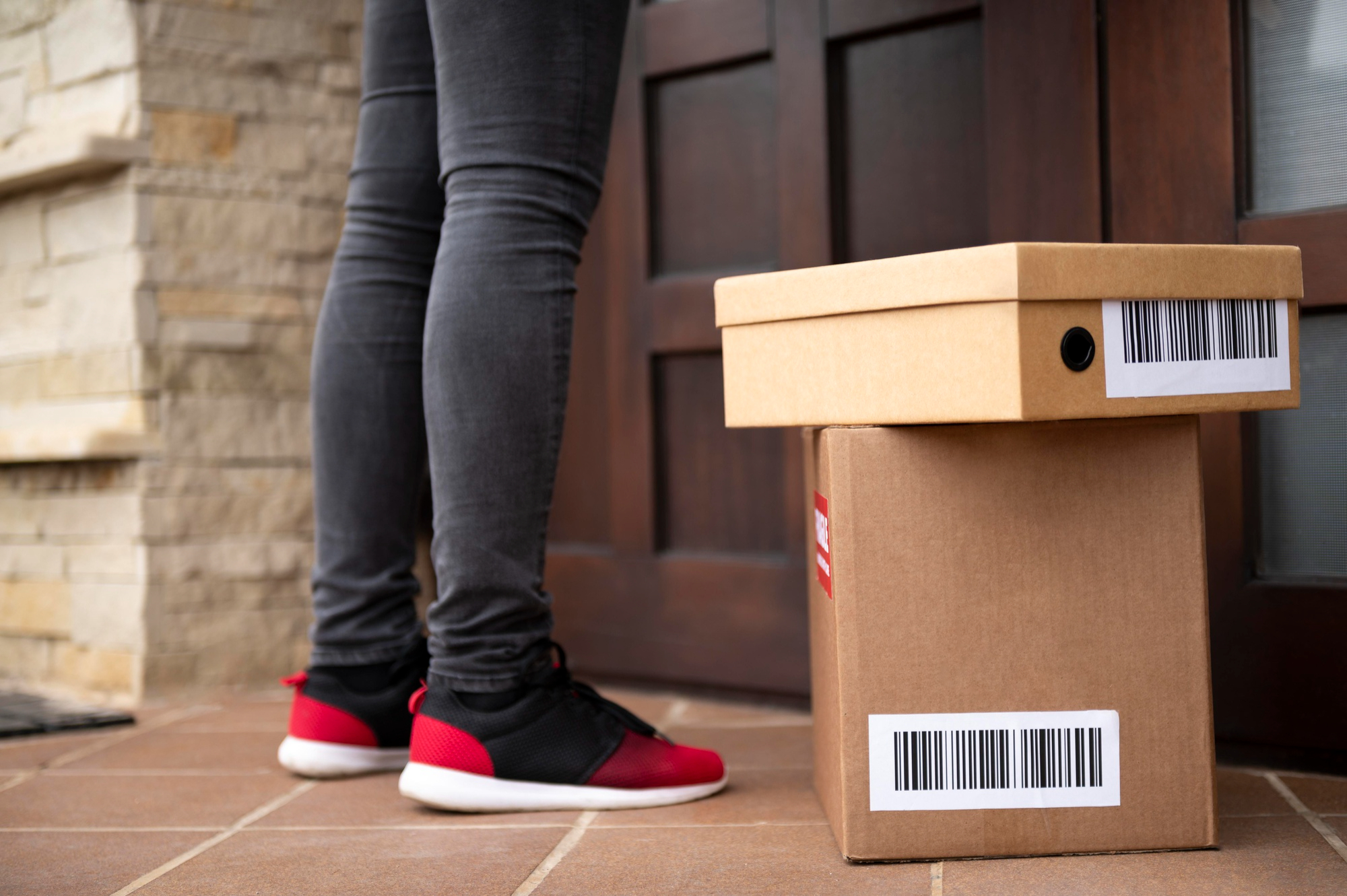
Jason didn’t shout when he said it. He didn’t raise his voice or make it dramatic. He was standing in our kitchen in socks, still carrying the faint smell of pancake batter and coffee, holding a plain brown cardboard box with both hands like it weighed more than it should.
The morning light came through the window the way it does on good days, warm and unhurried, the kind of light that makes you believe the world is basically safe. Jason was looking at the shipping label with the focused stillness he gets when something has caught the engineering part of his brain, the part that catalogs small discrepancies before the rest of him has finished processing them. His shoulders were tight. His hands were very still.
“Don’t open it,” he said.
I laughed the way you laugh when someone makes a face that seems like the beginning of a joke. “Why?” I asked. “You think it’s cursed?”
Jason did not smile. He did not make the dumb, warm remark he usually makes when I’m overthinking something. He nodded at the box, then at me.
“Look closer,” he said. “Please.”
I stepped around the counter. I leaned in and looked at the label the way you look at something when someone who pays attention to things has asked you to look at it carefully.
And then I saw it.
My breath stopped in the specific way that happens when your body understands something your mind is still catching up to.
I did not open the box.
I did something else.
Thirty minutes later, there were two officers on my porch.
My name is Rosanna Russo. In my family, it was never Rosanna. It was Riso, a nickname my sister Ellie invented at two because she could not pronounce it correctly, and my parents kept it because it made me sound smaller, lighter, easier to dismiss. With Jason it is Ro, said the way you hand someone something warm. With my mother it was Rosie, in the tone that meant she wanted something or was about to pretend she had not recently hurt me, or both.
I am thirty-four years old. I have a house with a porch swing and a herb garden I water inconsistently. I have a husband who takes my coffee order more seriously than my family ever took my feelings. I have a life that is, by most objective measures, quiet. I have worked very deliberately to make it quiet, the way you work to make something that did not come naturally.
I am not a birthday person. I do not post anything. I forget it’s happening until Jason appears with a chocolate bar from the checkout lane and says something like happy birthday to my mature wife and makes a face, and that is the whole celebration, and it is exactly enough. Peace is my preferred gift.
So when my mother called the day before my birthday and her voice came through the phone sounding like someone had injected sweetener directly into her larynx, my first response was not warmth.
It was the particular alertness of someone who has learned to read weather.
“We sent you a little surprise,” she sang. “It should arrive right on time.”
Right on time. As though my parents had ever been on time for anything that did not involve Ellie.
I made a neutral sound. “Oh. Thanks.”
My mother giggled. My mother did not giggle. My mother sighed, criticized, and spoke in the tone that communicated she was being reasonable and I was being difficult. Giggling was not in her repertoire.
“It’s nothing big,” she said. “Just a token of our love.”
That word: love. It landed in my ear like a coin dropping into an empty jar. Not because my parents were uncomplicated villains — life is rarely that legible — but because love in our family had always been a particular thing. It was the absence of visible trouble. It was silence. It was the unspoken contract that said you prove your place in this family by not requiring anything from it. Love was: don’t be so sensitive. Love was: Ellie didn’t mean it. Love was: you’re the older one, you should understand.
And yet here it was, syrup-sweet through the phone, and some small, stubborn part of me — the part that had survived thirty-four years on intermittent warmth and had not quite stopped hoping — lifted its head.
Maybe they’re trying, it whispered.
They were not trying.
The next morning, Jason made pancakes with crisp edges and too much butter, which is the correct amount of butter. He brought coffee to the bedroom, kissed my forehead, left me to drink it in the quiet. The ceiling fan ran. The neighborhood was still. Our life felt, in that moment, like something I had built with some care and was allowed to have.
Then the doorbell rang.
I heard Jason go downstairs. Heard the door open. Heard his footsteps returning, and they were heavier than when he left.
When I came into the kitchen, he was at the counter with a medium cardboard box.
No ribbon. No card. No handwriting anywhere, not even my mother’s cramped cursive on a stick-on tag the way she sometimes did at Christmas when she remembered. Just plain brown cardboard, printed label, taped by something that didn’t have opinions about what was inside.
“That’s from my parents,” I said. “Mom called yesterday.”
Jason’s eyes came up to mine. They were sober in the way that his eyes got when he was not going to let himself be talked out of something. “Still,” he said. “Don’t open it.”
I laughed again, nervous this time. “Why?”
He nodded at the label. “Look.”
I looked. There was no handwriting. The return address was a P.O. box — not my parents’ street, not their city, not even their state. The label was entirely machine-printed, the barcodes precise, the tracking numbers formatted in the specific way that comes from a warehouse management system rather than a home printer.
A cold feeling moved up my spine.
Jason leaned in and tapped the corner where the tape met the cardboard. There was a faint mark there, a partial logo pressed into the cardboard itself, almost invisible under the tape. And the way the barcode was aligned — the margin, the specific font — had a character that Jason’s engineering brain had flagged in the first thirty seconds and mine was now catching up to.
I had seen it before.
A year earlier, Jason and I had stopped at Ellie’s apartment to return dishes she had borrowed for one of her pop-up markets. Her hallway had looked like a storage facility. Boxes stacked in rows, identical labels, that particular smell of industrial adhesive and something beneath it, varnish or lacquer or something chemical that I had not been able to identify. I had picked up one of the boxes just to look at the label and Ellie’s laugh had come out fast and sharp.
“Put that down,” she’d said. Then, recovering: “The supplier is strict. They track who opens what.”
Strict. That was the word she had used. Not careful, not fragile, not expensive. Strict. The word you use when you have been told exactly what will happen if the wrong person examines the wrong thing.
Now the same packaging was on my kitchen counter.
With my name on it.
Jason did not say anything else. His eyes asked the question mine was already answering.
This was not a birthday gift assembled from whatever was available. This was a shipment. A deliberate, specific shipment, sent to my address in my name from a P.O. box that did not correspond to my parents in any way except that my mother had called the day before to make sure I was expecting it and to ask, almost immediately, whether I had opened it.
My phone rang. Mom.
Jason shook his head once, a small careful movement.
I answered anyway. Put it on speaker.
“Sweetie!” Her voice was all peaks and brightness. “Did it arrive?”
The box sat between us.
“Yeah,” I said carefully. “It came.”
“And did you open it?” Too eager. The question arrived slightly too fast, like she had been waiting to ask it.
I looked at the tape. The seal. The P.O. box. The partial logo pressed into the cardboard like a fingerprint.
“Yeah,” I said. “I opened it. It’s beautiful. Thank you.”
The pause on her end was microscopic. Then: “Oh, sweetheart.” A sound like relief, dressed as warmth. “We just wanted to remind you how much we love you. You’re our girl. Don’t ever forget that.”
You’re our girl.
In thirty-four years, through graduation and marriage and the afternoon two years ago when I sat on her couch shaking after a miscarriage and she patted my knee and said well, at least you know you can get pregnant — through all of it, my mother had never said that.
Jason’s eyes were on me. He had heard it too, the performance of it, the sugar that appeared in my family’s language only when there was something rotten underneath that needed covering.
“You’re so strong,” my mother continued. “You always have been.”
Strong. In my family that word had always meant the same thing. It meant: you can handle it. It meant: you don’t need anything. It meant: you’re the one we can use.
She hung up.
The silence after the call had weight.
I looked at Jason. He was already on his phone, not scrolling, dialing. He called a former colleague who had done regulatory compliance work for a logistics company, described the label details in the specific technical language that engineers use when they want an honest answer fast. The call lasted four minutes. When Jason hung up, his face told me what the answer had been before he said it.
“That’s a commercial fulfillment label,” he said. “The kind used for bulk distribution. Not retail. Not personal.”
We called the non-emergency police line from the kitchen, the box still on the counter, untouched.
The two officers who arrived twenty minutes later were professional and measured. I showed them the label. I explained the call from my mother. One of them photographed the exterior of the box while the other took notes. They asked if I had opened it. I told them I had not.
They asked if I would consent to them opening it.
I said yes.
What was inside I will not inventory in specific detail because some of it remains part of an ongoing process and I was asked to be careful about what I disclosed publicly. What I will say is that the officers’ expressions changed when they scanned the contents, shifting from the neutral professionalism of people handling a routine call into something more alert, more careful, the look of people who have recognized something with implications beyond the immediate scene in front of them.
They did not look at me like a birthday girl.
They looked at me like a name that had appeared somewhere in something larger.
They took the box. They told me someone would be in touch. They left.
My mother called three hours later, screaming.
Not the curated performance of the morning call. This was raw and undirected, the sound of a person who has just understood that a plan has gone wrong in a way that cannot be easily corrected. The word how came up many times. The word Ellie came up once, in a sentence I heard clearly enough to understand what it meant.
“How could you? You know what this means for Ellie.”
I sat with the phone and listened and did not say very much.
After the call, I went and sat on the porch swing with Jason and told him what she had said. It was late afternoon by then, the light going gold the way it does in autumn, the herb garden catching the last of it. We sat for a while without talking, the swing moving in small arcs.
“It was never a gift,” I said. It was not a question.
“No,” Jason said.
The detective assigned to the case called me one week later. He was methodical and unhurried in the way of someone who had been doing this long enough to know that what looked simple was usually not and what looked complicated usually had a straightforward center.
He told me my name appeared on multiple business documents.
I told him I did not own a business.
He asked if I had ever signed articles of incorporation for an LLC in the state of Nevada.
I told him I had not.
He texted me a photo while we were still on the phone. A signature, filed on an official business registration, entered into state records under my full legal name.
The signature was not mine. I would know. I have an unusual signature, deliberate and specific, developed in college and unchanged since. The one in the photo was a reasonable approximation. Not perfect, but not obviously fake to a document processor comparing it against nothing.
I sat at my kitchen table and looked at the photo and understood, in the fully assembled way that understanding sometimes arrives all at once, what had been happening.
The LLC had been active for fourteen months. Under my name. Using identifying information that my family had access to, my social security number from a form I had filled out at my parents’ house years ago for something I could no longer specifically recall, my date of birth, the address I had before I married Jason and changed everything.
My name had been the face of something my sister needed a face for. I had been selected for this, I understood now, not randomly, but with a specific logic: I was the stable one. The employed one. The one with an unblemished credit history and no record and a professional address and a husband with an engineering income that made the overall picture look even more legitimate. I had been used because I was the most usable version of a Russo.
The strong one. The one who could handle it.
The investigation took several months and moved through processes that I was not always fully informed about, which was itself an experience, being on the periphery of something that had been built in your name and then handed back to you as a problem you had to manage. I worked with an attorney who specialized in identity theft cases and who described what had been done to me with the even, technical language that professionals use when they want to be accurate without being inflammatory.
What had been done to me was a crime. My sister had committed it. My mother had known about it. My father, when interviewed, said he had not understood the specifics, which the investigators found partially credible and partially not.
I did not speak to my parents during the investigation on advice of counsel. I did not speak to Ellie at all.
The evening the detective called to tell me that charges had been filed, I was in the kitchen making dinner, the most ordinary possible thing, and Jason was at the table going through mail, and the light was the same warm kitchen light it always was. I stood there after the call with the phone in my hand and thought about the morning of my birthday, the pancakes and the coffee and the quiet, and then the box on the counter and Jason saying don’t open it and something in me being glad, so profoundly glad, that I had listened.
The identity restoration took longer than the investigation. It always does. There were documents to file and records to correct and creditors to contact and a series of processes that assumed you were guilty of the thing that had been done to you until you had provided sufficient paperwork to prove otherwise. I did all of it methodically, the way I approached anything that was essentially a documentation problem, with patience and precision and the help of my attorney and the credit bureau contacts she provided.
My credit was restored. The LLC was dissolved with a formal notation of fraudulent registration. The Nevada secretary of state’s office was surprisingly responsive once my attorney sent the right letter to the right department.
My name came back to me, which sounds like a simple thing and was not.
I have thought often, in the time since, about the word strong and what my family had made it mean. They had given me the word as though it were a gift, as though calling me strong was honoring something about me, when what they had actually been doing was using the word to describe their own convenience. Strong meant self-sufficient enough to be ignored. Strong meant resilient enough to absorb whatever was redirected at her. Strong meant the one whose name you could put on a business document because she will not fall apart publicly in ways that create problems for anyone else.
I understood this completely and cleanly, which felt different from the old understanding, the one that had known the same information but had been unable to stop hoping it might change.
Hope, in my family, had been the most expensive thing I owned.
I do not think I have entirely given it up, because I am not built that way and I know it. But I have moved it. I have put it somewhere more appropriate, in the herb garden I water inconsistently and the porch swing and the kitchen where Jason makes pancakes on the mornings that call for them. In the life that is, by most standards, boring. In the birthday that requires nothing larger than a chocolate bar and a dumb, warm remark from the person who takes my coffee order seriously.
The box had been sent to establish me as the carrier of something I had never agreed to carry. It had relied on my willingness to open gifts from people who had never actually given me one. It had relied on a version of me that still believed, when my mother’s voice turned sweet, that sweetness might be what it appeared to be.
Jason saw the label. I listened. That was the whole thing.
I am still the older one. I am still the responsible one. I am still, in whatever way the word remains salvageable, strong.
I am also the one who did not open the box.
And this time, for once, being the one who did not do the expected thing was the only protection I had, and it turned out to be enough.
Specialty: Emotional Turning Points
Rachel Monroe writes character-driven stories about betrayal, second chances, and unexpected resilience. Her work highlights the emotional side of family conflict — the silences, the misunderstandings, and the moments when someone quietly decides they’ve had enough.
I like,interesting post.