What She Left Me
The hydrangeas were in full bloom when I pulled into my father’s driveway, which would have pleased my mother enormously, and which is exactly the kind of detail she would have pointed out first thing, before even saying hello. She had planted them herself along the back fence the summer I turned twelve, hauling bags of soil amendment from the nursery in the trunk of the old Civic because my father had said the car was not meant for that kind of thing and yet had not offered an alternative. She planted them anyway. She planted most things in that house anyway, in one sense or another.
I was still in my scrubs. I had driven straight from the hospital, which meant I was still carrying the particular exhaustion that settles into your body after a twelve-hour shift not like tiredness but like ballast, a heaviness that becomes its own kind of steadiness. In emergency medicine you spend years training yourself to read rooms: the patient who says they’re fine whose blood pressure says otherwise, the family in the waiting area whose particular quality of stillness tells you what kind of news will land better and what kind will shatter. You develop a sensitivity to the atmosphere of a space the way some people develop perfect pitch. It is not always comfortable. It means you walk into rooms and feel things before you have any conscious reason to feel them.
I felt something when I turned off the engine and sat for a moment looking at the house.
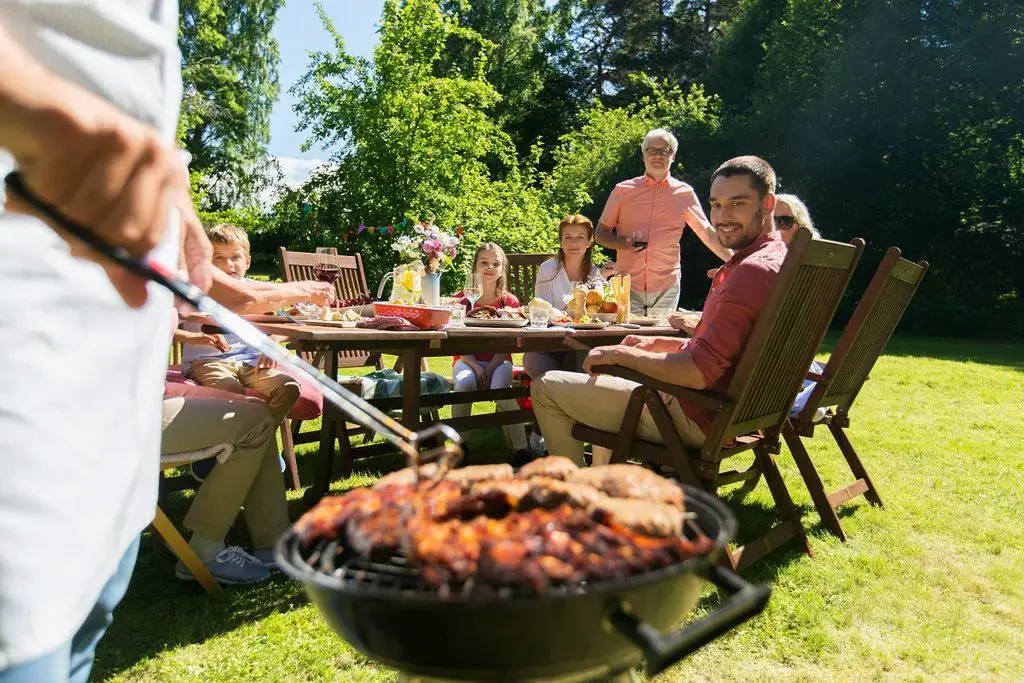
The yard looked, by every visual measurement, like the photograph on the front of a holiday card. Red, white, and blue bunting along the porch rail. A banner above the garage. The grill smoking in the corner of the yard where my father had always stationed it, with the authority of a man who believes his management of fire is one of his primary contributions to civilization. Folding tables with paper tablecloths in patriotic colors. Children running through the grass with sparklers, leaving bright trails in the warm air. My aunt Carol’s laugh carrying across the yard, which it always did; Carol’s laugh was essentially a navigational aid. Everything looked easy and festive and exactly like what it was meant to look like.
I sat in the car for one extra minute.
Then I took the envelope from the glove compartment, where I had kept it for the past four months, and put it in the front pocket of my scrub top. I had been carrying it in one pocket or another since March, moving it from coat to bag to scrub pocket the way you carry something you might need quickly and cannot afford to be without. I had read it so many times that I had memorized it, and yet I had not been able to leave it at home, because the letter and the carrying of it had become the same thing in my mind, and I wasn’t ready to separate them.
I got out of the car and went around back.
Thirty-one relatives, by my count. The extended landscape of the family that assembled itself two or three times a year around the coordinates of my father’s house, which had been the gathering point since my grandparents passed and their house was sold, the implicit center of the Moore family gravitational field. There were cousins I saw only at these occasions, who had grown children I was meeting for the first time. There were aunts and uncles who had the particular comfortable ease of people at a party they have attended many times in slightly different configurations. There was my aunt Paulette, who was my mother’s sister and who arrived at every family event with the specific contained vigilance of a person who has spent years watching something happen that she cannot stop and will not pretend isn’t happening.
Paulette caught my eye when I came around the corner of the house and gave me the kind of look that meant she had already assessed the situation, which meant the situation was worth assessing.
My father was at the grill. He had a beer in one hand and the long-handled spatula in the other, wearing the apron my mother had given him, the one with the cartoon flames on it that he wore with an earnestness that she had always privately found slightly heartbreaking. He looked well. He had put on some weight in the two years since she passed, which I had noticed at Christmas and again at Easter, and which I had decided was not my business. He was laughing at something my cousin Dennis had said. He looked like a man who was comfortable, which he was, because comfort was what he had always been best at cultivating.
I got a plate. I talked to my cousin Jason’s wife about their new baby. I talked to my uncle Richard about his retirement, which had gone better than expected. I ate something and drank a glass of water and moved through the gathering the way I moved through most gatherings, present but slightly orbiting, watching the room from the habit of someone who has learned to keep a portion of attention in reserve.
The afternoon was easy for a while. The kind of easy that precedes things.
My father had another beer. Then another. This was not unusual; it was a holiday, and beer at a holiday barbecue is not a noteworthy event. What I noticed, because I had been noticing it my whole life, was the quality of the looseness that came over him. There are people who drink and become warm, more generous, more likely to say the kind thing they usually keep behind a more cautious face. My father was not one of those people. He became expansive in a different direction. He became the loudest voice. He became the narrator of the gathering, the one who turned events into stories and stories into performances, with himself positioned at the center of each one.
He had always been the center of his own stories.
This is a thing I understood about my father the way you understand something you have grown up inside of: completely, without being able to fully articulate it, the way fish presumably understand water. The recliner in the living room that sat in the middle of the room like a throne that had been diplomatically renamed. The way the thermostat had been his decision, always, a point of control so minor it seemed petty to notice and so consistent you could not help noticing. The way he counted out grocery money at the kitchen table when my mother asked for it, slowly, with the performance of a man managing a budget, which made her asking feel like an audition for something she should have been entitled to by default.
I grew up watching my mother navigate around him the way water navigates around stone: not with force, but with patience, finding the paths of least resistance, shaping herself to the available channels. She was intelligent in ways that the house did not provide room for. She had read everything, had opinions on everything, had a wit that came out in the margins of conversations when my father was elsewhere and she could be fully herself. With me, late at night at the kitchen table while I did homework, she would say things that opened the world. She knew the names of things. She thought carefully. She had taken one semester of college before circumstances ended it, and she had spent the remaining decades of her life learning on her own time, in the gaps between everything else.
My father understood her value the way people understand the value of a service they have stopped noticing because it has never been interrupted. The house ran. The children were fed and clothed and ferried. The appointments were kept, the holidays organized, the relationships with extended family maintained through a correspondence that was entirely hers. When she was well, the architecture of his comfort was so complete and so invisible that I think he genuinely believed it was simply the natural condition of his life.
I became a doctor in part, I think, because competence in a demonstrable and external form was one of the few things that registered on his scale. I had driven myself past many points of reasonable exhaustion trying to be the son he thought he had been owed, without the word son and without the acknowledgment that this was what I was doing. I had learned to read his silences and to fill them with accomplishment, to bring home the evidence of myself in forms he could point to: the grades, the acceptance letters, the residency, the credentials framed on the wall of my apartment that I had not framed for myself. Some of that drive was genuine; I had always wanted medicine, had been drawn to it since I was old enough to understand what it was. But some of it was older and less elegant than that, and I had done enough therapy by the time I was thirty to know the difference.
My mother had not complained. That is not accurate; she had complained to me, sometimes, in the quiet way of a person who chose her audience carefully. She would say something like “your father thinks” and then let the sentence carry its own weight for a moment before finishing it. She had a gift for understatement that was so refined it occasionally became invisible. You had to be paying attention to hear what she was actually saying, and I had spent my whole childhood paying attention.
When she got sick, I paid attention to different things.
The diagnosis came on a Tuesday. I remember because I had just come off a night shift and had not slept and she called me from the waiting room because she did not want to hear it alone. We sat in the hospital together later that week, in a small room with a large window and a doctor who was kind in the particular way that oncologists learn to be kind, which is to say thoroughly and without false comfort. My father attended the first appointment. He sat in the chair beside my mother, and I sat in the chair beside him, and the three of us received the news in the respective ways of our characters: my mother with the measured stillness of someone who had suspected and had now had the suspicion confirmed, my father with a visible discomfort that I recognized as the discomfort of a man being confronted with something he could not manage by leaving the room.
He left eventually. Not the appointment, but the sustained work of it. He found projects. He found reasons. He was generous with practical things, with money and logistics, but the sitting beside her at three in the morning, the holding of the hand through the nausea, the learning of the medications and the side effects and the particular way she needed her pillows arranged when the pain was bad, that was mine. I am not saying this with resentment. I am saying it with accuracy, which is different. I chose to be there. I wanted to be there. But I was not there instead of him; I was there alongside the space where he was not.
After she passed, he grieved in the way he had always done everything: as a performance for an audience. He was the devoted husband at the funeral, which he had been to some extent, in the ways that required public demonstration. The eulogy was genuinely moving. I stood beside him at the reception and watched people come and hold his hands and say what a love story it had been, and I looked at my father’s face accepting these condolences, and I felt a complicated thing that I was not ready to name yet.
The letter arrived three weeks later, slipped to me by my mother’s lawyer at a quiet meeting she had clearly arranged before the end. It was sealed with my mother’s handwriting across the front, my name in her particular way of writing capital letters, the S in my name always slightly larger than necessary, a habit she’d had since I could remember. Inside was two pages, both sides, her careful script that had gotten smaller and more deliberate as her hands became less reliable.
I read it once in the lawyer’s office.
I did not read it again for three days, because three days was what I needed before I could hold the words without the words undoing me. After that I read it many times, late at night in my apartment after shifts, sitting at the kitchen table the way she had sat at her kitchen table for years, in the particular quiet of a life being accounted for.
She had written down things she had never said. That is the gift of a letter, and its particular cruelty: the person has finally found the words, and found the courage, and the finding has come too late to make them available to say out loud. She had written about her marriage with the fairness of a woman who had chosen it and lived it and understood its dimensions and accepted them while being unable to pretend, in these last pages, that those dimensions had been everything she needed. She had written about me with a specificity that still stopped my breath when I came to those paragraphs, the way she described watching me grow into someone who did not require an audience to know their own value, which she said was a thing she had not fully managed herself, and which she was glad had found its way to me.
She had written about my father.
The things she wrote about my father were not cruel. They were not a list of grievances or an indictment or a settling of scores. They were the observations of a woman who had lived alongside a particular person for forty years and had reached the end of that time and found that honesty required more than she had previously been willing to give it. She wrote about the counting of the grocery money. She wrote about the appointments he had not attended. She wrote about the particular quality of being married to someone who treated love as a resource to be managed rather than a thing to be given, and about the way that quality had shaped her life in ways she had spent decades not quite letting herself see directly.
She wrote that she loved him. She did. The letter was not a repudiation. It was a reckoning, and reckoning is not the same as repudiation. She loved him with the full-eyed love of someone who sees clearly and chooses anyway, and she wanted me to know that the choice had been hers, that she was not asking me to be angry on her behalf, that she had lived a life she would not have traded, and that there were things in it she wished had been different, and that both of those things were simultaneously true and she needed me to hold them both.
She also wrote that she needed me to know the truth of it. In case the truth ever became necessary.
She had not said when. She had left that to my judgment, which was perhaps the most complete act of trust she had ever given me.
I had been carrying the letter for four months when my father raised his voice at the barbecue.
He didn’t shout. He was not, even drunk, a shouter. He had a more refined instrument than that: the tone of someone saying something casual that is not at all casual, the delivery of a wounding thing as though it were simply a piece of information, the way certain people use the register of a joke to say the thing they actually mean because the register provides deniability.
He was talking to my cousin Dennis about something, and I had been half-listening the way you half-listen at gatherings when the conversation doesn’t require you, and then his voice rose slightly, with the slight rise of a man who has had enough beer to stop monitoring his volume, and he said it.
“She wasn’t planned, you know. I always hoped for a son.”
The sentence landed in the yard the way something heavy lands when it drops from a height: with a sound of impact that precedes the full understanding of what has just happened.
My aunt Paulette’s plate hit the ground. Not dropped so much as released, the way your hands open automatically when the rest of your body is processing a shock. I heard the plastic clatter without looking at it.
Every head turned toward me.
I had had a twelve-hour shift that had included two cardiac events, a pediatric case that I would not be able to stop thinking about for days, and the particular grinding exhaustion of a person who has been running on adrenaline and professional necessity since before sunrise. I was wearing scrubs with a coffee stain on the left sleeve that I had stopped noticing around hour six. My feet hurt.
I did not cry. I want to be clear about that, not because there is anything wrong with crying, but because I want to accurately represent what happened inside me, which was not grief in that moment. It was something cleaner and colder. The kind of clarity that arrives when something you have half-known for your entire life finally says itself out loud in a room full of witnesses.
It was not new. It was simply the loudest version of something that had always been there, the subtext made text, the wallpaper revealed as load-bearing. I had grown up in the atmosphere of his disappointment the way you grow up in a climate: so thoroughly and so gradually that you develop strategies for it without ever quite naming what you are adapting to. I had become a doctor in part, I think, because competence in a demonstrable and external form was one of the few things that registered on his scale. I had driven myself past many points of reasonable exhaustion trying to be the son he thought he had been owed, without the word son and without the acknowledgment that this was what I was doing.
I looked at him.
He was still holding his beer. His expression had the particular unsteadiness of a man who has said something and in the quarter-second after saying it has recognized that he has made a miscalculation, but whose pride prevents him from immediately acknowledging this and so he holds his position while his face attempts to process the information.
Thirty-one people in that yard, and the warm afternoon air, and the smell of the grill, and the hydrangeas along the fence blooming in the way my mother had planned for them to bloom, tended now by my aunt Paulette who had continued to come and care for the garden every spring because she understood that continuing to do so was how she remained close to her sister.
I reached into my pocket. I wrapped my fingers around the envelope without taking it out yet.
I let the silence run for a moment. Not long. Just long enough.
“Dad,” I said. My voice was level. This is something I trained for years in emergency medicine, the capacity to speak clearly in conditions that would make most people’s voices shake, and I used it now. “Would you like me to read what she wrote?”
His face changed.
The confidence, the expansiveness, the beer-loosened ease of a man performing his own comfort for an audience: it didn’t dissolve. It faltered. There is a distinction. A falter implies that it had been real, at least to him, at least in the way something built on sand is real until the tide. He had not, I think, known the letter existed. My mother had been careful. She was always careful.
I watched his hands.
His right hand, the one holding the beer bottle, was no longer still. A small tremor. Not from the alcohol; he had not had enough for that, not yet. From the recognition of something. From the particular fear of a person who has spent years carefully controlling the narrative of a relationship and has just been handed evidence that the narrative has been observed and recorded and held, by the one person whose opinion he had simultaneously dismissed and needed.
Paulette was watching him. My cousin Jason was watching him. Dennis, who had been his audience seconds ago, was watching him with the expression of someone who has just discovered that the casual remark he participated in was something larger than he understood.
My father set the beer bottle down on the table beside the grill.
“Where did you get a letter,” he said. Not a question exactly. The flat statement of a man buying time.
“She left it with her lawyer,” I said. “She left it for me.”
He looked at the envelope in my hand, which I had taken out now and was holding flat across my palm, the way you hold something you want to show clearly.
“She wrote things down,” I said. “She always paid attention. You knew that.”
The yard was quiet in the way yards are not usually quiet on the Fourth of July, which is a holiday that resists silence with some determination. But it was quiet now. The children had drifted toward the far end of the yard, guided by some instinct children have for the barometric pressure of adult situations. The conversations had stopped.
I did not read the letter out loud.
I want to be clear about that because it matters. I had considered it. I had considered it from the moment I understood that this afternoon was going to arrive at this particular moment, which I had anticipated without knowing exactly when or where it would come, only that it would, only that it always did. I had imagined reading it, standing in some room in front of some assembled witness, and I had imagined the effect of those words in her particular voice, her careful sentences, her naming of things she had spent forty years not quite naming.
I had also imagined my mother’s face if she could have seen me do it. She had not written the letter as a weapon. She had made that plain in the writing. She had written it with love, even the parts about him, with the measured, clear-eyed love of a woman who understood exactly what she had lived and had chosen, in these last pages, to say so, and who had understood also that saying so was not the same as wanting damage. She had loved him. The truth and the love had existed simultaneously in her for forty years and they coexisted in the letter, and deploying it as artillery in a yard full of relatives would have been a betrayal of both.
But she had left it to me. She had left its use to my judgment, which was the most complete act of trust she had ever given me, and I was going to honor that trust by using it the way she would have wanted it used: with precision and without cruelty.
I looked at my father across the yard, across the hydrangeas and the paper tablecloths and the two years of her absence that had rearranged this house in ways that felt unfamiliar, and I said the thing that had been true for my entire life without ever quite being said.
“She saw you clearly,” I said. “She wrote it down. I know what she saw.”
He did not say anything. His hands were not steady.
My aunt Paulette crossed the yard and stood beside me. She did not say anything either; she simply stood there, and the standing there was its own statement, was in fact a statement she had been composing for the better part of two decades and had finally found the moment to deliver. She was a small woman, my aunt, shorter than I was by several inches, but she had a quality of stillness that took up its full amount of space, and standing beside me she made the two of us into something that felt, in the charged air of that yard, like a verdict.
My cousin Jason’s wife pulled the children toward the other end of the yard with the quiet efficiency of someone who understands when an adult situation has exceeded its audience. Dennis had moved several feet away from my father in the unconscious way people move when they no longer want to be associated with a position.
My father sat down on the bench beside the grill. He sat down the way men sit down when their legs have decided something before their pride has caught up. He put his elbows on his knees. He looked at the grass.
I stood with the letter in my hand and watched him for a moment.
Then I said: “I drove her to every appointment. I sat with her through every treatment. I held her hand at the end, which you were not there for, and I have not said that to you until now because she asked me not to. She asked me to let you have your version of how it went. I honored that because she asked me to, and because she loved you, and because her love for you was real even when it was costing her something.”
He looked up at me.
I continued: “But you stood here today in front of this family and said something about me that you have been saying my whole life in quieter ways, and I am done being quiet about it. Not because I am angry, although I am. Because she deserved to be seen accurately, and so do I, and so does whatever she wrote in this letter, even if we are the only two people who ever read it.”
My father’s face was doing several things at once, the complicated work of a person being confronted with something real in a context that has stripped away his usual instruments. He could not perform. He could not redirect. He could not manage the narrative because the narrative had been witnessed and documented by someone he had underestimated, and both things were now in the room with him.
He said, after a long time: “I don’t know what she wrote.”
“I know,” I said.
“She could have said anything.”
“She said true things,” I said. “That’s all she ever did.”
Paulette made a small sound beside me that was not quite a word and not quite a breath and was entirely her sister.
What happened in the yard after that was not a resolution or a reckoning or any of the things that happen in the imagined version of these moments. What happened was that thirty-one people found their way back into conversation, slowly, carefully, the way water finds its way around an obstacle, and my father remained on the bench for a while, and eventually my cousin Dennis sat beside him, not from loyalty exactly but from the instinct to not leave someone entirely alone with themselves when alone with themselves is a dangerous place to be.
Some people came and found small reasons to stand near me for a moment, a refill of a glass, a question about something unrelated, the thin pretense of normal conversation that was actually something more than that. My cousin Jason squeezed my shoulder as he passed. My aunt Carol, who had laughed at nothing for the last forty minutes, touched my arm and said “your mother would have,” and then stopped, and swallowed, and said only “she knew,” which was not a complete sentence and was perfectly complete.
Paulette stayed close. She and I sat together at one of the folding tables as the afternoon began its long descent into evening, and she told me things about my mother that I had not known, the specific things that older sisters know about younger ones from the years before the younger one belonged to anyone else. Small things, some of them. The kind of person she had been before she was my mother. A woman who had wanted things. A woman who had been, in Paulette’s telling, funny in a way that had gradually and almost invisibly been quieted over the years, like a radio with the volume turned down so slowly you don’t notice the silence until you suddenly realize the music has stopped.
“She was the funniest person I ever knew,” Paulette said. “Before.”
I knew what before meant.
“She was still funny,” I said. “With me.”
Paulette looked at me. “I know,” she said. “That’s what saved her.”
I stayed until dark.
I did not stay out of obligation. I stayed because my mother had stood in that yard and cared for those hydrangeas and fed those people and made that space into something worth gathering in, and her presence was in every corner of it, in the flowers and the way the porch light fell across the flagstone path and the slightly uneven stone border of the garden that she had laid herself because she preferred it that way. I was not going to be driven from it by the loudest version of a thing I had been hearing quietly my whole life.
My father came and stood beside me near the end of the evening. The yard had thinned to a dozen people, easy and low in the late-summer dark. Someone had lit citronella candles. The sparklers were long gone.
He did not apologize. He is not a man who apologizes, which is not the same as saying he is a man without remorse. I have learned to read the distinction, because I am his daughter and I have been reading him my whole life, the same way he never quite managed to read me.
He said: “She was proud of you.”
I looked at him.
“She talked about you,” he said. “More than you probably knew. What you were doing. What you’d become.” He looked at the garden. “She was right to be.”
It was not an apology. It was not a full accounting of anything. It was a small, partial thing, the kind of offering a person makes when they have more to give than they know how to give and so they start with what they can actually manage. I understood this. I understood it the way I understood most things about my father: completely, without it resolving into anything easy.
I put the letter back in my pocket.
I drove home with the windows down, the warm July night coming through the car, and I thought about what she had written, the particular sentences I had memorized without trying to. The one about value not requiring an audience. The one about the choice she had made and its cost and her lack of regret. The one at the end, in the smallest of her handwriting, that said: you were exactly what I would have chosen, if I had been given the choice. Which is the most complete thing one person can say to another, and which I have been carrying in my front pocket ever since, because there are things you cannot afford to be without.
I thought about the way she had given it to me. Not in the final days, not in some deathbed scene. She had arranged it through the lawyer with the same quiet competence she had brought to everything, the same forethought that had kept the household running and the appointments kept and the correspondence maintained for forty years. She had written it while she was well enough to write it well, which means she had known, earlier than she acknowledged to anyone, that she needed to say it while the saying was still hers to do.
She had trusted me with it not because I was her only option but because I was the person who had been paying attention. Who had sat with her at the kitchen table at midnight and heard the things she said between the lines. Who had learned her understatement the way you learn a second language, until you stop translating and begin to simply understand.
She had trusted me to know when.
I pulled into my parking spot and sat in the car for a while, the way I had sat in the car in my father’s driveway, with the windows down and the neighborhood quiet around me. Someone down the block was still setting off small fireworks; the sky above the roofline flashed briefly and went dark and flashed again.
In the morning I would go back to the hospital. There would be patients who needed things I could give them, and patients who needed things I could not, and I would do my best with all of them in the way I had been trained to and the way I would have done regardless of training, because this is who I am, because it is not separate from who she raised me to be, because becoming myself and becoming her daughter are not two different stories.
The hydrangeas would bloom again next summer. Paulette would come and tend them. I would drive up and stand in the yard and feel my mother in the specific, enduring way you feel people who have made themselves permanent in the structure of who you are, not as a presence you can locate but as something closer than that, something woven into how you see and what you notice and the particular quality of attention you bring to a room.
And the letter would stay in my pocket, moving from coat to bag to scrub top with the seasons, because it was mine, and because she had left it to me, and because there are truths you carry not to use as weapons but simply to know: to feel their weight in your hand at three in the morning when the world is quiet and the long work of being her daughter, which was also the long work of becoming myself, is the only thing keeping you upright.
That is enough. She always said ordinary things were enough, when they were true.
She was right about most things.

Specialty: Quiet Comebacks & Personal Justice
David Reynolds focuses on stories where underestimated individuals regain control of their lives. His writing centers on measured decisions rather than dramatic outbursts — emphasizing preparation, patience, and the long game. His characters don’t shout; they act.