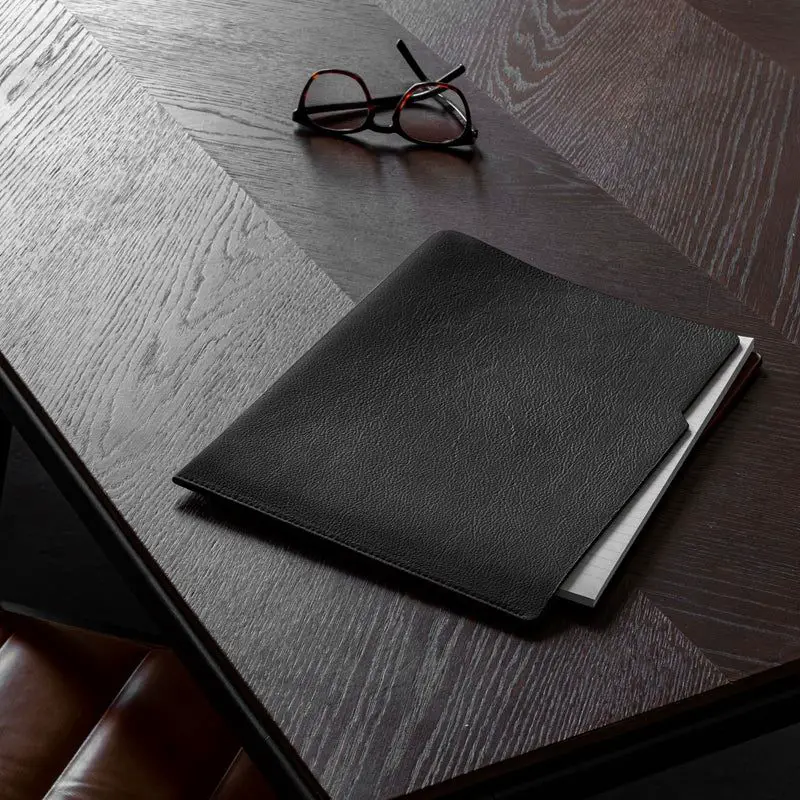
The Black Folder
The gift bag was heavier than it looked.
I had spent three weeks deciding on the frame. Not because I am the kind of woman who agonizes over gifts, but because this one mattered, and because I had been trying for years to give Carter things that mattered without ever fully understanding why mattering seemed to be so hard for him to receive. I had gone through the photograph albums, which I keep in the hall closet in three large binders that Carter has seen and never asked to look through, and I had found the one I was looking for on the third pass, which is usually how finding things works when the thing you’re looking for is the right thing rather than just an available thing.
It was taken in a parking lot somewhere, Carter with his tie loose and his head thrown back, laughing at something his old roommate had said. The pure uncalculated laugh of a person who does not know he is being watched, which is different from every posed photograph ever taken in the sense that posed photographs are of a person performing themselves and candid photographs are of the person themselves. This one was the person. This was the one I had spent three weeks looking for, because I wanted Carter to have it, to have an image of himself being himself, without the performance layer that had been thickening for years in every photograph he allowed to be taken.
I had it printed large, framed in dark walnut, and I had written on the back in my particular handwriting, which Carter has always said looks like the penmanship of a woman from another century. I wrapped it in tissue and placed it in the small white bag with the satin handles, and I carried it on my lap in the taxi because it felt wrong to put it on the seat. As though putting it on the seat was a statement about how much it mattered, and I had decided how much it mattered, and the statement was: on my lap.
The restaurant was the kind of place that exists to make you feel like being there is already an accomplishment. The sort of place where the lighting makes everyone look like the best version of themselves, where the menu is brief in the way of things that are confident they don’t need to explain much, where the staff have mastered the specific art of making you feel that your presence is both expected and slightly exceptional. I had looked it up when Carter texted me the address. I had seen the price range and understood immediately that Carter was making a statement with the choice of location, the kind of statement that says: look how far I have come, and I wanted to give him that, to be present for it, to witness his arrival at the life he had been building.
I had not expected to witness it from the patio.
I arrived at seven-fifteen. The reservation was for seven-thirty. I always arrive early, which is a habit of people who grew up understanding that being early was how you showed you took something seriously, and also how you ensured that the small indignities of arrival, the locating of the place, the parking or the taxi, the moment of uncertainty at the door, happened in private rather than in front of an audience.
The foyer was warm and lit with the amber light of a place that understood what amber light does to a room. There was a young woman at the host stand who smiled with the professional warmth of someone who had been trained to smile but had also, I thought, a genuine quality to it underneath the training. I said I was there for the Carter Moore reservation. She checked her screen and said his party was already here and she would take me through.
That is when I saw them.
Carter was standing at the entrance to the main dining room with Rachel beside him, and behind them three couples I recognized as his work friends, people I had met at the periphery of his life over the years in the way you meet the peripheral people, briefly and at moments when everyone is performing their best version of themselves. Rachel had on a dress I had not seen before, something green that cost more than I spent on clothing in a year. Carter was in the blazer he wore when he wanted to look effortlessly put together, which was the same blazer he had worn to three separate occasions and which I had noted each time with the particular observational database of a mother, which records things no one asks it to record and retains them indefinitely.
He saw me and something moved across his face that I had been watching him do since he was eleven years old, the small reorganization of expression that happens when something unexpected has arrived and the instinct is to manage rather than welcome it. I had learned not to name it. I had learned to pretend I didn’t see it. This is one of the negotiations you make when you love someone who does not always know how to love you back at the same volume.
“Mom,” he said.
I held up the bag. “For you,” I said. “For the promotion.”
He took it with one hand and set it on the chair behind him, which was the chair where Rachel had placed her bag, without opening it. Without looking at it. I watched this happen and I did not say anything about it because I never say anything about it, which is the other side of the same negotiation.
Then he said: “This table is for family, Mom. Go sit out on the patio.”
The sentence arrived in the warm amber light of that foyer like a hand pressed flat against a chest. Clear. Final. Not said cruelly, which would have been one thing; cruelty has heat in it, has acknowledgment of the thing being done. This was said with the casual authority of a man stating an arrangement that had already been agreed upon, a logistics decision being communicated rather than a choice being made in the moment. As though I had already been categorized and the categorization required only a brief explanation on my way past.
Rachel laughed first.
I have thought about that laugh many times since. It was not a long laugh or a loud one. It was brief and high and precise, the laugh of a woman who had been waiting for something and was relieved to hear it said at last, a laugh with a point to it. Then the others followed in the way that groups follow a social cue when someone with authority in the group provides one: quick, confirmatory, almost in unison, the way people agree on a new rule without a vote.
I stood there with the small white bag beside Carter’s chair.
Nobody moved the handbag on the last chair at the table. Nobody pulled out a chair and said, here, sit here, we’re glad you came. They moved through the foyer the way people move when the logistical question has been settled and there is nothing left to do but proceed: they walked into the warm light, Carter with his hand on Rachel’s back, the group filling in behind them with the ease of people who know their places.
I got left by the door, where cold air rushed in every time someone came or went.
I stood there for a moment. Not a long moment. But a real one, a moment with weight, the kind of moment you are aware of while it is happening, that you know you will return to later. I was still holding my coat. I had not been offered a place to hang it. I thought about the photograph in the bag, now sitting on Carter’s chair in the warm room I was not invited into, Carter in a parking lot with his head thrown back, laughing the pure unguarded laugh of someone who had not yet calculated who he was going to be.
I put my coat back on.
I found the patio on my own. It was around the side of the restaurant, through a door that required handling from the outside, the kind of door that tells you the patio is an afterthought, a concession to the demand for outdoor seating rather than a considered part of the dining experience. It was cold, as patios in early spring are cold, the kind of cold that makes you understand why most people choose not to sit there, and there was a space heater in the corner that was doing its best but losing. I dragged a chair from an empty table and placed it at the edge, not at the table exactly, but near it, the way you sit when you are making do with a situation you did not design and have not accepted but are not yet ready to leave.
I sat down.
I ordered black coffee. I said it to the server in the voice I use when I have decided that my voice is going to be steady: measured, clear, the voice I used in thirty years of work, in meetings where I was the only woman, in negotiations where I was the only person who had read the contract, in every room where making my voice shake would have been the thing that justified the people who expected it to shake. The server looked at me, then looked toward their table inside, a flicker of confusion crossing his face that he quickly smoothed professional again. He went to get the coffee.
I looked at the patio. It was a space that had been designed for summer and was being asked to function in early spring, which it was doing without enthusiasm. There were four tables, each with the small stubborn dignity of outdoor furniture that has not yet been put away, and a string of lights along the railing that someone had not turned on, and the heater in the corner doing its insufficient work. Nobody else was out here. It was the kind of space that said: we accommodate people who want to be here, but we do not expect anyone to want to be here.
I thought about the last time I had been to a restaurant with Carter. It had been fourteen months ago, a lunch near his office that had lasted forty minutes because he had a meeting at two. I had ordered a salad. He had ordered something I could not have pronounced. The conversation had moved through his projects, his plans, the features of a new apartment he and Rachel were considering. He had asked me, once, how things were going, and I had said fine, everything’s fine, which is the answer that costs nothing and gives nothing and which I had been giving for so many years that I had stopped noticing when I did it.
Fourteen months. Before that, six months. Before that, the previous holiday.
The pattern was not new. I had been watching it with the particular mixture of resignation and active avoidance that is the emotional signature of someone who sees a problem clearly and has decided, for reasons of love and hope and the human unwillingness to accept the evidence in front of them, to keep reinterpreting it as something smaller than what it is.
Sitting on the cold patio, I stopped reinterpreting it.
Through the glass, I could see their table.
It was the table I had originally imagined sitting at. Round, large, in the warm center of the room with light falling on it from above in a way that made the white tablecloth glow. There were eight of them, or nine, the numbers blurring slightly through the glass and the intervening cold air. Champagne arrived with a small sound I could almost hear, the pop of it, the laughter that followed. Carter was talking. I could not hear the words but I could read the performance of them: the shoulders back, the hands moving with the confidence of someone delivering information he knows will land well. He was describing the promotion, I imagined. The stock options. The forward momentum of a life that had gathered speed and was now arriving at its well-deserved destinations.
Rachel leaned across the table and said something to the woman beside her. She had not looked toward the patio once.
The coffee arrived. Bitter and hot, and I am going to tell you that there was something clarifying in those particular qualities, something that matched the temperature of what I was thinking, which was cool and clear and had been coming for a long time.
I thought about the years.
Not in a sentimental way. Not in the way of someone working up to tears, which I was not. In the accounting way, the methodical way of someone who has kept books and understands what a ledger is for, which is not sentiment but accuracy. I thought about the years after Carter’s father left and it was the two of us in the apartment on the south side, the years where every decision I made had Carter at the center of it, not as a sacrifice exactly, or not only as a sacrifice, but as an organizing principle, the way certain structures are organized around a load-bearing element. His needs had been the load. I had been the structure.
I thought about the lunches. Not because they are remarkable, they are not remarkable, every mother makes lunches, but because they were the daily evidence of a choice I made every day without being asked, the choice to show up for someone before the rest of the world was awake, in the small repetitive ways that don’t make good stories but make, over years, a life. I made them at six in the morning, before my own coffee, before anything, because the morning was a vulnerable time for Carter and starting his day with something prepared and waiting was the small steady message I had decided to send him every day for a decade: you are expected. You are provided for. Someone got up before you and thought about what you would need.
I thought about the money I had not spent on myself so that there would be more available for the things he needed: the camps, the equipment, the tutoring in the subject he struggled with, the things that were not strictly necessary but that I had decided were part of giving him a full life rather than just an adequate one. The winter coat I wore for seven years instead of four because the difference in money went to his sports fees, and I had not minded, genuinely had not minded, which is the thing about a certain kind of love: it does not feel like sacrifice while you are doing it. It feels like the correct allocation of a limited resource.
I thought about the job I did not take in Seattle when Carter was fourteen, the one that would have paid considerably more and required us to relocate. I had been offered it on a Thursday in October, and I had not told anyone I had been offered it, and I had called on Monday and declined it, and I had not thought about it as a significant decision for years, which is perhaps the most complete expression of what a certain kind of love looks like from the inside: the choices so immediate and obvious they do not register as choices at all.
Carter did not know about Seattle. I had never told him. Not to hold it over him, not as ammunition, but because there had never been a moment when telling him seemed like it was for him rather than for me. And I had always tried to keep the things I did for reasons that were for me rather than for him in the category of things I kept to myself.
I thought about the habit I had developed over the years of making myself smaller in Carter’s life so that his life had more room in it. The way I stopped calling when I noticed that my calls arrived at inconvenient times, and instead waited for him to call, and kept those calls brief, and asked questions rather than offering things because offering things could feel like obligation. The way I had made myself easy, which is the same maneuver I recognized now in retrospect as the gradual process of agreeing to matter less. The way “easy” had started to mean “absent,” and I had gone along with the redefinition because the alternative was the word “difficult,” which is what they call women who take up their full amount of space.
The coffee was almost gone. Inside, Wagyu was landing. I could see the plates, the architecture of expensive food arranged on white, the kind of abundance that announces itself.
Then Rachel moved.
She caught the server’s eye with the ease of a woman accustomed to being looked at when she wants to be looked at, the practised glance of someone for whom service is an expected feature of environments rather than something to be requested. She said something brief. She did not look toward me when she said it. She did not look toward me at all, not during this gesture and not at any point in the evening, with the consistency of someone who has made a decision about where their attention goes and is not revisiting it.
The server came out to the patio.
He placed the black folder in front of me.
I looked at it for a moment before I opened it, the way you look at something when you already know what it says. The black leather folder, small and heavy with itself, placed on the cold table of the patio with a precision that told me he had been instructed, that the instruction had been clear and had not included an explanation of why the bill for a table of eight inside was being presented to a woman alone outside on the patio with a cup of black coffee.
I opened it.
Three thousand five hundred and twelve dollars. The number had its own clarity. I looked at it with the same steadiness I had been maintaining since the foyer, the steadiness that was not calm exactly but something more useful than calm, which was knowledge. The knowledge that I had known this moment was possible in some form, that I had not known its specific shape, and that its specific shape was in some ways worse than what I had imagined and in other ways exactly what I had needed to see.
I looked through the glass.
Carter was on his phone. Not texting, not a quick check, but reading something with the focused attention of a man who has transferred his concentration to his screen and is no longer present to the room in anything but a physical sense. The others were talking, the easy post-meal talk of people who have eaten well and drunk well and are settling into the comfortable looseness of the end of an evening. Nobody looked toward the patio. Nobody acted surprised. Nobody performed the hesitation that would indicate they understood that a choice had just been made and were at least briefly uncertain about it.
Rachel refilled her wine.
I set the folder closed and took the last sip of my coffee.
Then I put my coat on properly and picked up my bag and walked back through the side door into the restaurant and through the warm amber light of the dining room to the table where my son sat with his phone and his champagne and his Wagyu and his lobster and his people and his promotion and everything that had become of the life I had organized myself around for thirty years.
I stood at the edge of the table.
Carter looked up from his phone with the mild expression of a man who has not yet understood that the situation has changed.
I placed the closed folder on the table in front of him. Not hard. Not with drama. The way you set something down when it belongs to someone and you are returning it.
“That’s yours,” I said.
He looked at the folder. “Mom—”
“The bill belongs to you,” I said. “I’ll pay for my coffee.”
Rachel set her wine glass down. The woman beside her stopped talking. The table went through its version of the shift, the same shift I had felt all those hours in emergency medicine, the moment when a room understands that the situation is different from what it was a moment ago.
Carter picked up the folder. I watched him open it. I watched his expression do the particular work of a man recalibrating in real time, moving through the options and the arguments and landing on the one he chose, which was: “This is embarrassing.”
“Yes,” I said. “It is.”
He looked at me with the expression of a man who is being disagreed with by someone who was supposed to agree. “We thought you’d want to treat us. You always—”
“I know what I always did,” I said. “I’m changing what I always do.”
Rachel made a sound that was almost a word and decided against being one. She had the expression of a woman who had miscalculated the terms of a situation and was deciding how much of that to show. I looked at her briefly, not with anger, but with the directness of a woman who is done performing blindness to things she sees very clearly.
“You sent the bill to me,” I said to her. “From across the room, without asking, without discussion. I’d like you to know I noticed that.”
She opened her mouth.
“You don’t need to explain it,” I said. “I just wanted you to know I saw it.”
The table was very quiet. One of the other couples was looking at their plates with the focused attention of people who have decided this is not their situation to involve themselves in, which was the correct decision and I respected it.
Carter put the folder down.
“Mom,” he said, and the word had a different quality in it now, the mild-authority tone gone, something lower and less rehearsed replacing it.
“I drove three hours to be here,” I said. “I brought you a gift that I spent three weeks choosing. I got seated on a patio in the cold with a cup of coffee and handed a bill for thirty-five hundred dollars of food I did not order. I want you to sit with that for a moment before you say anything else.”
He sat with it.
I will give him this: he sat with it genuinely. The phone was still in his hand but he was not looking at it. He was looking at me with the expression of someone hearing something they have been arranged never to have to hear, the accounting they did not know was being kept because the person keeping it had never presented it before and had therefore been assumed to have nothing to present.
I reached into my coat pocket and took out two folded bills, enough to cover the coffee and a reasonable tip, and I set them on the table’s edge. Then I picked up the small white bag from Carter’s chair, the one with the frame inside it, the one he had set down without opening, and I held it for a moment.
I had three weeks of thought in that bag. I had a photograph of my son laughing without calculation, and I had written something on the back that was true, and I had carried it on my lap in a taxi because it felt wrong to put it on the seat.
I set it back down on the chair.
I looked at Carter. He was thirty-six years old and he was successful by every external measurement and he had somewhere in the accumulation of his becoming learned to treat abundance as something he had arrived at under his own power, which is the story people tell when the parts that were given to them have become invisible through use.
“When you open that,” I said, “read what’s on the back.”
Then I walked out through the warm light and the cold foyer and into the night outside, where the air was sharp and clear and exactly the temperature it was, without pretending to be anything warmer.
I did not cry in the taxi home. This is not a statement of strength; it is a statement of what the feeling was, which was not grief. Grief has a quality of loss in it. What I felt was closer to the particular exhaustion of having finally set down something heavy, and the strange lightness that follows, and the work of figuring out what to do with your hands when they are empty.
My apartment was quiet when I got home. I made tea, which is what I do in the evenings when I have been somewhere, when I need the small ritual of a hot cup and a quiet room to decompress from being in the world. I sat at the kitchen table, which is where I have always done my thinking, where Carter had sat across from me for years doing homework, where I had sat alone in the years after his father left figuring out how to make the numbers work.
The numbers had always worked.
I thought about what I was willing to do and what I was not willing to do anymore, which is a different kind of accounting but accounting nonetheless, and which I approached with the same methodical honesty I had always brought to the other kind. I was willing to love my son. I had not stopped loving him in the restaurant and I was not going to stop, because love of that kind does not have an off switch and I would not want one if it did. What I was willing to reconsider was the particular shape of the love, the ways it had organized itself around his convenience rather than around anything mutual, the ways I had made myself easy and small and low-maintenance until I was sitting alone on a cold patio with a cup of black coffee being handed a bill for someone else’s champagne and lobster.
That shape was not working for me. That shape had not been working for me for some time, and I had been declining to notice, which is a choice even when it doesn’t feel like one.
Carter called the next morning. It was early, earlier than he usually called, which told me something. Carter was not an early caller. He operated on the schedule of someone whose mornings were managed rather than urgent, who woke when the alarm permitted and moved through the first hours at the pace of a person who had never had to be anywhere before sunrise. The fact that he was calling at seven-forty told me he had either not slept well or had woken early with the particular restlessness of an unresolved thing.
I let it ring once more than I normally would, not from pettiness but from the need to be ready, to have my voice where I needed it before I answered.
“Mom,” he said.
“I’m here,” I said.
There was a pause of the kind that precedes something that is difficult to begin. I had learned to wait in those pauses rather than fill them, which is a discipline that does not come naturally to me and which I had been practicing for years in every relationship where the other person needed more time than I did to find the words. I had learned that filling the pause was a way of taking the work away from someone who needed to do it themselves, and I was finished taking Carter’s work away from him.
“I opened the frame,” he said.
I waited.
“I read the back,” he said.
His voice had changed. Not broken, not yet, but changed in the way that voices change when something has reached them, when the performed layer has been briefly set aside and what is underneath is audible. Carter had a performed layer that had been thickening for years as his life had become more successful and he had developed more to protect. I had watched it thicken and I had said nothing and I had accommodated it, which was perhaps part of how it had gotten so thick, and which was one of the things I was going to need to say to him when we had the conversation I intended to have.
What I had written on the back of the frame was not an accusation. I want to be clear about that, because what happened in that restaurant could have made it easy to write something bitter, and I had chosen not to. I had written it three weeks earlier, before the restaurant, when I was thinking about Carter’s promotion and what it meant and what I wanted to say about it and about us and about the distance between where we were and where I needed us to be.
What I had written was: I was there the whole time. I was always going to be here. I need you to decide if that matters to you.
Three sentences. True ones. Not an accusation and not a surrender, but a question that required an actual answer, delivered in a form he could not defer or dismiss or put down on a chair without reading.
“It matters,” he said. “Mom. It matters.”
I looked out my kitchen window at the morning, which was ordinary and grey and present.
“Then we have some things to talk about,” I said. “Not today. When you’re ready.”
He said he was ready now.
I said I believed he thought he was, and that when the conversation happened I wanted it to be the real one, not the version performed in the aftermath of a bad evening when the feelings were still loud enough to drown out the harder parts. I told him I was not punishing him by waiting. I told him I was giving both of us the chance to come to it honestly rather than reactively.
He was quiet for a moment in the way of someone hearing something they expected to argue with and finding they cannot.
“Okay,” he said.
“Okay,” I said.
After I hung up, I sat with my tea and the grey morning and the particular quiet of a woman who has stopped apologizing for taking up her full amount of space, and I thought about the frame on his wall, or wherever he had put it, and the photograph inside it, and the words on the back.
I was there the whole time.
The whole time he was laughing in parking lots and getting promotions and ordering champagne and learning to treat abundance as his natural inheritance, I was there. Not behind him, not beneath him, not at the edge of the patio in the cold. There. The load-bearing structure. The one who made the lunches and scrambled and swallowed and stayed and drove three hours on a Wednesday night to celebrate a son who seated her on the patio and sent her a $3,500 bill without looking up.
That version of there was finished.
The new version was not finished. I want to be exact about that because it would be easier to write the ending where I walked away and the distance became permanent and I built a new life in which Carter was optional, and some people would say that was the correct ending, the empowered ending, the ending that honors everything I had swallowed for thirty years. But it would not be true. He was my son. He was the person I had organized my life around for long enough that even the parts of my life that had nothing to do with him had been shaped by his presence in my center of gravity. You do not simply excise that, nor should you, and I was not interested in stories about clean breaks that do not account for what makes people worth loving through their worst versions of themselves.
What I was interested in was the conversation we had not yet had. The one where Carter sat across from me without Rachel nearby and without his phone in his hand and said the things he was not used to saying because I had always made it easy not to say them by managing the situation before the saying became necessary. The one where I said the things I had always compressed into forms he could handle: full-sized, uncompressed, exactly what they were.
I thought he was ready for that conversation. The call that morning had told me something important, which was not just that he was sorry, which was the surface of it, but that the photograph had reached him, which meant the person in the photograph was still in there, the one laughing without calculation in a parking lot, the one I had raised before the performance layer had fully set. You cannot reach someone who is not there to be reached. I had reached him.
The rest was the work. It was ordinary work, the kind that happens over time in small increments without ceremony, the reassembly of a relationship that has drifted from its foundations. It would take longer than a conversation, and it would require things from both of us that neither of us had been asked for before, and some of it would be difficult and some of it would fail on the first attempt and require revision.
I had been doing difficult work my whole life. I was not afraid of it.
I finished my tea. The morning had lightened to a pale silver, the particular quality of light on a grey day that is not quite sun but is not quite absence of sun either, the ordinary complicated light of an ordinary complicated day. I had a list of things to do. I got up and started them, one at a time, in the quiet of my apartment, which was mine, which was enough, which had always been enough even when I had let myself believe otherwise.
I was going to be fine.
More than fine. I was going to be exactly what I had always been, which was the person who showed up and stayed, but on my own terms now, in my full amount of space, without apology.
I was going to be exactly that.
I got up and started them.

Ethan Blake is a skilled Creative Content Specialist with a talent for crafting engaging and thought-provoking narratives. With a strong background in storytelling and digital content creation, Ethan brings a unique perspective to his role at TheArchivists, where he curates and produces captivating content for a global audience.
Ethan holds a degree in Communications from Zurich University, where he developed his expertise in storytelling, media strategy, and audience engagement. Known for his ability to blend creativity with analytical precision, he excels at creating content that not only entertains but also connects deeply with readers.
At TheArchivists, Ethan specializes in uncovering compelling stories that reflect a wide range of human experiences. His work is celebrated for its authenticity, creativity, and ability to spark meaningful conversations, earning him recognition among peers and readers alike.
Passionate about the art of storytelling, Ethan enjoys exploring themes of culture, history, and personal growth, aiming to inspire and inform with every piece he creates. Dedicated to making a lasting impact, Ethan continues to push boundaries in the ever-evolving world of digital content.