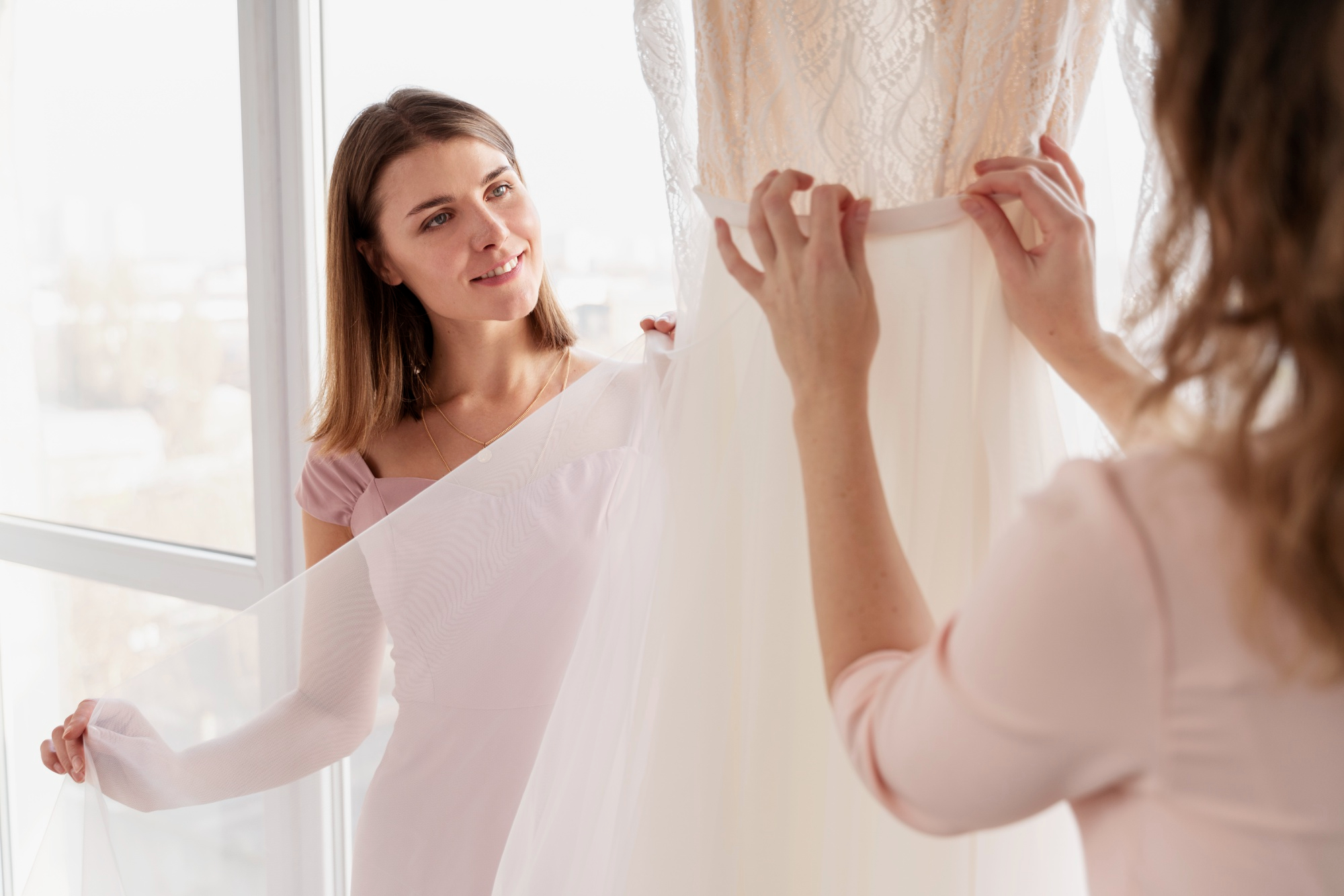
The boutique owner grabbed my wrist so firmly I nearly dropped my purse, pulled me behind a rack of evening gowns that rustled like birds startled from a branch, and put her lips close enough to my ear that I could feel the warmth of her breath.
“Do not say a word,” she whispered. “Stay right here. Trust me.”
Before I could ask why, before I could do anything except stand there with my heart beginning to knock against my ribs, I heard my daughter’s voice from the front of the store. Lily was laughing, that bright particular laugh she used when she was charming someone, the laugh that had always made me proud because it meant she was comfortable, she was happy, she was thriving.
Then I heard a man’s voice say something that pulled the floor out from under me, and I stood behind a curtain of sparkling fabric in a shop that smelled like perfume and new cloth, shaking, wondering whether I was about to witness my own daughter ruin herself and take everyone she loved down with her.
My name is Margaret Collins. I am seventy-two years old, and I mention that not as an apology for what I am about to tell you but as context for how long I have been learning to read the difference between what a person shows you and what they mean.
People have certain assumptions about grandmothers. We are supposed to be soft and tired and easily managed, supposed to smile and accept things without asking questions, supposed to believe the comfortable version of events that our children offer us because the truth is too complicated and we are too old for complications. I am soft sometimes, yes. I do get tired. But I am not blind, and I am not as quiet as certain people in my family had decided.
That particular Tuesday I was wearing my good church dress and a pair of white sneakers because my knees have opinions about heels that I have learned to respect. I had a small list in my purse with three items on it: find a gown for the rehearsal dinner, do not let Lily’s planning energy exhaust me, and remember that weddings are supposed to be joyful occasions even when the logistics are not. I should have added a fourth item. Do not trust the pretty smiles in expensive places. I will know better next time.
The boutique was called Rose and Ribbon, on a quiet street lined with little trees and bright window displays. Inside, everything was soft and calculated, mirrors positioned to multiply the dresses, lighting arranged to make every gown look like it was made specifically for you, air that smelled expensive in the general way of places that want you to spend money and have figured out that ambiance does most of the persuading. My daughter Lily was getting married in two weeks. She was twenty-eight years old, quick and polished, the kind of person who approaches every situation with a plan and a backup plan and a contingency for the backup plan. She worked in marketing and spoke about vision and strategy the way other people speak about the weather.
We had already found her dress months earlier at another shop. This trip was for me. Lily had explained, in the tone she used when she was being patient with me about something she considered obvious, that I could not arrive at her rehearsal dinner in my blue church dress, that as mother of the bride I would be observed and documented in photographs and therefore I needed to look like someone who had made an effort. I had said the blue dress had never done anything wrong, and she had not laughed. She had booked the appointment at Rose and Ribbon and asked me to please just try on some gowns for her.
So I came, because that is what mothers do.
The first dress was silver and heavy and made me feel like a piece of cutlery. The second was navy blue and pulled at my waist. The third was green with small beads that scratched my arms in a way that intensified with every movement. Lily sat on a small couch outside the fitting room and sighed at each dress with the theatrical disappointment of a director whose vision is not being realized. Too old. Too much like a curtain. Mom, you have to trust me.
I had been alive for seventy-two years. I knew what I liked. But it was her wedding and I loved her, so I kept trying.
It was during the third dress, while I was standing in the fitting room looking at a woman in a green beaded mirror who seemed uncertain about everything, that I noticed the boutique owner watching us from near the register. She was in her forties, hair pulled back, the kind of person who notices everything in a room because noticing is how she protects what she has built. Our eyes met and something passed across her face that was not what I expected, not the professional pleasantness of a woman managing a customer, but something that looked like fear.
She turned quickly and went into the back.
I did not mention it to Lily. The alarm bell was small and easy to dismiss. I am seventy-two and I have learned that small alarm bells are sometimes nothing and sometimes everything and you cannot always know which until later.
I was still in the green dress, arms scratching, when the owner reappeared and came directly to the fitting room. She put her hand through the slightly open door, touched my arm, pulled me a step further inside, and whispered the words I have already told you.
Stay here. Do not say a word. Trust me.
I am not sure why I did it. Maybe because the fear in her eyes the first time I saw it had been real enough that some part of me filed it away for later and now later had arrived. Maybe because something in her voice told me she was not performing concern but feeling it. I pressed my back against the wall, my purse clutched to my chest, my arms still scratching in the green dress, and I listened.
The music in the store was low and ambient. Hangers clinked. Then Lily laughed, and then a man’s voice began speaking, and I moved close enough to the fitting room door to see through the narrow crack that remained.
Lily was at the front of the store near the register, talking to a man I recognized immediately. Brian Hart, her wedding planner, a man who had been managing the logistics of the wedding for six months and whom I had never trusted without being able to say exactly why. He smiled too easily. He had the energy of someone who was always selling something, always working an angle, and he had made it politely clear from our first meeting that he found my presence in the wedding planning process an unnecessary complication.
Lily handed him an envelope. He opened it, glanced inside, nodded. Then he leaned toward her and said something in a lowered voice, but not low enough.
“Good. Once she signs the paper, everything is locked in. She will not be able to stop it.”
My hands found each other in the dark of the fitting room.
Lily said something I could not fully hear, her voice pleased and light.
Then Brian said, “Make sure your mom does not find out the gown is part of the plan. If she learns the truth, she will ruin everything.”
I put my hand over my mouth.
My gown. Part of the plan.
Then Lily said the words that reached through the door and into my chest and sat down there like something cold and heavy.
“Relax. My mom is sweet, but she is not smart like you think. She will stay quiet. She always stays quiet.”
The words were not cruel in the way that someone being intentionally vicious is cruel. They were casual. Offhand. The way you say something about a piece of furniture, or a habit, or a fact of nature. She was describing me to a man who was using her, and in her description I was someone whose predictable silence was a resource they could count on.
I had been alive for seventy-two years. I had raised that girl alone after her father left when she was eight years old. I had worked as a school lunch lady, then as a cashier, then as a babysitter for extra income, mending clothes instead of buying them, saving every dollar I could find, giving her everything I was capable of giving. I had spent decades choosing peace over conflict because I loved her and because I believed that love, expressed consistently enough, would eventually teach a person what love looked like in return.
Standing behind the door of that fitting room in a green dress that scratched my arms, I understood something that I had perhaps been refusing to understand for a long time. Choosing peace had not taught her what love looked like. It had taught her that I would be quiet.
Then Brian said it was the rehearsal dinner when it would happen, that everyone would be there, that it would be public and clean. Then Lily said after that she would get what she deserved, and it was not a happy girl talking about her wedding. It was a sharp, particular smile in her voice.
And then I heard her say something about a transfer, about money being ready, about it hitting after the rehearsal dinner like they had planned.
I stepped back from the door. My knees were soft. The green beads scratched my arms in their indifferent way.
Ethan was her fiancé. Ethan Brooks, a calm and steady man who called me mom and brought me tea when my arthritis was bad and had never once made me feel like an intrusion. He was kind in the specific way of people who are kind by nature rather than by strategy, and whatever was being planned in the front of this boutique, I did not believe he was part of it. Which meant he was the target.
The boutique owner came back to the door as soon as Lily and Brian left the store.
“Now,” she whispered.
I followed her through a door marked staff only, down a narrow hall smelling of fabric and something floral, into a small office crowded with boxes and a desk and a computer that had been running long enough to fill the room with a faint warmth. She closed the door and locked it and turned to face me, and I saw in her expression the complicated mixture of someone who is doing what they believe is right and is genuinely afraid of what that might cost them.
Her name was Marissa Lane, according to the small plaque on the desk. She opened a drawer and produced a folder.
“I am so sorry you had to hear that,” she said. “But you need to know the truth before your daughter hurts someone badly.”
“Who is she trying to hurt?” I asked.
Marissa said, “Your daughter is using this boutique to set up a trap. A trap that could send an innocent person to jail. And it starts with you.”
She slid the folder across the desk.
The first photograph showed Lily standing next to the locked glass display case near the front of the store, smiling, holding a necklace I recognized from the window display. A diamond lily pendant worth ten thousand dollars.
Marissa said the words plainly, without drama or embellishment, in the voice of a woman who has been carrying knowledge she did not want and is relieved to be putting it down somewhere else.
She planned to blame you for stealing it.
My phone buzzed. A text from Lily. Mom, do not leave. I will be right back.
I sat in the office chair with my hands in my lap and made myself breathe slowly the way my doctor had shown me years ago when my blood pressure made the room tilt. In and out, steadily, while Marissa told me what she had seen.
Lily had come in three days earlier, Marissa said, asking questions about security guard schedules and camera positions and how the boutique reported theft. Yesterday she had returned with Brian and they had stood near the display case for twenty minutes, Brian pointing at camera angles, Lily watching with the focused attention of someone memorizing a floor plan. That morning, before I arrived, Lily had come in early and asked a staff member to take the necklace case key to the back for cleaning, a request that did not follow any procedure Marissa had established in twenty years of running the boutique. The staff member had declined. Lily had waited near the case anyway, until Marissa came out and watched her, and only then moved away.
Then Marissa showed me the email thread.
Brian had written: Make sure she touches the case. Make sure it is on camera. Then we call it in simple.
Lily had written back: She will. She always reaches for shiny things. And she will be wearing gloves because of her arthritis. So no fingerprints, even better.
I read that sentence twice.
She knew about my gloves. The thin ones I wore because my hands stiffened in air-conditioned rooms and the cold made my arthritis flare. She was not just planning to use me. She was planning to use my pain. The particular physical accommodation I had made for my own body had been catalogued as a useful detail.
Marissa showed me more. A screenshot of an exchange where Brian explained that once I was accused and the police questioned me, the stress would keep me quiet and Ethan’s family would not want scandal before the wedding. His family cared about their reputation, Brian wrote. They would pay to make it disappear. And Lily had written back: Exactly. And I get to teach everyone a lesson.
I sat with that for a moment. Teach everyone a lesson. Not protect herself, not secure her future, but punish a family she had decided was looking down on her by using her mother as bait.
“Why are you helping me?” I asked Marissa.
She blinked several times before she answered.
“Because I know what it feels like,” she said finally, “when family turns your love into a weapon. And because if I let this happen in my store, I will never forgive myself.”
I slipped the folder into my purse.
Marissa handed me a gray hoodie from her desk drawer, told me to put it over the green gown so I would look different on the security footage if Lily tried to use it later. It smelled like laundry soap. I pulled it on.
We could both hear Lily’s voice outside the staff door, calling for me with sweet concern, asking if I was in there, saying she had been getting worried. The voice of a young woman performing the anxiety of a loving daughter.
Marissa opened the door, positioned herself in the hallway, and gave Lily a smile I had to admire even then for its steadiness.
“So sorry, we had an inventory question. Your mom is fine. She is just changing.”
I watched through the crack. Lily’s eyes moved behind Marissa toward the office door, quick and calculating, counting pieces, checking whether her plan was still intact.
Then Marissa stepped back and said one word to me: “Go.”
The back exit opened into an alley that smelled of warm concrete and city air. My car was around the corner. I walked quickly with the folder in my purse and the gray hoodie over a green beaded gown and my heart running faster than my legs, and I drove to the most public place I could think of, the grocery store parking lot on Maple Street where the lights were bright and the cameras were numerous and there were always people within shouting distance.
I sat there and let my hands shake on the steering wheel for a few minutes before I did anything else.
My phone was buzzing continuously. Lily calling. Lily texting. Where are you. Answer me right now. Do not make this a problem.
That last one I read three times. Do not make this a problem. It had the rhythm of a threat wearing the syntax of a reasonable request.
Then a text that removed any remaining uncertainty: I know you left through the back. I saw you. Come back right now.
She had been watching the back exit. Or Brian had. Either way, she had anticipated that I might run.
And then: If you talk to Ethan, you will regret it.
I sat in the parking lot across from the police station and thought about all the times in Lily’s life when I had chosen peace over honesty because I loved her and I did not want to add difficulty to difficulty. The times she had been unkind and I had found explanations for her. The times she had crossed a line I drew and I had moved the line rather than hold it, because holding it felt like withholding love and I had never been able to do that. I had thought I was being a good mother. I had been teaching her that love meant silence.
I called Ethan.
He answered on the second ring with the calm warmth of a man who had no idea what the next ten minutes were going to bring.
“Margaret. Everything okay?”
“I need you to come,” I said. “Maple Street grocery. Come alone.”
He came without asking more than was necessary, which told me something about his character that I already knew but was grateful to be reminded of just then.
He pulled into the lot, saw my face through the windshield, and got out of his car with the expression of someone who has understood that something serious has happened before he has been told what it is. We sat together in my car and I opened the folder on the dashboard and showed him the photographs first. Lily near the case. Lily holding the necklace. Lily’s smile.
Then the emails.
I watched his face as he read. Confusion first, then something harder. His jaw tightened. He went quiet in the specific way of a person who is not allowing himself to react until he has finished processing, because reacting before you have understood the full shape of a thing is how you make it worse.
When he finished he sat back and looked through the windshield for a long moment.
“That is not possible,” he said. Then, almost to himself: “Lily would not do that.”
I did not fill the silence. I let him arrive at his own reckoning.
“She threatened you,” he said. It was not a question.
I told him about the parking lot, the window, the photograph of him she had shown me on her phone. If you tell him anything, I will ruin him first.
He pressed his palms together and leaned forward with his elbows on his knees.
“My parents mentioned the prenuptial agreement last week,” he said quietly. “Lily was upset. I thought it was nerves. I did not think.” He stopped. “She thinks they look down on her. They do not. They are cautious, but they are not unkind.”
“I know,” I said.
He looked at me. “If she is willing to do this to you,” he said, “then I do not know who I am about to marry.”
We drove to Lily’s apartment together. I will not pretend I was not frightened. Not of Lily exactly, but of what the confrontation might produce, of the version of my daughter that would appear when she understood that her plan had been dismantled before it could run.
She was waiting outside when we arrived, already knowing something was wrong, already composing herself into the posture of the wrongly accused.
Ethan did not shout. He was not theatrical. He asked his question with the quietness of someone who has decided that staying steady is the only responsible way to proceed.
“Why did you plan to frame Margaret for stealing a necklace?”
Lily’s face moved through several versions of itself in quick succession. Then she looked at me with an expression I recognized, the flash of anger that arrives when a person who has been caught reaches for a counterattack.
“You were spying on me,” she said.
“I was standing in a fitting room,” I replied.
She looked at Ethan. “Mom misunderstood. Brian jokes all the time.”
Ethan held up his phone and played the call he had made to Brian while we were in my car. Brian’s voice confirming, when pressed, that yes there had been a plan, that Lily had been scared about the prenuptial agreement, that he had offered some ideas and it had gone further than it should have. Not a joke. A plan with camera angles and a timeline and a money transfer built into the rehearsal dinner schedule.
Lily stood on the steps of her own apartment and watched the plan she had built dissolve, and for a moment she fought it, she told Ethan he did not understand her situation, she told me I had always survived so this would have been fine, she threatened to tell people I had borrowed money and never repaid it, she said she would cry and Ethan would believe her over his old dramatic mother-in-law.
Then she seemed to run out of strategies, and what was left underneath them was something much younger and more honest.
“I did not want to end up with nothing,” she said. Her voice had gone quiet. “What if he leaves me one day? What if I end up like you, alone and struggling?”
The words landed precisely where she intended them to. I felt them.
I also understood them in a way I had not before. She had spent her life watching me endure, watching me absorb, watching me choose peace over confrontation, and she had read my survival as weakness. She had decided that if I was the model of a woman who loved without conditions, then loving without conditions was what left you vulnerable, and she was never going to be vulnerable.
“Lily,” I said, “I was not weak. I survived. Those are not the same thing.”
She looked at me across the steps and I watched the sharpness leave her face and something softer and more frightened take its place.
“I did not want to end up the way you did,” she said, barely above a whisper.
“I raised you,” I replied. “I kept the lights on. I kept you in school. I did not do any of that with tricks.”
She covered her face with her hands.
There was a long pause. Somewhere down the street a dog was barking. The evening was settling in.
Then Ethan’s phone buzzed. A message from Brian: If you think this ends here, you are wrong.
That changed the temperature in the air immediately. Lily’s head came up. Ethan read the message and understood, before the rest of us caught up, what it meant. Brian had access to the vendor contracts. He controlled deposits. He knew which caterer, which florist, which venue, which musicians. A man with nothing left to lose and a phone in his hand could dismantle an entire wedding in an hour.
This was the moment where I watched Ethan become someone to be trusted.
He did not panic. He did not spiral into recrimination or fall apart. He sat down at Lily’s kitchen table with a pad of paper and a clear head and began working through the list of what needed to happen, calmly, methodically, in the way of someone who has understood that the emotions are real but the problem is practical and practical problems have practical solutions.
First the bank. Lily called and placed a temporary freeze on the wedding account, all outgoing transfers requiring both signatures. Second the vendors, calling each one directly, explaining that any contact about cancellations from anyone other than Lily and Ethan personally should be ignored and confirmed with them before any action was taken. Third the documentation, gathering every email and message and contract and forwarding copies to Ethan’s father, who was a lawyer and who received the material, reviewed it, and called back within an hour with the composed authority of a man who has seen many crises and knows how to stop them from becoming catastrophes.
“Document everything,” he said. “If Brian attempts fraud or contract interference, you will have grounds for legal action. Do not engage emotionally.”
Lily said she was sorry, quietly, to Ethan’s father through the phone speaker, and there was a pause before he answered.
“We will talk about that,” he said. “Right now we focus on the problem.”
Not anger. Disappointment. Lily heard it, and I watched it land harder than anger would have.
When Brian called that evening, Ethan answered with the phone on speaker and his voice completely level.
“All vendors have been notified. The account is frozen. Our lawyer has your messages. If you attempt anything, we will press charges.”
Brian said they would not dare.
“Try us,” Ethan answered, and ended the call.
That was all. No drama, no ultimatums, no raised voices. Just a closed door.
The wedding was postponed by four weeks. Not cancelled. Postponed, because Ethan made a distinction between what had happened and who Lily was, and he was not willing to decide the latter based entirely on the former. He told her directly that he loved her, that he could not marry someone who believed hurting people was a strategy, and that if she was willing to do the work he was willing to wait and see.
They began counseling. At first Lily resisted the idea the way she resisted anything that seemed to cast her as the person who had gotten something wrong. Then she went anyway, because she was still capable of the honesty that arrives when strategies fail.
During those weeks she came to my apartment alone one evening and sat on my couch in the particular way of a person who does not know how to begin the thing they came to say. I made tea and waited.
“I thought if I did not grab control first,” she said finally, “I would be left behind. Like you were.”
“I was not left behind,” I said. “I chose to stay for you.”
She turned that over for a while.
“Were you ever scared?” she asked.
“Every day,” I told her. “But I did not solve fear by hurting people.”
She was quiet. Then she said, “I thought you stayed quiet because you were weak.”
“Sometimes staying quiet is weakness,” I said. “Sometimes speaking up is strength. The hard part is knowing which moment you are in.”
She looked up at me with her eyes wet.
“You spoke up this time,” she said.
“Yes,” I said. “Because I love you. And love does not mean helping someone do wrong.”
She cried then, not the performing kind, not the kind she had threatened to deploy in Ethan’s direction as a weapon. The real kind, the kind that comes from a specific place inside a person that they have been keeping locked. I held her the way I held her when she was small and the world had been too large for one day, and I did not tell her everything was fine because it was not all the way fine yet. But it was honest. And honest was more valuable.
The wedding, when it came, was quieter than originally planned. Smaller, simpler, without the elaborate staging that Brian had been designing for months. But it was real in a way that the original plan had never quite been, because the people standing in that room understood something about each other that they had not understood before, and that knowledge, even though it had arrived through difficulty, had made the foundation more solid rather than less.
Before the ceremony, Lily came to me in her dress.
“If you had stayed silent,” she said, “I might have ruined everything.”
“And if you had not listened,” I replied, “I might have lost you.”
She nodded slowly.
“I am still learning,” she said.
“So am I,” I told her. “That is the point.”
Ethan found me afterward near the edge of the reception, sitting at a small table watching Lily laugh with her friends in the uncomplicated way she used to laugh when she was a girl before the fear of losing things had settled into her.
“Thank you,” he said, sitting beside me.
I shook my head. “I did not protect you. I protected the truth. Truth is what protects everyone, eventually.”
He nodded and did not say anything else, which was the right response.
I thought about Marissa that evening, about the sharp fear in her eyes when she pulled me behind the rack of evening gowns and told me to trust her. I had called her the following day to tell her what had happened, and she had said she was grateful, and I had said no, I was, and then we had both understood that the debt ran in both directions and neither of us needed to track it.
I also thought about what Lily had said in my apartment: I thought you were weak because you stayed quiet.
She had been wrong, but I understood where the error came from. I had modeled endurance for so many years that the distinction between endurance and surrender had become invisible to the people watching me. What I had intended as patience had read as passivity. What I had offered as love had been received as permission.
The version of strength I had been performing for my daughter was not the one I had actually lived. The strength I had actually lived was quieter and less visible, the kind that gets you through a decade of raising a child alone on a cashier’s salary without losing your dignity or your sense of yourself. But I had not let her see that version clearly, and she had filled the space where it should have been with her own fears.
I was not certain how much of what happened was my fault. I thought about it for a long time, in the weeks after the wedding, sitting in my apartment with tea in the evenings when the day was done. I could not find a clean answer, which was probably the honest result. We had both been operating from incomplete information about each other, from the distances that form between parents and children when love is given in place of honesty.
What I knew was that the distance was smaller now.
Lily called me every week after the wedding, real calls, the kind that lasted longer than ten minutes and did not end with a sudden meeting she had forgotten. She told me things about her life that were not curated for my approval, not packaged to make her look successful. She asked me questions about my own life, about the years before she was old enough to remember, about what I had been like at her age, about what I had wanted.
I told her the truth. I had wanted exactly what she had wanted. Security, love, the confidence that the people who mattered to me would not simply leave one day and take the warmth with them. I had handled that fear differently than she had. I had absorbed it rather than acted on it, which had its own costs. But I had not let it make me into someone I did not recognize.
“You turned out okay,” she said once, with the particular tone of a person who is offering a compliment and also working something out for themselves.
“I turned out,” I said. “That is sufficient.”
She laughed, her real laugh, not the charming one.
Marissa and I have had coffee twice since the wedding. She is not what I would have called a friend before that day, but then neither was the woman who grabbed my wrist behind a rack of evening gowns and whispered trust me, and yet here we are. She told me over coffee the second time that she had been in a similar situation years ago, a family member who had decided that her silence was an asset to be used, and that watching it unfold in her own store had made her feel she had been given a second chance to do the thing she had not done the first time.
I told her she had done it well.
She said she was glad someone finally had.
I want to be clear about something before I finish telling this story. What I did was not clever or remarkable. I did not outmaneuver anyone. I did not build a trap or play a long game or wait for the perfect moment. I simply paid attention when a woman told me to stay quiet and listen, and then I refused to stay quiet when it mattered more to speak.
That is all.
But I have learned that all is sometimes everything, and that the difference between a person who endures and a person who is free is often nothing more than a single moment when they decide that love does not require them to help someone do wrong.
I thought I was weak because I was quiet. My daughter thought the same.
We were both wrong about what the quiet was.
It was not weakness. It was patience, and patience has its place, and it also has a limit, and the wisdom is in knowing where the limit is and being willing to stand at it when you reach it, even in a green beaded dress with scratchy arms and a purse full of evidence in a parking lot across from a police station while your daughter taps on your window and tells you not to make this a problem.
I was seventy-two years old in that parking lot.
I did not stay quiet.
And that, I think, was the most important dress I ever wore.

Specialty: Quiet Comebacks & Personal Justice
David Reynolds focuses on stories where underestimated individuals regain control of their lives. His writing centers on measured decisions rather than dramatic outbursts — emphasizing preparation, patience, and the long game. His characters don’t shout; they act.