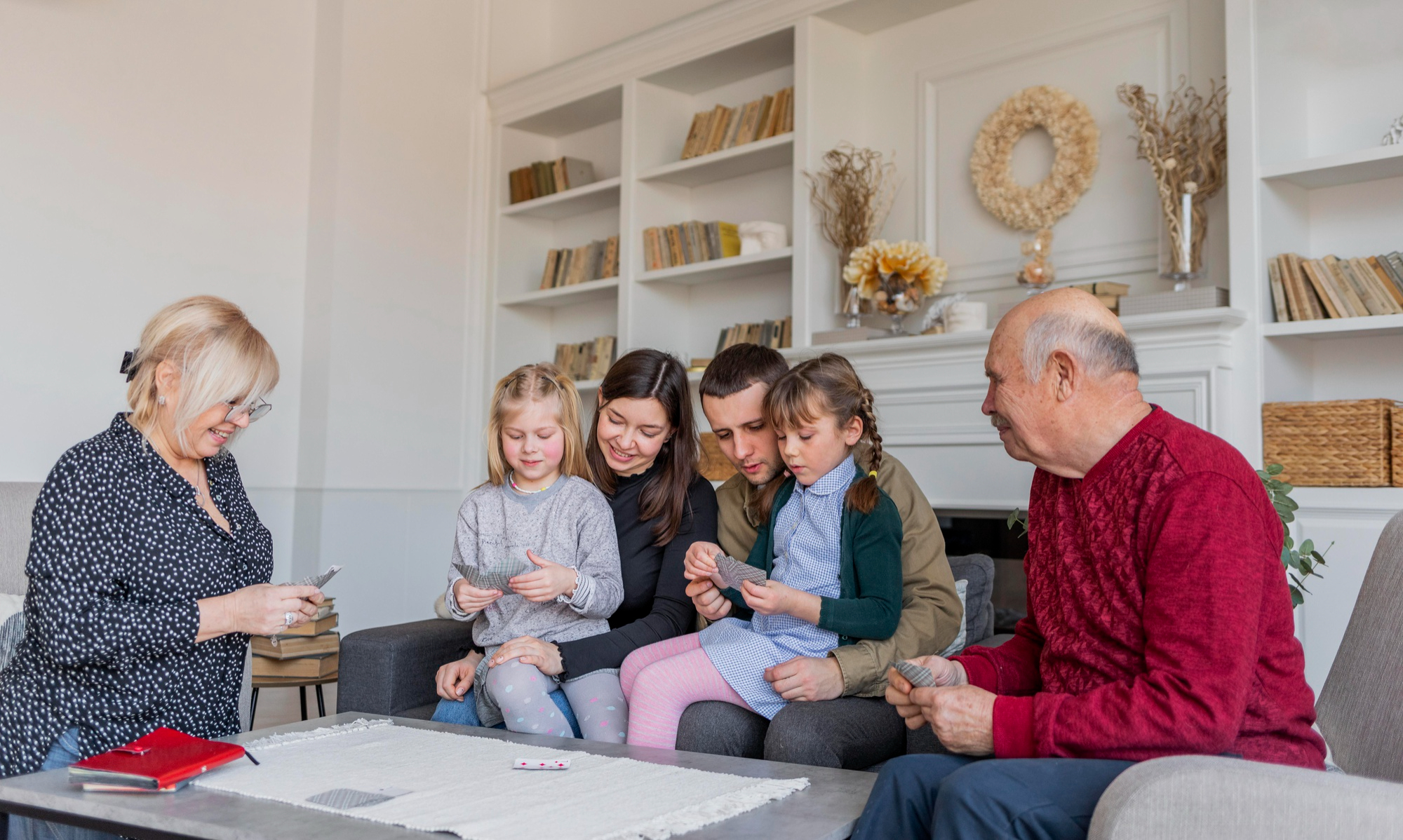
My father slammed his palm on the table hard enough to rattle the silverware and leaned into my face with the particular fury of a man who had never once been held accountable for anything in his life.
“You and your kid are just freeloaders.”
My mother did not object. She did not look surprised. She sat back and let a small, cold smile settle across her face, the smile of someone who has been waiting for someone else to say the thing she has been thinking, and she nodded once, slowly, like he had finally put a true thing into the air.
The cruel irony, the specific and devastating irony that I had to absorb in real time while sitting very still at that dining room table, was that the house around us no longer belonged to them. The floors, the walls, the roof over the heads of the two people calling my son a burden — all of it was mine. I had bought it quietly and legally and without drama, because banks do not accept family sentiment as a down payment.
My son Dylan was twelve years old and sitting beside me with his shoulders pulled in tight, staring at his plate like if he stayed small enough he could disappear from the room entirely. He had come because I had wanted him to understand that family could be something safe, something warm, something that did not require you to perform smallness in order to survive it. I had wanted that for him badly enough that I had ignored the way my stomach had clenched when we pulled into the driveway, ignored the peeling paint and the overgrown grass and the porch light flickering like a warning signal, ignored the way my mother’s hug felt like a stage direction and my father’s smile stopped a full inch below his eyes.
I could not ignore Dylan’s face now.
His cheeks were pale. His jaw was clenched. He was working very hard not to cry, not because he was fragile but because he was stubborn, because he had learned from watching me that you did not hand people who hurt you the additional gift of your visible pain.
My father’s voice still sat in the room.
Freeloaders.
My son.
I did not cry. I did not raise my voice. I did not slam my hands on the table the way my father did when he wanted to win an argument through volume and menace rather than reason.
I looked at him and said one sentence, quietly enough that he had to stop shouting to hear it.
“Then you’ll have no problem moving out of my house by the end of the month.”
The fork in my mother’s hand stopped halfway to her mouth. My father blinked with the specific confusion of a man who has not heard the word no spoken without apology in a very long time. My brother Philip, the golden child, the reason for everything and the author of nothing, froze mid-chew.
For five full seconds, no one in that room moved. The overhead fan turned and the refrigerator hummed from the kitchen and the silence had the particular quality of something fracturing under its own weight.
In that silence, I watched my parents understand, for the first time and all at once, that the thing they had been certain of for thirty-six years was not actually true. They were not untouchable. They were not in control. And the person they had spent decades treating as a resource to be managed rather than a daughter to be loved had, without announcing it, quietly changed the entire structure of the situation.
But to understand what that sentence meant, and why it carried the weight it did, you have to go back eighteen years to the summer my grandfather died and my parents showed me what they were made of.
My grandfather was my mother’s father, a quiet and steady man who smelled like sawdust and cinnamon gum and who hugged you in a way that felt like being anchored to something solid. He fixed things without making a performance of it and listened without waiting for his turn to talk. When he died I was seventeen and did not yet understand what his absence would cost us.
A year later, when I was eighteen, the will was read in a law office that smelled like carpet cleaner and polished wood. I sat in a chair that was slightly too large for me and heard the attorney say my name and the number that followed it.
One hundred thousand dollars.
I was eighteen years old and that number was not just money. It was oxygen. It was the gap between a future I had to fight for and a future I could build with some stability underneath it. I pictured college without debt, a computer science degree, a life that did not have to begin in panic and end in exhaustion. I pictured the particular freedom of not having to beg anyone for anything.
My parents smiled at me across the table when the attorney finished, but it was not a smile of pride. It was the smile of people who have just identified an asset.
That night they called me into the living room.
It was a humid summer evening and the air conditioner rattled against the heat and my mother stood near the window not quite able to look at me. My father sat in his recliner with his arms crossed and the expression he wore when he had already decided something and was delivering it rather than discussing it.
He did not spend time on preamble.
“We need your inheritance,” he said.
I held my college acceptance letter in my hands, the engineering program at the University of Louisville, folded soft at the edges from how many times I had unfolded and reread it as though repetition could make it more permanent.
“Need it for what?” I asked.
My mother managed to look at me then, her expression a careful mix of guilt and resolution, the expression of someone who had argued with herself and concluded that guilt was something she could manage if she kept moving.
“Your brother has a real opportunity,” she said. “He and your father are starting a construction business. They just need startup capital. It’s a sure thing, Colleen. We’ll pay you back.”
Philip was not in the room. He did not need to be. He was always the center of the conversation regardless of who was physically present.
“What about my college?” I asked.
My father shrugged in the way he shrugged when he found a question tedious. “You can get loans,” he said. “This is for the family.”
My mother nodded quickly to reinforce him.
That was the first time I understood with complete clarity something that would shape the next eighteen years of my life: my parents did not see my future as mine. They saw it as a component that could be removed and reassigned when Philip required it. I was not a daughter with a life. I was a resource with a name.
They did not ask.
They transferred the money. They signed the paperwork. They promised repayment once the business found its footing, and that promise floated away and vanished the way every promise in my family did, with no ceremony and no acknowledgment that it had ever been made.
The construction company collapsed within a year. Bad contracts, bad decisions, no accountability. My father blamed the economy. Philip blamed his partners. My mother blamed bad luck. No one mentioned that they had dismantled my future to fund something that required no competence and produced no results.
They never mentioned paying me back.
Not once.
Not ever.
That night, after understanding what had happened, I packed a duffel bag with clothes and a laptop and five hundred dollars saved from babysitting. I walked out of the house without a goodbye. No one came after me. No one called to ask where I was going or whether I was safe. I was eighteen years old and I was alone and something in me made a quiet vow that I was never going to let them own me again.
I moved into a cramped apartment near campus and shared it with two strangers to split the rent. I enrolled anyway. I worked three jobs: waitressing, stocking shelves, tutoring high school students in math. There were nights I was too tired to eat and weeks I lived on instant noodles and coffee, stretching every dollar as far as it would reach. I pinned my acceptance letter to the wall above my mattress like a promise I was making to myself and renewed every morning.
I graduated at the top of my class.
I got a job at a tech startup in Louisville and worked my way up from entry-level development to product management, building teams and software and a professional reputation that belonged entirely to me, that no one had helped me construct, that existed as evidence of what I had done when left with nothing but my own stubbornness and the specific anger of someone who has been underestimated by the people who should have been her foundation.
I met Travis. We had Dylan and three years of a marriage that ended when I found proof of infidelity and left his bags by the door without raising my voice. He stayed in Dylan’s life in the limited way he was capable of, and I stopped expecting perfect from anyone.
By thirty-six, I owned a three-bedroom house in a quiet suburb with a backyard where Dylan played soccer and a kitchen where I cooked real meals and my son told me every weekend about his plans to become an astronaut with the seriousness of someone already mapping the route. He was twelve and stubborn and funny and quietly determined, and he was the person I had built my entire adult life around, not in the suffocating way of a parent who makes a child responsible for their happiness, but in the way of someone who understands that the most important work they will ever do is create the conditions for another person to grow without damage.
My parents had begun contacting me again in recent years. The pattern was consistent. My mother would open with something that sounded like genuine interest in my life and arrive, within two or three messages, at the point, which was always financial. Philip’s latest venture had stalled. My father’s business had not recovered. They were in a tight spot. You’re doing so well, my mother wrote. Can’t you spare something for family?
I sent money a few times at first, telling myself each time that it was a one-time gesture, that I was doing it for some version of peace rather than in response to pressure. The requests did not diminish. They grew, and as they grew they became less careful, less veiled, more entitled. When I began saying no, my mother’s tone shifted from pleading to pointed. You’ve always been so focused on yourself. Your father sacrificed so much for you. We raised you.
Raised me. On the inheritance they had taken. On the college fund they had emptied into a business that failed within a year. On the absolute certainty that I would carry their decisions without complaint because that was what daughters like me were for.
I stopped answering most of their calls. I let the numbers go to voicemail. I had built a life that did not include them and I was not interested in dismantling it on their behalf.
Then my mother called on a Tuesday evening and her voice had a different quality.
“Colleen,” she said. “It’s your father. He’s sick. Really sick.”
My stomach tightened. Not because I immediately believed her, but because I recognized the specific power of that particular move. Illness created hesitation. It made reasonable people feel monstrous for holding boundaries. It was the strongest leverage my family had left.
“What’s wrong with him?” I asked, keeping my voice level.
She paused for exactly the right length of time. “His heart,” she said. “He needs surgery.”
Then she pivoted, faster than she probably intended.
“We’re in trouble,” she said. “The bank is threatening to foreclose. We’re three hundred thousand in debt. Your father’s latest venture went badly.”
There was the actual emergency.
“What do you want me to do?” I asked.
“Come over,” she said. “Talk to the bank. Help us out. You’re family.”
That word again. The word that in my family had always meant: you are obligated to absorb the consequences of our choices.
I told her I would think about it and sat on my couch after hanging up unable to sleep, turning the situation over. Part of me wanted to let them deal with it. They had never protected me from the consequences of their decisions; why should I protect them from the consequences of theirs? But another part, the part that remembered my father teaching me to ride a bike in the driveway and my mother baking cookies on winter afternoons, asked what if this is real? What if I don’t go and something actually happens?
I called Denise Bailey the next morning. Denise was my best friend and my financial adviser, the person who had told me years ago, with the directness of someone who understood exactly what she was looking at, that my parents were using me and that I did not owe them anything. She had helped me buy my house and set up Dylan’s college fund and think clearly about money in ways my family had never modeled.
“Don’t let them guilt you,” she said.
“I know,” I said.
“Then don’t go.”
But I had decided, in the hours I had spent unable to sleep, that I needed to face them one more time. Not for their sake. For mine. I needed to close something that I had left open for too long, and I needed Dylan to understand that managing difficult people was not the same as running from them.
I arranged for Dylan to stay with our neighbor Ms. Rowe, who adored him and treated him like a grandchild, and drove to my parents’ house with my hands tight on the wheel.
The house looked smaller than I remembered and considerably more deteriorated. Paint peeling, grass uncut, porch sagging at one corner. My mother opened the door, face composed but pale, and stepped aside in the manner of a receptionist rather than a parent.
Inside, my father sat in the living room looking frailer than I had ever seen him, though his eyes still held the stubborn quality of a man who had never stopped believing the world owed him something.
Over coffee, my mother presented the situation in the stripped-down language of someone who has stopped pretending. The bank was moving fast. They needed me to act.
“You’re making what now?” she said, and her tone had already moved past requesting into something closer to allocating. “You could cover at least two hundred.”
Two hundred thousand dollars. Not framed as a loan, not framed as a request. Framed as an arrangement, as though my salary were a shared account they had some claim to.
“Why is this on me?” I asked.
My father’s face hardened with the immediacy of a man who had always experienced that question as insubordination.
“We raised you,” he said. “We gave you everything. And now you’re hoarding your money while we lose our home.”
Gave me everything. The inheritance they took. The college fund they redirected. The years of silence between their financial emergencies.
I want to be precise about something: what I did next was not impulsive. It was not a reaction to being called a bad daughter or having my past erased. I had been planning it since the morning after my mother’s phone call, when I had met with Denise and with a real estate attorney named Laura Jennings before I had driven to my parents’ house at all.
Denise had listened with her jaw tight and said the thing that reframed everything: they are not asking you to save them. They are trying to chain you again.
Laura had laid out the financial situation with a clarity that made it structural rather than emotional. The house was in default. The bank wanted resolution. The timeline was short. I had the savings, investments, and credit access to purchase the property through an expedited sale to satisfy the default.
“What do you want?” Laura had asked.
“I want them to stop having power over me,” I had said.
“Then we take the power away.”
Laura negotiated with the bank and within a week we had a deal. I would purchase the property, satisfy the default, and the title would transfer to me. My parents could stay if they agreed to terms: a five-year repayment arrangement with automatic eviction for missed payments. A lifeline, but one that I held.
I had not told them because I needed to see something first. I needed to know whether they were capable of basic respect once they were no longer the ones holding the keys. I had brought Dylan because I was hoping, despite everything I knew, that this dinner might be the beginning of something different.
When my father screamed that my son was a freeloader, I had my answer.
The deed was in my bag in an envelope from Laura. I had been waiting for the moment my parents proved they did not deserve softness. They had provided that moment without hesitation.
So I said the sentence.
And the room stopped.
I did not slam the door on the way out. I did not throw anything or raise my voice or give them a scene they could later retell as Colleen being unstable. I took Dylan’s hand and felt his fingers tighten around mine and walked out into the night.
In the car, Dylan looked out the window without speaking for a while.
“I’m sorry,” I said. “You shouldn’t have been there for that.”
He swallowed. “Did I do something wrong?”
My chest tightened with the specific pain of watching a child trying to locate his own blame in a situation that had nothing to do with him.
“No,” I said. “You didn’t.”
He was quiet. Then: “Why do they hate us?”
He was not asking for drama. He was asking for logic. He was asking whether the world made sense, whether there was a reason for what had just happened that he could file away and use to understand how people worked.
“They don’t hate us,” I said. “They just don’t see us. There’s a difference.”
He nodded slowly, the nod of someone storing information.
“Are we going to be okay?” he asked.
“Yes,” I said, and I meant it from the floor of myself. “We are going to be more than okay.”
That night in a hotel room with my phone buzzing continuously, my mother’s texts arriving in waves of escalating injury. How could you do this. You’re tearing this family apart. After everything we sacrificed. My father’s messages were shorter and colder. You’ll regret this. You think you can control us. Philip called from an unknown number at midnight, his voice carrying the particular tone of someone who finds other people’s suffering intermittently interesting.
“Ruthless,” he said. “Didn’t know you had it in you.”
“You’ve never known me,” I replied.
“You’re really going to evict Mom and Dad?”
“I’m going to protect my son,” I said.
He sighed in the way people sigh when they want you to feel that your principles are an inconvenience to them. “You know they’ll make you the villain.”
“They already did,” I said. “I’m just done caring.”
The official notice went out the next morning. Paper, not a phone call, not a text. Crisp and legal and specific. I was the owner of record. My parents were occupants with no ownership rights. They were being offered a tenancy arrangement with a five-year repayment structure and automatic eviction for missed payments. The notice also contained a cease-and-desist from Laura regarding public statements about me or my son.
My mother called within an hour, voice shrill with fury.
“You think you can control us?” she demanded.
I let her finish.
“You got the notice,” I said when she paused.
“Of course I got it,” she said.
“Follow it,” I said, “or face the consequences.”
I hung up.
I thought that would be the end of the immediate escalation. I was wrong about that.
Denise sent me a link a week later with a message that said only: have you seen this?
I clicked it and my mother’s face filled the screen, tear-streaked, voice wavering with the specific quality of performed grief, clutching a tissue as she looked into the camera.
“My daughter abandoned us,” she said. “She has all this money but won’t help her own family save our home. She turned her back on us. On her own blood.”
The caption read: Ungrateful daughter leaves parents to lose everything.
Thousands of views. Hundreds of comments from strangers who did not know about the inheritance or the college fund or my father’s face when he called my twelve-year-old son a freeloader. Strangers who knew a story, the story my mother had always been talented at telling, the one in which she was the reasonable, grieving center of everything and I was the selfish one who refused to understand that family required sacrifice.
She had implied Dylan was benefiting. That he was somehow complicit in my cruelty. That a twelve-year-old child who barely knew her was living off sacrifices she had made.
I wanted to respond publicly. I wanted to put everything on a screen where strangers could see it: the eighteen years, the inheritance, the dinner table, my son’s pale face. I wanted to take her story and replace it with the truth the way you replace a rotten board with something solid.
But Denise’s voice was in my head before I could draft anything.
Don’t fight on their stage.
She was right. Responding in anger would give my mother exactly the footage she wanted. Colleen being unstable. Colleen proving she was the difficult one. My mother would edit whatever I said into evidence of her narrative and it would be twice as convincing because I would have handed it to her voluntarily.
So I called Laura instead.
Another letter went out. Formal documentation of the defamatory content, a citation of applicable law, and a clear statement that continued public false statements would result in litigation. The video came down within forty-eight hours.
The damage had been done in the sense that people had already seen it and drawn their conclusions. I had to make peace with the fact that strangers’ understanding of me was not mine to control and was not, ultimately, the thing that mattered.
My son’s safety mattered. My peace mattered. The life I had built mattered.
When my parents refused to sign the tenancy agreement, claiming they owed me nothing and intending to stay, I told Laura to proceed with eviction. I had expected this. My parents had spent their entire lives avoiding accountability; there was no reason to believe a legal notice would be the thing that changed that.
I saved everything during the weeks that followed. Every text, every voicemail, every written threat. I had learned early that people like my parents relied on fog, on the inability of their targets to produce specific evidence, on the gap between what had been said and what could be proven. I did not live in fog. I lived in documentation.
The legal process was thorough and not quick, but it moved. A court date was set. My parents filed no successful counter-claim because there was no counter-claim to file. The deed was in my name. There was no lease, no rental agreement, no written arrangement of any kind that gave them standing. They had been living in my house because I had let them, and I had stopped letting them.
By the end of the month they were gone.
Laura confirmed they had vacated, leaving the house in a state that described them accurately: half-packed boxes, furniture shoved against walls, the expensive things taken first and the broken things left behind.
I drove over alone. Dylan did not need to carry the memory of those rooms.
Walking through the house was strange in the particular way of being somewhere you have not been for a long time and finding that the shape of it has changed while the feeling of it has stayed the same. The kitchen where my mother had baked cookies was full of unwashed dishes. My old bedroom had been converted into storage for Philip’s failed ventures, boxes of inventory and stacks of paperwork and cheap goods still in plastic wrap. It looked like a physical map of my family: cluttered and chaotic and full of unfinished ideas to which no one had applied discipline or follow-through.
I hired a cleaning crew. I hired a contractor to assess and repair the damage. When the work was done, I put the house up for rent. The income would service the loan I had taken to purchase it and the remainder would go directly into Dylan’s college fund. Not generosity. Conversion. I was turning their chaos into my child’s future, which seemed like the most fitting possible use of it.
My parents moved into a small apartment across town. My father’s health remained fragile. My mother took part-time work at a grocery store. My father did bookkeeping for a local business. Philip moved in with them, still pursuing whatever he was pursuing.
For the first time in their lives they were required to stand on their own.
I blocked their numbers. Deleted their voicemails. Unfollowed my mother’s social media. The comments from strangers who had seen her video lingered at the edges of my thoughts occasionally, the people who had called me heartless without knowing anything, but I had to keep returning to the same reminder: those people knew a story. I knew what had happened.
My mother was good at stories.
I was good at reality.
When I picked Dylan up from Ms. Rowe’s he ran toward me holding a drawing of a rocket ship heading past the moon with stars scattered around it like confetti.
“For you, Mom,” he said.
I held him for long enough that he started to squirm.
That weekend we planted flowers in the backyard, something we had been planning for months. Dylan chose the colors himself: red, yellow, purple, the palette of someone who wanted the world to look louder. While we dug in the dirt he asked, quietly, whether they were mad at us.
“They’re mad at themselves,” I said. “But they’ll blame me because it’s easier than changing.”
He nodded, satisfied with the logic, and went back to planting.
That trust, that complete and unguarded trust, was worth more than any apology my parents could have manufactured.
Denise came over for coffee on an evening a few weeks after everything had settled and said, with the bluntness that made her the most useful person I knew: you’re free now. They can’t touch you anymore.
She was right. But freedom had a texture I had not expected, a strangeness that came from having organized so much of my internal life around the fight. I had to figure out who I was when the fight was over.
I threw myself into work, took on new projects, mentored younger colleagues, built things that mattered. My team noticed the shift in me before I had fully named it. The focus that had previously had something desperate underneath it acquired a different quality, steadier and less reactive, the focus of someone who is building rather than defending.
I thought sometimes about what lesson I hoped Dylan would carry from all of it. Not that difficult people should be avoided, because they cannot always be avoided. Not that strength means winning, because winning is not always the point. But that you could stand in a room with people who had decided you were nothing, look them in the eye, speak one factual sentence, and walk out with your child and your peace still intact.
That the size of your response does not have to match the size of their noise.
That documentation is quieter than screaming and considerably more powerful.
That the person who holds the deed to the building does not need to raise her voice.
I still drive past the old house occasionally. There is a young family renting it now. Their children’s bikes are on the lawn. Wind chimes hang on the porch my parents let fall into disrepair. The grass is cut. The windows are bright in the evenings.
It is just a house. Not a childhood, not a debt, not a weapon. A house with wind chimes and bikes on the lawn and people inside it who have nothing to do with me.
My home is the one where Dylan’s laugh fills the rooms and dinner is not an ambush and no one calls my son a burden. The one with the backyard we planted together, the red and yellow and purple flowers that Dylan chose because he wanted the world to look louder.
I do not know whether my parents learned anything. I do not need to know.
The line I drew was not a punishment. It was a fact. It was what happened when you called my child a freeloader in a house that had my name on the deed and assumed, as you had always assumed, that I would absorb it and say nothing.
I had said something.
One sentence.
Calm enough to make the room feel colder.
And then I had taken my son’s hand and walked out into the night with both of us intact, which was the only outcome that had ever actually mattered.

Specialty: Quiet Comebacks & Personal Justice
David Reynolds focuses on stories where underestimated individuals regain control of their lives. His writing centers on measured decisions rather than dramatic outbursts — emphasizing preparation, patience, and the long game. His characters don’t shout; they act.