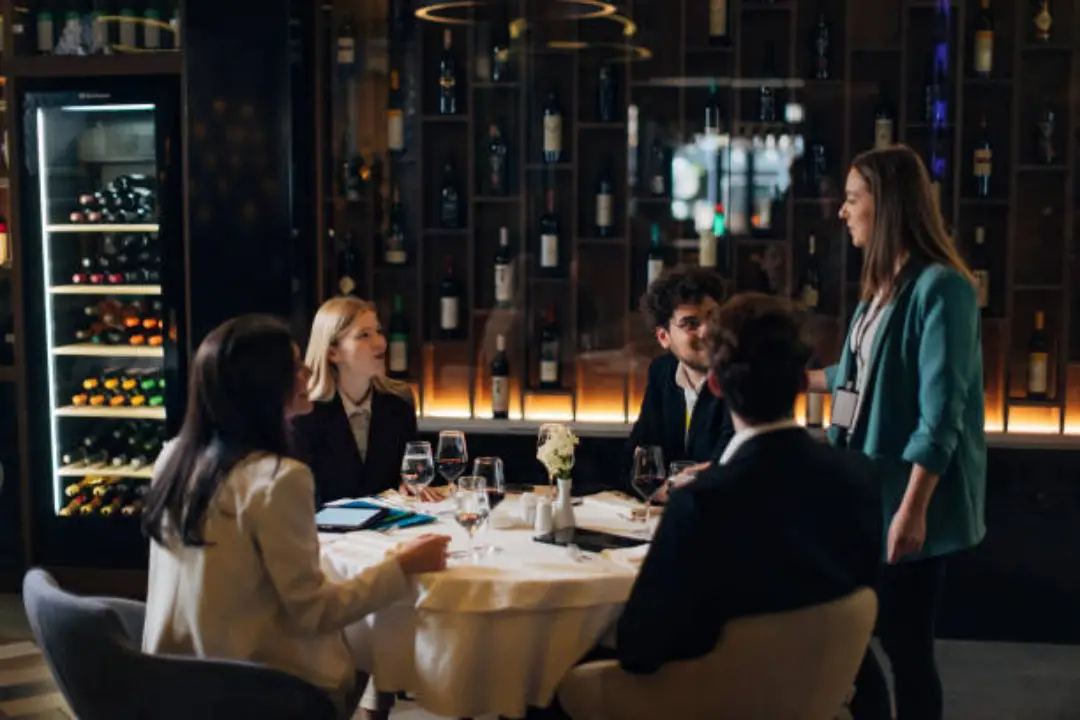
The country club dining room gleamed with old money and older traditions. Crystal chandeliers hung from vaulted ceilings, casting warm light over tables dressed in cream linens and silverplate settings. My parents’ fortieth anniversary celebration was exactly the kind of event they lived for — elegant, expensive, and packed with everyone who mattered in their social circle.
I sat at the family table in a simple black dress. Appropriate but forgettable. That had been my strategy at family events for the past four years.
Show up. Stay quiet. Leave early.
“Elena.” My mother’s voice carried across the table, sharp with forced cheerfulness. “Mrs. Whitmore was just asking what you’ve been up to. Tell her about your little projects.”
Mrs. Whitmore — dripping in pearls and condescension — turned to me with theatrical interest. “Yes, dear. Your mother mentioned you’ve been quite busy. What is it you do again?”
“I work in software development,” I said simply.
“Oh, how modern.” Her smile didn’t reach her eyes. “And are you with a major company? Google? Microsoft?”
“I run my own company.”
My father laughed — the sound cutting right through the pleasant dinner conversation around us. “She calls it a company. It’s more of a hobby, really. Elena’s always been creative with her descriptions of reality.”
Heat crept up my neck. Twenty-eight years of practice had taught me how to absorb these moments without reacting.
“Now, Richard,” Mrs. Whitmore said, though her tone suggested she was enjoying herself, “I’m sure Elena is doing her best.”
“Her best.” My mother dabbed at her lips with her napkin — a gesture I’d seen a thousand times when she was preparing to say something cutting. “That’s part of the problem, isn’t it? Elena’s best has always been somewhat limited.”
My brother Jason snorted from across the table. “She means she writes code in her apartment and calls herself a CEO.” He made air quotes. “Our little sister. The entrepreneur.”
His wife Amanda giggled. “That’s actually kind of cute. Like a lemonade stand but with computers.”
“It’s not quite like that,” I started.
“Elena has always had an active imagination,” my mother interrupted, addressing the table at large now. At least twenty people were listening — all part of my parents’ inner circle of wealth and influence. “Even as a child, she’d make up these elaborate stories about what she was going to accomplish. We thought she’d grow out of it. She didn’t.”
“Twenty-eight years old,” my father finished, “and she’s still living in a fantasy world. Pretending she’s building some empire from her studio apartment.”
“It’s a two-bedroom,” I said, immediately regretting the defensive tone.
“Oh.” Jason laughed. “Well then. Two bedrooms. That changes everything.”
The table erupted in polite laughter. I focused on my dinner plate and counted to ten.
Mr. Whitmore leaned forward. “What kind of software does your company work on, Elena?”
“Artificial intelligence,” I said quietly. “Machine learning applications for healthcare diagnostics.”
Mrs. Whitmore turned to my mother with exaggerated sympathy. “It must be so difficult, Catherine. Especially when Jason has done so well. Director of marketing at his age.”
“We are so proud,” my mother said warmly. “Jason has exceeded every expectation. Made all the right choices, attended the right schools, married wonderfully.” She beamed at Amanda. “They’ve just bought a house in Riverside Estates. Five bedrooms.”
“And Elena,” Mr. Whitmore asked, his tone making clear the answer would be unflattering, “where does she live?”
“The arts district,” my father said, making it sound like a slum. “One of those converted warehouse buildings. Very bohemian.”
“I like the neighborhood,” I said. “It’s central to the tech community.”
“The tech community?” Jason repeated, enjoying himself now. “Elena, do you hear yourself? You sound like a character from Silicon Valley. Except you’re not in Silicon Valley. You’re in a warehouse apartment pretending to be Steve Jobs.”
“Jason, don’t be cruel,” my mother said, though there was no real reproach in her voice. “Your sister is doing her best. It’s not her fault she wasn’t born with your drive and talent.”
“I just think it’s sad,” Amanda chimed in. “Elena, you were always so smart in school. Everyone thought you’d do something meaningful. But here you are, almost thirty, still playing around with computers like a teenager. Don’t you want a real career? A real life?”
“This is my real life,” I said, keeping my voice even.
My father set down his wine glass hard enough to make it ring against the table.
“That’s exactly the problem, Elena. This is your real life. Living alone. Working on projects no one understands. Earning God knows how little money. With no prospects, no future, and no ambition beyond your next coding session — or whatever it is you do.”
Then he turned to address the wider table, warming to his theme with the confidence of a man who’d never been challenged on anything.
“Elena has never understood her limitations. We’ve tried to help her see reality, but she’s convinced herself she’s some sort of genius entrepreneur. It would be funny if it weren’t so sad.” He gestured toward me with his wine glass. “She couldn’t succeed if she tried. She’s just not built for it. Some people have what it takes — the drive, the intelligence, the social skills necessary for real success. Others play with computers and call it a career.”
My mother nodded along. “Such wasted potential. She could have been something. Could have had a real life. Instead she’s thrown it all away on this technology fantasy.”
“Has she even made any money?” Amanda asked. “Like actual money?”
“If she has, she’s kept it very quiet,” Jason said. “Which tells you everything you need to know. If Elena had actually succeeded at anything, trust me, we’d hear about it. She’d make sure everyone knew.”
“I prefer privacy,” I said quietly.
“That’s what failures call it when they have nothing to show for themselves,” my father said. “Successful people are proud of what they’ve built. The fact that you’ve told us nothing about your supposed company in four years speaks volumes.”
My mother reached for my hand with manufactured warmth. “We’ve made peace with Elena’s choices. Not every child can be successful. Some people simply aren’t built for achievement. We love her anyway.”
I sat there, calm and composed, while my parents systematically dismantled me in front of fifty witnesses. I had learned long ago not to show the damage.
The Moment Everything Changed
Across the table, Jason was scrolling through his phone with a smirk. “Hey, Elena, remember that business plan you showed us three years ago? The one Dad called science fiction? Whatever happened with that?”
“I implemented it,” I said simply.
He laughed like I’d made a joke.
Then Mr. Whitmore’s phone buzzed.
He glanced at it, frowned, looked at it more carefully. His expression shifted — polite interest to confusion to something that looked like absolute shock.
“That’s odd,” he muttered.
His wife leaned over. Her eyes went wide. “Oh my God.”
And then it started — a wave of notification sounds spreading through the dining room like falling dominoes. My mother’s phone lit up on the table. She picked it up, read something, and the color drained from her face.
“Richard. Look at this.”
My father took her phone. His expression was skeptical as he read. Then it transformed — confusion, disbelief, and then something I’d never quite seen on his face before.
“What is it?” Jason demanded.
Amanda gasped, hand flying to her mouth, phone already in her hand. She turned it toward Jason without a word.
His face went from smug superiority to bewildered shock in about three seconds.
Mrs. Whitmore was staring at me. Her mouth slightly open.
“You’re Elena Chin?”
“Yes,” I said. “I’ve always been Elena Chin.”
“No, I mean — you’re the Elena Chin.”
My mother’s hands were shaking as she scrolled. “This says, Richard — this says she’s number one. Number one on the Forbes 30 Under 30 list.”
The dining room had gone completely silent.
My father kept reading, his face ashen. “Forbes’s number one pick for technology innovators. Elena Chin. Founder and CEO of Mediscan AI. Revolutionary diagnostic software that’s transforming healthcare globally. Twenty-eight years old. Company valuation—”
He stopped. Seeming unable to continue.
“$3.2 billion,” Mr. Whitmore finished quietly, reading from his own phone. “Personal net worth estimated at $890 million.”
Not a sound in the room.
Jason was scrolling frantically now, his face cycling through shock, confusion, and something that was quickly becoming horror.
“There are hundreds of articles. TechCrunch. Wired. MIT Technology Review. This went live ten minutes ago.”
“This has to be a different Elena Chin,” Amanda said, her voice going shrill. “She lives in a warehouse apartment. She doesn’t even dress nice. It has to be a mistake.”
Mrs. Whitmore turned her phone around. On the screen was a professional headshot from the Forbes article — me, in my office, looking far more polished than I did at family dinners.
“Does this look like a different Elena Chin?”
My mother’s voice was hollow as she read aloud. “Mediscan AI uses advanced machine learning algorithms to detect early-stage diseases from standard diagnostic images with 99.7% accuracy. The software has been adopted by over two thousand hospitals worldwide. It’s projected to save over one hundred thousand lives annually by catching cancers and other diseases years earlier than traditional diagnostic methods.”
“She founded the company four years ago,” my father continued from another article. “Working alone from her apartment, developing the initial algorithms. She’s been notoriously private, refusing interviews and publicity while building her company.”
Voices began filling the room as people at other tables shared what they were reading.
“The WHO is in talks to implement it in developing countries.”
“Johns Hopkins just published a study on it.”
“Reduced false positives by 87%.”
“They’re calling it the most significant diagnostic breakthrough in fifty years.”
Jason found a video — the single interview I’d agreed to, three months earlier, with MIT Technology Review. The only one. I’d done it on the condition they hold it until this month.
He pressed play. My voice filled the dining room.
“The goal was never to make money. The goal was to save lives. Too many diseases are caught too late. If we can use AI to detect them earlier — catch them before they become terminal — we can fundamentally change healthcare outcomes globally.”
The interviewer’s voice: “Your software is now in hospitals across six continents. How does it feel to know you’ve created something that will save tens of thousands of lives?”
“Humbling. And like validation that four years of eighteen-hour days were worth it.”
Jason stopped the video. His hand was trembling slightly.
My mother was crying now — not performatively, the way she sometimes did at family events, but genuinely. Tears tracking through her carefully applied makeup.
“You did all this in four years,” she said. “While we—”
She couldn’t finish.
What I Chose to Say
A man approached from a nearby table. He’d been watching everything unfold.
“Miss Chin. I’m Dr. Marcus Williams — a radiologist at Presbyterian Hospital. I use your software every day.” He paused, visibly gathering himself. “I need you to know it’s changed everything. I caught a pancreatic tumor last week that I would have missed completely without Mediscan. The patient starts treatment next week. She’ll survive because of your work.”
“I’m glad,” I said. And I meant it completely. “That’s why I built it.”
He shook his head slowly. “I had no idea you were so young. Or that you’d been working in such obscurity.” He looked at my family, then back at me. “Thank you. For everything.”
More people were approaching — doctors, medical professionals who’d been dining at other tables, all wanting to express something they hadn’t had words for until tonight. Through all of it, I answered questions calmly, genuinely, the way I always did in professional settings.
Meanwhile, my family’s phones began ringing. Not just buzzing with notifications — actually ringing with calls from media outlets, old friends, business associates. Everyone suddenly desperate to connect with the people who’d raised or grown up alongside Elena Chin.
My father set down his phone and looked at me.
“Four years. You’ve been building this for four years. Every family dinner. Every holiday. Every event where we criticized you, told you to get a real job, said you were wasting your life. And you were revolutionizing healthcare.”
“Yes.”
“Why didn’t you tell us?”
I looked at him. At his expensive suit, his perfectly styled hair, his face that had spent the entire evening radiating certainty and contempt.
“When would have been the right time, Dad? At Thanksgiving three years ago, when you told Uncle Mark I was unemployable? At your birthday last year when you said I’d never amount to anything? Tonight, when you told fifty people that I couldn’t succeed if I tried?”
He flinched.
Jason found another article on his phone. “There’s a video going viral. Someone recorded part of the dinner — Dad saying she couldn’t succeed if she tried. Shared forty thousand times in the last twenty minutes.” He looked up. “The comments are not kind.”
My father’s face went red. “You could have stopped this. You could have warned us.”
“Warned you not to publicly humiliate your daughter?” I asked calmly. “That shouldn’t require a warning, Dad.”
Mrs. Whitmore tried to recover the situation. “Well, this is wonderful news, Elena. We’re so proud. We always knew you were special.”
“Please don’t,” I said. “We both know that’s not true. You spent this evening calling me ordinary. Telling me to accept my limitations. Suggesting I find a nice entry-level job. You don’t get to rewrite history now that you know my net worth.”
She opened her mouth and closed it.
My mother’s sobbing had intensified. “How can you be so calm? We’ve said such horrible things. Such cruel, ignorant things.”
“Because you’ve been saying them for four years,” I replied. “I’m used to it. I stopped letting it hurt me a long time ago.”
“That’s worse,” she said softly. “That’s so much worse. You stopped caring what we thought because we treated you so badly.”
I didn’t disagree.
“What can we do?” my father asked. “How do we make this right?”
“I don’t know if you can,” I said honestly. “And I don’t know if I want you to.”
I checked the time, then looked at my brother.
“Why?” Jason asked suddenly. “Why didn’t you tell us? Really.”
I looked at him for a long moment.
“Because I needed to know who you all really were. Who you were when you thought I had nothing to offer you. When you thought I was a failure with no future and no prospects. And now I know.”
“What do you know?” my mother asked.
“That your respect has to be earned through success you can understand and quantify. That I’m only valuable to you when I’m worth $890 million and on a Forbes cover. An hour ago you were telling everyone I was delusional. Now you’re crying and trying to claim you always believed in me. The only thing that changed is your knowledge of my net worth.”
My father started to protest.
“Isn’t it?” I said, before he could form the words. “Look around this table. An hour ago you were describing me as a failure in front of the people you respect most in the world. Not strangers — your closest friends. The people whose opinions you value above your own daughter’s well-being.”
The dining room manager approached. “Miss Chin, there are approximately thirty reporters outside now—”
“I’ll leave,” I said, standing. “I don’t want to cause more disruption.”
“No.” My mother grabbed my wrist. “Please, Elena. Stay. We can work through this.”
“Work through what?” I asked gently. “Mom, you spent the evening telling your friends I was a failure. That I’d wasted my potential. That I couldn’t succeed if I tried. Those words came from somewhere real. The Forbes article doesn’t erase them.”
“If we’d known what you were building—”
“You would have treated me differently,” I finished. “That’s exactly my point.”
I pulled my phone out and sent a quick text. My security team had been on standby since the article dropped.
“Congratulations on forty years,” I said. “I mean that genuinely. I hope you have many more.”
Walking Out
Dr. Williams caught up to me at the door.
“One more thing,” he said. “My daughter is studying computer science at State University. She wants to work in medical technology. Would it be possible — could she reach out to you for advice?”
I smiled. The first genuine smile I’d managed all evening.
“Have her email me through the company website. I make time for students who are serious about using technology to help people.”
“Thank you,” he said, his voice full of something I couldn’t quite name. “For everything you’re doing. You’re changing the world.”
Outside, my security team formed a protective barrier as reporters shouted questions.
“Miss Chin, how does it feel to be number one on the Forbes list?”
“Elena, can you comment on the video of your father’s statements?”
“Is it true you developed Mediscan entirely alone?”
I didn’t answer any of them. Just walked calmly to my car — a Tesla, practical and efficient — and pulled away from the country club.
In the rearview mirror, through the dining room windows, I could see my family still sitting at that table. Surrounded by the people whose opinions they valued more than their daughter’s.
My phone was full of notifications. Interview requests, speaking invitations, messages from colleagues and investors and strangers. One text stood out, from Dr. Rachel Martinez at Johns Hopkins, one of the researchers who’d helped validate the software.
Saw the Forbes article. Congratulations on finally getting the recognition you deserve. Also saw the video of your father. I’m so sorry. You deserve better. If you need anything, call me.
I typed back: Thank you. Just ready for this day to be over.
Her response came immediately: Want to grab coffee tomorrow and talk about the next phase of the neural detection algorithms? Work is always a good distraction.
I smiled for the second time that evening.
Yes. That sounds perfect.
Because that was the thing — the thing my family would spend a long time trying to understand, if they ever did. The Forbes list wasn’t the point. The $890 million wasn’t the point. The work was the point. The hospitals using the software. The tumors being caught two years earlier. The families getting more time together because a disease was found before it became terminal.
That was real.
My family’s sudden warmth toward me — that was just reaction. To a number. To a cover story. To public validation they couldn’t ignore or reframe or dismiss.
I’d built something that was changing how medicine worked while they were suggesting I answer phones at a PR boutique.
I’d saved lives while they were telling fifty people that I couldn’t succeed if I tried.
And now they wanted to claim pride in it.
But I knew what I’d heard. And so did every person in that dining room who’d watched my parents dismantle me for an hour before the notifications started arriving.
I turned off my phone.
Tonight I was going home to my converted warehouse — my servers, my development equipment, my next project waiting on the screen. I was going to pour a glass of wine and pull up the latest test results from the neural detection algorithm.
Tomorrow I’d deal with the media. Figure out how to protect the privacy I’d worked hard to maintain. Decide what role, if any, this family would play in my life going forward.
But tonight, just the work.
The difficult, complex, world-changing work that had never once told me I wasn’t good enough.
That had always been enough.
It still was.
Specialty: Emotional Turning Points
Rachel Monroe writes character-driven stories about betrayal, second chances, and unexpected resilience. Her work highlights the emotional side of family conflict — the silences, the misunderstandings, and the moments when someone quietly decides they’ve had enough.