The Red Scarf
The first time Kevin and Karen Hart saw me again, they didn’t recognize me.
That is the particular cruelty of abandonment. The person left behind spends a lifetime carrying the moment like a stone worn smooth in the pocket, turning it over without meaning to, while the people who did the leaving treat it like a receipt they tossed years ago without bothering to read. They don’t carry it because for them there was nothing to carry. They simply walked away, and the walking was easy, and the ease is the thing you eventually have to make your peace with.
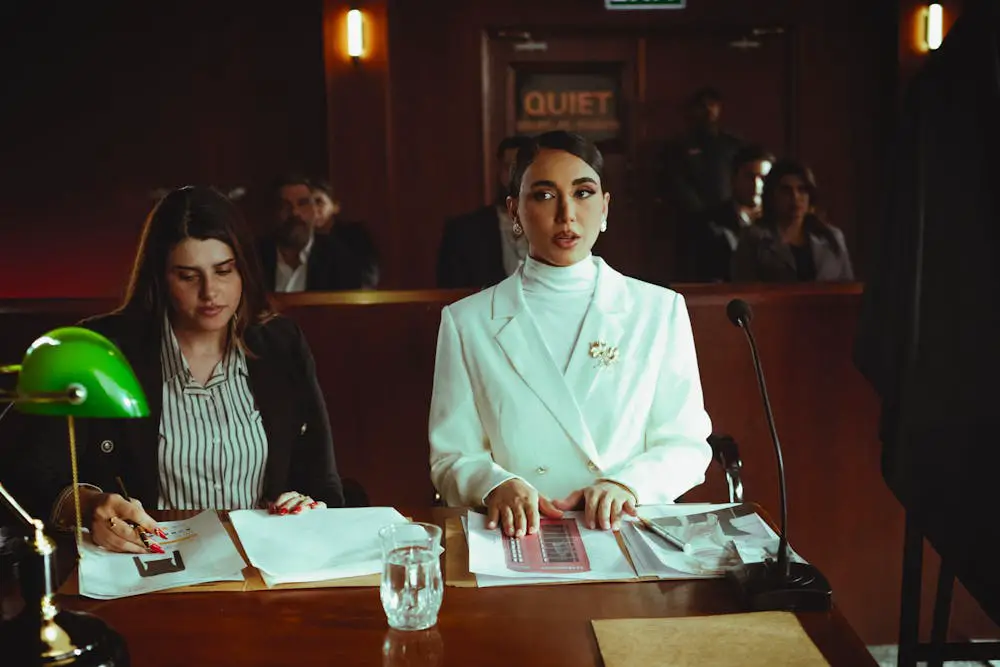
I was thirty-four years old, sitting at counsel table in Courtroom 23B, a red wool scarf folded in my lap even though the building’s heat was running full blast the way it always did in January. Across the aisle, Kevin and Karen were laughing quietly with their attorney as if they were already discussing what to do with money they were certain they were about to win.
They didn’t look haunted. They looked excited.
Karen’s hair was carefully curled into the kind of effort you make when you want to appear respectable to a stranger in authority. Kevin wore a suit that tried to look expensive and didn’t quite manage it, the shoulders slightly off, the tie too shiny under the fluorescent lights. Their attorney kept tapping a pen against his legal pad with the particular confidence of a man who has not yet understood that the courthouse is not his advantage.
Courtroom 23B had been mine for six years. I knew every scuff in the wood, every hairline crack in the tile near the jury box. It smelled the way all old courtrooms smell: paper and floor polish and the faint metallic trace of elevator air. It was where I had learned that silence, held correctly, is more powerful than anything you can say into it.
Kevin and Karen believed the silence belonged to them today. They’d brought their version of a story into my room and they were waiting for a stranger in black robes to hear it.
They were wrong about the stranger part.
The bailiff stepped forward. “All rise. Court is now in session for the Honorable Judge Samantha Hart.”
Kevin and Karen stood automatically, still smiling, still watching the side door where they expected someone to emerge. Their attorney rose with practiced ease, already composing his opening posture.
I rose from counsel table.
Karen’s smile lost its footing first. Her eyes moved to me the way a camera refocuses when it’s been pointed at the wrong distance. Kevin’s small laugh died mid-exhale. Their attorney’s pen went still above the page.
I didn’t rush. I didn’t turn to watch their faces. I walked past the bar, up the two steps to the bench, and sat down in the chair I had occupied a thousand mornings before.
The courtroom forgot how to breathe for one full, clean second.
The attorney’s practiced confidence collapsed. Kevin’s color drained. Karen’s mouth opened in the small, helpless way of someone who has just felt the ground change under them.
I looked down at the file without needing to. I already knew what it contained. A complaint dense with fabrication. A demand for five and a half million dollars. Claims that my adoptive father had unlawfully removed me from my family’s care. Claims that Kevin and Karen had spent decades searching with tireless devotion for the daughter they lost.
That last part I had to read twice before I believed they’d actually filed it. Not because it surprised me. Because the confidence required to put it in a legal document, under penalty of perjury, told me something about what thirty years had done to their capacity for honest self-examination.
I set my hands flat on the bench and met their eyes.
“My clerk has flagged a potential conflict of interest,” I said. “Before we proceed, I need to address it on the record.”
Kevin’s attorney recovered first, because attorneys are trained to keep moving when the floor drops. “Your Honor—”
I raised one hand, not aggressively, just far enough to reset the room’s understanding of who controlled the pace. “State your appearances.”
He did, his voice strained. My own attorney, seated at counsel table where I had been a moment before, stated hers with the calm of someone who has been preparing for this specific morning for months.
Then I looked at Kevin and Karen directly.
“Mr. and Mrs. Hart,” I said. “Do you recognize me?”
Karen’s throat worked. “You’re the judge.”
“Yes,” I said. “And I am also the person you have named as defendant in this action. Which means I cannot preside, and I am recusing myself effective immediately. This matter will be transferred to a reassigned judge.” I paused. “But before I step down, I will make one statement for the record, because the court record is permanent.”
Kevin’s attorney opened his mouth.
“You will have your opportunity,” I said, and my tone had the edge I used when someone tried to talk over a truth they didn’t want stated. “The person you are suing is alive and present in this courtroom. She has been alive the entire time you claim you were searching for her.” I let that settle. “Bailiff, please contact the assignment clerk.”
Karen made a sound that was not quite a word. Kevin stood frozen with the specific paralysis of a man whose plan has just been revealed to have been built on a foundation he never checked.
I stepped down from the bench, collected the scarf from counsel table, and walked out of Courtroom 23B.
Behind me, the room slowly remembered how to exhale.
To understand how I got to that bench, you have to go back to 1994 and Terminal 3 at O’Hare International Airport, where the floor hummed with the vibration of a thousand people moving through a world too large and too loud for a five-year-old to hold in her mind all at once.
The overhead announcements came in waves. Rolling suitcases clattered on the hard floors. People moved in fast, purposeful streams, weaving without looking, traveling in bodies that knew exactly where they were going.
I was five, wrapped in a red wool scarf my grandmother had given me the previous Christmas. It was too long, the tail of it dragging on the linoleum, and it scratched my neck, but I had refused that morning to let Karen take it off because it was mine and she had a way of taking things that were mine and not returning them.
“Keep up, Samantha,” she said, glancing back with eyes that measured rather than looked. “You’re slowing us down.”
Kevin didn’t look at me at all. He checked his watch. He studied the overhead signs with the focused attention of a man tracking something important that didn’t include me.
Neither of them held my hand.
They walked me through the concourse past gates where other families were pressing together, hugging, crying, doing the things that people do at airports when the arrivals and departures mean something. We ended up at oversized baggage claim: a wide, industrial space where golf bags and strollers and car seats came out on a metal carousel under lighting that made everything look slightly unreal.
Kevin pointed to a bolted metal bench. “Wait here. Watch the bags. We have to go get the tickets sorted.”
“How long?” My voice was small even to me.
“Not long,” Karen said, already turning.
“Can I come?”
“No. Stay with the bags. Don’t talk to anyone.”
And then they were gone.
I waited the way children wait, with the absolute certainty that the people who are supposed to return will return, because that is the operating assumption of a five-year-old who has not yet learned that it isn’t always true. I watched the carousel. I watched other people claim their things and leave. I watched the bags thin out until the carousel was almost empty.
The bags they had pointed me toward were not ours. I understood that eventually, the way you understand something you didn’t want to know.
An airport employee found me forty minutes later, still on the bench, the red scarf pooled around me, watching the door my parents had walked through. His name tag said Brian. He had kind eyes and a radio clipped to his belt that kept crackling with voices.
“Hey there,” he said, crouching to my level in the way adults do when they are trying not to frighten a child. “Are you waiting for someone?”
“My parents,” I said. “They went to get tickets.”
Brian looked at the nearly empty carousel. He looked at the door. He made a decision I will be grateful for the rest of my life.
“Okay,” he said. “Let’s go find them.”
They didn’t find them. Because Kevin and Karen Hart had already left the building.
Social services came. Then a temporary placement. Then another. The system did what systems do with small children who have no one: it moved me from one temporary space to the next while it looked for a permanent solution. I carried the red scarf through all of it. It was the only thing that remained constant.
William Aldrich found me two years later. That is not entirely accurate. The more precise version is that I found him first.
I was seven and living in my third foster placement when I wandered into the community library on a Saturday morning because it was the only place within walking distance that was open, warm, and didn’t require anything from me. William was in one of the reading chairs near the window, a large man in his late sixties with white hair and glasses and a book open on his knee that he wasn’t actually reading. He was watching the room the way some older people watch rooms: not looking for anything specific, just present in a way that suggested he had time.
I sat in the chair next to him because it was the only other empty seat.
He didn’t say anything for a while. Neither did I. Then he said, without looking up from the book he wasn’t reading: “That’s a remarkable scarf.”
“My grandmother made it,” I said.
“Where is she now?”
“She died,” I said. “Before all this.”
He looked up then, really looked at me, and whatever he saw made something in his expression change in the quiet, fundamental way of someone revising a decision they’d already made.
“I’m William,” he said.
“Samantha,” I said.
We sat in that library for two more hours. He bought me hot chocolate from the machine near the entrance and read to me from his book, which turned out to be a history of the Roman Empire that was completely inappropriate for a seven-year-old and utterly fascinating. When it was time for me to go back, he walked me to the door and said he’d be there the following Saturday if I wanted to come back.
I came back.
The formal adoption process took fourteen months. William’s attorney, a methodical woman named Helen whom I would later model my own professional bearing after, navigated every bureaucratic complication with the patience of someone who has decided that the outcome matters more than the inconvenience of the process. William’s background check was clean. His finances were more than stable, though I did not know the extent of this for years. What the social workers saw was a widower, retired, with a large house and no children and a clean record and an evident, unperformative affection for a seven-year-old girl who had been let down by the first people responsible for her.
The adoption was finalized on a Tuesday in March. William took me to the library afterward to celebrate, and then to dinner at a restaurant where they let me order whatever I wanted, and I ordered the pasta because the name was long and I liked practicing the pronunciation.
He never told me he was wealthy.
Not because he was hiding it, I understood later, but because he didn’t experience money as the most important thing about himself, and he didn’t want me to experience it that way either. We lived well. The house was large and comfortable. I had everything I needed and most things I wanted and none of it was flaunted. He drove a car that was twelve years old and well-maintained. He wore the same three pairs of shoes in rotation. He gave generously to things he cared about, which he did quietly.
What he gave me was structure, and time, and the particular confidence that comes from being treated as someone whose thoughts are worth hearing. He helped me with my homework and argued with me about history and attended every school event with the focused attention of a man who had decided this was the most important thing he had to do. He never made me feel like a project. He made me feel like a daughter.
I was good at school because I needed it to be true that effort produced results. I went to college and then to law school and then clerked for a federal judge who had the same quality William had of making you feel like the work mattered. I joined the DA’s office. I spent seven years in prosecution. I was appointed to the bench at thirty-two, and it felt, standing in the rotunda with the other new judges while the cameras flashed, like the particular completion of something that had started in a public library on a Saturday morning when a man with a book he wasn’t reading noticed a girl with a red scarf.
William died when I was thirty-three. It was sudden, which is the word people use when they mean there wasn’t enough warning to prepare, though I am not sure preparation is actually possible for the loss of someone who has been the fixed point of your life for more than two decades. He had a stroke on a Thursday evening in his reading chair. The book he’d been holding was about Byzantine architecture. The paramedics arrived within seven minutes. He was gone before they could do anything meaningful.
I sat with him for a long time before I let them take him.
The will reading, three weeks later, revealed what William had spent a quiet lifetime accumulating. His estate was valued at just over eleven million dollars. He had left half to the charitable foundation he’d established in his late wife’s name, which was the kind of thing that was completely in character and not the least bit surprising. The remaining five and a half million he left entirely to me.
There was a letter with it. I will not reproduce it in full, because it belongs to me in a way that most things don’t. But the relevant portion said this: You came into that library with a scarf and nothing else and you sat down like you had every right to be there, and you were correct. You always have had every right to be anywhere you’ve been. Never let anyone convince you otherwise. Everything here is yours because you are mine, and because I watched you build yourself into someone extraordinary, and I want you to have the means to keep building.
I read it sitting at his kitchen table, which was also my kitchen table, in the house where I had lived since I was seven, and I cried until I ran out of crying, and then I folded the letter and put it in the inside pocket of my coat close to where the red scarf usually lived.
Kevin and Karen found out about the estate through public probate records, because large estates in probate are a matter of public record and there are people who look for exactly this information.
They hired an attorney named Gerald Moss, who specialized in contested inheritance and had a reputation for creative legal arguments, which is the professional description of a man who will say almost anything if the contingency fee is large enough. The complaint they filed was, as I mentioned, impressively fictional. It alleged that William had taken me unlawfully from their care, that they had been searching without pause for thirty years, that their parental rights had never been legally terminated and that the adoption was therefore void, and that the inheritance rightfully belonged to them as my biological parents and legal heirs.
Every element of this complaint had a factual problem.
My attorney, Rachel Osei, had begun her career in family law and had spent sixteen years becoming extremely good at the precise intersection of probate, adoption, and civil fraud that this case represented. She was also, when the situation called for it, the kind of person who did not raise her voice because she didn’t need to.
She had been preparing the response to the complaint for six weeks by the time Kevin and Karen walked into Courtroom 23B. Their complaint contained the case number, the defendant’s name, and the courtroom assignment. It did not occur to Gerald Moss, apparently, to look up the sitting judge of Courtroom 23B.
Rachel had suggested, when we first discussed this possibility, that I could request reassignment before the hearing to avoid the procedural complication.
I told her I’d like to handle the recusal on the record.
She had looked at me across the conference table with the expression of someone who has just understood something they didn’t before. “Alright,” she said, and made a note.
The case was reassigned to Judge Harold Whitmore, who was sixty-one years old, had been on the bench for twenty-two years, and had approximately zero tolerance for what he later described in his written ruling as one of the more cynically constructed inheritance claims he had encountered in two decades of civil litigation.
Rachel presented the case with the methodical precision that is her signature. The record of my abandonment at O’Hare in 1994, documented in police and social services files. The subsequent foster placements. The legal adoption, finalized in a court of law with proper notice, proper procedure, and the termination of Kevin and Karen’s parental rights, which had occurred as a matter of law when they failed to respond to the state’s notices during the abandonment investigation. The thirty years of absence during which Kevin and Karen had made no documented attempt to locate me, contact social services, or file a missing child report. The complete lack of any parental action during the fourteen months of adoption proceedings, during which notice had been published in the legal register per statute.
Gerald Moss argued that the parental rights termination was procedurally flawed. Rachel produced every procedural record. He argued that William had deliberately concealed my whereabouts. Rachel noted that I had been enrolled in public school under my own name, had a public professional record spanning twelve years, and had been appointed to the bench, an appointment covered by the local newspaper. He argued that the adoption, being void, meant the inheritance should pass through biological intestate succession.
Judge Whitmore asked Gerald Moss whether he was aware that a void adoption and intestate succession to biological parents were two separate legal questions requiring separate demonstrations of merit, and whether he intended to argue both or was simply hoping one of them stuck.
Gerald Moss had the experience to keep his face neutral while this was happening, but Karen did not. She had come to the hearing expecting sympathy, the story of two grieving parents searching for a lost child, and what she found instead was a courtroom full of documents that told a different story, calmly and in order.
Kevin sat very still throughout, with the particular stillness of a man who has understood, probably somewhere in the middle of Rachel’s presentation, that this is not going to go the way he planned, and who is now principally occupied with managing his expression.
The ruling came eight days after the hearing.
Judge Whitmore dismissed the complaint in its entirety. He found no procedural defect in the original parental rights termination or the adoption proceedings. He found no basis for the claim that William had acted unlawfully. He found the allegations of a three-decade search to be unsupported by any documentary evidence whatsoever, including a pointed observation that no missing child report had ever been filed for Samantha Hart at any law enforcement agency in Illinois or any other state.
Additionally, he found that the complaint had been filed without adequate factual foundation and that the claims as pleaded were objectively without merit. He awarded sanctions. Gerald Moss would be paying Rachel’s fees.
He did not editorialize extensively. He didn’t need to. The ruling was fifty-three pages long and each page was another document that would live in the public record forever.
I read it in my office on a Tuesday morning with a cup of coffee going cold on the desk beside me. When I finished I sat for a while looking out the window at the street below, where people were moving in the purposeful streams that people always move in when they have somewhere to be.
I thought about Terminal 3. The carousel with its dwindling bags. The bench bolted to the floor. The way the time passed in the specific way that time passes when you are five years old and holding a red scarf and waiting for people who are not coming back.
I thought about Brian and his radio crackling with voices and his decision to crouch down to my level and take me seriously.
I thought about a library on a Saturday morning and a man in a reading chair and a book about the Roman Empire and hot chocolate from a machine.
I thought about William at every school play and every graduation, sitting with the focused attention of a man who had decided there was nothing more important to attend to. His handwriting in the margins of the books he lent me. His voice reading aloud in the evenings with the same investment whether the text was a legal brief or a novel. The way he argued with me about history and let me win when I was right and told me plainly when I was wrong, because he respected me too much to pretend.
Kevin and Karen did not contact me after the ruling. This did not surprise me. There was nothing they could say that would have served them, and they were fundamentally, whatever else they were, people who evaluated situations in terms of what served them.
Somewhere, I hope, Kevin and Karen are living with the accounting of what they chose. Not because I need them to suffer. I am past needing things from people who have already demonstrated what they’re capable of giving. But because accountability is the only way any of us grow, and I have spent enough of my life doing the work of understanding my own history that I believe, without particular anger, in the importance of other people doing theirs.
I kept the house. It felt right to keep it, the large comfortable house where I had done my homework at the kitchen table and argued about Byzantine architecture and learned that stability was not a luxury but a condition under which people can actually become themselves. I kept William’s reading chair. I kept the book about Byzantine architecture, which still has his pencil notes in the margins, small clear observations in the handwriting I know better than I know my own.
The scarf hangs on the hook by the front door. It has been washed many times and is softer now than it was in 1994, the red faded to something warmer and more complicated. It is the only object I have from my life before William, which means it is the only physical evidence I carry of the five-year-old who sat on a bolted metal bench and waited with absolute faith for people who had already decided to leave.
I don’t carry that faith anymore, in the sense of extending it to people who haven’t earned it. But I carry something else, which is harder to name and more useful. William called it discernment. The ability to look at a person and understand, without needing them to declare themselves, who they actually are. He thought it was a skill. I think it is a form of survival that became, over time, a form of wisdom.
I returned to Courtroom 23B the morning after the ruling.
I sat down in my chair behind the bench, the way I had a thousand mornings before. The clerk handed me the day’s calendar. The first case was a property dispute, two neighbors and a fence line, both of them certain they were right and both of them slightly wrong in the specific way of people who have let a small thing grow into a large one because they wouldn’t look directly at it.
I looked out at the courtroom: the scuffed wood, the cracked tile near the jury box, the smell of paper and floor polish that never quite goes away. The room where I had learned that silence held correctly can accomplish more than any argument made into it.
I had not been saved by money. I want to be clear about that, because the inheritance is the part of this story that is easy to fixate on, the number large enough to feel like the point. But the money is not the point. The money is the last thing William could do for me, and it was generous and I am grateful, and I will use it carefully in the way he used everything: deliberately, without display, in service of things that matter.
What saved me was a man in a reading chair on a Saturday morning who looked at a seven-year-old girl with a red scarf and decided she was worth his time and his attention and his whole, unhurried presence for the next twenty-six years of his life. What saved me was the library itself, warm and open and requiring nothing. What saved me was Brian with his crackling radio who crouched to my level and took my situation seriously. What saved me was every social worker who filled out the right forms and every attorney who navigated the right procedures and the clerk of court who published the right notices and the judge who signed the adoption order.
What saved me, in the end, was the accumulation of people who decided, in their various capacities, that a small person mattered. That she deserved the same consideration as anyone else. That the circumstances of her arrival were not a verdict on her worth.
I became a judge because I believe in that accumulation. Because I have seen what it costs when institutions fail to protect people who depend on them, and I have seen what it looks like when they work the way they’re supposed to, and I wanted to be part of the version that works.
Every morning I walk into Courtroom 23B and sit behind the bench and the room understands, without my having to explain it, that what happens here is serious. That the people who come into this room will be heard. That the record is permanent and the truth matters and silence, held correctly, is more powerful than anything shouted into it.
I learned that from William, who learned it in his own way, and passed it to me the way you pass something important: not in a single moment but over years, in small daily acts of consistency, until it became part of how I understood the world.
The scarf is on the hook by the door when I leave in the morning. It is on the hook when I come home.
It has been everywhere I have been. It was there at the beginning, when the world was loud and I was small and I was waiting.
It is here now, at the end of the story that isn’t really an ending, because the life built on William’s patience and my own stubbornness and the accumulated decisions of people who chose to see me is still ongoing, and I intend to be deliberate with it, and I intend to be worthy of the choosing.
That is the whole of it.
That is everything.

Ethan Blake is a skilled Creative Content Specialist with a talent for crafting engaging and thought-provoking narratives. With a strong background in storytelling and digital content creation, Ethan brings a unique perspective to his role at TheArchivists, where he curates and produces captivating content for a global audience.
Ethan holds a degree in Communications from Zurich University, where he developed his expertise in storytelling, media strategy, and audience engagement. Known for his ability to blend creativity with analytical precision, he excels at creating content that not only entertains but also connects deeply with readers.
At TheArchivists, Ethan specializes in uncovering compelling stories that reflect a wide range of human experiences. His work is celebrated for its authenticity, creativity, and ability to spark meaningful conversations, earning him recognition among peers and readers alike.
Passionate about the art of storytelling, Ethan enjoys exploring themes of culture, history, and personal growth, aiming to inspire and inform with every piece he creates. Dedicated to making a lasting impact, Ethan continues to push boundaries in the ever-evolving world of digital content.