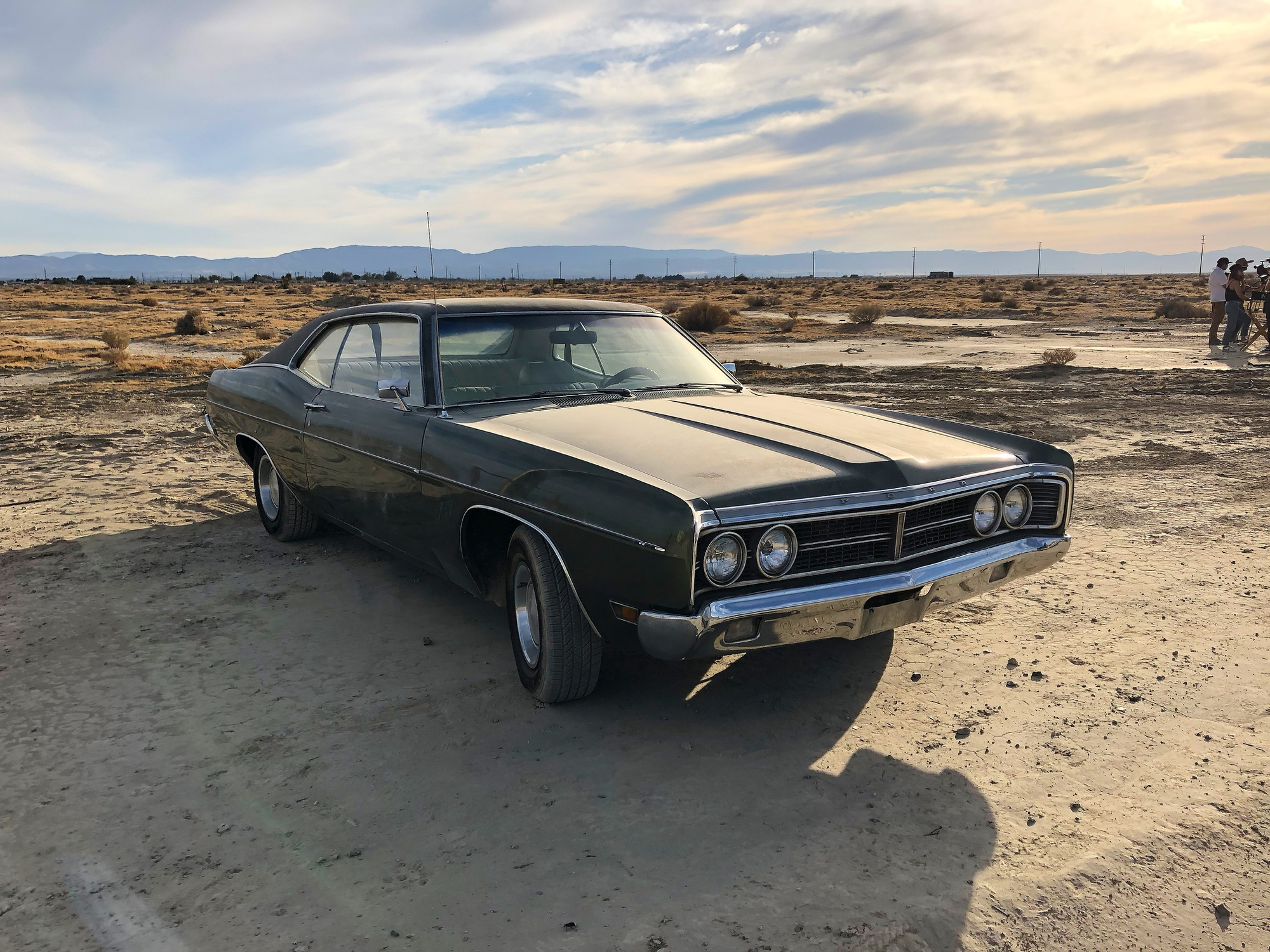
The first thing that hit me wasn’t the heat, though the heat was considerable, the thick Virginia August kind that sits on your chest and makes every breath feel like effort. It wasn’t the cicadas either, screaming in the oaks like someone had thrown a switch. It wasn’t even the smell of cut grass and warm asphalt that used to mean home when I was a child who understood what home was supposed to mean.
It was the open garage door.
Wide. Exposed. Hollow.
I stood at the end of my parents’ driveway with my duffel biting into my shoulder and my boots still carrying the dust of three airports and two foreign countries, and I looked at that open door and felt something drop out of the bottom of my chest. The sprinkler arced across my father’s lawn in its lazy, indifferent rhythm, turning the afternoon light into glitter. His newspaper lay folded on the porch swing the way it always had, right side up, the fold precise, as if the world were still running on its normal schedule. The wind chime my mother had hung after the last hurricane scare clinked softly in the breeze.
Everything looked exactly the way it was supposed to look.
Except for the place where my dream should have been.
No gleam of chrome. No rally-red shimmer catching the sunlight from the far end of the bay. No low, muscular silhouette that I had carried in my head since I was twelve years old and my grandfather first showed me a picture in a magazine and said, someday, kid. I had kept that image through seven years of deployments, through sandstorms and sleepless months and the particular loneliness of being far from everything familiar. I had held it the way soldiers hold whatever they hold in the long hours between action, a fixed point, a promise to themselves that there was a life waiting on the other side of all of it.
Just empty concrete. Oil stains. A shadow where something once belonged.
There is a cruel irony in training your entire adult life to manage chaos, to function inside firefights and ambushes and the grinding unpredictability of combat operations, and then being undone by silence. Not the silence of a cleared building or the hush after gunfire stops. The domestic silence of a garage that has been stripped clean.
My name is Emily Carter. I am thirty years old, a Captain in the United States Army, and standing at the end of that driveway I understood something I had been slow to accept for years. Whatever war I had been fighting overseas had nothing on the war that had apparently been running without my knowledge inside my own family.
I set my duffel down near the workbench and walked to the center of the bay. The air inside was cooler than outside, stale and faintly gasoline-scented, the smell of every garage I had known since childhood. My parents’ garage had always smelled like this. It used to comfort me. It used to mean tools on a pegboard and Grandpa’s old manuals with oil-stained covers and the possibility of something being made or fixed. Now it smelled like absence made physical.
I looked down at the concrete. The tire marks were still there, faint, the ghost of where it had sat. A pale rectangle of floor where sunlight had never reached because my car had blocked it for three years. Someone had rolled it out of here like it was just a thing. Like it was just metal and rubber and a price tag.
Like it wasn’t seven years of my life compressed into sixty-five inches of wheelbase.
My fingers found the key fob in my pocket by instinct, and I held it for a moment before I understood what I was doing. The weight of it felt absurd. A key for a door that had been torn off its hinges.
I picked up my duffel and went inside.
The kitchen was exactly as I remembered: sunlight angled through the window above the sink, a bowl of fruit on the counter, the refrigerator humming its steady note. The dish towels were folded over the oven handle the way my mother had always folded them, edges aligned, because she was a woman who believed the small visible things said something about the invisible ones. There was a glass of water on the counter with a lemon slice floating in it, the kind of detail that exists because someone put it there, a gesture toward beauty or comfort or the simple daily insistence on things being nice. The kitchen smelled the same as it always had. Some combination of dish soap and whatever had been cooking earlier and the particular warmth of a house that has been lived in for thirty years.
My mother sat at the table with a cup of tea, steam curling near her face. She looked calm, the specific calm of someone who has been waiting and has decided not to make it dramatic. My father stood at the counter with a cutting board, his movements unhurried, jaw set in that posture he had always had, shoulders rigid, as if the world owed him an apology he was still waiting to receive.
Neither of them said welcome home.
I stood in the doorway for a moment and let myself feel the full weight of that. Seven years. Seven years of deployments and training rotations and the particular loneliness of being somewhere difficult while the people you love are somewhere easy. Seven years of calls that connected badly and letters that arrived out of order and the sustained effort of maintaining relationships across distances that make maintenance hard. When you come home from a long absence you expect something from the people you come home to, not a parade, not anything excessive, but some acknowledgment that the absence was real and that the return matters. A welcome home is three syllables. It costs nothing. They had neither offered it.
I heard my own voice come out hoarse and quiet.
“Where’s the car?”
My mother stirred her tea with small, neat circles. Then she said, in a tone so casual it felt like being struck without any wind-up: “Oh. That.”
My father’s knife paused for a moment, not stopped, just considered, and then resumed.
My mother finally raised her eyes to me. They were soft, almost relieved, like someone delivering news they had rehearsed.
“Thanks to your car,” she said, “Andrew finally got the trip of his life.”
The words arrived but did not immediately assemble into meaning. My brain ran them through twice, the way you run an order through twice when the radio is breaking up, trying to hear clearly what was just transmitted.
My father exhaled through his nose. “It’s done,” he said. As if that resolved it.
“What do you mean it’s done?” I asked.
“Andrew needed something good, Emily,” my mother said. “You know how hard it’s been for him.”
Hard.
I stood in my parents’ kitchen still wearing the boots I had put on in Germany and I turned that word over and looked at it. I had spent the previous month running NATO exercises in conditions that left my muscles failing at the end of every day. Before that I had spent years in places where the sand worked its way into your teeth and the night sky was so vast it seemed designed to communicate your irrelevance. I had earned every promotion, every commendation, every breath I had taken in uniform. I had made choices, hundreds of them, to live smaller and save harder so that I could come home to something that was unambiguously mine.
And they were telling me Andrew had it hard.
“You sold it,” I said. The words came up like something being dragged from deep water. As soon as they were out I felt the thing they described become real in a way it had not been until I named it. “You sold my Corvette.”
My father set the knife down. He rubbed his forehead the way he had always rubbed it when I said something that inconvenienced him.
“You’re a soldier, Emily,” he said. “You’ve got money. You’ll buy another one. Andrew only has one youth.”
I almost laughed. Not because anything was funny. Because the line was so perfectly, absurdly consistent with every version of this conversation I had been having my entire life, in my head, in letters I never sent, in the long quiet hours of deployment, that my body didn’t know what other signal to produce.
That car had not been bought with money alone. It had been bought with nights on my back in a tent listening to distant sounds that might or might not require waking my unit. It had been bought with scars and discipline and birthdays missed and the specific hunger of wanting something badly enough to deny yourself everything else in service of it. It had been bought with seven years of choosing.
They dismissed it with a sigh and a phrase about youth.
I looked at my mother’s cup of tea and my father’s cutting board and the entirely ordinary kitchen around them, and something shifted inside me. Not heartbreak exactly, though heartbreak was part of it. More like clarity, the cold precise kind that comes when the fog finally clears and the terrain is exactly what it is, no worse and no better than what you can see.
I don’t remember sitting down, but I was suddenly in the chair across from my mother, looking at the grain of the table.
“How much,” I said.
My father answered. “Enough.”
“That’s not a number.”
He met my eyes then, steady, almost daring me to react. “Seventy-eight.”
Seventy-eight thousand dollars. I had paid eighty-two for it after a full restoration, numbers-matching 427, original interior, documented history, the kind of provenance that makes a car a record instead of a machine. I knew every bolt in it. I knew the sound of the engine cold versus warm, the particular way the hood sat in afternoon light, the feel of the wheel at highway speed.
“You undersold it,” I said automatically.
He shrugged. “It was just a car.”
My phone vibrated in my hand. I didn’t remember taking it out of my pocket. Unknown number, Virginia area code. I answered.
“Emily Carter.”
A man’s voice, measured, slightly uneasy. “My name is Peter Wallace. I just bought a 1969 Corvette Stingray from Robert and Linda Carter.”
I stood up from the table and walked toward the window.
“And?” I said.
“There’s a problem with the paperwork.”
“How did you get this number?”
“From the bill of sale. Your signature’s on it.”
The kitchen seemed to tilt slightly, the way a room tilts when something large and structural has just shifted without warning.
“My signature,” I repeated.
“Or at least,” he said carefully, “it’s supposed to be.”
Five words.
I walked out of the kitchen without looking at my parents and went back into the garage, into the cool and the smell of absence, and I stood in the pale rectangle of floor my car had left behind.
“Send me a photo,” I said.
My phone pinged a few seconds later.
There it was. My name. Emily Carter. A signature that looked almost right, almost, the way a forgery looks almost right when someone has practiced but has not lived with the original long enough to understand where it lives in the body. The E was wrong. I loop mine, always have, a habit from a teacher in fourth grade who said loops make it yours. That one was stiff. Hesitant. Practiced by someone who had copied the shape but not the motion.
My chest did not tighten.
It steadied.
This is the thing about crisis training that they do not explain until you are in the middle of something real: it does not make you unafraid. It makes you functional inside fear. My hands were entirely still.
“When did you purchase it?” I asked.
“Three days ago. I tried to register it this morning and the DMV flagged the VIN. The title transfer didn’t match the federal military vehicle registry record.”
Of course it did not. Because the title had never been transferred. Because I had never transferred it. Because the vehicle was still legally mine and had been since I bought it and the only thing that had changed was that someone had written my name on a piece of paper without my knowledge or consent.
“Mr. Wallace,” I said, “that vehicle was sold without my authorization. I am the sole legal owner. I never signed that document.”
Silence.
Then a low exhale. “You’re serious.”
“Yes.”
He said something quiet and not quite printable.
“I paid in full. Wire transfer. I had no idea.”
“I know,” I said. “Where is the car right now?”
“In my garage. Climate-controlled.”
Good. Safe. Not modified, not moved, not driven into anything that would complicate what came next.
“Do not touch it. Do not attempt to sell it or move it. I will have my attorney contact you within the hour.”
When I hung up, I stood for a moment in the garage with my phone in my hand and the shadow of my car on the floor and understood precisely what had happened and what it meant.
Betrayal is one thing. Betrayal is personal, emotional, the province of grief and anger. Forgery is something different. Forgery is a crime. Forgery is a felony. Forgery is something you can fight with tools that do not require you to win an argument or change someone’s feelings or convince anyone that you deserved better.
I walked back into the kitchen.
My mother looked up first. Something in my face had changed, apparently, because her composure cracked slightly at the edges.
“What?” she asked.
I placed my phone on the table and slid it toward my father, screen up, the image of the forged bill of sale visible.
“That,” I said, “is a felony.”
He did not touch the phone.
“Emily, don’t be dramatic,” my mother said.
“Forgery. Fraudulent sale of property. Interstate wire transfer under false pretenses.” I said each one with the same flat evenness I used in briefings when the information was important and the room needed to hear it clearly. “Those are not dramatic characterizations. Those are federal charges.”
My father looked at the screen. The color left his face slowly, which was almost worse to watch than if it had left quickly.
“You signed it,” he said. Not a statement, really. More like a wish that something could still be made true by saying it.
“No,” I said. “You practiced signing it.”
The silence that followed was different from all the silences I had been sitting in since I arrived. This one had weight. It had the specific gravity of consequences that have not yet landed but are visibly in motion.
My mother set her tea cup down with a careful precision that told me her hands were not entirely steady.
“We did what we had to do,” she said. “Andrew needed—”
“Andrew needed a yacht?” I pulled up his social media on my phone. The most recent post was from Ibiza. Champagne flutes, white deck, open ocean, his face turned up to the sun like a man who has never had to account for anything. The caption read, simply: Living my best life. Posted forty-eight hours ago.
My father ran one hand through his hair. “It was an investment in his future.”
“With my past,” I said.
I did not raise my voice. That is an important detail, not because restraint is a virtue in and of itself, but because I had learned, in seven years of leading people in high-stress situations, that volume is what you reach for when you have run out of substance. I had not run out of substance.
“I’m calling JAG,” I said. “And a civilian attorney. You have one hour to decide whether this becomes a police report or a full restitution agreement with written admission of what was done.”
My mother’s chair scraped back. “You would send your own father to prison?”
I looked at her steadily. “You made that decision when you signed my name.”
The cicadas outside went on screaming, indifferent, relentless, doing what cicadas do.
I stepped back into the garage and called Captain Harris. Legal. He answered on the second ring.
“Carter. You’re supposed to be on leave.”
“I am,” I said. “I need civilian counsel and a fraud report on title forgery.”
His tone shifted immediately, the way experienced people’s tones shift when they hear something serious. “Who forged it?”
“My father.”
A pause long enough to tell me he was choosing his next words carefully.
“Document everything,” he said. “Every text, every voicemail, every piece of paper. Don’t threaten and don’t escalate. Make one clear statement of what you’re prepared to do and then let the law move.”
That is what the military teaches you, underneath the tactics and the physical conditioning and the leadership doctrine. It teaches you that emotion doesn’t win anything. Structure does. Patience does. Knowing your next three moves before the first one lands.
When I walked back into the kitchen, my parents were speaking in low, urgent voices that stopped when I entered.
My father looked older than he had an hour ago. Smaller, somehow, though nothing about him had physically changed.
“Andrew can wire it back,” he said quickly. “We’ll fix it.”
“You can’t retroactively un-forge a federal document with a wire transfer,” I said. “But restitution and cooperation are things a judge considers when determining sentencing.”
My mother made a sound that was not quite a word.
“Sentencing,” she repeated, and the word seemed to require effort, like something she was picking up for the first time and finding much heavier than expected.
“Yes,” I said.
For the first time in my life, sitting in that kitchen in the house where I had grown up, they were genuinely afraid of me. Not of my anger, not of my disappointment, not of my judgment on their choices. Afraid of what I knew how to do next. Afraid because I was not crying and I was not begging and I was not looking for a way to make this smaller so that everyone could go back to being comfortable.
Three hours later, my brother called from Spain.
I let him finish what he had to say, which took about ninety seconds and was loud enough that I held the phone a few inches from my ear. When the volume dropped I said one sentence.
“You spent my sacrifice. Now you can fund your own consequences.”
He hung up.
The following morning, seventy-eight thousand dollars arrived in my account. Wire transfer. Then, a few minutes later, another twelve thousand, with a memo that read pain and inconvenience, which was someone’s attempt at damage control expressed in the only language they had ever been fluent in.
I did not touch either transfer.
I met Peter Wallace in person two days later. He was a decent man, visibly frustrated at having been pulled into something that had nothing to do with him, and cooperative in the way that people are cooperative when they want to be entirely clear that they were not involved in whatever happened. We voided the sale formally, filed the corrected documentation, and when he rolled my car out of his garage into the afternoon light, the rally-red paint did what it always did in direct sun. It caught fire a little. It became more than a color.
The engine started on the first turn. Deep and clean and completely itself.
I drove it home.
Not to my parents’ house.
To a storage facility twelve miles away, registered under my name, with a climate-controlled bay and a security code that existed in no phone but mine and no document but one I kept in a fireproof safe. I had it detailed and photographed and every piece of documentation associated with it placed in a folder that was clear and complete and would never again depend on anyone else’s good intentions.
I sat in the driver’s seat for a few minutes before I got out, just sat there with the engine cooling and the smell of the interior around me, that particular combination of original vinyl and old metal that good restoration preserves. I had imagined this moment for years. Not with any specific scene attached to it, just the general shape of it, the feeling of being home and being in the car and having both of those things be real at the same time. The actual moment felt different from the imagined one, as real moments always do. It felt quieter. More complicated. It felt like the end of something as much as the beginning.
I thought about my grandfather, who had first shown me a picture of this car in a magazine and said someday, kid. He had died while I was on my second deployment, and I had not been able to come home for the service, and I had sat in a communications tent in a desert and written a letter to my grandmother that I still have a copy of somewhere, the kind of letter you write when you are trying to say something true about a person you loved and you understand you are running out of occasions to say it. He would have understood what the car meant and what had been done to it and he would not have been surprised by any of the people involved.
I got out, locked the bay, entered the security code, and drove my rental car back to the hotel where I was staying while I figured out the next steps.
That night my father left a voicemail. I could hear in his voice the specific register of a man who is surprised by the outcome of his own decisions. “I didn’t think you’d go that far,” he said.
I deleted it.
What he meant was that he had not thought I would fight. He had understood, somewhere in his reading of me, that I was a person who had been trained to absorb difficulty and keep moving, that I was accustomed to sacrifice, that I was built for endurance. He had read all of that correctly and drawn the wrong conclusion. He had confused endurance with permission.
Soldiers do not just endure. We protect what we are responsible for protecting. We identify threats clearly and respond to them with the tools appropriate to the threat. We do not negotiate with the same party repeatedly on the same terms and expect different outcomes.
The Corvette was never just a car. I want to be precise about this because people tend to reach for that phrase, just a car, when they want to reduce something to a scale they can dismiss. It was not just a car. It was the concrete form of a decision I had made and kept through seven years of circumstances that would have been sufficient justification for abandoning it. It was proof, the specific kind of proof that exists only in objects, that the life I was living overseas was building toward something on the other side. It was mine in the most fundamental sense, built with choices that cost me something real every day for years.
They had tried to take it by writing my name on a document and pretending the document was real.
They had underestimated me. That is the most accurate and least dramatic way to say it. They had looked at everything they knew about me and concluded that I would absorb this the way I had absorbed other things, quietly, and continue. They were wrong.
I still drive it on Sunday mornings, when the roads near the storage facility are quiet and the air is cool enough to justify having the top down. I take it out on the route I planned years ago, during a deployment when I had too many night hours and a road atlas someone had left in the common area, a loop through the hills east of the city that takes about forty minutes at a civilized speed and somewhat less if I’m feeling honest about what the engine wants.
Every time I shift into second I hear my father saying you’ll buy another one. He was not wrong about the abstract possibility. I could, eventually, find another numbers-matching 427 with documented provenance. The market exists. The money exists now more than it ever has.
But I did not need to buy another one.
I kept the first one.
And there is a kind of proof in that, a different kind than the proof the car itself represents. The proof that what they tried to take is still mine. That the signature they practiced writing does not appear on any document that matters. That the title is clean and the registration is current and the key fob in my pocket opens something real.
My relationship with my parents is what it is, which is to say it is minimal and structured and honest in the way that things become honest when there is no longer anything to protect by being dishonest. My father has never said he was sorry. My mother has said it once, in a card, in language so cushioned by qualifications that the apology itself was difficult to locate. Andrew and I do not speak. There was a period, in the months after everything settled, when I tried to examine whether I had handled it correctly, whether a different approach might have produced a different outcome, whether there was some version of those conversations where I said the right thing and everyone understood and the family remained intact in some functional form. I spent some time with that question and concluded that the answer was no. Not because I am without flaw, but because the problem was not the conversation. The problem was the belief, long-held and deeply embedded, that I was a resource rather than a person. You cannot talk your way out of that belief in someone else. You can only decide whether you are going to continue operating inside it.
I am not carrying grief about this anymore. I carried it for a long time, the particular grief of understanding that the people who raised you are capable of choosing their comfort over your dignity, and that this is not something you can fix by adjusting yourself. That grief has its season and I gave it its season and now I am on the other side of it, which is not a place without feeling but a place where the feeling is clean.
I have a storage unit with a security code and a car that starts on the first turn and a folder of documentation that is complete and entirely in order.
I have seven years of sacrifice that built something tangible and still exists.
I have what I came home for.
And that, it turns out, is enough.

Specialty: Quiet Comebacks & Personal Justice
David Reynolds focuses on stories where underestimated individuals regain control of their lives. His writing centers on measured decisions rather than dramatic outbursts — emphasizing preparation, patience, and the long game. His characters don’t shout; they act.