The Great Room
There is a particular quality of light in Aspen in late October that I did not fully appreciate until I moved here. It arrives early, coming over the eastern ridge while the valley is still in shadow, and it hits the upper peaks at an angle that makes the snowfields look lit from within rather than reflected. By the time that light reaches my porch, it’s already been traveling for eight minutes from the sun and has done more in that time than most things accomplish in a day. I drink my coffee on the porch most mornings and watch it descend the mountain at its own pace, and I think about the fact that I spent thirty-seven years waking before dawn to begin work and that now I wake before dawn because I want to, which is a different thing entirely.
My name is Harold Winston. I am sixty-eight years old and I spent most of my working life in the restaurant business, which means I spent most of my working life on my feet, in heat, managing the particular chaos of an industry that operates in the exact hours when most people are at leisure. I owned three restaurants over the course of my career, starting with a forty-seat lunch counter in Denver when I was thirty-one and ending with a well-regarded dining room in Colorado Springs that seated a hundred and twenty and that I sold four years ago for more than I had imagined possible when I started. I don’t say that to impress anyone. I say it because it is the relevant context for everything that follows: I built what I have from long hours and small margins and decisions that I was solely responsible for and that occasionally kept me awake until two in the morning wondering if I’d gotten them wrong.
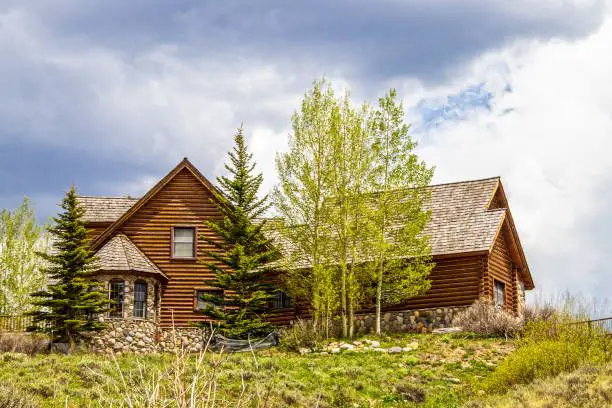
The cabin in Aspen I purchased eighteen months ago. It sits at the end of a private road about a mile and a half from town, surrounded by aspen trees that were gold when I first saw the property and are bare now that winter has settled in. It has four bedrooms, which is more than I need, a great room with a stone fireplace that runs floor to ceiling, and a porch that faces the mountains in a way the previous owners had clearly planned with some care. When my real estate agent walked me through it the first time, I stood in the great room for a long moment looking at that view and understood that this was where I was supposed to spend the next chapter of my life. I made an offer that afternoon.
I have not regretted it. I wake early and drink coffee on the porch and read and cook simple meals and take long walks in the afternoons when the light is low and the shadows on the snow run blue. On the weekends I sometimes drive into town for breakfast at a place on the main street that has been there longer than most of the newer establishments and that makes the kind of eggs that remind me of why I got into the food business in the first place. I have made a few friends, people I run into regularly enough that we’ve moved from nodding to talking, and I have kept up my friendships from Colorado Springs through phone calls and occasional visits.
It is a quiet life. I wanted a quiet life. I had earned a quiet life, and I intended to live it.
My son Trenton is forty-one. He was, for most of his childhood and young adulthood, the person in my life I was most proud of, which is saying something because I have generally been proud of the things I built. When he was young, really young, he would meet me at the door after my shifts with an energy that the late hours hadn’t dampened, demanding to know what I’d cooked that day, what had gone wrong, what I’d fixed, how I’d managed the rush. He had a genuine curiosity about the mechanics of things, how things got made, what it took to make them. I recognized it as something like my own quality, the orientation toward work not as obligation but as interest, and I fostered it as best I could in the years when I had enough presence of mind to be an intentional parent, which, I’ll say honestly, was not always.
The transition happened gradually, as these things tend to, and I cannot point to a single moment when Trenton became someone different. What I can say is that by the time he was in his mid-thirties, the curiosity had quieted and something more calculating had moved into its place. The calls became shorter. The visits became annual, then less. He began to talk about money in ways that were adjacent to conversations about me, my business, my plans for retirement, what my “intentions” were regarding the properties I owned. They were not aggressive conversations. They were just noticeably interested in a direction that made me pay attention.
Then he married Deborah, and the dynamic took on a different shape.
Deborah is forty-three, and she is, in social settings, a genuinely compelling person. She has the gift of full attention, or the appearance of it, which amounts to the same thing in a room full of people who are happy to be convinced. She asks follow-up questions. She laughs at exactly the right moments. She has opinions about interesting things and she states them with enough certainty to be engaging but enough qualification to seem reasonable. I have watched her work a room and understood, in a professional way, exactly what she was doing, having spent thirty-seven years managing people who were also always performing for their audience, and I respected the craft of it even when I didn’t trust the motivation.
In smaller settings, with just family, the performance had different qualities. She liked things to move at her pace and in her direction, and when they didn’t, she had ways of redirecting that were subtle enough to be invisible to people who weren’t watching. She did not argue in the traditional sense. She reframed. She introduced new contexts. She let silences sit just long enough to suggest that the alternative to her preference was an absence of resolution. She was, in other words, someone who was very skilled at getting what she wanted without appearing to want it.
What she wanted from me became clearer over time. The restaurant business, when I sold it, had generated a significant sum. The cabin in Aspen had been purchased outright. I had additional investments, managed carefully over the decades, and a retirement income that was comfortable without being extravagant. I was, by any reasonable measure, a man of some means, and I was aging, and I had a son whose wife was very interested in how things would eventually be arranged.
The conversation that changed the nature of my attention came from a man named Pete Gallagher, who had worked with me in the restaurant business in the early days and who had retired to a place in the mountains near Vail. We speak every few weeks by phone, the kind of friendship that survives distance because it was built on honesty rather than proximity. Pete called me on a Tuesday evening in August and said, after the usual preliminaries, that he wanted to mention something and that he hoped I wouldn’t take it the wrong way.
I told him I never took useful information the wrong way.
He said that his wife’s book club met monthly and that Deborah had recently begun attending with a woman from her yoga studio who was friends with Pete’s wife. He said Deborah was friendly and social and entirely pleasant at these gatherings. He also said that at the most recent meeting, while Pete was in the kitchen making himself a drink and the conversation in the living room drifted through the open door, he had heard Deborah describing, with some detail, the process by which families could legally assist elderly relatives who showed signs of diminished capacity. She had framed it as something she’d been reading about out of general interest, but the specificity of the questions she then asked, about documentation and timelines and what constituted sufficient grounds, had struck Pete as pointed in a way he couldn’t dismiss.
He said, “I don’t know what to do with this, Harold. But I thought you should know.”
I thanked him. We talked for a while about other things. After I hung up I sat in the great room with the fire going and the mountains dark beyond the windows and thought carefully about what I was going to do.
The answer, which came to me without a great deal of drama, was that I was going to do exactly what I had done in every difficult business situation over thirty-seven years: gather information, consult the right people, prepare thoroughly, and wait for the moment that required action.
I called my attorney, a woman named Carol Messner who had handled the legal work for my restaurant sales and my estate planning and who is one of the sharpest people I have ever worked with. I explained what Pete had told me and asked what it meant in practical terms. She explained, precisely and without alarm, the mechanisms by which a conservatorship could be pursued, what was required, how difficult it was to establish, and what protections existed for people who were competent and prepared. She also said that the most important thing I could do was to ensure that my existing estate documents were current, detailed, and unambiguous, and that I had recent documentation of my cognitive and financial competence that would render any challenge to my capacity an obvious waste of everyone’s time.
Over the following three months I did all of that. I had a full physical at my doctor’s office and requested a cognitive screening, which I passed without difficulty and which was noted in my medical records with the attending physician’s comments. I reviewed my will with Carol and updated several provisions that had become outdated. I restructured the ownership of the Aspen property in a way that Carol recommended and that placed it in a trust with specific and unambiguous terms regarding control. I prepared a detailed and notarized financial statement. I consulted with a second attorney who specialized in elder law, not because I doubted Carol but because two perspectives on this kind of thing are better than one.
By mid-October I had what Carol described, with the slight understatement of someone who is very good at their job, as a “thorough” documentation package. Everything was in order. Everything was clear. The trust documents for the Aspen property alone ran to forty pages.
The question was whether anything would actually happen, or whether Pete’s overheard conversation would amount to nothing more than Deborah’s private interest in a topic that, legally, she could read about all she wanted.
The answer arrived on a Thursday afternoon three weeks later, when my doorbell rang at two in the afternoon and I opened the door to find Deborah already stepping forward with rolling luggage, her chin up, her smile fixed in the particular way she holds it when she has decided a situation is already resolved.
She had not called. She had not written. She had offered no warning of any kind.
Trenton stood behind her with both hands full of bags and his eyes directed at a point slightly to my left, which told me everything I needed to know about the degree to which this visit had been his idea versus the degree to which he had been organized into it.
“Harold,” Deborah said, already past the threshold, wheels scraping across my hardwood floors. “We heard about the cabin. We thought it was time to come up and really talk, spend some time together, put any awkwardness behind us. We’re going to stay for a while.”
She said it the way someone reads from a mental script they’ve rehearsed often enough that it sounds natural, which is to say it sounded natural in the way that very practiced things do, smooth on the surface but noticeably even in its rhythm.
“Good to see you, Dad,” Trenton said, and his voice had the quality of a man reciting something in a foreign language that he has memorized without fully understanding.
I smiled. I stepped back and made a gesture of welcome toward the interior.
“Of course,” I said. “Come in.”
Deborah moved into the entryway the way she moves through all spaces she wants to assess, with a quality of relaxed attention that is actually quite focused attention in a relaxed costume. Her eyes went to the ceilings, the beams, the windows, the view. I watched her catalog the property with the practiced efficiency of someone who has been thinking about it for longer than this visit.
“Which room is ours?” she asked, already looking down the hallway.
“Let’s get you settled,” I said, which was not an answer.
I led them toward the great room.
I should describe what I had arranged there, because it requires some context to understand properly. Three days before, on the morning after a long phone call with Carol in which we had both agreed that the visit, if it came, would likely come soon, I had made several calls. Carol confirmed she could be present on short notice. She knew a notary she used regularly for estate matters, a methodical, unflappable woman named Ruth, who said she could rearrange her Thursday afternoon. And Carol mentioned, without my having to ask, that it might be useful to have someone else present, a second witness of the professional variety, and she suggested a woman named Sandra Vann who had worked in elder protective services for twelve years and who now did private consultations for families navigating exactly the kind of situation I was navigating. She said Sandra had a way of being in a room that was, in her words, “useful.”
I had also called Pete Gallagher on Wednesday evening, because I trusted him and because having someone present who could speak to the fact that I was myself, fully and without qualification, seemed like the kind of preparation that might matter.
The three chairs near the fireplace I had arranged myself on Thursday morning. The folder on the coffee table I had assembled with Carol’s guidance, containing, in order: the trust documents establishing ownership of the property, the updated will, the cognitive screening results and my physician’s signed statement, the financial documentation, and a letter from Carol on her firm’s letterhead summarizing the legal posture of my affairs in plain and comprehensive terms. The folder was closed. It didn’t need labels. Its presence in the center of the coffee table was sufficient communication.
Carol, Ruth, and Sandra had arrived at one-thirty at my invitation. Pete had arrived at one forty-five. They were in the great room when the doorbell rang, standing quietly and without any of the performative solemnity that might have made the scene feel theatrical. They were simply there, waiting, because I had asked them to be and because they were professionals who understood what the afternoon was likely to require.
When Deborah crossed the threshold of the great room and stopped, I watched the scene register on her face the way information registers on people who are very good at processing it quickly and who have, in this particular instance, encountered something they did not anticipate. There was no drama in her expression. It was more like a stillness, a pause, the moment between reading a word and understanding its meaning.
Trenton came in behind her and stopped too, his bags still in his hands, his eyes going from face to face with the dawning comprehension of a person who has been told a story and is only now understanding he was one of the characters being written.
Pete gave me a small nod from the far chair. Carol was standing near the fireplace with her briefcase at her feet and her hands folded, utterly comfortable. Ruth sat in the chair nearest the window with her leather portfolio on her knee. Sandra stood slightly apart from the others near the bookshelves, and Carol had been right about her presence: she had a quality of calm, attentive stillness that required no introduction. You simply became aware of her.
I walked past Deborah and Trenton and took my seat, the one facing the fireplace, the one that had, in the design of the room as I’d arranged it, the quiet authority of belonging to the person who lives there.
“Thank you all for coming,” I said, addressing my guests, which now included the people I had invited and the people who had invited themselves.
Carol opened her briefcase and removed a copy of the trust documents, the first of several items she would place on the coffee table over the next hour. She set them precisely in front of Deborah and stepped back without commentary.
Deborah looked at the documents. Her hands, I noticed, had settled at her sides in a way they don’t usually settle, without purpose, without the controlled energy she normally directs through them.
“Harold,” she said, carefully. “What is this?”
“This is the documentation for the Aspen property,” I said. “Along with my will, my financial statement, and my physician’s assessment of my health and cognitive function. Carol is my attorney. She’ll walk you through anything that needs clarification.”
Trenton set his bags down. It was a particular kind of setting-down, slow and without the sense that he planned to pick them back up soon. He looked at me for a long moment, the first time since he’d arrived that his eyes had actually found my face, and I saw something in his expression that was not the rehearsed version of himself he’d walked in with. It was closer to the boy at the door asking what I’d cooked, what I’d built. He looked, briefly, like he was being reached by something he hadn’t been ready for.
“Dad,” he said, and stopped.
“We’ll get to that,” I said. “Let’s take this in order.”
Carol spent the next forty-five minutes walking through the documents with the thorough, unhurried manner of someone who knows that the value of thoroughness in a room like this is not primarily informational. Everyone in that room understood the basic facts long before Carol finished. The point was that the facts were being stated, precisely and completely, in front of witnesses, and that no one in the room was going to leave with any ambiguity about what the facts were.
The trust was explicit: the Aspen property was held in Harold Winston’s revocable living trust, with Harold Winston as sole trustee. Successor trustees were named, and they were not Trenton and not Deborah. The will was similarly clear. My financial affairs were in order, managed by an advisor I had worked with for twenty years, and the statement of accounts reflected a man who was entirely in command of his circumstances. The physician’s letter was perhaps the most direct document of all. It stated, in the careful language of medicine, that Harold Winston, sixty-eight years of age, presented with no cognitive deficits, no memory impairment, no neurological concerns of any kind, and was in the full and unimpaired exercise of his mental faculties.
Sandra spoke only once during the presentation, near the end. She said, addressing the room generally, that she was present as an observer and that her observations would be documented in a report that she prepared for her own records in cases of this nature. She said this without emphasis or accusation, as a statement of fact about her professional practice. It was, in its quiet way, the most significant thing said in the room that hour.
Deborah sat through it. She sat with the particular stillness of a person who has calculated, in real time, that the best available option is to let the thing run its course and then assess what remains. She is smart, and she understood the room clearly. There was nothing here to argue with. There was nothing to redirect or reframe. There was only documentation, and witnesses, and a man in his own chair in his own home who had simply been more prepared than she had accounted for.
Trenton did not look at his wife for most of the hour. He looked at his hands, at the fire, at the folder, at the window, and occasionally, briefly, at me, with an expression I found difficult to read and did not try too hard to interpret in the moment. There would be time for that later.
When Carol finished, she gathered the documents back into the folder and sat down. Ruth noted several things in her portfolio. The fire crackled with the mild contentment of a fire that doesn’t know it’s in a charged room. The mountains were gold in the afternoon light beyond the windows.
“Any questions?” Carol said, with the pleasant finality of someone who has left very little room for questions of the kind that would have mattered.
Deborah said, “I think there’s been a misunderstanding.”
Carol said, “About what specifically?”
And Deborah, for the first time I had seen in five years of knowing her, did not have a ready answer. She found her way to one eventually, something about her concern for my wellbeing and her hope that we could maintain a family relationship and that none of this had to be adversarial. She said these things with reduced fluency, the words coming more carefully than her usual speed, chosen with the precision of someone who understands they are being documented.
I said that I appreciated her concern and that I was in excellent health and excellent spirits and that my affairs were, as she could see, entirely in order.
I said, “You’re welcome to stay for dinner if you’d like.”
There was a pause that lasted several seconds.
Then Deborah said she thought they would head back to Denver, actually, since it was getting late and they had the drive. She stood and gathered herself with the capable efficiency she always has, the composure that doesn’t fully leave even when the situation has not gone as planned. She was already reconstructing something, I could tell, some new story about what had happened and why it was fine, and that reconstruction would get her through the drive and into the next thing. I did not begrudge her that. Everyone needs a way to move through the things that don’t go their way.
Trenton stood more slowly. He shook hands with Carol and nodded to the others. When he got to Pete he stopped for a moment, and Pete said simply, “Good to see you, Trent,” and Trenton nodded again with the complicated expression of a man hearing something simple from someone who remembers who he was.
At the door, Trenton turned back once. Deborah was already at the car. He looked at me with that unguarded expression I’d seen briefly in the great room, the one that was closer to his childhood face than his adult one.
“Dad,” he said. “I’m sorry.”
I looked at him for a moment. There was a great deal I could have said, and I considered most of it in the space of a few seconds. I thought about the phone calls that got shorter. I thought about the years when the door used to have a boy waiting behind it. I thought about what it costs a person to become the version of themselves that shows up at a father’s home with rolling luggage and practiced phrases about putting things behind us.
“I know,” I said. “Come up some other time. Just you.”
He nodded, and there was something in the nod that felt like it might be the beginning of something rather than the end. I have learned, at sixty-eight, not to put too much weight on moments like that before they have time to be tested. But I did not dismiss it either. I let it stand as what it was, which was a small and genuine thing offered by a person who is still, underneath the changes, someone I recognize.
He walked out to the car and they drove down the private road and through the aspen trees, which are bare now, their white trunks luminous in the late afternoon light.
Carol and the others stayed for another thirty minutes, tying up the documentation, confirming next steps, ensuring that everything from the afternoon was properly recorded. Pete stayed for a beer afterward, sitting in the great room near the fire, talking about nothing important for an hour the way old friends do. I was glad he was there. Some things need to settle in the presence of someone who has known you for a long time.
After he left I made dinner from what I had in the kitchen, a simple pasta with olive oil and garlic and a handful of things from the refrigerator, eaten at the kitchen table with a glass of red wine and the mountains going dark beyond the windows. The quiet that came back into the house felt different from the quiet that had been in it before the doorbell rang, not emptier but more deliberate, more earned, which is perhaps the same quality I find in the light over the mountains in the early morning.
I have thought, in the weeks since, about what the afternoon was and what it wasn’t. It was not a confrontation, though it had the materials for one. It was not a punishment, though Deborah may have experienced it as something adjacent to that. It was not even, primarily, a demonstration, though it demonstrated certain things clearly. What it was, mostly, was the natural result of a man who spent thirty-seven years in a demanding business learning a single lesson well: preparation is not a response to crisis. Preparation is what you do so that crisis doesn’t get to choose the terms.
I don’t know what Deborah will do next. I don’t spend much time thinking about it. The documentation is in place, the trust is structured, Carol is available, and my physician will see me annually. What can be anticipated has been anticipated, and what cannot be will be handled when it arrives, the way everything is handled, with whatever clarity and steadiness I can bring to it.
What I think about more is Trenton, the boy at the door, the man at the threshold, the complicated distance between those two people and whether that distance can be crossed. He has called once since the visit, three weeks afterward, on a Sunday afternoon. It was a short call and an honest one, which is a different combination from the calls of recent years. He said he had been doing some thinking. I said that sounded worthwhile. He said he wanted to come up sometime, if the invitation was still open. I said it was.
He has not come yet. I am not counting the days. I have been that kind of father before, the one keeping score of absences and returns, and it did not serve either of us well. What I am doing instead is being here, in the cabin, at the top of the mountain, with the coffee and the porch and the early light over the peaks. Living the life I built, in the space I earned, on the terms I established. Waiting for the people worth waiting for, and not waiting for the ones who need more time.
This morning the light came over the eastern ridge just after six, the way it does, landing first on the highest snow and working its way down. I was on the porch with my coffee, wrapped in the heavy wool blanket I keep on the hook by the door, and I watched it descend, patient and entirely indifferent to whether I was watching, which is the best kind of beauty. The aspen trees were silver in the early dark and then the light found them too, and their white trunks went gold for about ten minutes before the angle shifted and they went back to being themselves.
I drank my coffee. I thought about what I might cook for breakfast. I thought about a walk I’d been meaning to take along the north trail where the snow hasn’t been packed down yet and where you can sometimes find fox prints in the morning. I thought, briefly, about the great room and the folder and the fire and the look on my son’s face at the door, and I held it the way you hold something you’re not yet sure what to do with, carefully and without forcing it.
Then I went inside to make breakfast, and the mountains stayed where they were, doing what mountains do, which is simply stand there and be large and quiet and unchanged by whatever happens at their feet.
That is the whole story. I bought the cabin for quiet mornings and clean mountain air, and that is what I have. Whatever else tried to arrive at my door arrived into a house that was ready for it. That readiness didn’t announce itself. It didn’t need to. It just sat in a folder on a coffee table in front of a fire on a Thursday afternoon and let the truth do what truth does when it’s properly assembled.
It stood.

Ethan Blake is a skilled Creative Content Specialist with a talent for crafting engaging and thought-provoking narratives. With a strong background in storytelling and digital content creation, Ethan brings a unique perspective to his role at TheArchivists, where he curates and produces captivating content for a global audience.
Ethan holds a degree in Communications from Zurich University, where he developed his expertise in storytelling, media strategy, and audience engagement. Known for his ability to blend creativity with analytical precision, he excels at creating content that not only entertains but also connects deeply with readers.
At TheArchivists, Ethan specializes in uncovering compelling stories that reflect a wide range of human experiences. His work is celebrated for its authenticity, creativity, and ability to spark meaningful conversations, earning him recognition among peers and readers alike.
Passionate about the art of storytelling, Ethan enjoys exploring themes of culture, history, and personal growth, aiming to inspire and inform with every piece he creates. Dedicated to making a lasting impact, Ethan continues to push boundaries in the ever-evolving world of digital content.