Who Really Owned This Home
There are two kinds of people who understand what a workshop really is. The first kind has never had one and thinks it’s a room where a hobby happens, a place for weekend projects and unfinished birdhouses. The second kind has had one for long enough that the distinction between the work and the self has become so blurred as to be meaningless. I am the second kind, and I want you to understand that before I tell you what happened, because the story doesn’t make sense unless you understand what was taken.
I have spent fifty years learning what things are made of. Not just wood and metal and the weight of a good joint under pressure, but people, situations, the difference between something that looks solid and something that actually is. My husband Roy used to say I could read the bones of a house before the framing was done, just by walking through the studs. He wasn’t wrong. But I should have read the bones of what was happening in my own home before it got to a Tuesday night in November with me standing in the rain holding bolt cutters, staring at a concrete floor stripped bare as a confession.
My name is Margaret Elaine Kowalski. I am seventy years old. I live in the suburbs outside Seattle, in the house Roy and I bought in 1987 when the neighborhood was still more fir trees than fences and you could hear crows before you heard traffic. We raised our son Daniel in that house, in the bedroom at the end of the hall with the window that looks onto the backyard, and we built the detached garage workshop three years after we moved in, Roy pouring the slab himself on a summer weekend while I handed him tools and our neighbor Pete drank beer on the fence and offered unhelpful opinions.
Roy died seven years ago. Pancreatic cancer, the kind that moves fast and doesn’t negotiate. He was here in June and gone by September and I have not yet found a way to describe that period of my life that does justice to what it actually was, so I mostly don’t try. What I will say is that after he was gone I kept working. I kept building things. I went back into the workshop two weeks after the funeral, on a Tuesday morning with frost still on the roof, and I turned on the shop lights and I ran my hand along the edge of the workbench Roy had helped me bolt to the wall, and I stood there for a long time before I picked up a plane and started working a piece of cherry I’d had drying for months.
The work was the thing that kept me in my body when grief tried to pull me out of it. That is the honest answer.
I am a master carpenter. I have been building and restoring things professionally for over four decades, which means I started when women in construction were rare enough to be remarkable and stayed until I was old enough to be the one other people asked for advice. I know framing and finish work and furniture and floors. I know which neighborhoods in the greater Seattle area were built by which contractors in which decade by the way the trim sits at the corners. I know zoning regulations and building codes the way other people know song lyrics, automatically, from repetition. My hands have calluses that have been there so long they feel like part of the original material.
The workshop is not a hobby room. I want to be very clear about this because it matters to everything that follows. The workshop is where I keep several thousand dollars worth of tools, some of them older than my son and worth more than a used car. My table saw, my band saw, the lathe Roy gave me for our thirtieth anniversary, three router tables, two drill presses, a thickness planer that took me eight months to find in the condition I wanted. The workbench along the east wall is twelve feet long and I built it myself from maple and it is the most solid thing I have ever made, which is saying something. The smell in there, cedar and sawdust and the faint machine-oil smell of tools kept properly, is the smell of my working life, the smell of fifty years doing something I love.
When the house feels too quiet, which it does, often, since Roy has been gone, I go to the workshop. I close the door and turn on the lights and I am never lonely in there.
Daniel is forty-three. He is a good man in the ways that matter and a weak one in some ways that have mattered increasingly since he married Renata four years ago. I want to be fair to my son so I’ll say clearly that the weakness is not malice. It’s the particular kind of avoidance that happens when someone is more afraid of conflict with the person in front of them than of the consequences to the person not in the room. Renata was always in the room. I was often not.
I had reservations about the living arrangement from the beginning. When Daniel and Renata first raised the idea of moving in with me, two years ago, they framed it as temporary, a year at most while they saved for a down payment in a market that was, admittedly, brutal. I said yes because Daniel was my son and the house was large and I traveled enough for work that having someone there when I was gone seemed sensible. I said yes because Roy would have said yes, and because I am not someone who withholds things from people she loves out of caution.
I should have been more cautious. I should have put the agreement in writing, which is a thing I know professionally and failed to do personally, and this is one of those failures you look back on and think, I knew better, I simply didn’t apply it.
Renata was pleasant at first. She cooked good dinners and kept the shared spaces tidy and made the kind of small social efforts that indicate a person who wants to be well thought of. She and Daniel took the back bedroom and shared the kitchen and paid me a modest rent that covered the additional utilities and not much else, which was fine, I wasn’t running a boarding house. What I began to notice, gradually, was the way her relationship to the house was shifting, the way you notice a subtle seasonal change, not in any one moment but in accumulation. She began commenting on the living room furniture, gently, in the way that begins as observation and ends as replacement. She reorganized the kitchen cabinets while I was on a two-week job in Bellingham and didn’t mention it. She had Daniel repaint the hallway without asking me, a color I didn’t choose, and when I said something about it she looked at me with such obvious surprise at my objection that I felt briefly like the unreasonable one.
This is a technique, whether deliberate or instinctive, and it works by making the rightful owner feel like a guest making demands. I recognized it and I didn’t do enough about it, because Daniel was happy and Renata was pregnant and I didn’t want to be the difficult mother-in-law in a story that wasn’t supposed to be about me.
The pregnancy was announced in the spring. I was genuinely happy. A grandchild was something I had wanted without letting myself want it too obviously, the way you want things that depend on other people’s choices. I offered to build furniture for the nursery, a crib, a changing table, a chest of drawers, whatever they wanted. I was in the workshop the next Saturday morning with a catalog and a cup of coffee, making notes on dimensions.
Renata thanked me and said they’d think about where the nursery would go.
I assumed the small bedroom at the front of the house, which was being used for storage and had a window that faced the quiet side of the street. There was plenty of room. It needed painting and the closet was narrow but nothing structural stood in the way of making it a fine room for a child.
I went back on the road in October for a job down the coast. A restoration project, an old Craftsman in Astoria that needed its original fir floors brought back, then a stop in Portland to visit Roy’s grave at the cemetery in the hills east of the city, which I did every year in the fall when the maples there went red and the place had a particular quality of quiet that I found comforting.
I was gone two weeks. I drove the RV, which I have had for twelve years and which serves as both transportation and lodging on longer jobs, a practical arrangement for a woman who works where the work is and prefers her own coffee to motel coffee. The RV is a 1998 Safari Trek that Roy and I bought together and have, between us, put a hundred and forty thousand miles on. It runs because I have learned to maintain it myself, which is a principle I apply to most things in my life.
I called Daniel twice while I was away, brief calls, checking in. He sounded fine both times, slightly distracted, the way people sound when they’re near someone they don’t want to have the full conversation in front of. I didn’t think much of it.
I drove home on a Tuesday in November. The rain had followed me from the coast, the kind of low cold Oregon rain that has no drama, just persistence, coming down in a fine steady curtain that soaks everything before you notice you’re wet. I pulled into the driveway at eight in the evening, headlights sweeping across the back fence, thinking about coffee and dry socks and whether I had any cedar left from the Astoria job that was worth bringing inside.
The headlights caught something on the workshop door.
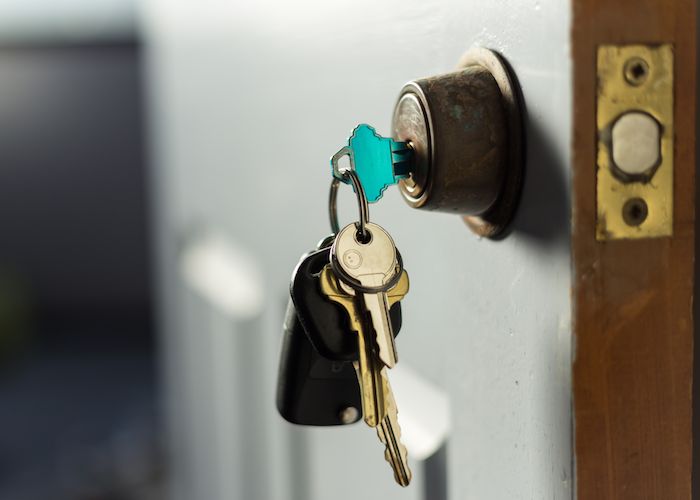
A digital padlock. Brand new, the keypad glowing a faint blue in the rain, mounted on my workshop door like it had always been there. I sat in the RV with the engine running and looked at it for a moment. Then I got out.
I tried the handle. Locked. I looked at the padlock the way you look at something that is clearly wrong but whose wrongness you haven’t yet fully processed. It was a good quality lock. Someone had installed it properly, the mounting hardware seated correctly in the wood. That small detail, the competent installation, made the wrongness of it worse somehow, more deliberate.
The back door of the house opened. Renata came out under the awning, dry and warm in a gray sweater, her pregnancy visible at five months, holding a green smoothie. She looked at me across the wet backyard with the specific expression of someone who has rehearsed this moment and is reasonably confident in their position.
I pointed at the lock. “What is this?”
She said, without flinching, that she and Daniel had changed it. She said the workshop was the nursery now. The word nursery landed with the flat finality of something that had already been decided, already been discussed and agreed upon, in some conversation I had not been part of.
I stood in the rain and looked at her.
I asked for the code.
She told me I didn’t need all that anymore. She said it wasn’t safe, the tools, the chemicals, with a baby coming. She said the space was better used. She had the slightly elevated patience in her voice of someone explaining something obvious to someone slow, and this was when I felt, in my chest and my hands and the back of my throat, the full weight of what was happening.
Daniel appeared in the doorway behind her. He was wearing the look I had seen on his face throughout the renovation of the hallway and the reorganization of the kitchen cabinets, the look of a man navigating between two people he doesn’t want to disappoint and who has quietly already chosen which side of the line he stands on. He said something about coming inside, about talking it over, about maybe there was a solution everyone could live with.
I didn’t go inside.
I walked back to the RV in the rain. I unlocked the side storage bay, the deep one on the driver’s side where I keep the heavy tools for the road. I took out the bolt cutters. They are a good pair, thirty-inch Knipex, the kind that go through a lock shackle without ceremony. I have carried them for twenty years.
I walked back through the rain to the workshop door.
Daniel was on the back step by then. He said my name, Mom, in the tone that means please don’t, and I looked at him and said nothing and positioned the bolt cutters. The lock snapped on the first try. The shackle pinged off the concrete and the door swung open under my hand and I reached in and hit the light switch.
And I stopped.
The workshop was empty.
Not disordered, not reorganized, not cleared to one side. Empty. Bare concrete floor. Clean walls. The rust shadows of my heavy machines still pressed into the slab where they had sat for decades, shapes worn into the surface from weight and vibration and years of use, my table saw’s shadow, the band saw’s shadow, the thick rectangular ghost of the workbench Roy and I had anchored to the east wall. Everything else was gone.
I stood in the doorway with the rain on my back and I looked at the empty space where fifty years of my working life had been and I thought about many things very quickly.
Behind me I heard Daniel pull a sharp breath and then the sound of his thumbs on his phone, fast, the urgent typing of someone sending a warning.
I turned around. He had the phone up, face tight, eyes not meeting mine.
“Who are you texting?” I said.
He didn’t answer.
“Who are you warning that I’m back, Daniel.”
He put the phone in his pocket. He opened his mouth and I watched him decide several times in quick succession what to say. Finally he said that some of the things had been moved to a storage unit. He said some of it was in the garage at his friend Kevin’s place. He said they were going to tell me, they just hadn’t had time.
I said, “Where is the lathe.”
He looked at his shoes.
The lathe Roy had given me for our thirtieth anniversary was a twenty-four inch swing Powermatic, a machine I had used for seventeen years and maintained myself, the kind of tool that, if you treat it correctly, will outlast the person who bought it. I knew exactly what that machine was worth in every sense of the phrase.
I said, “Daniel. Where is the lathe.”
He said it had been sold. He said Renata had found a buyer online and it had gone for a good price, that the money was going toward nursery furniture, that he knew it wasn’t the right call but everything had happened fast and he hadn’t known how to stop it once it started.
I went back into the empty workshop and stood in the middle of the floor.
I want to describe what that moment was like without being dramatic about it, because I am not a dramatic woman by nature. It was like standing in a house after the furniture has been cleared out before a move, the space both familiar and wrong, the proportions unchanged but the meaning evacuated. My machines were my tools but they were also my history, each one acquired at a specific point in my working life, carrying the specific projects I had used it on, carrying in some cases Roy’s hands on the same handles mine had touched thousands of times. The workbench was gone. The workbench I had built from maple and bolted to that wall twenty years ago was gone.
I stood there for a while.
Then I walked back into the house, past Daniel on the step, past Renata in the kitchen who was looking at me with an expression that had shifted from confident to something less certain, and I went to the small desk in the corner of the living room where I keep my files. I keep good files. Thirty years of documentation, filed by category, going back to the purchase of this house.
I took out the folder I needed.
Then I sat at the kitchen table.
Renata asked if I wanted tea in a voice that was working hard to sound normal.
I said, “I want you to sit down.”
She sat. Daniel came in from the back and stood by the counter, still with the phone in his hand, and I put the folder on the table and opened it.
I have the deed to this house. Of course I have the deed to this house, it is my house, paid off in full twelve years ago, in both my name and Roy’s and transferred to solely my name after his death with appropriate legal documentation. What else I have, and what I spread on the table that night, was the original two-week notice I had written when Daniel and Renata moved in, a document I had prepared because I was, at that time, still thinking like a professional. It was not a formal lease. It was a letter of agreement, signed by both of them, that laid out the terms of the living arrangement including the rent amount, the shared use of common spaces, and, stated clearly in the third paragraph, that the detached garage workshop remained my exclusive space and was not included in the living arrangement under any circumstances.
I placed this on the table.
Renata looked at it. Then she looked at Daniel.
Daniel was very still.
I told them what I was going to tell them the way I deliver difficult information on the job, clearly and without embellishment. I told them that the workshop was my property and its contents were my property and that the removal and sale of my tools without my knowledge or consent was not a misunderstanding. I told them I would be consulting a lawyer about the lathe and anything else that had been sold. I told them that the living arrangement we had agreed to had been violated in a significant enough way that it needed to be formally reconsidered.
Renata started to speak. She said something about the baby needing space and the workshop sitting empty while I was away and how surely I could understand that priorities had to shift.
I said, “The workshop was not sitting empty. The workshop is my place of business. It was unoccupied for two weeks while I was working, the same way your office is unoccupied on the weekends.”
She said a baby was not the same as a weekend.
I said, “You’re right. Which is why you should have discussed it with me instead of changing the lock.”
I said the rest of what I needed to say, which was that this was my house, purchased by me and Roy in 1987, maintained by me for thirty-three years, and that they were living in it under a specific agreement that they had chosen to disregard. I said that if they needed more space than this house provided, the appropriate response was to find a larger house, which I said without anger, as a simple statement of fact, because it was a simple statement of fact.
I said, “Then find your own house to put the baby in.”
Renata looked at me for a long moment and then she stood up and went down the hall to their bedroom. Daniel stayed at the counter with his hands pressed flat on the surface, looking at the agreement on the table, and I watched him work through it. He was reading the third paragraph, the workshop clause.
He said, finally, “I thought she’d talked to you.”
“She hadn’t.”
“I should have checked.”
“Yes,” I said. “You should have.”
We were quiet for a while. The rain was still going against the kitchen window, the same steady persistence it had had all the way from Portland. The kitchen smelled like whatever Renata had cooked for dinner, something with garlic and rosemary, and it was a good smell and I was hungry from driving and the whole evening had a particular quality of exhaustion that was not just physical.
I told Daniel that I loved him. I said this first because it was true and because what came next needed that foundation under it. I told him that I understood the position he was in, between his wife’s desires and his mother’s rights, and that I wasn’t interested in making him choose between loving me and loving her. I told him that what I was interested in was having my property respected and my agreements honored, and that these were not complicated requests.
I told him I was calling my lawyer in the morning, not to threaten anyone but because what had happened with the tools, specifically the sale of the lathe, was genuinely a legal matter and I needed advice on how to handle it correctly.
He nodded. He was still looking at the table. He said he was sorry, and he meant it, I could hear that he meant it, and I thought about how much I wanted him to have meant it before the lock was installed rather than after the bolt cutters came out.
I got up and made myself coffee and went to bed. The house was quiet in the way it got when people were in their rooms thinking. I lay in my bedroom with the rain on the roof and I thought about the empty workshop floor and Roy’s lathe and the rust shadows in the concrete and how my husband had spent a whole Saturday pouring that slab, forty-some years ago, while Pete made useless suggestions from the fence.
I called my lawyer in the morning. Her name is Sandra Wu and I have worked with her for fifteen years, on property matters and contracts and on Roy’s estate, and she is the kind of lawyer who listens to the whole story before she starts talking. I told her the whole story. She listened.
She confirmed what I already knew, that the sale of my tools without my consent was conversion, the civil equivalent of theft, and that I had a clear claim against whoever had conducted the sale. The signed letter of agreement regarding the workshop was useful documentation. The padlock installation was trespassing. None of this was ambiguous.
She also said, gently, that families often found ways to resolve these situations before they required legal action, and asked whether I wanted to give that path a genuine attempt first.
I said yes.
What followed was two weeks of hard conversations, the kind you can’t rush or smooth over, the kind that require everyone to stop performing their position and actually say what they mean. I had them with Daniel, mostly in the kitchen in the evenings, both of us with coffee, working through the history of the living arrangement and where it had gone wrong. I had one long conversation with Renata in which I tried to listen as much as I talked, which is a discipline, and in which I learned some things about how she had experienced the living arrangement that I hadn’t understood before.
She had felt like a guest. She had felt like everything in the house belonged to a life she wasn’t part of, Roy’s photographs and Roy’s furniture and the workshop in the backyard that she associated with my grief and my separateness. She had, I think, convinced herself that taking over the space was a kind of healing for the house, a practical updating, which was a significant misreading of the situation but was not, at its core, malicious. She was twenty-nine years old and pregnant and living in her mother-in-law’s house and those are conditions that can distort a person’s perspective in ways they don’t always recognize from the inside.
This did not make what she’d done acceptable. But it made it comprehensible.
The lathe was tracked down through the buyer Renata had found on Craigslist, a woodworker in Tacoma who had paid four thousand dollars for it, substantially below its value. He was willing to sell it back for what he’d paid plus a reasonable markup for his trouble. I paid it. The money came from the account where Daniel and Renata’s rent had been going, which turned out to be a satisfying symmetry.
The other tools were retrieved from Kevin’s garage and the storage unit over the course of a weekend, Daniel doing the moving, Renata staying inside. My workbench had been disassembled and was in pieces in the storage unit, which required three hours to reassemble and one repair to a joint that had been carelessly handled, but it was fundamentally intact.
I rebuilt the workshop over the following week. I put everything back where it had been, cleaned and oiled what needed cleaning and oiling, and at the end I stood in the doorway in the evening light with the sawdust smell coming back as the machines warmed up for the first time and I thought about Roy on the day the slab was poured.
The baby’s nursery is the front bedroom. I painted it myself, a soft gray-green that took me three tries to get right. I built the crib from white oak with hand-cut mortise and tenon joints, the kind that will hold for a hundred years. I built the changing table and a small chest with three drawers whose slides are waxed smooth enough that a child could open them. I did this because the baby is my grandchild and the workshop is where I build things that last, and it seemed right to put both of those truths together.
Daniel and Renata are still in the house. The arrangement has been rewritten, properly this time, with Sandra’s help, as a formal lease agreement with clear boundaries and clear terms. The workshop is enumerated specifically. It feels more businesslike than a family arrangement should perhaps feel, but I have come to understand that the businesslike quality is what makes it sustainable. Clarity is a kindness, even when it doesn’t feel like one at the time.
Renata and I are not close in the way I might have hoped. We are something more honest than that, which is two people who have seen each other clearly and chosen to continue anyway. She is a good mother so far, attentive and patient with the baby in the way that people sometimes discover capabilities in themselves that weren’t obvious before. The baby’s name is Clara. She was born in February, in the middle of a night that was cold and clear for once, no rain, just a frost that put ice on the windows by morning.
Daniel brought her home and I held her in the kitchen in the early morning light while the coffee was making, a small warm bundle with Roy’s eyebrows already somehow present on her tiny face, and I thought about everything that had happened to get to that moment, the padlock and the bolt cutters and the empty concrete floor and the hard conversations and the rebuilt workbench and the rebuilt agreement.
I thought about what lasts. I have spent my professional life thinking about this question in practical terms, what joinery holds, what wood weathers well, what foundations survive the thing that is built on them. What I have come to believe, at seventy, is that the things that last are the things that are built honestly. Not quickly, not without effort, not without the occasional necessary repair. But honestly, from good material, with the right tools, with attention to where the load bears.
Clara grabbed my finger with her whole small hand. Her grip was surprisingly strong for something so new.
I thought about Roy pouring the slab on a summer Saturday, forty years ago, while Pete made useless suggestions from the fence, and about the way some foundations hold everything that gets built on them without complaining, just quietly bearing the weight of all of it, year after year, rain or shine, grief or joy, empty workshop or full.
The shop lights were on in the detached garage. I could see them through the kitchen window, the warm glow of them across the backyard, the same light I had turned on that first morning two weeks after Roy was gone, when I went back in with frost on the roof and a piece of cherry that had been drying too long.
I told Clara, quietly, that someday I would teach her to use the tools in there. That a lathe is not a complicated thing once you understand what it wants to do. That cedar smells like peace. That her grandfather poured the floor she’d be standing on before either of us was part of the picture.
She didn’t have opinions yet about any of this.
But she held on.
I want to say something about the padlock itself, because people who heard this story later kept focusing on the bolt cutters, on the dramatic snap of the shackle on the concrete, and I understand why that’s the memorable image. But the thing that affected me most was not cutting the lock. It was the twenty seconds I spent standing in the rain looking at it before I walked back to the RV.
Twenty seconds is not a long time. It is long enough to absorb something completely. The lock was a Schlage, good quality, brushed nickel, with a five-digit keypad and a small LED that cycled blue when it was secure. Someone had taken time to choose it. Someone had considered the options and selected one that was sturdy and modern and, it must have seemed in the thinking, permanent. It had been installed with proper hardware, the mounting plate seated correctly, the screws driven into the door frame at the right torque. Someone who did not know anything about wood or tools or the correct way to hang hardware on a structure had managed, in this one instance, to do the job properly.
What I felt looking at it was not rage. I want to be clear about this because the bolt cutters suggest rage and the truth is more complicated. What I felt was a kind of recognition, the recognition you feel when something you have been watching develop at the edge of your peripheral vision finally moves to the center, when an ambiguity resolves into clarity. The lock was not an impulsive act. The lock had been thought about and purchased and installed over a period of time, while I was two states away with no knowledge of what was happening to my property. It had been done deliberately, carefully, with the intention that I would return to a fait accompli rather than a discussion.
That was the thing that settled in my chest as I stood in the rain. Not the lock itself but the calculation behind it.
My tools were my tools in the way that a surgeon’s hands are a surgeon’s hands. I had worked with them for decades. My table saw had come to me in 1994 from a retiring cabinetmaker in Tacoma who had used it since 1971 and who sold it to me because, he said, I was the first person who’d come to look at it and run their hand along the fence before asking the price. He meant that I understood what I was looking at. The band saw I had bought new in 2001 and had rebladed seven times. The router tables were built by me, the tops laminated and flattened in my own workshop, the fences custom-fitted to the way I worked.
Each tool had a history that was also my history. Each one marked a job, a period, a set of projects that were now complete and past. Losing them was not losing equipment. It was losing a library of my own life, the physical record of what I had made and how I had grown in the making of it.
The lathe most of all.
Roy had spent three months researching that lathe before he gave it to me. He had called three dealers and read two years of Fine Woodworking back issues and consulted a turner he’d met at a community fair who gave him a forty-five-minute education on spindle capacity and headstock bearings. He was not a man who did things carelessly. He had given me that machine on our thirtieth anniversary with a card that said, in his round, slightly labored handwriting, “For the woman who taught me what good work looks like. With love that tries to match it.” I had put the card in the drawer of the workshop’s small tool chest, where it had stayed through seven years of grief and work, through seasons and projects and the gradual quieting of the sharpest edges of loss.
The card was in the drawer of the tool chest when the tool chest left. I didn’t know that until later, when the chest came back from Kevin’s garage. The card was still there, a little damp from the storage, but intact. I put it back.
This is what I mean when I say the workshop was not a hobby room.
Sandra Wu, my lawyer, told me something in our first conversation that I have thought about since. She said that the clearest sign of disrespect is when someone takes an action that they know you would not consent to, and takes it specifically while you are absent and unable to object. It’s not impulsiveness, she said. Impulsive people act in front of you. This was planning. This was a choice made in the full knowledge that asking first would have produced the wrong answer.
She said she’d seen this pattern in property disputes and estate matters and neighbor conflicts for thirty years. The lock on the door, she said, was not really about the baby. The baby was a justification for something that had been building for longer than the pregnancy. A gradual assumption of territory, room by room, surface by surface, until the only piece left that hadn’t been absorbed was the workshop, and then the workshop, too.
I told her I’d noticed the drift. I told her about the kitchen cabinets and the hallway paint.
She said, “And you let those go.”
I said I had.
She said, “People learn from what you let go.”
She wasn’t blaming me. She was describing a mechanism. I understood the mechanism. I had simply, at each earlier point, chosen peace over precedent, and the precedent had accumulated into a padlock.
The conversations with Daniel over those two weeks were the hardest of our adult relationship. We had been close in the way that parents and children are sometimes close when there are only two of them left, after a loss, a closing of distance that grief produces. I knew my son and I loved him and I was also honest with myself that he had allowed something to happen that he could have stopped, at multiple points, if he had chosen differently. The choosing wasn’t mine to make for him. But the consequences were mine to live with, which meant we needed to talk about it directly and not through the softening language of misunderstandings and best intentions.
He said, one evening, that he had told himself I had so many tools I probably wouldn’t miss some of them. He said he had told himself I was slowing down and might be ready to let the workshop go anyway. He said he had told himself a lot of things over the three weeks before I got home, and that he knew, when he said them to me in the kitchen, how they sounded.
I said, “How do they sound?”
He said, “Like I was trying not to know something I already knew.”
I said, “Yes.”
We sat with that for a while.
I told him that what I needed from him, going forward, was not for him to choose between his wife and his mother. I told him that was a false choice and an unfair one and I wasn’t interested in constructing it. What I needed was for him to be a person who told the truth to both of us about what was his to decide and what wasn’t. The workshop had never been his to decide about. Not because I was withholding it from him, but because it was mine, clearly and documented and undisputably mine, and the proper response to a space you want is to ask for it, not to take it.
He nodded slowly. He said he knew that. He said he had known it the whole time.
I believed him. And I also thought about how much of our lives we spend knowing something and doing the other thing anyway, because the other thing is easier in the moment, and the consequences feel distant until they’re not.
Clara is four months old now. She has Roy’s eyebrows and Daniel’s long fingers and a temperament that is, so far, calm and observant in a way that suggests she is already paying close attention to the world she’s been placed in. She will be a person who notices things. I can see this already in the way she tracks movement and light, in the way she pauses when there’s a new sound to locate it first before deciding how to respond to it.
I have plans for the workshop furniture I’ll build her when she’s older. A proper workbench at child height, adjustable, so it grows with her. A small tool roll with good beginner tools, a marking gauge and a block plane and a small set of chisels ground properly, which is the thing most people neglect. You can teach someone technique all day but if the tool isn’t sharp it will teach them the wrong lesson about what the work feels like.
Roy would have spoiled her completely and taught her nothing practical whatsoever, and I would have loved watching it. This is the deal you make with grief over time, that you let the person you lost be present in the future you imagine, that you don’t exile them from it just because they’re gone. He’s in the workshop with me still, in the particular way of people who shaped a space and then left it. I hear him occasionally in the grain of the cherry or the way the light comes through the small window over the bench in the late afternoon. I don’t find this sad. I find it true.
The workshop is mine. This house is mine. The padlock is gone, the concrete floor still holds the rust shadows of the machines that stood on it through decades, and those shadows are not going anywhere because they are pressed into the material itself, the evidence of weight and time, the record of a life’s work that no one can clear away by emptying a room.
This is what lasts. Not just the things you build. The mark they leave in the floor where they stood.

Specialty: Quiet Comebacks & Personal Justice
David Reynolds focuses on stories where underestimated individuals regain control of their lives. His writing centers on measured decisions rather than dramatic outbursts — emphasizing preparation, patience, and the long game. His characters don’t shout; they act.