I should have known something was wrong long before the dumpster.
Looking back, the warnings had been present for years, small and consistent, like a low note played beneath a louder piece of music. The way Barbara’s smile stiffened whenever Emma ran into a room with something she had made. The way she never quite looked at the thing itself, only at whatever mess surrounded it. The way she said the word homemade with a faint, almost imperceptible contraction of her nostrils, as though the word carried a smell.
But that morning, standing in our driveway with Emma’s plastic storage bin between us and her breath making small clouds in the December air, I still wanted to believe this time would be different.
Emma had been awake since six. I had heard her moving around in her room before the sky was fully light, heard the careful sound of lids being lifted and checked and replaced, and I had lain in bed for a while listening to it and feeling something complicated in my chest, something that wanted to call itself hope but kept bumping up against everything I knew about Barbara Matthews.
“Careful, honey,” I told her when she adjusted the lid on the bin. “We don’t want anything to bend.”
“I know,” she said, furrowing her brow the way she had since she was a toddler, that expression of small-scale serious concentration that I would remember long after everything else about this particular morning had faded. “I checked everything twice. Then three times. Grandma’s gonna love them, right?”
She looked up at me with those big brown eyes, her father’s eyes exactly, and there was so much trust in them that I had to work to hold her gaze. There was a dried smear of blue paint on her cheek, left over from the final session at the kitchen table the night before. The blue of the ribbon she had chosen for Barbara’s gift.
“She’s going to love them,” I said.
David came down the porch steps with his car keys and his scarf still half wrapped, doing the cheerful voice he used when he was managing something privately while presenting a different face to the room. He asked if we were ready. Emma nodded so hard her ponytail bounced, and she told us that Uncle Tom was probably going to cry because she had put the photo of him and David on the boat on the first page of his frame, and David raised his eyebrows at me over her head with the expression of a man who knows what his wife is thinking and agrees with all of it but cannot say so in front of their daughter.
Emma held the bin on her lap the entire drive, forty minutes up the highway, her fingers drumming on the lid and occasionally lifting it a fraction of an inch to check inside, as though the gifts might have somehow dissolved between our driveway and the road. She narrated the contents from memory, unprompted, the jewelry box with the painted flowers for Aunt Susan, the illustrated recipe book for cousin Beth, the candle set for Aunt Carol, the photo frame for Uncle Tom, and finally, in a slightly softer voice, the memory book for Barbara. Three months of late evenings at the kitchen table, the printer jamming at critical moments, Emma asking me to spell words and asking David for stories, glitter in our food for a solid two weeks.
“I put stories in there,” Emma said, in the tone of someone presenting their most important piece of evidence. “About her. And Dad. And the family. So she remembers.”
David made a sound in his throat that he covered by pretending to react to the heater.
I pressed my head against the cold window and watched the town slip past, the coffee shop, the park, the ordinary, modest, genuinely happy life we had built that had never quite satisfied Barbara’s idea of what her son’s life should look like. I had met Barbara fifteen years ago in her immaculate foyer, my hands sweating inside cheap leather gloves, shaking hands with a woman who organized charity galas with military precision and assessed a new person’s value in the first four seconds of contact. She had said my name with perfect, measured politeness, and I had seen her eyes move across my dress once, just once, cataloging and filing, and then she had moved on. I was a kindergarten teacher who had fallen in love with her son. I had never been what she wanted for him, and she had spent fifteen years finding elegant, deniable ways to make sure I understood that.
The venue appeared at the end of a tree-lined road like something from a film about people who are comfortable with money, all reflective glass and manicured winter shrubs. Emma pressed her nose to the window and breathed wow. The parking lot was already layered with luxury vehicles. As we walked across it toward the entrance, Emma clutching the bin to her chest and refusing my offer to help carry it because she wanted Barbara to see that she had done it herself, I felt the old familiar whisper, the one that said you don’t belong here, that I had been arguing with for fifteen years without fully winning.
Inside, warmth and perfume and the scent of an unreasonable number of flowers. Crystal chandeliers. Gold-rimmed place settings. A jazz trio in the corner playing music that cost more per hour than I made in a day. And Barbara, appearing from within the crowd like something orchestrated, her floor-length silver gown catching every available light, her diamond earrings working overtime.
She kissed the air near David’s cheek. She told me my color was unexpected. Then her gaze landed on the bin in Emma’s arms, and something happened behind her eyes, very brief, very controlled, gone before most people would have noticed it.
Emma launched into her explanation with the unstoppable momentum of a child who has been waiting to say something for three months. She had made something different for everyone. She had started in July. She had a list.
Barbara’s smile settled into a configuration I had come to think of as her hostess setting, present, correct, generating no actual warmth. She said how industrious in a tone that used the word as a polite container for something less flattering. Then she reached for the bin with the smooth efficiency of someone removing an item from a table before guests arrive, and she said she would put these somewhere safe until it was time for gifts, and Emma’s hands hung empty at her sides as Barbara disappeared into the crowd with three months of her daughter’s work tucked under one arm.
I told myself Barbara had simply moved the gifts to a safer location. I told myself this for the next hour while we found our table and made conversation and I watched Emma keep looking in the direction Barbara had gone, her brow furrowing slightly when no explanation came.
The party operated exactly as Barbara had designed it to. Everything was precisely calibrated for effect. The food arrived at intervals that kept conversation animated without interrupting it. The music swelled and softened on an invisible schedule. Compliments circulated like currency. I had three separate conversations in which something that was not quite an insult was wrapped inside something that resembled a compliment with just enough social plausibility that challenging it would have made me seem thin-skinned. My dress was apparently similar to something available at a large chain retailer. Emma’s crafting hobby was described as a phase, like chicken pox, by a woman whose pearls probably cost more than my car. Someone told me it was refreshing that David had married someone with a real job, as though teaching kindergarten were a charming eccentricity rather than an actual profession.
I scanned the gift table repeatedly. Everything on it was wrapped in metallic paper or packed into glossy bags with tissue paper spilling out. Emma’s work, the hand-decorated packages covered in the little stars and flowers she had drawn with a ruler and a red pen at the kitchen table, was nowhere visible.
I told myself there was a reasonable explanation.
Emma pulled at my sleeve and asked if it was time for presents yet, and her voice had just enough of a tremble in it that I heard it even over the jazz.
I sent her to show her cousins a dance routine, and she brightened immediately, the wonderful resilience of a child whose enthusiasm is large enough to fill the gaps left by a grandmother’s indifference, and I watched her go with something aching in my chest before I excused myself to find the restroom.
I didn’t find the restroom. I found something else.
The further I moved from the main hall, the quieter it became, the music softening to a pulse through the walls, the scent shifting from flowers and perfume to something more functional, detergent and old air. I was moving toward the service corridor when a flash of color caught my peripheral vision through a narrow window.
A corner of familiar wrapping paper, hanging from the edge of an open dumpster lid. The specific paper from the craft store, the kind with a slight texture that Emma had loved because, she said, it felt more special than the smooth kind. I could see from where I stood a small hand-drawn star in the corner.
My feet were moving before I had finished the thought.
The alley was cold and dim, the dumpsters standing in a row against the building’s exterior. The one with the open lid was the second from the end. I could smell it before I reached it. Coffee grounds and wilted flowers and something sour underneath both.
I grabbed the edge and pulled myself up to look inside.
They were all there.
The photo frame for Uncle Tom, its corners caked with coffee grounds. The knitted scarf for cousin Sarah, tangled around discarded napkins. The jewelry box for Aunt Susan, lid cracked, a smear of red lipstick across the painted flowers where some discarded cosmetic had landed on the surface. And on top of everything, tilted sideways, pages splayed and one corner stuck to a wet teabag, the memory book. The blue ribbon Emma had selected and tied and untied and retied twice because she wanted it to lie correctly was soaked dark. I could see a photograph peeking out from between the warped pages, David at six years old holding up a lopsided clay bowl, and beside him Barbara, kneeling, and she was actually smiling in the way people smile when they are not thinking about being photographed.
I stood in that alley for a moment and did not move.
Three months. Three months of Emma at the kitchen table after dinner, her tongue poking out in concentration, asking me to spell consecutive and cherished and unforgettable because she wanted the captions to be right. The nights she stayed up past her bedtime because the wax had to cool at a specific rate. The afternoon she cried briefly and quietly over the jewelry box because the first attempt at the hinge mechanism hadn’t worked and she had thought the whole thing was ruined, and David had sat with her for an hour and they had figured out together that it just needed a smaller screw.
Barbara had taken all of it, and she had put it in the dumpster with the kitchen scraps.
I took my phone out. I photographed everything, methodically, moving around the dumpster to capture different angles. The stained scarf, the cracked jewelry box, the memory book half-submerged in refuse. I zoomed in on the wrapping paper with Emma’s hand-drawn designs. I made sure there could be no ambiguity about what I was seeing and where it was.
As I was doing this, another memory surfaced, one I had been keeping in a specific compartment where I put things I wasn’t ready to act on.
A week earlier, I had been at Barbara’s house helping prepare for the party, and I had been recording Emma’s choir practice on my phone. The recording had continued running when I put the phone in my pocket and forgot about it, and later that night, listening back to figure out which sections Emma wanted to work on, I had heard voices in the background. Barbara’s voice, clear and unhurried, talking to someone in another room while I had apparently been carrying my phone through the house.
Can you imagine, Barbara’s recorded voice had said, and then a little laugh, the specific polished laugh she produced for social situations. My son married a kindergarten teacher, and now my granddaughter is turning out just as common. A murmured response from someone I couldn’t identify. Then Barbara again: oh, she’s sweet enough, I suppose, but always making things instead of buying proper presents like civilized people. Last Easter she brought homemade cookies on my antique serving plates. I nearly died. No understanding of how things are done.
I had sat in bed with my earbuds in and the room dark around me, and I had watched Emma on the small screen, mouth open in song, wearing her too-big choir robe, completely unaware that her grandmother’s voice was dismantling her in the next room. I had not told David. I had not confronted Barbara. I had filed it in the compartment and told myself I was keeping the peace, which was what I always told myself, which had always been the lie I told myself to cover the less flattering truth, which was that I was afraid of what would happen if I stopped absorbing it.
Standing in that alley with the cold on my face and the smell of garbage in my nose and my daughter’s gifts rotting in front of me, the compartment burst open.
Barbara had not just dismissed my career or made a comment about my dress. She had taken Emma’s love, three months of it, carefully crafted and personally meaningful, and she had put it in the trash. Not misplaced it. Not set it aside for later. Put it in the trash, out behind the building, with the kitchen waste and the discarded flowers, because handmade gifts at an elegant event were an embarrassment she could not absorb.
I climbed down from the dumpster, straightened my coat, and walked back inside.
The warmth and noise of the party hit me like something physical. Emma was in the center of a small cluster of cousins, laughing at something, her cheeks flushed, her ponytail spinning as she demonstrated a turn. She looked safe and happy and entirely unaware.
Barbara stood a few feet away, champagne flute in hand, angled toward a cluster of her friends, and she was laughing at something, and the laugh was exactly right, warm but controlled, gracious, the laugh of a woman who has constructed her public self with considerable attention to detail.
For a moment I stood at the edge of the room and considered doing what I had always done, which was to find a way to contain the situation, clean up the gifts, invent an explanation, protect Emma from the specific pain of knowing, add this to the ledger of things I carried alone. I knew how to do this. I had spent fifteen years practicing it.
Then Emma looked up and saw me and her face opened into that trusting, expectant smile. Is it time for presents yet, Mom?
I walked into the room.
My voice, when I spoke, was louder than I intended. “Actually, sweetie,” I said, and the words carried over the jazz, and heads turned, “I need to talk to Grandma about your presents.”
Barbara’s head moved in my direction. Her eyes found my face and she read something there and her expression reconfigured in the careful, practiced way of someone preparing to manage a situation.
“Sarah, dear,” she said, setting down her champagne with the deliberate calm of someone buying time, “perhaps we should discuss this privately.”
I took my phone out of my pocket.
“I think it’s time,” I said, “for a public discussion about how you treat your granddaughter’s gifts.”
The nearest conversations slowed and stopped. The ripple moved outward through the room. The saxophonist in the jazz trio played a note that trailed off into nothing.
“And while we’re at it,” I continued, “maybe everyone should hear what you really think about your common family members.”
Barbara’s color left her face all at once.
David appeared at my side, his forehead creased. Before he could speak, I turned my phone screen toward the nearest guests and opened the photograph gallery.
I asked, in a voice that surprised me with its steadiness, whether anyone would like to see what a sixty-year-old woman did with presents made by her twelve-year-old granddaughter.
The first photograph appeared. The jewelry box, its painted flowers smeared with lipstick, nestled in coffee grounds inside a dumpster. Gasps moved through the group the way weather moves through a room, sudden and collective.
I swiped. “The hand-painted jewelry box Emma made for Aunt Susan,” I said. “She spent two weeks on the flowers alone.” Swipe. “The illustrated recipe book for cousin Beth. Emma went around the Fourth of July barbeque with a notebook asking everyone for their favorite recipe.” Swipe. “The memory book. Made for Barbara. You can still see the ribbon.”
Emma pushed through the cluster of bodies. She was pale, and she looked at the photographs, and then she looked at her grandmother, and she said, in a voice that was small but entirely clear: those are my presents. Grandma, why are they in the trash?
The silence that followed that question was different from the silence of social awkwardness. It was the silence of a room in which something true has been said that cannot be unsaid.
Barbara’s composure fractured in stages. Her lips moved. She attempted an explanation. The staff must have moved them. There must be a misunderstanding.
David’s voice, when it came, was low and quiet in a way I had never heard from him before, a register below his normal range, controlled in the way that very intense feelings get controlled when a person has decided to express them precisely rather than loudly. “In the dumpster, Mom,” he said. “You were just what? Reorganizing? In the dumpster?”
Barbara tried the laugh, the social one, the one that dismissed unpleasant things by treating them as misunderstandings. “There must have been some confusion,” she said. “Someone on the staff—”
“The staff,” I said, “didn’t spend three months making these. Emma did.”
I pulled up the voice recording.
Barbara’s face, when she saw my thumb hovering over the play button, went through several expressions in rapid succession.
“Don’t,” she said.
I pressed play.
Her own voice filled the room, tinny through the phone speaker but unmistakably hers. Can you imagine. My son married a kindergarten teacher, and now my granddaughter is turning out just as common. Always making things instead of buying proper presents like civilized people.
The room reacted in the way crowds react when something private becomes public suddenly, a collective intake of breath, whispered exchanges, someone’s hand going to their mouth. Lydia’s fingers flew to her pearls. Barbara lunged for the phone.
David stepped between them. His hand came up, not aggressive, just present, and he said, very quietly, no, Mom, and then he looked at me with an expression that contained apology and anger and something that was resolving into a decision. Keep playing it, he said.
So I did.
The recording continued. Homemade cookies on my antique serving plates. I swear that girl has no understanding of how things are done. No class, no sense of what’s appropriate.
“Stop it,” Barbara said, and for the first time all evening her voice had no performance in it. “You’re embarrassing yourself.”
“I think,” came a voice from the edge of the crowd, “you’re managing that quite well on your own.”
Barbara’s sister Carol stepped forward. She was a few years younger, with the same cheekbones but softer eyes, and she had always been the person in this family who said the accurate thing when everyone else was busy saying the diplomatic one. She looked at the photographs on my phone. Her jaw tightened. Barb, she said, this is beautiful work. How could you do this. She’s your granddaughter.
Barbara’s eyes filled. They were real tears, not the managed kind she produced for charity speeches. Her voice, when it came, was stripped of its social architecture. “You don’t understand,” she said. “I have a reputation. What would people think if there were handmade gifts at an event like this? It would look like we couldn’t afford—”
“We think,” said one of her country club friends, a brunette whose name I didn’t know, in a voice that had gone cold and flat, “that you just threw away something worth more than anything in this overpriced room.”
The word she used next was disgraceful. It hung in the air. Around it, the party began its dissolution, not all at once but in the way things end when the reason for being present has evaporated, people reaching for coats and bags, conversations dropping to murmurs, the jazz trio looking at each other with the uncertainty of musicians who have lost the room.
David moved without saying anything. He walked toward the service corridor doors. Barbara asked where he was going. He said he was going to get his daughter’s gifts, if they were still salvageable, and he kept walking.
The few minutes he was gone felt very long.
Barbara stood in the center of the room as it thinned around her, and for the first time in fifteen years of knowing her, she looked like a person who was not in control of what was happening. Emma stood beside me with her hand in mine, gripping tightly. She asked me in a whisper if she had done something wrong.
I knelt so we were at the same level. I told her that she had done everything right. That this was not about her. That the problem was not her presents.
“You made them with love,” I said. “That’s what matters. Grandma forgot what real gifts look like.”
The service doors opened and David came back.
He was carrying the bin with both arms, damp and stained, and a few items tucked under one arm. His suit jacket had something dark on one sleeve. There was a smudge of dirt on his cheek. He walked directly to the main table at the front of the room, the one set up for Barbara’s place of honor, and he set the bin down on the pristine white linen next to the centerpiece.
Then he laid the gifts out one by one.
The scarf, still damp. The jewelry box, its flowers still visible beneath the smear. The photo frame. The memory book, set in the center, the ribbon dark and limp but the cover intact.
Coffee grounds clung to some edges. A wilted petal had attached itself to the memory book’s cover. A tea stain marked the lower corner.
David stepped back and looked at his mother.
“Every time Sarah asked me to consider that something was wrong,” he said, “I told her people don’t change unless they have a reason to. I didn’t want to believe my own mother could be this.” He paused. “I was wrong not to believe her sooner.”
Barbara’s voice shook. “Everything I have ever done has been for this family’s standing. For respect. For doors to open for you and for Emma. These things—”
“Are worth more,” I said, “than everything in this room.”
I looked at Emma and asked her if she wanted to show everyone what she had made.
She hesitated. She looked at the stained, damp objects on the table with an expression that held grief and something else, something that was making up its mind. “They’re all dirty now,” she said.
“They’re perfect,” David said. “Just like you.”
Something shifted in her posture. She straightened by an inch and walked to the table. She picked up the memory book with both hands and turned to face the room.
“I made this for Grandma,” she said. Her voice shook at the start and steadied as she went. “It’s a memory book. I asked Mom for old photos and Dad for stories, and I wrote down things I remembered too. Like when Grandma let me lick the frosting spoon when Mom wasn’t looking, and when she showed me how to fold napkins into swans, and when she told the story about Dad falling in the pool in his good suit.” She paused. “I put everything in here so she’d have something to look at. So she’d remember.”
The room that was left was quiet.
Emma looked directly at her grandmother. “Why didn’t you like it?” she asked. “Is it because it didn’t come from a store?”
Barbara opened her mouth. Nothing came out.
The remaining guests gathered their things with the careful efficiency of people who understand that a gathering is over. Some paused to hug Emma and say something quiet and genuine about her work. Aunt Carol stayed behind and found a clean napkin and began gently dabbing at the edge of the memory book, carefully, without being asked.
Barbara stood near her birthday cake, untouched, the candles dripping wax down into the frosting.
David collected the gifts into the bin with the slow care of someone handling something salvaged from a fire. I put on my coat. Emma held the memory book to her chest.
David turned to his mother one final time.
“When you’re ready to apologize,” he said, his voice quiet and without heat, “really apologize, you know where we are.”
She did not speak. We walked out past the balloon arch and the glossy printed photographs of Barbara’s smiling face and the security guard who worked very hard not to look at us, and the cold outside was a relief after the warmth of the ballroom.
In the car, Emma sat quietly in the back with the memory book in her lap, tracing the edge of the darkened ribbon with one finger.
David asked softly if she was okay.
“I don’t think Grandma likes me very much,” Emma said.
I started to say the automatic thing, the kind thing, the thing I had always said to smooth the sharp edges of Barbara’s behavior into something Emma could live with more comfortably. Then I stopped myself.
“Grandma is confused,” I said instead, “about what matters. But that is about her, not about you. Your presents were wonderful. What she did with them was wrong.”
David’s hands were tight on the wheel. “Your presents were incredible,” he said. “I am so proud of you. What she did says everything about her and nothing about you.”
Emma leaned her head against the window. “I just wanted her to like me the way she likes her friends,” she said.
There was nothing to say to that. So I reached back and put my hand on her knee, and she put her hand over mine, and we drove home.
The weeks that followed were quiet. Barbara did not call. What we heard instead, through Carol and through the particular efficient channels of family information, was that Barbara had stopped going to her country club, had missed her Wednesday hair appointments, had withdrawn from the social circuit she had spent decades building. She was, Carol said, hiding. Too mortified to appear where people who had been in that room might see her. But also, Carol thought, doing something more than hiding. Sitting with something.
Emma went back to school. She kept making things, spreading paper and markers across the kitchen table on weekday evenings, working on cards and small gifts for people who she said liked getting things she made, and one afternoon I came into the kitchen and found a card with To Mom written on the front in bubble letters, and I pretended not to notice it.
One quiet Sunday morning, the doorbell rang.
David was in the shower. Emma was upstairs. I opened the door to find no one standing there, just a small cardboard box with soft corners sitting on the porch, and on top of it an envelope with my name in Barbara’s handwriting.
I carried both inside and sat at the kitchen table. The envelope held a single piece of cream-colored paper. I found these in my attic. I think I finally understand. May I come over to talk. Just Barbara.
The box was light. Inside were handmade gifts, dozens of them, old birthday cards with wobbly letters, painted rocks, macaroni art in various stages of disintegration, a clay object that might have been a bowl or an ashtray or something without a category. Each piece had a small note in Barbara’s handwriting with an age and an occasion. From David, age 5. Mother’s Day. Second grade.
Emma appeared in the doorway and asked what was in the box.
David came down a moment later, hair still damp. He read the note twice. He picked up the clay object and turned it over in his hands and said he remembered making it, he had told her it was an ashtray and she hadn’t smoked but she had put it on her vanity to hold her rings. His voice when he said this was very quiet.
Then there was a knock at the door.
Barbara on the doorstep looked different in a way that was difficult to name at first. She was wearing simple black slacks and a soft sweater. No diamonds. Small pearl studs. Her hair was down and showed more gray than I had ever seen. Her makeup was minimal. She looked older, but she also looked, for the first time in fifteen years of my knowing her, like a person rather than a performance.
She held a shopping bag in one hand and gripped the strap with both as she stood in our hallway and said before you say anything, I need to show you something.
She pulled from the bag a photo album. Not one of her expensive leather-bound ones. A homemade one, cardboard cover, fabric peeling at the corners, photographs pasted in at slight angles. She said her mother had made it. She had found it the same day she found David’s old crafts in the attic.
The first page showed Barbara at seven or eight, grinning with a gap where her front teeth had been, wearing a paper crown decorated with glitter. In the next photograph her mother held up a child’s drawing with obvious and entirely unperformed pride. Barbara’s hands trembled slightly on the album pages.
“Every terrible thing I made,” Barbara said, “my mother kept. She put them on the walls and the mantel and the fridge. She told anyone who visited that her daughter had made them.”
Emma had drifted close and was looking at the photographs over Barbara’s shoulder.
David asked, gently, without accusation, when appearances had started to matter more than the people in front of her.
Barbara let out a long, shaky breath. “So slowly I didn’t notice,” she said. “Every social step up. Every new circle. Every perfect event. Every time someone looked at me with admiration for what I had built, it felt like proof. Proof that I wasn’t ordinary. That I had made it into something worth being.” She looked at her hands. “I told myself I was doing it for the family. That better connections meant better opportunities for David, and later for Emma. That I was opening doors.”
She laughed, a small, bitter sound. “What a lie I told myself.”
She turned to Emma. Her eyes were full.
“I found your memory book in the box your father brought back,” she said. “I read every page. Every story you wrote. You saw good things in me that I had completely forgotten were mine.”
Emma looked at her steadily. “I just wrote what I remembered,” she said. “Like when you let me lick the frosting spoon. And when you showed me the napkin swans. And when you told the story about Dad and the pool.”
“Those were real,” Barbara said. “Not staged ones. Not planned. Just us being people in the same room.”
Emma’s expression was careful. She was twelve, old enough to have been hurt and to be thinking about whether trust was worth attempting again, and young enough that the question was still open. “So why did you throw it away?”
Barbara did not deflect or qualify or reach for a more comfortable framing. “Because I panicked,” she said. “I saw the handmade wrapping paper and I heard Ruth’s voice from last year in my head, making a little comment about crafty projects. I imagined what people would say. How quaint. How common. And I walked those gifts out the back and told myself I’d deal with it later, knowing perfectly well I had no intention of dealing with it at all.” She paused. “The truth is I didn’t want anyone to see the part of me that still understood why they mattered.”
She looked at me then, directly and without the social buffer she had always maintained between us. “When you played that recording,” she said, “I didn’t want to sink into the floor because you had embarrassed me. I wanted to sink into the floor because you were holding up a mirror, and I recognized the person in it, and I was ashamed of her.”
Silence in the kitchen, the particular silence of people sitting with something real.
“I can’t undo the last fifteen years,” Barbara said. “I know that. I’m not here to ask you to pretend they didn’t happen. I’m here because I want to try, if you’ll let me, to be something closer to who I used to be. Who my mother raised me to be.”
She reached into the shopping bag and took out something wrapped in tissue paper.
Emma’s memory book. Cleaned, as much as it could be. The stains were still faintly present, and the pages had a slight warping to them from the moisture, but most of the damage had been gently addressed. The ribbon was new, replaced in exactly the same shade of blue.
Barbara set it on the table. “The woman at the restoration shop told me some marks might always be there,” she said. “I told her that might be a good thing.”
Emma reached out and touched the corner of the book carefully.
“Will you still care what your friends think?” she asked.
Barbara shook her head slowly. “I’ve lost most of them,” she said. “It turns out that when you build relationships on appearances, they don’t survive the appearance cracking. But I have been thinking, for three weeks now, about a different kind of account. The kind where what you accumulate is actual history with actual people. And I have very little of it, because I have spent a long time choosing the wrong currency.”
Emma looked at her for a long moment. Then she stood and left the room without speaking. Barbara’s face contracted slightly. She started to say something about deserving that.
Emma came back carrying a large plastic storage container. She set it on the table and opened it. Inside were paper and markers and ribbon and glue and all the surplus materials from the gifts, neatly organized because Emma organized things neatly.
“I saved the extras,” Emma said. “We could make new ones. Better ones. While the cookies bake.”
Barbara blinked. “Cookies?”
“The ones in the oven,” Emma said. “I started them this morning. I thought if you came, maybe we could finish them together.”
What happened next did not happen all at once, and I do not want to describe it as though it did, because that would make it into a simpler story than it was. Barbara rolled up her sleeves and fumbled with measuring cups and got flour on her sweater, and Emma laughed at her and showed her how to level the sugar properly, and David stood in the doorway watching his mother make a mess in his kitchen with the expression of a man encountering something he had assumed was gone.
You used to be better at this, he said.
We did this every Sunday when you were little, she told him. Before everything else. We used to make a complete disaster of the kitchen.
At the table, Emma spread out paper and handed Barbara a marker, and Barbara held it with the uncertain grip of someone returning to something they have not done in a very long time. She stared at the blank paper. I don’t remember how, she said.
You just draw, Emma said. It doesn’t have to be perfect.
Barbara’s first marks were tentative and a little crooked and not particularly representational. Emma told her that the crooked line could be a border, and then it would be fancy, and Barbara laughed in a way that was connected to something genuine rather than constructed for effect.
The oven timer went off and Barbara startled and laughed at herself again. She pulled the tray out and looked at the edges critically and said they might be a little overdone.
Extra toasted, Emma said immediately. That’s what Mom and I call it.
Extra toasted, Barbara repeated, as though tasting the phrase. I like that.
Later, David and I stood in the doorway watching them at the table, their heads close together, Emma guiding Barbara’s hand to add a detail to the page they were working on for a new section of the memory book. The kitchen smelled of slightly burned cookies and glue. The afternoon light was coming through the window at a low angle, the particular pale light of December late in the day.
I said something to David about how sometimes people need to be reminded of who they were before the world convinced them to be something else.
He nodded. He said he didn’t know if he could fully forgive her for what she had done, to me, to Emma, to all of us over fifteen years. But he wanted to try, he said, and he thought wanting to try was the honest place to start.
The path after that was not smooth, and I do not want to describe it as smooth, because smooth would be untrue and also would miss the point. Barbara said thoughtless things sometimes and had to apologize. Old habits showed up at the edges of new behavior, a flicker of judgment about someone’s clothes, a moment of restlessness when conversation moved somewhere she found uncomfortable. Emma did not forget overnight. There were invitations she declined because she needed the distance, afternoons she preferred the kitchen table at home to a visit. Trust, when it has been genuinely broken, does not reconstruct itself on a schedule or because everyone would prefer it to.
But there were also other moments.
Barbara at Emma’s dance recital in the third row, holding a bouquet of slightly wilted flowers she had forgotten to put in water, crying without any apparent concern for her mascara when Emma took her bow. I missed a lot, she said afterward, pressing the flowers into Emma’s hands. But I’m here now.
The afternoon she called me, not David, me, to ask for help choosing Emma’s birthday present. I was thinking of something expensive, she said. Then I thought, that’s my old thinking, isn’t it. What would she truly enjoy. And I told her what Emma would enjoy was a day at the craft store picking out her own materials, and then time at the kitchen table making something, and Barbara said that sounded messy, and then said but good. It sounds good.
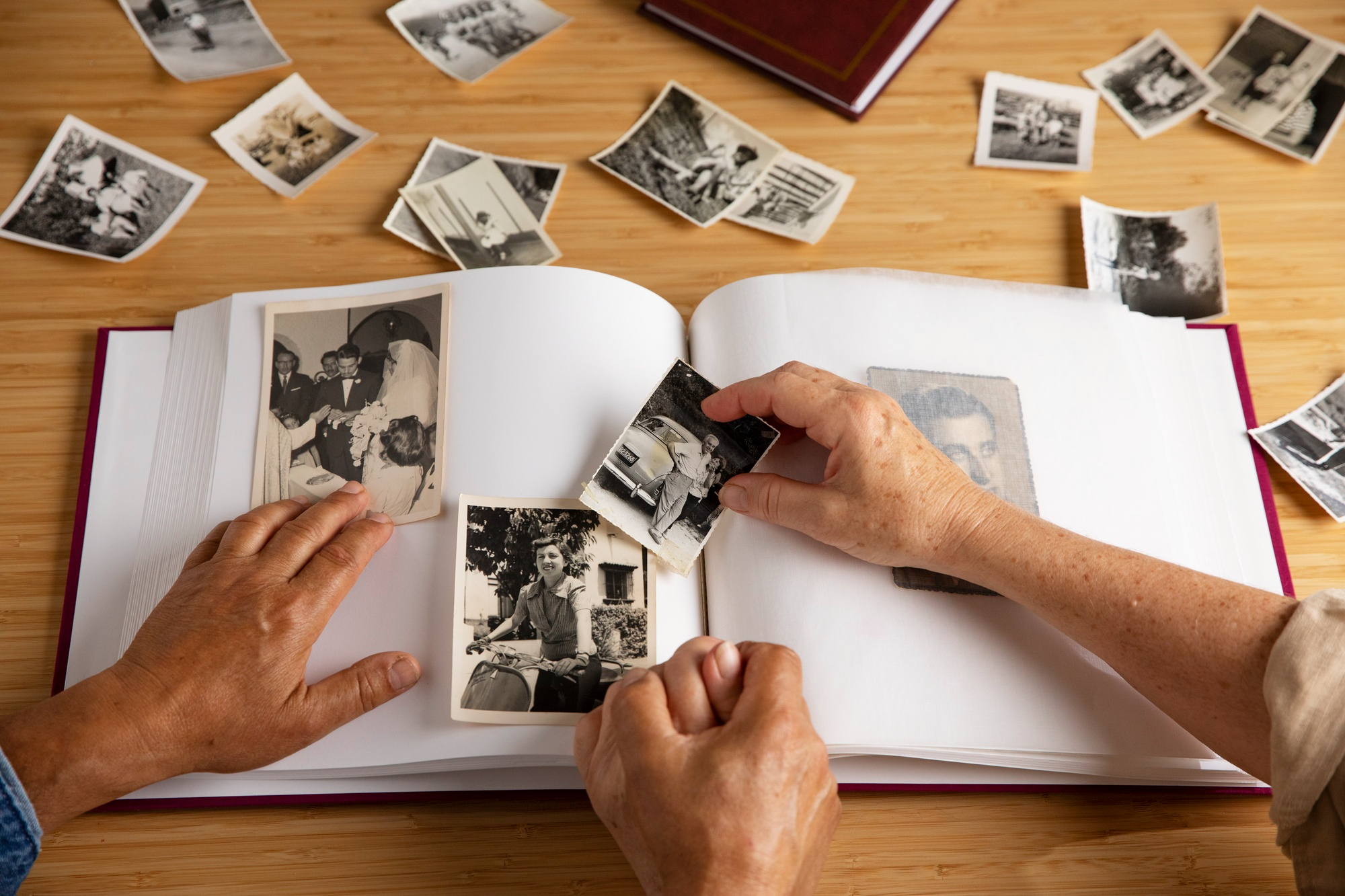
On our living room mantel we placed two albums side by side. Barbara’s mother’s homemade album, old and faded, full of crooked photographs and loving captions, a document of a little girl whose mother displayed everything she ever made with pride. And Emma’s memory book, restored as best it could be, faint stains still visible at the edges, the ribbon replaced in the same blue.
They did not match. They were not meant to match. One told the story of a child who made things for a mother who understood their value. The other told the story of a granddaughter who held up a mirror at the right moment and showed her grandmother something she had forgotten she used to know.
Emma stopped at the mantel one evening to look at them, the way she did sometimes, and she said they looked good together, the old one and the new one, and I told her I thought so too.
She picked up a marker from the coffee table where she had been working and went back to what she was making, and the kitchen table was covered in paper and the evening light was coming through the windows, and in the quiet I could hear her humming to herself, already absorbed in the next thing, already pouring herself into whatever this new one would become.

Specialty: Quiet Comebacks & Personal Justice
David Reynolds focuses on stories where underestimated individuals regain control of their lives. His writing centers on measured decisions rather than dramatic outbursts — emphasizing preparation, patience, and the long game. His characters don’t shout; they act.