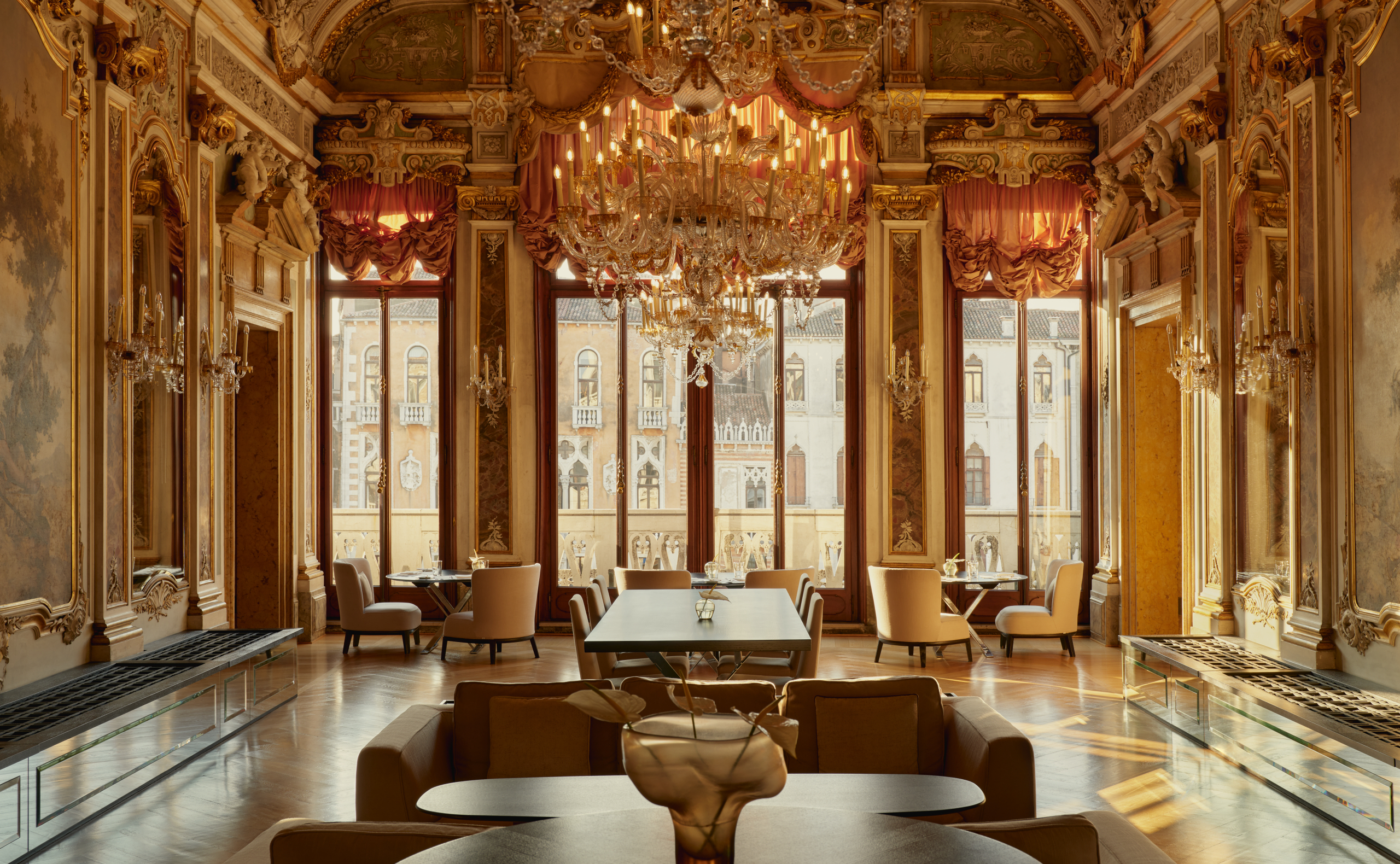
Elena had worked enough dinner services to read a table in under ten seconds.
She could tell within a glance who was celebrating, who was arguing, who was performing for an audience they’d brought with them. She knew the difference between a guest who wanted to be left alone and one who desperately wanted someone to notice them.
So when she approached table seven that Friday evening and saw the older woman sitting beside the sharply dressed man in his forties, Elena noticed immediately. Not the woman’s elegant clothes or the careful way she sat with her hands folded in her lap. What she noticed was the way the woman’s eyes moved — sliding around the room without landing, absorbing the noise and light and motion of the restaurant the way a person absorbs weather. Present in body, elsewhere in every way that mattered.
Elena had seen that look before. She saw it on her sister Sofía every time someone spoke too fast in a crowded room and decided it wasn’t worth slowing down.
She pulled out her notepad and began her standard greeting.
“Good evening. My name is Elena. Can I start you both with something to drink?”
The man — Julián, she would learn his name later — smiled and ordered whisky. The woman beside him didn’t respond. She was looking past Elena’s shoulder toward the ocean visible through the tall windows, her expression politely vacant.
Elena almost moved on. She had seven other tables and Mrs. Herrera was watching from across the room with the focused attention of a woman who catalogued every wasted second.
But something stopped her.
She lowered her notepad. Then, without fully deciding to, she raised her hands.
Good evening. My name is Elena. Would you like some wine?
The change in the woman’s face was immediate. Not dramatic — just sudden and complete, the way a room changes when someone opens the curtains. Her eyes found Elena’s for the first time. Her lips parted slightly. And then, with hands that trembled just a little, she signed back.
Yes. Thank you for asking me.
Julián had lifted his whisky glass halfway to his mouth. He set it back down without drinking.
“Mom?” he said softly.
Elena continued as if the moment were entirely normal, because for her, in a way, it was. She had been navigating this her entire life.
Chardonnay? Or something else?
Carmen — that was her name, though Elena didn’t know it yet — smiled. A small smile, careful and unguarded at once, the kind that surfaces when someone has spent a long time not being smiled at.
Chardonnay is perfect.
Elena wrote it down. Her heart was moving faster than usual, but years of restaurant work had given her a face that knew how to stay still.
When she turned to go, she felt a light touch on her sleeve. Carmen had reached out — just her fingertips, barely contact — and signed once more.
Thank you for speaking to me.
Elena swallowed. She was aware, suddenly, that the nearest tables had gone quiet. A few guests were watching with the particular attention people give to something they can’t quite categorize.
She signed back: Everyone deserves to be heard.
Then she walked toward the bar before something in her expression gave her away.
Behind her, she heard nothing from Julián. No conversation, no resuming of whatever had brought them here tonight. Just silence, which somehow felt louder than the rest of the room.
Elena had worked at La Marea for eleven months. It was the kind of restaurant where the glasses cost more than her weekly groceries and the guests expected a level of invisible precision that meant they would only notice you when something went wrong. Mrs. Herrera, the floor manager, had made the rules clear on Elena’s first day: correct, discreet, forgettable. That was the standard.
Elena had needed the job badly enough to become very good at those rules.
Her sister Sofía was seventeen and enrolled in a specialized school forty minutes away — one of the few programs in the region with staff trained in deaf education. The tuition was not covered by anything. It came entirely from Elena’s pay, which meant Elena’s job was not simply a job. It was the floor her sister stood on.
She reminded herself of this while she prepared the drinks at the bar. Crystal clinked softly. She kept her hands steady by concentrating on the task.
When she returned to table seven, Carmen was watching the entrance to the dining room. Waiting, Elena realized. Checking whether she would come back.
She placed the wine gently in front of the older woman and signed: If you need anything, you can tell me.
Carmen nodded. Her eyes were bright in a way that made Elena look away.
Julián waited until Elena had set his drink down before he spoke.
“Excuse me.” His voice was careful, the way people speak when they’re approaching something they’re not sure is solid. “You know sign language?”
Mrs. Herrera’s instructions moved through Elena’s mind like a warning sign on a dark road. Don’t draw attention. Don’t make the guests uncomfortable. Don’t make mistakes tonight.
“Yes,” she said. “My younger sister is deaf.”
Something shifted behind Julián’s eyes. He looked at his mother, then back at Elena, and whatever composed certainty he’d carried into the restaurant began, almost visibly, to recalibrate.
“For years,” he said, “everyone told me my mother could hear perfectly.”
Elena felt a coldness settle in her stomach. The specific kind that comes not from surprise but from recognition — the moment when something you half-sensed becomes real.
She said nothing. She didn’t need to. Carmen’s hands were already moving.
Elena watched the signs carefully, translating in silence before she spoke. What she saw made the cold feeling spread.
They never wanted him to know. The people who run this place.
“What did she say?” Julián asked immediately.
Across the dining room, Mrs. Herrera had begun moving toward them. Not quickly — she was too practiced for anything that visible — but with the deliberate angle of someone repositioning.
Elena thought about Sofía. About the bus fare, the textbooks, the monthly invoice from the school with the polite reminder at the bottom about balances due.
Carmen’s hands moved again, urgency threading through the signs.
Please tell him the truth.
Elena had a gift that most people considered ordinary. She had learned sign language at age nine because her sister needed her to, and she had never stopped improving because Sofía needed that too. What most people didn’t understand about signing was that it wasn’t just vocabulary. It was the whole face, the whole body — expression and inflection and the weight behind a word. You couldn’t fake desperation in sign language. It used too much of a person.
Carmen wasn’t faking anything.
Elena inhaled once.
“Your mother,” she said, “has been deaf for a long time.”
Julián didn’t move. “That’s impossible. Her doctors said—”
Carmen cut him off with quick, precise signs. Elena translated as they came.
“She says the doctors worked for the company that managed your father’s estate.”
A murmur moved through the nearest tables. Julián’s jaw tightened. “What does that have to do with—”
Carmen’s hands moved again. Slower this time, with the controlled steadiness of someone who has rehearsed a truth so many times it’s become a weight they carry constantly.
“She says after your father died, certain people needed her not to be deaf. They were concerned you might question documents she had signed.” Elena paused, making sure she had the next signs right. “She trusted them. They told her the papers were routine. She didn’t know what she was agreeing to.”
The sound of the restaurant seemed to recede. Somewhere, a fork clinked against a plate. Outside, the ocean moved in the dark beyond the windows.
Julián leaned back in his chair. He was a man who made decisions worth hundreds of millions of dollars and had the posture to prove it — composed, deliberate, in control. Right now he looked like someone who had picked up a familiar object and discovered it was hollow.
“Who?” he said. The single word was very quiet.
“That will be enough.”
Mrs. Herrera had arrived. Her voice was the temperature of the refrigerated wine she guarded so carefully. She positioned herself at the edge of the table like a weather system blocking the horizon.
“Elena.” She didn’t raise her voice. She never raised her voice. “You are here to serve, not to entertain guests with fabricated stories.”
Every eye in the section turned toward them.
Elena felt the specific vertigo of a moment that has become irreversible. She was standing in it and there was no direction back.
“Apologize to our guests immediately,” Mrs. Herrera said. “Or you can collect your things from the staff room tonight.”
There was nothing subtle about the offer. One sentence of apology, and the evening would fold back into itself like nothing had opened. Her job would survive. Sofía’s tuition would land in the school’s account on the first of the month. Life would continue exactly as it had before she’d raised her hands at a table and signed good evening to a woman no one else had bothered to speak to.
Elena looked at Carmen.
The older woman’s eyes were still. Not pleading — something past pleading, something more resigned. The expression of someone who has watched doors close so many times they no longer expect them to open.
Elena thought about Sofía at the kitchen table at ten o’clock at night, practicing signs in front of a cracked bathroom mirror propped against her textbooks. Drilling vocabulary she would need the next day at school, in a world that mostly didn’t know she existed in the way she needed to exist.
Everyone deserves to be heard.
She had signed it casually, instinctively, forty minutes ago. Now it was asking her something.
She straightened.
“I’m not fabricating anything,” she said.
Mrs. Herrera’s composure cracked slightly at the edges. “You ungrateful—”
“Wait.” Julián’s hand came up, flat and final.
The room went still.
He looked at Elena with the complete attention of a man who had spent decades learning to identify when someone was telling the truth.
“Tell me exactly what my mother said.”
Elena looked once at Mrs. Herrera — at the fury there, and beneath it, something that looked distinctly like fear — and understood that she had already made her choice. She had made it the moment she turned back to the table forty minutes ago.
She turned to Carmen. She watched the next signs with careful attention, then spoke.
“She says the person who arranged everything. Who set up the documents and directed the doctors and decided you should never know.” Elena paused. “She says that person worked here.”
The blood left Mrs. Herrera’s face in a single, visible wave.
Julián’s gaze moved from Elena to Mrs. Herrera with the slow, absolute precision of a man settling a conclusion.
For a long moment, nobody in the room moved. The ocean outside continued its indifferent work against the shore.
Then Julián reached into his jacket and placed his phone on the table. He did not break eye contact with Mrs. Herrera.
“Sit down,” he said quietly.
It was not a request.
Mrs. Herrera sat.
What happened in the next forty minutes, Elena would spend a long time replaying. Julián made three phone calls, each one brief and increasingly serious. Two men in suits arrived — she assumed legal staff — and took a table nearby with laptops and folders they seemed to produce from nowhere. Carmen sat with her hands folded and her wine untouched, watching her son work with an expression Elena could only describe as someone watching a window they had pressed against for years finally come open.
Elena was asked to remain available. She stood near the service station, watching Mrs. Herrera’s composure continue its quiet collapse across the room.
At some point, Julián came to find her.
He stood across the service station, and for a moment he simply looked at her — the practical uniform, the worn edges of her comfortable shoes, the notepad still tucked into her apron.
“How long have you worked here?” he asked.
“Eleven months.”
“And my mother — you’d never seen her before tonight?”
“No.”
He was quiet. “You risked your job for a stranger.”
Elena thought about how to answer that honestly. “I risked my job for someone who needed to be heard,” she said finally. “That felt like the part that mattered.”
He was quiet again for a moment. “Your sister. She attends a special school?”
“The Valle Verde program. Forty minutes from here.”
He nodded slowly, as if confirming something he was already thinking.
“Go finish your shift,” he said. “Someone will speak with you before you leave.”
She went back to her tables. She refilled waters and described the evening’s desserts and said thank you and you’re welcome and of course and right away. She did her job. Her hands stopped trembling somewhere around the third table.
The two men in suits were still at their corner table when the dining room began to empty. Mrs. Herrera had disappeared somewhere after the second phone call and had not returned.
Carmen found Elena near the end of the night, when the last guests were finishing their coffee and the kitchen had gone quiet behind its doors. The older woman moved carefully through the near-empty room, watching the floor rather than the tables, and when she reached Elena she stopped and simply looked at her for a moment.
Then she raised her hands.
I spent twelve years watching people talk around me as if I had already left the room. Her signs were slow and deliberate, the way people speak when they want every word to land. I had almost forgotten what it felt like to be spoken to directly. You gave that back to me tonight.
Elena felt the particular tightening behind her eyes that she had been holding back since the moment Carmen had first signed yes, thank you for asking me.
She signed back: I’m glad I turned around.
Carmen smiled — fuller this time, without the careful quality of before. She reached out and briefly held both of Elena’s hands between her own, the gesture of someone passing something along. Then she turned and walked back toward where Julián was waiting.
One of the suited men approached Elena as she was collecting her things from the staff room.
He handed her a card and explained, with the practiced efficiency of someone who did this regularly, that Julián Vega wished to offer several things. First, a position within his company’s hospitality division at a salary he named, which was a number Elena had to hear twice. Second, full coverage for her sister Sofía’s enrollment at Valle Verde for the remainder of her education, paid directly to the institution. Third, and the man’s voice became slightly less formal here, Julián’s personal gratitude.
Elena held the card without speaking for a moment.
“He doesn’t have to do this,” she said.
“No,” the man agreed. “He wants to.”
She thought about what wanting to meant. She had spent eleven months in a restaurant where wanting things was something other people did — guests who wanted the good table, managers who wanted smooth service, a world that wanted her invisible and correct and forgettable.
Wanting something for herself had started to feel like a language she was losing the vocabulary for.
She looked at the card. She looked at the number written on the small notepad the man had handed her alongside it.
“Okay,” she said.
The night outside was cold and clear. The ocean she had watched through the restaurant windows all evening was invisible now, but she could hear it — a constant, unhurried sound that didn’t care about any of what had happened inside.
Elena walked to her car and sat for a moment before starting the engine. She thought about the eleven months. The careful invisibility. The way she had learned to move through a room like something ambient and necessary, like lighting or temperature, noticed only in its absence.
She thought about the moment she had turned back to the table. Not because she had calculated anything or seen an opportunity or known what would follow. But because she had recognized something in a stranger’s face and it had moved her hands before her caution could.
She started the car.
She would call Sofía in the morning. Not to explain everything — there was too much to explain in one call — but to tell her that something had changed. That the thing they had been working toward together, in different ways, from either side of a distance that neither of them had chosen, had shifted.
That the floor they stood on was more solid than it had been yesterday.
She pulled out of the parking lot and drove home through streets that looked like they always had, ordinary and continuous, holding their shape around a night that had quietly rearranged everything inside it.
On the passenger seat, the business card caught the passing light.
She didn’t look at it again. She already knew what it said.
She already knew what it meant.
Some moments don’t announce themselves. They arrive looking exactly like every other moment that came before — a table, a guest, an ordinary evening in a restaurant where the glasses cost more than your groceries. And then something moves in you before your caution catches up. You turn back. You raise your hands. You say the thing that is true.
And the world, quietly, rearranges itself around that choice.
Elena drove home through the dark, both hands on the wheel, already thinking about what to say to her sister.

Specialty: Emotional Turning Points
Rachel Monroe writes character-driven stories about betrayal, second chances, and unexpected resilience. Her work highlights the emotional side of family conflict — the silences, the misunderstandings, and the moments when someone quietly decides they’ve had enough.