The morning arrived the way certain mornings do, carrying a weight that everyone in the building seemed to feel before they could name it. The front desk staff at the veterinary clinic spoke in half-voices. The usual rhythm of the place, phones ringing, a dog barking somewhere in the back, the cheerful exchange between a receptionist and a patient owner, had gone quiet. Even the fluorescent lights in the examination hallway seemed subdued, though of course that was not possible. Some silences are so complete they reshape the room around them.
Officer Alex Voronov arrived at 9:14 in the morning, earlier than anyone had expected, because he had not slept.
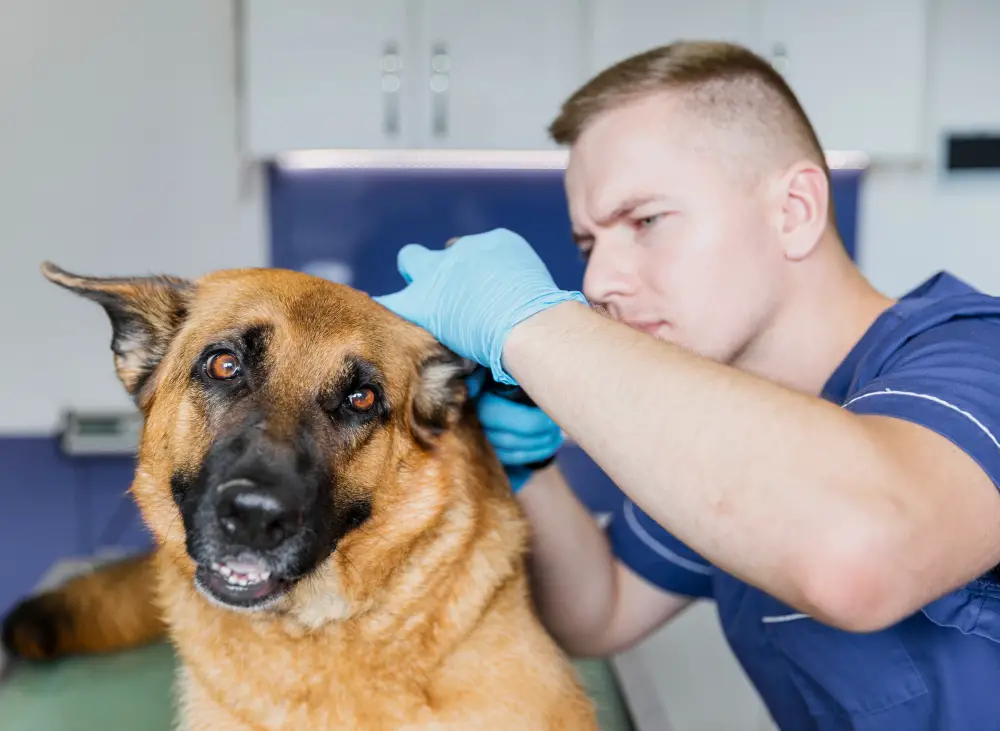
He carried Rex through the front door with both arms, the dog pressed against his chest the way you carry something irreplaceable, carefully and without hurry. Rex was a German Shepherd, eight years old, forty kilograms of muscle and bone that had once moved through forest undergrowth like water finding its path. This morning he lay still against Alex’s chest, his broad head resting on the officer’s shoulder, his breathing slow and uneven in a way that made the space between each breath feel like a held question.
The waiting room went quiet when they entered. A woman with a tabby cat in a carrier looked up, read the room in an instant, and looked back down at her hands. A teenage boy sitting beside his mother with a bandaged terrier on his lap watched Alex pass with the particular solemnity that young people sometimes find in moments that clarify something for them about the world.
Alex did not notice any of it. He was looking at Rex.
Dr. Elena Marsh was already in the examination room when Alex arrived, standing at the far end of the metal table with the practiced stillness of someone who had prepared herself for a difficult hour. She had been Rex’s primary veterinarian for four of his eight years of service, and she had reviewed his file three times that morning, each time hoping the numbers would rearrange themselves into something more forgiving. They had not.
Two patrol officers from Alex’s unit stood against the wall near the window, shoulders back, hands clasped in front of them, wearing the posture of men attending something formal. Their names were Dmitri and Oleg. They had both worked alongside Rex on various assignments over the years and had come without being asked. That, too, said something about the kind of animal Rex had been.
“Place him here,” Dr. Marsh said quietly.
Alex laid Rex on the examination table with a gentleness that was almost architectural, as though he were lowering something into the precise space that had always been meant to hold it. He kept one hand on the dog’s neck. Rex’s eyes were open, dark and calm, tracking Alex’s face with the unhurried attention he had always reserved for his handler, a focus so complete it sometimes seemed like a form of language.
Alex had spent eight years learning to read that focus in return. He knew Rex’s breathing the way a sailor knows the sound of a particular sea. He knew the exact set of the dog’s ears when he picked up a scent worth following, the subtle tension that moved through his haunches before he committed to a direction, the particular stillness that descended over him in the seconds before something dangerous resolved itself. He had learned all of it gradually, the way you learn the grammar of a language that has no written form.
Today the breathing was wrong. Too shallow, too irregular, with small catches between inhale and exhale that had nothing to do with exertion.
Dr. Marsh reviewed the test results from the folder in her hand, though she had already committed them to memory. She set the folder down on the counter and looked at Alex directly.
“We ran everything twice,” she said. “The kidneys are functioning at a fraction of normal capacity, and there is fluid accumulation in the lungs. His overall condition is severely compromised, and it has been declining steadily for the past two weeks despite treatment.”
Alex absorbed this without expression. He had been absorbing versions of it for the better part of a month.
“Surgery,” he said. “Is there a surgical option we haven’t tried? A specialist somewhere, a different facility, something experimental?”
The veterinarian’s expression held steady. She had been asked some version of this question many times in this room, and she had never found a way to answer it that did not feel inadequate to the weight of what was being asked.
“If there were a viable surgical option, I would have raised it before now. What we are looking at is systemic failure that has progressed beyond the point where intervention would offer meaningful benefit.” She paused, then continued in the same measured tone. “Continuing treatment at this stage means prolonging discomfort without reversing the cause of it. What I can offer Rex now is a peaceful exit, and I believe that is the most humane thing we can do for him.”
The words settled into the room and did not dissipate.
Rex had found a missing child in a forest near Kazan during a November storm, following a scent trail across seven kilometers of frozen undergrowth while visibility dropped to almost nothing. He had located a significant drug cache in a warehouse on the city’s eastern edge that three previous searches had missed, pressing his nose to a section of wall with such quiet certainty that the officers on scene had dismantled the entire partition based on nothing more than that gesture. He had participated in four arrests that Alex described in his official reports as high-risk, a phrase that covered, inadequately, the reality of moving toward armed individuals in confined spaces while trusting the animal beside you with your life.
The word “go” applied to such a creature felt like the wrong instrument for the job.
The authorization paperwork had been completed at the department that morning. The duty sergeant had handled the administrative process with quiet efficiency and had said nothing unnecessary. Alex had signed his own section without reading it because reading it would have required him to process the words as words, and he was not ready for that.
Dmitri and Oleg approached the table one at a time. Dmitri placed his hand briefly on Rex’s flank, applying a gentle pressure that was not quite a stroke. “Best partner I ever worked next to,” he said, and his voice was even. Oleg leaned down close to the dog’s ear and said something too quiet for anyone else to hear, then stepped back.
Alex leaned close to Rex’s head, close enough that the dog’s ear was against his cheek.
“I’m here, buddy. You don’t have to fight anymore. I’ve got you.”
And then Rex moved.
The movement came from some reserve that no one in the room had anticipated, given the condition he was in. With significant visible effort, Rex raised both front paws from the table and placed them around Alex’s shoulders. Not a reflexive twitch, not an involuntary response to stimulus, but a deliberate act of contact. He pressed himself toward his handler with everything he had remaining, the weight of his chest leaning into Alex’s, his paws gripping the back of the officer’s jacket with gentle but unmistakable intention.
The room became completely still.
In eight years, Rex had never done that.
Alex’s throat closed. He could feel the dog’s heartbeat through the fabric of his uniform, irregular and effortful, working against odds it had no business working against. His eyes filled and he did not try to prevent it.
“It’s okay,” he managed, barely above a whisper. “I’m right here. I’m not going anywhere.”
Dr. Marsh had already lifted the prepared syringe from the tray beside the table. Her hand stopped.
She stood for a moment with the syringe in the air, looking at Rex with an expression that had shifted, subtly but unmistakably, from the composed attentiveness of a practitioner managing a difficult procedure to something sharper and more investigative.
She set the syringe down.
“Wait,” she said.
The word landed in the silence with unusual clarity. Everyone looked at her.
Dr. Marsh placed her right hand carefully on Rex’s abdomen, applying gentle pressure, moving her fingers in a slow, deliberate pattern. She paused. Moved her hand to his left side. Pressed again, this time more firmly, her eyes not on the dog but focused on the middle distance the way a person looks when they are reading information through their fingertips rather than their eyes.
Something changed in her face.
It was not dramatic. It was the change of someone who has seen something they were not expecting and is being careful not to misinterpret it.
She turned to her assistant, a young woman named Sasha who had been standing quietly by the door throughout the procedure.
“Turn the ultrasound back on. I need another image.”
Sasha moved to the machine without speaking and powered it back up. The familiar hum returned to the room. The gel was applied. The probe moved across Rex’s side.
The grainy, grey-toned image filled the monitor, the same image they had reviewed that morning, the same fluid, the same diminished organ function, the same evidence of a body in serious and progressing decline. Dr. Marsh studied it in silence. The room watched her watch the screen.
Then she straightened. Her spine went from the slight lean of concentration to fully upright, and she turned to face Alex with an expression that no one in the room had seen on her face before.
“Stop,” she said. “This is not organ failure.”
The silence that followed was of a completely different quality than the silence that had preceded it.
Dmitri and Oleg looked at each other. Alex raised his head from where he had been resting it against Rex’s, his eyes still wet, confusion replacing grief in the arrangement of his features.
“What are you saying?” he asked, and his voice came out rougher than intended.
Dr. Marsh turned back to the monitor and adjusted the zoom, bringing a specific region of the image into closer focus. She pointed at the screen, directing everyone’s attention to a small, distinctly shaped dark area positioned near what would have been Rex’s lower left side.
“Do you see this formation here? This irregular density?”
Alex moved around the table to look at the screen. He had no expertise in reading ultrasound imagery, but the object she was indicating was visible enough in its outline to register as something with a defined boundary, something that did not have the soft, dispersed appearance of tissue or fluid.
“What is that?”
“I want to be certain before I say definitively, but I believe this is a metallic fragment.” She switched the ultrasound to a different imaging mode and studied the result carefully for several seconds. “Yes. A metal fragment. Small in size but positioned in close proximity to critical tissue. Not superficial, not recently introduced. It has been in there for some time.”
She was quiet for a moment, assembling her thinking.
“Metal fragments of this kind create a localized toxic environment as they degrade. The contamination is slow and gradual, which is why the presentation can mimic systemic organ failure so precisely. The kidneys are affected, the lungs show fluid accumulation, the whole clinical picture fits. But it fits because of a single, discrete cause, not because of general physiological decline.”
She looked directly at Alex.
“This is why his tests look the way they do. Not because his body is shutting down for reasons we cannot address. Because there is a foreign object contaminating his system from the inside, and it has been there long enough to cause this level of damage.”
Nobody spoke immediately. The information required a moment to reorganize the room around it.
“So the deterioration,” Alex began slowly, “everything we’ve been seeing for the past month—”
“Is consistent with the presence of this fragment. Yes.”
“And if it were removed?”
Dr. Marsh took a measured breath. She was not a person who offered false reassurance, and everyone in the room understood that about her. When she said something, it carried the weight of precision.
“If we act today, the surgery itself carries risk. I will not minimize that. He is weakened, and operating on an animal in this condition requires extraordinary care. But the fragment can be removed. And if the surgery is successful, the contamination stops. His kidneys have been compromised but not destroyed. Lungs can clear. Given appropriate post-operative care and time, there is a genuine possibility of meaningful recovery.”
She let that sentence finish completely before continuing.
“I cannot promise outcomes. What I can tell you is that thirty minutes ago I was looking at a dog at the end of his life. What I am looking at now is a dog with a problem we may be able to solve. Those are two fundamentally different situations.”
Dmitri made a sound from his position against the wall, something between a short breath and a word that did not quite form. He pressed the back of his hand to his mouth and looked at the ceiling.
Oleg stood very still with his eyes closed for a moment.
Alex turned back to Rex, who still had his paws draped loosely over his handler’s shoulders, the grip relaxed now but the contact maintained. Rex’s eyes were on Alex’s face. They had always been on Alex’s face in moments that mattered.
“Did you hear that?” Alex said quietly, his voice unsteady in the way voices become when relief and grief arrive at the same moment and collide. “You stubborn, brilliant animal. You are not planning to leave today after all.”
Rex exhaled, a long, slow breath that moved through his whole body.
Dr. Marsh was already giving instructions to Sasha about preparing the surgical suite. Her voice had taken on the efficient, decisive quality of someone with a clear task in front of them, a quality entirely different from the careful gentleness she had been using for the previous hour.
“I need the surgical prep room ready in ten minutes. I am calling Dr. Petrov in for assistance. Alex, I need you to authorize the surgical procedure in writing. The decision to move forward is yours and the department’s, and I want you to have full understanding of the risks before we proceed.”
Alex was already reaching for the form Sasha held out to him.
“Tell me the risks.”
She told him plainly and in detail, the challenges of operating on a dog whose system was already weakened, the possibility of complications during anesthesia, the uncertainty of how thoroughly the contamination could be addressed in a single procedure, the long recovery period that would follow even a successful surgery. She said all of it clearly and without softening any part of it.
Alex listened to every word.
Then he took the pen and signed the form.
“How long before we know anything?”
“The surgery itself will take several hours. I will send an update through Sasha as soon as we are through the critical phase. You are welcome to wait here, and I would encourage you to eat something and sit down, because you look like you have not slept in two days.”
“Three,” he said.
She looked at him. “Sit down.”
The hours that followed had their own particular texture. The surgical suite door closed, and the waiting began, which is its own form of work, the effort of holding a specific outcome in mind without gripping it so tightly that the fear underneath becomes unmanageable.
Alex sat in a small staff room down the corridor from the operating suite, a cup of coffee Sasha had brought him growing cold on the table beside him. Dmitri and Oleg remained, sitting in chairs across from him, not filling the silence unnecessarily but not leaving either. At one point Dmitri said, “He wrapped his arms around you,” and Alex nodded once and did not elaborate, and that was sufficient.
The department duty sergeant called twice. On the second call, learning that surgery was underway, he said only, “Keep us updated,” and meant it in a way that carried the endorsement of the entire unit.
Two hours and forty minutes into the procedure, Sasha appeared at the door of the staff room.
“Dr. Marsh says the fragment has been removed. She says it was lodged deeper than she initially estimated, which made the procedure more complex, but it is out. Rex is stable. She says to tell you it went as well as it could have gone.”
Alex placed both hands flat on the table and looked at them for a moment.
“Thank you,” he said.
Sasha nodded and disappeared back down the corridor.
Dmitri released a long breath and leaned back in his chair, pressing his fingers against his eyes for a moment in a gesture that he would not have made in public but seemed to have forgotten, temporarily, that others were present. Oleg stood up and walked to the window and stood there looking out at the parking lot below, saying nothing, which was its own kind of response.
The recovery would not be fast. Dr. Marsh made this clear when she came to speak with Alex after the surgery was complete and Rex was in the post-operative care suite, sedated and monitored, his breathing still slow but now for entirely different and far more manageable reasons.
The contamination had been building for an estimated six to eighteen months, she told him. The fragment appeared to have originated from an old injury, possibly a confrontation during an operation where Rex had been in close proximity to something that had discharged or shattered at speed. There was no definitive record of a specific incident, but given the nature of the dog’s service history, the origin was not difficult to imagine. Small fragment, deep entry point, no visible wound significant enough to have prompted investigation. The body had simply incorporated it over time until the damage it was doing became impossible to ignore.
Removing it did not undo the months of accumulation. But it removed the source, and without the source, the body could begin the long and uncertain work of restoring itself.
“Six to eight weeks minimum before we can make meaningful assessments about his long-term prognosis,” Dr. Marsh said. “Dietary management, controlled activity, follow-up imaging every two weeks. And rest. He has been fighting this without anyone knowing it for a very long time. He needs to stop fighting and start healing.”
Alex visited Rex in the recovery suite before he left the clinic that evening. The room was dim and quiet, the only sounds the steady note of the monitoring equipment and the soft rhythm of the dog’s breathing, which had steadied and deepened since the surgery. Rex was lying on a padded surface, an IV line taped neatly to his foreleg, his eyes half-open in the unfocused way of an animal still moving through the edges of anesthesia.
Alex pulled a chair close to the recovery surface and sat down. He did not speak immediately. He rested his hand lightly near Rex’s, not touching the IV site, just close. Present.
After a while he said, very quietly, “You always knew where to go when things were bad. Even today. You knew.”
Rex’s eyes moved toward his voice.
There are certain things that cannot be fully contained in the language of function or utility, even when a relationship has been built in the context of work. Eight years of moving through the world together, the accumulated weight of shared difficulty and shared relief, the particular trust that comes from having your life depend on another creature’s judgment and having that judgment prove reliable enough times that dependence becomes something closer to partnership. That kind of history settles into the body. It becomes a form of knowledge that operates below articulation, the kind Rex had drawn on when he lifted his paws to his handler’s shoulders in a room that had gathered to say goodbye, insisting on contact, insisting on presence, in a way that changed the direction of everything that followed.
It was that gesture, Dr. Marsh said later, that had caused her to pause. Not because it was medically significant in itself, but because it was so intentional, so deliberately sustained, that it had pulled her attention back to the animal in front of her with a quality of focus she had not been bringing to the procedure. She had been managing a conclusion. Rex had interrupted it.
Whether that was instinct or something less easy to categorize was a question Dr. Marsh was content to leave open. In eighteen years of veterinary practice, she had learned to hold that kind of question loosely. Animals did things that fit neatly within established frameworks of behavior and cognition, and occasionally they did things that did not, and both were worth paying attention to.
What she was certain of was that the fragment had always been there, that the correct diagnosis had always been available to someone looking at the right thing, and that the decision to look more closely had been prompted by a dog who, in what was supposed to be the final minutes of his life, had reached for the person he trusted most and held on.
Over the weeks that followed, the Voronov family rearranged their home around Rex’s recovery with the kind of collective commitment that tends to emerge when a household is united around a single clear purpose. Alex’s daughter, who was nine years old and had grown up with Rex as an immovable fact of her family’s life, appointed herself his primary daytime companion during the period when he was confined to limited movement. She read to him from a series of adventure novels she was working through, not because she believed he followed the plot, but because she had decided that the sound of a familiar voice was good for healing and she was not wrong about that.
Alex took the first three weeks of the recovery period on leave, a decision the department supported without reservation. He administered Rex’s medication on schedule and attended every follow-up appointment, sitting through the imaging sessions with the focused attention of a student who has already been tested once and does not intend to miss anything a second time.
The two-week imaging sessions told a steady story of gradual improvement. The fluid in the lungs reduced consistently. The kidney function markers moved slowly but persistently in the correct direction. Dr. Marsh tracked the numbers with the careful attention of someone who does not celebrate too early but can be seen, if you watch her expression closely, registering the difference between what she had feared and what she was seeing.
At the eight-week follow-up, she sat across from Alex in the same examination room where the morning had begun, and the light through the window was different now, winter having given way to something earlier and more tentative in its warmth.
“His kidney function is at sixty-two percent,” she said. “That is not where it was before this began, and I cannot promise it will fully return to its previous baseline. But it is a stable, livable level. The lungs are clear. His appetite has normalized. He has gained back four of the six kilograms he lost during the worst period.”
She closed the folder.
“With appropriate management, I see no reason why Rex cannot return to a healthy quality of life. Active service is a different question, and that will require a separate conversation with the department’s medical advisors. But as an animal, as a living creature with time ahead of him, he is in a genuinely good place.”
Alex sat with this for a moment.
“Thank you,” he said, and the two words covered more than their literal surface.
The question of Rex’s return to active service was resolved thoughtfully and without haste. The department’s veterinary medical advisor reviewed the full recovery record and concluded, in consultation with Dr. Marsh, that the physical demands of active search and detection work, while not impossible given Rex’s recovery, introduced stress loads that were difficult to justify against the backdrop of the damage that had already been sustained. Rex had given eight years of extraordinary service. The record spoke for itself.
The recommendation was retirement from active duty, effective immediately, with full transition to Alex Voronov’s household as a companion animal at the department’s standard provision for retired service dogs.
Alex accepted this without appeal, because the alternative was not something he had any interest in arguing for. Rex had earned whatever came next on his own terms.
The day Rex came home permanently, without the working vest, without the operational cadence that had structured his days for eight years, Alex’s daughter met them at the front door and sat down on the entryway floor without ceremony, and Rex walked up to her and lay down beside her with the ease of something returning to its natural position.
He was slower now, and would remain so. He tired more easily than he once had, and the afternoon naps that had always been brief had extended into longer stretches of comfortable rest. But his eyes, when he lifted them toward familiar faces, were clear and present and held the particular attentiveness that had always been one of his most distinctive qualities, the sense that he was not simply occupying a room but actively reading it, noting everything that mattered.
Alex, for his part, had stopped trying to fully explain what had happened on the morning in the veterinary clinic. He told the story when he was asked, and he was asked with some regularity, because stories of that kind move through the networks of people who work with animals and accumulate meaning as they go. He told it accurately, without embellishment, because the facts were sufficient.
A dog who had been given up for lost had reached for his person in the final moment. A veterinarian who had paused to look more carefully had found the thing that changed everything. A fragment so small it had evaded detection for months was removed in a surgery that lasted just under three hours. A body that had been slowly poisoned began, with time and care, to restore itself.
What Alex believed, and what he did not particularly require others to share, was that Rex had known something. Not in a mystical or inexplicable sense, but in the particular way of a creature whose entire life had been organized around attention and communication, who had spent eight years learning to convey critical information to the person beside him through gesture and posture and behavior, and who had done precisely that one final time in a room that had gathered to end rather than continue his story.
He had communicated that he was not finished. And someone had listened.
The morning that had arrived carrying the weight of an ending became, instead, the morning everything turned. Not loudly, not with fanfare, but in the way the most significant changes tend to arrive: through one person paying attention at exactly the right moment, and one animal refusing, with the last of his available strength, to go without being truly seen.

Ethan Blake is a skilled Creative Content Specialist with a talent for crafting engaging and thought-provoking narratives. With a strong background in storytelling and digital content creation, Ethan brings a unique perspective to his role at TheArchivists, where he curates and produces captivating content for a global audience.
Ethan holds a degree in Communications from Zurich University, where he developed his expertise in storytelling, media strategy, and audience engagement. Known for his ability to blend creativity with analytical precision, he excels at creating content that not only entertains but also connects deeply with readers.
At TheArchivists, Ethan specializes in uncovering compelling stories that reflect a wide range of human experiences. His work is celebrated for its authenticity, creativity, and ability to spark meaningful conversations, earning him recognition among peers and readers alike.
Passionate about the art of storytelling, Ethan enjoys exploring themes of culture, history, and personal growth, aiming to inspire and inform with every piece he creates. Dedicated to making a lasting impact, Ethan continues to push boundaries in the ever-evolving world of digital content.