My name is Laura Paxton. I am thirty-four years old, and the night I stopped being invisible began with six words spoken into a microphone in front of two hundred people.
“Security. Remove this useless woman.”
My stepmother Diane said it without raising her voice. She said it the way you’d ask someone to clear a glass from the table, with that particular, practiced calm that is somehow colder than shouting. My father, Richard Paxton, was standing three steps away in his custom tuxedo when she said it. He looked at the floor. He said nothing.
I walked out. I did not run. I did not cry. I placed a small velvet box on the nearest table as I passed, kept my back straight, and walked through the ballroom doors and into the October night while the jazz quartet started playing again behind me.
What happened in the forty-seven minutes that followed is the part of this story most people find difficult to believe, because it looks, from the outside, like something that was done in anger. It was not. It was done with the quiet precision of a woman who had been given her instructions years before she understood what they meant, by the only person who had ever truly thought ahead on her behalf.
But to understand what I did in that hotel parking lot, you need to understand what my mother left behind when she died. And to understand that, you need to understand what the twenty-three years before that night actually looked like from where I was standing.
My father’s name is Richard Paxton. If you have driven through the suburbs north of New York City and noticed those glass-and-steel office parks that multiply along the highway like cells dividing, there is a reasonable chance his name is on the permits. Commercial real estate was his kingdom, thirty-five years of buying land, financing construction, and shaking hands with men whose watches cost more than most people’s annual salaries. When he announced his retirement that spring, the town reacted the way it might to a senator stepping down. But that kingdom had a foundation most people never saw, including, for a very long time, me.
My mother, Catherine Hail Paxton, died when I was eleven years old. Ovarian cancer. Eight months from diagnosis to funeral, and then she was simply gone, the way a candle goes out in the middle of dinner. What I remember most is not the hospital or the particular quality of silence that followed. What I remember is the kitchen table.
She would sit across from me with a roll of craft paper and a set of drafting pencils, teaching me how to draw a floor plan. She sketched the bones of buildings, the load-bearing walls, the joists, the hidden geometry that held everything upright, and she would say, “See, Laura, everything beautiful starts with structure.” I did not know then that she was a licensed architect. I did not know she had her own firm. Those details were buried along with everything else about her. Nobody told me, not in eleven years of childhood and not in the twenty-three years that followed.
Eight months after the funeral, my father married Diane Hartwell.
I remember the exact morning he told me because I was sitting at that same kitchen table, drawing a floor plan of our house from memory, and he sat down across from me and said I was going to have a new mother. I was eleven. I did not know how to say that I did not want one. So I said nothing. That was the first time I chose silence. It would not be the last.
Let me tell you about Diane, because understanding her is essential to understanding everything that followed. Diane Paxton, born Hartwell, was the kind of woman who could walk into a room and rearrange it without moving a single piece of furniture. She did it with tone and timing, with the specific talent of making every suggestion sound like a kindness and every command sound like a question. She wore Chanel tweed the way other women wear denim, casually, constantly, as if it simply materialized on her body each morning. Her hair was always blown out, always honey blonde, always precisely the same. I never once saw Diane Paxton look unprepared, and I should have recognized earlier that this was not a personality trait but a strategy.
Within a year of the wedding, the Thanksgiving seating chart changed. I went from sitting beside my father to sitting at the smaller table in the sunroom, because, Diane explained, I was so much more comfortable away from the crowd. By year three, the family Christmas card featured Diane, my father, and Meredith, Diane’s daughter from her first marriage, who was two years younger than me. I was told the photographer had run out of time before my solo shots. By year five, my bedroom had become Diane’s yoga studio. My things were boxed and moved to the guest room. She would be leaving for college soon anyway, Diane told my father. No point wasting the space.
Diane introduced Meredith to people as our daughter. She introduced me as Richard’s daughter from before, the word delivered with a particular emphasis that positioned me as a rough draft my father had since improved upon. The Cartier Love bracelet on her wrist, eighteen-karat gold, the one my father gave her for their tenth anniversary, I would later learn had been purchased with money from the family trust. A trust built, in significant part, on my mother’s inheritance. But I did not know that yet.
I became a restoration architect. I work on the buildings everyone else has forgotten: a crumbling Carnegie library in the Hudson Valley, a nineteenth-century firehouse in the Catskills, a schoolhouse in Beacon with a collapsed roof and a hundred years of stories sealed in its walls. I strip back the decay, locate the original bones, and bring them back to life. It is painstaking and physical work. Some days I am covered in plaster dust, crawling through attic spaces with a flashlight clenched between my teeth. I earn a hundred and ten thousand dollars a year, which is a perfectly good living. But in the Paxton world, where Meredith’s Instagram sponsorship deal was worth two hundred thousand dollars for posting photographs of handbags, my career was a punchline delivered with a tilted head.
At the previous Christmas dinner, when the table turned to me after Meredith announced her latest brand deal, Diane looked across the white linen and said, “And Laura, have you found anything more stable yet?” As if I had been job hunting for a decade. As if restoration architecture were a phase that had simply extended past its natural conclusion. My father looked at his plate. He always looked at his plate.
I drove home that night in my seven-year-old Subaru Outback with two hundred thousand miles on the odometer, paid off. Meredith’s Mercedes was parked beside it when I left. She had patted my hood on the way in and said, “Cute car. Very you.” I did not answer. I just drove. That was what I had always done. Drove and swallowed and drove.
What none of them knew was that six weeks before that Christmas, the Historic Preservation Society had awarded me their highest honor for the Carnegie Library project. I had not told them. I had stopped offering good news to people who only knew how to diminish it.
Eleven months before my father’s retirement party, I was kneeling on the floor of my Brooklyn Heights apartment, sorting through a cardboard box I had not opened in years. It was my mother’s box, battered at the corners, carried from the Westchester house to my college dorm to my first apartment and finally here, to a third-floor brownstone walk-up with creaky floors and good eastern light. Inside: her leather-bound notebook, a few of her drafting pencils, and a photograph of her standing in front of a half-built house with sawdust in her hair and the biggest grin I had ever seen on anyone’s face.
And at the very bottom, beneath a stack of old birthday cards, a sealed envelope I had never noticed before.
It was cream-colored, heavy stock. On the front, in my mother’s handwriting, that slanted, confident script I would recognize anywhere on earth, it read: For Laura, when she’s ready.
My hands were shaking when I opened it. Inside was a single sheet of her personal letterhead, and what was printed at the top of that sheet stopped my breathing completely. It read: Catherine Hail, AIA. Hail Architecture and Preservation.
My mother had been a licensed architect. She had had her own firm. Not a single person in twenty-three years had told me. Her profession had been erased along with her photographs and her name and her books, one quiet removal at a time.
Below the letterhead, in that same slanted hand, she had written: My darling girl, there are things about our family’s money I need you to understand when you’re old enough. I’ve made arrangements to protect what’s yours. Mr. Aldridge has everything. Find him.
Tucked behind the letter was a business card. Thomas Aldridge, Esquire. Trusts and Estates.
I sat on the floor of my apartment for a long time. Then I opened my laptop and searched his name. Thomas Aldridge was sixty-seven years old and still practicing, his office on the fourteenth floor of a prewar building on Madison Avenue, twelve subway stops from my front door. I composed an email with my full name and the words: My mother was Catherine Hail Paxton. She left me a letter. She told me to find you.
He responded in two hours. The subject line read: I’ve been waiting for this email for 23 years, Miss Paxton.
I went the next morning.
But before I tell you what I learned in that office, I need to say something about my father, because it matters to how this story is understood. Richard Paxton was not a villain. That was what made it so much worse. A villain you can hate cleanly. My father was something far more complicated and far more painful: a man who loved me in the abstract but consistently lacked the courage to show it whenever doing so cost him anything.
The memory I returned to most often was from when I was fourteen. He picked me up from school on a Tuesday for no reason I could identify, drove me to the west side of town, and parked in front of a beautiful old stone building that was in the process of being demolished. We sat in the car and watched the wrecking ball swing.
He was quiet for a long time. Then he said, “Your mother would have fought to save that building.”
It was the last time he ever mentioned her name.
After that, Catherine Hail Paxton became a ghost in her own house. Her photographs disappeared from the hallways. Her books were boxed. Her name was replaced by Diane’s in every sentence, every tradition, every toast raised at a family table. And my father let it happen, one small erasure at a time, because Diane’s tears were always louder than my silence.
Three weeks before the retirement party, I called him and asked if we could meet for coffee, just the two of us. He said yes immediately, and for half a second I felt something warm and unfamiliar, the possibility that he might simply choose me, unprompted, without an audience. Ten minutes later my phone rang. Diane’s voice. She told me his schedule was very full right now and perhaps after the party would be better.
A week after that, the invitation arrived. Crane and Company card stock, gold foil lettering. Celebrating 35 years of excellence: Richard Paxton, hosted by Diane Paxton and Meredith Paxton. My name was printed as Laura Paxton Hartwell. Diane’s maiden name, hyphenated onto mine like a brand, like a revision, like a declaration about whose daughter I actually was.
I decided I would go. But first, I would see Thomas Aldridge.
The three weeks leading up to the party were a study in the particular methodology Diane had perfected over two decades. The moves were small enough to be individually deniable and collectively devastating. I sent a message to the family group chat asking what time guests were expected at the venue. It sat delivered but unanswered for three days. When I texted Meredith separately, she replied four hours later to tell me her mother had made a new chat and it must have been a glitch. There are never glitches with Diane.
When I called the Whitmore Hotel to confirm my RSVP with the event coordinator, a woman named Janelle, there was a long pause before she told me my name was not on the guest list. Two hundred guests confirmed months in advance, and I was not among them. When I called Diane directly she picked up on the second ring, because Diane never wanted to appear to be avoiding anyone. She expressed mild surprise that I was calling, made a comment about not being sure I would come given everything, and told me not to wear one of my work outfits as the event was black tie. She would have someone add my name.
Two weeks before the party I drove to Westchester to deliver my father’s retirement gift early. I had spent three months restoring an original architectural rendering of the first commercial property he had ever purchased, in 1989. I tracked down the original blueprint from the county archive, stabilized the paper, and reframed it in reclaimed walnut. It was, I thought, the kind of gift that said: I see who you were before all of this.
My father opened it in the living room. His eyes went soft. His fingers hovered over the glass and for a moment he was somewhere else entirely, somewhere before the gold foil and the Chanel tweed. He began to say my name. Then Diane appeared in the doorway, glanced at the framed rendering the way you might glance at a child’s finger painting on a refrigerator, and told me it was sweet but the walls were already full. Meredith had commissioned a portrait of my father, oil on canvas, by a real artist.
He set my gift down on a side table. He did not fight for it. He never fought for anything that was mine.
I stood alone in the living room after they moved to the kitchen and looked at the fireplace. Above the mantel hung the portrait Meredith had commissioned. My father in a leather chair, Diane standing behind him with one hand on his shoulder, Meredith at his side. The composition was complete. There was no empty space. There was no room for anyone else in the frame.
As I turned to leave, I heard Diane’s voice through the kitchen door, low and fast. She was telling my father that I was going to make a scene at the party, that I always brought up my mother and ruined things, and that perhaps they should prepare security. My father said, barely audibly, that I was his daughter. Diane replied that daughters should know their place.
I left through the front door. As I passed her study, I saw it on the desk: a manila folder bearing the logo of a law firm I did not recognize, with the words trust amendment draft printed across the tab.
I did not stop. I did not open it. I saw it, and I remembered.
One week before the party, I had lunch with Ellen Marsh at the French bistro on the Upper East Side where my mother used to take me for Sunday brunch. Ellen had been my mother’s closest friend, one of the few people still living who said Catherine’s name out loud, naturally, as if she were a real person and not a historical footnote. The waiter still remembered that my mother ordered the croque madame every time. I ordered the same.
Ellen was quieter than usual, rearranging her silverware. When she finally spoke, she told me she had heard something at the garden club luncheon that week. Diane had told the women there that I had been let go from my job, that I was struggling financially and relying on my father, that I had mental health difficulties and pushed everyone away, that the family had been trying to help but I refused to accept it. She had called me the frigid daughter.
I sat very still. I had not been fired. I had not relied on my father for a single dollar since the day I left for college. And my mental health, while undeniably tested by twenty-three years of Diane Paxton, had never been discussed with anyone in that garden club.
Diane was seeding a narrative into every social circle that mattered, the charity boards, the country club wives, the people who would be at that party and who would therefore be present when I was removed. So that when it happened, no one would question it. They would nod and murmur and return to their champagne.
Ellen took my hand across the table and told me she had not believed a word of it. She told me my mother was the strongest woman she had ever known and that I was her daughter. Something inside me that had been bending for a very long time stopped bending and started straightening.
Thomas Aldridge’s office on Madison Avenue looked exactly as you would imagine a trust attorney’s office looks after forty years of deliberate practice, floor-to-ceiling bookshelves, leather-bound volumes of estate law, a mahogany desk buried under neatly ordered files. On the wall behind his chair hung a framed photograph of my mother, younger than I had ever seen her, standing in front of a building wearing a hard hat and grinning at something off camera. She looked like a person in full possession of her life.
Aldridge was sixty-seven, silver-haired, deliberate in the way of people who have learned that every sentence carries weight. He told me my mother had retained him in 2003, when she first learned about the cancer. She wanted to ensure that her assets, specifically the seventeen million dollars in inherited family wealth she had brought into the marriage from the Hail estate, would be protected for me.
He placed the trust agreement of 2004 on the desk between us. Forty pages, leather-bound, my mother’s signature in blue ink on the final page. He explained that the money had been placed into the Paxton family trust with a critical legal distinction: it was designated as segregated funds, walled off and legally separate from the rest of the trust’s assets, even though it sat within the same account. In 2006, six months before she died, my mother signed an amendment naming me, Laura Catherine Paxton, as sole beneficiary of the segregated funds, effective upon my thirtieth birthday. No co-signature required. No trustee approval needed.
In the margin of that amendment, in her handwriting: for my girl.
I asked whether my father knew about this. Aldridge paused in the way that tells you the answer before the words arrive. My father had been present when the original trust was established. He had always known.
I asked about Diane. Aldridge told me she had never been informed. She appeared to believe the entire forty-two million dollars in the trust belonged to the family generally. She had been calling his firm and the fiduciary manager, a woman named Rebecca Stone, requesting access to the trust provisions. Rebecca Stone had correctly declined.
I asked what would happen if I withdrew the segregated funds. Aldridge said the remaining twenty-five million would not cover the loans Diane had authorized against the full trust value. The bank would issue a margin call.
I told him I was not going to sign that day. I told him to give me until after the party. I wanted to see whether my father would choose me.
Aldridge looked at the photograph of my mother on the wall and then looked back at me. He said my mother would understand.
I left his office carrying a copy of both documents and something I had not held in years: a genuine choice.
Now you know what I knew when I stood in that ballroom.
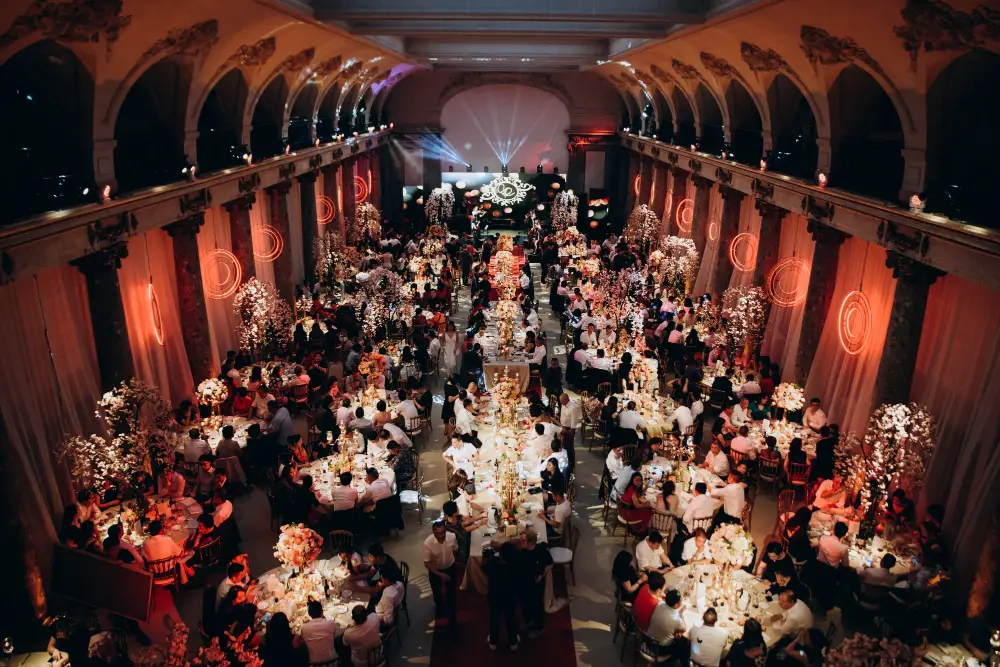
The Whitmore Hotel on a Saturday evening in October is the kind of place that makes you feel underdressed regardless of what you are wearing. Crystal chandeliers the size of small cars. Italian marble floors polished to a mirror finish. Waitstaff in black tie carrying silver trays of champagne that caught the light like liquid gold. The grand ballroom had been transformed with white Belgian linen, centerpieces of hydrangeas and pale gold roses, and a live jazz quartet playing Cole Porter with the effortless precision that money buys. Two hundred guests moved beneath a banner that read: Cheers to Richard Paxton. 35 years of building legacy.
I gave my name at the reception table. The young woman checked her list twice before finding me. I had been added the previous day, squeezed into the margin like a typo caught at the last minute. I said thank you and walked in.
The whispers reached me in waves, not shouts or accusations, but the kind of quiet commentary that travels across a cocktail hour like a draft beneath a door. The frigid daughter. Out of work for months. Can’t do anything right. Diane’s seeds had been flowering on schedule. I kept my back straight and kept walking.
I found my father near the small stage at the far end of the ballroom, standing between Diane and Meredith while a photographer arranged them into a family portrait. Richard. Diane. Meredith. Three people, perfectly composed, perfectly lit. No one looked for me. No one called my name. Two men in dark suits near the ballroom entrance wore earpieces and watched me as I crossed the room. They had been told to watch me.
My father saw me approach. His face moved through something complicated: a flicker of warmth followed almost immediately by something that resembled panic. He opened his mouth, but Diane’s hand was on his shoulder before the words came, her fingers pressing into the fabric of his tuxedo like a tightened leash.
“Laura,” he managed. “Glad you could make it.”
Five words. The words you offer a colleague you barely recognize.
Diane turned to face me. She was radiant in her cream silk gown, diamonds at her throat, that particular smile she wore when she was about to draw blood. She pitched her voice just loud enough for the fifteen people around us to hear every syllable. She expressed mild surprise at my arrival, with the implication of some shameful context I should already be aware of, and then told me, with an expression of tender concern, not to make it about myself. Tonight was about family.
The word landed like a stone dropped in still water.
Meredith materialized at Diane’s elbow wearing a new Tiffany necklace, eight thousand dollars in platinum and diamonds. She looked at my dress with the specific kind of smile that is actually an inventory.
I asked my father if I could speak with him alone for a moment. I saw the instinct in him, the flicker of yes, his body leaning half an inch in my direction. Then Diane told him the Hendersons were waiting, that he could speak to me later, and guided him away from me like a rudder correcting course. I stood alone in the center of the room.
The speeches began at half past eight. Diane took the microphone first, naturally. She stood on the small stage and delivered something flawless: gratitude to the guests, praise for Richard’s thirty-five years, an embrace with Meredith that drew a collective sound of warmth from two hundred throats. She spoke about family, about loyalty, about the people who truly make a house a home. She did not say my name. She did not look at me. My mother’s name was not mentioned once.
When the applause settled, I stood. I was not going to make a speech. I simply wanted to carry the velvet box to the front of the room, place it in my father’s hands, and say something quiet that was only for him. Inside the box was a brass compass I had spent weeks restoring, a piece my mother had given him in their second year together, when he told her he wanted to build things and she told him he would need to know which direction he was facing first. I had cleaned the patina, repaired the hinge, polished the engraved initials until they were legible again. C.H. Catherine Hail.
I was ten steps from the stage when Diane saw me coming.
Her expression did not change. That was what I remember most clearly. The absolute control of it.
She leaned into the microphone and said, in a voice as clear and composed as a dinner bell: “Security.” The ballroom murmured. Heads turned.
Then she completed the sentence: “Please remove this woman. She wasn’t invited, and she’s causing a disruption.”
Two hundred people went silent. The jazz quartet stopped mid-phrase. Even the bartender paused with a bottle suspended in air. Every pair of eyes in the room turned to me, standing alone in the center aisle, holding a small velvet box, wearing my mother’s pearl earrings.
I looked at my father.
Richard Paxton was three steps from the microphone, three steps from his wife, three steps from his daughter. He looked at Diane. He looked at me. Then he looked down at the floor and said nothing.
The two security guards materialized at my sides. I set the velvet box on the nearest table, gently, the way you set down something you love and are leaving behind. I looked at my father one last time and said, clearly enough for the people nearby to hear: “I came for you, Dad. Not for her. But I see your choice.”
Then I turned and walked toward the exit. Back straight. Eyes dry. My mother’s Mikimoto pearls catching the last of the chandelier light as I passed through the double doors.
Behind me, I heard Diane return to the microphone. I’m so sorry about that, everyone. Now, where were we? The jazz quartet started playing before the doors closed.
The October air hit me like cold water. I sat on the marble steps of the Whitmore Hotel and looked at my reflection in my phone screen: my own face, composed and steady, and below the surface, something cracking along a fault line that had been there since I was eleven years old.
I gave myself sixty seconds. Sixty seconds to feel all of it: the humiliation, the silence where my father’s voice should have been, the knowledge that two hundred people had watched me be erased and then returned to their champagne. Sixty seconds for every swallowed word, every Christmas at the small table, every drive home when I had told myself it did not matter.
Then I stood up. My mother had not raised me to sit on other people’s steps.
I called Rebecca Stone. She picked up on the first ring. I had warned her this call might come.
“Rebecca, this is Laura Paxton. I’m ready to proceed with the segregated fund transfer tonight.”
Her voice was steady and professional. She needed my digital signature and the authorization code from Aldridge and could execute within forty-five minutes of receiving both. I told her she would have them in ten.
I walked to my car in the hotel parking lot. My laptop was already in it. I had brought it the way a surgeon brings a scalpel: hoping not to use it, prepared if she had to.
I opened the laptop on the passenger seat. The screen illuminated the interior of my Subaru in pale blue light while the parking lot stretched dark and quiet around me. Inside the building, two hundred people were dancing. Out here, it was just me and a wireless connection and twenty-three years of silence finally reaching their limit.
I dialed the conference call. Aldridge read the authorization code: twelve alphanumeric characters, calm and precise as a weather report. Rebecca confirmed receipt. I opened the DocuSign document on my phone, read every line because my mother had taught me that everything beautiful starts with structure, and signed.
While the transfer processed, I attended to the arithmetic. Three American Express Platinum cards, to which Diane and Meredith were authorized users. The country club membership. The supplemental insurance riders. All of it tethered to the same pool of funds that was about to contract by seventeen million dollars. When the trust balance dropped below the covenant threshold, the bank’s automated compliance system would freeze every linked account. I was not acting out of spite. I was watching arithmetic do what arithmetic does.
At nine forty-seven, Rebecca called back. Transfer complete. Seventeen million, forty-two thousand, three hundred and sixteen dollars and seventy-eight cents. The funds were in my trust.
I closed the laptop. I sat in the dark for a moment and listened to my own breathing. Then I turned off my phone, started the engine, and drove home to Brooklyn.
When I turned my phone back on forty minutes later, there were twelve missed calls. By the time I set it on the kitchen counter, twenty-nine. By the time I finished making chamomile tea, fifty-six.
Fifty-six calls. They had not called me fifty-six times in the previous twenty-three years combined.
Here is what those calls represented, reconstructed afterward from Ellen, who stayed through the end of the party and remembered everything with the fidelity of someone who had been waiting for precisely this accounting.
At nine fifty-two, five minutes after the transfer cleared, Meredith tried to buy a round of drinks at the ballroom bar. Her card was declined. She laughed, embarrassed, tried a second card. Declined. A third. Declined. The bartender’s smile went stiff. Meredith’s cheeks went red.
At nine fifty-eight, Diane’s phone buzzed with an urgent notification from the fiduciary firm. She stepped away from the dance floor and called Rebecca Stone directly. Rebecca told her, professionally and without elaboration, that a beneficiary had exercised their right to withdraw segregated funds under the original trust agreement and that she was not authorized to disclose further details by phone.
Ellen told me later that she watched the color drain from Diane’s face in real time. First the smile, then the composure, then the certainty. All of it gone within a single phone call. Diane walked directly to Richard, gripped his arm, and pulled him to a quiet corner near the coat check. She asked what he had done. He stared at her and said he had no idea what she was talking about. She pulled up the trust portal on her phone with shaking fingers. The account balance, which that morning had read forty-two million dollars, displayed twenty-four million, nine hundred fifty-seven thousand, six hundred and eighty-three dollars.
And in the transaction log: segregated fund withdrawal, beneficiary: Laura C. Paxton.
Richard’s face went gray.
My father sat at the head table for the remainder of the evening and did not eat. He did not speak during the toast his business partner offered. He kept looking, Ellen said, at the velvet box sitting untouched on the table near the center aisle, like a small monument to something broken. He did not open it.
The messages on my phone came in waves while I sat in my apartment in my cashmere sweater with chamomile tea and the photograph of my mother on the wall. Meredith, frantic. Diane, no longer velvet. Richard, simply: Laura, please call me. We need to talk. The screen lit up and went dark in the rhythm of a family in cardiac arrest. I did not answer. I had said what I needed to say.
Then, at eleven fifteen, the intercom buzzed.
All three of them were on my stoop: my father in his tuxedo with the tie loosened, his face the color of wet concrete; Diane still in her cream silk gown with mascara tracked in dark lines down both cheeks, clutching her Hermès bag like a lifeline; and Meredith half a step behind, holding her phone to her chest with both hands, her eyes swollen and red.
For twenty-three years I had gone to them. To their house, their dinners, their parties, their terms. I had driven to Westchester and sat at the small table and smiled through comments designed to diminish me, ringing their doorbell like a guest in my own family.
Now they were at mine.
I stood at the intercom screen for a moment and simply looked at the image. Diane Paxton, who had never once visited my apartment in seven years, standing on my stoop with mascara on her face and genuine panic in her posture. There was something in that image I needed to absorb before I opened the door.
I walked to my desk drawer and retrieved the folder: the trust agreement, the amendment, the transfer confirmation from Rebecca Stone, and one more document that I had not yet shown anyone. I tucked it at the back.
I checked my reflection in the hall mirror. Cashmere sweater. Hair down. No makeup. Clean and simple, entirely mine. Then I pressed the intercom button and told them to come up.
I unlocked the front door and opened it before they reached the landing. Diane was first up the stairs, heels clicking on the old wood, already drawing breath for whatever she had rehearsed in the car. She crossed my threshold and began. I raised one hand, not dramatically, just enough. I told her she was at my door and should lower her voice or leave. She stopped mid-sentence.
It was, I think, the first time in twenty-three years that anyone had said no to Diane Paxton on a doorstep. She looked at me as if I had spoken a language she had not expected me to know.
I stepped aside and told them to come in. I told them I would be the one talking tonight.
They arranged themselves in my living room the way people arrange themselves in a doctor’s office when the news is already bad. My father took the armchair I had reupholstered in olive linen, looking shrunken inside his tuxedo, a man built for conference rooms compressed into a Brooklyn apartment that smelled like chamomile and old books. Diane refused to sit, because standing was control and she was not ready to surrender it. Meredith perched on the edge of the sofa with her arms crossed, not looking at anyone.
Diane accused me of stealing. I opened the folder on the coffee table without rushing, without raising my voice. I had spent my career finding the original structures of buildings beneath decades of bad renovation work, locating the load-bearing walls, and now I was going to do the same thing in this room.
I told her that seventeen million dollars had never belonged to my father. I slid the trust agreement across the table: forty pages, leather-bound, my mother’s signature in blue ink. It belonged to my mother, I said. Catherine Hail Paxton. Her predecessor. The trust agreement of 2004 designated it as segregated funds, legally walled off, mine.
Diane said it was a fake and turned to Richard. Richard was staring at the document. He did not look up. He did not deny it. The silence in the room was the loudest thing I had heard in years.
I asked my father whether he had known. His throat moved. His hands gripped the chair arms. When he finally spoke, his voice had the particular quality of something that has been sealed shut for a very long time. He said my mother had set it up before she got sick and that he should have told me.
Diane turned to him as if she had been struck. She had not known that he had known.
I placed the amendment on the table. Signed by my mother six months before she died, naming me as sole beneficiary, effective on my thirtieth birthday, no co-signature required. I was thirty-four. I had exercised my legal right that evening. I told Diane she was welcome to read the documents. She did. I watched her scan the pages rapidly, searching for the crack, the loophole, the mistake that would give her an exit. She did not find one. My mother had been meticulous. Twenty-three years of legal architecture built specifically to hold against precisely this kind of pressure.
When Diane looked up, she had shifted to her most practiced mode: the quiver of the chin, the careful widening of the eyes, the trembling hand pressed to her collarbone. Victim mode, perfected over decades.
I cut her off before she could complete the performance. I told her I knew about the trust amendment she had been drafting.
The performance collapsed instantly. Her hand dropped from her collarbone. The room went absolutely still.
I told her that three weeks earlier, passing her study on the way out of the Westchester house, I had seen the folder on her desk: a draft amendment from an unfamiliar law firm, designed to remove me as beneficiary and transfer the segregated funds to Meredith. I told her I had also confirmed with the fiduciary firm that she had been calling repeatedly, requesting access to my mother’s trust provisions, access that Rebecca Stone had correctly refused because Diane had no legal standing to receive it.
Meredith’s head came up sharply. She had not known about the amendment.
Diane’s voice, stripped of all the silk: “That money’s been sitting there doing nothing for twenty years. Meredith deserves it more than you. At least she contributes to this family.”
Meredith said quietly: “Mom. Stop.”
I looked at my father and told him he did not get to say enough tonight. He had lost that particular right when he stood three steps from the microphone and watched two security guards walk his daughter out of his retirement party in silence.
Then I explained what was going to happen. Not with emotion or satisfaction, but the way I would explain load calculations on a restoration project. Facts. Structure. Arithmetic. The withdrawal of seventeen million dollars had dropped the trust balance from forty-two million to twenty-five. But over the preceding years, using her position as co-trustee, Diane had authorized loans collateralized against the trust’s full value. The total outstanding debt was approximately thirty-eight million dollars. The bank’s loan covenant required collateral coverage at a minimum of one-point-one.

Specialty: Quiet Comebacks & Personal Justice
David Reynolds focuses on stories where underestimated individuals regain control of their lives. His writing centers on measured decisions rather than dramatic outbursts — emphasizing preparation, patience, and the long game. His characters don’t shout; they act.