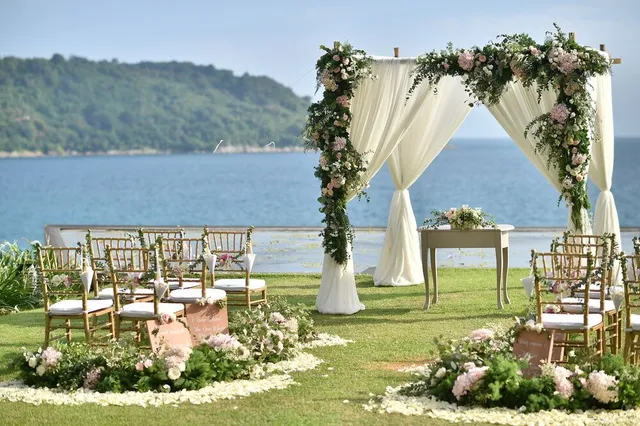
The first thing that registered were the chairs.
Not the dress. Not my sister’s hand hooked through Daniel’s arm. Not my mother’s delighted clapping, sharp and bright as if someone had just unveiled a priceless sculpture.
The chairs.
They sat in two uneven rows in the vineyard courtyard, tilted slightly toward the stone archway that framed the view of the hills. White folding wood, ribbon-tied with sprigs of early-summer roses. They were almost right, but not quite — one side nudged a little farther forward, one aisle wider than the other. They bothered me the way a picture frame hanging a degree off level bothers you. Easy to ignore if you don’t care about details. Impossible if you’ve spent your life trying to fix them.
I had meant to straighten them before everyone arrived. That had been on my rehearsal notes, the ones I was clutching as I paused at the top of the stone steps.
Fix chairs. Check microphones. Remind Uncle Joe not to improvise his toast.
I stood there, halfway between the world I’d been planning and the one that had already tilted without me, and I stared at those crooked rows.
Then I saw the dress.
It took a second because my brain refused to accept it. For weeks, that dress had lived in my head and in the careful lines of my sketchbook and in the whispered arguments with the seamstress. It had been a set of decisions: the exact length of the lace sleeves, the slight scoop of the neckline, the narrow row of covered buttons down the back. It had been mine in the same deep, private way a song stuck in your head is yours.
And there it was. On my sister.
My mother laughed that breathy little laugh she reserves for when she thinks cruelty equals honesty and said, “Oh, look. It fits her perfectly. She always was the one who looked good in white.”
The words landed like a slap disguised as a compliment — a feeling I knew too well to name.
Lily lifted the hem of the gown with practiced delicacy so she wouldn’t trip. My gown. The one I had designed in pencil and stubbornness. The bodice hugged her narrow frame, the lace traced her arms, light caught the tiny beading at the waist — beading I had argued for against my mother’s insistence that it was too much for you, dear.
She tilted her head toward me, her dark hair spilling over her shoulder in loose effortless curls, and sang out: “Surprise!”
It echoed off the courtyard walls in a way that sounded both rehearsed and shallow.
She tightened her grip on Daniel’s arm like he was a prop in her big reveal. He stood beside her in his navy suit — the one we had picked together, the one my credit card had paid for. His expression was the one I had seen in a hundred photographs with my extended family: polite, strained, a little stiff. His hand rested on her waist. It looked placed there, like he’d been told to put it there.
“We’re eloping tonight,” Lily added brightly, projecting the line as if this were a stage and not my rehearsal dinner.
There was a ripple through the gathered guests. Not outrage. Not applause. Something softer and more uncertain — the sound people make when they’re not yet sure whether they’re witnessing a joke or a tragedy.
Something rose in me, hot and immediate. A month ago, it would have been rage. Maybe humiliation. But standing there with my rehearsal notes and the crooked chairs and my sister in my dress, what rose first was recognition.
Of course.
This was familiar ground.
My sister standing where I was supposed to stand. My mother applauding the substitution as if the universe had corrected a mistake. Everyone else watching me — the older daughter — to see if I would make it easy for them by smiling through it.
It was the same pattern, just dressed up in white lace.
Lily saw my silence and mistook it for shock. She giggled, pressing closer to Daniel. “We didn’t want to make it awkward. But we’ve been in love for months. Haven’t we, Daniel?”
The courtyard turned toward him like a flock of birds changing direction. He cleared his throat. His fingers flexed against the fabric at her hip. He still hadn’t met my eyes.
Before he could say anything, my mother rushed into the pause the way she always did, smoothing over mess with words that sounded practical but cut deep.
“These things happen,” she said, turning her bright, brittle smile on me. “You two were never quite right, darling. You know that.”
Never quite right.
I placed my rehearsal notes down on the nearest chair with almost absurd care, aligning the edges with the wood. My hands were steady. I noticed that, and the noticing steadied me more.
“Is that so?” I asked. My own voice surprised me — level, unraised, almost detached. Like a narrator.
Lily’s answering smile grew bigger. She thought she had the scene under control.
“We wanted to tell you in private,” she lied without blinking. “But there was never a good time. And then everything here was already set up and it just seemed fated.” She spread her free hand as if presenting the stone walls, the vineyard, the archway blooming with roses. “You always said you didn’t care that much about the actual ceremony anyway.”
That was a sentence she had heard me say once, during finals in college when I was tired and naïve enough to believe that as long as you loved each other, the details didn’t matter.
I studied Daniel’s face openly now. He shifted, finally flicking his gaze my way. There it was — the flicker of guilt, of being caught. I watched humiliation creep toward me, ready to bloom hot and choking.
And then I remembered something important.
They thought I didn’t know.
They thought this — Lily in my gown, my mother’s applause, Daniel’s silent guilt — was my first discovery. They had choreographed my surprise for maximum effect. The pretty thief. The reluctant groom. The jilted bride. The dramatic scene everyone would retell at holidays.
They wanted me to crack in front of an audience.
The realization was oddly calming. It gave me something solid to stand on.
I slipped my hand into my clutch and closed my fingers around my phone. The gesture was small and unhurried. The screen lit up as I pulled it out, glow soft in the fading afternoon light. It drew attention the way a match does in a dim room — not dramatic, but irresistible.
“I’m glad you’re all here,” I said, looking out at the people gathered. Friends from college. Cousins. Co-workers. Daniel’s groomsmen, awkward in their matching ties. “It saves me having to send emails.”
That got more reaction than Lily’s announcement. People shifted in their seats. One of Daniel’s friends straightened as if anticipating impact.
Daniel finally took a full step toward me. “Avery, I—”
I unlocked my phone and opened the first message thread. It had sat pinned at the top of my inbox for weeks, a digital wound I had shown no one.
“I found this about a month ago,” I said, not raising my voice but letting it carry.
I didn’t read the words aloud. I didn’t need to.
I tilted the screen toward the closest cluster of guests — Daniel’s cousin, my college roommate, one of Lily’s friends. On the display, Daniel’s name sat at the top of the thread, clear and bold, with a timestamp from three weeks earlier. Beneath it, his carefully worded paragraphs unfolded: He was confused. He felt like Lily really saw him. He didn’t know how to break things off with me without causing a scene. Could she be patient a little longer? He promised it would all work out.
Lily’s replies were shorter. Emojis. Hearts. Little rockets of validation.
I watched the expressions shift across the faces closest to me. Confusion first. Then comprehension. Then that fascinating inward recoil that happens when people realize they are witnessing something uglier than they wanted to believe possible.
I slid my thumb to another item — an email chain with the venue coordinator, started two days ago.
“Two days back,” I continued, “I asked the coordinator not to file any marriage license on my behalf.” I glanced toward the reception hall door. “Isn’t that right, Marisol?”
She had been hovering in the doorway, watching with the professional stillness of someone who had seen every kind of human mess. At the sound of her name, she stepped out into the courtyard.
“Ms. Avery contacted us directly,” she said, addressing the group with calm, even tones that cut through the murmurs. “All legal paperwork for tonight’s ceremony has been withdrawn at her request. The contract for this venue is under her name only. Fees and reservations are not transferable. Without a valid license filed, no legal ceremony can take place here this evening.”
Silence settled again, but it had changed shape. It wasn’t the shocked silence that had met Lily’s announcement. This one had structure. The kind of silence that appears when authority enters a room.
Lily’s smile faltered for the first time. The hand on Daniel’s arm tightened. “Fine,” she said quickly. “It’s just a piece of paper. We’ll go somewhere else.” She tossed her hair, aiming for breezy and landing somewhere nearer to brittle.
“Of course,” Marisol replied with professional politeness. “You’re welcome to leave at any time. But this property will not host your ceremony. Only Ms. Avery’s event is scheduled here tonight.”
It was an odd thing to watch — my sister standing under an arch I had chosen, wearing a dress I had designed, next to a man I had once been in love with, and realizing that despite the tableau, she did not, in any meaningful way, belong to this space.
I saw it hit Daniel just as clearly. He let his hand drop from Lily’s waist as if it had been there accidentally. That, unexpectedly, was the moment that hurt — the exact second he physically stepped away from her and toward the floating fantasy where he would have somehow kept both of us orbiting him with minimal discomfort.
My mother spun toward me then, her smile gone sharp.
“You planned this,” she said, as if the word itself were an accusation.
“No,” I replied, meeting her eyes. “I prepared.”
Three words, simple enough. They landed between us like a line drawn on the stone floor.
“I wanted to be sure before I did anything drastic,” I continued. “So when I first saw the messages, I waited. I gave you all space to decide what kind of people you wanted to be.”
I looked at Daniel when I said that. He flinched — a small, involuntary movement, like a boy caught cheating on a test.
“And I decided what kind of person I would be.”
No insults. No shouting. Just facts, laid out like place cards on linen.
“So what now?” Lily demanded, her voice rising. “You’re canceling everything just to punish us?”
“Yes,” I said, keeping my tone conversational. “I am canceling the wedding. Not to punish you. To free myself.” I took a breath and added, because petty is different from precise: “But dinner is already paid for. The wine’s been opened. It would be a shame to waste it.”
A nervous laugh escaped someone in the middle row. Another person exhaled like they’d been holding their breath since Lily appeared in my dress.
“You’re all welcome to stay,” I told them. “Consider it a farewell party instead of a rehearsal.”
My mother stared at me like she’d never quite seen me before. Maybe she hadn’t.
“You’re overreacting,” she said, dropping to that urgent whisper meant only for me. “Love is rarely simple. You could have fought for him.”
“I just did,” I answered quietly. “You just don’t recognize it because I’m not fighting for him. I’m fighting for me.”
Daniel stepped toward me, leaving Lily slightly behind, reaching out as if this were some misunderstanding we could talk through over coffee.
“Avery, I never wanted this to hurt you,” he began.
“It was always going to hurt,” I said. “You just wanted it to hurt me somewhere out of sight so you didn’t have to see it.”
He dropped his hand.
“I hope you’re happy together,” I added, looking between them. I didn’t inflect it with warmth or venom. Just accuracy. “Really. Because the way this started — if it isn’t worth the cost, then what was the point?”
Lily searched my face for the collapse she had been expecting. The tears, the begging, the dramatic accusation. I saw the confusion flicker there when she found only steadiness. In her fantasy, my despair was supposed to make her glow brighter by comparison. Without it, she just looked like a woman standing in a stolen dress, sweating under too much attention.
Marisol, with a small discreet gesture, indicated the open gate that led back to the gravel parking lot. It wasn’t hostile. Just a clear boundary.
Daniel turned first. Of course he did. He walked away without looking back, shoulders tight. Lily hesitated, opening her mouth as if to say something that would restore her control of the narrative, then thought better of it and hurried after him, the hem of the gown whispering over stone I had paid for.
My mother lingered, suspended between her daughters.
“If you walk away from this, you’ll regret it,” she said finally. “You’re not getting any younger, Avery. Men like Daniel don’t come around every day.”
“You’re right,” I replied. “They don’t.”
She flinched at the implication and, for a moment, looked smaller than I had ever seen her. Then she lifted her chin, turned, and followed the path her favorite child had taken.
When she disappeared past the archway, the courtyard seemed to expand, as if it had been holding its breath along with everyone else.
To understand that evening, you need to understand the twenty years that built it.
Growing up, my mother loved to tell people that my sister and I were so different but equally special. She would say it in this proud voice, as if she had curated us that way on purpose.
“Avery is my steady one,” she’d add, patting my shoulder. “She’s always been responsible. Predictable. Dependable.” She used dependable the way you use the word beige.
“And Lily,” she’d say with a little sigh, as if even her name were a caress, “is my wild child. So full of life.”
Handling the wild child, in practice, meant that when Lily made a scene, everyone rearranged themselves around her. If she hated the dress my mother bought her for a recital, I would switch with her. If she forgot her homework, I stayed up late helping her finish it, my own assignments shoved to the side.
“It’s easier for you,” my mother would say to me. “You’re more adaptable.”
What she meant was: You’ll move your chair so the picture looks right.
The first time Lily took something that truly belonged to me, we were in high school. His name was Ethan, and we liked the same band. He kissed me under the bleachers after a football game and told me I had mysterious eyes, which I later learned was a line he used frequently. We lasted three months. Then I showed up unannounced at his house one afternoon and saw him through the kitchen window — Lily between his knees, his hand under her jaw.
My mother’s response was crisp and efficient. “You knew what she was like,” she told me, meaning Lily. “You can’t blame her for being irresistible.”
“Actually, I can,” I said. I was sixteen and still believed that being right should count for something.
“Oh, don’t be melodramatic. You’ll have other boyfriends. She’s just having fun.”
Fun was a word that, in our house, meant: Your feelings are an acceptable casualty.
I learned, slowly, to step aside early. To preempt the hurt. To choose the role of the dependable one because at least it gave me a script. I became good at logistics. At smoothing wrinkles. At making sure there were enough chairs for everyone.
When I met Daniel, it was at a friend’s birthday dinner. I was twenty-eight, working in project management, tired of men who treated relationships like group projects where they could slack off and still expect an A. Daniel was quieter than most — thoughtful, with a dry sense of humor and a habit of actually listening when other people spoke. What he offered, over several months of coffee dates and walks and shared grocery trips, was consistency. He showed up when he said he would. He remembered the stories I told him. When my mother said something cutting about my hair at dinner one night, he squeezed my knee under the table in silent solidarity.
“I like the way she looks at you,” my college roommate Maya said after meeting him. “Like you’re safe.”
Safe was seductive. I had spent so many years adjusting myself around other people’s chaos that steadiness felt like a miracle.
When Daniel proposed, it was in our kitchen on a Wednesday. No fireworks, no flash mobs. He cooked dinner, we argued about whether cilantro tasted like soap, and then he pulled a ring from his pocket and said, “I thought we could make this permanent. If you want to.”
I said yes. Of course I did.
Planning the wedding became a project in the professional sense — spreadsheets, timelines, vendor quotes. I thrived on it. The only thing I didn’t outsource was the dress. That, I knew, needed to feel like me in a way nothing else did.
I found a small boutique whose seamstress let me sit for hours with a sketchbook. We designed it together — lace sleeves that hit just at the wrist, a neckline that showed collarbones but not cleavage, a line of fabric-covered buttons fastened with a tiny hook.
My mother thought it was too modest. Lily said it was sweet, but safe.
“You could show more skin,” she suggested. “You might as well make a statement.”
“This is my statement,” I replied. “I don’t want to look like anyone else’s idea of a bride.”
Which is why, when she stepped into that courtyard wearing that exact dress, it felt less like theft and more like erasure.
The signs, in retrospect, had been there. The way Lily lingered after family dinners, hopping up to help Daniel while I was in the bathroom. The inside jokes they developed about my spreadsheet brain. The time I walked into my parents’ kitchen and found them standing a fraction too close at the sink, her hand on his forearm, his smile a little too eager.
You’re jealous, I told myself. You’re projecting old patterns. Daniel is not Ethan. You’re not sixteen.
So I swallowed the discomfort and made excuses.
The night I found the first message, it wasn’t even on his phone. It was on mine.
Daniel had borrowed my laptop to print a work document. He’d signed into his email and forgotten to sign out. When I opened it, his inbox appeared instead of mine. I moved to log out immediately.
Then I saw Lily’s name.
I wish I could say I resisted opening the thread. But I didn’t. My thumb clicked before my conscience could catch up.
Most of the messages were harmless at first — sibling-in-law banter, links to memes, him asking what wine my mother liked. It soothed me. Then I scrolled up.
Tucked between discussions about venue lighting and honeymoon ideas was a message from him to her that began: I feel like you’re the only one who really sees me.
My heart thudded against my ribs. I read the rest in a kind of frozen focus.
He wrote about feeling trapped by the expectations of the wedding. How he and I had become partners in logistics instead of lovers. How sometimes he felt like he was just checking boxes on my to-do list. How with Lily, he felt spontaneous. Alive. Understood.
He hadn’t written directly that he wanted to leave me. Not yet. Instead, he asked my sister for patience, for secrecy, for more stolen moments until he could figure things out without causing a scene.
Her responses were enthusiastic. Encouraging. There were heart emojis after sentences that carved into me.
I remember sitting very still at our kitchen table, the hum of the refrigerator loud in the quiet apartment. A part of me wanted to slam the laptop shut and pretend I had never seen any of it. Another part wanted to drive across town and scream.
What I did, instead, was neither.
I took a screenshot. Then another. I forwarded them to my own email, labeled with a deliberately boring subject line: Tax Documents. Then I logged out of his account and closed the laptop.
For the next week, I watched. I stopped explaining away the things that made my skin prickle. The way Lily always seemed to know more about Daniel’s schedule than I had told her. The quick glances between them at family gatherings. The small guilty flinch in his eyes when I asked vaguely, how was your day?
I didn’t confront them right away because I wanted to be sure. Because some stubborn, still-hopeful part of me wanted to be wrong. But also because I’d lived long enough in the shadow of my sister’s chaos to know how people would spin it if I exploded prematurely.
You’re overreacting, they’d say. You’re paranoid. You’re threatened by her.
It was so predictable I could have written the lines for them.
So instead, I started writing my own.
The email to Marisol began two days before the rehearsal. Dear Marisol, I typed, my fingers remarkably calm on the keys. I’d like to make a small change to the paperwork for Saturday.
I asked her to hold the filing of any legal documents. I confirmed that the reservation and all payments were in my name only. I asked that no changes be made without my personal written consent.
She called me forty minutes after I sent it.
“Are you sure you want to proceed this way?” she asked, her voice gentle. “We can postpone instead, if you prefer. You don’t have to explain, but I want you to know you have options.”
It was such a simple kindness that my throat tightened. “No postponements,” I said. “If I change my mind, you’ll be the first to know. For now, I would just like the event space. And the dinner.”
“You can absolutely do that,” she said. “I’ll note it in your file.”
“And if things become messy on the day,” I added, “I’d appreciate your help in clarifying the contract, if necessary.”
There was a small, knowing pause. “Of course,” she replied.
I didn’t sleep much the night before the rehearsal. I lay in bed next to Daniel, listening to his even breathing, feeling like there was a pane of glass between us. A month earlier, I would have nudged him, rolled into his side, whispered my anxieties about seating charts and vows.
I thought about waking him and asking, point blank: Are you in love with my sister?
But I knew how that scene would go. Deflection. Minimization. Maybe tears. Maybe an apology. And then, no matter what happened, I would be the one who called off the wedding. I would be the villain in the story my family told.
By the time the sun rose, I had made a decision.
I couldn’t control what Lily and Daniel would do. I couldn’t control what my mother would say. But I could control whether I spent the rest of my life fighting for space in a story that required me to stay small.
So I didn’t cancel the rehearsal. I straightened my shoulders, packed my clutch with my phone and transcripts and lip balm, and went to the vineyard.
Which is how I ended up at the top of those courtyard steps, staring down at crooked chairs.
When the guests finally settled after the exodus of my ex-fiancé, my sister, and my mother, there was a strange, tentative quiet. The air smelled faintly of cut roses and spilled wine.
Maya was the first to move. She walked straight up the steps to me and wrapped me in a hug so fierce it knocked a little of the numbness out of me.
“You are a goddamn legend,” she whispered into my ear.
I laughed unexpectedly, a sharp, shaky sound. “I feel like I’m going to throw up,” I admitted.
“That’s just adrenaline.” She pulled back and scanned my face. “Also grief. Also rage. Also relief. It’s a cocktail. Let it hit.”
Daniel’s best man approached, hands jammed into his pockets. “Avery. I didn’t know the half of that. I’m so sorry. You deserve so much better than this circus.”
Behind him, a few older relatives were already drifting toward the bar as if some internal sensor had kicked in and reminded them of their duties in times of crisis. Wine glasses clinked. Low voices rose and fell.
I stepped to the front of the courtyard and cleared my throat lightly.
“So,” I said. “The rehearsal is obviously canceled. But the kitchen is ready, the bar is stocked, and I’m fairly certain my name is on all the receipts. You’re welcome to stay. Eat. Drink. Tell whatever version of tonight’s story you want later, but for now, please just enjoy being here.”
My Uncle Joe called out, “Best rehearsal I’ve ever attended,” and people laughed, the sound loosening something in my chest.
The evening unspooled in a way I could never have planned.
Some guests left, murmuring about early mornings and long drives. Most stayed. The staff served the appetizers as if nothing in the schedule had changed. The courtyard filled with the smells of roasted garlic and grilled vegetables and seared steak. The fairy lights winked on overhead. The sky shifted from pale blue to lavender to indigo.
People approached me in ones and twos. My father’s sister squeezed my hand and said, “You did the right thing, sweetheart,” in a tone that suggested she had once done something similar and never been thanked for it. Daniel’s cousin muttered, “I always thought he was too passive for you,” then went red and added, “Okay, shutting up now.”
At one point, I caught Marisol’s eye across the courtyard. She lifted her glass of water in a subtle salute. I lifted my wine back.
When the photographer realized there wasn’t going to be a ceremony, she hesitated.
“We can send you a partial refund—” she began.
“No,” I said. “Stay. Take pictures. Just document whatever this is.”
Whatever this was turned out to be a strange, tender sort of wake. Not for a person, but for a future I had spent years imagining.
There are photos of my college friends doing shots at the bar, their makeup streaked with tear tracks but their smiles real. Photos of my younger cousins dancing barefoot to the playlist I had made for the reception, stomping on rose petals. Photos of my father — who had divorced my mother a decade earlier and moved to another state — standing a little off to the side, watching me with eyes that looked both proud and a little broken.
Eventually, at someone’s urging, I stepped under the archway.
“Just one,” the photographer said. “For you. If you want it.”
I wanted it.
I stood there, alone in front of rows of chairs that were at last perfectly aligned, hands at my sides, back straight. I thought about all the times in my life I had shifted to accommodate someone else’s comfort. All the times I had been told to move, to make room, to be the bigger person.
This time, I stayed exactly where I was.
The camera clicked.
Weeks later, when the images arrived, I stared at that shot for a long time. I expected to see devastation in my face. Instead, I saw something else: tiredness, yes. Sadness, absolutely. But also a kind of clean, quiet defiance.
There would be paperwork afterward, of course. Calls to vendors. Negotiations about deposits. An awkward meeting with Daniel in a coffee shop to return the ring and divide the honeymoon fund. There would be conversations with my mother, some of which ended with her hanging up on me, some of which ended with both of us silent, the old script crackling between us like a dying transmission.
Lily didn’t speak to me for months. When she finally texted, it was a single line: You ruined everything.
I stared at it for a full minute before replying.
No, I typed. I stopped letting you ruin me.
I didn’t hear from her again for a long time.
In therapy, I learned new words for old dynamics. Triangulation. Scapegoating. Enmeshment. It was both liberating and infuriating to realize how predictable the patterns had been. I started the slow work of shifting my role in my family from designated fixer to something more honest, more complicated.
“You can’t make them see you differently overnight,” my therapist said. “But you can stop playing the part they wrote for you.”
“Is it bad that I feel relieved?” I asked her once. “Even with all the hurt?”
“Relief is what you feel when you stop holding something heavy,” she said. “Even if it was a gift at the beginning.”
On the one-year anniversary of what should have been my wedding day, Maya showed up at my apartment with a bottle of champagne and said, “We’re going out.”
“Where?” I asked.
She grinned. “You’ll see.”
I should have known. The arch had been too integral to the story to leave behind entirely.
We drove out of the city, music humming low, windows cracked. The air smelled like sun-warmed asphalt and distant rain.
When we turned into the familiar gravel drive and the vineyard came into view, my heart did its startled animal thing in my chest.
“You didn’t have to bring me here,” I said quietly.
“I know,” she replied. “That’s why I did.”
The courtyard looked smaller in the late afternoon light. No chairs this time. No arch. Just stone and vines and the memory of fairy lights that weren’t yet on.
We walked the perimeter slowly. My feet remembered the path between the hall and the gate, the exact spots where my heels had clicked on stone. I paused where the rows of chairs had once been uneven, where Lily had stood in my dress, where Daniel had let go of her waist.
“What do you see now?” Maya asked, leaning against the wall.
“Space,” I said after a moment. “I see space.”
We stood there in silence for a while. The vineyard hum drifted around us — distant laughter from a tasting room, the soft shush of wind through leaves, the low buzz of bees.
“Do you ever think about what would have happened if you hadn’t seen those emails?” she asked.
“All the time,” I said. “I’d probably be married to someone who resented me quietly, flirting with my sister at family gatherings, wondering why I always felt like something inside me was shrinking.”
“And Lily?”
“She’d still be reaching for whatever I had,” I said. “And my mother would still be applauding.”
Maya nudged my shoulder. “You broke a pattern,” she said. “That’s some generational curse level stuff. You know that, right?”
“I just didn’t get married,” I said.
“You didn’t get married to the wrong person,” she corrected. “That’s different.”
We watched the sun slide toward the horizon, turning the vines gold.
As we walked back to the car, I glanced over my shoulder one last time. In my mind’s eye, I saw the rows of chairs again — not crooked now, but lined up neatly, waiting. Not for a wedding. Not for a betrayal. Just for whatever gathering I chose to host in that space, under my name, on my terms.
Later that night, back in my apartment, I took out the photograph from that almost-wedding evening — the one of me standing beneath the arch alone. I propped it on my dresser, where every morning afterward I would catch a glimpse of that woman: tired-eyed, yes, but steady. A woman who had refused to compete for love that required her diminishment. A woman who, when the chairs were crooked, finally chose not to rearrange herself to make the picture look right.
There would be other gatherings. Other loves. Other stories. Some would be messy. Some would hurt. But one thing had shifted irrevocably.
This time, I would notice the chairs first.
And if the symmetry didn’t hold, I would walk away before someone else asked me to step aside.
I had, at last, learned that preparation is its own kind of power.
And that sometimes, the bravest thing you can do at your own almost-wedding is not to stand at the altar and wait, but to stand in the courtyard and say, clearly and calmly: no.
Then pour yourself a glass of wine, invite everyone who stayed to join you, and begin, quietly, to write a different story.

Specialty: Legal & Financial Drama
Michael Carter covers stories where money, power, and personal history collide. His writing often explores courtroom battles, business conflicts, and the subtle strategies people use when pushed into a corner. He focuses on grounded, realistic storytelling with attention to detail and believable motivations.