The letter arrived on a Tuesday morning, which was the same as every other morning in the sense that Alex woke up cold and the sky was the color of old concrete and there was nothing immediately ahead of him that resembled a reason to move faster than necessary. He was seventeen years old and had learned, over the past several weeks, to regulate his energy with the precision of someone who understood that the gap between enough and not enough was narrower than most people ever had reason to discover.
He and his younger sister Marta had been sleeping behind the Merkur supermarket on the eastern edge of Brno for twenty-six days. He knew the exact number because he had been counting from the first night, not from pessimism but from the habit of a person who tracks what he can measure when everything else is outside his control. The spot they had found was a narrow channel between the rear wall of the building and the row of industrial waste containers, which provided shelter from the wind on three sides and, on the coldest nights, a faint residual warmth from the compressor unit mounted to the building’s exterior. It was not a good place to sleep. It was, however, a better place than several others they had tried.
Marta was fourteen. She had their mother’s face and their grandmother’s stubbornness, a combination that had served her well in some contexts and made her difficult to manage in others. She did not complain about the cold with any frequency, which Alex appreciated, though he sometimes wished she would complain just slightly more so he could have the relief of addressing it. Her silence on the subject was its own kind of weight.
They had accumulated a small system around themselves. Two sleeping bags obtained from a church donation center six weeks prior, one significantly warmer than the other, which Alex always gave to Marta. Three cardboard boxes broken flat and layered beneath the sleeping bags as insulation from the ground. A backpack each containing their remaining possessions, which in Alex’s case meant a change of clothes, a notebook he no longer wrote in, a charger for the phone he no longer had, and the photograph of their mother he had carried since she died two years earlier. In Marta’s backpack there was a paperback novel she had already read four times, a small zippered pouch with their remaining documents and identification cards, and the wooden hair comb that had belonged to their grandmother.
Their mother had died of a fast and ungenerous cancer in the spring of the previous year, leaving behind a rental apartment they could not afford alone and two children the state had made a series of administrative attempts to assist before those attempts concluded in ways that benefited the administration more than the children. There were forms, hearings, a temporary placement that lasted eleven days before it became clear that the placement was not suited to the placement. Alex had taken Marta and left before anything worse could be arranged.
Their grandmother, Helena, had been the one person they might have turned to, but Helena lived alone in a wooden house somewhere in the mountains near the Slovak border, and she was eighty-one years old and had not been well for the better part of a year. She had died in the district hospital in October without either of them at her side, and Alex had found out from a neighbor who had tracked down his phone number through a chain of calls that no longer mattered to trace. He had sat behind the supermarket that evening with Marta’s head against his shoulder and said nothing for a long time, and Marta had also said nothing, and the compressor unit had run its indifferent cycle, and that was the night they had grieved Helena without ceremony or company.
They had never expected anything from her beyond what she had already given them, which was the memory of her kitchen and the smell of apple jam in late summer and the specific quality of safety that a child feels in the presence of someone who is entirely on their side. That had been enough. That had been, in many ways, more than they had found anywhere else.
So when the envelope appeared on a Tuesday morning in the small pile of mail that occasionally accumulated in the alcove near the supermarket’s service entrance, the alcove where Alex sometimes sat in the early hours when the overnight staff were changing shifts and the door was propped briefly open and the warm air from inside moved outward into the cold, he almost did not look at it. He had learned not to invest attention in mail, which was never addressed to him and which existed in his experience primarily as a vehicle for demands and warnings and notifications of consequences that applied to other people’s lives.
But this envelope was different. He registered the difference before he fully understood why. It was white and thick, with a sealed back and typed text on the front rather than the handwritten scrawl of something forwarded through multiple hands. His name and Marta’s name were printed together on the front, neatly, formally, as though someone had looked them up with care and written it out correctly on the first attempt.
Marta saw him holding it when she emerged from the sleeping bag, still wrapped in it to the shoulders, her dark hair flattened on one side from the night.
“Alex, look,” she said, studying his face rather than the envelope. “What is it?”
“It’s from a lawyer,” he said, reading the return address.
Marta was quiet for a moment. “Open it.”
He opened it carefully, working a finger under the seal rather than tearing it, which was a habit from a time when documents had to be preserved and presented and proved. Inside was a single folded document, printed on formal letterhead, with the name Martin Carter, Notarial and Estate Services across the top in a restrained serif font. Alex read the first paragraph. Then he read it again, more slowly, parsing each phrase as though looking for the place where it would reveal itself to be something other than what it appeared to say.
The letter informed them, in the precise and considered language of legal correspondence, that they were the sole living heirs to the estate of Helena Vosková, their maternal grandmother, and that said estate consisted of a residential property situated in the mountain district of Beskydy, described by address and cadastral number, to be transferred to their joint ownership upon their appearance at the property with the attached documentation.
“What property?” Marta asked. She had moved close to read over his arm, close enough that he could feel the warmth from the sleeping bag she was still wearing around herself like a cloak.
Alex looked up from the letter.
“Her house,” he said. “Grandma’s house in the mountains.”
Marta looked at him for a long moment without speaking.
“That can’t be right,” she said finally. Not because she doubted the letter but because her mind, like his, had no practiced path for receiving good news and was arriving at it awkwardly, without the right equipment.
“It says our names,” he said. “Both of us. It’s legal.”
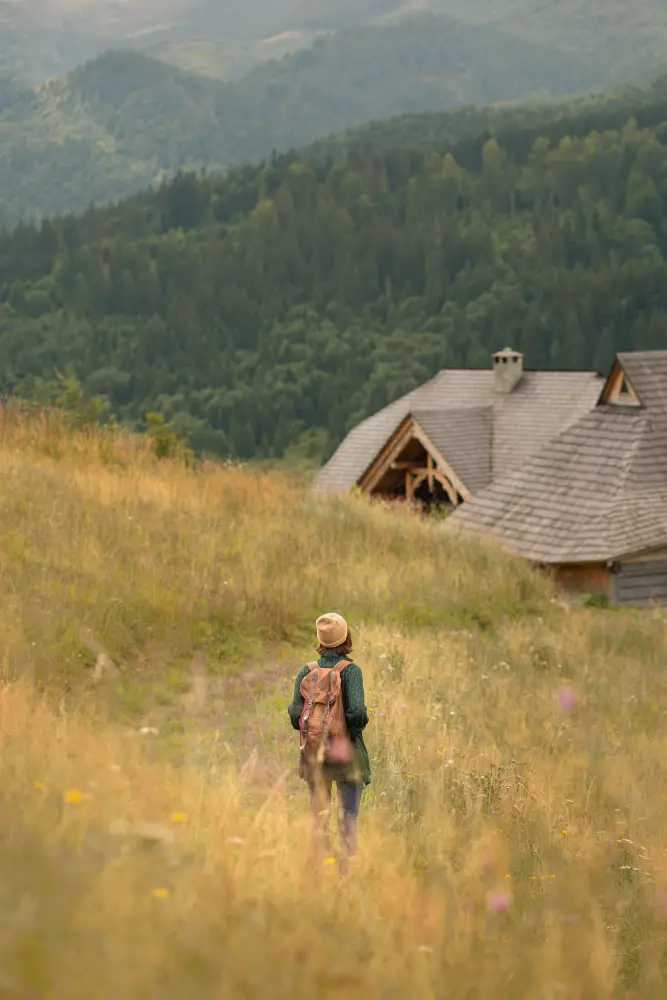
Three days later, they were standing on a narrow unpaved road at the edge of a village so small it had no signpost of its own, looking up at the wooded slope where the road continued to climb before disappearing into a wall of pine trees. The bus from Brno had taken four hours and deposited them at the village square, which was not so much a square as a widening in the main road, anchored by a post office and a small shop with a handwritten hours sign taped inside the window. The driver had told them to walk from there. Another two kilometers, he said, up the road that follows the treeline.
The air was cold and clean and smelled of wet earth and pine resin and something further back beneath both of those things that Marta identified before Alex did because she had a better memory for that particular register of sensation.
“I remember this,” she said, gripping his hand as they started up the slope. Her voice had shifted into the quieter register she used when she was feeling something she had not yet found words for. “She used to stand at the top of this road when we came to visit. Standing there with her arms crossed, just watching us come up. Like she’d been watching the whole time we were on the bus and this was just the final part.”
Alex remembered too, though his memory of it was through a different lens, the lens of a twelve-year-old who had been more focused on his grandmother’s cooking than on the geometry of arrival. He remembered the kitchen more than the approach. The low ceiling and the woodstove and the table that was slightly uneven on one leg and the blue-painted chairs that Helena had repainted herself every few years because she believed, with the pragmatic certainty of someone who had lived through several eras, that maintenance was a form of respect.
The house emerged from the fog gradually, the way significant things sometimes do, giving you just enough time to prepare yourself and never quite enough. It sat at the end of a short path that branched off the main track, surrounded by overgrown grass and the bare framework of what had once been a kitchen garden along the southern wall. The wooden boards of the exterior had darkened with moisture and time, and several roof tiles were visibly missing or displaced over the rear section. The porch sagged at one corner where a support post had settled into the soft ground. The windows were dark and filmed with the particular opacity of glass that has not been cleaned from the inside for a long time.
It looked small. It looked old. It looked like a house that had been managing on its own for too long without someone to look after it.
It was, without question, the most valuable thing anyone had ever given them.
Mr. Carter was waiting at the gate, a man in his late fifties in a good wool overcoat that was slightly too formal for the setting, holding a manila folder with both hands in the manner of someone who has arrived early and is maintaining composure through propriety. He was a tall man who stood with the slight forward lean of someone accustomed to looking down at paperwork, and he studied Alex and Marta as they came up the path with an expression that was carefully professional and only very slightly surprised, the surprise of someone who had been told the heirs were young and had still not quite calibrated his expectations to the reality of two thin teenagers in worn coats carrying backpacks that held everything they owned.
He cleared his throat.
“You are Alexandre and Marta Vos?” His voice was practiced and neutral.
“Alex,” Alex said. “And yes. That’s us.”
“Your grandmother’s documentation is in order. The property transfer is straightforward.” Carter opened the folder and moved through the required process efficiently and without condescension, which Alex appreciated, walking them through the transfer forms, the cadastral registration, the utility accounts that would need to be transferred to their names. He explained that Helena had paid the property taxes through the current year from a small account held with his office for that precise purpose, which meant they would have time to settle before any financial obligations came due.
When the paperwork was signed, Carter reached into the folder and produced a brass key ring, heavy and slightly tarnished, holding four keys of different sizes. He held it out to Alex.
Alex took it. The weight of it was surprising, disproportionate to its size, the weight of something that had been handled for years and had accumulated significance in the way objects do when they have been the instrument of daily life for a long time.
“Your grandmother was very specific in her instructions,” Carter said, in the tone of a man who is delivering his final piece of information before his professional obligation concludes. “She said to tell you that everything you need is inside.”
He nodded once, adjusted the folder under his arm, and walked back down the path toward the village road where his car was parked, the soft crunch of his shoes on the frost-hardened gravel diminishing until the fog absorbed the sound entirely.
Marta was still looking at the house.
“Everything we need,” she repeated.
“That’s what he said.”
“She always talked like that. In sentences that meant more than they said.”
Alex looked at the keys in his hand. He found the largest one, which by size and patina looked like it belonged to the front door, and he walked up the porch steps carefully, testing each one for stability before committing his weight to it. The second step flexed but held. The porch boards were soft underfoot in places but structurally intact. The door was a solid piece of work, old pine darkened with years of varnish and weather, with an iron lock plate worn smooth around the keyhole.
He fitted the key and turned it. The mechanism resisted for a moment, the resistance of something that has not moved in months, and then it yielded with a deep, satisfying sound, the sound of a thing doing what it was made to do after a long interval of disuse.
He pushed the door open.
The smell of the house came out to meet them before anything else, the particular compound smell of old timber and woodsmoke and dried herbs and something beneath all of that, something warmer and more personal, that both of them recognized at the same moment without being able to name it. It was the smell of Helena’s house. It had been sealed inside since the last time she closed the door behind her, preserved in the cold air of the unheated rooms like a message that had been waiting at exactly this temperature for exactly this reunion.
Marta made a sound that was not quite a word.
They stepped inside.
The main room was smaller than memory had made it, the way rooms from childhood always are, but it was exactly as their grandmother had left it, which meant it was arranged with the particular deliberate order of someone who understood that order was a form of preparation. The furniture was old but solid, the same blue-painted chairs at the kitchen table, repainted a final time in a slightly different shade, the armchair by the cold woodstove with the crocheted blanket folded over its back, the shelf of glass jars along the kitchen wall holding dried chamomile and rosehip and something dark that was probably dried plum. A crucifix above the door. A framed photograph on the wall beside the window that Alex moved toward immediately because he had recognized it from across the room.
It was a photograph of their mother, taken when she was perhaps twenty years old, standing on the porch of this house in summer with her arms at her sides and her hair loose and a look on her face that was different from any photograph of her Alex had seen before. She looked, in this photograph, entirely herself, without the exhaustion that had characterized the later years and without the particular careful expression she had worn in photographs taken when she was already sick. She looked like someone standing in a place where she did not need to perform anything. She was simply there, and the camera had caught her in it.
Alex stood in front of the photograph for a long moment. Behind him, he heard Marta moving through the kitchen, opening a cabinet, closing it gently.
“Alex,” Marta said. Her voice had changed.
He turned.
She was crouched near the far wall of the kitchen, beside the woodstove, where the floorboards ran in a north-south direction and one of them, a board perhaps sixty centimeters from the wall, sat slightly higher than its neighbors. Slightly but visibly, the kind of displacement that would be invisible to a casual eye but that Marta had noticed because she was moving slowly and close to the floor, the way someone moves when they are absorbing a space rather than simply passing through it.
Alex crossed to her and crouched beside her. He could see it now that she had pointed it out, the faint raised edge along one side of the board, the absence of the dust line that accumulated in the cracks between boards undisturbed for years. This board had been lifted, more than once, and replaced with care but not with perfect precision.
“How did you see that?” he asked.
“She told me once,” Marta said slowly, as if the memory were assembling itself as she spoke, “that good houses always kept their secrets in the floor. I thought she was talking about the way houses sound at night. The settling and the creaking. I thought it was something she said the way old people say things, like a kind of poetry.”
Alex examined the board’s edge. One end was cut slightly shorter than the others, leaving a gap just wide enough for a finger. He retrieved the small folding knife from his jacket pocket, the one he carried for the practical purposes of a person who has learned to carry practical things, and worked the blade carefully into the gap. The board lifted with a slight sucking resistance, the resistance of wood that had been fitted tightly and maintained but had accepted that it would be opened again eventually.
He set the board aside.
In the space beneath, cradled between two floor joists on a foundation of old newspaper folded several layers thick to keep the damp away, sat a metal box. It was approximately the size of a shoebox, painted dark green, with a hinged lid and a simple clasp. There was no lock. Helena had trusted the floor.
Alex lifted it out. It was heavy enough that he used both hands, the weight distributed in a way that suggested solidity throughout rather than just the mass of the box itself. He set it on the kitchen table. Marta pulled out one of the blue chairs and sat down without speaking, her eyes on the box.
He opened the clasp and lifted the lid.
Inside, arranged with the same deliberate order that characterized everything Helena had done, were three bundles of banknotes held together with rubber bands that had dried and stiffened with age. Beneath the money were several folded documents held together with a small binder clip, and beneath the documents, at the bottom of the box, lay a plain white envelope. On the front of the envelope, in Helena’s handwriting, the same precise, slightly forward-leaning script that Alex had seen on birthday cards and recipe cards and the labels of her preserve jars, were four words.
For Alex and Marta.
Neither of them spoke.
Alex counted the money first, not because the money was more important but because it was the concrete thing, the quantifiable thing, and he needed to hold something quantifiable for a moment before he opened the letter. It took him several minutes, working through each bundle carefully, unfolding and smoothing the notes as he counted. When he was done, he set the total in his mind and looked at it from several directions before he was confident in the figure.
It was enough to carry them forward for a long time. Not a fortune. Not the kind of number that transformed a person’s life through sheer abundance. But the kind of number that, applied carefully by people who had learned to be careful, represented choices they had not had yesterday. It represented warmth and food and time, which is to say it represented the conditions under which it is possible to think clearly about what comes next.
The documents beneath the money were the property papers for the house, a duplicate of what Carter had already provided, and below those, a folded sheet in Helena’s handwriting that proved to be a list. It was titled, at the top, in the straightforward manner of a practical woman: What you need to know about this house. What followed was two pages of dense, precise notes covering the location of the main water shutoff valve, the correct procedure for lighting the woodstove and the particular sequence required to avoid back-drafting the chimney, the names of the two families in the village below who Helena had trusted and who she indicated would be willing to help with anything serious. There were notes on the roof tiles, which ones were secure and which section needed attention, and a note at the bottom of the second page in slightly larger letters that said: The garden will come back in spring if you turn the soil before the frost leaves. It knows what it’s doing. Just help it get started.
Alex read the list twice. Then he set it down and picked up the envelope.
He opened it carefully, working the flap up without tearing it, and unfolded the letter inside. It was three pages, written front and back on paper from a lined notepad, Helena’s handwriting smaller and more compressed than usual, as though she had needed to fit everything into the space available and had planned it out in advance to make sure she would.
He read it aloud, because Marta was beside him and it was her letter as much as his, and because he felt that Helena’s voice deserved to move through a room rather than remain only on the page.
The letter began without preamble, in the way of someone who has thought carefully about what they want to say and has decided to say it directly.
My dear children. If you are reading this, then you found the house, and if you found the house, then things have been difficult enough that you needed it. I am sorry I could not be there. I am sorry I could not do more while I was here to do it. But I want you to know that this house has been waiting for you for a long time. I began saving the money when your mother was first sick. I did not tell her. She would have argued with me. She had her father’s stubbornness about accepting help, which you may have noticed in each other, and which you should both try to resist more than she did.
Alex paused. Marta was looking at the table.
He continued.
I have lived in this house for eleven years since your grandfather died and I decided I did not need as much space as grief makes you feel you need. This house has been good to me. It is old, and it requires attention, and there are things about it that need repair. You will find the list in the box. Pay attention to the chimney before the winter is serious. The tile on the north section of the roof is manageable but should not wait another season.
I know you are young. I know the world has not been as careful with you as it should have been. But I have watched you both since you were small, and I know what you are made of, even when you do not know it yourselves. Alex, you have always carried more than your share without being asked. I am asking you now to put some of it down. You do not have to hold everything. The house will help. Marta, you have your mother’s eyes and her way of seeing things that other people miss. Use it. The world does not always reward that quality quickly, but it rewards it eventually, and the rewards are the ones worth waiting for.
There is money enough to begin. I will not tell you what to do with it because you are not small children, and I never believed in telling people what to do with their own resources. I will only say that I have kept this house with care because I believed you would come to it one day, and I hope it feels to you the way it has always felt to me, which is like the kind of quiet that is not empty but full. The mountains are patient. The house is solid. The rest is yours to decide.
I love you both very much. I have loved you your whole lives without having enough chances to say it in the way I would have liked to. This is the best way I knew how.
Your grandmother, Helena.
Alex set the letter down on the table.
The kitchen was very quiet. Outside the window, the fog had thinned slightly, and through it the slope of the mountain was visible in the gray light, the pine trees standing in their dense, unhurried rows, the ground below them matted with old needles and the compressed remains of seasons.
Marta was crying, quietly, with the particular quality of crying that has nothing to do with despair and everything to do with the release of something that has been held under pressure for a long time. She was not trying to stop, and Alex did not suggest she should. He sat beside her with one arm around her shoulders and looked at the photograph of their mother on the wall, at the woman in her twenties standing on this porch in summer, entirely herself, and he felt the particular strange fullness that comes from being given something you needed so badly that you had stopped letting yourself know you needed it.
After a while, Marta wiped her face with the back of her hand and looked around the kitchen.
“We should light the stove,” she said. Her voice was steadier than he expected.
“I was thinking the same thing.”
“She wrote instructions.”
“She wrote instructions for everything.”
Marta almost smiled. “She wrote instructions for the apple jam recipe in three places because she was afraid she’d lose them. Different notebooks. Same recipe.”
Alex retrieved the instruction list from the table and found the section on the woodstove. Helena’s notes were precise and sequenced, noting which damper to open first, how much kindling to use at the base, how to arrange the larger pieces so the draw would be efficient from the first match. There was a note at the end of the section that said: The woodpile is under the tarpaulin on the east side of the house. I have left enough for several weeks. Do not let it get below a third.
He went out to the east side of the house through the door off the kitchen and found the woodpile exactly where the note said it would be, covered with a blue plastic tarpaulin anchored at the corners with stones. The wood was dry, stacked with the alternating grain direction of someone who knew how to stack wood for long-term storage. He carried in three armfuls, enough to get started and enough to keep going into the evening.
The stove took four matches and the better part of twenty minutes before it was burning with the stable, unhurried heat of a properly fed fire. Alex kept the damper slightly open through the initial stages the way the notes advised, and when the draw was established and the fire no longer needed management he closed it to the correct setting and both of them sat at the kitchen table and felt the warmth begin to move outward from the stove into the room.
It was the first time either of them had been warm without effort in over a month.
They spent the rest of that afternoon moving through the house room by room, not cataloguing or assessing but simply inhabiting it, allowing themselves the experience of being somewhere with walls and a roof and a door that closed and locked and belonged to them. The two small bedrooms off the main room each had a bed with a bare mattress and a folded set of linens on the shelf inside the wardrobe. The beds were narrow and the mattresses were old but firm, and Marta sat on the edge of hers for a long moment with both hands flat on the surface in the same way Alex had once seen her sit on the ground in a park, as though she were taking a measurement through her palms.
In the wardrobe in the second bedroom, beneath the linens, Alex found a folded quilt that he recognized immediately. It was Helena’s kitchen quilt, the one that had always been draped over the back of the armchair when they visited in winter, a patchwork of fabric squares in colors that had no thematic consistency beyond the fact that Helena had found them beautiful and had chosen to put them together. He stood holding it for a moment, then carried it out and laid it over the back of the armchair where it had always been.
That evening, with the stove burning steadily and the fog outside the windows replaced by the clean dark of a mountain night, they ate a simple meal from the provisions in the kitchen, dry pasta cooked on the woodstove’s surface plate in a pot Alex found in the lower cabinet, seasoned with salt and a jar of dried herbs from Helena’s shelf. It was an adequate meal and nothing more, but they ate it at the kitchen table on the blue chairs, with the light from the stove making the room orange and warm, and it tasted like something that did not have an accurate name in Alex’s experience, something in the vicinity of relief and arrival.
After dinner, Marta took the paperback novel from her backpack and settled into the armchair. Alex sat at the table with the instruction list and a notebook he had found in a kitchen drawer, empty, with Helena’s name on the inside cover. He began making his own list. Roof tiles, north section. Window seals, front two. Porch post, southwest corner. Garden, turn soil before frost lifts. The list was practical and immediate and gave him something his hands could follow.
At some point Marta fell asleep in the armchair with the book open in her lap, and Alex pulled the quilt from the back and covered her with it without waking her, and she did not wake when he did it, which meant she was sleeping deeply for the first time in longer than he could accurately estimate, the deep sleep of someone whose nervous system has finally received confirmation that the immediate emergency is over.
He sat back down at the table and looked at his list.
In the weeks that followed, the house became knowable in the way that houses become knowable when you live in them rather than visit them, which is to say it revealed itself gradually and on its own schedule, offering up its particular idiosyncrasies one by one as the season progressed. The second step on the porch required a specific placement of the foot to avoid the flex, a placement that both Alex and Marta learned independently within the first week and never needed to discuss. The window in the main room created a draft at a particular wind direction that was managed by a folded piece of card in the lower left corner of the frame, which Helena had left in place and which they left undisturbed. The woodstove, once its particular temperament was understood, proved to be an efficient and generous source of heat, capable of warming the main room and both bedrooms if the internal door was left open at the right angle.
Alex contacted the families Helena had named in the village. The first was an older couple named Beneš, who received him at their kitchen door with the mild wariness of people who have lived long enough to be careful with strangers and the warmth of people who had thought well of Helena and were prepared to extend that estimation provisionally to her grandchildren. Mr. Beneš drove them to the building supply shop in the nearest town in his truck one Saturday and helped Alex buy the materials for the roof repair at the local rate, which was lower than the rate Alex had looked up online, a distinction that Mr. Beneš explained as the difference between the price for someone who belongs here and the price for someone passing through.
The roof repair took an entire Saturday and most of the following Sunday. Mr. Beneš worked alongside Alex, explaining technique with the patient economy of a craftsman who has done a thing so many times that the only challenge remaining is how to transfer the knowledge to someone who has not. Alex learned quickly, which Mr. Beneš noted with the brief, approving nod of someone who does not distribute praise broadly but means it precisely when he does.
Marta, for her part, applied herself to the house in a different direction. She cleaned the interior methodically over the first two weeks, working room by room with the focused attention she applied to everything she decided mattered. She re-lined the kitchen shelves. She replaced the curtain rod in the second bedroom that had been sagging at one end for what appeared to be some years. She found a box of old photographs in the bottom of Helena’s wardrobe and sorted through them slowly over several evenings, identifying faces where she could from the memories she carried, and assembling them in chronological order as best she could determine it, until she had a rough visual history of the family that now occupied the wall beside the photograph of their mother.
The photograph of their mother remained where it was. It was the fixed point around which everything else was arranged.
Spring arrived incrementally, as it does in mountain country, in small permissions rather than announcements. The frost began leaving the upper layer of soil at the beginning of March, and Alex went out on a cold Saturday with a garden fork from the shed and turned the soil in the kitchen garden along the south wall the way Helena’s instructions had described, working it to a depth of roughly twenty centimeters, breaking the compacted surface and turning in the organic material that had accumulated on top over the previous season. It was harder work than he had anticipated and took most of the morning, and when he was finished and standing at the edge of the turned bed looking at the dark, aerated soil, he felt something that was not quite pride but was in the same family. The satisfaction of having done something concrete in service of something that would grow.
Helena had been right. By April, without any additional intervention, the first shoots appeared along the south edge of the bed. Onion sets she had planted in the autumn, waiting under the frost, now emerging into the March light with the unperturbed certainty of things that know what they are doing. Marta saw them first from the kitchen window and came outside in her socks, which Alex pointed out and which she ignored, crouching at the edge of the bed with her face close to the soil to look at the pale green tips.
“She planted them before she went to the hospital,” Marta said.
“She was planning ahead.”
“She was always planning ahead. She planned ahead for things that hadn’t happened yet, for things she probably knew she wouldn’t be there to see.”
Alex looked at the shoots. “She saw them,” he said. “Just not in the way she thought she would.”
In April, Marta enrolled in the school in the valley town, a thirty-minute bus ride each way that she began without complaint and continued with the steady, undemonstrative commitment that she applied to everything she had decided was necessary. Alex had more complicated administrative work ahead of him, having missed enough school that re-entering the standard progression was not straightforward, but he had begun conversations with a school counselor in the town who had engaged with the situation practically rather than procedurally, and who had said, in almost exactly the words he needed to hear, that the goal was completion, not sequence, and that there were paths available if he was willing to work.
He was willing to work. He had never been anything else.
On an evening in late April, Alex sat on the porch steps in the cooling air after dinner, the valley below partially visible through the new leaves, the sky still holding a residual light along the western edge. Marta came out and sat beside him, pulling the sleeves of her sweater over her hands against the evening chill.
They sat without speaking for a while, the way they had learned to sit together, comfortable in the shared silence of people who have been through enough together that words are available when needed and unnecessary when not.
“Do you think she knew?” Marta said finally.
“Knew what exactly?”
“That it would get as bad as it did. That we’d end up where we ended up.”
Alex thought about the letter, about the particular phrasing Helena had used. I began saving the money when your mother was first sick. I have kept this house with care because I believed you would come to it one day.
“I think she prepared for the worst,” he said. “I think she hoped she was wrong and prepared as if she wasn’t.”
Marta considered this. “That’s what she always did. She never assumed things would go well. But she never assumed they wouldn’t either. She just arranged things so that either way there was something solid to stand on.”
The light along the western ridge had gone to a deep amber, and below it the valley was settling into blue and gray. The pine trees on the slope above the house were utterly still, the way trees are still on calm evenings, not passive but present, the accumulated patience of things that grow slowly and do not need to hurry toward anything.
Alex thought about the letter again, about the sentence he had returned to most often in the weeks since he had read it aloud in the kitchen. I hope it feels to you the way it has always felt to me, which is like the kind of quiet that is not empty but full.
He had not had a word for it before she gave him one. But since she had given it to him, he had recognized it every day. In the mornings when the mist was still on the slope and the stove was warm and Marta was moving around the kitchen making tea. In the evenings like this one when the valley went quiet and the house settled into its nighttime sounds. In the particular quality of sleep that had replaced the sleep behind the supermarket, the deep, unguarded sleep of someone who no longer needs to be alert for sounds that mean danger.
It was full quiet. The quiet of being somewhere that held you.
He had not known, before this, that a place could hold you. He had understood shelter in the purely practical sense, as a requirement for survival, as a calculation of warmth versus exposure. He had not understood it as something that remembered you, that had been arranged in advance by someone who loved you, that could carry forward the warmth of a person after they were gone.
Helena had known this. She had understood it clearly enough to build it deliberately, saving money over years, maintaining a house she did not know for certain she would still be alive to hand over, planting bulbs in the autumn soil knowing she might not see the spring. She had understood that love, at its most practical and enduring, is a form of preparation. That the real gift is not the object but the forethought, the calculation that says: something may go wrong, and if it does, I want there to be something waiting.
There had been something waiting.
The porch steps held their weight. The stove was cold now but would be warm again tomorrow morning. The garden was growing. The photographs were on the wall. Their mother’s face was on the wall, young and entirely herself, standing on this porch in a summer that was gone but not gone, preserved in a frame in a house that had kept its promises.
“I’m glad we came,” Marta said. It was a simple statement, offered without qualification, and it contained within it every complicated thing that had happened to bring them here.
“Me too,” Alex said.
They sat on the steps until the last of the light left the ridge and the valley below was dark and the stars over the mountain were very bright and very many, the particular abundance of stars that is only visible when there are no other lights to diminish them, when you are somewhere far enough from the noise of other lives to see clearly what has always been there.
Helena had sat on these same steps, on many such evenings, looking at the same sky. He did not know what she had thought about, what specific concerns had occupied her or what specific comforts she had found. He knew only that she had sat here and looked up and had continued, and that she had done so with enough surplus of care to leave something behind for the people who came after her.
That was enough. That was, in its quiet way, everything.
They went inside when the cold became serious, and Alex bolted the door behind them and Marta put the kettle on and the kitchen filled with the small sounds of the evening settling into itself, and neither of them said anything more that needed to be said, because the house itself said the rest, in the language of solid walls and a door that locked and the smell of wood and dried herbs and the specific warmth of a place that had been expecting you, patiently, for a very long time.

Ethan Blake is a skilled Creative Content Specialist with a talent for crafting engaging and thought-provoking narratives. With a strong background in storytelling and digital content creation, Ethan brings a unique perspective to his role at TheArchivists, where he curates and produces captivating content for a global audience.
Ethan holds a degree in Communications from Zurich University, where he developed his expertise in storytelling, media strategy, and audience engagement. Known for his ability to blend creativity with analytical precision, he excels at creating content that not only entertains but also connects deeply with readers.
At TheArchivists, Ethan specializes in uncovering compelling stories that reflect a wide range of human experiences. His work is celebrated for its authenticity, creativity, and ability to spark meaningful conversations, earning him recognition among peers and readers alike.
Passionate about the art of storytelling, Ethan enjoys exploring themes of culture, history, and personal growth, aiming to inspire and inform with every piece he creates. Dedicated to making a lasting impact, Ethan continues to push boundaries in the ever-evolving world of digital content.