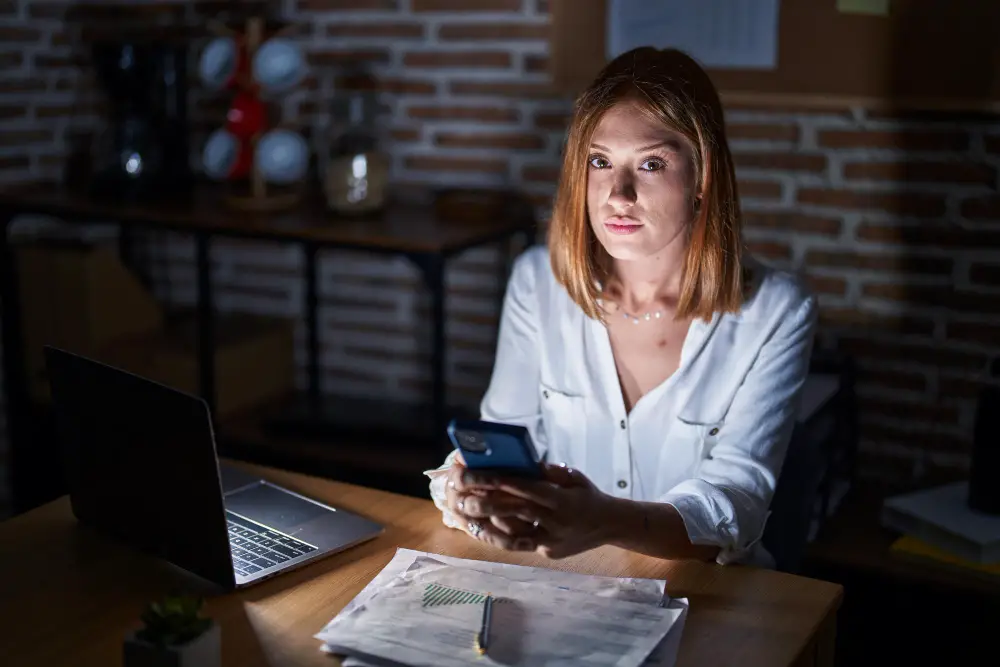
My phone didn’t just buzz that night.
It panicked.
One vibration, then another, then a rapid-fire tremble that sent the device skittering across my kitchen counter like it was trying to escape what I’d just done. The screen lit up bright in the dark apartment, casting that cold rectangular glow across the wall, and I stood there reading the messages as they came in, one after another, from the people who were supposed to love me most.
My name is Alyssa Grant. I’m thirty-two years old. I built a tech startup from a folding table and a dying laptop, slept under my desk more times than I’ll admit, lived on vending machine coffee and the kind of ramen you eat standing over the sink at two in the morning because you’ve forgotten what a real meal feels like. I missed birthdays. I missed weddings. I missed years of my own life because I believed in what I was building the way some people believe in religion.
And then it worked.
It worked so well that people who used to ignore my emails started returning my calls within minutes. It worked so well that relatives who’d once asked when I was going to get a stable job began dropping my name into conversations like it made them sound important. It worked so well that when I sold the company for twenty million dollars, I thought I’d finally bought myself peace.
Instead, I bought silence.
The kind of silence that settles over a room when people realize you’re no longer useful in the way they prefer. The kind that isn’t absence but calculation. The kind that makes you feel watched, not supported.
Simon had warned me.
Simon was my lawyer. He had the kind of calm that comes from having already seen the ending of whatever story you think you’re living. A few days before everything fell apart, he sat across from me in his office and said something I wasn’t ready to hear.
“Your parents aren’t celebrating your success, Alyssa. They’re calculating it.”
I laughed. The tired, disbelieving laugh of someone who wants to defend people they’ve spent a lifetime making excuses for.
Simon didn’t laugh back. He just looked at me with quiet patience.
“I want you to do something,” he said. “Tonight, tell your parents you lost it all. Bad investments. Everything gone. Then watch who contacts you first. Watch what they say.”
“That’s cruel,” I said.
“Is it?” He leaned forward slightly. “Or is it a test you already know the answer to?”
I drove home that evening thinking about his words. I made dinner I barely tasted. I sat on my couch in the quiet of my apartment and stared at my phone for a long time before I typed the message.
I lost everything. Bad investments. It’s all gone.
I sent it to my parents and put the phone face-down on the cushion beside me.
Then I waited.
My mother’s reply came first. Not a phone call. A text.
We need to talk privately.
That was it. No Alyssa, are you okay. No sweetheart, come home. No let’s figure this out together.
Just: privately. Like I’d become a liability. Like my grief needed to be managed rather than felt.
My father’s message arrived sixty seconds later.
Don’t come home. We can’t afford your recklessness.
Recklessness.
I read that word three times. It landed with the particular sting of something I’d heard in different forms my entire childhood — the message that my emotions were always too loud, my ambitions too big, my needs too expensive.
I set the phone down on the counter and looked out the window at the city. It was late but the skyline still blinked with life, indifferent to everything happening inside my kitchen.
Then at three in the morning, my cousin Emma texted.
Emma wasn’t the kind of cousin you saw in holiday photos smiling too hard. She was the one who showed up early and stayed late because she didn’t want to go back to her own house. We’d bonded as kids over being the ones who heard too much, watched too closely, and learned to keep quiet about it.
Her message was one line.
Alyssa, I’m so sorry. You need to see this.
Then the screenshot loaded.
It was a family group chat. Not the normal one — the sanitized one where people posted birthday cake emojis and filtered vacation photos. This one was called The Real Family. My name wasn’t in the participant list. I was never supposed to see it.
At the top, my mother had written four words.
This is our chance.
I stared at that sentence until my eyes watered.
Below it, the rest of my relatives had responded like sharks smelling blood.
Uncle Ray: If she’s broke, she’s useless. Pull the paperwork before she realizes.
My father: We move fast. Don’t let her know about the trust.
My sister Brooke: Told you she’d crash. She never deserved any of it.
Trust. Paperwork. Pull it before she realizes.
I sat down hard on the kitchen floor because my legs forgot how to hold me. The tile was cold against my thighs. My breath came shallow and fast. I read the messages again, hoping I’d misunderstood something, hoping there was an interpretation that didn’t mean what it clearly meant.
There wasn’t.
A trust. My grandmother’s trust. And my own parents were plotting to cut me out of it while I was supposedly falling apart.
I called Simon at seven in the morning.
He answered on the second ring. “They asked you to come in, didn’t they?”
“Not yet,” I said. “But my mother called. She wants me to come by the house today. She mentioned documents.”
“Don’t sign anything,” he said immediately. “Don’t argue. Don’t react. Just observe.”
“Observe,” I repeated.
“What you’re walking into is not a family conversation,” Simon said. “It’s a transaction. Remember that.”
My childhood home looked smaller than I remembered. Maybe it hadn’t shrunk. Maybe I’d just outgrown the version of myself who used to stand on that porch with a report card in her hands and a desperate hope in her chest, waiting to be told she was enough.
I parked at the curb and sat there for a moment. The curtains in the front window shifted slightly.
They were already watching for me.
When I stepped inside, the air felt stiff, like the house had been holding its breath. My mother didn’t hug me. She didn’t touch my arm. She just shut the door behind me and whispered, “We don’t have long. Your father is getting the documents.”
As if time itself was their enemy.
My father came down the hallway carrying a thick envelope with my name printed on the front in neat official lettering. He held it out without meeting my eyes, the way you hand someone a bill they owe.
“Sign these,” he said. “It’s better for everyone.”
My sister Brooke was already on the couch, arms crossed, wearing the particular smirk she reserved for moments she’d been looking forward to. “Mom said you messed up big time,” she said. “You always do.”
I took the envelope. It felt heavier than paper should.
The first page was thick, legal, stamped. I read the first line and the breath left my body.
Revocation of beneficiary rights.
My vision blurred. I scanned it again, hoping my eyes had made a mistake.
They hadn’t.
My father finally looked at me. His expression was calm in a way that made me faintly nauseous, the look of someone watching a bank transaction rather than sitting across from his own daughter.
“You’re unstable right now,” he said slowly. “You’ve made reckless choices. The trust needs protection.”
“From who?” I asked.
My mother stepped closer, lowering her voice like she was offering comfort, her face arranged into something that was trying to be concern but had sharp edges she couldn’t quite hide.
“If you sign it now,” she murmured, “we won’t pursue the clause that penalizes irresponsible heirs.”
Irresponsible heirs.
The phrase scraped against my ribs like it had been rehearsed for years, held in reserve for exactly this moment.
Brooke leaned forward, delighted. “Honestly Lyss, you should be grateful,” she said. “You’re terrible with money. You blew twenty million in one weekend?”
She believed it. They all believed it, because they wanted to. The idea of me falling appealed to something rotten in them.
Then Brooke lifted her phone and started recording.
Her smile widened. “Look at her,” she announced, angling the camera toward my face. “The millionaire who lost it all. Dad, send it to the family group.”
Everyone laughed. My mother’s laugh was quick and nervous, uncertain how far to go. My father’s was silent, but the corner of his mouth twitched with something that looked like satisfaction.
I stood there holding the revocation papers, listening to the sound of my family enjoying my humiliation like it was dessert.
Then the front door clicked open.
The laughter stopped so fast it felt like someone had pressed mute.
Simon walked in.
Crisp suit, leather briefcase, expression carved from stone. He moved with the calm of someone who knows exactly what he’s carrying. He didn’t look at anyone at first. He set his briefcase down on the coffee table with a soft thud that somehow sounded much louder than it should have.
“Good morning,” he said pleasantly. “I see you’ve already started without me.”
My mother’s voice wobbled. “Why are you here?”
Simon looked at me first, his eyes steady. Then he turned back to the room.
“Alyssa didn’t lose twenty million dollars,” he said. “She followed my legal instruction to reveal the truth about this family’s intentions.”
My father’s jaw tightened. “What are you talking about?”
Simon opened his briefcase and slid a folder onto the coffee table. It was thick — bulging with paper, tabbed, organized, and prepared with the kind of precision that means someone has been doing their homework for a long time.
“The truth,” Simon said simply, “about what you’ve been attempting to do.”
He pulled out documents one by one.
Bank transfers.
Emails.
Notarized letters.
Account information.
All bearing familiar names.
“Your parents attempted to reroute the family trust into a private account under your sister’s name,” Simon said, his voice almost gentle. “If Alyssa had signed those papers today, everything her grandmother built would have been permanently transferred out of her reach.”
My mother’s face drained of color. “That’s not—”
“It’s taken out of context,” my father snapped.
Simon tilted his head slightly. “The clause you mentioned to Alyssa,” he said to my mother, “the one penalizing irresponsible heirs. I wrote that clause. It applies to fraudulent trustees. Not beneficiaries.”
Brooke swallowed. Her phone lowered fully. Her fingers gripped it like it might save her.
For a long moment nobody spoke.
I set the unsigned envelope down on the coffee table. The paper looked so harmless sitting there, like it wasn’t capable of destroying someone’s life.
“No,” I said.
My voice didn’t shake. That surprised me. I’d been shaking internally for hours, but the word came out clean and steady.
“You’ll be signing something today,” I said, letting my eyes move from my mother to my father to Brooke. “But it won’t be that.”
Brooke scoffed, reaching for whatever was left of her confidence. “You can’t force us.”
Simon raised one hand, not dramatic, just factual. “Actually,” he said, “she can.”
From his briefcase he produced a new set of documents. Clean. Crisp. He slid them across the table toward my parents.
“Formal resignation of trustee rights,” he said. “Effective immediately. Failure to sign will trigger a court audit of every account you’ve touched in the last fifteen years.”
My father’s face twisted. “You wouldn’t dare.”
Simon met his stare without blinking. “Try me.”
My mother’s hands began shaking as she stared at the paperwork. Her mouth opened and closed. The mask slipped, and beneath it was a frightened woman who had spent years playing the role of mother without ever really understanding what it required.
“Alyssa,” she whispered, tears arriving fast, conjured like a last-resort spell. “Please. We were only trying to—”
“To steal from me,” I said quietly.
The sentence hung in the air between us.
“And to humiliate me,” I added, my eyes moving to Brooke’s phone. “To record me breaking.”
Brooke’s cheeks flushed. “That was just—”
“Entertainment?” I offered. “A highlight for the family group chat?”
She opened her mouth. No sound came out.
Brooke surged forward a moment later, her voice cracking. “Lyss, please,” she said, dropping the sarcasm like it had never existed. “If Mom and Dad lose control of the trust, I lose my stipend. My condo. My car. I can’t afford that.”
And there it was.
Not love. Not loyalty. Not any version of sisterhood I had ever wanted.
Just dependence, finally spoken out loud.
“Sign,” Simon said.
I watched my family come apart in stages. First the anger — the instinctive flare of entitlement that said they couldn’t possibly deserve consequences. Then fear, because the paperwork in front of them was not a bluff. Then the slow realization that they were trapped inside a plan they had set in motion themselves.
My father grabbed a pen. His knuckles were white. He looked up at me with eyes that had gone hard and cold.
“You think you’re punishing us?” he said. “You’re destroying this family.”
I didn’t flinch.
“You destroyed it,” I said, “the moment money mattered more than your daughter.”
They signed.
It wasn’t cinematic. No thunder cracked. No one collapsed onto the carpet. It was just the quiet scratch of a pen on paper, the sound of rights being surrendered, the sound of a lifetime of manipulation finally meeting something it couldn’t talk its way around.
When the last signature dried, I felt something I hadn’t expected.
Not triumph. Not joy.
Relief. The deep, bone-level exhale of someone who has been holding their breath for thirty-two years without realizing it.
But Simon leaned close to my shoulder before I could move.
“Brace yourself,” he murmured. “There’s one more thing.”
He reached into his briefcase a final time and placed a small velvet envelope on the table.
Ivory-colored, worn at the edges, sealed with dark wax. The kind of envelope that has been waiting in a locked drawer for exactly the right moment.
My mother moved toward it immediately. “No,” she said sharply. “She doesn’t need to see that.”
I held up one hand.
For the first time in my life, my mother stopped.
I broke the seal.
Inside was a handwritten letter and a single key.
My grandmother’s handwriting looped across the page in the familiar script that made my chest ache with grief I hadn’t expected. She’d died three years earlier. At her funeral, my mother had wept so dramatically that people assumed they’d been close. I had stood there quietly, remembering the woman who used to slip me peppermint candies and tell me I was built for more than small rooms.
My hands trembled as I read.
Alyssa, she had written, I always knew your strength would come from surviving what others tried to break in you. Everything I built is yours now, but this key is the real legacy. You don’t owe your silence to anyone. You don’t owe your loyalty to those who misuse it. You owe yourself a life that is yours.
Under the letter was a second document.
Property deeds.
To a private estate in Vermont.
My grandmother had seen this coming. Years before any of it happened, she had anticipated the greed, the maneuvering, the way my parents would eventually try to twist family into leverage. And she had quietly, carefully, made sure they couldn’t reach everything.
My father’s voice cracked in a way I had never heard before. “Mother left that to you?”
The question wasn’t really about me.
It was about him. About the humiliation of being outplayed by someone who had loved me enough to plan ahead.
I folded the letter carefully, slipped the key into my pocket, and felt the cool weight of it against my palm.
“This family ended itself,” I said. “I’m just walking away from the ruins.”
I walked to the door. My father didn’t stop me. Brooke didn’t call my name. They watched in silence, frozen somewhere between outrage and the slow dawning understanding that they didn’t know which version of me they were dealing with anymore.
Outside, the morning sun spilled across the driveway. The air smelled like cut grass and someone’s laundry drying in the breeze. Ordinary life, continuing as if nothing extraordinary had just happened inside that house.
Simon followed me out and closed the door behind us with a soft, final click.
“You didn’t lose twenty million dollars, Alyssa,” he said. “You gained your freedom.”
I stood on the sidewalk and looked at the house that had shaped so much of who I was. Trimmed hedges. Clean windows. A porch swing my mother had never once used. It looked like the kind of house where a family lived.
I knew better now.
I pulled out my phone. There were dozens of new messages — relatives suddenly checking in, acquaintances offering sympathy, people who had never cared circling because the rumor that I’d lost everything was already spreading. I imagined Brooke’s video making its rounds. My face, my shock, my humiliation edited into entertainment for the group chat I was never supposed to see.
A year ago that would have leveled me.
Now it only made something in my spine go harder.
I opened The Real Family chat. My mother’s message was still right there at the top.
This is our chance.
I understood it completely now. They had never seen me as a person. They saw me as a door they could open or close depending on what was behind it. They hadn’t loved me as a daughter. They had managed me as a resource. And resources, to people like them, were meant to be controlled until they weren’t useful anymore.
I typed one sentence and sent it to every name in that chat.
You don’t get my silence anymore.
Then I blocked them all.
The act felt both small and enormous, like setting down a weight you didn’t know you’d been carrying until your hands were suddenly empty.
I called Emma before I even started the car.
She answered immediately. “Are you okay?”
It was the first time anyone in my family had asked me that in longer than I could remember. Something in my chest loosened at the sound of it.
“I’m better than okay,” I said. “Thank you for sending me that screenshot. You did the right thing.”
“They’ll be furious with me,” Emma said quietly.
“Let them,” I said. “You did the right thing.”
A pause. Then, smaller: “Alyssa, can I ask you something?”
“Anything.”
“Can I come with you? Just for a little while. I can’t stay here. They’ll turn on me for this.”
I didn’t hesitate.
“Pack,” I said. “I’ll pick you up in an hour.”
The drive to Vermont stretched out like a ribbon unwinding. The sky shifted from city haze to open blue. Trees thickened on both sides of the road. Billboards disappeared. The world grew quiet in a way that felt like something healing.
Emma sat in the passenger seat with her knees tucked up, watching the landscape pass like she was afraid it might disappear if she blinked. We didn’t talk much. Some silences are heavy and some are simply rest. That one was rest.
When we turned onto the road listed on the deed, my heart started pounding again — not with dread this time but with something that felt closer to anticipation. A long gravel driveway flanked by tall pines formed a green corridor ahead of us. At the end sat an old iron gate with curling designs that looked like vines frozen in metal.
I stopped the car and got out.
The air smelled like pine needles and earth. Somewhere in the distance a bird was calling. No traffic. No sirens. No constant background noise reminding me the world was moving faster than I could keep up with.
I took the key from my pocket.
It was plain metal, slightly worn, the kind of key that looks like it has been waiting a long time for the right hands.
I slid it into the lock.
It turned smoothly.
The gate swung open with a slow, welcoming groan and Emma exhaled a breath she’d been holding for what seemed like miles.
I drove through.
The estate emerged at the end of the driveway like something from a story I would have rolled my eyes at if someone else told it. A wide farmhouse-style home with deep porches and white paint softened by age. Windows reflecting the afternoon sky. A barn at the far end of the property. A small pond with a wooden dock. Rolling land beyond it, edged with trees just beginning to turn.
It wasn’t flashy.
It was grounded.
It felt, in a way I had no other word for, safe.
I parked and sat in the car for a moment before I understood why I wasn’t getting out.
I was waiting for permission.
Waiting for someone to tell me I was allowed to walk into a life that wasn’t defined by surviving.
My grandmother’s words came back.
You owe yourself a life that is yours.
I got out of the car.
The porch boards creaked under my shoes. I reached for the front door handle. Turned it.
Unlocked.
Of course it was.
My grandmother had never believed in locking people out of what was meant for them.
Inside, the house smelled like cedar and old books. Sunlight came through the windows in long rectangles that lay across the hardwood floors. Furniture sat covered in white sheets. A stone fireplace anchored the living room. On the mantle, a row of framed photographs.
I stopped.
One of them was of me.
Not the public version — not the founder in the press releases or the CEO in the business profiles. This was a candid photo of me at nineteen, hair tangled, laughing at something just out of frame, eyes bright and completely unguarded. I didn’t remember the moment being captured.
My grandmother had.
She’d been collecting pieces of my life quietly for years, like she’d known I would need proof someday that someone had been paying attention. That someone had loved me without needing anything back.
Emma stood beside me, her voice barely above a whisper. “She really saw you.”
I nodded, because if I tried to speak I was going to fall apart, and I had done enough of that in that kitchen in the dark at three in the morning. I had earned something different now.
On the dining table sat a small wooden box. No lock. Just a lid.
Inside was a second letter, shorter than the first.
Alyssa, she had written. If you’re reading this, then you’ve chosen yourself. That’s the only inheritance I ever wanted to give you.
I pressed my fingertips to the page and sat there for a long moment in the quiet, in the cedar smell, in the light coming through windows that nobody had opened in three years.
Emma sat across from me. “What do we do now?” she asked softly.
I looked around. At the covered furniture. The still rooms. The land visible through every window, rolling away in every direction like possibility that hadn’t been claimed yet.
“We breathe,” I said. “We rest. We figure out what comes next without them.”
Outside, wind moved through the trees and the leaves rustled against each other in a sound that was almost like applause.
I thought about my parents back in that suburban house, signing their names with shaking hands. I thought about Brooke, already calculating how to survive without her stipend. I thought about Uncle Ray and everyone else in that group chat, reshaping the story into one where they were the victims.
Let them.
Their version of events had never needed to be mine.
Simon’s voice came back to me from a few days ago, patient and certain.
Observe.
I had observed.
And I had finally understood something I’d spent thirty-two years refusing to accept because accepting it was too painful.
Some people love you the way a person loves an asset. Only as long as it benefits them. Some people raise you without ever really seeing you. And some people — rare, fierce, quiet people — love you in a way that doesn’t ask for anything back.
My grandmother had loved me that way.
And because she had, I was standing in this house, holding a key to a life she had protected for me long before I knew I needed protecting.
I slipped the key back into my pocket.
Not because I still needed it to get inside.
But because it reminded me what I’d earned.
The right to choose.
I stood up and walked to the window. The pond caught the late afternoon light and threw it back in pieces. The dock waited at the edge of the water like a quiet invitation. The trees at the far end of the property swayed in the breeze.
Emma came to stand beside me.
We didn’t say anything for a while.
I had built a twenty-million-dollar company from a folding table and a failing laptop. I had done it without their belief, without their encouragement, without any of the support that parents are supposed to give. I had done it in spite of them, quietly, without asking permission.
I could build a life the same way.
Not for their approval.
Not to prove anything to anyone.
Just for me.
The sun moved lower through the windows and the room filled with that late golden light that makes everything look like the last scene of something ending and the first scene of something beginning at the same time.
And standing there, in the house my grandmother had quietly held for me across years and distance and everything my family had tried to take, I made myself a promise.
I would never let anyone buy my silence again.
Not with money.
Not with guilt.
Not with the threat of belonging or the fear of being left out.
I had been left out of the real family chat. I had been erased from the plan. I had been recorded falling apart for entertainment while my own mother stood there watching.
And I was still standing.
I had built something once from nothing.
I would build it again from here.
And this time there would be no one at the table who didn’t choose to be there.

Lila Hart is a dedicated Digital Archivist and Research Specialist with a keen eye for preserving and curating meaningful content. At TheArchivists, she specializes in organizing and managing digital archives, ensuring that valuable stories and historical moments are accessible for generations to come.
Lila earned her degree in History and Archival Studies from the University of Edinburgh, where she cultivated her passion for documenting the past and preserving cultural heritage. Her expertise lies in combining traditional archival techniques with modern digital tools, allowing her to create comprehensive and engaging collections that resonate with audiences worldwide.
At TheArchivists, Lila is known for her meticulous attention to detail and her ability to uncover hidden gems within extensive archives. Her work is praised for its depth, authenticity, and contribution to the preservation of knowledge in the digital age.
Driven by a commitment to preserving stories that matter, Lila is passionate about exploring the intersection of history and technology. Her goal is to ensure that every piece of content she handles reflects the richness of human experiences and remains a source of inspiration for years to come.