By the time I turned onto Elmwood Drive that October evening, the maples had gone that particular deep red that only happens in late autumn when the air has finally given up pretending summer might return. The sky over Toronto was a dull pearl gray, low and heavy, and my little blue Corolla hummed along the familiar route like it could have driven itself.
I parked in the same spot I had parked in for fourteen years, under the streetlamp that flickered twice before it came on, and sat there for a moment with my hands resting on the steering wheel. My knuckles looked older in the half-light. More like my mother’s than they used to.
Thirty-one years of nursing show up in the hands first. The rest of you goes soft and tired. The hands stay practical.
I picked up my work bag and walked up the front path. The porch boards creaked in the same places they always had. Somewhere down the street a dog barked once and then thought better of it.
When I opened my front door, the familiar smell of the house came to meet me. Old wood, lemon oil from the furniture polish, a faint trace of coffee grounds that never quite leaves the air. I stepped inside, kicked off my shoes, and reached without looking to drop my keys into the ceramic bowl on the hall table.
They hit with the same hollow clink they had made every evening since Gerald and I bought that bowl on a weekend trip to Niagara-on-the-Lake. A small sound, but an anchoring one.
I shrugged off my coat, looped it over the banister, and walked toward the kitchen, already thinking about tea. Left past the family photos, right at the bookcase with the cookbooks, straight into the heart of the house.
And there, in the middle of my kitchen, my mind came to a full stop.
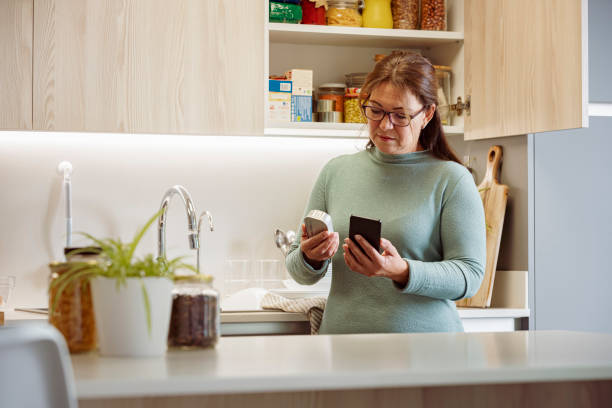
The pantry door — the simple white door with the brass handle I had polished so often I’d worn it dull — had a lock on it.
Not a dainty little thing. A thick, black, heavy-duty combination lock, threaded through a metal hasp someone had screwed directly into the door frame. It looked like it belonged on a storage unit or a high school locker, not on a pantry in a 1950s bungalow owned outright by a sixty-six-year-old woman who had never in her life locked food away from anyone.
I set my bag on the counter very carefully, as if any sudden movement might cause the scene to rearrange itself into something more reasonable. The refrigerator motor clicked on. Somewhere in the living room, the television murmured.
The lock stayed exactly where it was.
I walked closer until I could see the brand name stamped into the metal. The dials were set to a random four-digit combination. A faint ring of darker paint framed the new hardware where someone had drilled into the wood of my door frame.
There is a kind of shock that is loud, where you immediately hear your own heartbeat in your ears. This was not that kind. This was the quiet kind, where your mind goes very still and a cool, clinical part of you starts taking notes.
Pantry door. New hasp. Combination lock. Unauthorized change to my property.
“Dorothy? Is that you?”
Clare’s voice floated in from the living room. I didn’t answer. I stayed where I was, looking at the lock, waiting until I trusted my voice again.
Clare appeared in the doorway, a mug of tea in one hand and her phone in the other. She wore yoga pants and a cream sweater that draped just so. She always managed to look like she had stepped out of a lifestyle blog. Natural makeup, perfectly messy bun, herbal tea as a permanent accessory.
“Oh,” she said, following my gaze. “That.”
She smiled. Not an apologetic smile. The sort of smile people use when they expect you to be reasonable about something you have not agreed to.
“We needed to separate the groceries,” she said, as if she were explaining a simple scheduling change. “Derek and I buy our own things, and it just makes more sense to keep them organized.”
The word we slid off her tongue as if it were self-evident that we all shared the same we.
I looked at her. Clare had sharp cheekbones and quick eyes, the kind that do a lot of calculating very fast. In the beginning, I had thought that was a good thing. That my son had married someone capable. Someone who remembered the details he tended to forget.
Now, standing in my own kitchen, in front of a lock on my pantry, I was not so sure.
“That’s my pantry, Clare,” I said. Quietly. Almost conversationally.
She took a sip of her tea. Peppermint, from the smell of it. She was using my favourite mug, the one with the blue rim that Gerald had claimed by unspoken right for years. She had claimed it just as silently, sometime in the spring, and I had not said anything.
“It’s a shared space,” she said. “This just makes things cleaner. Less confusion about whose food is whose.”
There was a lightness in her tone, as if drilling into my door frame had been a minor household task rather than a small declaration of territory.
Something moved under my ribs. A complicated tangle of anger and disbelief and a weary, dangerous clarity.
I could feel the words rising. The righteous speech. The laundry list of this is my house and who gave you permission. The questions that would pour gasoline on whatever quiet fire had started here.
After thirty-one years watching what happened when families said the first thing that came into their heads in hospital hallways, I did something else.
I said nothing.
I let the silence expand between us for two, three breaths. Then I nodded once, the way you might when a stranger tells you the weather is changing.
Without another word, I turned and walked upstairs.
In my bedroom, I shut the door, changed out of my work clothes, and scrubbed my hands at the bathroom sink until the hot water stung. The face in the mirror looked composed. My eyes did not. I pressed my fingertips to the cool edge of the porcelain and concentrated on breathing.
In for four. Hold for four. Out for four. I had taught that to countless anxious patients over the years. Breathing is one of the only things in life you can voluntarily control that also directly tells your body it is safe.
When my pulse had stopped rattling in my ears, I went to the window and parted the curtains. The cedars in the backyard stood tall and dark against the fading light, twelve feet now, the hedge I had planted the summer Gerald died because I needed something to take care of that wasn’t suddenly gone.
My name is Dorothy Haynes. I am sixty-six years old. I spent thirty-one years as a registered nurse, half of them on night shifts, which changes a person in ways that are hard to explain. I am a widow. I am a mother of two. And up until that Tuesday in late October, I had never once imagined I might need to defend my pantry.
To understand how we got there, you have to go back eight months.
Derek and Clare had arrived in February with overnight bags and apologetic smiles and a story about being between places. Derek’s job at the property management company was in transition. His position was being redefined. Clare used those phrases like she was reading from a PowerPoint slide. Derek stared into his coffee cup and nodded at the steam.
“And my consulting business is just getting off the ground,” she said. “Once a few contracts close, we’ll be fine. We just need a bridge. A few months.”
Derek looked up then with those eyes I’d known since he was small, that particular mix of hope and apprehension that had always made it impossible for me to say no to him.
“Just until we get back on our feet, Mom. We don’t want to impose.”
Of course I said yes. What else was I going to say? The house had three bedrooms. I only used one. And if I am honest, I liked the idea of someone else being here. Late-night cups of tea. Voices in the hallway. The possibility of laughter coming from the living room.
“A few months,” I said. “We’ll make it work.”
If you want to see where things go wrong, look back to the moments when everyone is being generous and reasonable. Those are the seeds.
At first, it was almost pleasant. Clare was efficient in the ways I had admired when they first started dating. She reorganized the fridge, made labels for the shelves, bought glass containers and decanted the dry goods. My flour and sugar and rice suddenly stood in clear, labelled rows like well-behaved students.
“Isn’t that better?” she asked, stepping back with satisfaction.
It was. In a way. Just not how I would have done it. But it seemed small, and they were temporary, so I said thank you and meant it.
Then she rearranged the living room.
I came home one afternoon in March to find the couch angled differently, the armchair pushed under the front window, the rug turned ninety degrees. The side table where I kept my knitting basket had migrated to the opposite corner.
“Oh!” Clare said when she saw me standing there. “You’re home early.”
Apparently the room had not been “flowing properly.” Now, she explained, it was cozier and much better for entertaining. The room did look magazine-worthy. My armchair, however, no longer had a direct line of sight to the television, which I discovered that evening at six when I went to watch the news and found the remote missing.
“I’ve got a call at six,” Derek said from the kitchen table, laptop open. “Big client. Can we put the news on mute? Or maybe you could watch it upstairs?”
“That’s fine,” I heard myself say. “Just for tonight.”
It is astonishing how many permanent concessions start with just for tonight.
By June, Clare’s vitamins had expanded to occupy an entire lower cabinet, and my casserole dishes had been relocated to the top shelf where I could only reach them with a step stool. By July, my coffee, the brand I had bought every two weeks since 1998, was subjected to a gentle observation.
“You know this one is really acidic,” Clare said, peering at the package. “No wonder you get heartburn. I’ll add a better one to the grocery list.”
She said it with such certainty that I found myself wondering, for a bizarre moment, whether I had been drinking the wrong coffee for twenty years without knowing it.
It was a thousand small things, each one easy enough to overlook on its own. The throw pillows Gerald and I had chosen together replaced by neutral ones Clare called more modern. The needlepoint my sister had made for me moved from the hallway to the guest room where it apparently fit better. My evening news time routinely displaced by Derek’s suspiciously timed work calls.
None of it was catastrophic. All of it added up.
By the time the lock appeared, I had begun, in unguarded moments, to wonder if I was being unreasonable. If perhaps this was simply what happened when you lived with younger people. If my ways were old-fashioned and theirs were simply more efficient.
Clare was very good at that word. Efficient. It carried its own moral glow, as if anything efficient was automatically right.
Standing at my bedroom window that night, watching the cedars sway in the dark, I thought about efficient and reasonable and all the ways those words could be used against a woman who lived alone and didn’t like to make a fuss.
I thought too about Derek. He was thirty-eight. He had his father’s easy laugh and my stubborn jaw, though he had spent years pretending he hadn’t inherited that last part. He was good with people, kind in a way that sometimes made him unkind through omission, and he had developed, slowly and almost imperceptibly, a habit of disappearing whenever things became uncomfortable.
He and Clare fit together like puzzle pieces. His silence and her decisiveness formed something that, from the outside, looked a great deal like competence.
They had been in my house for eight months. Temporary had stretched like taffy into something new. And now there was a lock on my pantry.
I sat on the edge of my bed and laced my fingers in my lap, the way I used to do before walking into a difficult conversation on the ward. The nurse’s questions rose unbidden.
What do I actually know?
What I knew: the house was mine. Paid off in 2009. The title deed in my name alone, bought with Gerald’s life insurance and my own savings over decades of night shifts and careful living. I had the file in the metal box in my closet, behind the extra blankets.
What I needed to know: whether Derek and Clare had involved my property in any of their financial scrambling.
Two months earlier, I had found on the printer in the study an application form for a home equity line of credit. The address at the top was Elmwood Drive. The owner signature section was blank.
At the time, I had stared at it for a long minute and then slid it quietly back into the printer tray. I had told myself stories. Perhaps they were only exploring options. Perhaps Derek had started filling it out and thought better of it. Perhaps. Perhaps. Perhaps.
Now, with the lock still fresh in my mind, perhaps felt like a luxury I could no longer afford.
The next morning, before anyone else was up, I took my coffee and the metal box from the closet and spread the title deed on the kitchen table. The lock glinted across the room, smug in its newness.
I read the deed line by line. Legal language has a peculiar comfort to it when it is on your side. My name. My signature. No one else’s.
Then I picked up the phone and called my lawyer.
Sandra Okafor had handled Gerald’s estate, the refinancing in 2009, and a messy business involving an old will my aunt had left. She was precise, calm, and allergic to unnecessary words, three qualities I have always valued.
“Dorothy,” she said when she answered. “How are you?”
“Concerned,” I said. “And trying not to be foolish about it.”
I told her about the lock, the eight months of gradual rearrangement, the credit application on the printer. She listened without interrupting. At the end, there was a small pause.
“Come in Thursday,” she said. “Bring the deed, that application if you still have it, and anything else that seems relevant. We’ll make sure you’re protected.”
After I hung up, I called the bank. The loans officer, a cheerful young man named Paul, was very helpful.
“There are no active or pending applications associated with your property, Ms. Haynes,” he said. “You’re all clear.”
Some of the tightness in my chest loosened. Not all of it.
Over the following weeks, I did three things.
First, with Sandra’s help, I added a formal notation to the title requiring my in-person, witnessed signature for any credit application or property transfer. The legal explanation took several pages. The practical effect was simple. The door was locked from my side now, and anyone trying to tamper with it would find it considerably more difficult.
Second, I started keeping a record. Nothing elaborate, just notes on my phone in the same careful, unemotional style I had used for patient charts for thirty-one years.
June 5. Living room furniture rearranged while I was out. My chair no longer faces the television.
July 12. Asked about timeline for moving out. Derek said things would become clearer after the new year. Did not specify which new year.
August 30. Found home equity line of credit application on printer listing Elmwood Drive as collateral. Owner signature section blank. No prior discussion with me.
October 7. Pantry lock installed without notice. Clare’s explanation: we needed to separate the groceries. Derek was absent.
Writing it down turned vague unease into facts. It kept me from convincing myself I had imagined things. It reminded me that these events had happened in sequence, that I was not losing my mind, and that the pattern was real.
Third, I called Terry.
Terry was a contractor who had re-roofed the house in 2015. He was built like a refrigerator and had a surprisingly gentle way of discussing load-bearing walls. We had coffee in the kitchen while he glanced, briefly and politely, at the lock on the pantry door and pretended not to see it.
“What are you thinking?” he asked when we went down to the basement.
“Options,” I said. “A separate unit, maybe. For rental income. For flexibility.”
We walked the length of the space together. The ceilings were nearly nine feet, high for a basement. A side door already opened to the driveway. The bathroom had been roughed in years ago by Gerald, started before he got sick and never finished.
Terry knocked on a support beam. “Good bones down here. One-bedroom, easy. Proper kitchen along that wall, full bathroom there. Three months, give or take. You want it done nice, I can do it nice.”
I imagined it then. Clean new drywall, warm light, a small kitchen with its own pantry door that no one would dream of locking against me.
“I’ll think about it,” I said. But something in me had already decided.
The lock came off the pantry door on a Thursday morning before dawn.
I woke early, earlier than usual even for an old nurse whose body never fully released the habit of night shifts. The house was still and dark. I padded downstairs in my slippers, the wood cool through the thin soles.
In the kitchen, the lock hung where it had been for three weeks.
I had, in the days since its appearance, looked up the model online. The manufacturer’s website included an instruction manual with a section on override codes and factory reset procedures. Manufacturers are often careless about security. This one was no exception.
I stood at the counter with the printout, glasses on, and followed the steps.
Eight minutes.
The lock clicked open with a small, gratifying snick. I removed the hasp from the door frame one screw at a time, filled the holes with wood putty from the junk drawer, and stepped back to look at the door. If you didn’t know where to look, you would never have known anything had been there.
I set the lock in the centre of the counter.
Then I took out my good stationery, sat down at the table, and wrote a note.
I wrote it slowly, in my best handwriting, with a ruler under each line the way my mother had taught me at the kitchen table of our farmhouse. I did not cross anything out. I did not soften any of the sentences.
This is my house. I own it. Every room in it belongs to me, including this pantry.
I am asking you respectfully, and once, to remember that.
I am also asking you to set a date for when you and Derek will be moving out. I need that date in writing by the end of this week.
I have a lawyer. I have been keeping records. I am entirely prepared for whatever conversation comes next.
Dorothy.
I folded the note and placed it beside the lock.
Clare found it before I came back downstairs. I knew because I heard the sharp intake of breath, the quick rhythm of her steps across the kitchen tile. A murmur of Derek’s voice. Then a loaded, thinking silence.
They were both gone when I came down. His car was missing from the driveway. Her laptop had disappeared from the table. The lock and the note were gone too.
At half past three in the afternoon, my phone buzzed.
Dorothy, the text read. I think we need to talk.
Of course, I typed back. Dinner at six. I’m making roast chicken.
If you ever need to have a difficult conversation with someone you love, I recommend roast chicken. There is something grounding about peeling carrots and rinsing potatoes, about sliding rosemary under the skin the way Gerald had taught me, about the smell of garlic and lemon and sizzling fat filling a house in slow, deliberate waves. It reminded me, as the oven preheated, that I had been feeding this family long before Clare came along. That my stewardship of this kitchen was not theoretical.
At five forty-five, Derek came home with his shoulders slightly hunched, as if bracing for a wind that hadn’t arrived yet. Clare followed a few minutes later, her jaw set, her eyes darting from me to the pantry door and back again.
We sat at the dining table. I had set it properly, with the good plates and cloth napkins.
“Smells amazing, Mom,” Derek said, carving the chicken with practised strokes.
“Thank you,” I said. “It’s been a while since I made a proper roast.”
We talked about the weather for a few minutes. The first frost. The predicted snow. In Canada, you can build a temporary shelter out of weather talk when you’re not quite ready to step into the real one.
Then I laid my fork down on the edge of my plate, folded my hands, and looked at them both.
“I’d like to talk about the note,” I said.
The weather evaporated.
Clare’s eyes flashed to Derek, then back to me. “I just feel,” she began, her voice already edged with indignation, “that the way you—”
“Clare,” I said.
I did not raise my voice. I used the tone I had used with panicked families in hospital waiting rooms. The one that said: you can keep talking if you like, but it will not change what has to happen next.
“I’m not asking for your feelings about the note. Or for your opinion on whether my request is reasonable. I am telling you what I need.”
A silence fell, thick and a little stunned.
Derek’s fork paused halfway to his mouth. For the first time in a long time, he really looked at me. Not in passing, not with the distracted fondness of a busy son. With actual attention.
“We’ve been meaning to talk to you about the timeline,” he said carefully. “Things have been complicated. With work. With money.”
“I know they have,” I said. “I’m not unsympathetic to that. But I have been clear about what I need. A date. Specific. In writing.”
He swallowed. I could see the muscles in his jaw working.
“February first,” he said at last. “We’ll be out by February first.”
Clare made a sharp sound. “Derek, that’s barely—”
“February first,” he repeated, more firmly this time. He looked up at me again. “We’ll be out by then, Mom.”
My heart hurt in that moment, for the little boy he had been and the man he was trying to become, caught between a wife who had grown accustomed to shaping reality around her preferences and a mother who had finally stopped yielding.
“Thank you,” I said. “I’ll need that in writing before you go to bed tonight. An email will do.”
Clare set her fork down with great deliberate care. She was pale with fury. She opened her mouth, then closed it, perhaps realizing she was about to say something that would make everything considerably worse.
We finished the meal in tense quiet. The chicken was good. The rosemary, as always, from the bush by the back step that I had tended for years.
At 9:47 that night, an email arrived.
Subject: Move-out date.
Body: Clare and I will vacate the Elmwood Drive property by February 1st.
No greeting. No signature. Just the sentence.
I forwarded it to Sandra with a two-word note: As discussed.
The weeks that followed were not comfortable. They were, however, mine.
The atmosphere in the house changed, the way it does on a ward after difficult news has been delivered and everyone is adjusting to a new reality. Less small talk. More closed doors. Clare became quiet with me, her requests now careful rather than assumed. She stopped rearranging things. She moved her vitamins back to a higher shelf without comment. The pantry door remained, pointedly, unlocked.
Derek, to my surprise, became more present. He started coming downstairs to watch the evening news with me a few nights a week. We sat side by side on the couch, in its original position, and watched the anchors talk about elections and storms and faraway disasters.
We did not talk much, but the silence felt different. Less like avoidance. More like two people sharing a room while they remembered who they were to each other.
One evening, during a commercial, he said quietly, “I didn’t know about the loan application.”
I kept my eyes on the television. “It had my address on it, Derek. That makes it my concern.”
“I wouldn’t have submitted it without talking to you,” he said.
I believed him. I also believed, based on the last year, that he might well have let Clare push him toward signing something in a moment of financial panic.
“I’m glad we won’t have to find out,” I replied.
On January thirty-first, the sky was the flat gray of old pewter and snow threatened without committing. Derek and Clare spent the day moving boxes to the rental truck in the driveway. I watched from the window for a while, then made myself step back. It is one thing to require your son to leave. It is another to hover while he goes.
On his second trip up the porch steps, Derek paused just inside the door. He reached into the ceramic bowl on the hall table and placed his spare key in it with a small decisive clink.
Then he turned and looked at me.
“I’m sorry, Mom,” he said.
He looked older than he had in October. Tired in a way that went beyond the fatigue of moving day. There were new lines around his mouth and his eyes were shadowed.
“I know,” I said. “I believe you.”
I also knew that his apology, while sincere, did not erase the year. It did not fill the screw holes in the pantry door frame or reverse the feeling of being slowly edged toward the margins of my own home. Those things would remain, faint but instructive.
“That version of you,” I added gently, “the one who stood by while someone else made themselves at home in your mother’s house. That’s between you and yourself. That’s work only you can do.”
He swallowed. “Yeah,” he said, voice rough. “I know.”
“Come for dinner in a few weeks,” I said. “Call first.”
Something eased in his face, just slightly. He nodded, then walked down the porch steps and climbed into the passenger seat of the truck.
I stood in the doorway and watched them turn left at the corner and disappear.
The house, when I closed the door, was very quiet.
I walked to the kitchen. The pantry door stood as it always had, a simple wooden door with a brass handle. I opened it and looked at my shelves. My olive oil. My jars of beans. My tin of Scottish shortbread I had been rationing since Christmas.
I took a piece of shortbread, put the kettle on, and stood at the window while the water heated. The cedars at the back of the yard were green against the gray sky, tall and steady. Gerald would never see them at this height. Loss is like that. It keeps growing in directions the lost person can’t follow.
I wrapped my hands around my mug and felt the warmth move into my palms.
I had been home this whole time, of course. But that afternoon, the house felt different. Not just like a place I slept and paid taxes on, but like a skin I had slipped back into after wearing someone else’s clothes for far too long.
In March, Terry and his crew arrived. For weeks, the sound of drills and hammers and radio music filtered up through the floor. The house smelled of drywall dust and fresh lumber. Every few days I went down to check on the progress. Bare studs became walls. Wiring disappeared behind plaster. The roughed-in bathroom grew tile and a vanity, and eventually a rainfall showerhead I chose from a catalogue simply because I liked the idea of that small luxury existing under my roof.
“It’s your house,” Terry said when I hesitated at the price. “You should have the nice things where you can.”
By May, it was an apartment. A small but bright one-bedroom unit with a kitchenette, afternoon light, and a clean bathroom where the showerhead gleamed like a small silver promise. I had taken something that had felt like a trap and turned it, with good advice and some money and considerable resolve, into an exit and an entrance at the same time.
The first tenant was a woman named Fiona. Forty-two, a librarian, recently divorced, looking for somewhere quiet and steady.
“It’s just me,” she said on her first visit, canvas tote on her shoulder. “And my books.”
“I like books,” I replied. “And quiet.”
She smiled. “Then we’ll get along.”
She moved in at the start of June. Her rent covered more than half my property taxes. She watered the hydrangea without being asked and left a small pot of basil on the shared back step with a note: For our kitchen. Not once did she question my coffee brand. Not once did she suggest a better arrangement for the furniture. She had her own door, her own kitchen, her own life moving quietly beneath mine.
On Tuesdays and Thursdays I still go to the community health centre to volunteer, blood pressure cuff in hand. On weekday evenings I watch the six o’clock news in my living room with the couch exactly where I like it. Some Saturdays my daughter Pamela comes up from Waterloo and we sit at the kitchen table with spreadsheets and coffee and talk about nothing in particular, which is one of my favourite things in the world.
Every so often, Derek comes for dinner. He calls ahead, as asked. He brings dessert more often than not, as if sweetness could patch things faster than time. We do not talk directly about the lock, but sometimes his eyes linger on the pantry door a moment longer than necessary, and he clears his throat. We are both learning, I think, where our edges are. Where they were always supposed to be.
I want to say something to you, if some part of this story has felt familiar.
If you have felt, in your bones, the slow slide of your belongings out of their places. Your routines nudged aside by someone else’s preferences. The particular exhaustion of a thousand small concessions that each seemed too minor to contest but that together added up to something you no longer recognized as your life.
Your home is not just a building. It is the physical expression of the life you built. The years of work that paid its mortgage. The evenings you stood at that stove. The pictures on the walls that remind you of who you were at twenty and forty and sixty.
When someone treats it as raw material to rearrange around themselves, they are not only being thoughtless about casserole dishes or couch positions. They are telling you something about how they see you. About whether they see you at all.
And you are allowed — more than allowed, required, if you want to remain intact — to tell them who you actually are in return.
You do not need to ask permission to open your own pantry door. You do not need to explain, over and over, why the six o’clock news matters to you. You do not need to justify the coffee you buy with your own money to people living under your roof by your generosity.
Generosity is not an endless resource and it is not owed. It is something you offer freely until the moment you realize it is being consumed as if it were a given, as if you are merely infrastructure in someone else’s life.
That is the moment to speak.
Not in rage, if you can help it. Rage burns bright and fast and leaves everyone scorched and confused. Clarity is quieter. It writes itself on good stationery in firm, legible strokes. It says: this is my house. I own it. This is what I need. Once.
In thirty-one years of nursing I learned that people will not treat you according to the standards you claim to have. They will treat you according to the standards you actually enforce.
For a while, I let my standards blur. I told myself stories about being flexible, about being kind, about how it was only temporary. I let one small accommodation slide into the next until I hardly recognized the shape of my own days.
All it took to begin reclaiming them was a note, a lawyer, a few careful phone calls, and the decision to hold the line once I had drawn it.
Kindness and firmness are not opposites. You can love your son and refuse to be displaced from your own house. You can make roast chicken and still require an email with a move-out date. You can hold the door open and also hold the boundary.
And if someone puts a lock where it does not belong, on your pantry, on your time, on any part of your life that is yours by right, you are allowed to take it off.
The door was yours to begin with.

Sophia Rivers is an experienced News Content Editor with a sharp eye for detail and a passion for delivering accurate and engaging news stories. At TheArchivists, she specializes in curating, editing, and presenting news content that informs and resonates with a global audience.
Sophia holds a degree in Journalism from the University of Toronto, where she developed her skills in news reporting, media ethics, and digital journalism. Her expertise lies in identifying key stories, crafting compelling narratives, and ensuring journalistic integrity in every piece she edits.
Known for her precision and dedication to the truth, Sophia thrives in the fast-paced world of news editing. At TheArchivists, she focuses on producing high-quality news content that keeps readers informed while maintaining a balanced and insightful perspective.
With a commitment to delivering impactful journalism, Sophia is passionate about bringing clarity to complex issues and amplifying voices that matter. Her work reflects her belief in the power of news to shape conversations and inspire change.