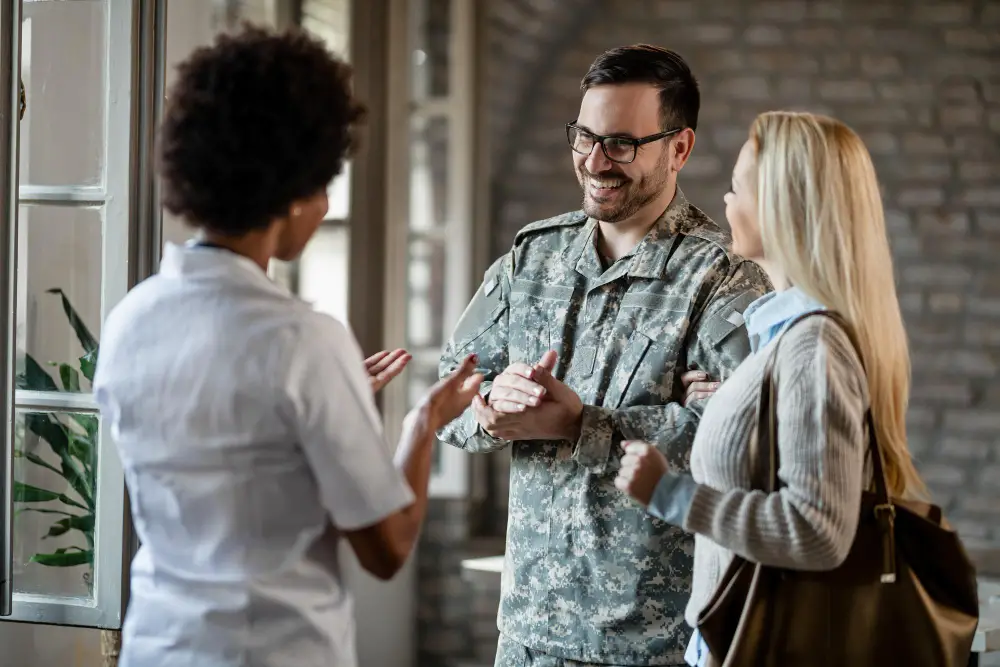
My name is Megan Callaway. I am forty-one years old, and I have two crooked fingers on my left hand that bend wrong in cold weather and ache in a way that is both complaint and memory, the kind of ache that reminds you, each time the temperature drops, of the specific morning when everything that could go wrong did go wrong and you kept working anyway.
I served sixteen years in the United States Army as a 68W combat medic specialist. Three combat deployments. Two theaters of operation. I have a Silver Star in a drawer in my apartment and a photograph in my wallet that I have carried for seven years without once considering leaving it behind.
And on a late October evening in Fairfax, Virginia, I stood in a ballroom at Brierwood Country Club and listened to my stepmother tell two hundred people that I was a fraud, a washout, and a disgrace to the uniform, while the man whose severed femoral artery I had packed and held for nine hours in a collapsing field hospital in Mosul stood ten feet behind her holding a glass of water and the truth folded twice in his jacket pocket.
That is the sentence I will carry the rest of my life. Not because it was the worst thing Diane Callaway ever did to me, but because it was the last.
I enlisted in 2002 at nineteen. My mother, my real mother, Claire Callaway, had been dead for ten years by then, ovarian cancer, and the house my father built with her had been systematically reimagined by a woman named Diane Patricia Whitfield, who became Diane Patricia Callaway in 1995 when I was twelve and who spent the next twenty-five years ensuring that everyone in Richard Callaway’s life understood one organizing principle: the first family was a rough draft. She was the final copy.
I didn’t leave home for the Army. I left home because there was no home left. The enlistment was simply the paperwork that made the departure official.
Basic training at Fort Sam Houston, then Advanced Individual Training, then my first duty station, and the world opened in a way I hadn’t known it could. Not wider, exactly. Sharper. Everything had edges. Everything counted. You learn that fast as a combat medic. The snap of latex gloves in a trauma tent means work has begun. It means someone is bleeding. It means your hands are the only available distance between that person and a flag-draped box on a transport plane, and there is no room in that distance for hesitation or self-doubt or the internal negotiations that might slow you by half a second. Half a second is a unit of measurement that matters.
You learn to move before you think. You learn to think while you move. You learn that the smell of blood on your hands doesn’t fully wash off with soap. It sits in the creases of your knuckles for hours after the patient is stabilized or gone, and you keep working because there is always another patient, and the work is the only honest thing in the room.
I deployed to Iraq in 2005. I came back a sergeant. I deployed to Afghanistan in 2010. I came back a staff sergeant. I deployed to Mosul in 2016, and I came back with a Silver Star and two fractured metacarpals that I had splinted myself with medical tape and a tongue depressor so I could keep applying pressure to a lieutenant colonel’s wound without stopping, and a photograph in my wallet of a twenty-one-year-old corporal named Devon Wade who bled to death twenty minutes before the helicopters arrived while I held his hand and told him he was going to be fine.
I lied to him. That is the part the citation doesn’t mention.
Back in Fairfax, Virginia, in the house on Maple Crest Drive that my mother had picked out and my father paid off and Diane had redecorated with Pottery Barn furniture and careful ambition, a different version of my life was being constructed. A version I had not written. A version I did not know existed until it had hardened into family scripture.
Diane had started small. That was her particular talent, the incremental lie, the quiet editorial revision, the story adjusted by just enough degrees that no one noticed the seam until the original shape was no longer visible. After my first deployment she told Richard’s friends I’d barely passed basic training, that the Army was being patient with me, that I struggled under pressure. I was at Fort Hood running trauma drills when this was happening. I was twenty-four and still believed the people back home were proud of me.
After my second deployment, she escalated. She told the family I had anger problems, that I had been written up, that officers had concerns about my reliability. She used words like struggling and difficult and we’re all so worried about her, words that sounded, at the right distance, like compassion, but which had the structural logic of a campaign.
And then Mosul.
In 2017, while I was lying on a concrete floor in a collapsed field hospital with two fractured metacarpals on my left hand, taping my own fingers together with a tongue depressor so I could keep working, while I was doing that, Diane told my father’s social circle that I had been dishonorably discharged. She used those specific words. Dishonorably discharged. She delivered them the way she delivered everything, with a practiced sadness in her voice, a slight shake of her head, the expression of a woman who has been trying for years to help someone and is finally, regretfully, being honest about the results.
She told them while I was still deployed. She told them while I was still wearing the uniform.
And my father, Richard Allen Callaway, the quietest man I ever knew, the man who taught me to bait a fishhook and who cried at my mother’s funeral without being ashamed of it, who never once raised his voice in my presence, heard this and said nothing. Not because he believed it entirely, but because Diane’s voice was the one in the room and mine was seven thousand miles away. Richard was a man who had learned to survive by not making waves in water someone else controlled. That is not condemnation. That is grief, taking the shape available to it.
I came home in 2019 with an honorable discharge after sixteen years. I took a job as an emergency department trauma nurse at a regional hospital in Northern Virginia, which required, among other things, exactly the skills the Army had spent sixteen years refining in me. I tried to see my father. I drove to the house. I called. I sent letters. Diane managed access the way she managed everything, with the surface appearance of reasonableness and the actual substance of a locked door. Phone calls went unreturned. Holiday invitations were not extended. When I asked Tyler, my half-brother, Diane’s son, thirteen years younger than me, if I might come for Thanksgiving, he said awkwardly that his mother thought it might be too stressful for Dad.
Tyler was not cruel. He had been raised inside Diane’s version of the family the way a plant grows in a pot too small for its roots. He had no frame of reference for a different shape.
Richard Callaway’s sixty-ninth birthday was in February 2023. I drove four hours from Northern Virginia to Fairfax with a card and a box of Arturo Fuente Hemingway Short Stories, his favorite, because he liked to smoke one on the porch after dinner and he always said the short ones meant he didn’t feel guilty about finishing them. I parked in the driveway of the house on Maple Crest. I walked up the steps. I rang the bell.
Diane answered.
She stood in the doorway with a dish towel in her hand and looked at me the way you look at a solicitor you’re about to turn away.
“He’s sleeping,” she said. “He doesn’t want visitors.”
It was four in the afternoon. Through the front window I could see that the living room lights were on. I could hear the television.
“Can you give him these?” I said.
She took the box without looking at it.
“I’ll let him know you stopped by.”
The door closed before I had finished turning. I left the card on the porch because there was nowhere else to put it.
Three weeks later, Harold Mitchell, a retired Army major who had been my father’s oldest friend and the one man in Richard’s orbit that Diane had never fully managed, called me on a Tuesday evening and said, very carefully, that my father had been awake that afternoon. That he had asked where I was. That Diane had told him I canceled.
I sat in my car in the hospital parking lot with the engine off and my hands on the steering wheel.
I flexed my left hand. The third and fourth fingers bent wrong, as they always bend wrong, the metacarpals healed slightly crooked because I had splinted them myself in a collapsing building and never had them properly reset. They ached in the cold the way old injuries ache, like a conversation the body refuses to finish.
Richard Callaway died of a heart attack eleven months later, at sixty-nine years old.
I learned about it from Harold Mitchell, not from Diane, not from Tyler.
I attended the funeral. Diane introduced me to mourners as Richard’s older daughter and added, to at least three separate people, that I had had a difficult time. Then she filed paperwork to have me removed as beneficiary on my father’s life-insurance policy. One hundred and twelve thousand dollars. She forged a notarized letter claiming I had voluntarily relinquished my share, and had the document executed by a paralegal named Susan Ward, who accepted four hundred dollars in cash and a story about a daughter who didn’t deserve the money.
That was the woman who organized the memorial.
Late October. Brierwood Country Club. Two hundred guests. A three-tier vanilla cake with my father’s photograph printed on the edible topper. Prime rib carving stations, glazed salmon, champagne flutes on silver trays. A raw bar on a terrace where heat lamps glowed orange and did nothing useful against the October cold.
Richard Callaway would have wanted pulled pork and paper plates and a cooler of beer and his fishing buddies telling the story about the largemouth bass he caught in his neighbor’s pond using a piece of hot dog as bait. He would not have wanted this. He would not have wanted any of this. But Diane was throwing his memorial for the guests she wanted in the room, the real-estate colleagues and charity-board members and country-club acquaintances who comprised the social architecture she had spent twenty-five years building, and the event reflected her, not him.
There was a printed program.
It listed the Callaway family’s accomplishments in descending order of visibility. Tyler’s insurance career. Diane’s volunteer work. Richard’s years at the postal service. The phrase small but strong appeared twice, as both header and benediction.
My name was not in the program.
I walked through the front entrance at 4:15 in dark slacks and a navy cardigan and flat black shoes, my hair pulled back. I drew no attention. Diane stood near the entrance in a charcoal dress and pearls, greeting guests with the rehearsed warmth of a woman who has practiced hospitality until it no longer requires sincerity.
“Oh, Megan.” A pause calibrated to convey surprise, perhaps slightly disappointed surprise. “I didn’t think you’d come.”
No embrace. A half turn to the next guest before I could respond. No seat with my name on it, no entry in the printed program, no acknowledgment that I had driven two hours to be in a room that had been arranged to make me invisible.
I found an empty chair near the emergency exit.
The memorial table stood near the far wall: fifteen photographs of Richard Callaway arranged in matching silver frames. Richard at his postal-service retirement. Richard and Diane at a charity gala. Richard with Tyler at a baseball game. Richard and his fishing friends on a dock in the Outer Banks.
I was in three of those original photographs.
Diane had them reprinted and cropped.
In the visual record of my own father’s life that occupied one full wall of this ballroom, I no longer existed.
A server placed a plate of glazed salmon and asparagus in front of me. I folded my napkin beside it and left the food untouched. Diane took the podium at five o’clock and spoke for six minutes. She described Tyler’s career, her own charity work, the marriage she and Richard had built. She used the phrase from the ground up, as though there had been nothing standing on that ground before she arrived. She described the family as small but strong. She did not say my name.
Tyler found me during the applause. He was twenty-eight, with Diane’s jaw and Richard’s eyes, and he stood beside my chair with the expression of a man holding a question someone else had loaded for him.
“Meg,” he said. “Can I ask you something? Mom said you got kicked out for talking back to an officer. Is that true?”
The room kept applauding.
I looked at my half-brother, this boy I had held as an infant, this boy I had taught to ride a bicycle in the driveway of the house on Maple Crest before Diane decided my visits were disruptive, and I understood that he was not being cruel. He was repeating what he had been told since childhood, as a fish knows water without knowing it is water.
“No,” I said. “It isn’t.”
I did not say more. Not then.
When Diane returned to the microphone, she held up one hand for quiet and the applause died, and she waited a beat in the manner of someone who understands that silence, correctly managed, is the most effective frame for what comes next.
“I need to address something difficult,” she said. The practiced tremor in her voice was impressively calibrated, sincerity worn like a well-fitted coat. “Some of you may have noticed that Richard’s older daughter is here tonight. I want to be honest because Richard would have wanted honesty.” A pause. “Megan was dishonorably discharged from the United States Army.”
She let the words travel.
“She has been lying to this family for years about her service. We have tried to be patient, to be kind. But I will not have someone who disgraced the uniform stand in a room honoring Richard’s memory.”
She looked directly at me.
“Megan, I am asking you to leave.”
Two hundred heads turned. Two hundred pairs of eyes found me near the emergency exit, and the room became the particular kind of silent that you only get when a crowd of people collectively stops whatever interior conversation it was having and directs its full attention at a single person.
Then Diane added the line she had been saving.
“Your father knew. He was ashamed of you. He told me so.”
My father never said those words. I know this the way I know the sound of a medevac rotor at two hundred meters, because I lived inside the truth of what he felt and no version of it will ever be overwritten by what someone else claims he said to her in a room I wasn’t in.
I did not move.
My hands stayed at my sides. My shoulders stayed level. My face gave Diane nothing.
I touched my left pocket, the weight of my wallet, the photograph, the note in blue ballpoint ink.
And I held her gaze.
Ten feet behind her, near the back of the ballroom, a man in a gray sport coat set down his glass of water.
He had silver-streaked hair and pressed trousers and a slight mechanical unevenness in his gait that most civilians in this room would not have registered. I had registered it an hour ago from across the room, as soon as I saw him walking toward the bar, because I had spent sixteen years around people with prosthetics and the body compensates in ways that are recognizable once you know what to look for.
Colonel Nathan Brandt straightened his jacket.
He began to walk.
The crowd parted ahead of him without understanding why. Something in his bearing, the set of his shoulders, the unwavering direction of his eyes, created a corridor of instinctive deference that people stepped back from without being asked.
He did not go to the podium first.
He came to me.
He stopped two feet in front of me, close enough that whatever he said next would belong to us, and his eyes went immediately to my left hand, to the third and fourth fingers bent slightly inward, healed wrong, permanently offset. He looked at them the way someone looks at a scar whose origin they know personally, not with pity, but with the weighted recognition of shared history.
Then he looked at my face.
“November Six,” he said. Two words, quiet as a field radio on whisper protocol.
And for a moment the ballroom dissolved entirely. The champagne and the glazed salmon and the memorial table with its carefully cropped photographs all went distant, and I was on a concrete floor in Mosul with blood on my hands and tape on my broken fingers and a lieutenant colonel fading in and out while I told him to keep talking to me.
“Colonel Brandt,” I said.
I looked at his left leg, at the crease in the trousers that fell differently on the prosthetic side.
“You kept your leg,” I said.
He shook his head slightly. The corner of his mouth moved, not a smile, something older and heavier.
“You kept three men breathing with two broken fingers and a roll of tape,” he said.
He reached into the inside pocket of his sport coat and withdrew a single sheet of paper, folded twice, the creases deep and permanent from years of being carried. The edges had softened. This was not a document kept in a file. This was a document kept on a person.
He turned and walked to the podium.
Diane was still standing beside the microphone. I watched something shift in her from forty feet away, the way a person shifts when they feel the floor tilt without yet identifying the source. She stepped aside. She did not choose to. Her body made the decision for her, responding to the posture of authority the way people respond to it even when they cannot name what they are responding to.
Brandt positioned himself behind the microphone. He unfolded the paper. He smoothed it flat against the podium with both hands.
“My name is Colonel Nathan Brandt. United States Army. I am currently stationed at Fort Eustis, Virginia.” He paused. The murmuring in the room stopped entirely. “I am here tonight as a guest of Major Harold Mitchell, a friend of the Callaway family. I did not come here to speak. But I have just listened to a woman be publicly accused of disgracing the uniform of the United States Army, and I find I cannot remain silent.”
He looked down at the paper.
“I am holding a photocopy of a Silver Star citation. I have carried it in my jacket pocket since 2018. The original is on file with Human Resources Command. I provided written testimony for this award because the Army asked me to describe what happened, and I wanted to make sure the words were accurate.”
He began to read.
“The President of the United States of America, authorized by Act of Congress July ninth, 1918, has awarded the Silver Star to Staff Sergeant Megan E. Callaway, 68W Combat Medic Specialist, for gallantry in action against an enemy of the United States while serving in support of Operation Inherent Resolve, Mosul, Iraq, 2017. On the date of action, a mortar strike collapsed the field hospital at a forward operating base. Staff Sergeant Callaway, the senior medic on duty, provided continuous trauma care to three critically wounded soldiers for approximately nine hours in a partially collapsed structure with limited medical supplies. Despite sustaining fractures to the third and fourth metacarpal bones of her left hand, Staff Sergeant Callaway applied improvised pressure tourniquets, managed hemorrhage control, and maintained radio communication with extraction teams under her call sign, November Six. Her actions directly preserved the lives of two soldiers, including a lieutenant colonel who sustained an amputation below the left knee.”
Brandt paused.
He looked up from the paper.
He looked at me.
“That lieutenant colonel was me.”
The silence that followed was the kind that does not exist naturally in a room of two hundred people. It had to be created by the simultaneous, involuntary cessation of every sound a human body makes when it stops being social and becomes simply present. No silverware. No fabric rustling. No whispered aside. Even the catering staff had gone still, a tray of shrimp cocktail suspended in the air between two tables as if time had paused to consider what to do next.
Brandt folded the citation. He placed it on the podium. He straightened.
And from behind the microphone, in front of every guest Diane had assembled to honor the memory of a man whose daughter she had spent twenty-five years erasing, Colonel Nathan Brandt raised his right hand to his brow and held it there. Crisp. Formal. Sustained.
Not to Diane. Not to Tyler. Not to the two hundred guests.
To me.
Near the back of the room, Harold Mitchell rose from his chair. His knees made it a slow process, but his bearing made it inevitable. He straightened his VFW blazer. He raised his hand.
A man I had never met, standing near the bar, gray-haired, a VFW pin on his lapel, set down his drink. He stood. He saluted.
Three salutes.
Two hundred witnesses.
The champagne flute in Diane’s right hand tilted forward. The liquid ran over her fingers and down her wrist, and she didn’t notice. Her mouth opened, and closed, and opened again without producing sound.
Brandt lowered his salute. He stepped back from the microphone slightly, but the room was so quiet that every word still carried to the back wall.
“Staff Sergeant Callaway served sixteen years in the United States Army. Three combat deployments. She was the senior medic in that collapsed field hospital and she kept three soldiers alive for nine hours. I lost my left leg. I kept my life.”
He paused.
“One soldier, Corporal Devon Wade, aged twenty-one, did not survive. He died twenty minutes before the helicopters arrived. Staff Sergeant Callaway held his hand until he was gone, and then went back to work on the rest of us.”
He turned to Diane.
His expression did not contain anger. It contained something more damaging. It contained the measured, precise assessment of a career officer evaluating a situation and finding it deficient, without heat, without performance, without any quality that could be argued with or dismissed.
“Mrs. Callaway, I don’t know what Megan told you about her service. I suspect she told you very little, because Megan doesn’t talk about herself. But I want you to understand what happened here tonight. The woman you publicly accused of disgrace in front of two hundred people has a Silver Star, an honorable discharge, and my personal testimony that she saved my life. I have carried this citation in my jacket for six years because I never wanted to forget the name of the person who refused to let me die.”
Harold Mitchell had been on his phone during the citation reading, stepped partially away from his chair, now moving back toward Diane with the deliberate pace of a man carrying something heavy on a very short fuse. He stopped beside her and spoke low, but the room was still silent enough and the microphone close enough that the words reached everywhere.
“Diane. The insurance company’s fraud investigators traced the notarization. Susan Ward. Four hundred dollars in cash. They are filing charges.”
The champagne glass slipped from Diane’s fingers and shattered on the ballroom floor. The sound was small and bright and complete.
From near the emergency exit, I spoke my first full sentence to Diane Callaway in two years.
“He didn’t tell you that. You told him.”
The ballroom emptied in stages, the way a body loses heat. The extremities first, then the core. Diane’s real-estate colleagues gathered their coats in pairs with the efficient briskness of people who had decided they were never really there. The charity-board members followed. Within twenty minutes, two hundred people had become thirty, and the catering staff moved through the thinning room with the practiced quiet of people trained to be invisible during difficult moments. The champagne towers stood untouched. The three-tier cake with my father’s photograph on the edible topper sat at the center of the dessert table, already beginning to look like the remnant of an event that had ended badly.
Diane had not moved from the spot where the glass broke. Someone had swept the shards. She stood on clean floor now, but her shoes were still wet with champagne, and her face had the gray, concave quality of a structure after its load-bearing wall has been removed.
I walked toward her.
Not fast. Not slow. The way I walk into a trauma bay when I already know the general shape of what I’m going to find.
Tyler was still at a table nearby, elbows on the cloth, head in his hands. He looked up when he heard my shoes on the parquet. His eyes were red, not from crying, but from the specific strain of a person whose operating assumptions have just developed a fracture they cannot close.
Diane’s chin lifted when she saw me coming. Reflex. Twenty-five years of performance does not switch off because the audience has changed.
“You could have told us,” she said, her voice stripped of its usual weight. “You could have said something. One phone call. Why didn’t you ever say something?”
I stopped six feet from her.
“You weren’t asking questions, Diane. You were building a story. You didn’t want the truth. You wanted a confession.”
Her mouth opened.
“You spent twenty-five years constructing a family that only worked if I didn’t exist. You told my father I washed out. You told Tyler I was discharged. You told two hundred people tonight that I disgraced the uniform, and every single word of it was something you invented because the truth made you feel small.”
My voice did not rise. My hands stayed at my sides. In my left pocket, the wallet, the photograph, the note written in blue ballpoint ink by a mother whose son I could not save.
“I didn’t owe you an explanation. I don’t owe you one now. But I’ll give you this. I held a twenty-one-year-old kid’s hand while he bled to death in a building that was collapsing around both of us. And the last thing he said was to tell his mother he tried. That is what I did in the Army, Diane. That is what you stood at a microphone and called a disgrace.”
Diane’s hand found the edge of the podium and gripped it. The wood creaked.
Then, very quietly: “I didn’t know.”
“You didn’t want to know. The distance between those two things is large enough to lose a family inside it. And you did.”
Tyler stood. His chair scraped. He looked at Diane, then at me, then at the memorial table where fifteen photographs of our father sat in silver frames and not one of them contained the daughter who had served sixteen years in the United States Army and held dying soldiers’ hands in collapsing buildings while the woman at the podium told everyone she was a fraud.
“Is any of it true?” he said, and he was asking Diane, not me. “Anything you told me about her? The discharge. Any of it.”
Diane said nothing. Her fingers whitened on the podium.
“Tyler,” I said.
He turned.
“I will not be at Thanksgiving. Not because of tonight. Because I no longer need to stand in a room that required me to be smaller than I am.”
I looked at Diane one last time. She looked old in a way that had nothing to do with years, the way people look when the scaffolding comes down and it becomes visible that the building behind it was never finished.
I turned toward the coat-check alcove, where Colonel Brandt was standing with the patient, watchful stillness of a man who understands when a mission is complete and will not insert himself into its final steps. He nodded as I passed, one clean downward motion of his chin. Not ceremony. Recognition.
Harold Mitchell held the door.
The October air came in like cold water against my face and I breathed it fully in, the wet stone and chimney smoke and the particular sharp clarity of a Virginia autumn that cuts through whatever you are carrying.
I walked to my car. I drove home.
The investigation moved with the methodical, unhurried precision of a system that does not care about social standing. Diane’s forged notarization, the document claiming I had voluntarily relinquished my share of my father’s insurance policy, was traced within a week to Susan Ward, who cooperated within forty-eight hours of her first interview. She provided the cash receipt, the text messages, a written statement detailing what Diane had told her about a daughter who was estranged and unstable and did not deserve the money.
Insurance fraud charges were filed against Diane Patricia Callaway in late November. The charge carried a potential sentence of up to ten years.
She retained a criminal defense attorney, a man from her country club who billed four hundred and fifty dollars an hour and who had been among the two hundred guests in the ballroom the night Colonel Brandt read the citation.
Her real-estate brokerage placed her on administrative leave the morning the charges became public. Three active listings were reassigned. Two clients requested different agents. The Brierwood Country Club Women’s Auxiliary Board accepted a resignation she had not submitted, delivered by hand to her home by a woman named Patricia Anderson, who had been Diane’s co-chair on the spring gala committee for three years and who apparently could no longer recall being particularly close.
The charity memberships dissolved. The holiday-card list contracted. The network of social position and curated reputation that had sustained Diane’s campaign against me for twenty-five years dismantled itself with the quiet, efficient cruelty of people protecting their proximity to someone else’s consequences.
Richard’s sister, Margaret Hall, called me on a Wednesday when I was driving home from a twelve-hour shift. Her voice was careful. She said she was sorry. She said she had believed Diane’s version of things because it required fewer questions. She said she had a box in her garage of Richard’s belongings, photographs mostly, including the ones Diane had reprinted with me cropped out. She asked if I wanted them.
I said yes.
Tyler called three weeks after the ballroom. The conversation lasted four minutes.
He spoke first.
“I believed her. I’m sorry.”
“You were twelve when she started,” I said. “You didn’t have a choice.”
A pause that held more weight than most long sentences.
“Can I see you sometime? Not for Thanksgiving. Just sometime.”
“Sometime,” I said.
That night, the night of the ballroom itself, before the investigations and the phone calls and the slow public unraveling of Diane’s constructed world, I sat on the back porch of my apartment in Northern Virginia. The sky had cleared just enough for the October cold to arrive with real commitment. Clean air, frozen leaves, the faint smell of pavement and distance.
I reached into my left pocket.
The wallet was leather bifold, worn at the fold, unremarkable. I opened it. Behind my driver’s license, folded along a crease so deep it had become permanent, was the photograph. Wallet-sized, slightly faded at the fold. A young man in Army dress greens, twenty-one years old, standing at parade rest with the expression of someone who has just completed the first real thing of his life. Corporal Devon Wade. Boot-camp graduation.
I turned it over.
Blue ballpoint ink. A mother’s handwriting. Small and uneven and absolutely certain.
He told me you held his hand. I’ll carry that forever.
I held it for a long time.
The porch light was yellow and the photograph was worn at the fold and Wade’s face was clear and specific in the way that faces of people gone too young are always specific, the particular unfinished quality of twenty-one, certain and unmarked and gone.
I did not cry.
I closed the wallet.
I breathed.
Six weeks later I sat in the waiting room of the VA hospital in Northern Virginia. Fluorescent lights. Plastic chairs. A television mounted to the wall playing cable news that no one watched. A clipboard in my lap with a form I had been avoiding for six years, the kind of avoidance that is not cowardice exactly but a private reckoning with what it costs to formally name the thing you went through and ask for help with what it left behind.
Under branch of service, I wrote United States Army.
Under MOS, I wrote 68W.
Under years of service, I wrote sixteen.
Under rank at separation, I wrote Staff Sergeant.
My own handwriting. My own history. No cover, no deflection, no one else’s version interposed between the truth and the page where I was writing it down.
Just Megan Callaway.
Just the truth in blue ink on a government form in a waiting room where no one knew my name or my call sign or the sound of a collapsing building at dawn in Mosul, Iraq.
There is power in patience, the kind of patience that does not require an audience or a vindication schedule, that simply waits because it knows that the truth is structural and that structures built on fabrication develop, eventually and without exception, the specific kind of failure that cannot be repaired from inside.
There is freedom in the truth, even when it comes late.
And there is a peace available on the other side of the silence you kept for people who never deserved the kindness of your quiet. I know that now. I know it in my bones, and in the two fingers on my left hand that bend wrong in cold weather and ache the way old things ache, like a story insisting on being told.
I am no longer the version of me that Diane built in an empty room and called real.
I am the woman who held a twenty-one-year-old soldier’s hand in a collapsing building and went back to work when he was gone. I am the woman who kept two men breathing for nine hours with broken fingers and ran out of things to work with before she ran out of the will to keep working. I am the woman who carried a citation in a drawer and a photograph in a wallet and never once told the story that would have settled the account, because she was too busy doing the work that made the story true.
I am Megan Callaway.
Sixteen years.
Honorable discharge.
Three crooked fingers and a Silver Star and a wallet that holds the weight of a promise kept to a boy I could not save.
I am still here.
I kept moving.

Specialty: Quiet Comebacks & Personal Justice
David Reynolds focuses on stories where underestimated individuals regain control of their lives. His writing centers on measured decisions rather than dramatic outbursts — emphasizing preparation, patience, and the long game. His characters don’t shout; they act.